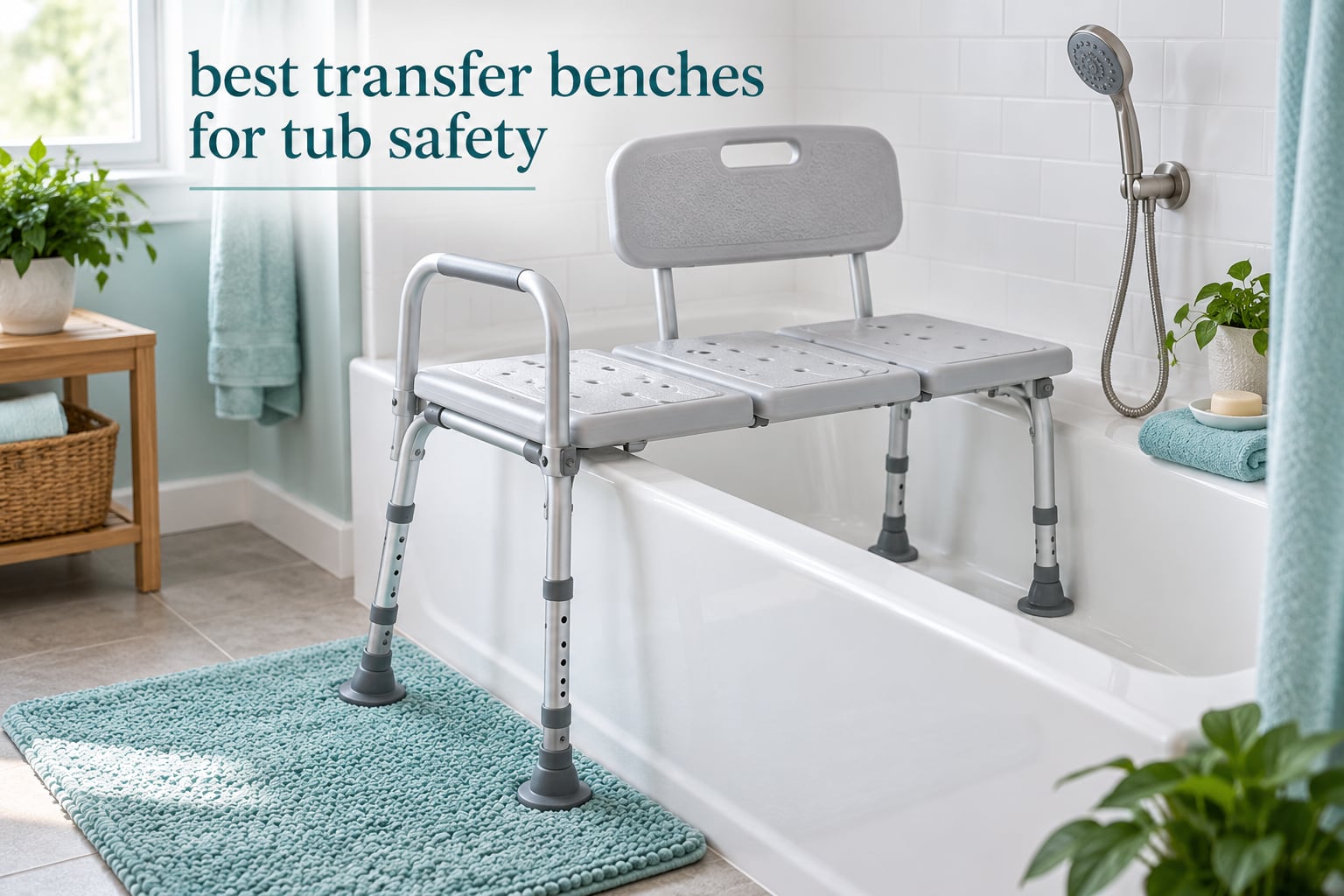
The worst moment in a bathtub is not the bathing. It is the ten seconds when you have to stand on a wet tile floor, lift one leg, then the other, over a 15 to 20 inch wall of cast iron or acrylic. That is where most bathroom injuries happen, and it is the exact moment a transfer bench removes. After logging several weeks of research, spec sheets and reader questions on the best transfer benches for tub safety, here is where we landed: twelve benches, each with a real job, and a shortlist for the four situations that come up most often.
A tub transfer bench is a long bath seat that straddles the tub wall, with two legs inside the tub and two on the bathroom floor. The user backs up to the outboard half, sits down, lifts each leg over the rim while fully supported, then slides or swivels into the bathing end. Nobody stands on the wet floor at any point during entry, which is why it outperforms almost every other bathroom aid for the step-over.
We ranked these on the things that actually decide whether a bench works in a real bathroom: rated capacity and the margin above the user’s weight, seat width and depth, how the seat moves, how the feet grip, and whether the frame clears the tub wall at a useful height. We also weighted reversibility and arm strength heavily, because the fixed-seat-versus-sliding-seat question is the single biggest source of returns. What follows covers twelve picks, how to measure your tub before ordering, what a bench cannot do, and how Medicare treats them.
ContentsTable of Contents
- 1Top 3 Tub Transfer Benches for 2026→
- 2Medline Transfer Bench→
- 3Carex Shower Bench→
- 4Platinum Health Carousel→
- 5All 12 Picks at a Glance in 2026→
- 61. Medline Transfer Bench: Best Overall Tub Transfer Bench for Everyday Safety→
- 7Medline Transfer Bench for Bathtubs and Showers, Adjustable Shower Bench and Bath Seat For Seniors and adults, Slip-resistant Feet, Heavy-Duty 400 lb. Weight Capacity, Tool-Free Assembly→
- 8Pros→
- 9Cons→
- 10Who this bench suits→
- 11When to pick something else→
- 122. Carex Shower Bench: Best Value Tub Transfer Bench for Reversible Entry→
- 13Carex Shower Bench and Shower Chair For Elderly and Disabled with Height Adjustable Legs, Tub Bench Converts to Right or Left Hand Entry, Shower Chair For Bathtub→
- 14Pros→
- 15Cons→
- 16What we checked before recommending it→
- 17When a different bench makes more sense→
- 183. DMI Sliding Tub Transfer Bench: Best for Wheelchair-to-Tub Transfers→
- 19DMI Tub Transfer Bench and Shower Chair with Non Slip Aluminum Body, FSA Eligible, Adjustable Seat Height and Cut Out Access, Holds Weight up to 400 Lbs, Bath and Shower Safety, Transfer Bench→
- 20Pros→
- 21Cons→
- 22Who this bench suits→
- 23Where it falls short→
- 244. Platinum Health Carousel: Best Premium Swivel Tub Transfer Bench for Small Bathrooms→
- 25Platinum Health Carousel Sliding Shower Chair Tub Transfer Bench with Swivel Seat, Premium Padded, Pivoting Arms, Adjustable Space Saving Design for Tubs, Inside Shower, for Handicap & Seniors, Blue→
- 26Pros→
- 27Cons→
- 28Why the swivel design wins in tight rooms→
- 29When to choose something cheaper→
- 305. Moen DN7105 Home Care: Best Tub Transfer Bench for Old Sloped Tubs→
- 31Moen DN7105 Home Care Premium Tub Transfer Bench→
- 32Pros→
- 33Cons→
- 34Where this bench is genuinely better→
- 35What to check before buying→
- 366. Flash Furniture HERCULES: Best Budget Transfer Bench with a Side Arm→
- 37Flash Furniture HERCULES Series 300 Lb. Capacity Adjustable Gray Bath & Shower Transfer Bench with Back and Side Arm→
- 38Pros→
- 39Cons→
- 40When this is the right call→
- 41When to spend more→
- 427. Drive Medical Splash Defense: Best Transfer Bench for Keeping Water In the Tub→
- 43Drive Medical Splash Defense Tub Transfer Bench, Adjustable Height, White→
- 44Pros→
- 45Cons→
- 46Why splash control changes daily life→
- 47How it fits with other choices→
- 488. Carex Universal Bench: Best All-Plastic Transfer Bench That Cannot Rust→
- 49Carex Universal Tub Transfer Bench, Bath Seat with Backrest, Shower Chair for Elderly and Disabled, Transfer Bench & Shower Seat for Bathtub with Adjustable Legs, Converts to Right or Left Hand Entry→
- 50Pros→
- 51Cons→
- 52When all-plastic matters most→
- 53What to add to make it better→
- 549. Vive Heavy Duty Bench: Best Tub Transfer Bench for Fast Setup→
- 55Vive Shower Bench for Transfers – Heavy Duty Tub Transfer Bench for Bathtub→
- 56Pros→
- 57Cons→
- 58Who this bench suits→
- 59What to check before ordering→
- 6010. TABEKE Tub Transfer Bench: Best for Ten Height Settings and a Bolted Backrest→
- 61TABEKE Tub Transfer Bench & Shower Chair for Bathtub, Elderly & Disabled→
- 62Pros→
- 63Cons→
- 64Why ten settings beat four→
- 65Measure these two numbers first→
- 6611. Medline Padded Transfer Bench: Best for Long Sits and Tender Skin→
- 67Medline Padded Transfer Bench for Bathtub and Shower, Height Adjustable, Slip-Resistant Legs, Rust-Resistant, Side Arm & Back Rest for Extra Support, 400 lb. Weight Capacity, Tool-Free Assembly→
- 68Pros→
- 69Cons→
- 70Who benefits most from padding→
- 71What to pair it with→
- 7212. Medical King MK7140: Best Transfer Bench for Compact Bathtubs→
- 73Medical King Transfer Bench MK7140 – Bathtub Shower Chair, Adjustable Height, Holds Up to 400 Lbs, White, Plastic→
- 74Pros→
- 75Cons→
- 76When a narrow bench is the only bench→
- 77How to handle the water problem→
- 78What a Tub Transfer Bench Actually Is→
- 79Tub Transfer Bench vs Shower Chair: Which One Fits Your Bathroom?→
- 80The practical decision rules→
- 81When a bench is more than you need→
- 82How to Measure Your Tub Before You Order→
- 83The sizing-up rule for weight→
- 84Two numbers that disqualify most listings→
- 85Are Tub Transfer Benches Actually Safe?→
- 86What makes a bench safer in practice→
- 87Duration matters more than most people expect→
- 88What a Tub Transfer Bench Cannot Do→
- 89And it is not a substitute for an assessment→
- 90Split Shower Curtains and Splash Guards→
- 91When the bench itself handles it→
- 92Two extras worth adding at the same time→
- 93How to Sit On and Slide Across a Tub Transfer Bench→
- 94Practice it dry first→
- 95How to Transfer From a Wheelchair Onto a Bench→
- 96What to add for a lateral transfer→
- 97Will Medicare Pay for a Tub Transfer Bench?→
- 98Where the money usually comes from instead→
- 99Buying Guide: Seven Criteria That Decide the Purchase→
- 100Fixed, sliding, swivel or 2-in-1→
- 101Material and frame→
- 102Comfort and support→
- 103Maintenance, Inspection and When to Replace a Bench→
- 104The monthly check→
- 105Replace rather than repair when→
- 106Frequently Asked Questions→
- 107What is the best tub transfer bench?→
- 108How safe are tub transfer benches?→
- 109Does Medicare pay for a tub transfer bench?→
- 110Is a shower chair or a tub transfer bench better for me?→
- 111How much weight can a transfer bench hold?→
- 112How do I measure my bathtub for a transfer bench?→
- 113Do I need a split shower curtain for a tub transfer bench?→
- 114How do I transfer from a wheelchair to a shower bench?→
- 115The Bottom Line for 2026→
Top 3 Tub Transfer Benches for 2026

Medline Transfer Bench
- 400 lb capacity
- Height adjusts 17.5-22 in
- Reversible backrest
- Suction cup feet

Carex Shower Bench
- 300 lb capacity
- Tool-free legs
- Reversible backrest
- Textured seat

Platinum Health Carousel
- Swivel seat locks at 90 deg
- Padded seat and arms
- 330 lb capacity
- Reversible
As an Amazon Associate we earn from qualifying purchases. CERTAIN CONTENT THAT APPEARS ON THIS SITE COMES FROM AMAZON. THIS CONTENT IS PROVIDED 'AS IS' AND IS SUBJECT TO CHANGE OR REMOVAL AT ANY TIME.
All 12 Picks at a Glance in 2026
Every bench below clears the tub wall and holds at least 300 lb. The differences are in seat type, capacity and how the unit grips the tub floor. Read the table for a fast scan, then jump to the full review for anything you are considering.
| # | Product | Key details | Where to buy |
|---|---|---|---|
| 1 | Medline Transfer Bench |
|
Check Latest Price |
| 2 | Carex Shower Bench |
|
Check Latest Price |
| 3 |  DMI Sliding Transfer Bench DMI Sliding Transfer Bench |
|
Check Latest Price |
| 4 | Platinum Health Carousel |
|
Check Latest Price |
| 5 |  Moen DN7105 Home Care Moen DN7105 Home Care |
|
Check Latest Price |
| 6 |  Flash Furniture HERCULES Flash Furniture HERCULES |
|
Check Latest Price |
| 7 |  Drive Medical Splash Defense Drive Medical Splash Defense |
|
Check Latest Price |
| 8 |  Carex Universal Bench Carex Universal Bench |
|
Check Latest Price |
| 9 |  Vive Heavy Duty Bench Vive Heavy Duty Bench |
|
Check Latest Price |
| 10 |  TABEKE Tub Transfer Bench TABEKE Tub Transfer Bench |
|
Check Latest Price |
| 11 |  Medline Padded Bench Medline Padded Bench |
|
Check Latest Price |
| 12 |  Medical King MK7140 Medical King MK7140 |
|
Check Latest Price |
We earn from qualifying purchases. CERTAIN CONTENT THAT APPEARS ON THIS SITE COMES FROM AMAZON. THIS CONTENT IS PROVIDED 'AS IS' AND IS SUBJECT TO CHANGE OR REMOVAL AT ANY TIME.
1. Medline Transfer Bench: Best Overall Tub Transfer Bench for Everyday Safety
Medline Transfer Bench for Bathtubs and Showers, Adjustable Shower Bench and Bath Seat For Seniors and adults, Slip-resistant Feet, Heavy-Duty 400 lb. Weight Capacity, Tool-Free Assembly
- Aluminum frame
- 400 lb capacity
- Seat adjusts 17.5-22 inches
- 32 inch wide footprint
- 12.6 lb unit weight
Pros
- 400 lb rating on a rust-resistant aluminum frame
- Push-button height adjustment in half-inch steps
- Reversible backrest works from either side of the seat
- Suction cup feet inside the tub for slip resistance
- Tool-free assembly with no tools in the box
Cons
- 32 inch overall width crowds compact bathrooms
- No padded seat for long soaks
- Stationary arm only on one side
We earn a commission, at no additional cost to you. CERTAIN CONTENT THAT APPEARS ON THIS SITE COMES FROM AMAZON. THIS CONTENT IS PROVIDED 'AS IS' AND IS SUBJECT TO CHANGE OR REMOVAL AT ANY TIME.
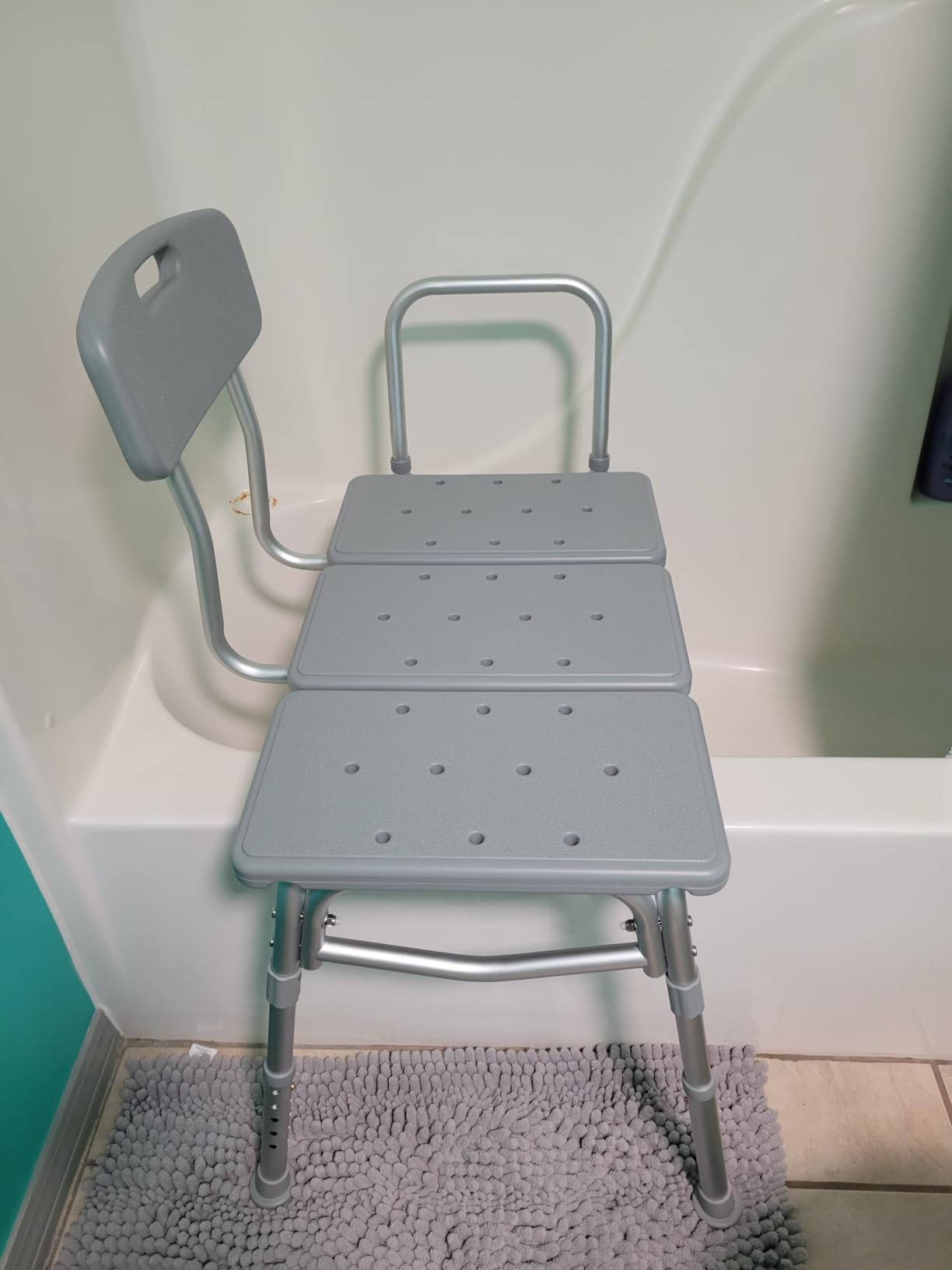
This is the bench we keep coming back to because it does the ordinary job without any special conditions attached. The frame is rust-resistant aluminum rated to 400 lb, and the seat moves through 17.5 to 22 inches on a push-button column, which is enough range to match most knees without tools.
The backrest flips, so the same bench works when the user’s strong side is the one facing the bathroom rather than the tub. Feet inside the tub use a wide suction cup design, and outside feet are slip-resistant rubber. The whole thing assembles tool-free.
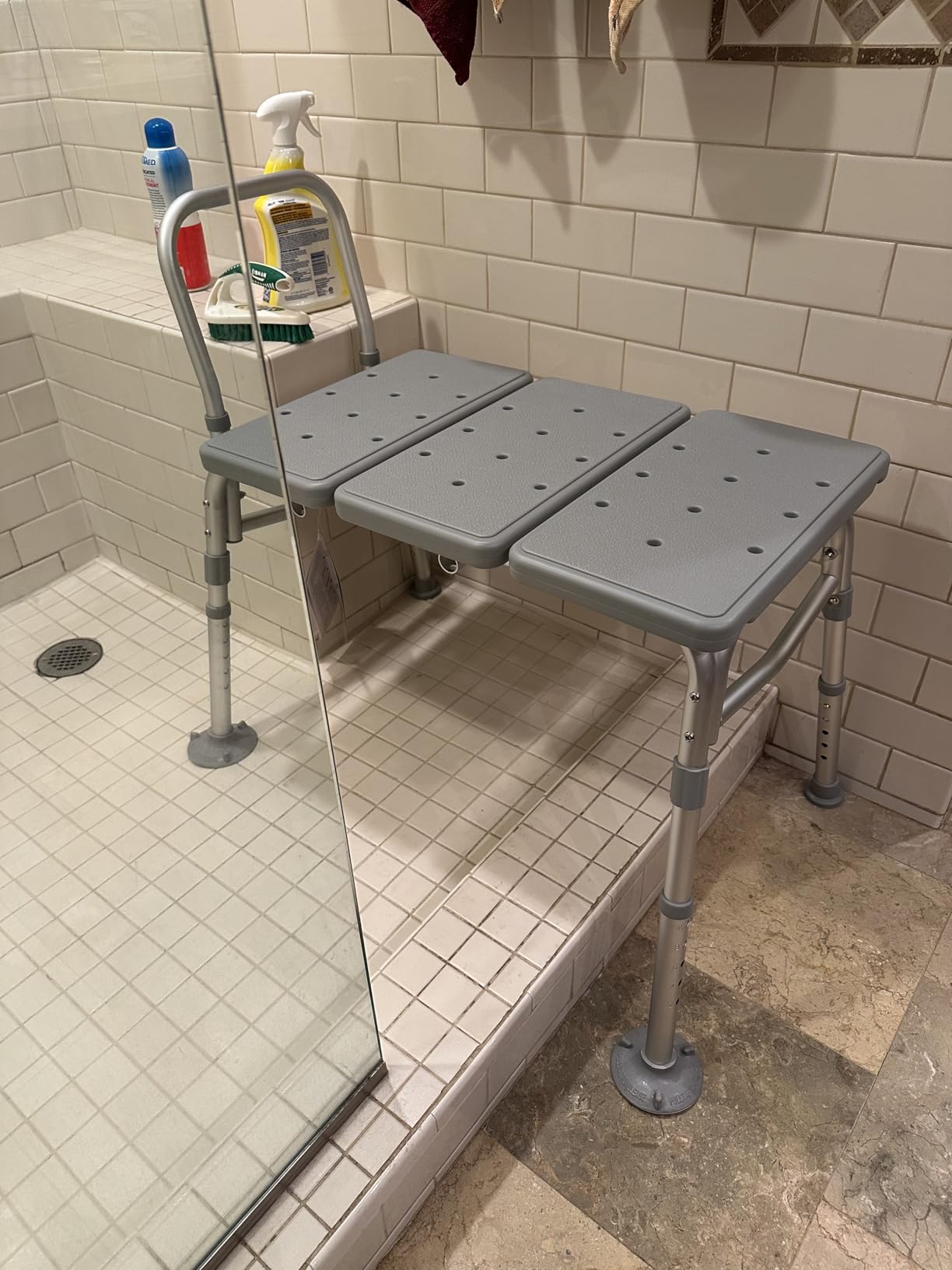
Owners consistently praise three things: the frame does not flex, the height adjustment is genuinely quick to operate, and the feet stay put in a wet tub. Across more than 7,000 reviews the rating sits at 4.6 out of 5, and the recurring note is that this is a bench that survives being moved in and out of a bathroom by a caregiver.
The single complaint that keeps appearing is width. At 32 inches overall, it needs a real span from the interior tub wall out to the outside legs. In a narrow bathroom it crowds the space in front of the tub, and it can be awkward to hang a shower curtain around.
Who this bench suits
A person with a stable left-and-right balance who still cannot lift a leg over the rim while standing. It is also a sensible choice when a caregiver needs to help, because the fixed backrest and arm give a firm push point during the slide. The 400 lb rating covers most adults with a large safety margin.
When to pick something else
If your bathroom cannot spare 32 inches of clearance, or if the user is weak enough that a shuffle across a hard plastic seat will fail, this is the wrong tool. Weak arms and a painful hip are the two complaints that call for a sliding or swivelling seat instead. A padded model is the better pick for anyone sitting for a long shower.
We earn a commission, at no additional cost to you. CERTAIN CONTENT THAT APPEARS ON THIS SITE COMES FROM AMAZON. THIS CONTENT IS PROVIDED 'AS IS' AND IS SUBJECT TO CHANGE OR REMOVAL AT ANY TIME.
2. Carex Shower Bench: Best Value Tub Transfer Bench for Reversible Entry
Carex Shower Bench and Shower Chair For Elderly and Disabled with Height Adjustable Legs, Tub Bench Converts to Right or Left Hand Entry, Shower Chair For Bathtub
- 300 lb capacity
- Tool-free adjustable legs
- Reversible backrest
- Textured non-slip seat
- 11.7 lb unit weight
Pros
- Highest review volume of any bench we ranked
- Individually adjustable legs level the bench between tub and floor
- Reversible backrest for either hand entry
- Textured seat surface resists slipping when wet
- Disassembles for storage or travel
Cons
- Backrest is light and gives little support if leaned on
- Pop-pin fittings are stiff for weak hands
- No opening to wash underneath
- No handheld shower head holder
We earn a commission, at no additional cost to you. CERTAIN CONTENT THAT APPEARS ON THIS SITE COMES FROM AMAZON. THIS CONTENT IS PROVIDED 'AS IS' AND IS SUBJECT TO CHANGE OR REMOVAL AT ANY TIME.
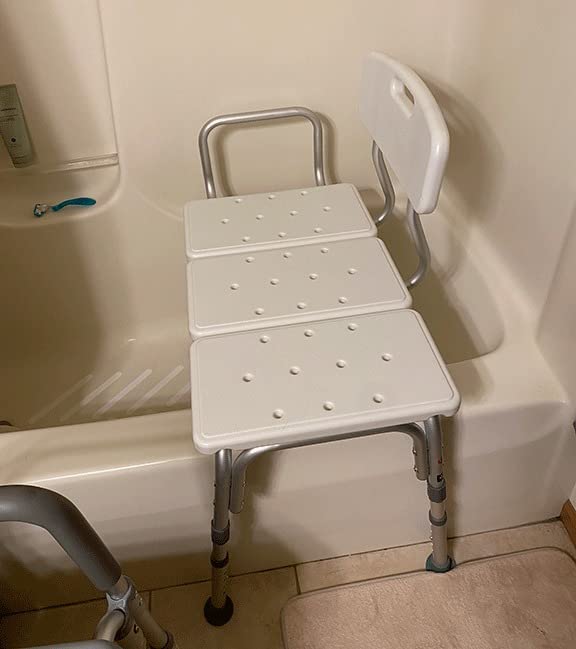
With 8,800+ reviews at 4.6, the Carex bench has the broadest owner history of anything on this list, and that history is unusually consistent. People who bought it for post-surgical recovery report the same outcome: the bench arrived, the legs leveled themselves against an uneven tub floor, and the slide across went smoothly.
The design is straightforward. Four legs adjust by hand with no tools, the seat is textured plastic that stays put when wet, and the backrest reverses so the bench can be set up for entry from either side of the tub. It holds 300 lb and weighs 11.7 lb, so a caregiver can carry it between rooms.
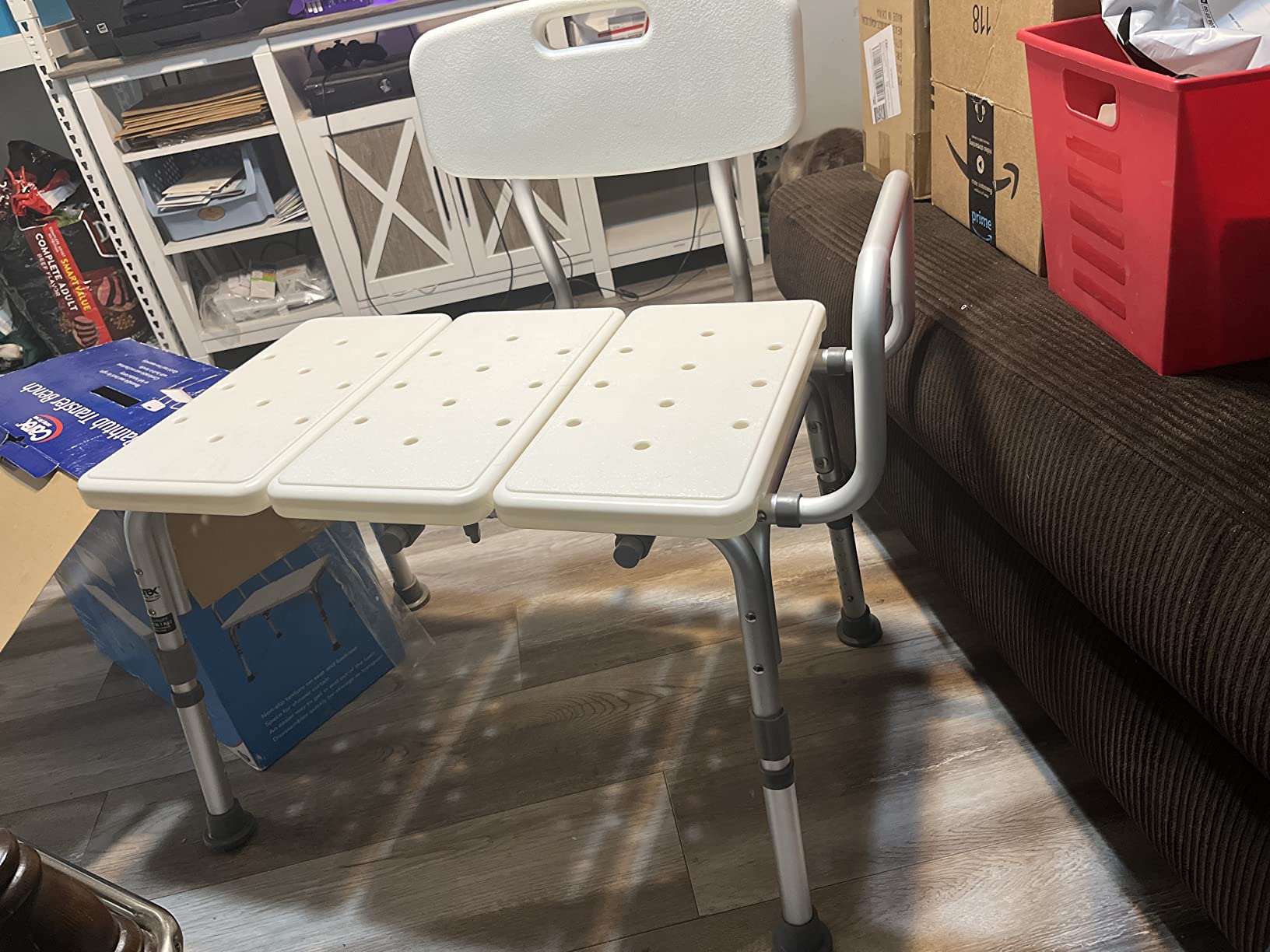
The honest weakness is the backrest. Owners describe it as light, with little resistance if someone leans back during a sit-down. Two smaller gripes come up often: the pop-pin fittings need real hand strength to operate, and there is no cut-out underneath, so you cannot wash under the seat without standing up.
That combination makes this a strong fit for a user with good grip who needs a straightforward, serviceable bench, and a poor fit for anyone with advanced arthritis in the hands or a habit of leaning back for support.
What we checked before recommending it
The 300 lb rating is the lowest among the fixed-frame benches here, so we looked at what that means in practice. With a rule of thumb of sizing up when you are within 50 lb of a rating, this suits users up to roughly 250 lb with margin to spare. The frame itself does not flex in the reports we read.
When a different bench makes more sense
Bariatric users, or anyone above 250 lb who wants margin, should look at a 400 lb model instead. So should users with limited hand strength or poor trunk control, because the pop-pin fittings and the light backrest work against both. A padded seat also wins for long showers.
We earn a commission, at no additional cost to you. CERTAIN CONTENT THAT APPEARS ON THIS SITE COMES FROM AMAZON. THIS CONTENT IS PROVIDED 'AS IS' AND IS SUBJECT TO CHANGE OR REMOVAL AT ANY TIME.
3. DMI Sliding Tub Transfer Bench: Best for Wheelchair-to-Tub Transfers
DMI Tub Transfer Bench and Shower Chair with Non Slip Aluminum Body, FSA Eligible, Adjustable Seat Height and Cut Out Access, Holds Weight up to 400 Lbs, Bath and Shower Safety, Transfer Bench
- 400 lb capacity
- Sliding seat with strap locks
- Removable cut out
- Seat adjusts 19-23.5 inches
- 10.7 lb unit weight
Pros
- Slide mechanism carries the user across instead of the user shuffling
- Hook-and-loop safety belt plus nylon strap locks
- Removable cut out gives perineal access while seated
- Two rows of off-center adjustment holes for finer leveling
- Tool-free assembly and either-side configuration
Cons
- 39 inch width is bulky and complicates curtain placement
- Seat extends only partly outside the tub so small users have little room
- Removable cut out cover sits loosely
- Locking latch is hard to lift from inside the tub
We earn a commission, at no additional cost to you. CERTAIN CONTENT THAT APPEARS ON THIS SITE COMES FROM AMAZON. THIS CONTENT IS PROVIDED 'AS IS' AND IS SUBJECT TO CHANGE OR REMOVAL AT ANY TIME.
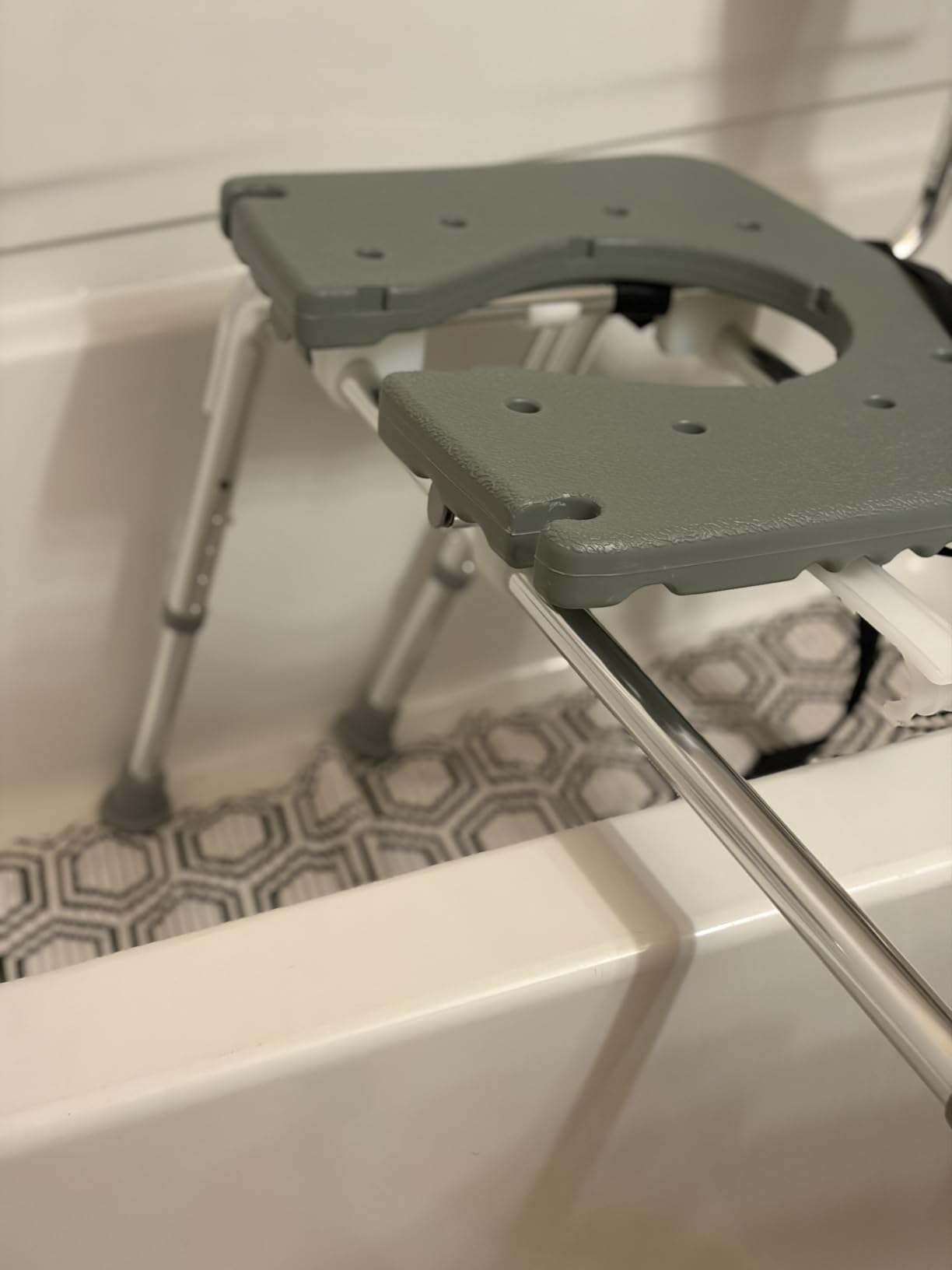
This is the fixed-frame bench that behaves more like a sliding one. The seat runs on a track and is held in place by nylon strap locks and a hook-and-loop safety belt, so the user does not have to push across with their legs. Reviewers credit that mechanism with making wheelchair and walker transfers workable again.
It is a 400 lb unit on a rust-resistant aluminum frame with a blow-molded seat, adjustable from 19 to 23.5 inches across two rows of off-center holes. The removable cut out gives perineal access without leaving the seat, which is a real benefit for anyone who cannot stand to wash.
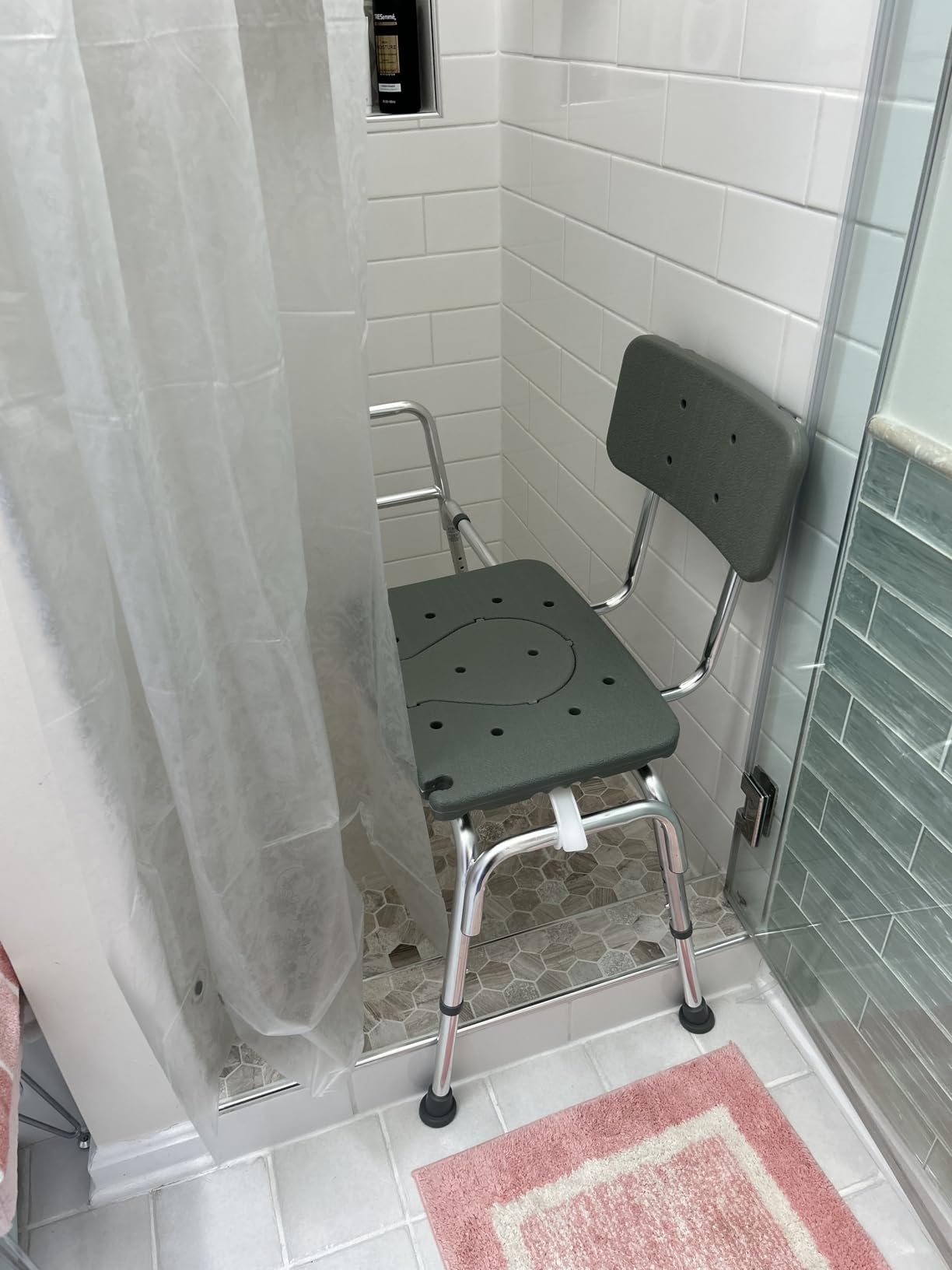
The 4.2 rating is the lowest of the twelve, and the reason is consistent: how much seat hangs over the bathroom side. Once the cut out cover is off, some users report very little room to sit before the slide begins, which matters most for smaller users. At 39 inches wide, it is also the bulkiest footprint we measured.
Two more friction points come up. The removable cover can lift while someone is sitting on it, and the locking latch needs a firm hand to lift from inside the tub, which is difficult for a frail user already seated and wet.
Who this bench suits
A wheelchair user who transfers laterally, or anyone whose legs cannot manage a shuffle across a fixed seat. The belt and strap locks do the work of positioning, and the cut out keeps personal care possible while seated. It is also FSA and HSA eligible, which helps families budgeting out of pocket.
Where it falls short
Small bathrooms. At 39 inches, this is the widest bench in the roundup, and owners in tight spaces report constant repositioning of the shower curtain. If floor area is tight, a compact model with a shorter span will serve better. For a smaller user who needs to sit before sliding, the same space problem applies in reverse.
We earn a commission, at no additional cost to you. CERTAIN CONTENT THAT APPEARS ON THIS SITE COMES FROM AMAZON. THIS CONTENT IS PROVIDED 'AS IS' AND IS SUBJECT TO CHANGE OR REMOVAL AT ANY TIME.
4. Platinum Health Carousel: Best Premium Swivel Tub Transfer Bench for Small Bathrooms
Platinum Health Carousel Sliding Shower Chair Tub Transfer Bench with Swivel Seat, Premium Padded, Pivoting Arms, Adjustable Space Saving Design for Tubs, Inside Shower, for Handicap & Seniors, Blue
- Commercial grade foam and aluminum
- 330 lb capacity
- Swivel locks at 90 degrees
- Seat 15 x 13 inches
- 20 lb unit weight
Pros
- Swivel seat locks every 90 degrees and slides with little force
- Closed-cell polyurethane padding stays warm and does not absorb water
- Swivel design protrudes far less into the room than a fixed bench
- Weight-bearing armrests flip up for wheelchair transfers
- Reversible and adjustable in half-inch steps
Cons
- Solid seat has no cut out for washing while seated
- Release lever sits on one side only
- Heaviest unit here at 20 lb
- Deep soaking tubs need the optional leg extension kit
We earn a commission, at no additional cost to you. CERTAIN CONTENT THAT APPEARS ON THIS SITE COMES FROM AMAZON. THIS CONTENT IS PROVIDED 'AS IS' AND IS SUBJECT TO CHANGE OR REMOVAL AT ANY TIME.
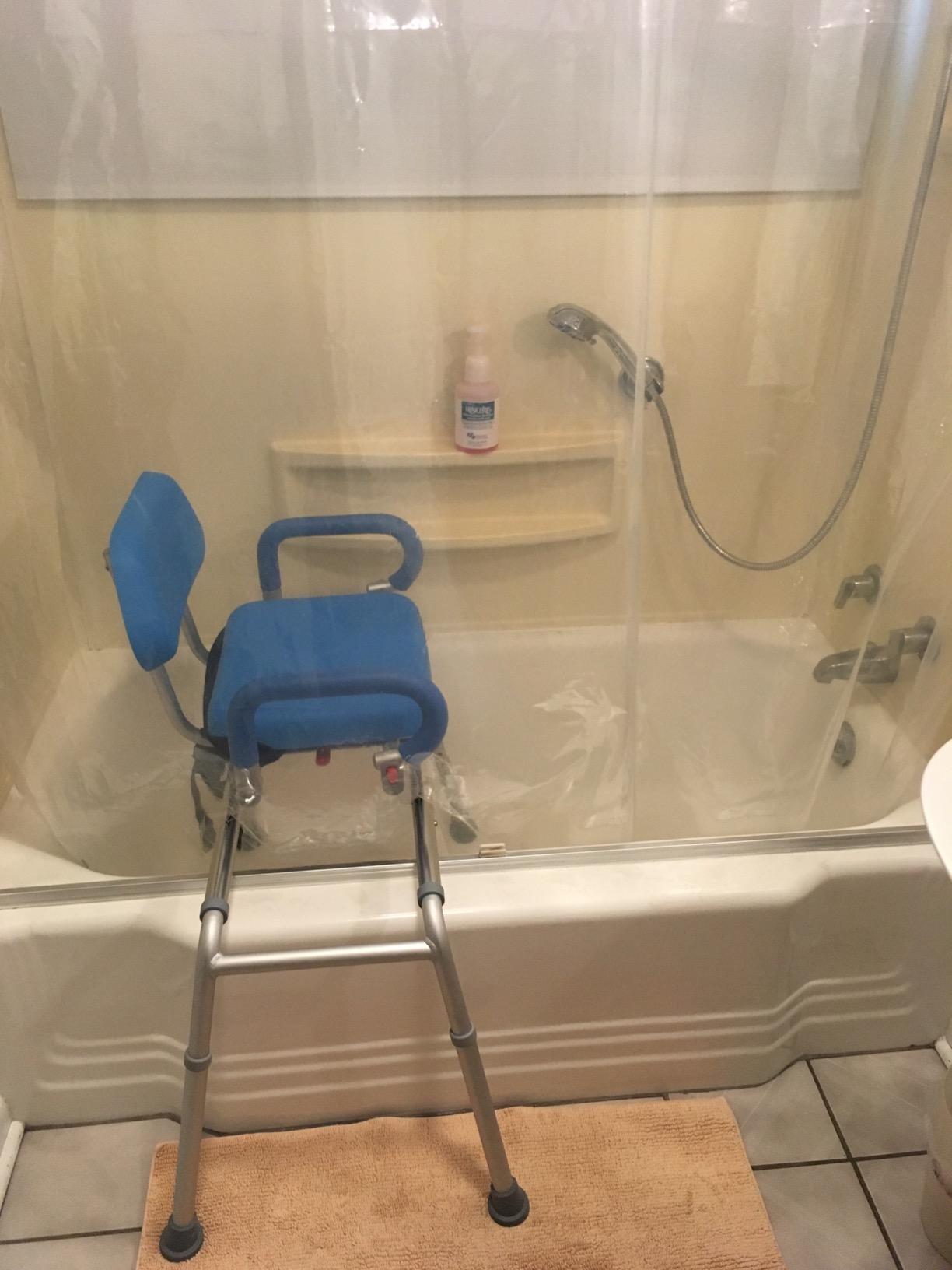
No other bench on this list solves the small bathroom problem the same way. Instead of a long seat reaching out into the room, the seat swivels and slides, so when it is out of the tub it sits almost directly over the tub wall. Owners in tight bathrooms describe it as the first bench that physically fit.
The seat locks every 90 degrees, which means it holds position while the user transfers rather than drifting. Padding is commercial grade closed-cell polyurethane on the seat, back and armrests, which stays warm to sit on and does not soak up water the way foam can.
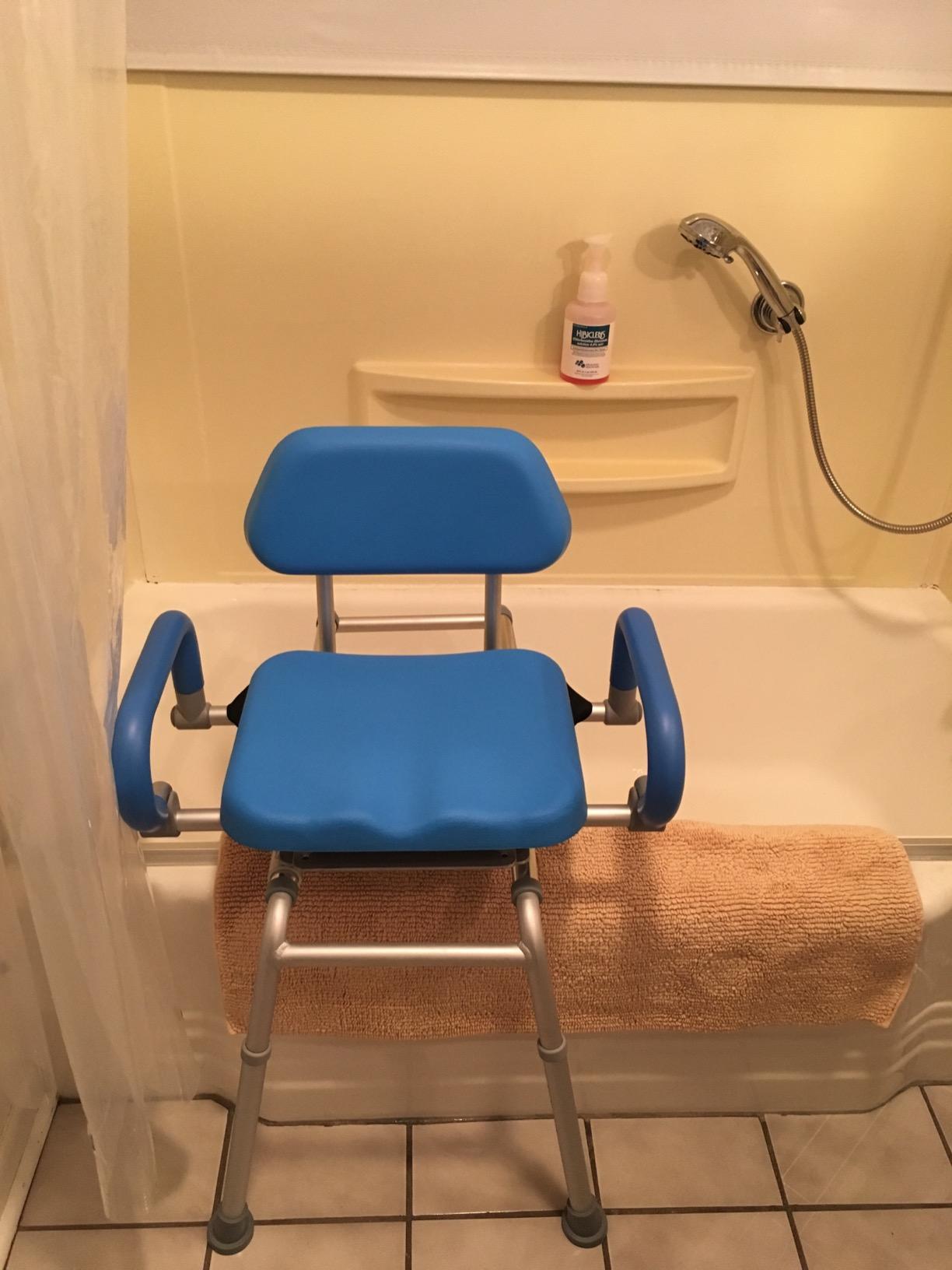
At 330 lb it sits in the middle of this group, not at the top, so we would not choose it for a bariatric user. It is also the heaviest unit we reviewed at 20 lb, which matters if a single caregiver is moving it between rooms. Deep soaking tubs need the optional leg extension kit.
The most practical gripe is the release lever position. It sits on one side of the seat, so a user with weakness on that side needs help to swivel or slide. There is no perineal cut out either, so washing between the legs means standing up.
Why the swivel design wins in tight rooms
Fixed benches occupy roughly 32 to 39 inches of floor outside the tub whether they are in use or not. The Carousel gives most of that space back, which in a 5 by 8 foot bathroom is the difference between a usable room and a frustrating one. The flip-up armrests also accept a lateral transfer from a wheelchair in a way that fixed arms do not.
When to choose something cheaper
If your bathroom has room and your user can manage a shuffle, a 400 lb fixed-frame bench does the same job for less money and a higher rating. Pick the Carousel when floor space is the binding constraint, when a long padded sit is expected, or when a caregiver-assisted wheelchair transfer is part of the routine.
We earn a commission, at no additional cost to you. CERTAIN CONTENT THAT APPEARS ON THIS SITE COMES FROM AMAZON. THIS CONTENT IS PROVIDED 'AS IS' AND IS SUBJECT TO CHANGE OR REMOVAL AT ANY TIME.
5. Moen DN7105 Home Care: Best Tub Transfer Bench for Old Sloped Tubs
Moen DN7105 Home Care Premium Tub Transfer Bench
- Metal and plastic
- 400 lb capacity
- Seat height 16.5-21 inches
- Wide pedestal outside leg
- 17.2 lb unit weight
Pros
- Wide pedestal-style outside leg makes tipping forward or backward very unlikely
- Individually adjustable inner legs handle sloped tub floors
- 33 inch seat with rounded ends makes transfers easier
- Integrated grab handle and a clip for a handheld shower head
- Limited lifetime manufacturer warranty
Cons
- Solid seat has no drainage holes so water pools
- Wide outside leg makes it hard to keep a curtain inside the tub
- Front inner leg may not sync with a sloped tub floor
- May be too large when the toilet sits close to the tub
We earn a commission, at no additional cost to you. CERTAIN CONTENT THAT APPEARS ON THIS SITE COMES FROM AMAZON. THIS CONTENT IS PROVIDED 'AS IS' AND IS SUBJECT TO CHANGE OR REMOVAL AT ANY TIME.
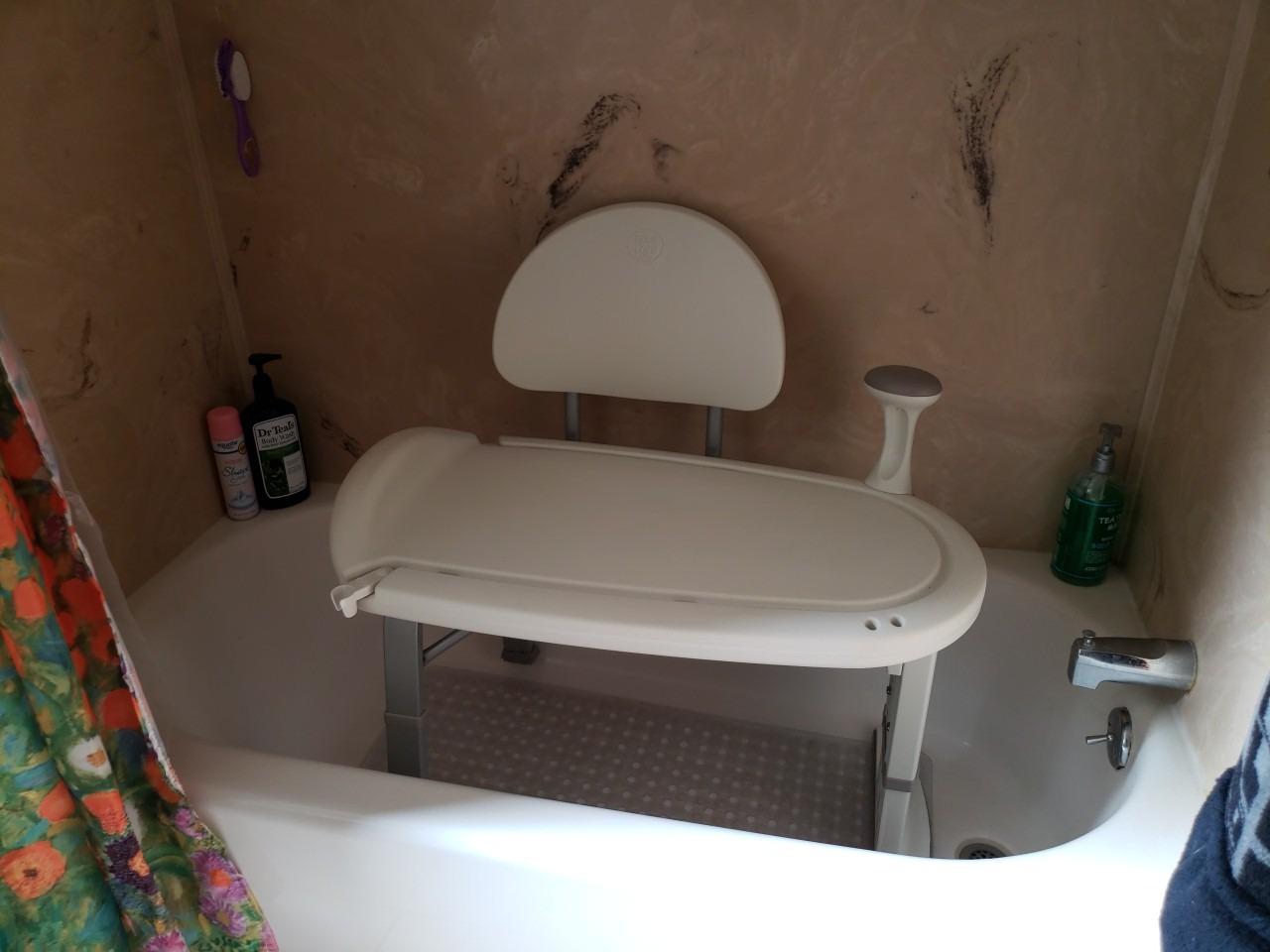
This bench earns its place for one reason: stability on older tubs. Owners of vintage and sloped tubs report that cheaper benches tipped or rang hollow on a curved floor, while the Moen holds steady because the inner legs adjust individually against the slope.
Geometry is the second advantage. The outside leg is a broad pedestal rather than a single tube, so the bench resists tipping forward when a user leans over to wash. The 33 inch seat has rounded ends, which makes sliding on and off feel less like a drop than a square-edged seat.
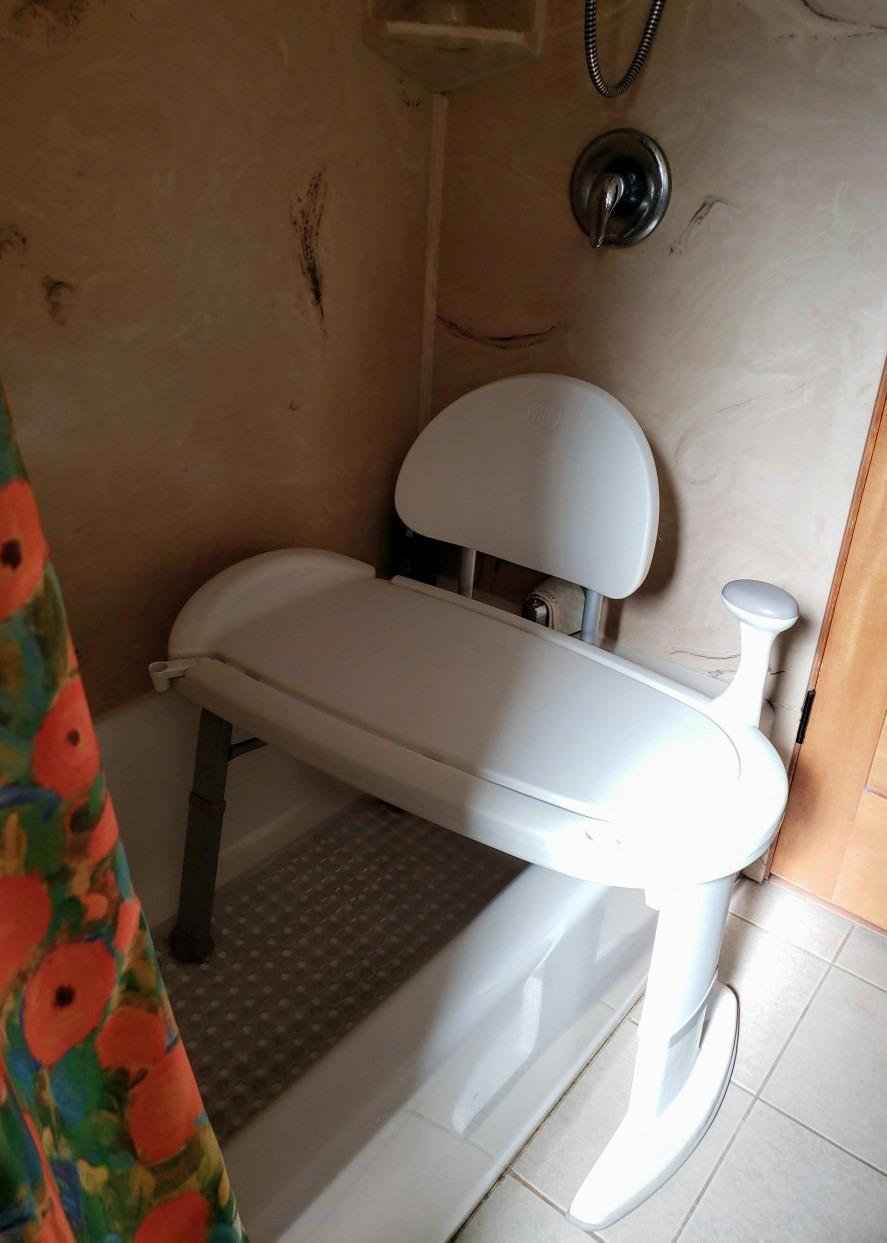
It carries a limited lifetime warranty from the manufacturer, which is unusual in this category and worth noting for anyone planning to keep a bench for years. It is also one of the few models here with an integrated grab handle and a clip for a handheld shower head, so the user does not need a separate caddy.
The trade-offs are water management. The seat is solid high-density polyethylene with no drainage holes, so water pools unless the user tilts. And the wide outside leg makes it difficult to tuck a shower curtain inside the tub rim, which is exactly the flooding problem the Drive Medical bench was designed to solve.
Where this bench is genuinely better
Cast iron tubs from previous decades often have uneven floors and a slightly rounded shape. The independently adjustable inner legs are the feature that decides whether the bench sits flat or rocks, and reviewers with old tubs single that out. The pedestal leg also matters when a caregiver is leaning in to assist with washing.
What to check before buying
Measure the space between the tub and the toilet. At 32.75 inches wide with a wide outside leg, this bench is not compatible with every bathroom, and owners in tight layouts report it simply will not fit. If floor area is tight, the Carousel or a compact model is a better direction.
We earn a commission, at no additional cost to you. CERTAIN CONTENT THAT APPEARS ON THIS SITE COMES FROM AMAZON. THIS CONTENT IS PROVIDED 'AS IS' AND IS SUBJECT TO CHANGE OR REMOVAL AT ANY TIME.
6. Flash Furniture HERCULES: Best Budget Transfer Bench with a Side Arm
Flash Furniture HERCULES Series 300 Lb. Capacity Adjustable Gray Bath & Shower Transfer Bench with Back and Side Arm
- Plastic and aluminum
- 300 lb capacity
- Seat height 17.25-21.25 inches
- Backrest with side arm
- 10.5 lb unit weight
Pros
- Corrosion-resistant aluminum frame with rubber feet
- Side arm and backrest give support sitting down and standing up
- Drain holes in the seat reduce standing water
- Adjustable seat height across a four inch range
- Conforms to ANSI/BIFMA X5.1-17 and is FSA eligible
Cons
- 300 lb rating is below most competing benches
- Hard plastic seat is uncomfortable for long sits
- No suction cups
- no curtain channel
We earn a commission, at no additional cost to you. CERTAIN CONTENT THAT APPEARS ON THIS SITE COMES FROM AMAZON. THIS CONTENT IS PROVIDED 'AS IS' AND IS SUBJECT TO CHANGE OR REMOVAL AT ANY TIME.
This is the entry point we recommend when the goal is a solid, functional bench without spending heavily. The frame is corrosion-resistant aluminum, the seat adjusts from 17.25 to 21.25 inches, and the backrest carries a side arm that gives a handhold for both sitting down and standing up.
It is also one of the few cheap benches with drain holes moulded into the seat, so water runs off instead of pooling. That single feature removes the most common complaint about plastic bath seats, and it comes with a five year limited warranty on non-moving metal parts.
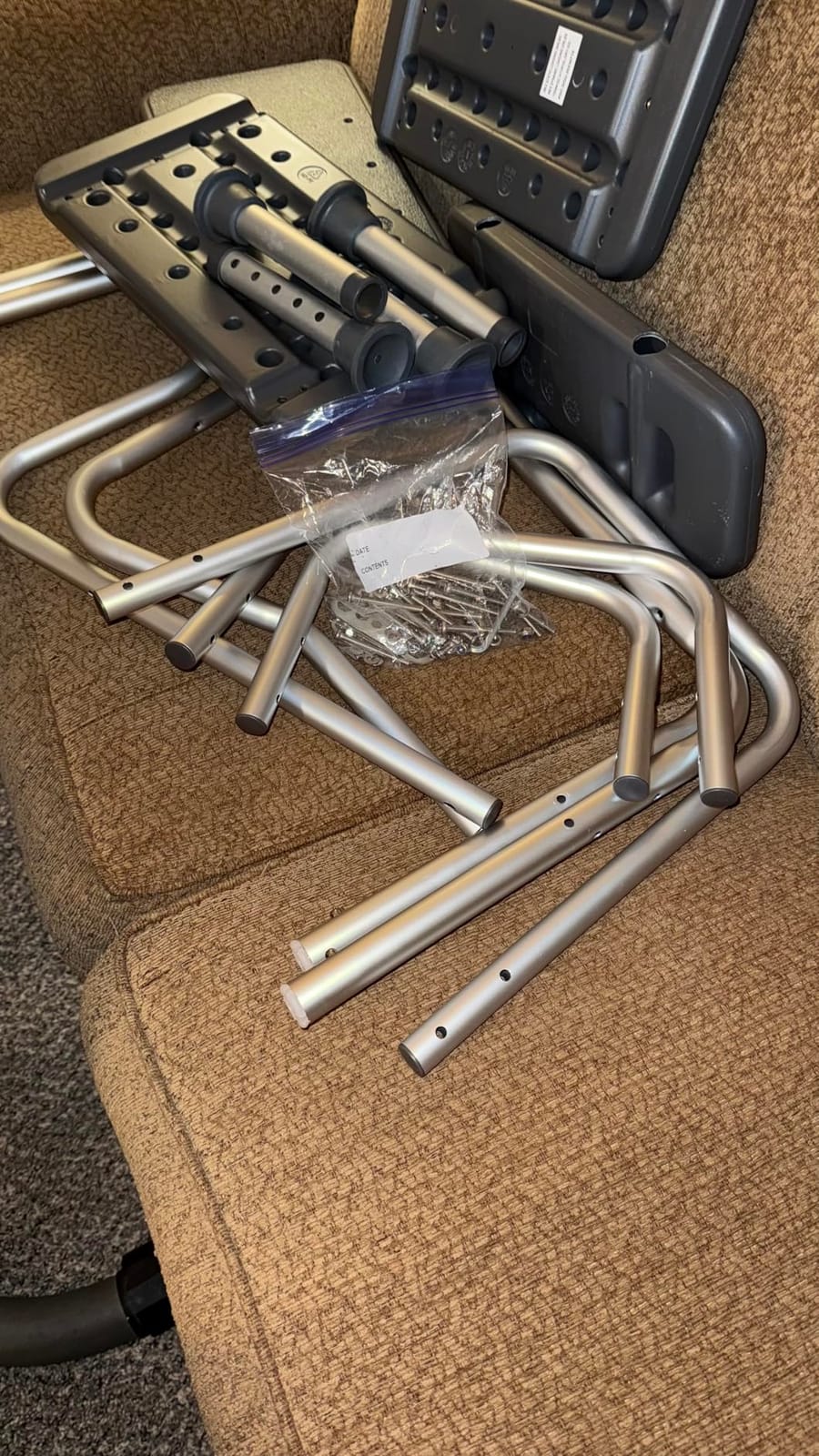
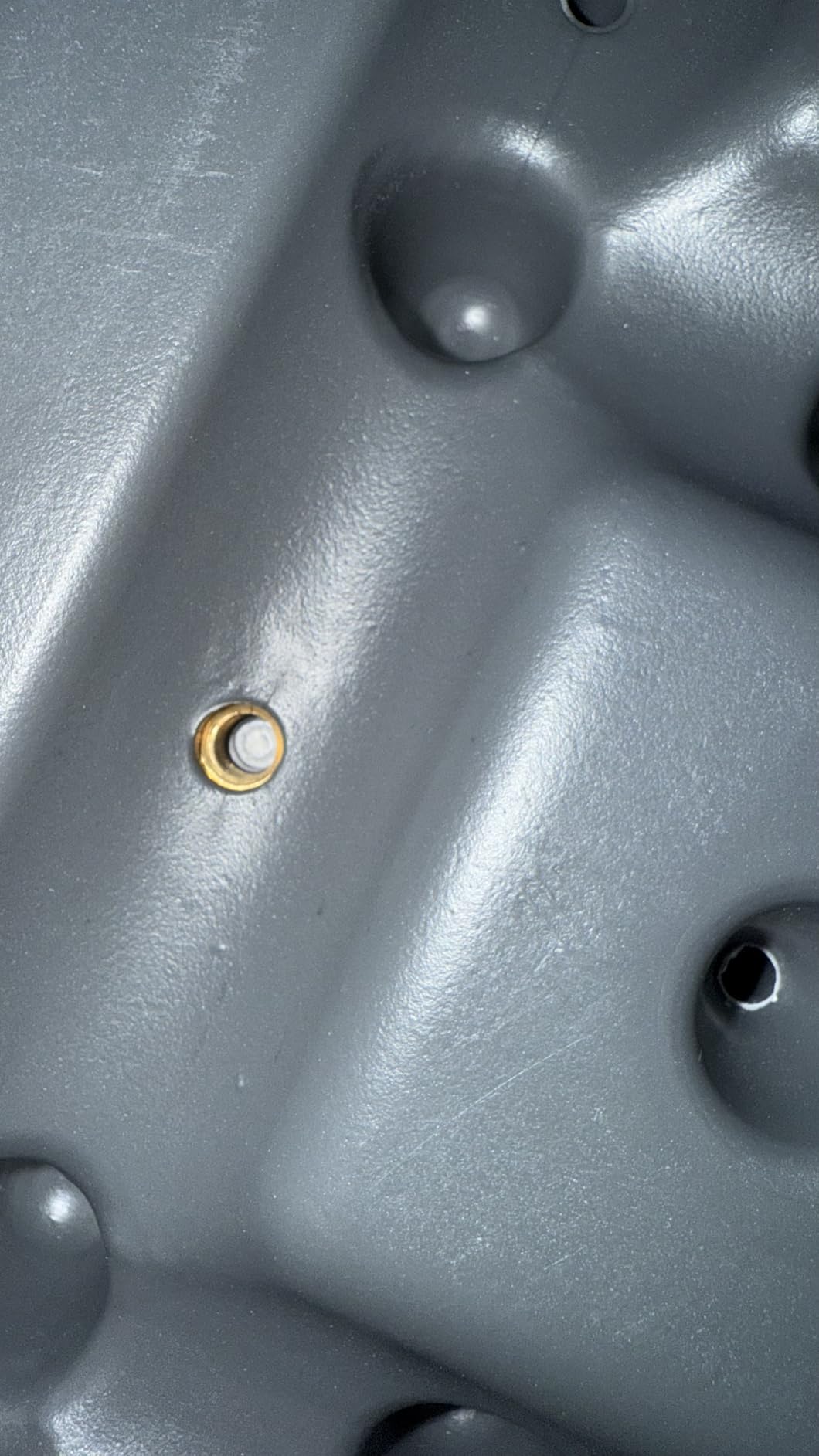
Where it falls short is capacity and comfort. The 300 lb rating is among the lowest here, so it offers the thinnest safety margin, and the hard plastic seat is punishing over a twenty minute shower. There are no suction cups inside the tub, only rubber feet, so grip depends on how clean and how wet the tub floor is.
That said, owners report it as stable and does what it promises. It is a sensible first bench for a user around 200 lb who bathes quickly and needs a solid place to sit and a hand to push off from.
When this is the right call
Short showers, a lighter user, and a bathroom where floor space is at a premium. It weighs 10.5 lb, disassembles easily, and its 30 inch width is at the tighter end of this list. The side arm is genuinely useful for anyone with limited core strength who needs something to push against on the way up.
When to spend more
If you are within 50 lb of 300 lb, go to a 400 lb model. The extra capacity usually means a heavier frame and firmer adjustment pins, which matters when the bench is carrying full weight on a wet floor. Anyone showering for a long period, or anyone with tender skin, should also add padding or move up to a padded bench.
We earn a commission, at no additional cost to you. CERTAIN CONTENT THAT APPEARS ON THIS SITE COMES FROM AMAZON. THIS CONTENT IS PROVIDED 'AS IS' AND IS SUBJECT TO CHANGE OR REMOVAL AT ANY TIME.
7. Drive Medical Splash Defense: Best Transfer Bench for Keeping Water In the Tub
Drive Medical Splash Defense Tub Transfer Bench, Adjustable Height, White
- Plastic and steel
- 400 lb capacity
- Seat 28 x 16 inches
- Dual-column legs at 0.5 inch steps
- 12.7 lb unit weight
Pros
- Curtain channel bars let the shower curtain close inside the tub
- Keeps water in the bathing area instead of flooding the bathroom floor
- U-shaped cutout channels water back toward the drain
- Dual-column legs adjust in half-inch increments for leveling
- Pinch-free lever system avoids pinched fingers during setup
Cons
- Curtain channel bars can strike a standard tub wall and stop the outside legs reaching the floor
- Loops over the rim can catch when the rim flexes
- Limited height range makes taller tubs difficult to level
- Seat is wide and will not suit narrower tubs
We earn a commission, at no additional cost to you. CERTAIN CONTENT THAT APPEARS ON THIS SITE COMES FROM AMAZON. THIS CONTENT IS PROVIDED 'AS IS' AND IS SUBJECT TO CHANGE OR REMOVAL AT ANY TIME.
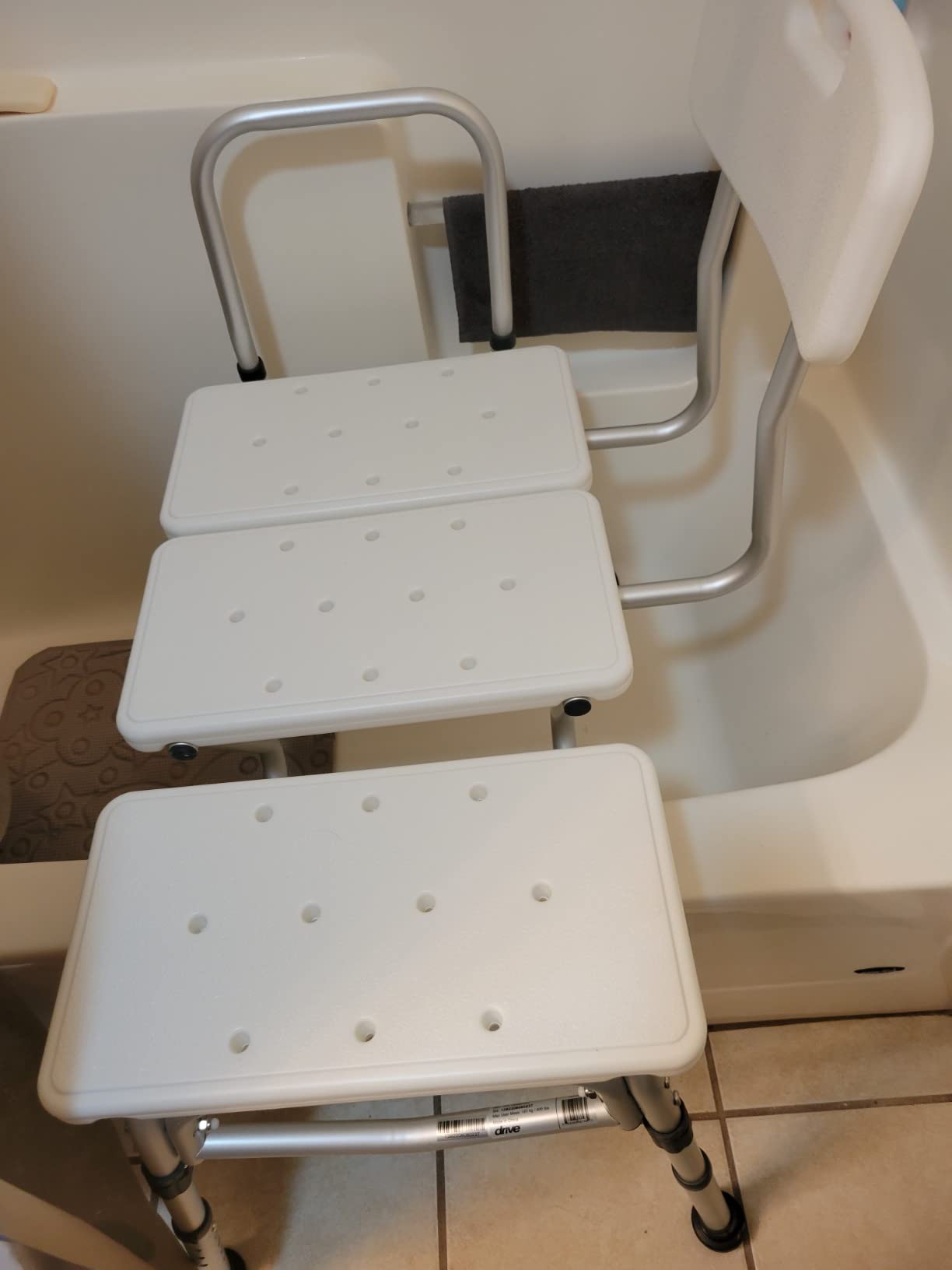
Flooded bathroom floors are the most common complaint we heard about transfer benches, and this one was built to solve it. Two curtain channel bars run along the seat, so a standard shower curtain can hang inside the tub rim instead of outside the bench. Water stays where it belongs.
The U-shaped cutout in the seat works with that idea, channeling water back toward the drain instead of letting it run forward onto the floor. Reviewers repeatedly describe it as the only bench they have used that leaves the bathroom dry.
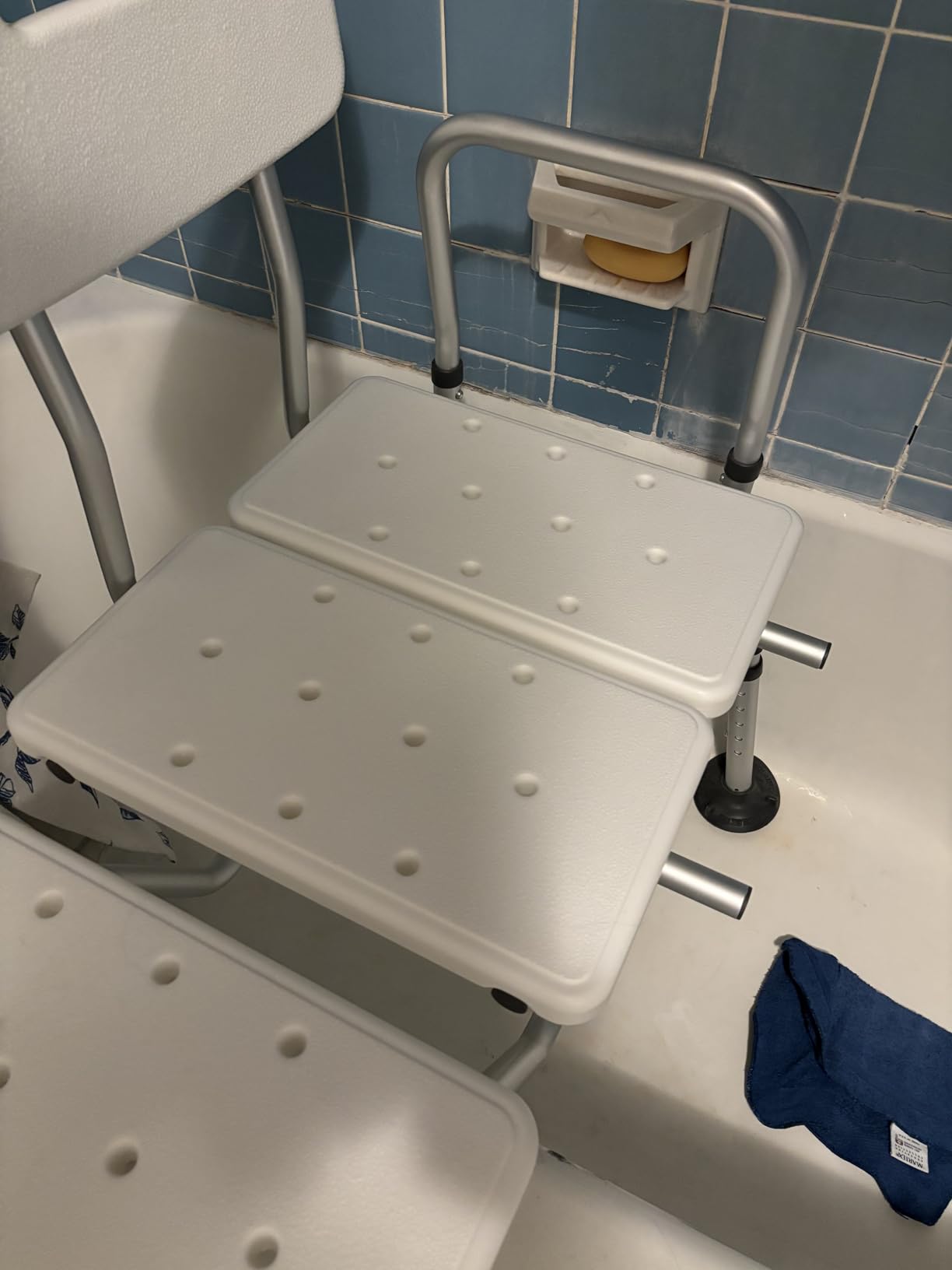
There is a real catch, and it is a fit issue rather than a quality issue. Those same channel bars need clearance above the tub rim. On a standard-height tub wall they can strike the rim and stop the outside legs from reaching the floor, which means the bench will not level properly.
So the rule is simple: measure your tub wall height first. This model suits low-profile and curbless tubs. On a standard wall, expect to need the leg extension or choose a different bench entirely. The 28 inch seat is also wide, so narrow tubs are out.
Why splash control changes daily life
A wet tile floor outside the tub is a fall hazard every single day, not only when the bench is being used. Anyone with balance issues who uses a transfer bench is dealing with that risk every time the curtain swings open. Solving the water problem removes an entire category of risk rather than one specific movement.
How it fits with other choices
If your tub has a standard rim, a fixed-frame bench paired with a split shower curtain achieves the same result more cheaply. The Moen has the stability to pair well with one. This bench is the better answer when your tub is low and you would rather not add a separate accessory.
We earn a commission, at no additional cost to you. CERTAIN CONTENT THAT APPEARS ON THIS SITE COMES FROM AMAZON. THIS CONTENT IS PROVIDED 'AS IS' AND IS SUBJECT TO CHANGE OR REMOVAL AT ANY TIME.
8. Carex Universal Bench: Best All-Plastic Transfer Bench That Cannot Rust
Carex Universal Tub Transfer Bench, Bath Seat with Backrest, Shower Chair for Elderly and Disabled, Transfer Bench & Shower Seat for Bathtub with Adjustable Legs, Converts to Right or Left Hand Entry
- All-plastic construction
- 400 lb capacity
- Tool-free adjustable legs
- Reversible entry
- 14.51 lb unit weight
Pros
- No metal parts at all
- so nothing can rust or corrode in a wet tub
- Tool-free legs level the bench exactly
- Backrest includes two built-in handles for positioning
- Converts for right-hand or opposite-side entry
- Holds 400 lb and disassembles for storage
Cons
- Solid plastic seat has no drainage holes so water collects
- Older design with no armrest or shower head holder
- No padding for long sits
- Heavier at 14.51 lb
We earn a commission, at no additional cost to you. CERTAIN CONTENT THAT APPEARS ON THIS SITE COMES FROM AMAZON. THIS CONTENT IS PROVIDED 'AS IS' AND IS SUBJECT TO CHANGE OR REMOVAL AT ANY TIME.
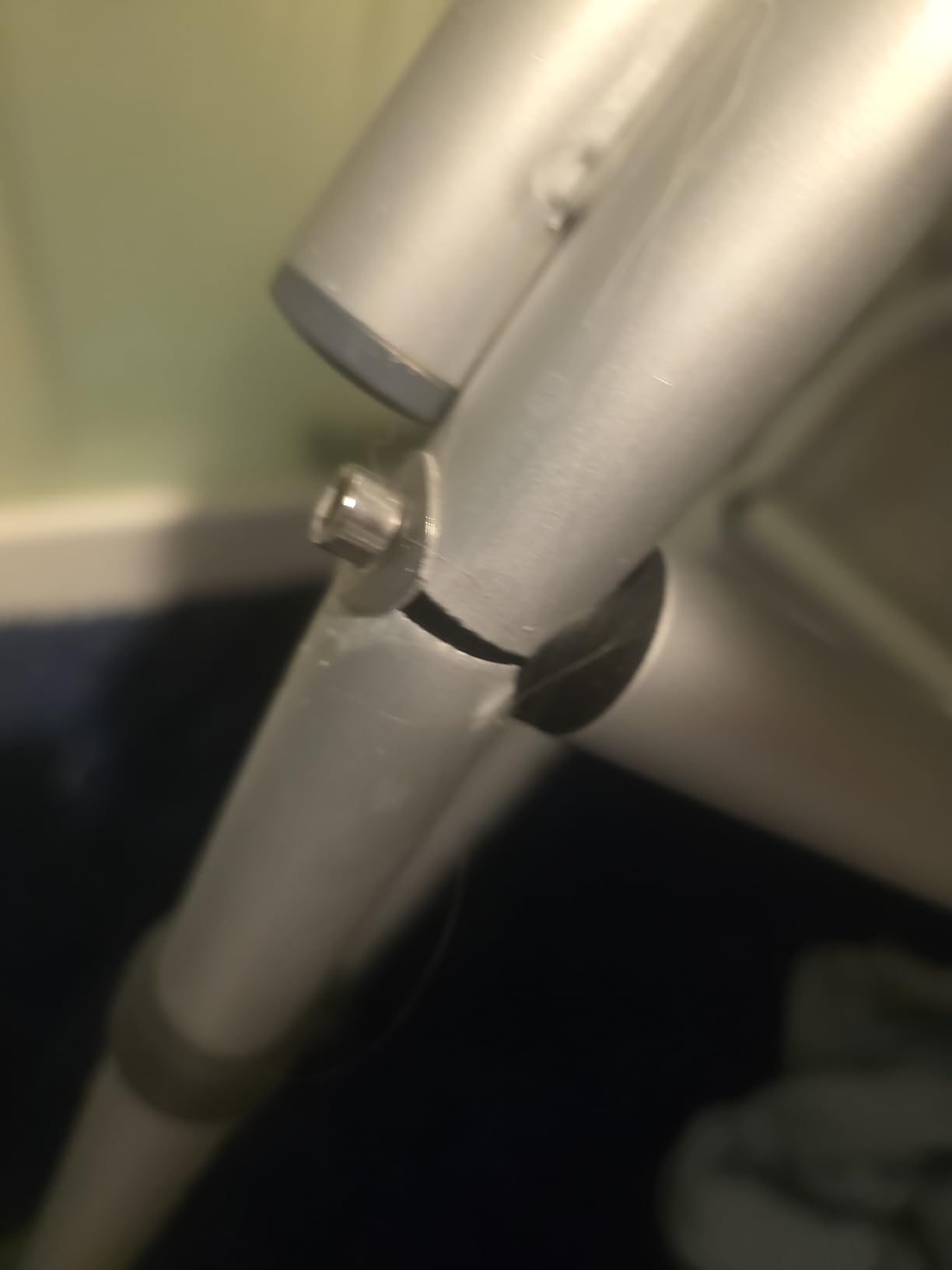
Two screws on a bench are enough to make it fail. We saw reports of rust appearing on screw heads after roughly ten uses on one of the models here, and this is the bench that answers that problem directly: there is no metal in the frame at all.
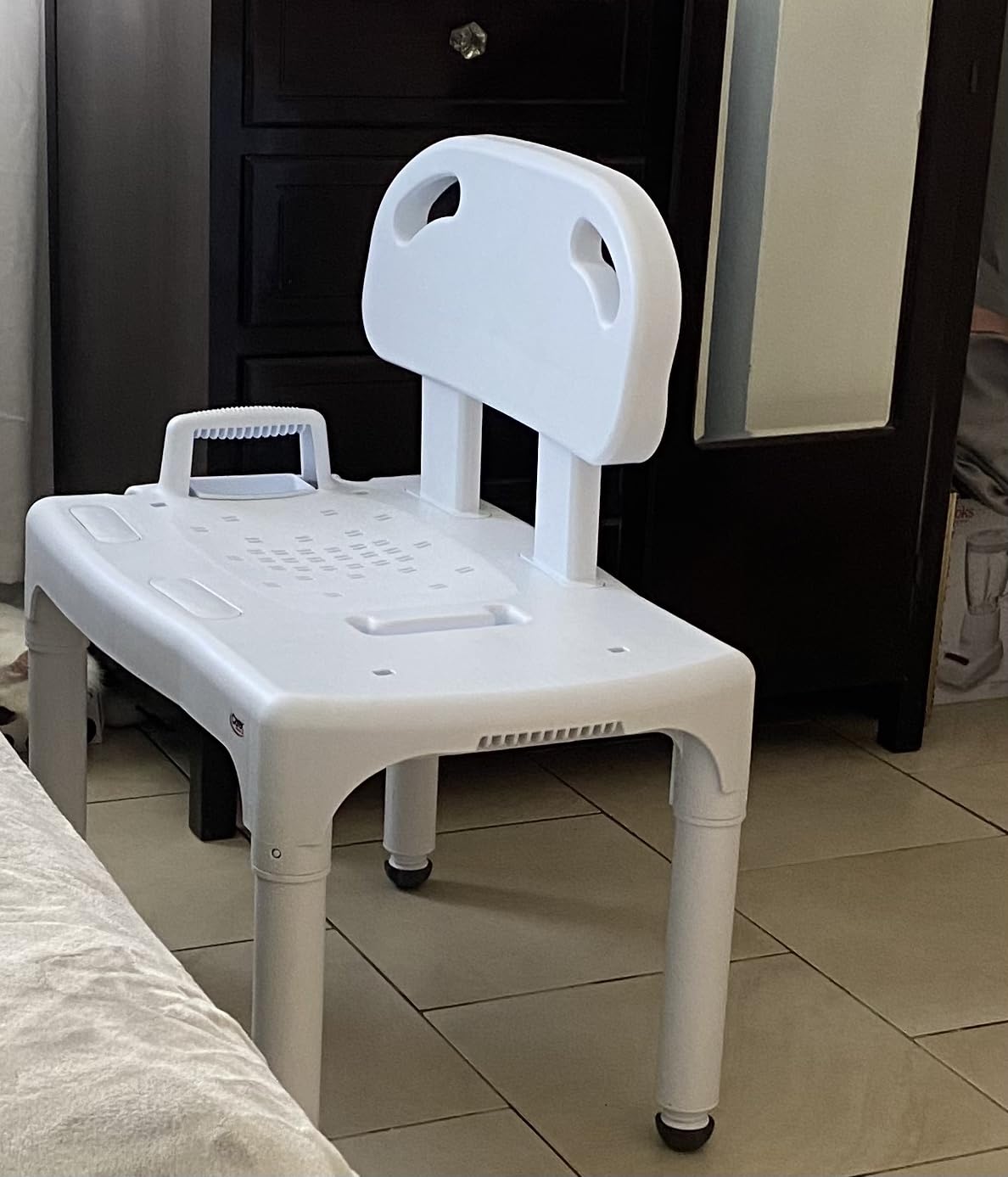
Everything is plastic, which means no rust and no corrosion no matter how long it sits in a wet tub. The legs adjust by hand with no tools, the backrest has two built-in handles to help with positioning, and the unit converts for entry from either side.
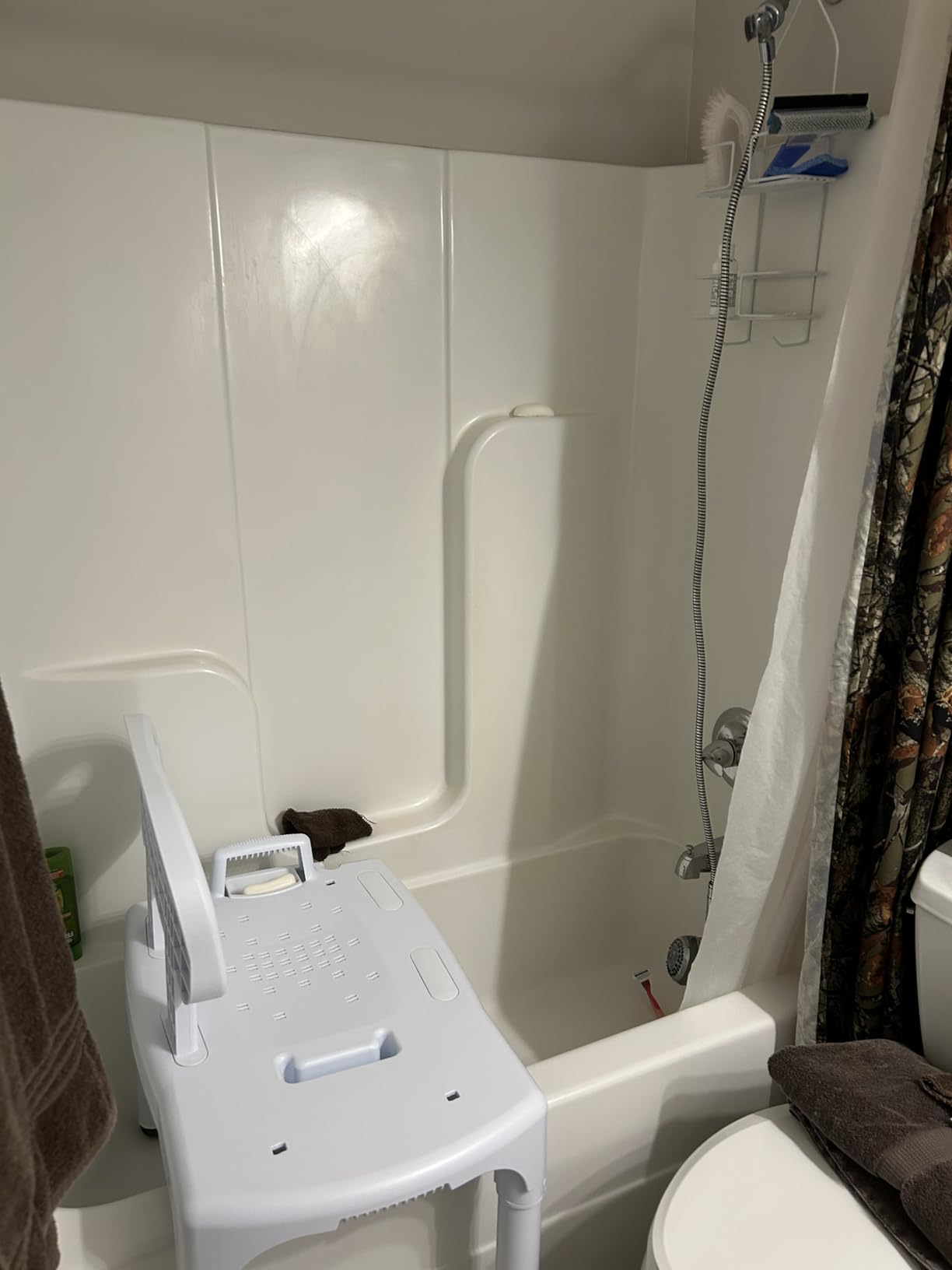
At 400 lb it is one of the heavier-rated all-plastic options, and owners report it leveling exactly once set. It dates back well before the current wave of swivel designs, which shows in the details: there is no armrest, no shower head holder, and no padding.
The main drawback is water on the seat. The plastic is solid with no drainage holes, so a user who is not careful will bathe in a puddle. It also weighs 14.51 lb, which is worth knowing if one person has to carry it between rooms.
When all-plastic matters most
In a hard water area, or for anyone who leaves the bench in the tub permanently rather than carrying it in and out, corrosion resistance is the whole game. A metal bench left in standing water for years will show it. This one will not, and the reversible entry adds flexibility if the bathroom layout is later changed.
What to add to make it better
A handheld shower head on a clip and a non-slip mat will cover the missing storage and the puddle problem. If long showers are the plan, the padded Medline bench later in this list addresses comfort. Just confirm the seat depth works for the user, since there is no cut out to shorten it.
We earn a commission, at no additional cost to you. CERTAIN CONTENT THAT APPEARS ON THIS SITE COMES FROM AMAZON. THIS CONTENT IS PROVIDED 'AS IS' AND IS SUBJECT TO CHANGE OR REMOVAL AT ANY TIME.
9. Vive Heavy Duty Bench: Best Tub Transfer Bench for Fast Setup
Vive Shower Bench for Transfers – Heavy Duty Tub Transfer Bench for Bathtub
- Stainless steel frame
- 400 lb capacity
- Seat height 18.5-23.5 inches
- 30 drainage holes
- Arrives partially assembled
Pros
- Arrives mostly assembled and finishes tool-free in about ten minutes
- Reversible arm and backrest fit any tub layout
- 30 drainage holes stop puddling on the seat
- Dual-column extension legs reach up to 23.5 inches
- Large suction cup caps inside and non-skid tips outside
Cons
- Legs extend past the seat so a toilet or cabinet can restrict placement
- Interior suction cups are strong enough to be hard to break for moving
- Printed directions are confusing to follow
We earn a commission, at no additional cost to you. CERTAIN CONTENT THAT APPEARS ON THIS SITE COMES FROM AMAZON. THIS CONTENT IS PROVIDED 'AS IS' AND IS SUBJECT TO CHANGE OR REMOVAL AT ANY TIME.
The Vive bench ships partly assembled, which matters more than it sounds. Setting up a bench in a small bathroom usually means working in an awkward crouch between the tub and the wall, and arriving with only the final fittings left keeps that job short. Owners put the finish at about ten minutes with no tools.
The seat is moulded plastic with 30 drainage holes, so water does not pool, and the stainless steel frame is rated to 400 lb. Leg height runs from 18.5 to 23.5 inches on dual-column extensions, which is the tallest reach of the fixed-frame benches here.
Who this bench suits
Post-surgical users recovering from knee, foot or ankle surgery are the group owners most often describe, largely because the taller seat height sits closer to a standard chair height and makes standing up easier. Reversibility means the same bench can be reconfigured if the bathroom changes. It is HSA and FSA approved and carries a two year unconditional guarantee.
What to check before ordering
Measure floor clearance, not just tub width. The legs project beyond the seat footprint, and owners report a nearby toilet or cabinet restricting where the bench can stand. That is the most common reason this otherwise well-reviewed bench ends up in a cupboard.
The interior suction cups are strong by design, which is good for safety and awkward for moving. Break them by pulling straight up rather than tilting the bench, and plan on assistance if the user cannot lean on the tub wall.
We earn a commission, at no additional cost to you. CERTAIN CONTENT THAT APPEARS ON THIS SITE COMES FROM AMAZON. THIS CONTENT IS PROVIDED 'AS IS' AND IS SUBJECT TO CHANGE OR REMOVAL AT ANY TIME.
10. TABEKE Tub Transfer Bench: Best for Ten Height Settings and a Bolted Backrest
TABEKE Tub Transfer Bench & Shower Chair for Bathtub, Elderly & Disabled
- Aluminum and HDPE
- 400 lb capacity
- Seat height 17.75-22 inches across ten settings
- Quad-bolt backrest
- 12.3 lb unit weight
Pros
- Backrest is bolted on with quad-bolt cross tubes instead of spring buttons
- Ten height settings give finer control than most rivals
- Non-slip rubber tips plus two suction cups grip inside and outside the tub
- Foam padded side handles stay warm and comfortable to grip
- Includes a shower head clamp and spare parts
Cons
- Needs 32 inch clearance from the interior tub wall
- Compatible only with tub walls up to 19.75 inches high
- Unpadded HDPE seat is hard over a long shower
We earn a commission, at no additional cost to you. CERTAIN CONTENT THAT APPEARS ON THIS SITE COMES FROM AMAZON. THIS CONTENT IS PROVIDED 'AS IS' AND IS SUBJECT TO CHANGE OR REMOVAL AT ANY TIME.
Two details set this bench apart from the cheaper fixed frames. The backrest attaches with bolted cross tubes rather than spring-loaded buttons, which is the first component that usually fails or works loose. And the seat height has ten settings from 17.75 to 22 inches, so matching a user’s knee height takes less trial and error.
Feet grip from both directions: rubber tips plus two suction cups handle the tub interior and the bathroom floor. The foam padded side handles are warm to the touch, which matters in a cold bathroom, and a shower head clamp is included.
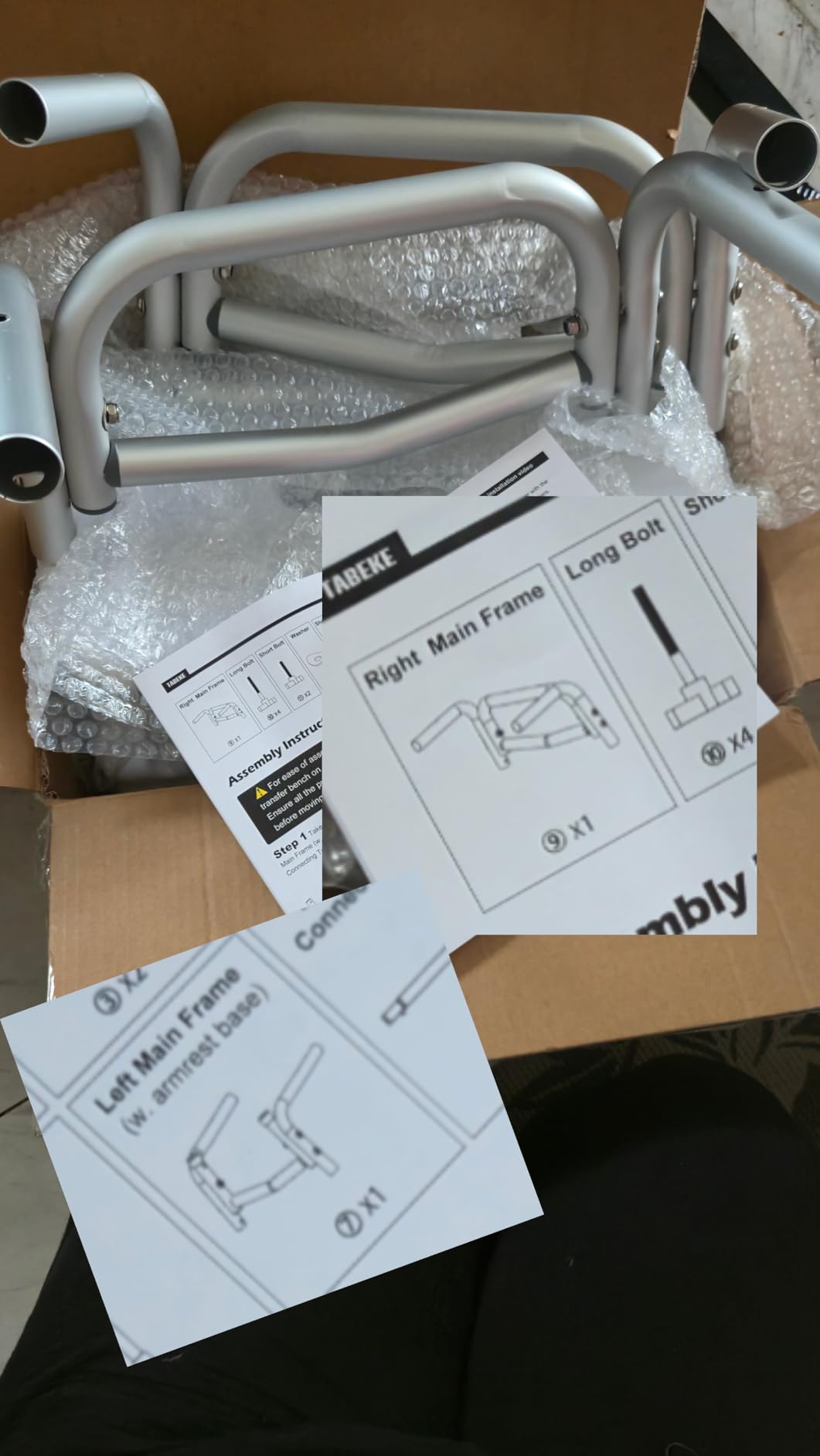
Fit is the deciding factor and the number one caution in reviews. It needs 32 inches of total clearance from the interior tub wall out to the outer legs, which rules out a lot of compact bathrooms. It also caps out at 19.75 inches of tub wall height, so deeper tubs will not work.
The seat is unpadded HDPE. It is fine for a normal shower, but anyone sitting for a long time will prefer a cushioned model. The unit itself weighs roughly 12.3 lb, in line with the other aluminum benches here.
Why ten settings beat four
With four or five holes, getting a level bench often means choosing a height that is close but not right, and a bench sitting a half inch off level is a bench the user will distrust. Ten settings let a caregiver dial the seat to actual knee height and lock both columns independently, which is what makes the difference on an uneven tub floor.
Measure these two numbers first
Write down the depth from the interior tub wall to wherever the bench can stand, and the height of your tub rim. If either falls outside the stated limits, move on rather than trying to improvise. This model is FSA and HSA eligible, and spare parts are included, which helps for a bench that will live in a wet room for years.
We earn a commission, at no additional cost to you. CERTAIN CONTENT THAT APPEARS ON THIS SITE COMES FROM AMAZON. THIS CONTENT IS PROVIDED 'AS IS' AND IS SUBJECT TO CHANGE OR REMOVAL AT ANY TIME.
11. Medline Padded Transfer Bench: Best for Long Sits and Tender Skin
Medline Padded Transfer Bench for Bathtub and Shower, Height Adjustable, Slip-Resistant Legs, Rust-Resistant, Side Arm & Back Rest for Extra Support, 400 lb. Weight Capacity, Tool-Free Assembly
- Aluminum frame with padding
- 400 lb capacity
- Seat height 18-22 inches
- 29 inch seat width
- 12 lb unit weight
Pros
- Padded seat and backrest are far more comfortable than hard plastic and helped prevent a pressure sore
- Individually adjustable legs compensate for an uneven tub floor
- Reversible backrest works from either side of the tub
- Side arm adds a push point for standing
- Fits between the toilet and the tub in a small bathroom
Cons
- Padding is thinner than the listing implies and can crack over time
- Assembly instructions are unclear
- Tight for larger users maneuvering legs in a narrow bathroom
We earn a commission, at no additional cost to you. CERTAIN CONTENT THAT APPEARS ON THIS SITE COMES FROM AMAZON. THIS CONTENT IS PROVIDED 'AS IS' AND IS SUBJECT TO CHANGE OR REMOVAL AT ANY TIME.
Padding is the reason to buy this one. Users recovering from surgery, or anyone with thin skin, reduced circulation or a history of pressure sores, report that the cushioned seat and back made long showers bearable where a hard plastic seat was not.
The structure underneath is the same proven layout as the other Medline bench: a rust-resistant aluminum frame rated to 400 lb, push-button height adjustment from 18 to 22 inches, individually adjustable legs, and slip-resistant feet with wide suction cups in the tub.

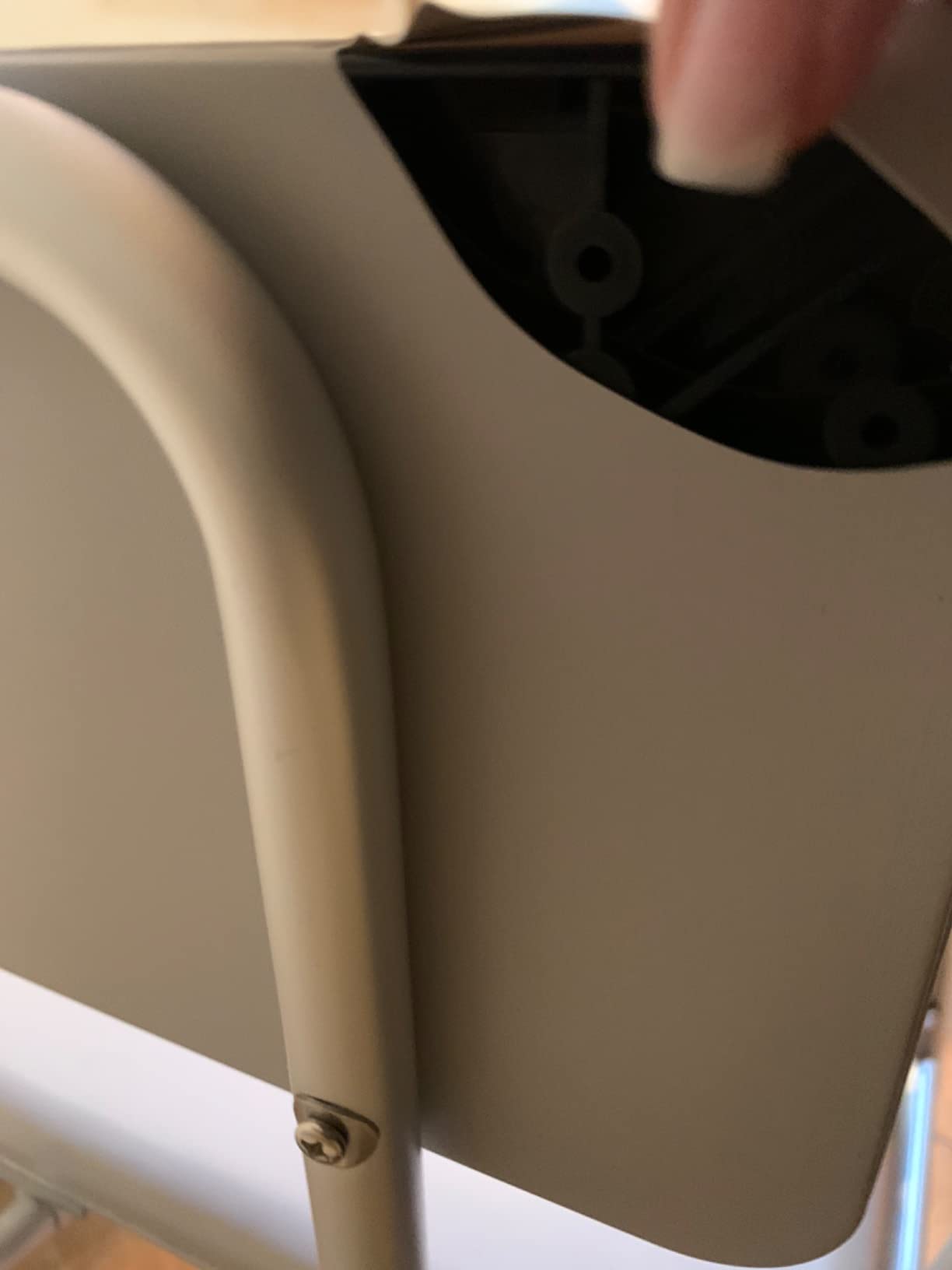
The honest criticism is about the padding itself. A recurring note in reviews is that the cushioning is thinner than the listing photographs imply, and that it can crack after extended use. Treat it as a comfort improvement rather than a therapeutic surface, and check it annually for splits.
The 29 inch seat width is mid-pack, so it is not a bariatric option, and owners in narrow bathrooms note it is tight for larger users when the legs need to swing into place. Assembly instructions are among the weakest we saw, so budget an extra ten minutes.
Who benefits most from padding
Anyone who cannot finish a shower in ten minutes. Long hot showers after a hip or knee replacement, or bathing a child or adult with limited mobility who needs more than a quick wash, are the cases where a hard seat becomes uncomfortable and a padded seat does not.
What to pair it with
A handheld shower head on a flexible hose makes a long seated shower practical, since the user does not have to stand to rinse. A non-slip mat inside the tub handles the wet floor the bench feet cannot cover. If the user is above 400 lb, step up to a bariatric model instead of this one.
We earn a commission, at no additional cost to you. CERTAIN CONTENT THAT APPEARS ON THIS SITE COMES FROM AMAZON. THIS CONTENT IS PROVIDED 'AS IS' AND IS SUBJECT TO CHANGE OR REMOVAL AT ANY TIME.
12. Medical King MK7140: Best Transfer Bench for Compact Bathtubs
Medical King Transfer Bench MK7140 – Bathtub Shower Chair, Adjustable Height, Holds Up to 400 Lbs, White, Plastic
- Plastic and steel
- 400 lb capacity
- Reaches up to 25.5 inches
- Handle mounts on either side
- 13 lb unit weight
Pros
- Suction cups hold the bench firmly in the tub with no slippage
- Legs adjust easily to suit different users and tub heights
- Frame is stable at a 400 lb rating
- Handle mounts on either side to match the strong side
- Assembles and disassembles for moving between homes
Cons
- Gap between the seat and the tub lets water splash onto the floor
- No splash guard or drainage holes included
- Some screws showed rust after about ten uses
We earn a commission, at no additional cost to you. CERTAIN CONTENT THAT APPEARS ON THIS SITE COMES FROM AMAZON. THIS CONTENT IS PROVIDED 'AS IS' AND IS SUBJECT TO CHANGE OR REMOVAL AT ANY TIME.
This is the narrowest unit in the roundup at 26.5 inches wide, and that is the whole reason it is here. In a bathroom where a 32 to 39 inch bench simply will not fit, the four inch difference decides whether a bench is possible at all.
It is still a 400 lb rated frame with adjustable legs, and the legs reach up to 25.5 inches, which is high enough to suit a taller user or a higher tub wall. The handle mounts on either side so it can be set for the user’s stronger arm.
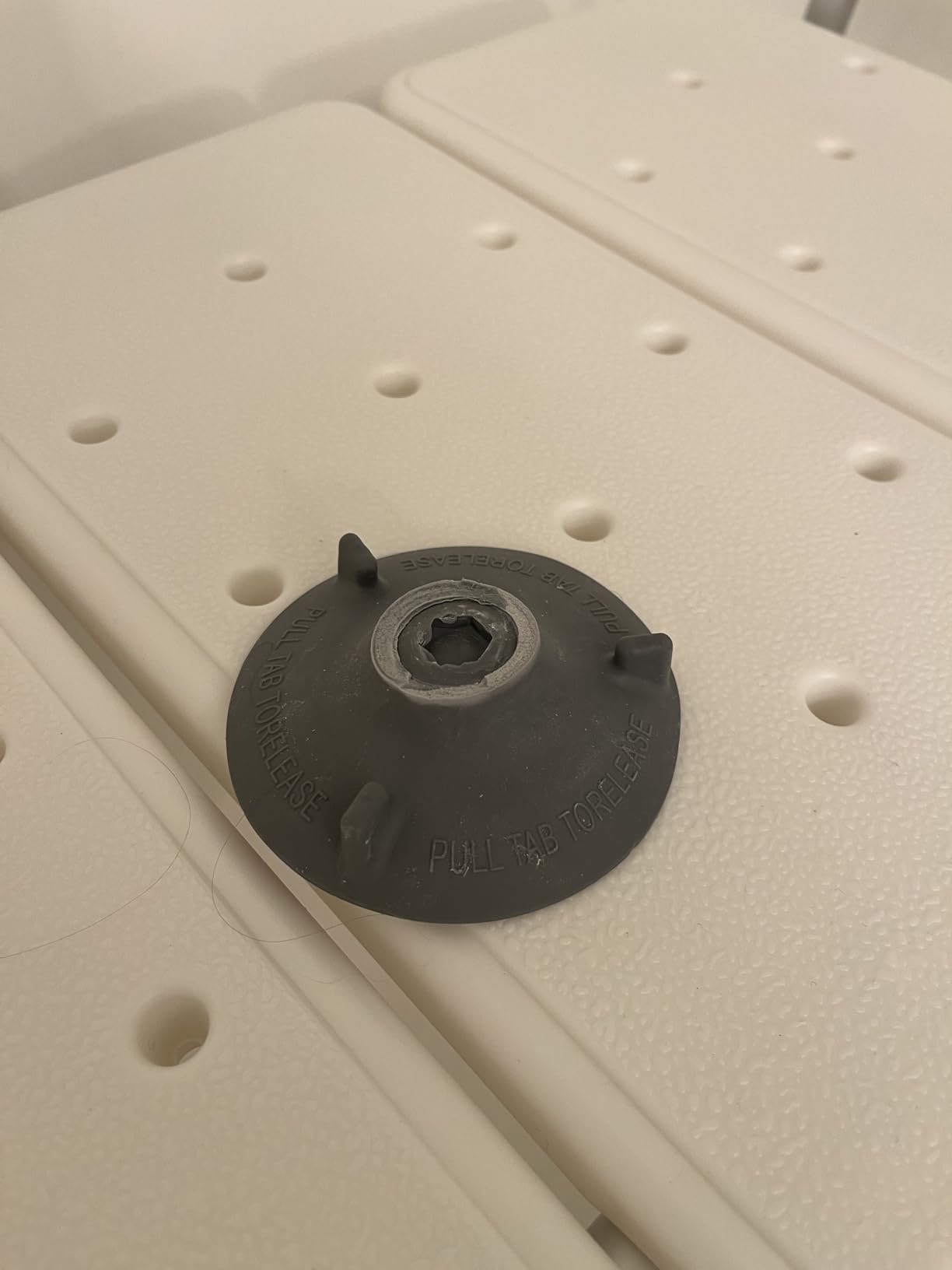
Two problems show up repeatedly. There is a gap between the seat and the tub wall, so water splashes out onto the bathroom floor during a shower, and there is no drainage feature in the seat. Owners in small households accept the tradeoff because the alternative is no bench at all.
The second issue is build detail: some buyers reported rust on screws after about ten uses. We would inspect the hardware at purchase and periodically after that, and replace any that have started to pit.
When a narrow bench is the only bench
Measure the tub span before ruling this option out. If the gap between the interior tub wall and the far edge of the bathroom is under 28 inches, this is one of very few 400 lb rated benches that will work. It disassembles for storage, which also suits renters who cannot install anything permanently.
How to handle the water problem
A split shower curtain or a splash guard is not optional with this model. Hang the curtain inside the tub rim, run a handheld shower head on a low flow, and lay a non-slip mat on the floor outside the tub. That combination addresses the main complaint without replacing the bench.
We earn a commission, at no additional cost to you. CERTAIN CONTENT THAT APPEARS ON THIS SITE COMES FROM AMAZON. THIS CONTENT IS PROVIDED 'AS IS' AND IS SUBJECT TO CHANGE OR REMOVAL AT ANY TIME.
What a Tub Transfer Bench Actually Is
A tub transfer bench is a long, height-adjustable bath seat that straddles the bathtub wall, with two legs inside the tub and two outside on the bathroom floor. The user sits on the outboard half, lifts each leg over the rim while fully supported, then slides or swivels into the bathing area. Nobody stands on a wet floor at any point during entry.
That is the entire mechanism, and it is why a bench changes the risk profile rather than just trimming it. The step-over of a 15 to 20 inch tub wall while standing is the single riskiest movement in a bathroom, and a bench removes it completely. Height adjustment sets the seat near knee height so the feet rest flat, and suction cups or rubber feet lock the legs to the tub floor.
A bench is for anyone who cannot safely lift a leg over a tub wall while standing: people recovering from hip or knee replacement, wheelchair users, and people with arthritis, Parkinson’s, balance disorders or a history of falls. It also cuts the load on a caregiver, and caregiver back injury is one of the commonest reasons home bathing stops working.
Tub Transfer Bench vs Shower Chair: Which One Fits Your Bathroom?
A shower chair is for a shower. A tub transfer bench is for a bathtub you cannot step into, and the difference is structural rather than cosmetic. A shower chair has four legs inside one enclosure. A bench spans two spaces with a different floor level on each side, which is why it needs individual leg adjustment.
Most of the confusion in this category is naming. Listings mix shower chair, shower bench, tub bench and bath seat for the same product. Read the specifications, not the title, and look for the tub wall span in the dimensions.
The practical decision rules
Choose a tub transfer bench if there is a bathtub wall to get over, a wheelchair transfer, or a user who cannot stand and lift a leg. Choose a shower chair or stool if the bathing area is a walk-in with a low threshold, or a level-access shower with no wall at all. A bench in a level walk-in is just an unstable seat spanning nothing.
Neither one replaces a grab bar. Therapists in an occupational therapy forum are asked this question constantly, and the professional answer is that a bench handles the entry but not the standing, turning and exiting movements that grab bars are for.
When a bench is more than you need
If the user has reliable balance and only wants extra confidence, an anchored grab bar and a non-slip mat take up no floor space at all. A bench that is not needed becomes one more object to manoeuvre around in a small wet room, and it is a trip hazard rather than an aid.
How to Measure Your Tub Before You Order
Measure first, order second. Opened bathroom goods are usually not returnable, and a bench that does not span your tub is the most common reason a purchase goes in the cupboard. Take four measurements and write them down.
- Span width. Measure from the interior tub wall out to the far edge of the bathroom floor where the outside legs will stand. Compare that number to the bench’s stated width, not its seat width.
- Tub wall height. Measure the outside of the rim from the floor. Any bench with curtain channel bars or a fixed maximum will not level if your rim is taller.
- Knee height. Sit the user on a dining chair and measure floor to the top of the knee. The bench seat should match or sit just below it.
- Floor space outside. Measure the clear floor in front of the tub. Remember that many benches have legs projecting beyond the seat, so leave a few inches.
The sizing-up rule for weight
Pick a rating at least 50 lb above the user’s weight. A 300 lb bench for a 265 lb user has no margin, and a bench carries a dynamic load when someone sits down abruptly. Higher-rated frames are also generally built from heavier gauge material, so the rating is a reasonable proxy for build quality.
Two numbers that disqualify most listings
A tub wall above 20 inches, and a soaking tub deeper than standard, will rule out a large share of fixed benches. The Platinum Health model has an optional leg extension kit for high ledges, and the TABEKE caps out at 19.75 inches of wall, so check the stated maximum before you commit.
Are Tub Transfer Benches Actually Safe?
Tub transfer benches are safe when they fit, when they are used the way they were designed, and when they are combined with the rest of a bathroom safety plan. They remove the step-over, which is the highest-risk movement in a bathtub, and they do it reliably.
They are less safe in three situations: on a tub they do not span, on a surface that is not level, or as the only safety equipment in a bathroom. Every fall we would worry about on a bench involves one of those three.
What makes a bench safer in practice
Suction cups or slip-resistant rubber feet inside the tub, individual leg adjustment so the frame sits level, and a seat height close to knee height. Users also need something to push against on the way up, which is what a backrest and arm provide, and something to hold on the way down.
Duration matters more than most people expect
On a forum for people recovering from knee replacement, one user described a transfer bench as invaluable for the first two to three weeks after surgery, then reported stepping in without it once recovery advanced. A bench is frequently a short-duration recovery tool rather than a permanent fixture, and buying one with that in mind makes the purchase easier to justify.
What a Tub Transfer Bench Cannot Do
A bench does not replace grab bars. It handles entry and seated bathing, and it does almost nothing for the standing, turning and exiting movements that a grab bar covers. Occupational therapists asked about this in a professional forum give the same answer: the bench and the bars are complementary, not alternatives.
It also does not make a wet floor safe. Water that runs out of the tub onto tile is a hazard on every trip, not only on the days the bench is used. A split shower curtain, a splash guard and a non-slip mat address that, and the Drive Medical Splash Defense is the only bench here that tackles it at the source.
And it is not a substitute for an assessment
If someone has fallen in the bath more than once, or has a diagnosis that affects balance, cognition or judgement, talk to an occupational therapist before buying. A therapist can tell you whether a bench is the right aid, whether the user needs assistance from a caregiver, and where grab bars should be mounted. Nothing in this article is medical advice.
Split Shower Curtains and Splash Guards
Do you need a split shower curtain for a transfer bench? Usually yes, and it is the accessory most often left out of the purchase. A standard curtain hangs outside the bench, so water runs over the edge and onto the floor every single time.
A split curtain, or a curtain with a magnetic strip in the middle, hangs inside the tub rim and closes around the bench. It is a small part that fixes a problem most buyers discover only after the first flood. Budget for it in the same purchase rather than as an afterthought.
When the bench itself handles it
Two designs solve the problem without a separate accessory. The Drive Medical Splash Defense runs curtain channel bars along the seat, so a standard curtain clips inside the tub. For anyone who wants a swing curtain rather than a fixed panel, this is the closest thing to a one-part solution.
Two extras worth adding at the same time
A handheld shower head on a flexible hose lets a seated bather rinse without standing, which is the whole point of the bench. A non-slip mat inside the tub and one outside it covers the surfaces the bench feet cannot reach. Together they cost far less than a single ER visit.
How to Sit On and Slide Across a Tub Transfer Bench
- Set the bench first. Place it in the tub with the outside legs on the floor, then level each leg independently. The inside and outside legs sit at different heights by design, and both columns need adjusting.
- Lock the feet. Press the suction cups down inside the tub and confirm all four feet are bearing weight. A bench that rocks under a hand will feel unstable under a body.
- Back up to the outboard end. Back your heels to the edge of the seat until you feel the bench behind your legs.
- Sit down slowly. Reach back for the armrest or backrest, and lower yourself rather than dropping. The seat height is set so this is a controlled move.
- Lift one leg, then the other. This is the movement the bench exists for. You are seated the entire time, which is what makes it safe.
- Slide or swivel across. Push with your heels and hands on the armrests. On a sliding bench, release the strap locks first and use the seat belt.
- Reverse it to exit. Slide back to the outboard end, swing both legs over the rim, then push up to standing using the arm.
Practice it dry first
Run the sequence sitting on the edge of the bed or a dining chair before anyone gets wet. It takes five minutes and it teaches the user where the armrests are, which is the part first-time users get wrong.
How to Transfer From a Wheelchair Onto a Bench
Position the wheelchair at the outboard end of the bench, at a slight angle rather than square, and lock the brakes. The backrest on most of these benches reverses, so set it on the side the user is transferring from before starting.
- Flip the armrest up. The Platinum Health arms lift and lock, and several other benches accept a flip, which removes the obstacle between the wheelchair and the seat.
- Remove or swing the wheelchair armrest. This is the detail people miss. Caregivers in a caregiver support forum describe removing the wheelchair arm entirely so the lateral move is not over an obstruction.
- Angle toward the bench. A slight angle reduces the distance the user has to travel and lowers the chance of a wheel catching the bench frame.
- Slide across the seat surface. Keep the user low and use a transfer board if the lateral gap is wide. Do not lift under the arms.
- Lower the armrest and turn to face the tub. Then lift each leg over the rim while seated, exactly as in the seated sequence.
What to add for a lateral transfer
A handheld shower head on a hose means the wheelchair user never has to stand to rinse. A non-slip mat on the bathroom floor outside the tub matters most here, because the wheelchair wheels will be on a wet tile surface during the pivot.
Will Medicare Pay for a Tub Transfer Bench?
No. Original Medicare generally denies bathtub seats and transfer benches as a comfort and hygiene convenience item rather than a covered durable medical equipment benefit. That denial sits under the national coverage determination for bathroom aids, so it is not a billing error you can argue with at the counter.
HCPCS code E0247 is associated with transfer benches, and that confuses a lot of families. A billing code describes what a supplier can submit. It does not create a coverage entitlement, and a denial under the determination still stands.
Where the money usually comes from instead
Several of the benches here are FSA or HSA eligible, so pre-tax health spending accounts are the most direct route for many families. Medicaid waivers for home and community based services can fund equipment for eligible members, and Area Agency on Aging programs often run loan closets with equipment available to borrow.
Rental is the option most people overlook. A bench needed for two to three weeks of post-surgical recovery does not need to be bought, and medical supply companies and home health agencies rent them routinely. The rest of the bathroom plan, including grab bars, is often covered or discounted under a different rule than the bench itself.
Buying Guide: Seven Criteria That Decide the Purchase
Weight capacity first. Choose a rating at least 50 lb above the user’s weight, and treat the rating as a rough proxy for frame quality as well. Next is seat type, which is where most buyers get lost.
Fixed, sliding, swivel or 2-in-1
A fixed bench is a solid seat the user scoots across. It suits anyone with reasonable arm and core strength. A sliding bench moves the seat on a track, which suits weaker legs and wheelchair transfers, and the DMI in this roundup adds a safety belt. A swivel bench rotates and slides, which returns floor space in small bathrooms. A 2-in-1 model extends past the toilet so the same movement covers both fixtures.
Next comes the tub wall span and height, then the feet. Suction cups grip a smooth tub floor better than rubber tips, though both need the tub scrubbed and rinsed. Then look at height adjustment increments: finer steps mean the seat reaches knee height without being off level. Finally, check reversibility, since a bench that cannot flip to the accessible side of the tub will be a problem the first time the bathroom is rearranged.
Material and frame
Aluminum frames are the norm and resist corrosion well. All-plastic frames go further and cannot rust at all, which we prefer in hard water areas. Whatever the material, inspect screw heads and welds at purchase, because that is where early failure starts.
Comfort and support
Padding matters for anyone bathing longer than about ten minutes, and it matters more with reduced circulation. Armrests are close to essential, since they are the push-off point during both entry and exit. Backrests vary widely in strength, and the light plastic ones are the first thing owners complain about.
Maintenance, Inspection and When to Replace a Bench
A transfer bench is a cheap piece of safety equipment that deserves a monthly look. Scrub the tub floor, rinse it, and check that every suction cup seals fully by pulling straight up on each leg. A cup that does not hold is the single most important thing to catch.
The monthly check
Confirm every adjustment pin is fully clicked home on both columns. Inspect rubber tips and suction cups for cracks, hardening or flattened edges. Look for rust on screws and at welds, especially in hard water. Check that the seat and backrest have no splits, and wipe the frame dry after use.
Replace rather than repair when
Any frame crack, any bent leg, or a pin hole that no longer holds its position means the bench is finished, because those are the components carrying the load. Replace a seat with deep cracks or split padding. Replace any suction cup that has lost its grip, since compromised grip removes the entire safety argument.
A bench that has been used hard for several years is worth replacing as a matter of course. In the categories we reviewed, screws and suction cups fail long before the aluminum does, and both are cheap to replace on their own.
Frequently Asked Questions
What is the best tub transfer bench?
The best tub transfer bench is the one that spans your tub, rates at least 50 lb above the user’s weight, and offers a seat type matching their arm strength. Our top pick is the Medline Transfer Bench for its 400 lb rating, half-inch push-button height adjustment, reversible backrest and suction cup feet. Swivel or sliding designs are better for tight bathrooms or weak legs.
How safe are tub transfer benches?
They are safe when they fit the tub, sit level on all four legs, and are used for sitting rather than standing. A bench removes the step-over of the tub wall, which is the highest-risk movement in a bathroom. They are not safe as the only safety equipment, so pair one with a grab bar, a non-slip mat and a handheld shower head.
Does Medicare pay for a tub transfer bench?
No. Original Medicare generally denies bathtub seats and transfer benches as a comfort and hygiene convenience item under the national coverage determination for bathroom aids. The HCPCS code E0247 is a billing code, not a coverage guarantee. FSA and HSA funds, Medicaid home and community based waivers, Area Agency on Aging loan closets and short-term rental are the usual routes.
Is a shower chair or a tub transfer bench better for me?
A shower chair suits a walk-in shower or a stall with a low threshold. A tub transfer bench is required when there is a bathtub wall to get over, or for a lateral wheelchair transfer. Neither replaces a grab bar. In a level walk-in shower with no wall, a bench is unnecessary and a shower chair or stool is the correct choice.
How much weight can a transfer bench hold?
Ratings in this category run from 300 lb to 400 lb across the models we compared. Choose a rating at least 50 lb above the user’s weight so there is a real safety margin. A higher rating also usually means a heavier gauge frame, so it is a reasonable proxy for build quality rather than just a maximum load.
How do I measure my bathtub for a transfer bench?
Measure four things: the span from the interior tub wall to where the outside legs will stand, the height of the outside tub rim, the user’s knee height while seated on a dining chair, and the clear floor space in front of the tub. Note that many benches have legs extending past the seat footprint, and that opened bathroom goods are usually not returnable.
Do I need a split shower curtain for a tub transfer bench?
In most bathrooms, yes. A standard curtain hangs outside the bench, so water runs over the edge onto the tile floor with every shower. A split curtain or one with a magnetic strip hangs inside the tub rim and closes around the bench. The Drive Medical Splash Defense solves the same problem with curtain channel bars built into the seat.
How do I transfer from a wheelchair to a shower bench?
Position the wheelchair at a slight angle at the outboard end and lock the brakes. Flip up the bench armrest if it has one, and remove or swing out the wheelchair armrest so nothing blocks the lateral move. Slide across at seat level rather than lifting under the arms, then turn to face the tub and lift each leg over the rim while seated.
The Bottom Line for 2026
For most people, the Medline Transfer Bench is the right starting point: a 400 lb rating, half-inch height adjustment, a reversible backrest and suction cup feet, backed by the largest body of owner feedback in this category. The Carex shower bench is the value pick if you need reversible entry and want the widest review history, and the Platinum Health Carousel is the one to buy when floor space is the binding constraint.
Match the seat type to arm strength rather than to price. Weak arms and a painful hip call for a sliding or swivelling seat; reliable grip suits a fixed frame. Then measure the tub wall span and rim height before you order, because that is the one mistake that ends with an assembled bench in a closet.
A bench handles entry and seated bathing. It does not handle grab bar work, wet floors or the judgement calls that come with balance and cognitive change, so treat it as one piece of a bathroom plan rather than the plan itself. If you are arranging this after a hip or knee replacement, start the conversation with an occupational therapist before the purchase, not after.