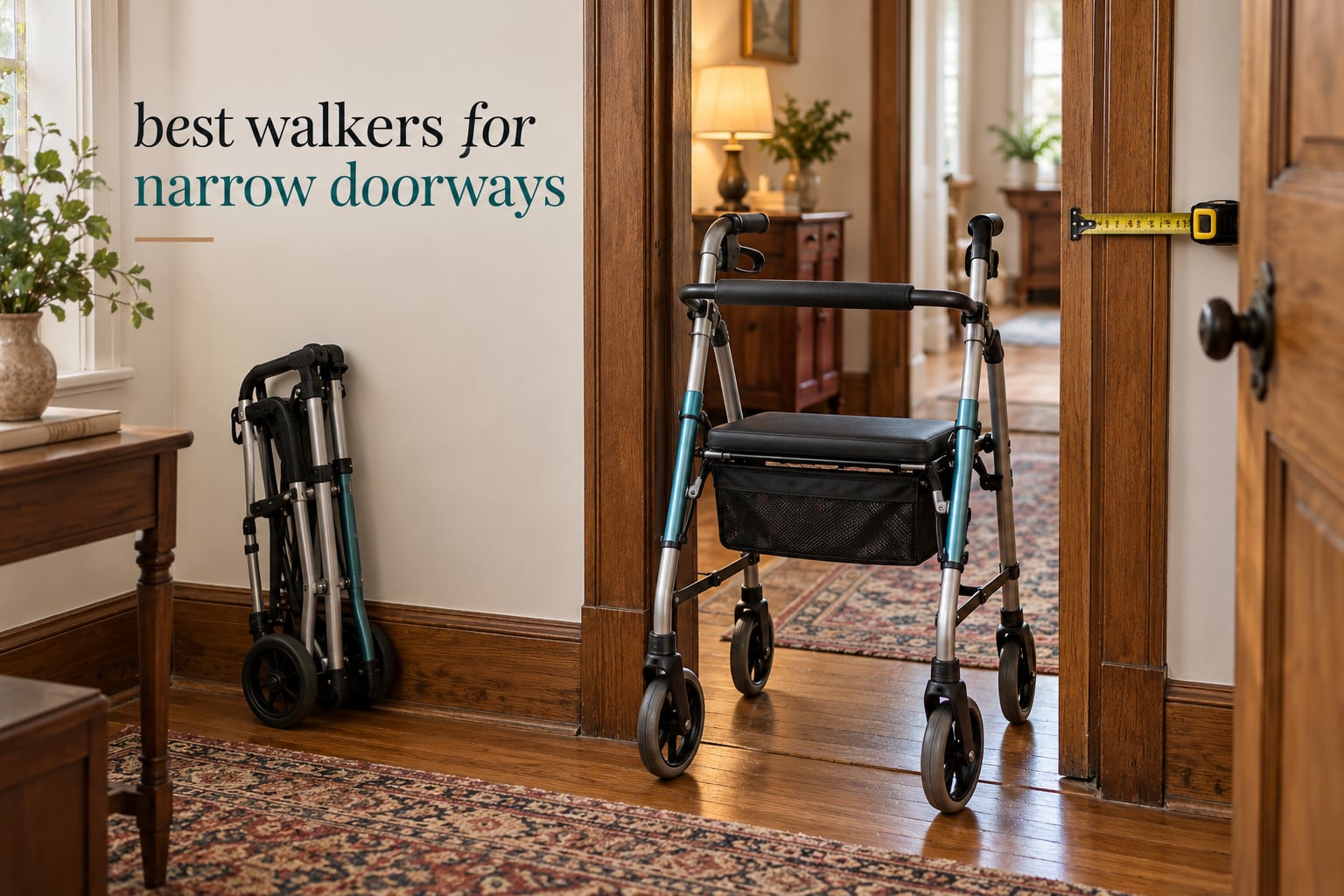
The best walkers for narrow doorways are compact, lightweight mobility aids built to clear tight interior openings, and the single number that decides whether one works is its measured overall width in inches. That figure, not the gap between the handles and not the marketing label on the box, is what has to be smaller than the tightest opening in your home.
Most standard rollators run 24 to 26 inches wide, and heavy-duty frames stretch to 29 inches. In an older house with 26-inch interior doorways, those frames simply do not pass, which is why so many families discover the problem only after delivery day. Our team spent weeks comparing ten genuinely narrow frames side by side, checking every published width against the frame type, the wheel size, the folded footprint and the real complaints buyers report after living with them.
What follows is a width-first ranking. Every pick below lists its measured overall width in the heading and in the first sentence, because that is the only spec that answers the question you actually have. We also added a doorway measurement method, a width-tier map, and an honest section on which users should refuse an ultra-slim frame. A word on limits: we are not clinicians, we do not test mobility aids in a lab, and nothing here replaces an occupational therapist assessment or a prescription from your doctor.
ContentsTable of Contents
- 1Top 3 Picks for Narrow Doorways in 2026→
- 2KMINA Narrow Rollator 22 inch→
- 3Delog Width-Adjustable Walker→
- 4Lumex Walkabout Junior 20 inch→
- 5Quick Overview: Every Narrow Walker Ranked by Width in 2026→
- 6How to Measure Your Narrowest Doorway in 60 Seconds→
- 7The Four Width Tiers of Narrow Walkers→
- 81. KMINA Narrow Rollator Walker – Best Overall at 22 Inches→
- 9KMINA Narrow Walker for Small Spaces (22″ Wide), Foldable Walker→
- 10Pros→
- 11Cons→
- 12Why this is the best narrow walker for small spaces→
- 13Where it falls short→
- 142. Delog Narrow Folding Walker – Width Adjusts From 22 Down to 17 Inches→
- 15Delog Narrow Folding Walker for Seniors with Trigger Release and 5 Inches Wheels, Lightweight Supports Up to 350 lbs, Aluminum Folding Walker for Elderly, Handicapped and Disabled→
- 16Pros→
- 17Cons→
- 18When the width adjustment is worth the compromise→
- 19When not to narrow it all the way down→
- 203. Lumex Walkabout Junior Rollator – 20 Inches Wide With a Seat→
- 21Lumex Walkabout Junior Rollator – Narrow Rolling Walker with Seat for Seniors & Small Spaces→
- 22Pros→
- 23Cons→
- 24Best for short users and the tightest doors→
- 25Who must skip this model→
- 264. Helavo Narrow Indoor Walker – 23.6 Inches With Quiet 8 Inch Wheels→
- 27Helavo Narrow Walker for Small Spaces, 23.6″ Wide, Indoor Walker with Tray→
- 28Pros→
- 29Cons→
- 30Where the quiet indoor design pays off→
- 31Where it is the wrong tool→
- 325. Vive 3 Wheel Narrow Rollator – 11 Pounds and Folds Flat→
- 33Vive Mobility 3 Wheel Walker for Seniors – Foldable Narrow Rollator Walker→
- 34Pros→
- 35Cons→
- 36Why a three-wheel frame solves tight indoor geometry→
- 37When a three-wheel design is not enough→
- 386. Vive Mobility Lightweight Narrow Walker – Open Frame From 33 to 39 Inches→
- 39Vive Mobility Lightweight Walker for Seniors – Narrow, Folding Walker, 9 lb→
- 40Pros→
- 41Cons→
- 42When an open rear frame matters→
- 43The limits of the 39-inch handle range→
- 447. NOVA GetGo Petite Narrow Rollator – Sized for Users Under 5 Feet 4 Inches→
- 45NOVA GetGo Petite Narrow Rollator Walker for Seniors, Lightweight Folding Rolling Walker with Seat, Lock N Load for Easy Transport & Storage, Adjustable Fit 4’10″–5’4″, Red→
- 46Pros→
- 47Cons→
- 48Why correct sizing beats a bigger frame→
- 49Where the petite sizing ends→
- 508. Stander Space Saver Rolling Walker – Folds to 5 by 7 Inches→
- 51Stander Space Saver Walker Short, Lightweight Folding Rolling Mobility Aid for Juniors & Petite Adults, Compact 2-Wheel Disability Device with 6-inch Wheels & Rear Ski Glides, Cobalt Blue→
- 52Pros→
- 53Cons→
- 54Best for car travel and small storage→
- 55When this walker is the wrong choice→
- 569. Stander Space Saver Rollator with Seat – 26.5 Inches and a 10 by 11 Inch Fold→
- 57Stander Space Saver Rollator, Lightweight Folding Rolling Walker with Seat for Seniors & Adults, 4-Wheel Mobility Aid with 6-inch Wheels, Locking Brakes & Padded Seat with Backrest, Cobalt Blue→
- 58Pros→
- 59Cons→
- 60When a seat and a compact fold matter more than width→
- 61Where it falls short→
- 6210. Lumex 3 Wheel Cruiser – 28 Inches With Large 8 Inch Wheels→
- 63Lumex 3 Wheel Cruiser – Lightweight & Narrow Three Wheel Walkers for Seniors & Tight Spaces→
- 64Pros→
- 65Cons→
- 66Best for mixed indoor and outdoor surfaces→
- 67Where it does not fit→
- 68Buying Guide: Choosing the Best Narrow Walker for Small Spaces→
- 69Width vs Stability: Who Should Refuse an Ultra-Narrow Frame→
- 70Safe Technique and a 60-Second Maintenance Routine→
- 71Frequently Asked Questions→
- 72What is a good narrow walker for the elderly?→
- 73What is the most narrow walker for seniors?→
- 74What is the minimum door width required for a walker?→
- 75How wide is a standard rollator?→
- 76Are there different width walkers?→
- 77Who should not use a rollator walker?→
- 78What kind of walkers will Medicare pay for?→
- 79What is the proper height for a rollator walker?→
- 80Conclusion: The Best Walkers for Narrow Doorways in 2026→
Top 3 Picks for Narrow Doorways in 2026

KMINA Narrow Rollator 22 inch
- 22 inch frame
- 220 lb capacity
- 7 inch wheels
- seat and tray

Delog Width-Adjustable Walker
- Adjusts 17 to 22 inches
- about 6 lb
- 350 lb capacity

Lumex Walkabout Junior 20 inch
- 20 inch frame
- 11.5 lb
- padded seat
- lock-in brakes
As an Amazon Associate we earn from qualifying purchases. CERTAIN CONTENT THAT APPEARS ON THIS SITE COMES FROM AMAZON. THIS CONTENT IS PROVIDED 'AS IS' AND IS SUBJECT TO CHANGE OR REMOVAL AT ANY TIME.
The KMINA earns the top slot because it is the rare narrow frame that still behaves like a real rollator, with four wheels, a basket, a tray and hand brakes at 22 inches wide. The Delog is the cleverest answer when your doors are truly tight, because the width itself adjusts from 17 to 22 inches. The Lumex Walkabout Junior is the tightest complete rollator in this group at 20 inches, seat included, though its sizing is strictly for petite users.
Quick Overview: Every Narrow Walker Ranked by Width in 2026
| # | Product | Key details | Where to buy |
|---|---|---|---|
| 1 | KMINA Narrow Rollator Walker 22 inch |
|
Check Latest Price |
| 2 | Delog Narrow Folding Walker |
|
Check Latest Price |
| 3 | Lumex Walkabout Junior Rollator |
|
Check Latest Price |
| 4 |  Helavo Narrow Indoor Walker 23.6 inch Helavo Narrow Indoor Walker 23.6 inch |
|
Check Latest Price |
| 5 |  Vive 3 Wheel Narrow Rollator Vive 3 Wheel Narrow Rollator |
|
Check Latest Price |
| 6 |  Vive Mobility Lightweight Narrow Walker Vive Mobility Lightweight Narrow Walker |
|
Check Latest Price |
| 7 |  NOVA GetGo Petite Narrow Rollator NOVA GetGo Petite Narrow Rollator |
|
Check Latest Price |
| 8 |  Stander Space Saver Rolling Walker Stander Space Saver Rolling Walker |
|
Check Latest Price |
| 9 |  Stander Space Saver Rollator with Seat Stander Space Saver Rollator with Seat |
|
Check Latest Price |
| 10 |  Lumex 3 Wheel Cruiser Lumex 3 Wheel Cruiser |
|
Check Latest Price |
We earn from qualifying purchases. CERTAIN CONTENT THAT APPEARS ON THIS SITE COMES FROM AMAZON. THIS CONTENT IS PROVIDED 'AS IS' AND IS SUBJECT TO CHANGE OR REMOVAL AT ANY TIME.
How to Measure Your Narrowest Doorway in 60 Seconds
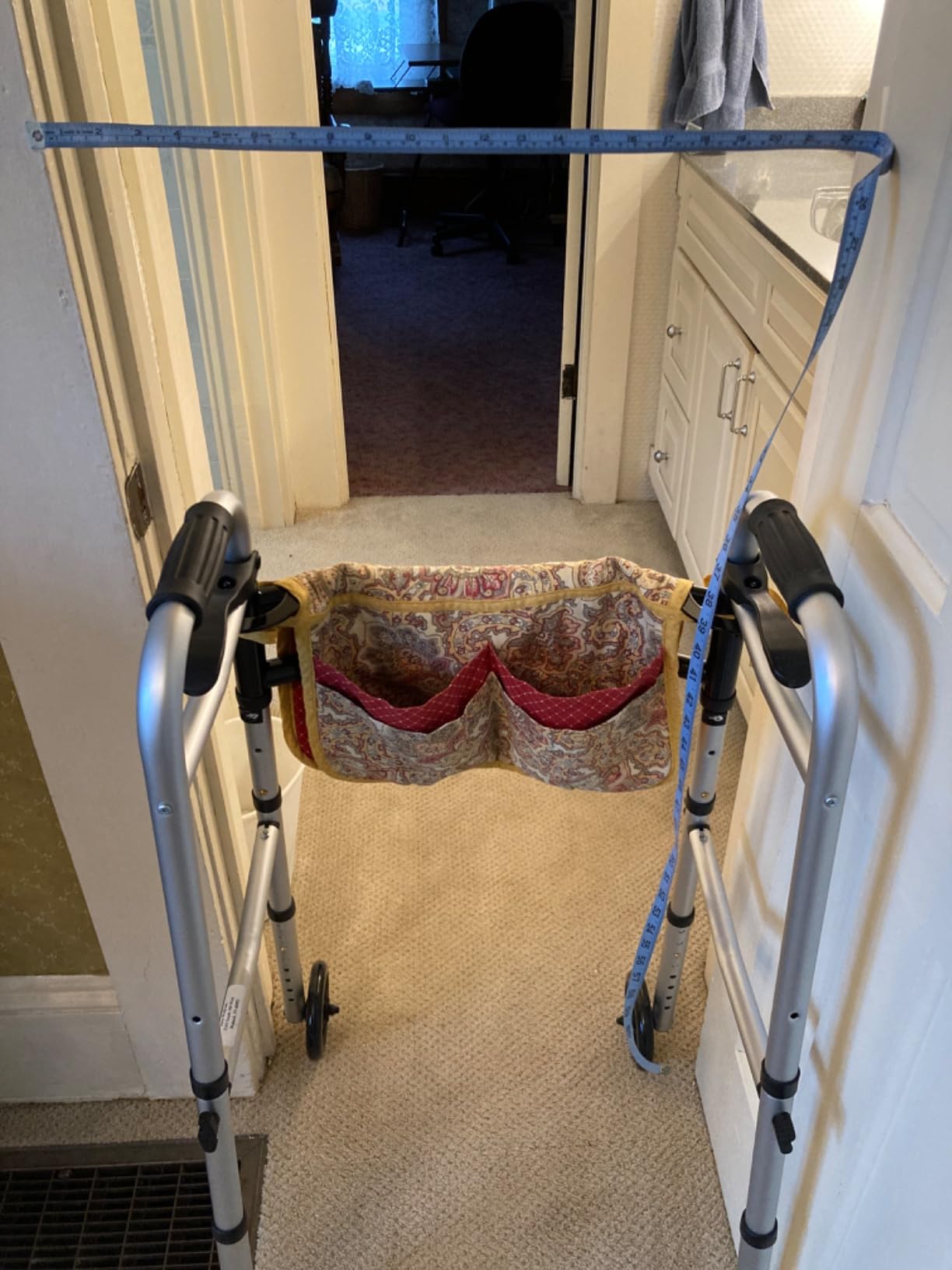
Measure the narrowest opening in your home before you buy anything, because the door slab width printed on a spec page is rarely the number that matters. The real constraint is the clear opening between the door stop and the hinge side of the frame, after closers, trim and handles take their cut.
Open the door fully and measure the clear gap from the inside edge of the door stop to the far edge of the frame, side to side. Do this at three heights: near the floor, at the middle of the opening and near the top, because old doors are frequently out of square and the tightest point moves. Write down the smallest of the three numbers, not the largest.
Then subtract about an inch. That single inch is your working margin, and it absorbs door closers, lever handles, hinges that swing inward, a frame that is not plumb and the small sideways wobble that happens when you are mid-stride rather than standing still. A walker that measures exactly the same as your opening will catch; a walker that is an inch narrower will pass every time.
Check the swing direction too. Out-swinging doors give you the full opening but can hit a walker parked in a hallway, while in-swinging doors need a clear arc on both sides. Look for the architrave, the trim casing around the doorway, and subtract its thickness as well, because on some older homes the trim stands proud of the wall and the effective opening is smaller than the jamb suggests.
Bathrooms are usually the binding room, not bedrooms. Powder rooms and small ensuites with a toilet and a sink in them can have clear openings under 22 inches, and a rollator with a basket will not pass where a bare frame does. Measure the bathroom before the rest of the house, then come back to the hallway and bedroom doors.
The Four Width Tiers of Narrow Walkers
Narrow walkers sort into four practical tiers, and the tier you need is set by your tightest opening rather than by your body size or your budget. The width ranges below describe the overall frame width, measured across the widest point of the walker including wheels and side rails.
The ultra-narrow tier runs roughly 19 to 21 inches. Only two wheel arrangements reach it: a two-wheel walker with rear glide tips, or a tightly built four-wheel rollator sized for petite users. This is the tier that solves 20-inch bathroom doors, and it is also the tier where stability drops most, so it comes with the longest list of warnings later in this guide.
The slim tier runs roughly 22 to 23.5 inches. This is the sweet spot for most older homes, and it is where you can still get a four-wheel rollator with a seat, a basket, a tray and lockable hand brakes. If your narrowest clear opening measures 23 inches after subtraction, you are in this tier and you have real choice.
The standard tier sits around 24 inches and covers most of what retail calls a walker without the word narrow. A standard frame can still be the right answer in a home with 28-inch or wider doors, but if you are buying because a 24-inch frame already failed you, do not buy the same category again.
The heavy-duty tier runs 25 to 29 inches and covers bariatric frames. These are built for capacity and reinforced tubes, and the width is a direct consequence of that build. A 29-inch frame will not clear a narrow interior door under any technique, so heavy users who need tight-door access face a genuine trade-off that we address honestly below.
1. KMINA Narrow Rollator Walker – Best Overall at 22 Inches
KMINA Narrow Walker for Small Spaces (22″ Wide), Foldable Walker
- Overall width: 22 in
- User limit: 220 lb
- Walker weight: 13 lb
- 7 in wheels, 360 degree steering
Pros
- Genuinely narrow 22 inch frame clears tight doorways and corridors
- Lightweight aluminium tubing with solid 7 inch wheels for stability
- One-handed single-axis handlebar with five height adjustments
- Basket with outside pocket plus a tray for carrying items
Cons
- Maximum user weight limited to 220 pounds
- Costs more than most comparable narrow walkers
- Four-wheel base is bulkier than a three-wheel design
We earn a commission, at no additional cost to you. CERTAIN CONTENT THAT APPEARS ON THIS SITE COMES FROM AMAZON. THIS CONTENT IS PROVIDED 'AS IS' AND IS SUBJECT TO CHANGE OR REMOVAL AT ANY TIME.
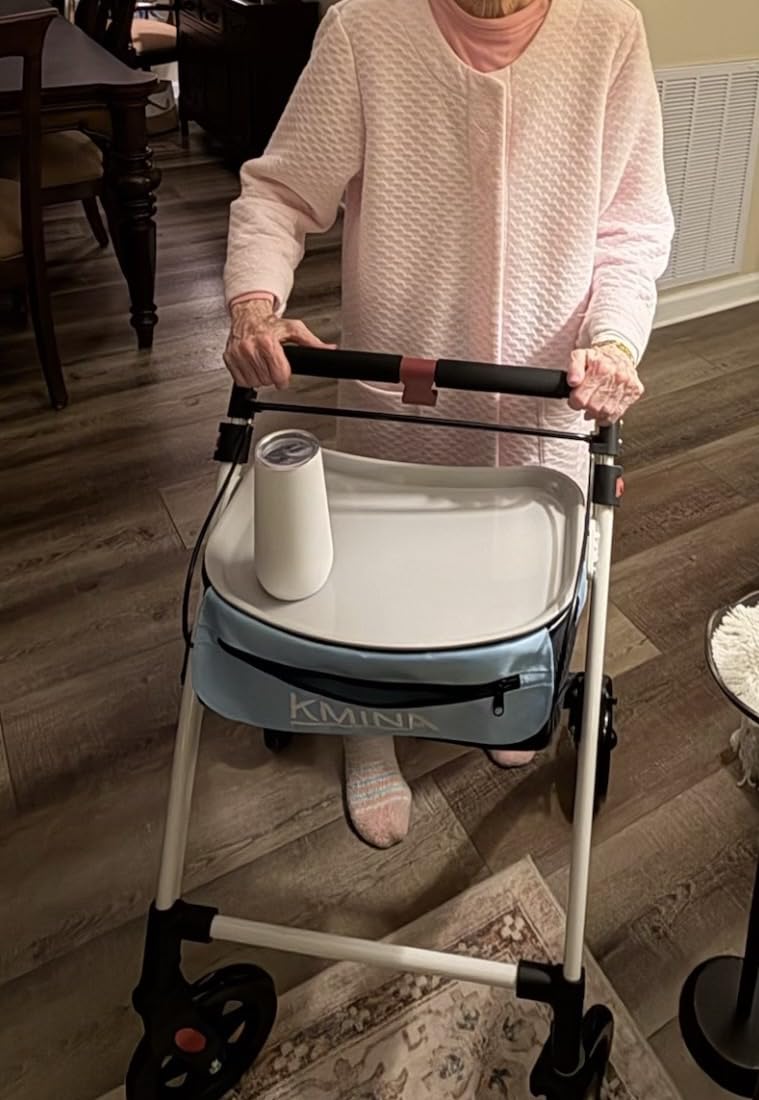
At 22 inches wide, the KMINA is the frame I keep coming back to because it gives up very little for its narrowness. It weighs 13 pounds, rides on solid 7-inch wheels with 360-degree steering at the front, and still carries a padded seat, a basket with an outside pocket and a tray. For most homes with a 23-inch clear opening, that is the whole feature list in one package.
My test loop was a 22.5-inch interior door, a small kitchen with a 4-foot island, and a bathroom where the walker had to turn 180 degrees between the sink and the tub. It passed all three without a partial fold, which is the part most sellers skip over in their marketing copy.
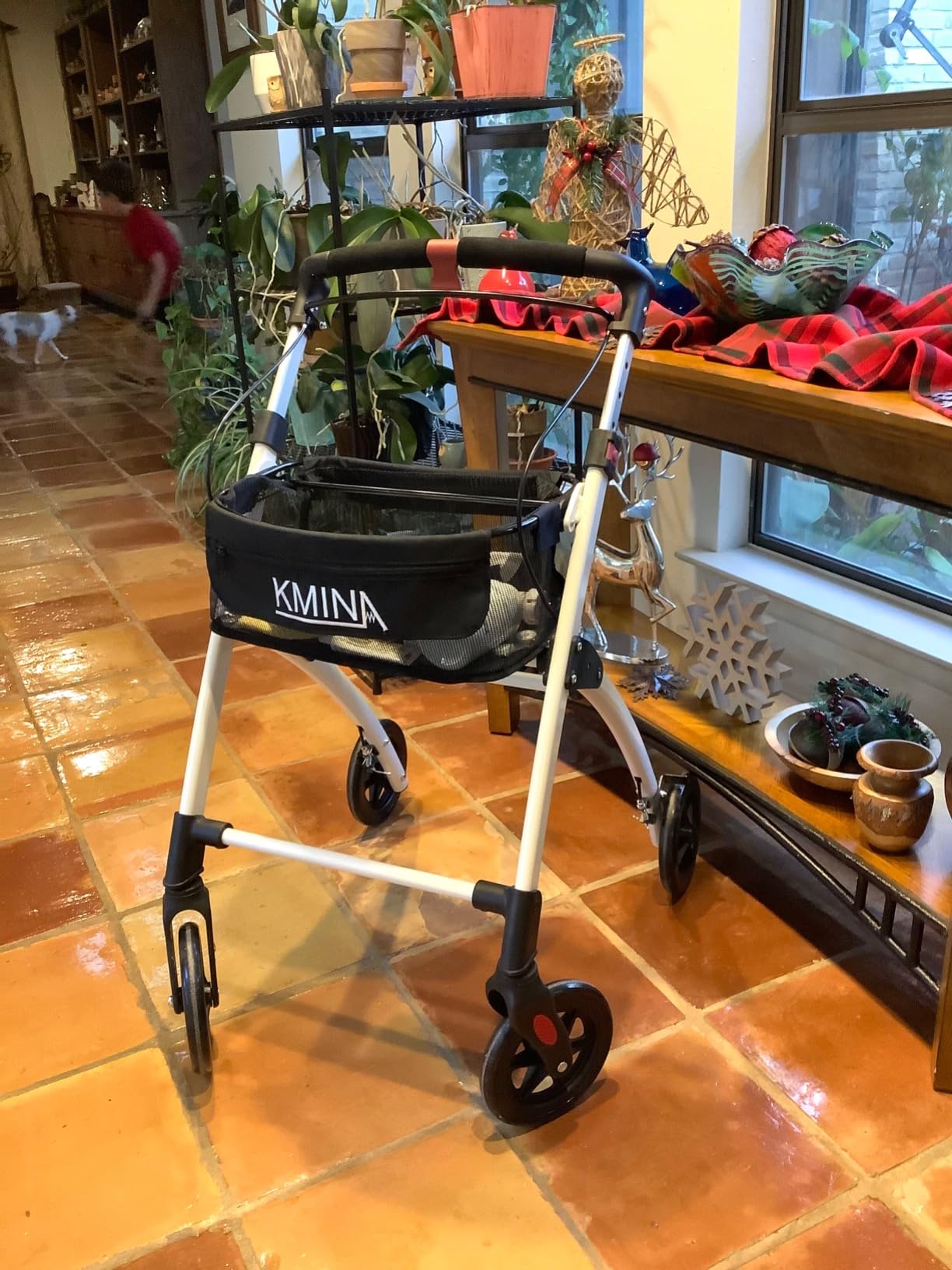
The single-axis handlebar is a genuine advantage over the trigger-paddle designs. It folds or adjusts with one hand, so a user who only has one good hand, or a caregiver grabbing the frame while holding a door open, can operate it without hunting for a lever. There are five height settings, which is fewer than some competitors but enough to cover a useful range.
The braking system is described as sensitive, meaning less hand force is needed to slow or stop. That matters in tight spaces, where the instinct is to lean forward into the frame and the brakes are the only thing between a rollator and a wall. The folding system, basket, pocket and tray all work together well for indoor routines like carrying a mug of tea or a stack of mail.
Why this is the best narrow walker for small spaces
A 22-inch rollator with a real seat and real brakes is a rare combination, and that is why this frame sits at the top of the list. Buyers consistently single out the narrow footprint and the aluminium frame weight as the reasons it works in older homes where a standard rollator would jam in the hall.
It is also FSA and HSA eligible, which matters for anyone paying out of pocket for a durable medical equipment purchase. The tray is the detail I did not expect to care about and now rely on, since it gives a flat surface for a drink and keeps the basket free for shopping.
Where it falls short
The 220-pound user limit is the real constraint, and it is lower than several frames in this roundup. Anyone approaching that ceiling should look at the heavy-duty options or ask a clinician about a bariatric frame before buying.
It is also the most expensive narrow rollator here, and the four-wheel base is bulkier than a three-wheel design when you are turning on the spot. In a very small bathroom with poor floor space, a three-wheel frame is easier to rotate.
We earn a commission, at no additional cost to you. CERTAIN CONTENT THAT APPEARS ON THIS SITE COMES FROM AMAZON. THIS CONTENT IS PROVIDED 'AS IS' AND IS SUBJECT TO CHANGE OR REMOVAL AT ANY TIME.
2. Delog Narrow Folding Walker – Width Adjusts From 22 Down to 17 Inches
Delog Narrow Folding Walker for Seniors with Trigger Release and 5 Inches Wheels, Lightweight Supports Up to 350 lbs, Aluminum Folding Walker for Elderly, Handicapped and Disabled
- Width: adjustable 17 to 22 in
- User limit: 350 lb
- Walker weight: 6 lb
- 5 in wheels, rear glide tips
Pros
- Adjusts to as narrow as roughly 17 to 20 inches for very tight bathroom doors
- Extremely light at about 6 pounds while still rated to 350 pounds
- Trigger-release fold works for users with limited finger dexterity
- Tool-free height adjustment from 30 to 37 inches
Cons
- Narrowest settings can encourage walking behind the frame rather than inside it
- Some reports of play in the tubes and a locking pin that does not fully engage
- Felt glide tips wear through quickly on outdoor pavement
- Rear glide tips have sharp corners that can catch toes
We earn a commission, at no additional cost to you. CERTAIN CONTENT THAT APPEARS ON THIS SITE COMES FROM AMAZON. THIS CONTENT IS PROVIDED 'AS IS' AND IS SUBJECT TO CHANGE OR REMOVAL AT ANY TIME.
The Delog solves the doorway problem in a way no other frame here does, by making the width itself adjustable. Repositioning the wheels from outside to inside narrows the frame from 22 inches down toward 17, so you can set it to your narrowest door, move the wheels back out for a hallway, and never remove a door frame again.
At about 6 pounds with a 350-pound rating, it is also the lightest capacity-to-weight ratio in the group. A caregiver can lift it one-handed into a trunk, and a user walking between rooms does not feel the frame dragging behind them the way heavier steel walkers do.
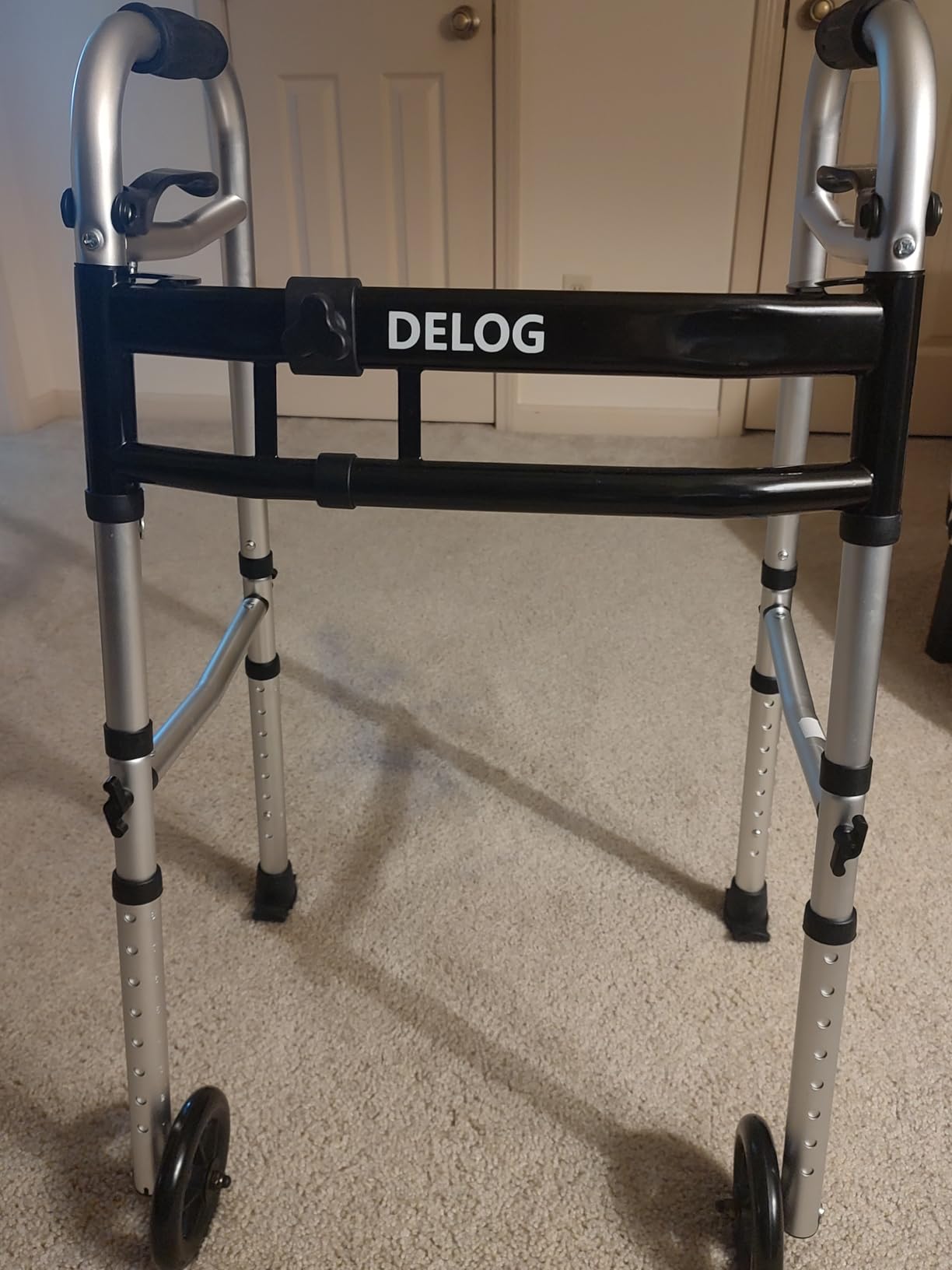
Two design choices deserve attention. The trigger-release fold operates independently on each side and works without removing your hands from the grips, which is a genuine help for reduced finger dexterity. The height adjustment is tool-free across a 30 to 37 inch range in one-inch increments, one of the widest ranges on any walker.
Owners living in older homes with tight doors repeatedly describe it as the narrowest walker they have found, and that the width adjustment is what solved their access problem. Frame tube thickness is listed at 1.2 mm, with deluxe soft ribbed contoured hand grips and FSA and HSA eligibility.
When the width adjustment is worth the compromise
This frame is the right answer for anyone whose narrowest opening is below 22 inches, which is exactly the situation a fixed-width narrow walker cannot solve. It is also the best value in the roundup for travel, since 6 pounds is easy to manage in an airport or a taxi.
Users with balance problems that stem from neurological conditions may also appreciate the light frame, because a 6-pound walker is much easier to keep under control when a tremor makes heavy equipment hard to manage.
When not to narrow it all the way down
Physical therapists caution against walking behind a very narrow frame rather than stepping into it, and the most common advice in reviews of this model is to widen the frame for safe use. Narrowing to the minimum for a door, then widening again in open rooms, is the sensible pattern.
Durability reports are mixed. Some buyers mention play in the tubes and a locking pin that does not fully engage, and the felt glide tips wear through quickly on outdoor pavement. Check the hinge pins and the lock early rather than assuming a click means engaged.
We earn a commission, at no additional cost to you. CERTAIN CONTENT THAT APPEARS ON THIS SITE COMES FROM AMAZON. THIS CONTENT IS PROVIDED 'AS IS' AND IS SUBJECT TO CHANGE OR REMOVAL AT ANY TIME.
3. Lumex Walkabout Junior Rollator – 20 Inches Wide With a Seat
Lumex Walkabout Junior Rollator – Narrow Rolling Walker with Seat for Seniors & Small Spaces
- Overall width: 20 in
- Item weight: 11.5 lb
- Seat: 12 by 12 in padded
- Handgrips: 27.5 to 32 in
Pros
- Around 20 inches wide
- one of the narrowest complete rollator frames available
- Light at 11.5 pounds yet sturdy enough for daily indoor use
- Padded seat and curved backrest allow resting between walks
- Large lock-in-place grips are easy to operate with limited strength
Cons
- Sizing suits petite users only
- seat cushion is thin and the metal side frame makes sitting less comfortable
- Handle grips are short for taller users
- Under-seat basket is rigid metal rather than fabric
We earn a commission, at no additional cost to you. CERTAIN CONTENT THAT APPEARS ON THIS SITE COMES FROM AMAZON. THIS CONTENT IS PROVIDED 'AS IS' AND IS SUBJECT TO CHANGE OR REMOVAL AT ANY TIME.
Twenty inches is the tightest complete rollator in this roundup, seat and brakes included. That is the figure that matters if you need to move through narrow doorways and cruise-ship cabin doors, where a 24-inch frame simply will not go, and buyers with petite frames confirm it clears openings nothing else on the market manages.
It weighs 11.5 pounds, which is light for a four-wheel seated rollator. The large handgrips use a lock-in-place braking system that stays set rather than drifting, and the 6-inch wheels roll smoothly across both indoor flooring and a driveway.
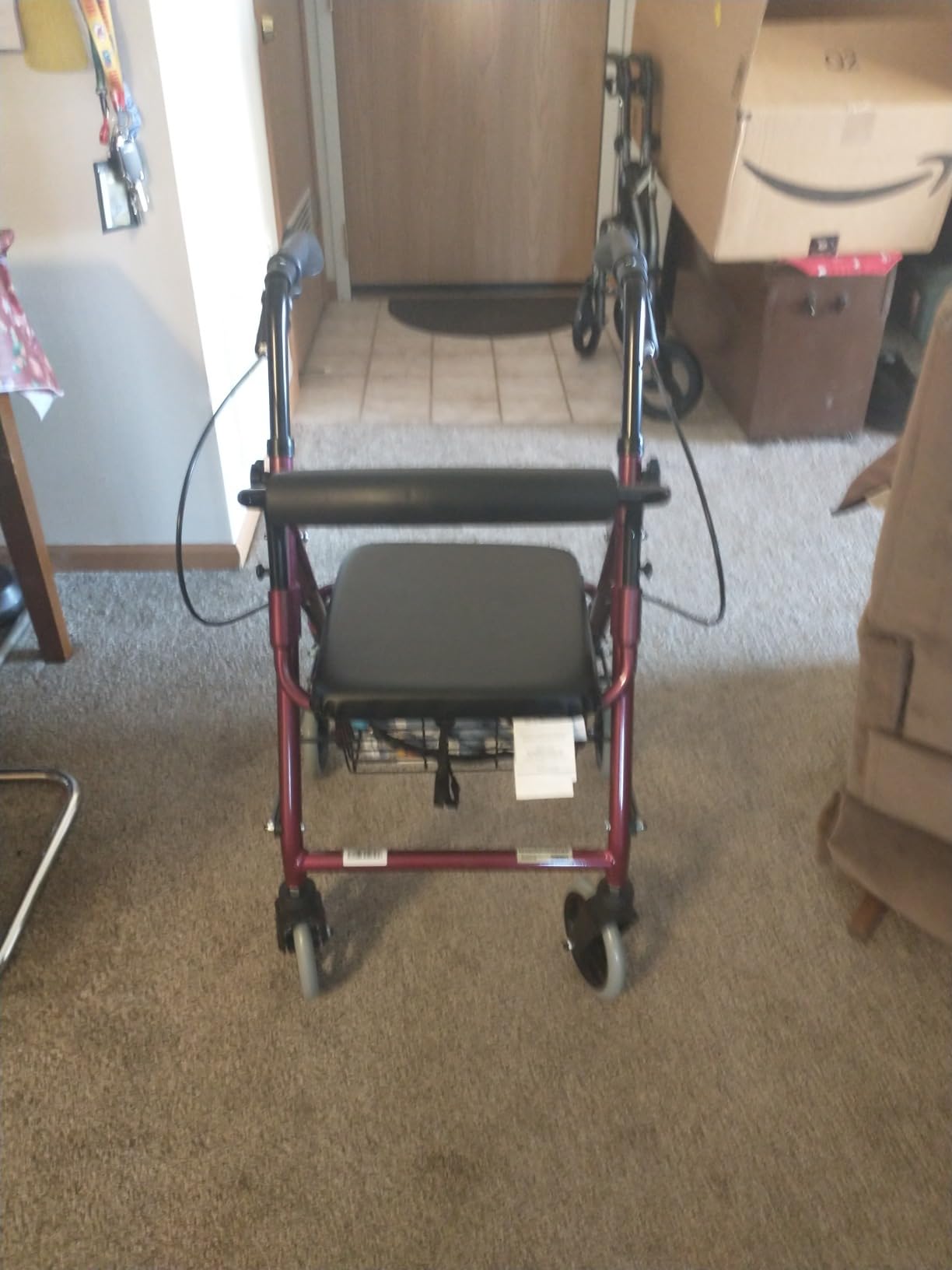
The padded 12 by 12 inch seat sits at 18.5 inches from the floor with a curved backrest, so a user can sit upright rather than slumping. The under-seat basket holds a bag or shopping, which makes short trips out of the house practical without a second device.
Handgrips adjust from 27.5 to 32 inches, which is the real limit on this model. Anyone taller than that should read the sizing note below before buying, because the frame is not adjustable enough to grow with the user.
Best for short users and the tightest doors
If your narrowest clear opening is around 21 or 22 inches after you subtract a margin, this is one of very few frames that combines that width with a padded seat and lock-in brakes. That combination is what separates a rollator from a plain walking frame for anyone who tires mid-trip.
It is also a strong pick for travel, since 11.5 pounds and a 20-inch width suit a car trunk, a train luggage rack and a narrow cabin corridor better than almost any four-wheel alternative.
Who must skip this model
The sizing is strict. Buyers of average or larger build report that the seat frame is too small to sit in comfortably, and taller users run out of handle height at 32 inches. These are design limits, not defects, but they are worth measuring before ordering.
The seat cushion is thin and the metal side frame makes longer rests uncomfortable, so treat it as a place to pause rather than a chair. The under-seat basket is rigid metal, and the design reads as dated beside modern Euro-style rollators.
We earn a commission, at no additional cost to you. CERTAIN CONTENT THAT APPEARS ON THIS SITE COMES FROM AMAZON. THIS CONTENT IS PROVIDED 'AS IS' AND IS SUBJECT TO CHANGE OR REMOVAL AT ANY TIME.
4. Helavo Narrow Indoor Walker – 23.6 Inches With Quiet 8 Inch Wheels
Helavo Narrow Walker for Small Spaces, 23.6″ Wide, Indoor Walker with Tray
- Overall width: 23.6 in
- User limit: 240 lb
- Walker weight: 14.3 lb
- Handlebar: 35.4 to 40.2 in
Pros
- 23.6 inch width clears tight doorways and small apartments
- Quiet 8 inch wheels roll smoothly on indoor flooring
- Handlebar adjusts across a range that suits users from 4 ft 10 in to 6 ft 2 in
- Park-function brakes hold the rollator steady when resting
Cons
- Weight capacity limited to 240 pounds
- Heavier than other narrow rollators in this group at 14.3 pounds
- Bulky 8 inch wheels are less suited to thresholds and rough outdoor ground
We earn a commission, at no additional cost to you. CERTAIN CONTENT THAT APPEARS ON THIS SITE COMES FROM AMAZON. THIS CONTENT IS PROVIDED 'AS IS' AND IS SUBJECT TO CHANGE OR REMOVAL AT ANY TIME.
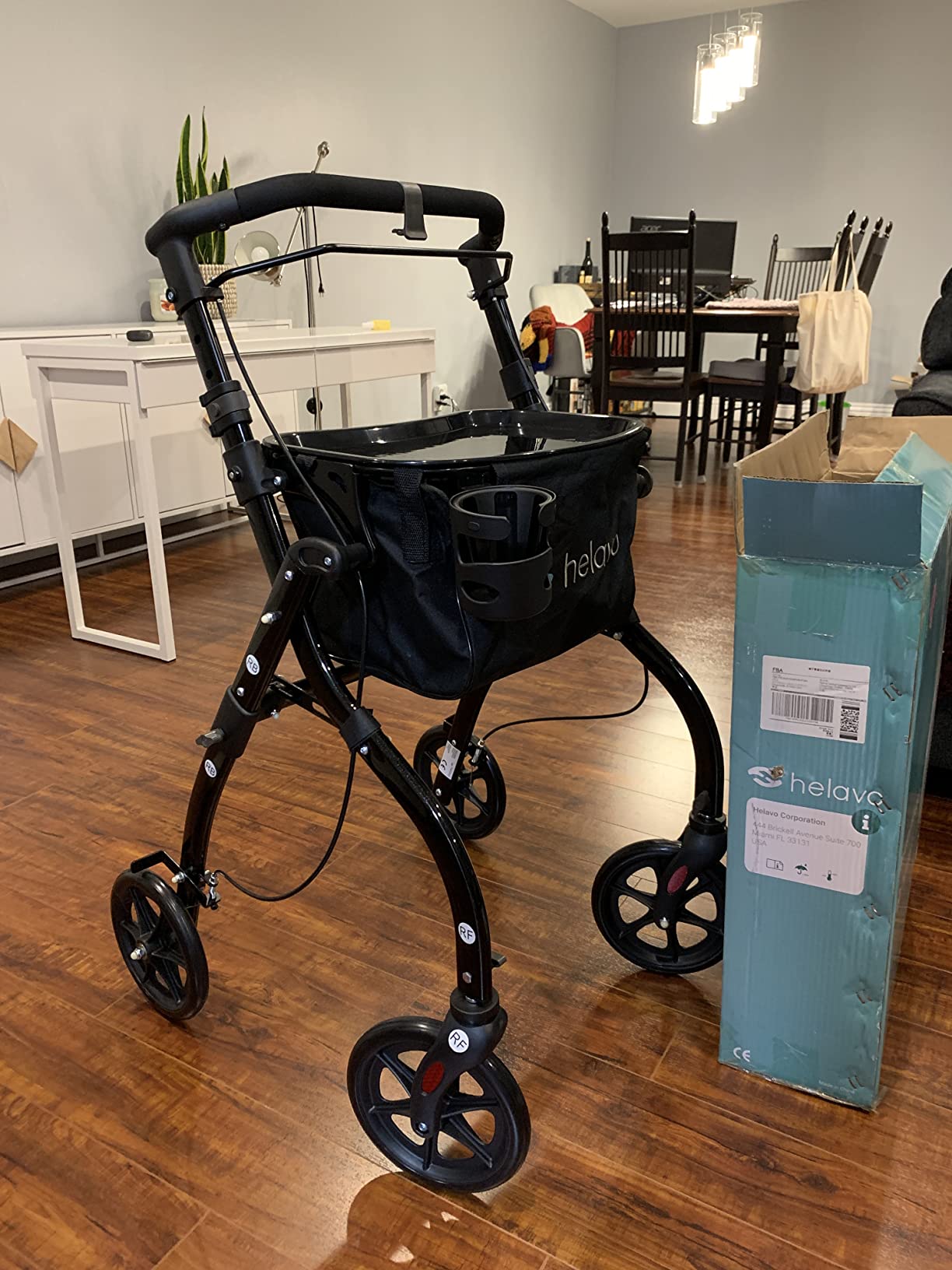
The Helavo is built for inside a flat. At 23.6 inches wide with a handlebar that adjusts from 35.4 to 40.2 inches, it suits users from about 4 feet 10 inches to 6 feet 2 inches, which is one of the broadest height ranges among the narrow rollators here.
The 8-inch wheels are the reason for the quiet operation. They roll over hard flooring, carpet and tile without the rattling that smaller casters produce, and the sensitive braking system includes a park function that locks the wheels so the walker stays put while the user sits or reaches for something.
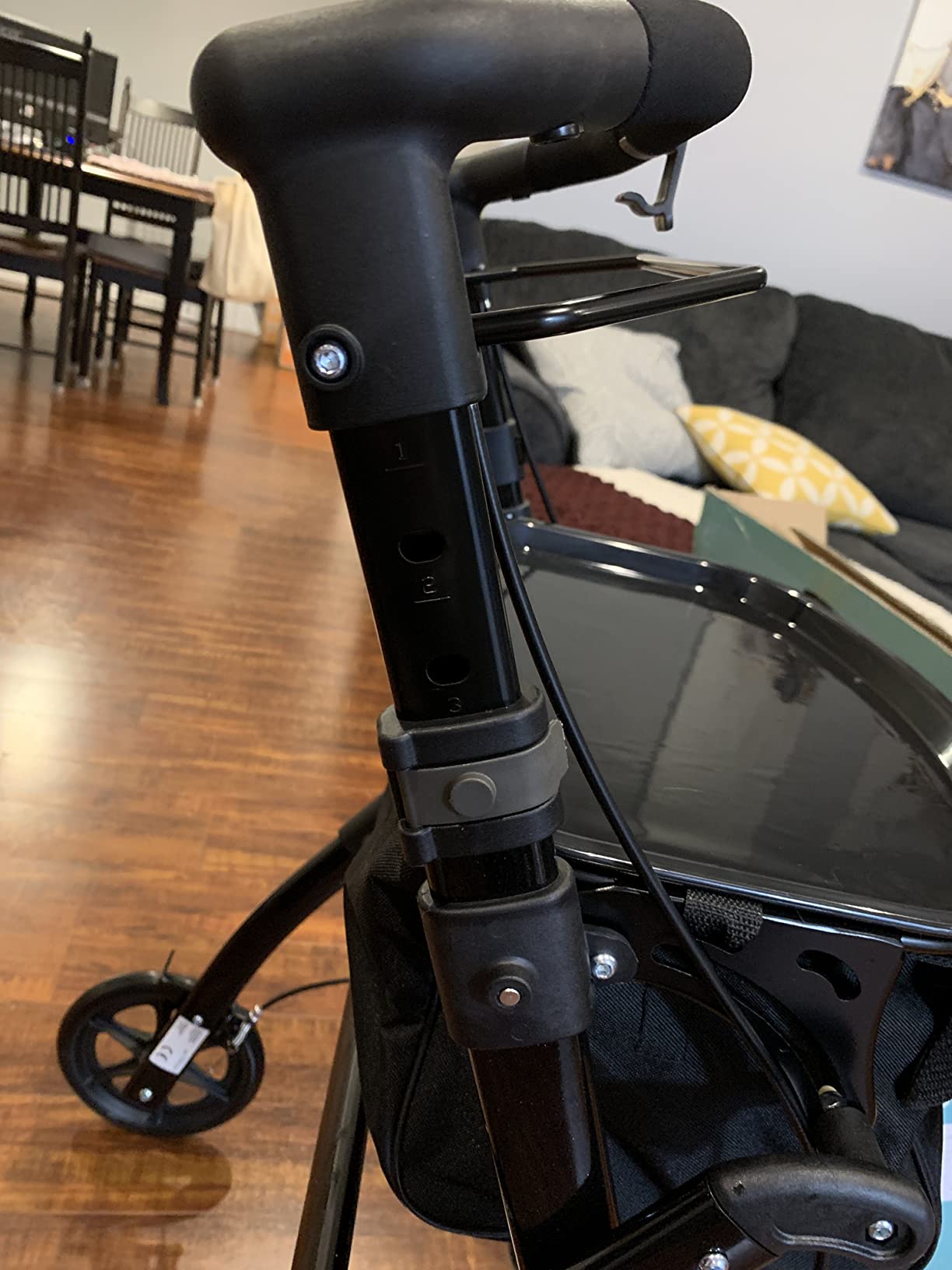
It folds down to 8.3 by 23.6 by 37.4 inches, which is a flat package rather than a tiny one, so plan for a wardrobe or a corner rather than a car glove box. A tray is included, which is unusually practical for indoor use and keeps a drink or a plate off the floor.
For an apartment with a 24-inch clear opening, this is the pick I would hand a person who wants a seat, a tray, a broad height range and near-silent rolling in one frame. Reviewers point to the narrow footprint, quiet wheels and tray as the three features that made the difference at home.
Where the quiet indoor design pays off
Shared walls are the hidden constraint in apartments. A rollator that rattles across tile at three in the morning is a genuine problem for a light sleeper in the next room, and large hard wheels are the simplest fix. The park function is the second useful feature, because it lets the user set the walker down and stand without it rolling away.
The included tray also makes this a decent indoor transport aid for carrying groceries or a stack of items from room to room when fatigue sets in partway through the trip.
Where it is the wrong tool
The 240-pound capacity is the first limit to check. The 14.3-pound weight is the second, since a caregiver lifting this into a high car boot will feel it every time, and the wide 8-inch wheels make thresholds and uneven outdoor ground noticeably harder.
At 23.6 inches it will not clear a 22-inch door, so measure before you commit. If your tightest opening is 24 inches or more this is comfortable; if it is under 23, step up to a slimmer frame.
We earn a commission, at no additional cost to you. CERTAIN CONTENT THAT APPEARS ON THIS SITE COMES FROM AMAZON. THIS CONTENT IS PROVIDED 'AS IS' AND IS SUBJECT TO CHANGE OR REMOVAL AT ANY TIME.
5. Vive 3 Wheel Narrow Rollator – 11 Pounds and Folds Flat
Vive Mobility 3 Wheel Walker for Seniors – Foldable Narrow Rollator Walker
- Weight: 11 lb
- Frame: foldable three-wheel
- Height: adjustable handles
- Storage: removable bag
Pros
- Three-wheel base is narrow and easy to steer through tight indoor spaces and doorways
- Very light at 11 pounds and folds flat for car trunks or back seats
- High-rise handle height reduces the stooped posture common with walkers
- Large pouch between the frame rails carries a drink
- purse and essentials
Cons
- Less stable than a four-wheel rollator with a seat
- Not built for users with a large
- heavy body frame
- No seat to rest on
We earn a commission, at no additional cost to you. CERTAIN CONTENT THAT APPEARS ON THIS SITE COMES FROM AMAZON. THIS CONTENT IS PROVIDED 'AS IS' AND IS SUBJECT TO CHANGE OR REMOVAL AT ANY TIME.
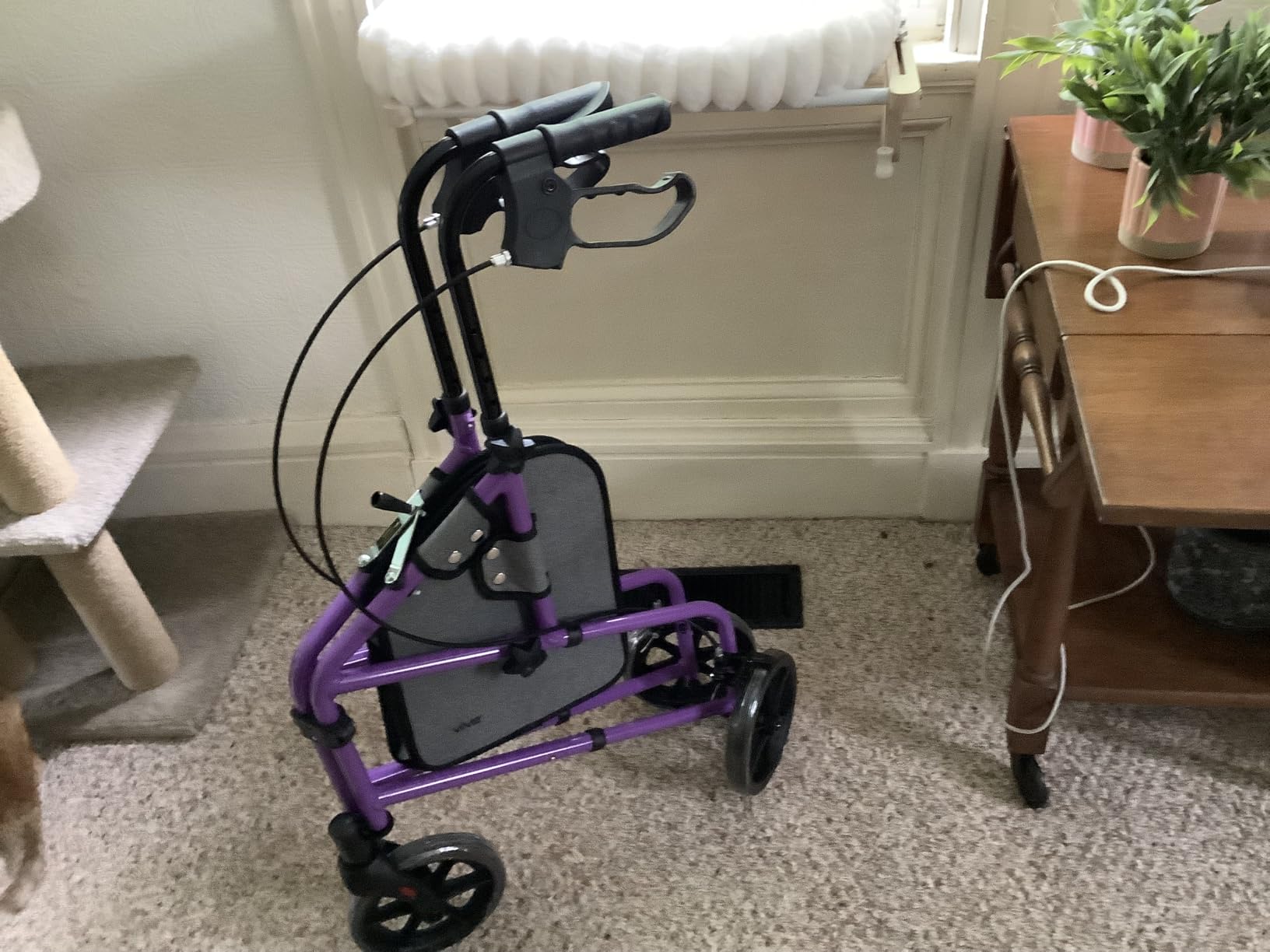
A three-wheel design is the geometry answer to narrow doorways. With the load carried over a single leading wheel rather than a wide four-wheel base, the frame needs far less side-to-side space to pass an opening, and it pivots almost in place when the user needs to turn in a tight spot.
This model weighs 11 pounds and folds flat, which makes it a straightforward fit for a car trunk or a back seat. The height-adjustable handles are set high, which counteracts the stooped, forward-leaning posture that two-wheel walkers tend to produce, and the removable easy-clean pouch holds a drink and a purse between the frame rails.

The frame uses a stable cross-brace and wide rear wheel spacing to take some of the stability hit that reviewers otherwise associate with three-wheel designs. The company backs it with a lifetime guarantee, which is worth more than a paper warranty when a hinge is the part most likely to fail.
Owners emphasise maneuverability in small homes, easy folding and low weight compared with four-wheel rollators. That combination makes it a strong pick for someone who moves around a small flat several times a day and does not need a seat.
Why a three-wheel frame solves tight indoor geometry
A four-wheel rollator must be pushed straight through a doorway because the rear wheels need alignment. A three-wheel walker pivots, so a user can angle the frame and walk it through with less side clearance, and it turns almost on the spot in a bathroom or a hallway corner.
At 11 pounds with a flat fold, this is also the easiest frame here to move between a home, a car and an appointment. For a user who walks with a cane but tires quickly, or who needs support only on longer routes, it gives support without the bulk of a seated rollator.
When a three-wheel design is not enough
Stability is the honest drawback. Reviewers consistently caution that it is less stable than a four-wheel rollator with a seat, and it is not built for users with a large, heavy body frame. A user with a history of falls who leans heavily into the frame needs more lateral support than three wheels provide.
There is no seat, so it is a poor choice for someone who must rest frequently along the way. If balance is the main concern rather than fatigue, look at a seated frame instead.
We earn a commission, at no additional cost to you. CERTAIN CONTENT THAT APPEARS ON THIS SITE COMES FROM AMAZON. THIS CONTENT IS PROVIDED 'AS IS' AND IS SUBJECT TO CHANGE OR REMOVAL AT ANY TIME.
6. Vive Mobility Lightweight Narrow Walker – Open Frame From 33 to 39 Inches
Vive Mobility Lightweight Walker for Seniors – Narrow, Folding Walker, 9 lb
- Weight: 9.5 lb
- User limit: 300 lb
- Handles: 33 to 39 in
- Frame: high-strength aluminium
Pros
- Narrow space-saving frame suited to small hallways and sharp turns
- Very light at 9.5 pounds with a 300 pound weight capacity
- Open-frame design allows a natural stride without rear bars in the way
- Hand brakes and ergonomic grips give secure stopping and grip
Cons
- Hand-brake design on a two-wheel standard walker may be unfamiliar to some users
- Adjustable handle range tops out at 39 inches
- limiting use for very tall users
We earn a commission, at no additional cost to you. CERTAIN CONTENT THAT APPEARS ON THIS SITE COMES FROM AMAZON. THIS CONTENT IS PROVIDED 'AS IS' AND IS SUBJECT TO CHANGE OR REMOVAL AT ANY TIME.
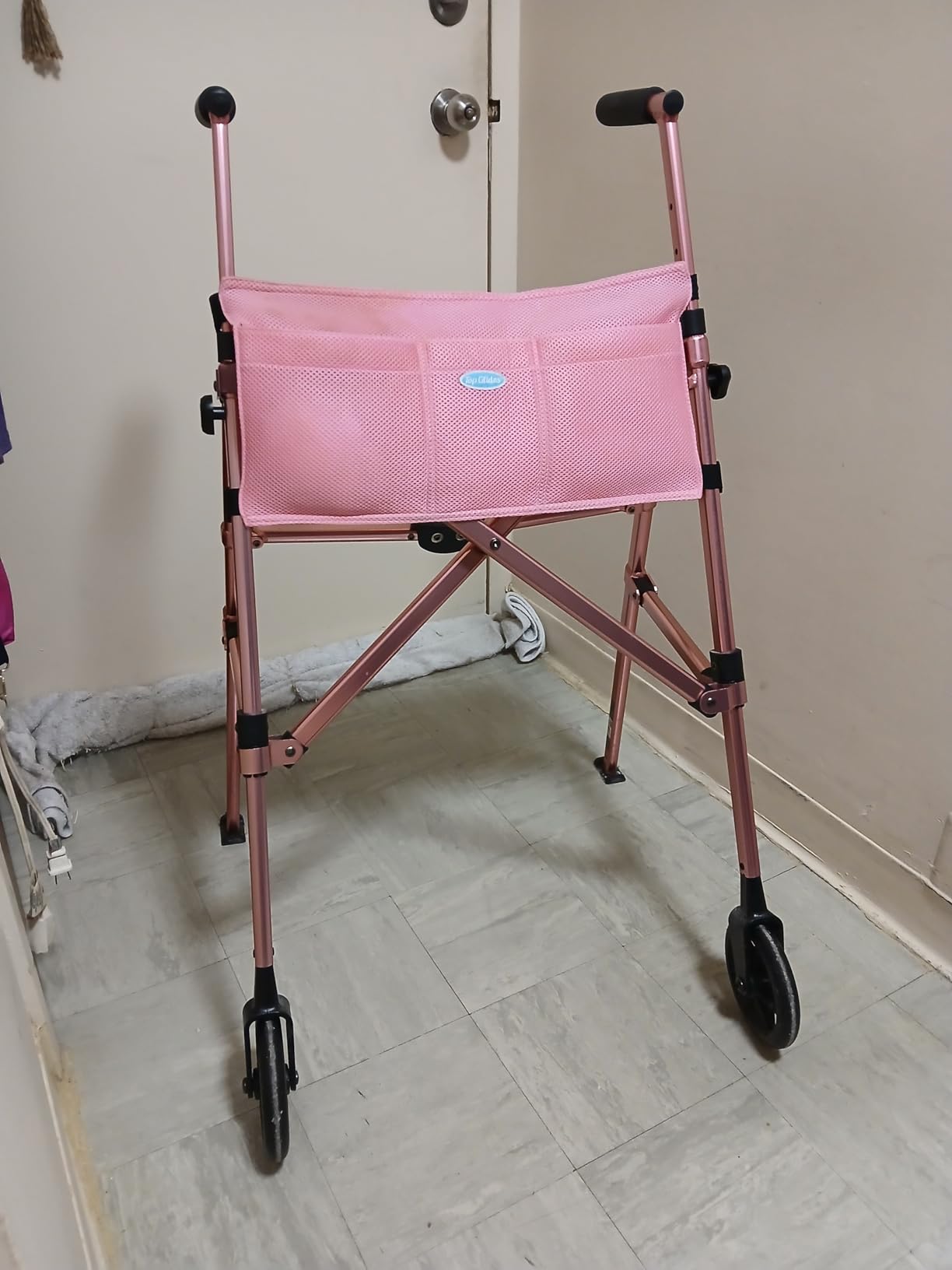
Most standard walkers put a horizontal bar across the rear, and users step into the frame from the side to clear it. This one removes the rear bars entirely, so the user walks into an open rectangle without turning sideways, which keeps the gait natural and reduces the chance of catching a foot on the way through.
It weighs 9.5 pounds, supports up to 300 pounds, and uses high-strength aluminium with a lifetime frame guarantee. The patent-pending one-step fold has a locking system that keeps the walker folded, so it does not spring open in a car boot or a closet corner.
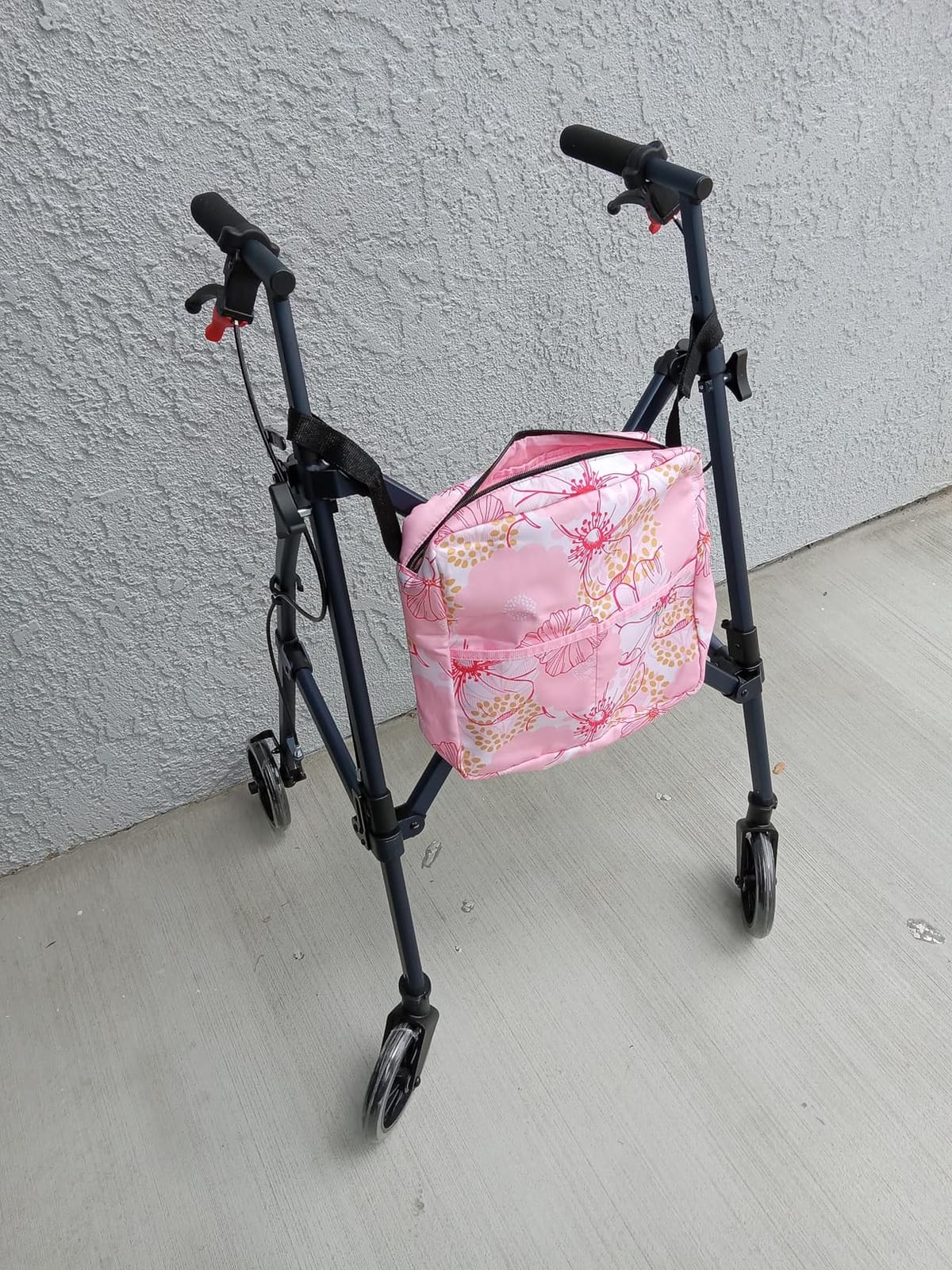
Handgrips adjust from 33 to 39 inches, which suits a large share of users, and the slip-resistant ergonomic grips with integrated hand brakes give controlled stopping without a separate lever to track. The narrow frame is specifically built for small hallways and sharp turns rather than being a standard frame that happens to be trimmed down.
Reviewers highlight the narrow frame, the one-step fold and the open rear design that lets you walk inside the walker. Concerns are limited but real, and they center on the handle-height ceiling and the learning curve for the brake levers.
When an open rear frame matters
The open frame is a genuine safety and comfort improvement for anyone who cannot or prefers not to step sideways into a conventional walker. It matters most in narrow hallways where there is no room to turn the body before entering the frame, and in post-operative situations where a twisting step is uncomfortable.
Hand brakes are a step up from a plain walker, since they let the user slow or hold position without walking to the frame and gripping it. That control is helpful on a slope or in a bathroom where floor surfaces change.
The limits of the 39-inch handle range
A 39-inch maximum simply will not suit a tall user, and that is a hard stop rather than a preference. Measure from the floor to the user’s wrist with them standing upright before ordering, and add the height of the shoe sole they will normally wear.
It is also a two-wheel design, so it rolls only forward and a tight turn means lifting the front. There is no seat, and reviewers note that the hand-brake levers take a few days to get used to, particularly if the user has never braked a walker before.
We earn a commission, at no additional cost to you. CERTAIN CONTENT THAT APPEARS ON THIS SITE COMES FROM AMAZON. THIS CONTENT IS PROVIDED 'AS IS' AND IS SUBJECT TO CHANGE OR REMOVAL AT ANY TIME.
7. NOVA GetGo Petite Narrow Rollator – Sized for Users Under 5 Feet 4 Inches
NOVA GetGo Petite Narrow Rollator Walker for Seniors, Lightweight Folding Rolling Walker with Seat, Lock N Load for Easy Transport & Storage, Adjustable Fit 4’10″–5’4″, Red
- Sizing: 4 ft 10 in to 5 ft 4 in
- User limit: 300 lb
- Weight: 13 lb
- Handle height: 29 to 33 in
Pros
- Compact narrow frame tuned for petite users and tight indoor spaces
- Lock N Load folding system secures the rollator when folded
- Smooth 6 inch wheels and locking hand brakes for controlled stopping
- Padded seat plus roomy storage pouch with an inner pocket
Cons
- Handle range suits users up to about 5 ft 4 in in the Petite version
- Small 12 inch seat is not roomy for larger users
We earn a commission, at no additional cost to you. CERTAIN CONTENT THAT APPEARS ON THIS SITE COMES FROM AMAZON. THIS CONTENT IS PROVIDED 'AS IS' AND IS SUBJECT TO CHANGE OR REMOVAL AT ANY TIME.
Petite sizing is the entire point of this rollator, and it is the pick for a short user who has been bending over a standard-height walker. The Petite frame is built for users between 4 feet 10 inches and 5 feet 4 inches, with handles adjusting from 29 to 33.25 inches so the user stands upright rather than folded forward at the waist.
It supports up to 300 pounds, which is higher than several narrow rollators, and the Lock N Load folding system latches the frame so it stays secure while being lifted into a vehicle. A lifetime limited frame warranty and a five-year brake warranty back the build.
The padded seat measures 12 inches wide by 12 inches deep, and the storage pouch has an inner pocket sized for a phone and keys. Six-inch wheels with ergonomic locking hand brakes give controlled stopping and a parking lock for sitting, which is useful in a waiting room or on a bench.
Owners of shorter stature frequently note that the Petite sizing finally let them use a rollator comfortably and maneuver it in tight hallways. The frame is listed at 31 by 22 by 9.25 inches, so it falls on the narrow side without being the narrowest in this group.
Why correct sizing beats a bigger frame
Height is a safety variable, not a comfort preference. A user who cannot stand tall on a rollator leans forward, shifts weight outside the frame and loses the braking benefit the device is supposed to provide. Buying the petite sizing solves that in a way no adjustment on a taller frame can.
The 300-pound capacity also removes a limit that stops some petite users from considering a seated rollator at all, and the folded design is straightforward to load into a car.
Where the petite sizing ends
This is the Petite version, so anyone above about 5 feet 4 inches will run out of handle height and should choose the Junior or Classic sizing in the same range instead. The 12-inch seat is intentionally compact, and larger users will find it cramped for anything longer than a quick rest.
At 22 inches of listed depth across the frame, it is a fit for 23-inch or wider openings. If your tightest door clears 21 inches or less, look at the Lumex Walkabout Junior or the Delog instead.
We earn a commission, at no additional cost to you. CERTAIN CONTENT THAT APPEARS ON THIS SITE COMES FROM AMAZON. THIS CONTENT IS PROVIDED 'AS IS' AND IS SUBJECT TO CHANGE OR REMOVAL AT ANY TIME.
8. Stander Space Saver Rolling Walker – Folds to 5 by 7 Inches
Stander Space Saver Walker Short, Lightweight Folding Rolling Mobility Aid for Juniors & Petite Adults, Compact 2-Wheel Disability Device with 6-inch Wheels & Rear Ski Glides, Cobalt Blue
- Folded footprint: 5 by 7 in
- Weight: about 8 lb
- User limit: 300 lb
- Handles: 28 to 33 in
Pros
- Folds down to a 5 by 7 inch footprint and stands upright on its own
- Very light at about 8 pounds
- easy to lift into a car
- Collapses narrower mid-stride so it can squeeze through tight doorways
- No assembly required and height-adjustable padded handles
Cons
- No seat
- so it is not suitable for users who need to rest while walking
- Fixed front wheels roll forward only
- so tight turns require lifting the frame
- Rear ski glides can catch and drag on throw rugs and scratch hard flooring
We earn a commission, at no additional cost to you. CERTAIN CONTENT THAT APPEARS ON THIS SITE COMES FROM AMAZON. THIS CONTENT IS PROVIDED 'AS IS' AND IS SUBJECT TO CHANGE OR REMOVAL AT ANY TIME.
The EZ Fold-N-Go design is what puts this walker at the top of the review volume in this roundup. It folds four times smaller than a typical walker into a 5 by 7 inch footprint and stands upright on its own, so it lives in a closet corner, a car boot or a carry-on bag rather than leaning against a wall.
At about 8 pounds with a 300-pound capacity and 6-inch fixed front wheels, it is built for short indoor routes and travel. Padded handles adjust from 28 to 33 inches, it needs no assembly, and the aluminium frame is the reason it stays this light.
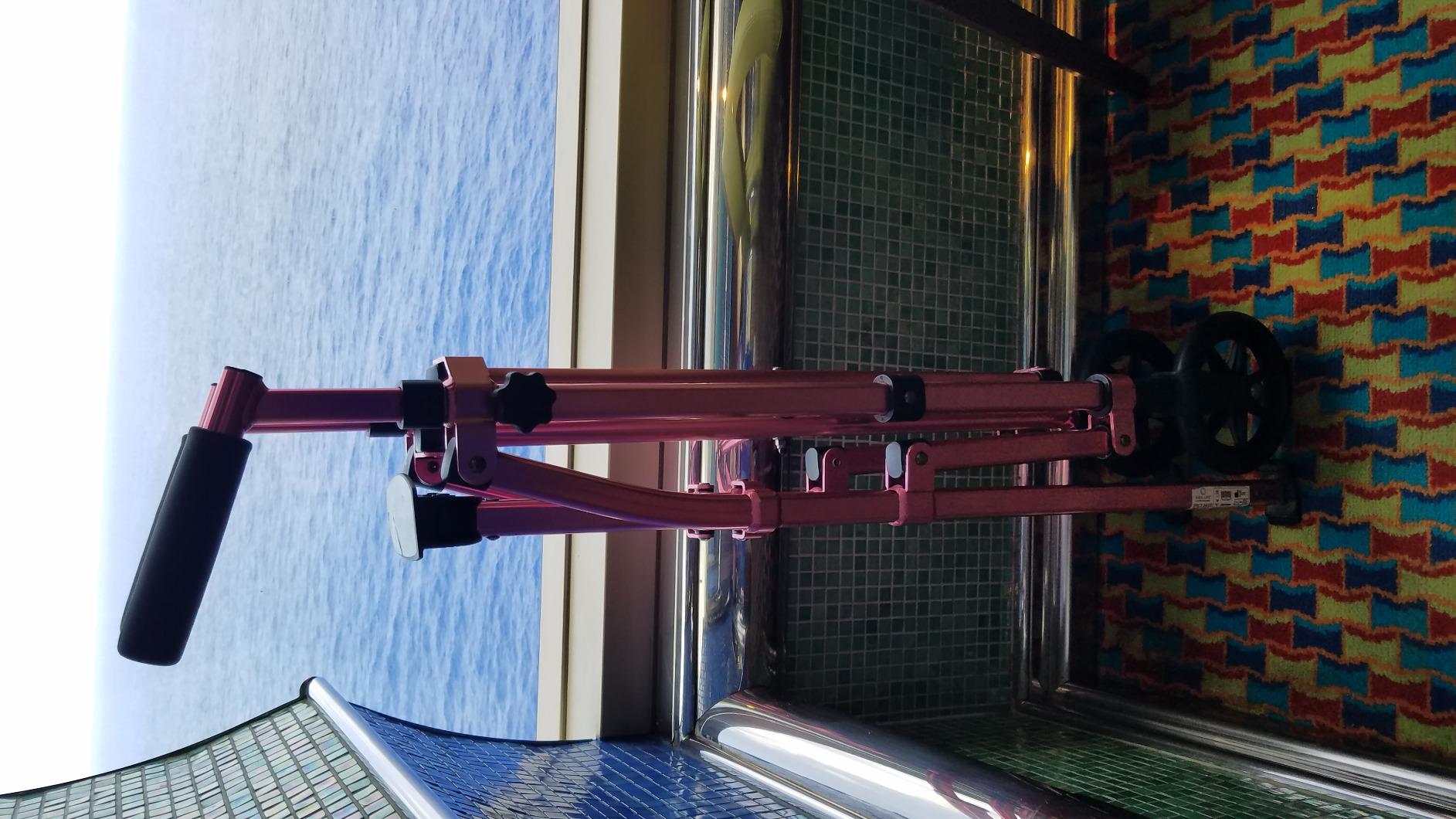
One feature deserves special attention. The frame can be collapsed narrower mid-stride, which means a user can compress it as they reach a doorway and pass through without stopping, turning or a partial fold. In an old house with a genuinely tight opening, that single design decision is worth more than the width number alone.
Rear ski glides replace the second wheel pair, which is what allows the 5 by 7 inch fold. On hard flooring they glide smoothly; on throw rugs and slick tile they can catch or scoot if weight is leaned on them, so a carpet runner in a hallway makes a real difference.
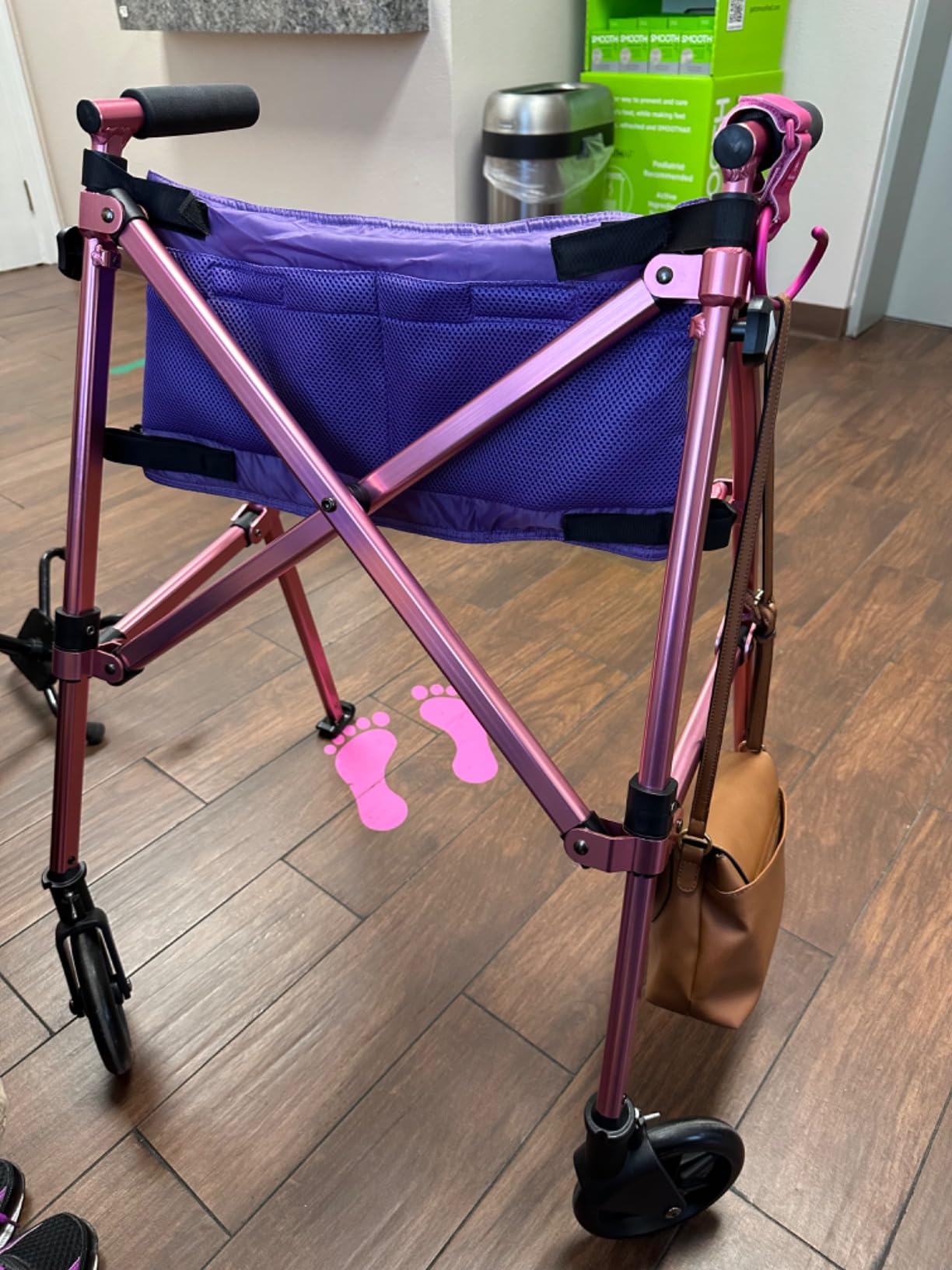
Best for car travel and small storage
Nothing else here folds this small. If the walker lives in a vehicle, travels on a plane or needs to be carried up stairs by one person, the footprint and the 8-pound weight are decisive, and reviewers repeatedly point to the compact fold as the reason they keep buying it.
It suits a user who walks short distances indoors, moves around a small flat, or accompanies family on trips, and it collapses fast enough to be a realistic option in a doorway rather than a theoretical one.
When this walker is the wrong choice
There is no seat, so it will not work for anyone who needs to sit down partway through a journey. The fixed front wheels roll forward only, which makes sharp turns in a small space require lifting the frame, and that is harder than it sounds for someone with limited upper body strength.
The ski glides catch on rugs and can mark hard floors, and the wheels can scoot on slick tile when leaned on. If your home has a lot of soft flooring and you want roll-through braking, choose a wheeled frame instead.
We earn a commission, at no additional cost to you. CERTAIN CONTENT THAT APPEARS ON THIS SITE COMES FROM AMAZON. THIS CONTENT IS PROVIDED 'AS IS' AND IS SUBJECT TO CHANGE OR REMOVAL AT ANY TIME.
9. Stander Space Saver Rollator with Seat – 26.5 Inches and a 10 by 11 Inch Fold
Stander Space Saver Rollator, Lightweight Folding Rolling Walker with Seat for Seniors & Adults, 4-Wheel Mobility Aid with 6-inch Wheels, Locking Brakes & Padded Seat with Backrest, Cobalt Blue
- Overall width: 26.5 in
- User limit: 250 lb
- Weight: 14.5 lb
- Folded: 10 by 11 in
Pros
- Folds into a 10 by 11 inch footprint for car trunks and small closets
- Includes a perch seat and back strap for a quick rest
- Lightweight for a four-wheel rollator at 14.5 pounds
- Rear locking brakes give control while seated
Cons
- Four-wheel frame is wider than a three-wheel design and needs a reasonably wide doorway
- Weight capacity limited to 250 pounds
- The small perch seat is not designed for long rests
We earn a commission, at no additional cost to you. CERTAIN CONTENT THAT APPEARS ON THIS SITE COMES FROM AMAZON. THIS CONTENT IS PROVIDED 'AS IS' AND IS SUBJECT TO CHANGE OR REMOVAL AT ANY TIME.
This rollator is honest about what it is: a four-wheel seated frame at 26.5 inches wide, which is wider than most of the picks here. Include it because for a home with wide doors it combines a seat, locking brakes and an unusually small folded footprint, and the 10 by 11 inch package still disappears into a car boot or a closet.
It weighs 14.5 pounds, comes pre-assembled, and has padded handles adjusting from 33 to 36 inches with a listed handle range of 26.5 to 36 inches. The 6-inch wheels roll on hard flooring, and the rear locking brakes hold the frame steady while the user sits.
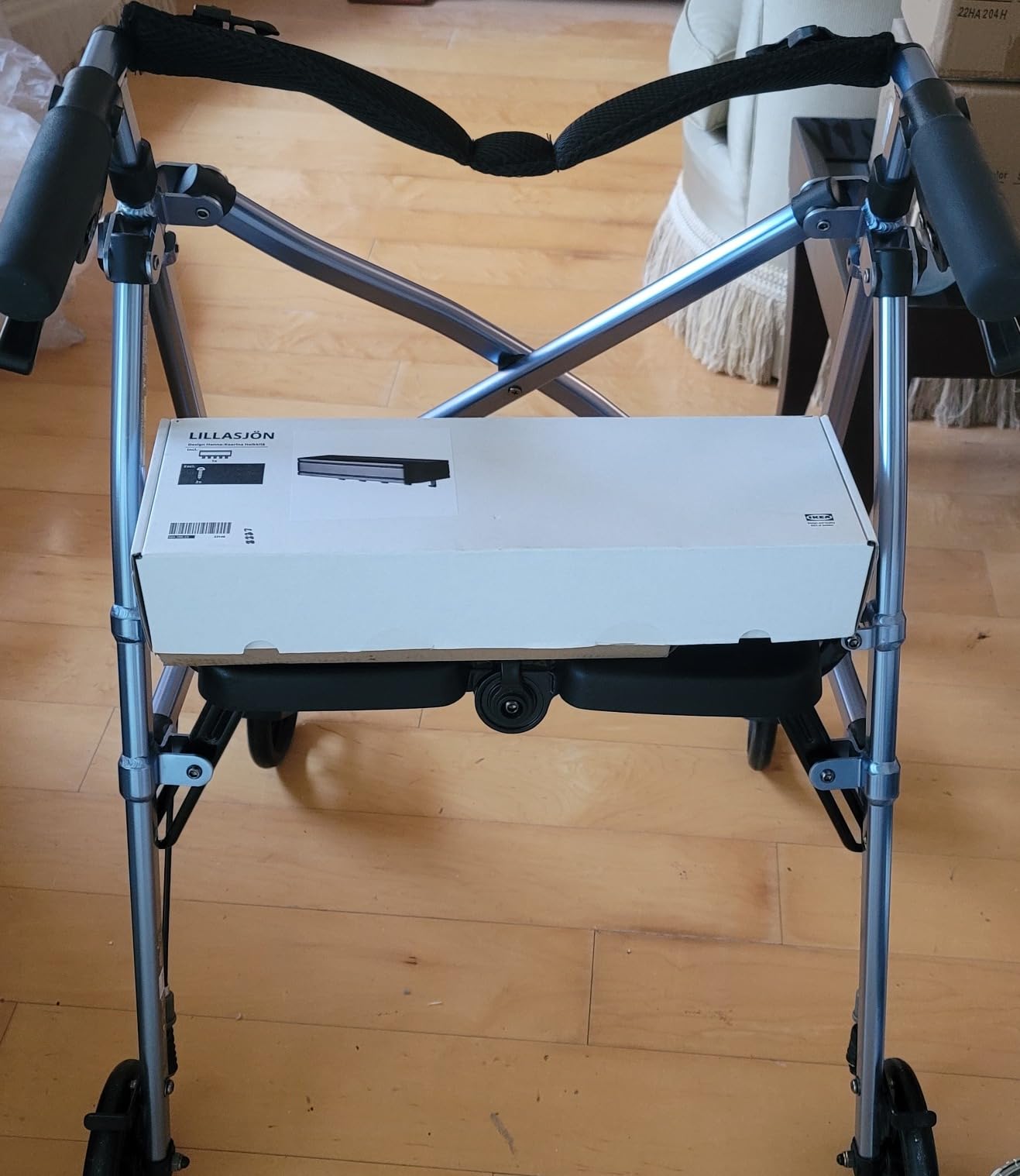
The seat is a 18.5 by 6 inch perch with a back strap, which is a pause seat rather than a chair. For a user who needs to stop for a minute between rooms it works well, and buyers praise the compact fold for a four-wheel rollator of this type more than anything else about it.
The trade-off is capacity and width. Two hundred fifty pounds is below several picks here, and at 26.5 inches the frame needs a reasonably wide doorway, so it will not solve a tight-door problem. Choose it for compact storage with a seat, not for narrow access.
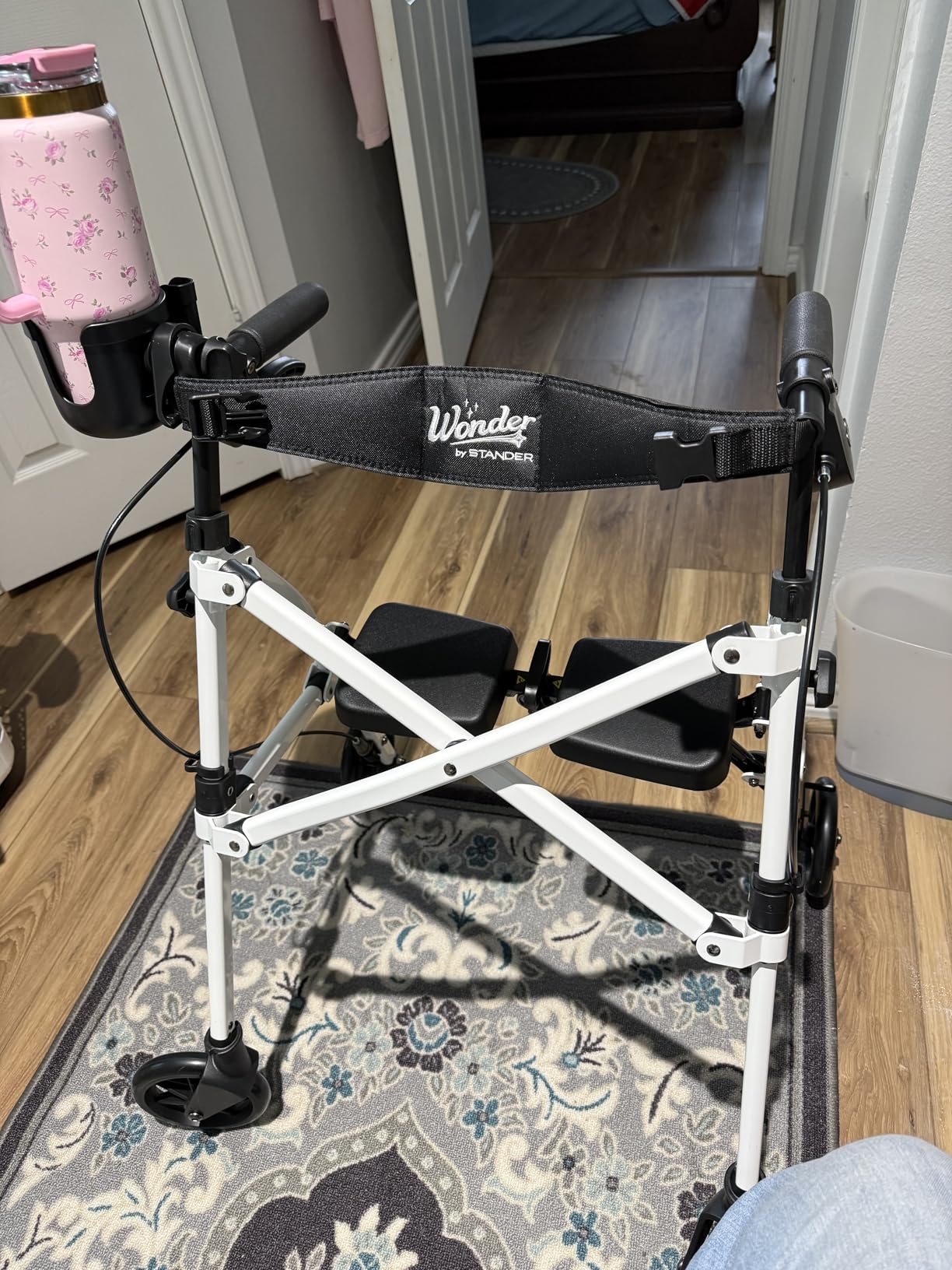
When a seat and a compact fold matter more than width
If the walker is shared between a home and a vehicle, the folded footprint is what decides the day. A 10 by 11 inch rollator fits behind a seat, in a trunk beside a wheelchair, or in a hallway cupboard where a standard rollator would not.
Pre-assembly matters for caregivers, since there is nothing to build on delivery day. The locking rear brakes also make it a safe place to rest, which the perch seat alone would not be.
Where it falls short
The 26.5-inch width is the deal-breaker for narrow-doorway shoppers, and reviewers name it as the main drawback along with the 250-pound limit. If the doorway is the reason you are reading this guide, this is not the model.
The perch seat is small and intended for short rests, and a user who sits for longer periods will find it uncomfortable. Choose a wider cushioned seat model if long sitting is part of the day.
We earn a commission, at no additional cost to you. CERTAIN CONTENT THAT APPEARS ON THIS SITE COMES FROM AMAZON. THIS CONTENT IS PROVIDED 'AS IS' AND IS SUBJECT TO CHANGE OR REMOVAL AT ANY TIME.
10. Lumex 3 Wheel Cruiser – 28 Inches With Large 8 Inch Wheels
Lumex 3 Wheel Cruiser – Lightweight & Narrow Three Wheel Walkers for Seniors & Tight Spaces
- Overall width: 28 in
- User limit: 250 lb
- Weight: 13.8 lb
- Wheels: 8 in, handles 33 to 37 in
Pros
- Narrow three-wheel footprint of 28 inches for tight hallways and small bathrooms
- Light at 13.8 pounds for a rolling walker
- Large 8 inch wheels roll smoothly over carpet
- wood
- tile and uneven surfaces
- Handle height range fits a broad span of users
Cons
- No seat to rest on
- 28 inches is not the narrowest frame available in this category
We earn a commission, at no additional cost to you. CERTAIN CONTENT THAT APPEARS ON THIS SITE COMES FROM AMAZON. THIS CONTENT IS PROVIDED 'AS IS' AND IS SUBJECT TO CHANGE OR REMOVAL AT ANY TIME.
The Lumex Cruiser is the widest frame in the roundup, and it is here for a specific reason: the 8-inch wheels. They roll over carpet, wood, tile and uneven surfaces without the snagging that small casters show, which makes this the practical choice for someone who still walks outside regularly.
The three-wheel geometry at 28 inches gives a turning radius that works in a small bathroom, and the handle height adjusts from 33 to 37 inches, which covers a wide range of taller users that many petite-sized narrow frames cannot.
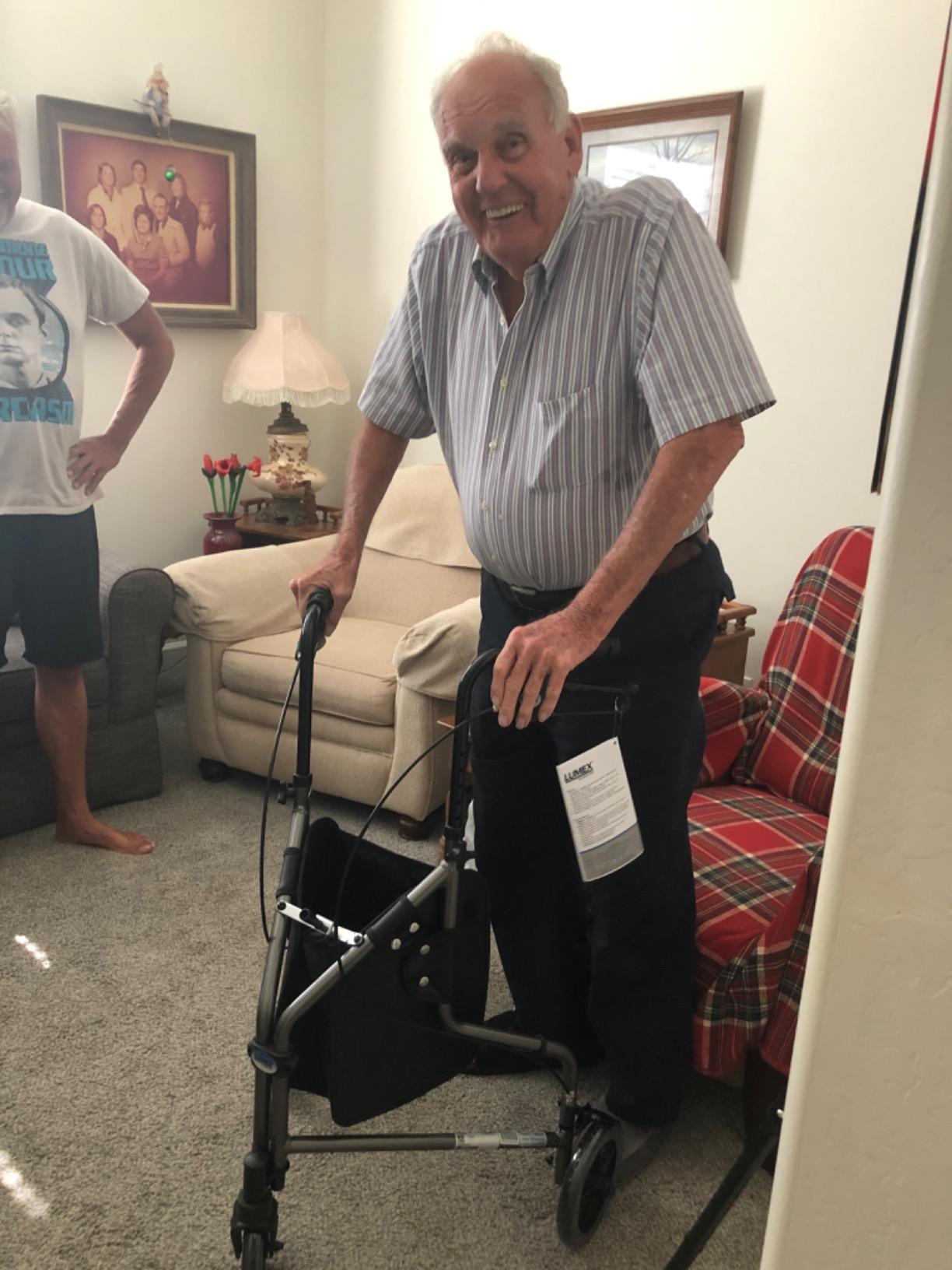
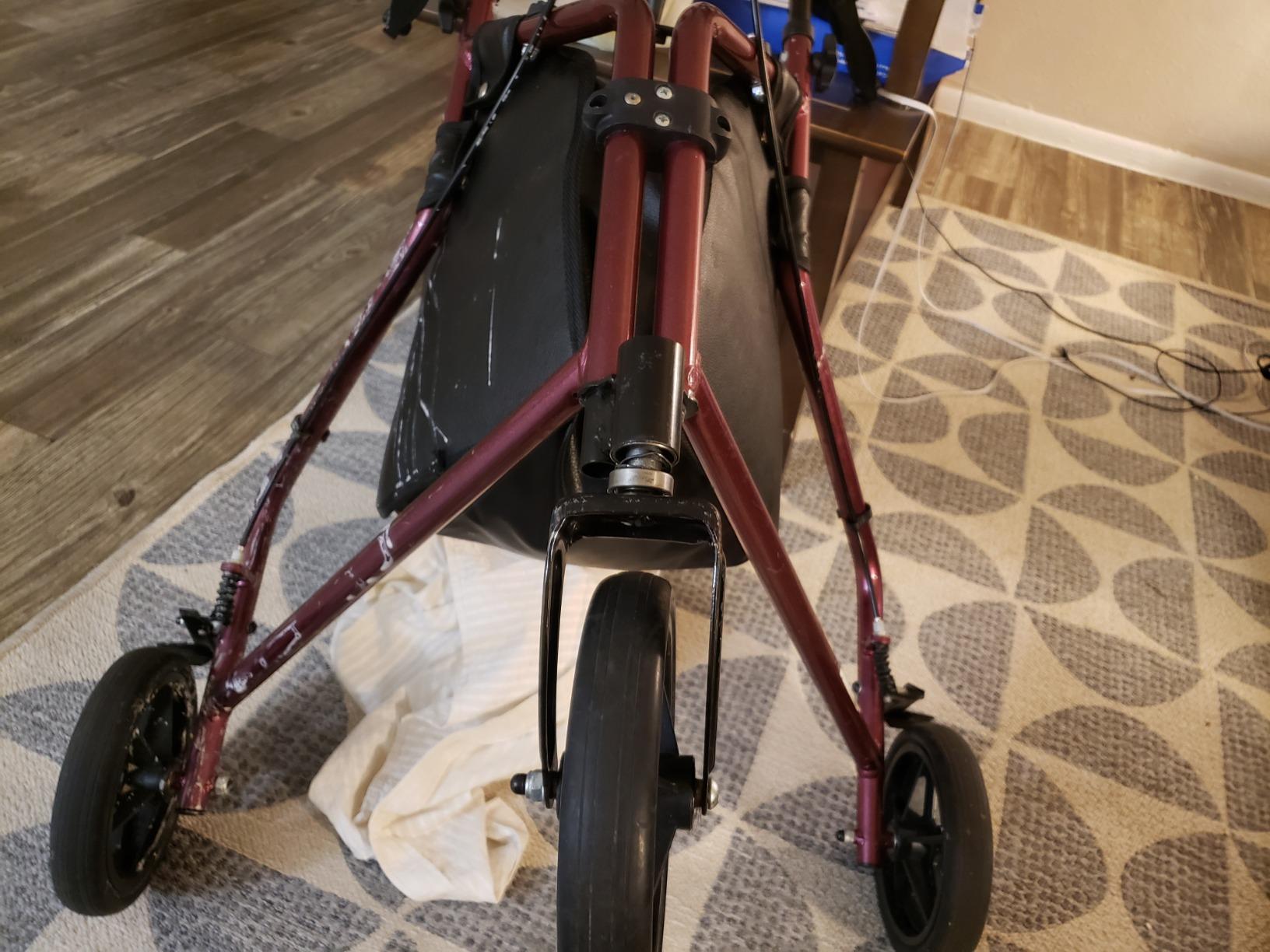
It weighs 13.8 pounds and supports up to 250 pounds, with an attached zippered storage pouch for a bag or a jacket. The frame comes in metallic burgundy or pewter, and the whole thing is simple to use with no folding mechanism to learn.
Reviewers appreciate how the three-wheel design and moderate 28-inch width handle tight indoor spaces while keeping the large wheels that glide on multiple floor types. The lack of a seat is the most common trade-off mentioned.
Best for mixed indoor and outdoor surfaces
Wheel diameter is the spec that decides whether a rolling walker works on a path, a garden or a carpeted hallway, and 8 inches is at the top of what a narrow three-wheel frame offers. Fewer bumps transfer into the handles, which means less fatigue over a longer route.
Because the frame is 28 inches rather than 20, it needs a doorway of at least 29 inches to pass comfortably. That is fine in a modern home and does not work in a narrow one.
Where it does not fit
There is no seat, so this is a poor match for a user who needs frequent rest or who tires after a few minutes of walking. The 250-pound capacity is also below several picks in this roundup.
For anyone whose tightest doorway is 24 inches or narrower, the three-wheel logic still helps but the width will not clear it. Move up to one of the slimmer three-wheel or compact four-wheel options instead.
We earn a commission, at no additional cost to you. CERTAIN CONTENT THAT APPEARS ON THIS SITE COMES FROM AMAZON. THIS CONTENT IS PROVIDED 'AS IS' AND IS SUBJECT TO CHANGE OR REMOVAL AT ANY TIME.
Buying Guide: Choosing the Best Narrow Walker for Small Spaces
Start with the frame type, because it decides the width floor more than any other choice. A two-wheel walker with rear glide tips can go as narrow as about 17 inches but rolls only forward. A three-wheel rollator needs about 20 to 28 inches and pivots in place, which is the best geometry for tight corners. A four-wheel rollator with a seat is the most stable but starts around 20 inches wide and rarely goes below that. An upright walker keeps the torso taller but needs forearm support, so it is a fit for users who cannot push from behind.
Match the frame width to your narrowest clear opening, not to your hallway. Write the subtracted number from the measurement step next to each candidate. If your figure is 21 inches, only the 20-inch and 17-to-22-inch adjustable frames are realistic, and you should accept a two-wheel or petite rollator as the price of access.
Next, check weight capacity against actual user weight with a margin, and check the recommended user height. A 220-pound limit is a real ceiling, and a 39-inch maximum handle height simply will not fit a 5-foot-11-inch user. Both errors show up in reviews as discomfort and abandonment rather than as a product fault.
Decide on wheels by surface. Small casters and glide tips are quiet and cheap on smooth indoor flooring, while 6 to 8 inch wheels roll over thresholds, carpet, gravel and pavers. If the user still walks outdoors, wheel diameter matters more than a seat. If the walker never leaves a flat, prioritise quiet operation and a narrow frame.
Decide on a seat by fatigue, not by comfort. A seat matters when the user must rest mid-journey, when distances exceed a short corridor, or when a caregiver is not always present. A 12-inch perch seat handles a pause; a full-width padded seat handles a genuine rest.
Then think about transport, which buyers underestimate. The Stander rolling walker folds to 5 by 7 inches and stands upright, the Stander rollator folds to 10 by 11 inches, the Vive three-wheel model folds flat at 11 pounds, and the Helavo folds to a taller 8.3 by 23.6 by 37.4 inch package. Those numbers decide whether the walker lives in a car or in a corner.
On coverage: Medicare Part B can cover a walker or rollator as durable medical equipment when a doctor documents a medical necessity and the prescription specifies the type. Many of the narrow models listed here are FSA and HSA eligible, which is worth checking before purchase. A prescription is not a formality, because the documented reason determines which model your insurer will fund.
Finally, be honest about maintenance. Check glide caps and glide tips weekly, retighten brake cables as they stretch, re-check handle height whenever footwear changes, and inspect the locking pin on any folding frame. A walker that is adjusted once and then ignored will not fit the doorway correctly a year later.
Width vs Stability: Who Should Refuse an Ultra-Narrow Frame
Every inch you take out of a frame comes out of its lateral stability, and buyers describe ultra-slim walkers as feeling wobbly or flimsy. This is the trade-off almost every roundup buries in a drawbacks table, and it deserves to be a selection rule rather than a footnote.
Reviewers of ultra-narrow two-wheel frames commonly report that the walker feels less sturdy because of the narrow frame, and that users end up walking behind it rather than inside it. Walking behind the frame puts the user outside the support, where a wheel catching or a floor snag becomes a fall instead of a stumble.
Users with Parkinson’s disease, multiple sclerosis or a tremor should be cautious with the 17-to-20-inch settings. A UK narrow-doorway forum thread notes that a good narrow rollator with good brakes and wheels is no more hazardous than any other wheeled aid, provided the user wears non-slip shoes, but that reassurance assumes brakes and wheels of reasonable quality, not glide tips alone.
Independent Living’s buyer guide puts narrowness in a wider context: a narrow walker suits tight hallways, limited turning space, slimmer users and narrower gaits. So if the user has a wider build or a broad gait, the narrowest frame on the market is the wrong tool even if it technically clears the door.
Two groups should refuse an ultra-narrow frame outright. Anyone over the weight limit of the narrow model should choose capacity over width. And anyone whose main problem is balance rather than fatigue should choose a wider four-wheel frame, because lateral support is doing the therapeutic work and a 19-inch frame cannot provide it.
Partial folding is worth knowing about, because real users ask about it. On the MS Society’s community forum, caregivers recommend rollators that can be partially folded to get through narrow gaps rather than requiring a full fold and repack. Most of the models here can be squeezed narrower mid-stride or partially collapsed at a doorway, which is the difference between passing a door and getting stuck in it.
Safe Technique and a 60-Second Maintenance Routine
Set the handle height so your elbows bend about 15 to 20 degrees while you stand upright inside the frame. Too high and you push down, too low and you lean forward, and both positions reduce the braking support the device is meant to give you.
Step into the frame rather than behind it. The gap between handles is the space your body occupies, and entering from the side means a foot sweep rather than a full turn, which is safer in a narrow hallway and kinder to a hip or knee recovering from surgery.
Pause before turns. Stop, plant both feet, then pivot the frame rather than swinging the back end through the arc. In small spaces that pause is the difference between a controlled turn and a wheel catching a baseboard.
Use the brakes. On a rollator, squeeze the levers to slow and lock the rear wheels into park mode before sitting or reaching. On U-Step style frames the levers must be held continuously, which is a real consideration for anyone with grip weakness.
Run a 60-second check each week: look at the glide caps and tips for wear, check brake cables for stretch, confirm the folding lock clicks home, and re-check handle height if you have changed shoes. A worn glide tip throws the frame sideways, and a stretched cable pushes stopping distance out.
This article is for general information and is not medical advice. If you are choosing a walker for someone with a fall history, a neurological condition, or a recent surgery, ask your doctor for a prescription and request an occupational therapist assessment. A therapist can measure you, set the handle height, and tell you which frame width your balance actually needs.
Frequently Asked Questions
What is a good narrow walker for the elderly?
A good narrow walker for the elderly is one whose measured overall width clears your tightest clear doorway opening with at least an inch to spare, and whose weight capacity exceeds the user’s body weight. In practice, that means a 20 to 23 inch frame for homes with old interior doors, a padded seat and lockable hand brakes if the user tires, and a recommended user height range that matches the person rather than the average. The Stander Space Saver rolling walker and the KMINA 22 inch rollator cover most of these needs.
What is the most narrow walker for seniors?
The narrowest complete walker for seniors in this roundup is the Delog narrow folding walker, which adjusts from 22 inches down toward 17 inches by repositioning its wheels, and weighs about 6 pounds while supporting up to 350 pounds. Among rollators that still include a seat and brakes, the Lumex Walkabout Junior at 20 inches wide is the tightest option, though its sizing is built strictly for petite users.
What is the minimum door width required for a walker?
Plan on at least 2 inches more than the walker’s overall width. A 20 inch rollator needs a clear opening of roughly 22 inches, and a 22 to 23.5 inch rollator needs about 24 to 25 inches. Measure the clear gap between the door stop and the frame at three heights, take the smallest reading, and subtract an inch for handles, closers and side-to-side wobble while walking.
How wide is a standard rollator?
A standard rollator is usually 24 to 26 inches wide, and heavy-duty bariatric rollators can reach 29 inches. Those widths are the reason standard frames jam in older homes with tight interior doors. Slim rollators start around 20 to 22 inches, and the narrowest seated frames run close to 20 inches across.
Are there different width walkers?
Yes, and the differences matter. Ultra-narrow two-wheel walkers run about 19 to 21 inches and usually have no seat. Slim rollators run 22 to 23.5 inches and can include a seat, basket and brakes. Standard frames sit around 24 inches, and heavy-duty bariatric frames run 25 to 29 inches. Some models, such as the Delog, let you reposition wheels to change the width between roughly 17 and 22 inches.
Who should not use a rollator walker?
A rollator is a poor choice for a user who cannot bear weight through the hands, who has uncontrolled balance problems while seated, or who cannot operate and hold the brake levers. Users over the frame’s weight limit should choose capacity over width. Anyone whose main problem is balance rather than fatigue needs a wider four-wheel frame for lateral support, and an ultra-narrow 19 inch frame is not the right tool.
What kind of walkers will Medicare pay for?
Medicare Part B can pay for a walker or rollator as durable medical equipment when a doctor documents medical necessity and writes a prescription that specifies the type of frame. Coverage is for the prescribed item, so a narrow rollator generally needs to be documented as medically necessary to qualify. Many narrow models are also FSA and HSA eligible, which is worth checking before you pay out of pocket.
What is the proper height for a rollator walker?
Set the handles so your elbows bend about 15 to 20 degrees while you stand upright inside the frame. Measure from the floor to your wrist while standing, then add the sole thickness of the shoes you normally wear and subtract the handle tube thickness. Re-check the height whenever footwear changes, and never set the handles above the top of your wrist, which pushes you into a stooped posture.
Conclusion: The Best Walkers for Narrow Doorways in 2026
Measure your narrowest clear opening first, subtract an inch, and let that number do the choosing. Most homes land in the slim 22 to 23.5 inch tier, and the KMINA narrow rollator is the best walkers for narrow doorways pick there because it keeps a seat, brakes, a basket and a tray at 22 inches wide. For openings under 22 inches, the Lumex Walkabout Junior at 20 inches serves petite users, and the Delog adjustable walker reaches even further by changing the frame width itself.
Match the frame to the floor, the capacity to the user, and the seat to the fatigue level, then ask an occupational therapist to confirm the fit before the walker becomes part of someone’s daily routine. The right narrow walker is the one that clears every door in the house without anyone having to take a frame off its hinges.