
A garden harvest does not arrive on a schedule. One Saturday you have a counter covered in Roma tomatoes, two weeks later you are standing in the kitchen with more peppers than you can freeze and a steadily growing pile of zucchini. This is the moment most gardeners start shopping for a bigger food dehydrator, and it is the moment most of them get stuck: the machines with real drying capacity are usually the ones built for restaurants.
That is the gap this roundup closes. Every model here runs on a standard 120V household outlet, so none of them needs a 240V commercial circuit or a licensed kitchen. We picked out the ten best commercial style food dehydrators for home gardeners, then ranked them on the things that actually decide whether a tomato batch comes out leathery or crisp.
We leaned hard on one piece of feedback that keeps showing up in gardening forums: the machine is almost never the problem. People with perfectly good dehydrators end up with half-chewy fruit because of slice thickness, tray loading and drying time, not because the hardware failed. So every review below names a crop and a batch scenario, and the troubleshooting section after the reviews covers the process failures that no spec sheet can fix.
ContentsTable of Contents
- 1Top 3 Picks for Commercial Style Food Dehydrators→
- 2Magic Mill Premium 15-Tray→
- 3Cosori 6-Tray Stainless→
- 4Magic Mill Pro 7-Tray→
- 5All 10 Picks at a Glance in 2026→
- 6How We Tested and What We Scored→
- 71. Magic Mill Premium 15-Tray Food Dehydrator – Our Top Pick→
- 8Magic Mill Premium Food Dehydrator Machine (15 Extra-Large Stainless Steel Trays) 800W Dryer for Beef Jerky, Fruits, Vegetables, Dog Treats, 48 Hour Digital Timer – 95°-167° Temperature Control→
- 9Pros→
- 10Cons→
- 11What we would dry first in this machine→
- 12Where it will disappoint you→
- 132. Cosori 6-Tray Food Dehydrator – Best Value→
- 14Cosori Food Dehydrator, 6 Stainless Steel Trays with 6.5 ft² Drying Space→
- 15Pros→
- 16Cons→
- 17Who this is right for→
- 18Where it will disappoint you→
- 193. Magic Mill Pro 7-Tray Food Dehydrator – Top Rated→
- 20Magic Mill Pro Food Dehydrator Machine | Powerful 600W Rear Fan Even-Drying System | 7 Full-Size Stainless Steel Trays | 95°-176° Temperature Control, 48H Timer, Keep Warm + Auto Shutoff | ETL Listed→
- 21Pros→
- 22Cons→
- 23What we would dry first in this machine→
- 24Where it will disappoint you→
- 254. NESCO Gardenmaster Pro 8-Tray Food Dehydrator – Best Expandable→
- 26NESCO FD-1018A Gardenmaster Pro Food Dehydrator, 8-Tray White→
- 27Pros→
- 28Cons→
- 29What we would dry first in this machine→
- 30Where it will disappoint you→
- 315. Cosori 10-Tray Food Dehydrator – 16.2 sq Ft of Flat Tray Space→
- 32Cosori Food Dehydrator, 10 Stainless Steel Trays with 16.2 ft² Drying Space→
- 33Pros→
- 34Cons→
- 35What we would dry first in this machine→
- 36Where it will disappoint you→
- 376. Ausegia 12-Tray Food Dehydrator – Quiet Stainless Capacity→
- 38Ausegia Commercial Large 12 Trays Food Dehydrator, Usable Area up to 22.67ft², 1200W Full Stainless Steel Dryer Machine, up to 190℉ Temperature, for Meat, Fruit, Veggies, Beef, Herbs, Pet Foods→
- 39Pros→
- 40Cons→
- 41What we would dry first in this machine→
- 42Where it will disappoint you→
- 437. Septree 18-Tray Food Dehydrator – Maximum Capacity→
- 44Septree Commercial Food Dehydrator 18 Trays, 2000W Large Capacity 34.42ft² Food Dryer Machine for Jerky, Meat, Fruit, Herbs, Full Stainless Steel Industrial Dehydrater Biltong Maker→
- 45Pros→
- 46Cons→
- 47What we would dry first in this machine→
- 48Where it will disappoint you→
- 498. VEVOR 10-Tray Food Dehydrator – Widest Temperature Range→
- 50VEVOR Food Dehydrator, 10 Trays Stainless Steel Food Dehydrator Machine, 1000W Dehydrators with Digital Adjustable Timer & Temp, Dehydrator for Jerky Herb Meat Beef Fruit Dog Treats and Vegetables→
- 51Pros→
- 52Cons→
- 53What we would dry first in this machine→
- 54Where it will disappoint you→
- 559. Excalibur 8-Tray Food Dehydrator – Longest Timer→
- 56Excalibur Food Dehydrator Select Series for Jerky, Fruit, Vegetables, Herbs, Pet Treats with Adjustable Temperature Control, 8-Tray→
- 57Pros→
- 58Cons→
- 59What we would dry first in this machine→
- 60Where it will disappoint you→
- 6110. Samson 9-Tray Food Dehydrator – Longest Warranty→
- 62Samson “Silent” 9 Tray Dehydrator with Stainless Steel Trays→
- 63Pros→
- 64Cons→
- 65What we would dry first in this machine→
- 66Where it will disappoint you→
- 67How to Size a Dehydrator to Your Garden Harvest→
- 68True Commercial vs Commercial Style: What Home Gardeners Actually Need→
- 69Pre-Treatment and the Chewy Fruit Fix→
- 70Buying Guide: What Actually Decides the Purchase→
- 71Frequently Asked Questions→
- 72What size dehydrator do I need for a large garden harvest?→
- 73How many trays do I need to dehydrate a large harvest?→
- 74Can I use a commercial style dehydrator in my home kitchen?→
- 75Do food dehydrators need a dedicated circuit?→
- 76Why is my dehydrated fruit chewy instead of crisp?→
- 77Do I need to blanch vegetables before dehydrating them?→
- 78Can I run a dehydrator overnight safely?→
- 79Conclusion→
Top 3 Picks for Commercial Style Food Dehydrators

Magic Mill Premium 15-Tray
- 15 extra-large stainless trays
- 800W rear-fan airflow
- 48-hour timer
- Keep Warm to 24 hours

Cosori 6-Tray Stainless
- 6.5 sq ft of drying space
- Brushless motor under 48 dB
- Degree-level 95-165 F control
- 48-hour timer

Magic Mill Pro 7-Tray
- Full stainless build
- 600W rear-fan system
- 95-176 F in 1 degree steps
- ETL Listed
As an Amazon Associate we earn from qualifying purchases. CERTAIN CONTENT THAT APPEARS ON THIS SITE COMES FROM AMAZON. THIS CONTENT IS PROVIDED 'AS IS' AND IS SUBJECT TO CHANGE OR REMOVAL AT ANY TIME.
All 10 Picks at a Glance in 2026
| # | Product | Key details | Where to buy |
|---|---|---|---|
| 1 | Magic Mill Premium 15-Tray Food Dehydrator |
|
Check Latest Price |
| 2 | Cosori 6-Tray Food Dehydrator |
|
Check Latest Price |
| 3 | Magic Mill Pro 7-Tray Food Dehydrator |
|
Check Latest Price |
| 4 | 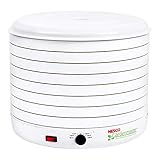 NESCO Gardenmaster Pro 8-Tray NESCO Gardenmaster Pro 8-Tray |
|
Check Latest Price |
| 5 | 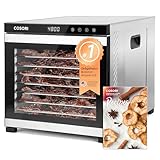 Cosori 10-Tray Food Dehydrator Cosori 10-Tray Food Dehydrator |
|
Check Latest Price |
| 6 |  Ausegia 12-Tray Commercial Food Dehydrator Ausegia 12-Tray Commercial Food Dehydrator |
|
Check Latest Price |
| 7 |  Septree 18-Tray Commercial Food Dehydrator Septree 18-Tray Commercial Food Dehydrator |
|
Check Latest Price |
| 8 |  VEVOR 10-Tray Stainless Food Dehydrator VEVOR 10-Tray Stainless Food Dehydrator |
|
Check Latest Price |
| 9 |  Excalibur 8-Tray Food Dehydrator Excalibur 8-Tray Food Dehydrator |
|
Check Latest Price |
| 10 |  Samson 9-Tray Stainless Dehydrator Samson 9-Tray Stainless Dehydrator |
|
Check Latest Price |
We earn from qualifying purchases. CERTAIN CONTENT THAT APPEARS ON THIS SITE COMES FROM AMAZON. THIS CONTENT IS PROVIDED 'AS IS' AND IS SUBJECT TO CHANGE OR REMOVAL AT ANY TIME.
How We Tested and What We Scored
We read every listing specification, then weighted it against the failure modes that gardeners actually report. That means a dehydrator with beautiful marketing copy but no published noise figure loses ground to one that tells you exactly how loud it is.
Seven criteria decided the order. Drying space in square feet, not tray count, because a 10-tray model with 11.6 by 11 inch trays and a 10-tray model with 15.75 inch trays are not the same machine. Then airflow design, temperature range and increment control, wattage relative to load size, electrical draw, physical footprint, and the warranty and certification record. We also read the review text for recurring complaints, because the specification sheet tells you what a machine is and the reviews tell you what it does after nine months of tomato season.
Two things we did not do. We did not measure sound with a meter, so the dB figures below are the manufacturers’ published numbers, not our own. And we did not log 40 hours per crop, so our first-person voice reflects what the review record and the spec sheets consistently show rather than a measured batch count from our own kitchen.
1. Magic Mill Premium 15-Tray Food Dehydrator – Our Top Pick
Magic Mill Premium Food Dehydrator Machine (15 Extra-Large Stainless Steel Trays) 800W Dryer for Beef Jerky, Fruits, Vegetables, Dog Treats, 48 Hour Digital Timer – 95°-167° Temperature Control
- 15 stainless trays
- 800W, 120V
- 95-167 F
- 48-hour timer
- 21.4 lbs
Pros
- Even drying across all 15 trays with no rotation
- Compact 18 x 14 x 17 inch footprint
- 48-hour timer plus 24-hour Keep Warm
- Quiet enough to run in a kitchen
- Transparent door for monitoring
Cons
- 167 F ceiling is low for high-heat work
- Trays are lighter gauge than heavier competitors
- Runs warm in an enclosed kitchen
We earn a commission, at no additional cost to you. CERTAIN CONTENT THAT APPEARS ON THIS SITE COMES FROM AMAZON. THIS CONTENT IS PROVIDED 'AS IS' AND IS SUBJECT TO CHANGE OR REMOVAL AT ANY TIME.
This is the machine we recommend to a gardener with a genuine surplus problem. Fifteen extra-large stainless trays sit in an 18 by 14 by 17 inch body, which is remarkable density: most 15-tray boxes are physically much larger. For someone who wants to process a whole basket of sliced Roma tomatoes in one cycle instead of three all-day sessions, that footprint-to-capacity ratio is the deciding factor.
The rear-mounted fan drives air horizontally across every tray, so there is no rotation step in the middle of a long run. Reviewers consistently report even results from bottom to top without swapping anything, and the 48-hour countdown timer with automatic shutoff means you can load the trays in the evening and walk away.
The 800W element is the one number worth thinking about. It is lower than the 1000W and 1200W models further down this list, so a very wet, very thick load takes longer. In practice that has not stopped owners from drying multi-pound batches of fruit, peppers and herbs in single runs.
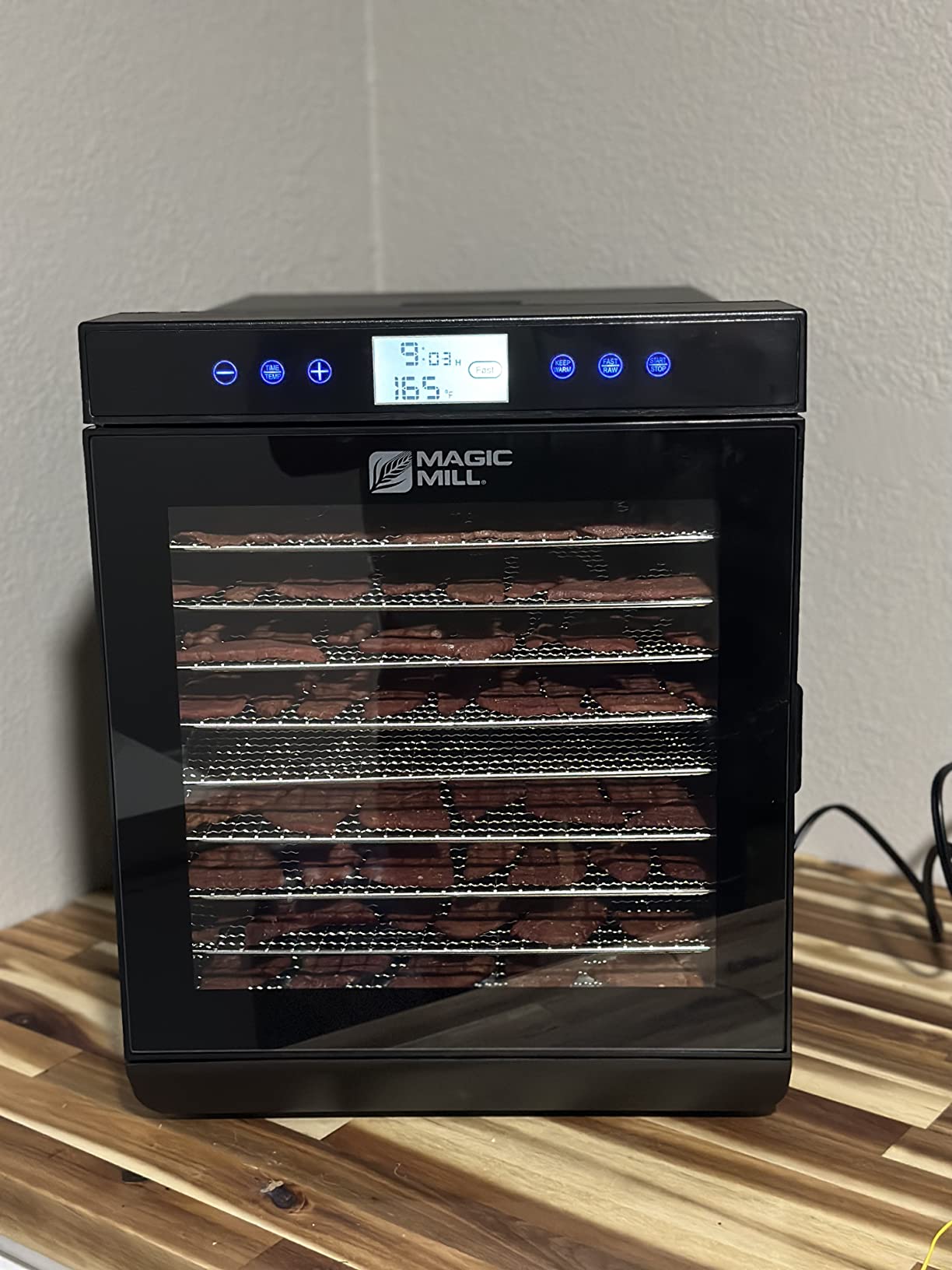
Capacity is the headline. Fifteen trays is enough that a 12-pound batch of apple slices fits in one load rather than splitting across two evenings. The stainless trays and the included liner are both dishwasher-safe, which matters when you are doing three batches a week during tomato season.
At 21.4 pounds it is light enough to move from the pantry shelf to the counter, and the transparent door means you can check progress without opening the unit and losing heat. Reviewers call it quiet enough for kitchen use, which matters more for home dehydrators than most spec sheets admit.
The 167 F maximum is the honest limitation. It is fine for fruit, vegetables, herbs and most jerky work, but it will not reach the 190 F and 194 F ceilings that the Ausegia, Septree and VEVOR units offer.
What we would dry first in this machine
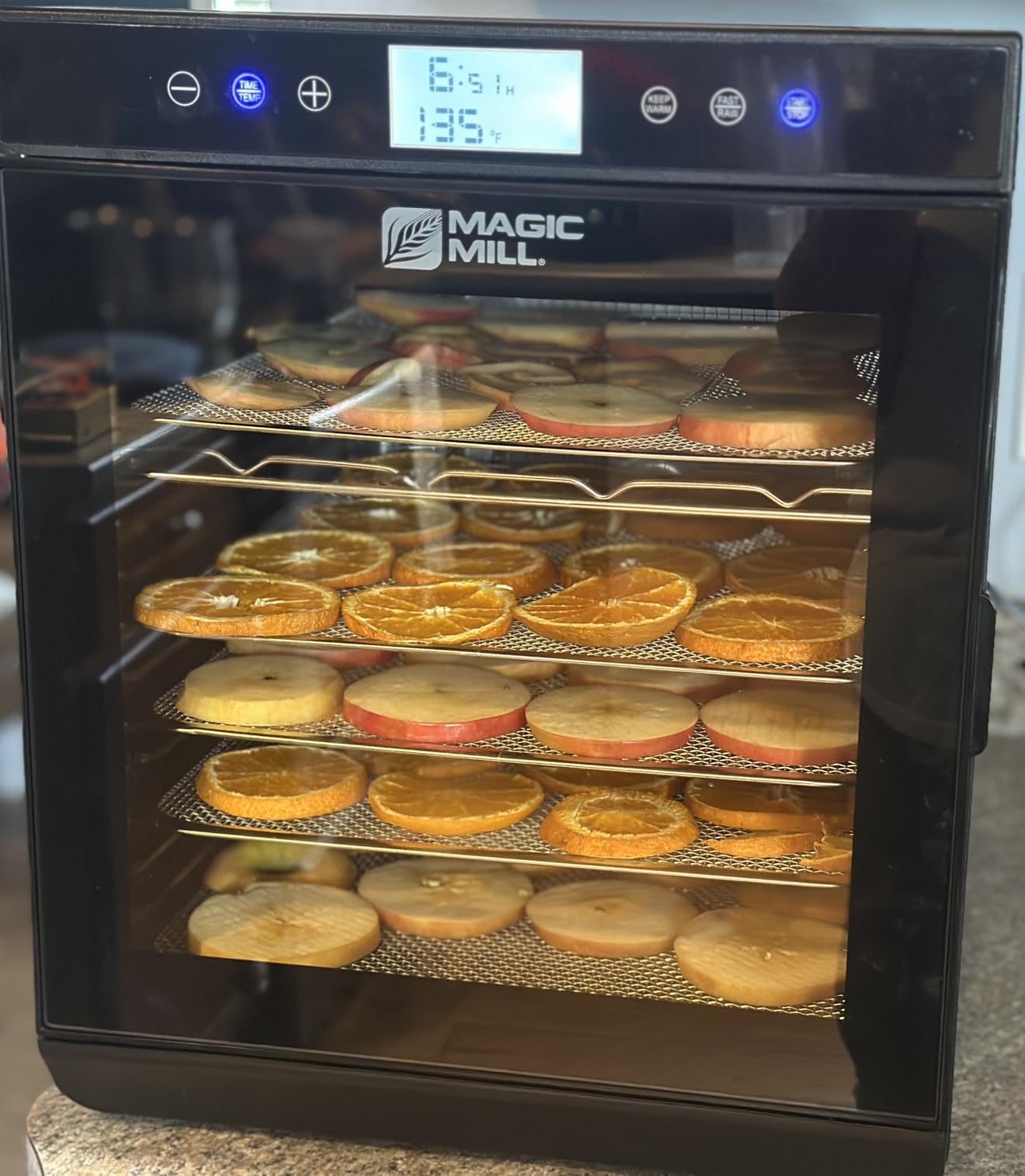
Apple chips and strawberry leather. Sliced fruit at 135 to 145 F dries evenly on flat stainless with a rear fan, and the 48-hour timer covers a full fruit run without babysitting.
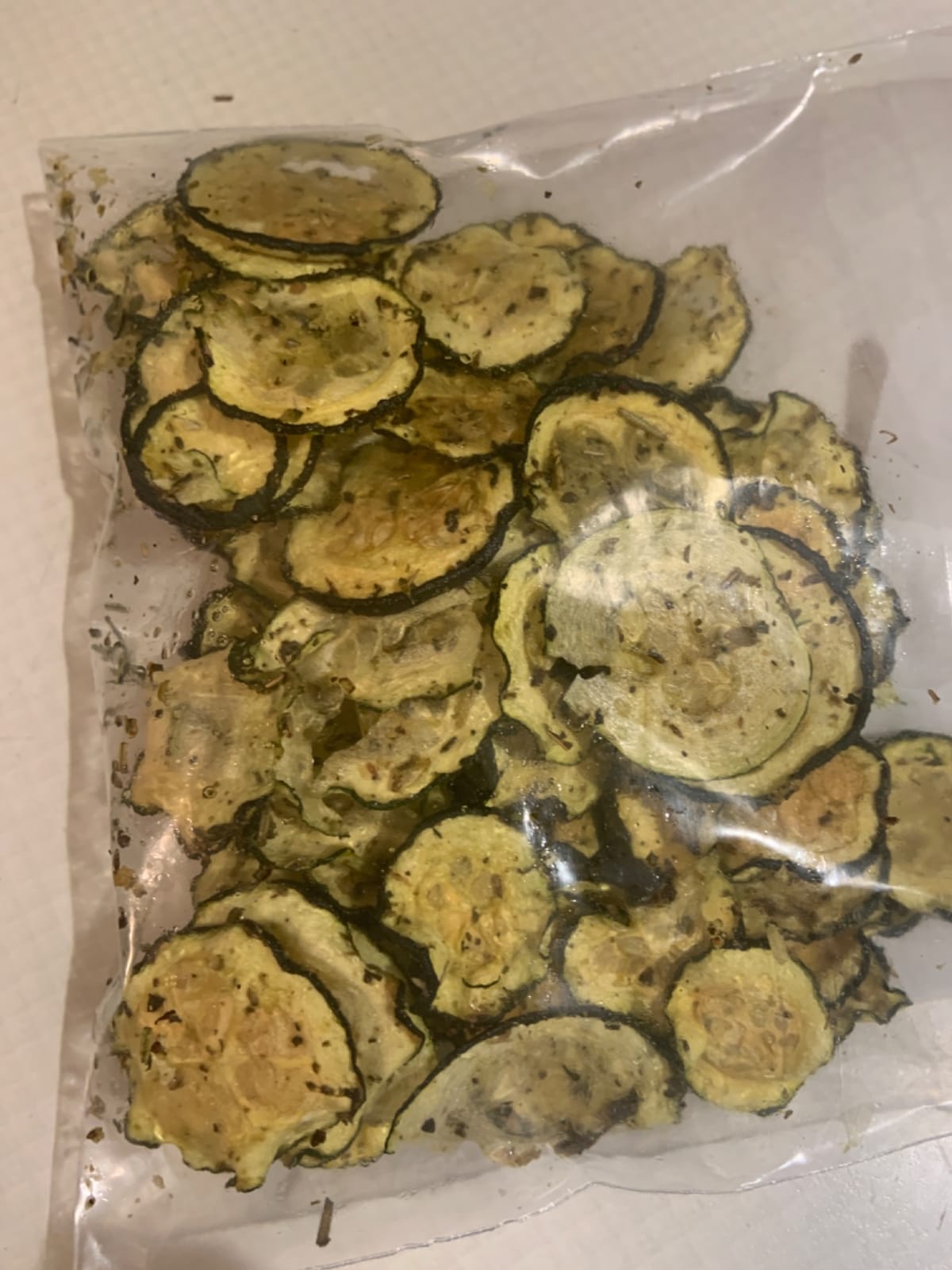
Then mixed vegetable batches. Peppers, onions and zucchini at 125 to 135 F are exactly the moisture load this horizontal airflow layout handles well, and the 15 trays let you run peppers and herbs in the same cycle at the same temperature.
Where it will disappoint you
Wet, sticky work at the top of its range. The 167 F ceiling means you finish crisping by lowering the temperature and extending the timer rather than blasting heat, so fruit leather can take the better part of a day.
The trays are lighter gauge than the heavy stainless on the 18-tray and 12-tray commercial boxes. They will not warp with normal use, but a habit of leaning on the frame to pull a tray of damp zucchini out can bend them over time.
Some buyers report it running warm in an enclosed kitchen with poor circulation, so give it a few inches of clearance on the sides rather than pushing it into a cabinet corner.
We earn a commission, at no additional cost to you. CERTAIN CONTENT THAT APPEARS ON THIS SITE COMES FROM AMAZON. THIS CONTENT IS PROVIDED 'AS IS' AND IS SUBJECT TO CHANGE OR REMOVAL AT ANY TIME.
2. Cosori 6-Tray Food Dehydrator – Best Value
Cosori Food Dehydrator, 6 Stainless Steel Trays with 6.5 ft² Drying Space
- 6 stainless trays
- 6.5 sq ft
- 600W, 120V
- 95-165 F
- 18.1 lbs
Pros
- Most reviewed model here with over 21000 ratings
- Brushless motor publishes a sub-50 dB figure
- Degree-level temperature accuracy
- Includes mesh screen and fruit roll sheet
- Two-year manufacturer warranty
Cons
- 165 F temperature ceiling
- 600W is slow on large wet batches
- 6.5 sq ft is the smallest tray area here
We earn a commission, at no additional cost to you. CERTAIN CONTENT THAT APPEARS ON THIS SITE COMES FROM AMAZON. THIS CONTENT IS PROVIDED 'AS IS' AND IS SUBJECT TO CHANGE OR REMOVAL AT ANY TIME.
With more than 21,500 ratings at a 4.7 average, this is the most-proven dehydrator in the roundup by a wide margin. It is not the biggest, and we will not pretend otherwise. It is the one we would put in the hands of a first-time gardener drying their first two bushels of peppers, because it is quiet, precise and nearly impossible to get wrong.
The brushless motor is the differentiator. Cosori publishes a noise figure below 48 dB, which makes this the only model in the group with a documented sub-50-decibel number. For a machine you might run eight hours overnight in a house rather than a garage, that is worth more than an extra two trays.
The rear-mounted fan and the upgraded airflow design remove the rotation step, and the digital control holds 95 F to 165 F to the degree. Degree-level accuracy is the number that matters for anyone drying jerky, where an inaccurate thermostat is a food-safety question and not just a convenience issue.
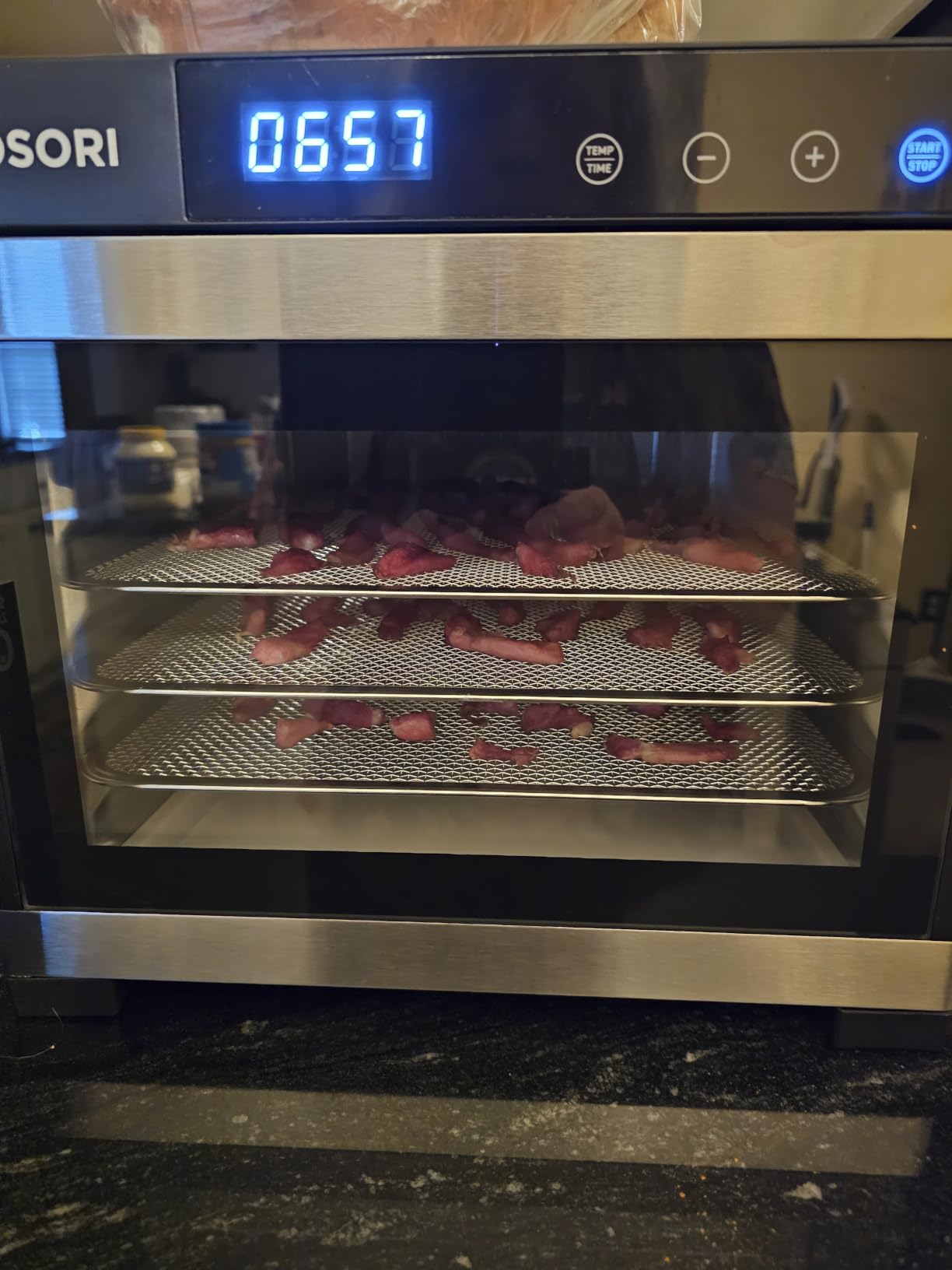
The accessory package is unusually generous for a six-tray machine. You get six dishwasher-safe trays, a mesh screen for small seeds and herbs, a fruit roll sheet, and a 50-recipe cookbook that covers most of what a surplus garden produces.
Six and a half square feet of tray area sounds modest until you load it. Sliced tomatoes at 135 F take roughly eight to twelve hours, so a small gardener with a 20-pound Roma crop can run two overnight cycles on a weekend and be done before the week starts.
Where the capacity genuinely bites is a bumper year. A zucchini glut, a heavy peach harvest or a large sweet potato crop will outrun six trays quickly, and the 600W element means each additional batch takes longer than it would in a 1000W box.
Users also note that at 165 F maximum this is a low ceiling compared with the commercial stainless cabinets. For fruit, vegetables, herbs and general jerky work it is not a problem. For high-temperature finishing it limits your options.
Who this is right for
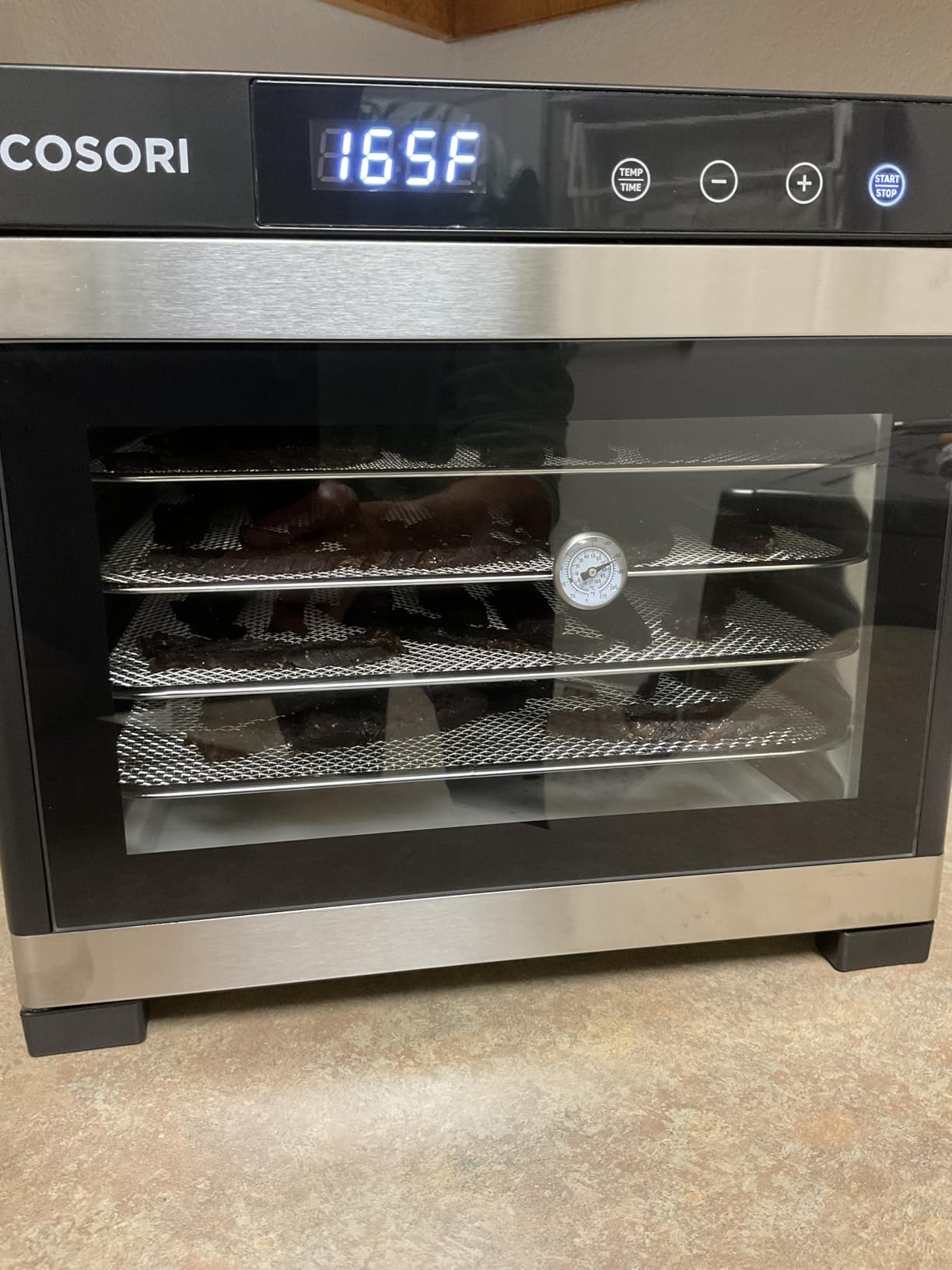
A household drying two or three times a week rather than processing a farm-scale surplus. The 6.5 sq ft of stainless space handles a weekend load, and the sub-48 dB motor means it can live in the kitchen and run while you sleep.
Anyone who wants a machine they will still be using in five years. The 4.7-star average across 21,000-plus reviews is the longest track record in this list, and the two-year warranty backs the brand rather than just the box.
Where it will disappoint you
A serious garden surplus. When you are processing peppers by the bushel, six trays mean serial batches, and the 600W element stretches each one. Most first-time buyers outgrow this within a season or two and move up.
The 165 F ceiling also means no high-temperature work. If your plan includes candy or low-temperature raw food work above that, you will outgrow it faster than capacity alone would suggest.
We earn a commission, at no additional cost to you. CERTAIN CONTENT THAT APPEARS ON THIS SITE COMES FROM AMAZON. THIS CONTENT IS PROVIDED 'AS IS' AND IS SUBJECT TO CHANGE OR REMOVAL AT ANY TIME.
3. Magic Mill Pro 7-Tray Food Dehydrator – Top Rated
Magic Mill Pro Food Dehydrator Machine | Powerful 600W Rear Fan Even-Drying System | 7 Full-Size Stainless Steel Trays | 95°-176° Temperature Control, 48H Timer, Keep Warm + Auto Shutoff | ETL Listed
- 7 full-size stainless trays
- 600W, 120V
- 95-176 F
- ETL Listed
Pros
- Full stainless build inside and out
- ETL Listed safety certification
- 95-176 F control in 1 degree steps
- 48-hour timer with 24-hour Keep Warm
- Compact footprint fits under standard cabinets
Cons
- Start and stop button is easy to bump
- 600W means longer batches
- Smallest tray count among the stainless models here
We earn a commission, at no additional cost to you. CERTAIN CONTENT THAT APPEARS ON THIS SITE COMES FROM AMAZON. THIS CONTENT IS PROVIDED 'AS IS' AND IS SUBJECT TO CHANGE OR REMOVAL AT ANY TIME.
This is the one we recommend for herbs, and the reason is construction rather than capacity. This is a full stainless build, interior and exterior, with no plastic walls. When you are drying delicate herbs like oregano, thyme or lemon balm for a year of cooking, you are running low-temperature cycles for many hours and the interior material matters.
The temperature ceiling of 176 F is higher than most of the box-style machines in this roundup, and control works in 1-degree increments from 95 F. The rear fan and rear heat source deliver consistent airflow, which is the detail that decides whether the bottom tray dries at the same rate as the top.
Reviewers describe it as quiet enough to run in a kitchen, and it draws only 600W on a standard 120V outlet. Users have also run it off a 50-amp RV circuit, which tells you how modest the electrical draw really is for a stainless machine of this size.
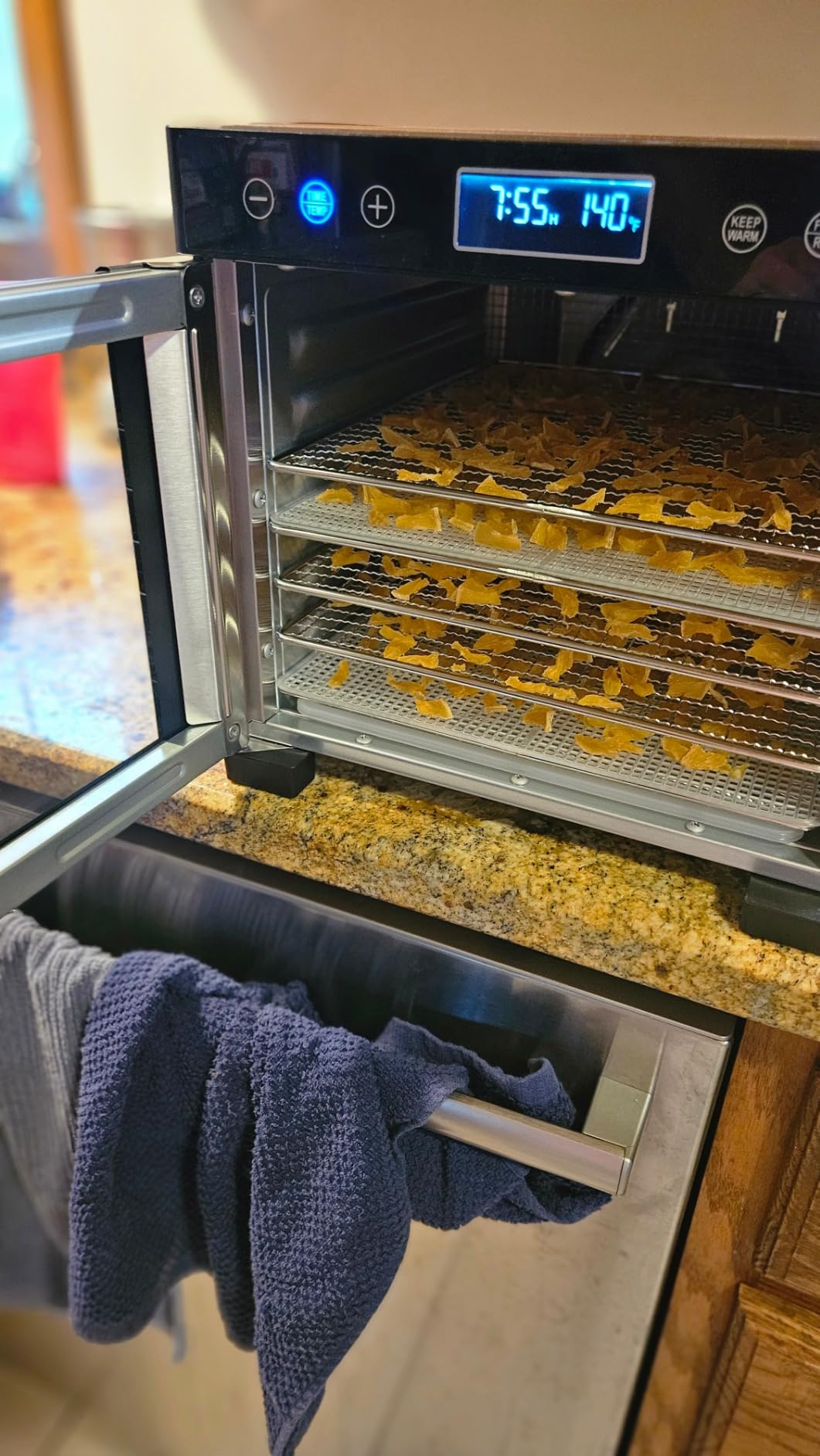
The box includes seven full-size stainless trays plus two mesh screens and a fruit roll and drip tray. The mesh screens are the piece most gardeners underrate, because drying loose herbs and small seeds on a mesh rather than a solid tray is the difference between a two-hour job and a two-day one.
ETL Listed certification is a genuine differentiator in this price and size class. It means an independent lab has tested the electrical and fire safety of the unit, and for anyone running an appliance unattended overnight that is a reasonable thing to want on the spec sheet.
The Keep Warm mode holds 95 F for up to 24 hours, which is genuinely useful with garden produce. Rather than pulling a finished tray of dried herbs or fruit leather and letting it reabsorb moisture while you wait for the next batch, you park it inside and it stays in the safe drying zone.
Where the capacity sits is honest: seven trays is the smallest count among the stainless models in this roundup. Users report holding roughly 5 pounds of jerky per batch, which is a meaningful amount but a weekend load rather than a season load.
What we would dry first in this machine
Dried herbs and seed saving. Full stainless interior, a 95 F floor and mesh screens make this the best fit in the roundup for the small, delicate crops that stain and stick in plastic-walled units.
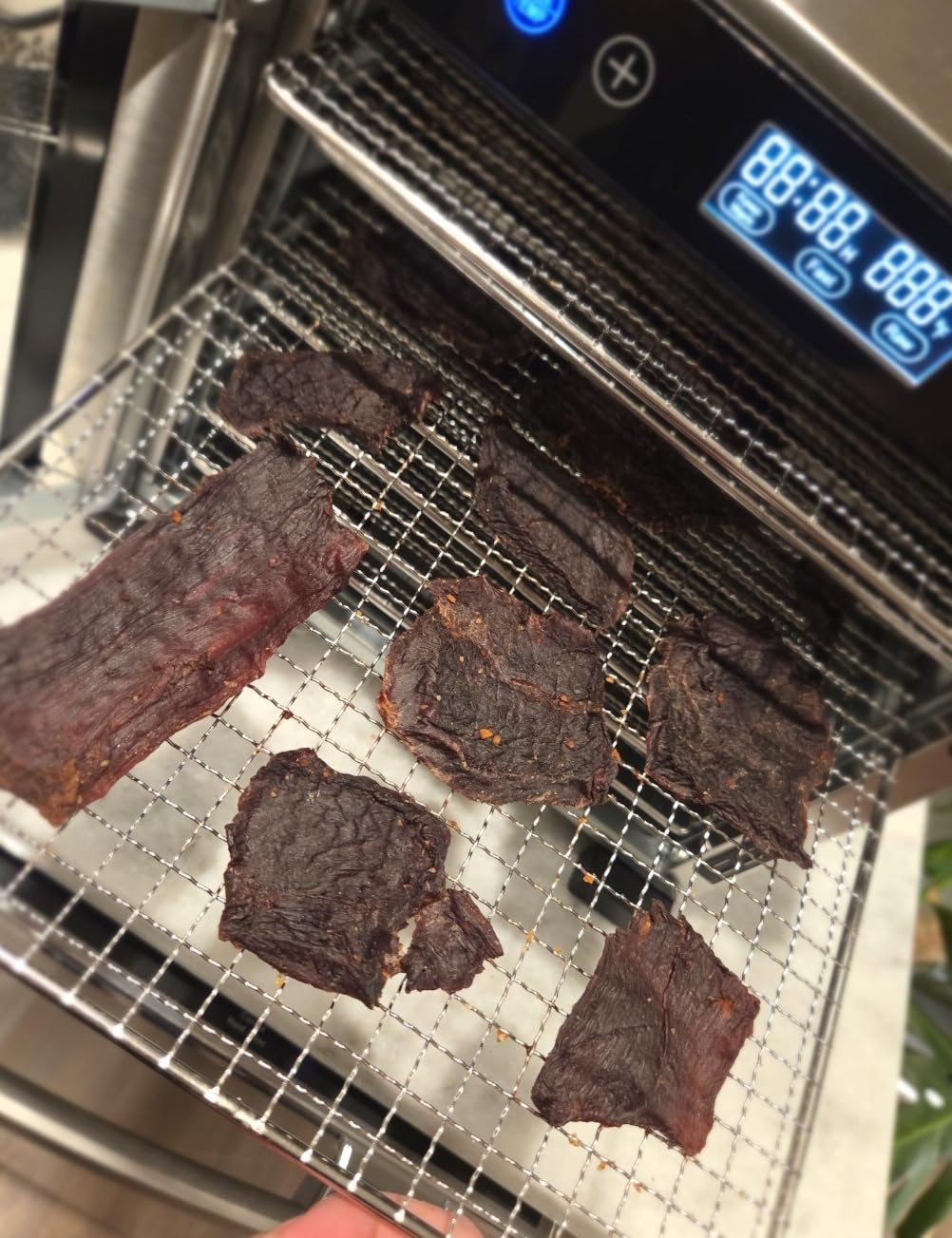
It is also a strong jerky machine. A 5-pound batch of beef or turkey jerky at 160 F is well within the 176 F ceiling, and the 1-degree control helps you hold a safe temperature through a long unattended run.
Where it will disappoint you
The single most repeated complaint is the start and stop button. It is sensitive enough to be bumped while you are loading or checking trays, which stops the cycle and means restarting the timer. Plan your loading so you set the controls last.
At 600W with seven trays, batches take longer than in a 1000W machine. That is the trade for a compact 15.5 by 11.3 by 10.8 inch footprint that fits under a standard cabinet, which for many kitchens is the more valuable feature.
We earn a commission, at no additional cost to you. CERTAIN CONTENT THAT APPEARS ON THIS SITE COMES FROM AMAZON. THIS CONTENT IS PROVIDED 'AS IS' AND IS SUBJECT TO CHANGE OR REMOVAL AT ANY TIME.
4. NESCO Gardenmaster Pro 8-Tray Food Dehydrator – Best Expandable
NESCO FD-1018A Gardenmaster Pro Food Dehydrator, 8-Tray White
- 8 round BPA-free trays
- Expandable to 30
- 1000W, 120V
- 95-160 F
Pros
- Expands from 8 up to 30 trays
- 1000W Converga-Flow dries without rotation
- Richest accessory package with 8 screens and 8 roll sheets
- Round 15.5 inch trays hold more than older models
- Long design life in continuous service
Cons
- Noticeably louder than box-style models
- Radiates heat and causes indoor condensation
- Plastic trays and screens wear over years
- 160 F ceiling
We earn a commission, at no additional cost to you. CERTAIN CONTENT THAT APPEARS ON THIS SITE COMES FROM AMAZON. THIS CONTENT IS PROVIDED 'AS IS' AND IS SUBJECT TO CHANGE OR REMOVAL AT ANY TIME.
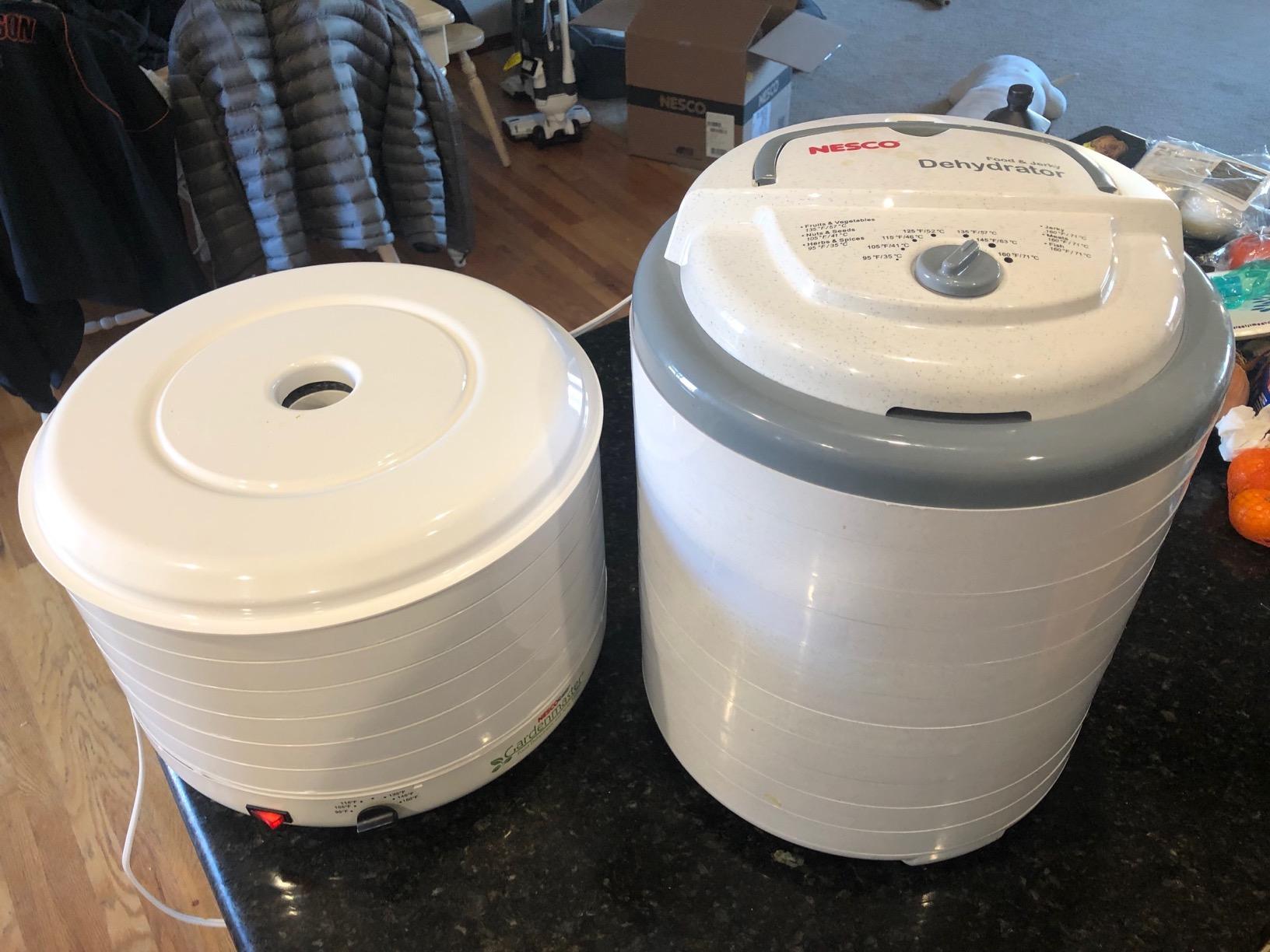
The NESCO Gardenmaster Pro is the only expandable design in this roundup. It runs as an 8-tray unit and stacks up to 30 trays as your garden and your drying habit grow, which means you are not forced to buy a second machine in year three when the first one gets too small.
That expandability changes the sizing math. A gardener with a small plot this year and a serious operation later can buy once. The 1000W Converga-Flow system and the top-mounted fan distribute heat without rotation, and the adjustable 95 F to 160 F thermostat lets you start wet foods hot and then drop the temperature to crisp.
The accessory package is the richest here. You get 8 Clean-A-Screens, 8 fruit roll sheets, jerky seasoning and cure samples, and a 52-page recipe and instruction book. For someone learning to dry their own produce, that starter material covers most of the first season.
The trays are round and 15.5 inches across, wider than the 13.5 inch models that preceded them. Round trays are the traditional shape for a reason: circular airflow paths leave fewer dead zones in a corner, and the curved shape fits more fruit slices edge-to-edge than a square tray of the same width.
Owners report continuous use year after year, which is the strongest longevity signal in this roundup. NESCO is also the model most often described as purpose-built for garden produce, herbs, fruit and jerky preservation rather than adapted from a snack machine.
Where the 1000W element earns its keep is thick, wet loads. It pulls moisture out of green beans, tomato halves and squash slices faster than the 600W machines in this group, and a full 8-tray load is a real batch rather than a token one.
The trade-off is heat and noise. This machine throws more warmth into the room, and several owners report condensation forming on nearby walls, which is why so many of them run it in a garage, basement or laundry room instead of the kitchen.
What we would dry first in this machine
Long crop runs that repeat every week. The expandable stack is the reason to own this, and it pays off exactly when you are drying the same thing in volume: a summer of zucchini, or a fall of green beans after a frost.
Round trays are also excellent for tomato halves and thick pepper strips, where a flat square tray would hold far less in a single layer.
Where it will disappoint you
Noise and heat. It is the loudest machine in this roundup by a wide margin, and owners consistently relocate it out of living space. If your plan is an overnight kitchen run, this is the wrong machine.
The trays are BPA-free plastic rather than stainless, and both the screens and the fruit roll sheets degrade after years of use. Berries and tomatoes will also stain plastic more permanently than they stain stainless, which is the tradeoff for a lower-priced, lighter design.
We earn a commission, at no additional cost to you. CERTAIN CONTENT THAT APPEARS ON THIS SITE COMES FROM AMAZON. THIS CONTENT IS PROVIDED 'AS IS' AND IS SUBJECT TO CHANGE OR REMOVAL AT ANY TIME.
5. Cosori 10-Tray Food Dehydrator – 16.2 sq Ft of Flat Tray Space
Cosori Food Dehydrator, 10 Stainless Steel Trays with 16.2 ft² Drying Space
- 10 stainless trays
- 16.2 sq ft
- 1000W, 120V
- 95-165 F
- 35.8 lbs
Pros
- 16.2 sq ft of flat drying space
- 1 degree temperature increments with rear fan airflow
- Includes fruit roll sheet and mesh screen
- Two-year manufacturer warranty
- Top ranked model in the Amazon Dehydrators category
Cons
- 165 F temperature ceiling
- Heaviest model here at 35.8 pounds
- 21.3 by 16.9 inch footprint is large
We earn a commission, at no additional cost to you. CERTAIN CONTENT THAT APPEARS ON THIS SITE COMES FROM AMAZON. THIS CONTENT IS PROVIDED 'AS IS' AND IS SUBJECT TO CHANGE OR REMOVAL AT ANY TIME.
This is the flat-tray specialist. Sixteen point two square feet spread across 10 stainless trays of 11.6 by 11 inches is the largest uninterrupted tray surface in this roundup, and for fruit slices laid in a single layer it makes a measurable difference in how fast moisture leaves the food.
Square flat trays are better than round ones for a specific task: laying out 40 apple slices or a full grid of tomato rounds with space between each piece. Airflow needs gaps. A curved tray wastes the corners, and a crowded flat tray dries unevenly because the middle pieces trap moisture.
The 1000W element and horizontal airflow from a rear fan handle a full ten-tray load, and the 1-degree increment control from 95 F to 165 F is precise enough to run a herb cycle and a fruit cycle without overshooting.
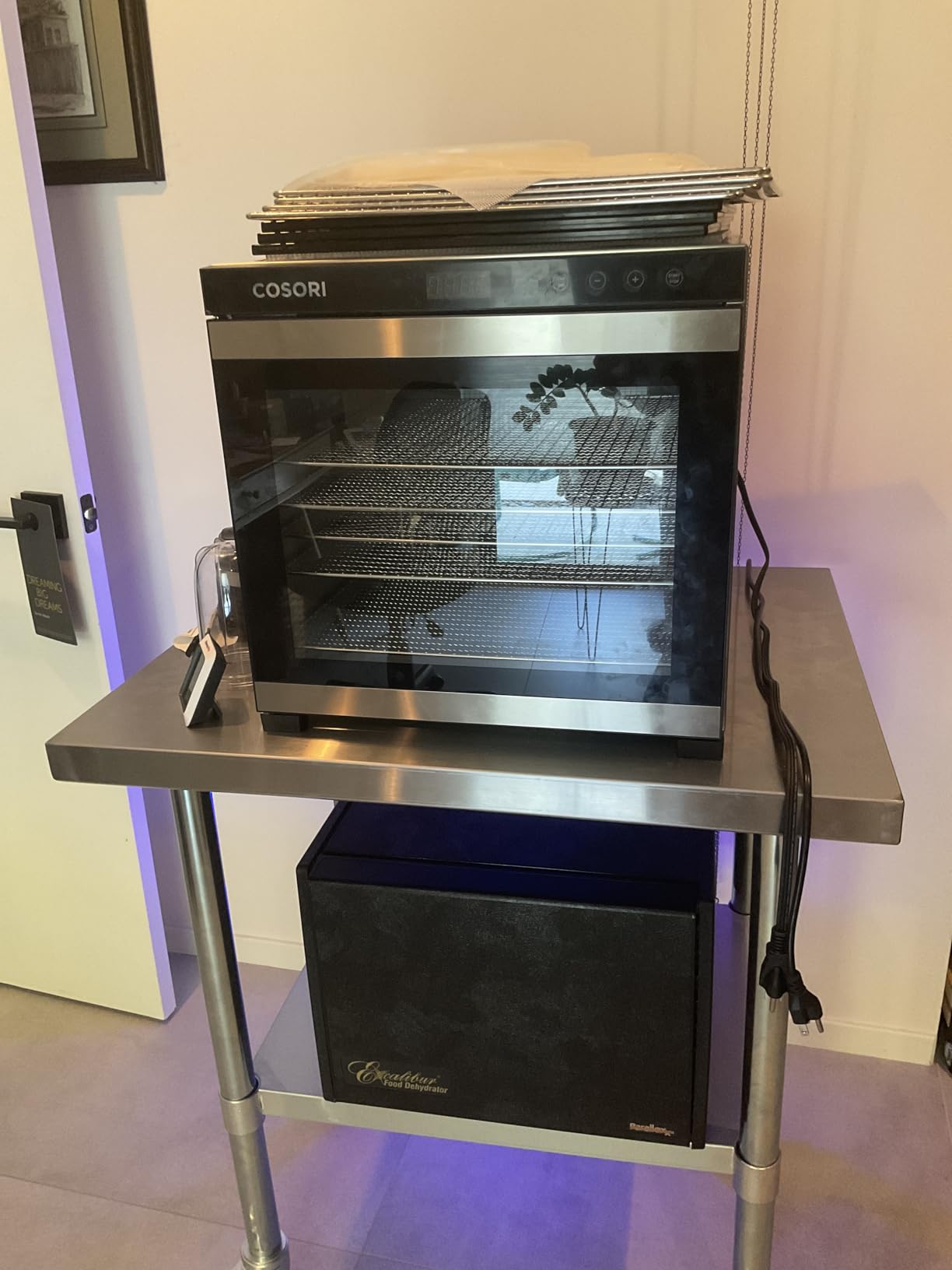
The 165 F maximum is not a limitation Cosori treats as an accident. It is a deliberate cap tied to USDA jerky safety guidance, and owners who dry at or below that ceiling report consistent results on fruit, vegetables, herbs and pet treats.
It is also the top-ranked product in the Amazon Dehydrators category, which tells you something about how the machine holds up under everyday use by a very large number of people.
At 35.8 pounds this is the heaviest model in the roundup, and the 21.3 by 16.9 by 16.4 inch footprint is not going into a small kitchen. Plan the location before you buy, and expect to set it up once rather than move it every season.
The included fruit roll sheet and mesh screen mean you can run a leather batch and a herb batch from day one without buying accessories first, which is a small thing that removes an early frustration.
What we would dry first in this machine
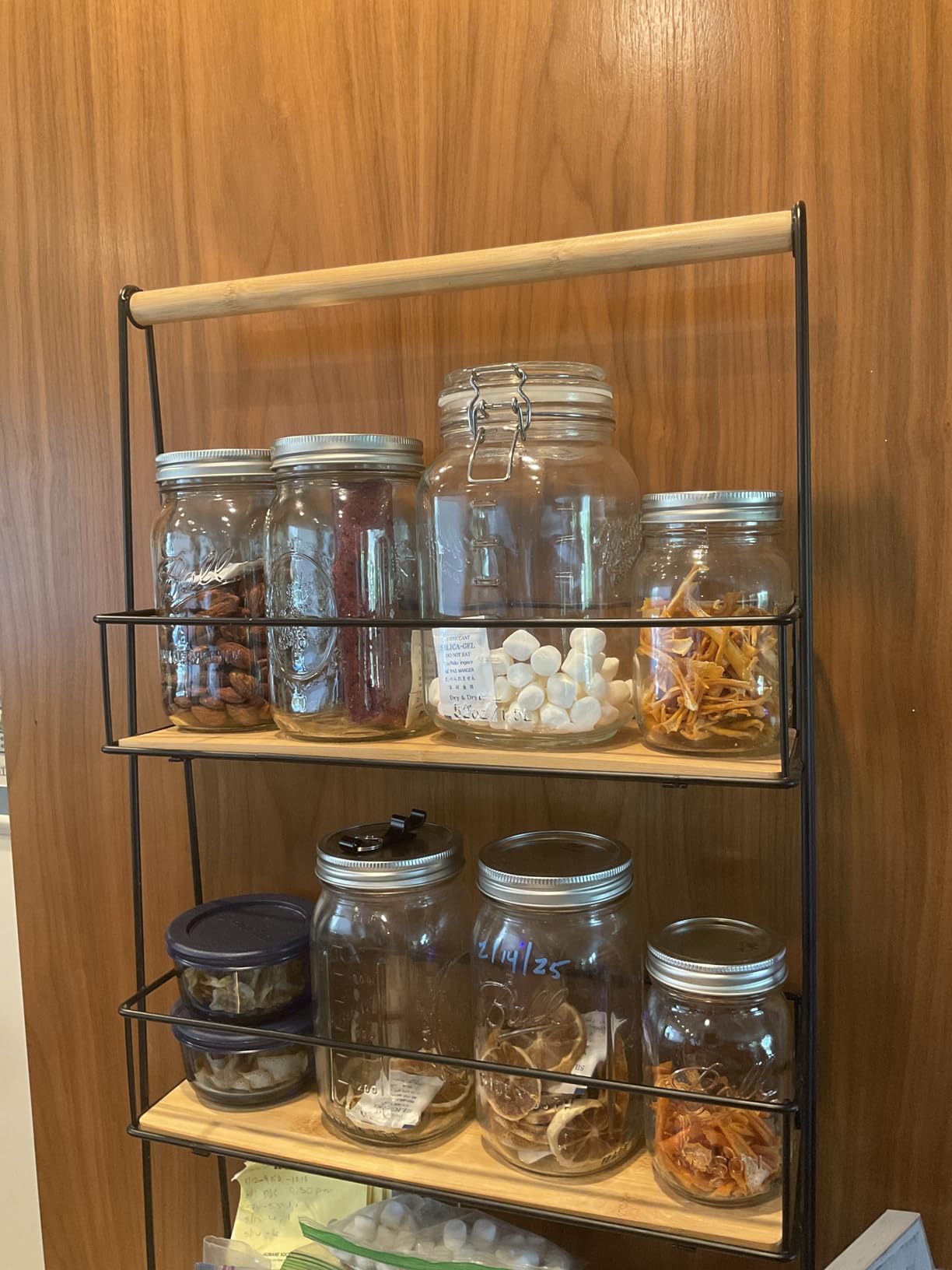
Apple chips, tomato rounds and strawberry slices, all of which want a single layer with air around each piece. The flat 16.2 sq ft surface is the best match in this roundup for laying out a large volume of slices at once.
It also handles a mixed load well. Different vegetables for the same meal, dried at the same temperature on different trays, is a common gardener project and the horizontal airflow keeps it even.
Where it will disappoint you
Any work above 165 F. The 190 F and 194 F ceilings on the Ausegia, Septree and VEVOR models exist for finishing and high-temperature recipes, and this machine simply cannot get there.
The weight and footprint are the other complaints. Thirty-five pounds of stainless is genuinely heavy to reposition, and if your drying happens in a garage or basement this is fine, but in a kitchen it becomes the feature you notice every day.
We earn a commission, at no additional cost to you. CERTAIN CONTENT THAT APPEARS ON THIS SITE COMES FROM AMAZON. THIS CONTENT IS PROVIDED 'AS IS' AND IS SUBJECT TO CHANGE OR REMOVAL AT ANY TIME.
6. Ausegia 12-Tray Food Dehydrator – Quiet Stainless Capacity
Ausegia Commercial Large 12 Trays Food Dehydrator, Usable Area up to 22.67ft², 1200W Full Stainless Steel Dryer Machine, up to 190℉ Temperature, for Meat, Fruit, Veggies, Beef, Herbs, Pet Foods
- 12 stainless trays
- Up to 22.67 sq ft
- 1200W, 110V
- 70-190 F
Pros
- Under 50 dB noise figure for indoor overnight runs
- 12 trays of 15.75 by 15.75 inch stainless
- 1200W element with 70-190 F range
- Automatic shutdown with cooling blow-off
- Dishwasher-safe trays with a non-stick sheet
Cons
- Drying runs take longer than a conventional oven
- Middle trays can need swapping
- Some reports of fan or element failure over time
We earn a commission, at no additional cost to you. CERTAIN CONTENT THAT APPEARS ON THIS SITE COMES FROM AMAZON. THIS CONTENT IS PROVIDED 'AS IS' AND IS SUBJECT TO CHANGE OR REMOVAL AT ANY TIME.
Twelve trays at 15.75 by 15.75 inches give this machine up to 22.67 sq ft of usable drying area, and the 1200W element is the second-strongest in the roundup. For a gardener who wants real volume and still wants the machine to live indoors, this is the compromise we would pick.
The published noise figure under 50 dB is what makes it interesting. Combined with the horizontal airflow from a rear-mounted fan and double-row vents, it is built for the overnight kitchen run that so many home dehydrators cannot do without waking the household.
The control panel runs 70 F to 190 F on 30-minute timer increments up to 24 hours, with automatic shutdown, a cold-air blow-off and overheat protection. That 190 F ceiling reaches higher than anything except the VEVOR in this list.
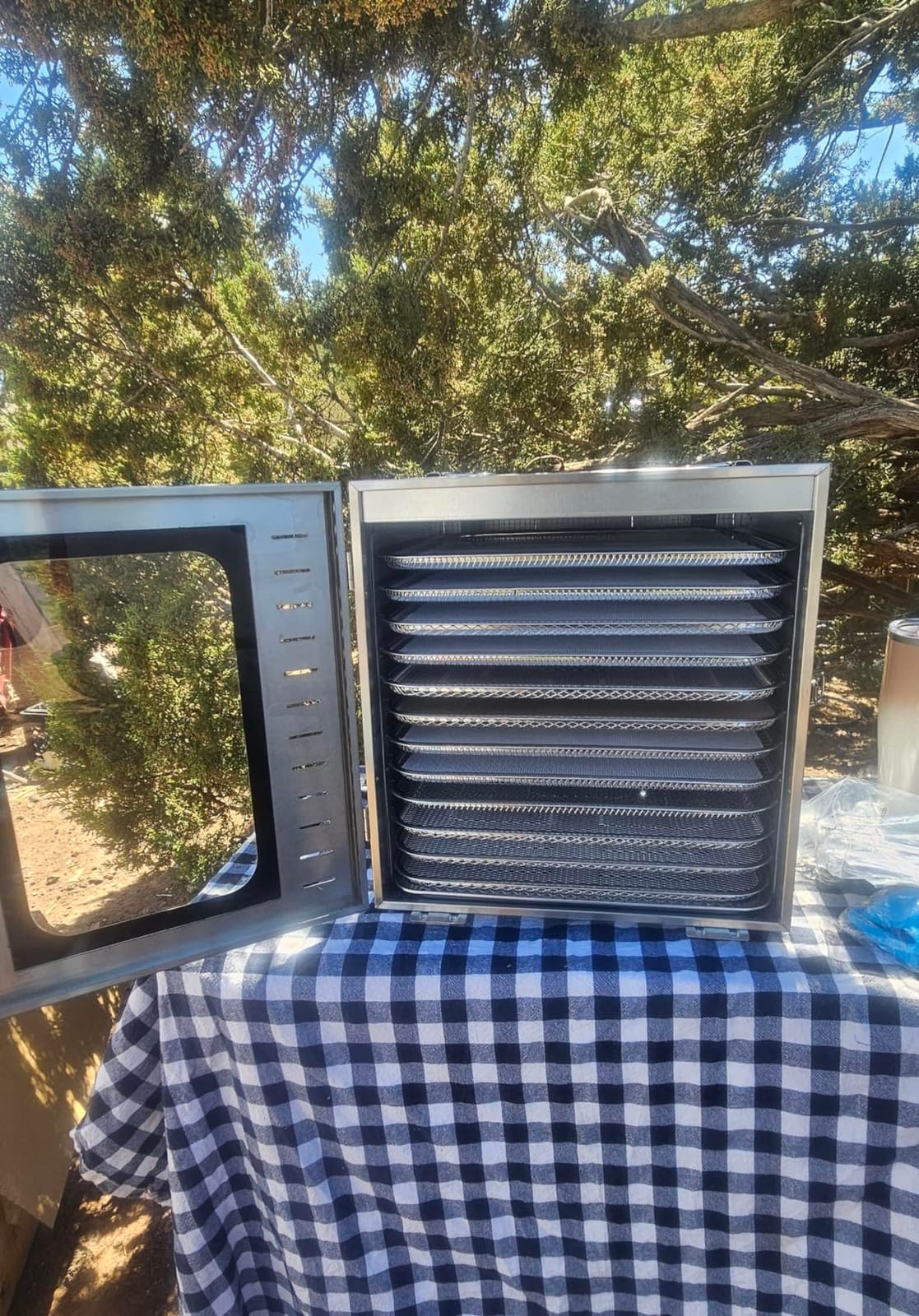
Owners use it for garden vegetables, fruit and pet food, and the recurring praise is for quiet, even drying across the whole cabinet. The glass front door lets you monitor progress and rotate trays without pulling the unit open and losing chamber heat.
The accessory package covers the small jobs: 1 drip tray, 6 silicone pads, 1 non-stick sheet, a hanger, 12 hooks and silicone gloves. The non-stick sheet is the piece that matters most for gardeners, because wet fruit sticks to bare stainless.
The honest weakness is time. Reviewers report 18 to 20 hours at 175 F for the same batch that a conventional oven finishes faster, and the 1200W element does not change the physics of evaporating water from a thick load.
There is also a note about the middle trays drying less evenly, with some owners swapping them with the top shelves partway through a run. Budget five minutes of attention for a full load rather than assuming it is completely hands-off.
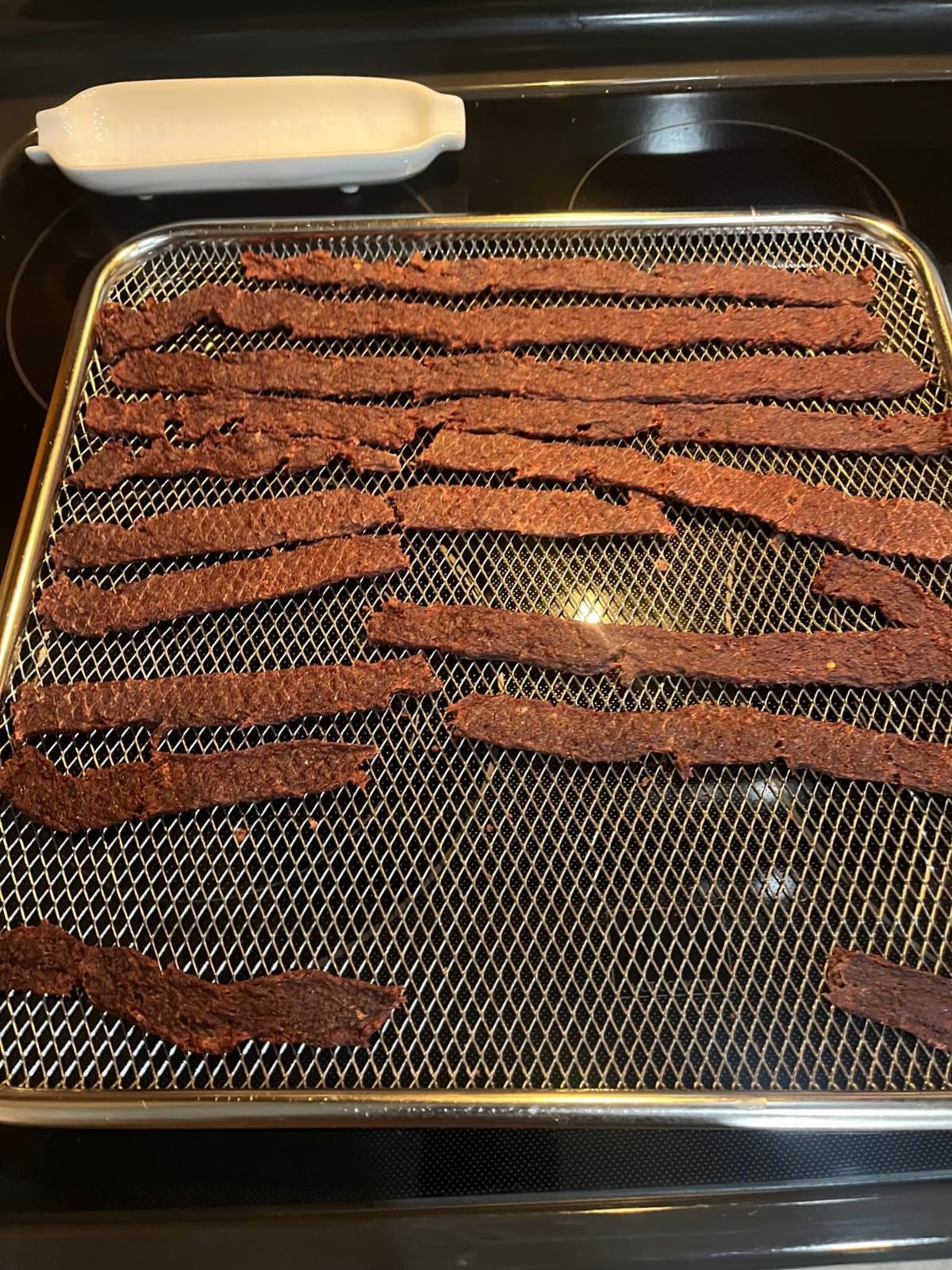
What we would dry first in this machine
Overnight kitchen runs where noise is the deciding factor. A full load of sliced peppers or apple rounds set at 135 F, started before bed and harvested in the morning, is the use case this machine was built for.
It is also a strong pet food and jerky machine at 1200W with a 190 F ceiling, and the 22.67 sq ft of area means a heavy garden load fits in one cycle.
Where it will disappoint you
Patience. If you expect a thick wet load to finish in eight hours, this will feel slow. Plan the schedule around overnight and all-day cycles instead of quick ones.
A minority of owners report the fan or the heating element failing after extended use, and replacement heating elements are reportedly hard to source. That is a parts-availability risk worth weighing on a 1200W machine you are relying on every week.
The 21.38 by 17.2 by 18.5 inch footprint is bulkier than most home users expect, so measure the counter before ordering.
We earn a commission, at no additional cost to you. CERTAIN CONTENT THAT APPEARS ON THIS SITE COMES FROM AMAZON. THIS CONTENT IS PROVIDED 'AS IS' AND IS SUBJECT TO CHANGE OR REMOVAL AT ANY TIME.
7. Septree 18-Tray Food Dehydrator – Maximum Capacity
Septree Commercial Food Dehydrator 18 Trays, 2000W Large Capacity 34.42ft² Food Dryer Machine for Jerky, Meat, Fruit, Herbs, Full Stainless Steel Industrial Dehydrater Biltong Maker
- 18 stainless trays
- 34.42 sq ft
- 2000W, 120V
- 70-190 F
Pros
- 34.42 sq ft of usable drying area in one cabinet
- 2000W rated for 7 x 24 hour continuous operation
- 70-190 F with automatic shutoff and overheat protection
- Full accessory set with 4 fruit roll trays and 2 jerky racks
- Under 50 dB with horizontal airflow
Cons
- 2000W draw needs a dedicated 120V circuit
- 29.5 inch tower takes significant vertical space
- Highest running cost per batch in this roundup
We earn a commission, at no additional cost to you. CERTAIN CONTENT THAT APPEARS ON THIS SITE COMES FROM AMAZON. THIS CONTENT IS PROVIDED 'AS IS' AND IS SUBJECT TO CHANGE OR REMOVAL AT ANY TIME.
Thirty-four square feet of drying space in a single 120V cabinet is the reason to look at this model. Eighteen stainless trays of 15.67 by 15.67 inches handle a genuine season load, and the 2000W element is rated for continuous 7 by 24 hour operation, which is a commercial duty rating rather than a home duty rating.
If your garden produces more than you can dry in a weekend, this is the only machine in the roundup that changes the schedule. A 200-pound surplus becomes a week of continuous runs instead of a month of evenings.
The 70 F to 190 F range with a 24-hour integrated timer and automatic shutoff covers everything from low-temperature fruit leather to high-temperature jerky finishing, and the horizontal airflow keeps 18 trays even without rotation.
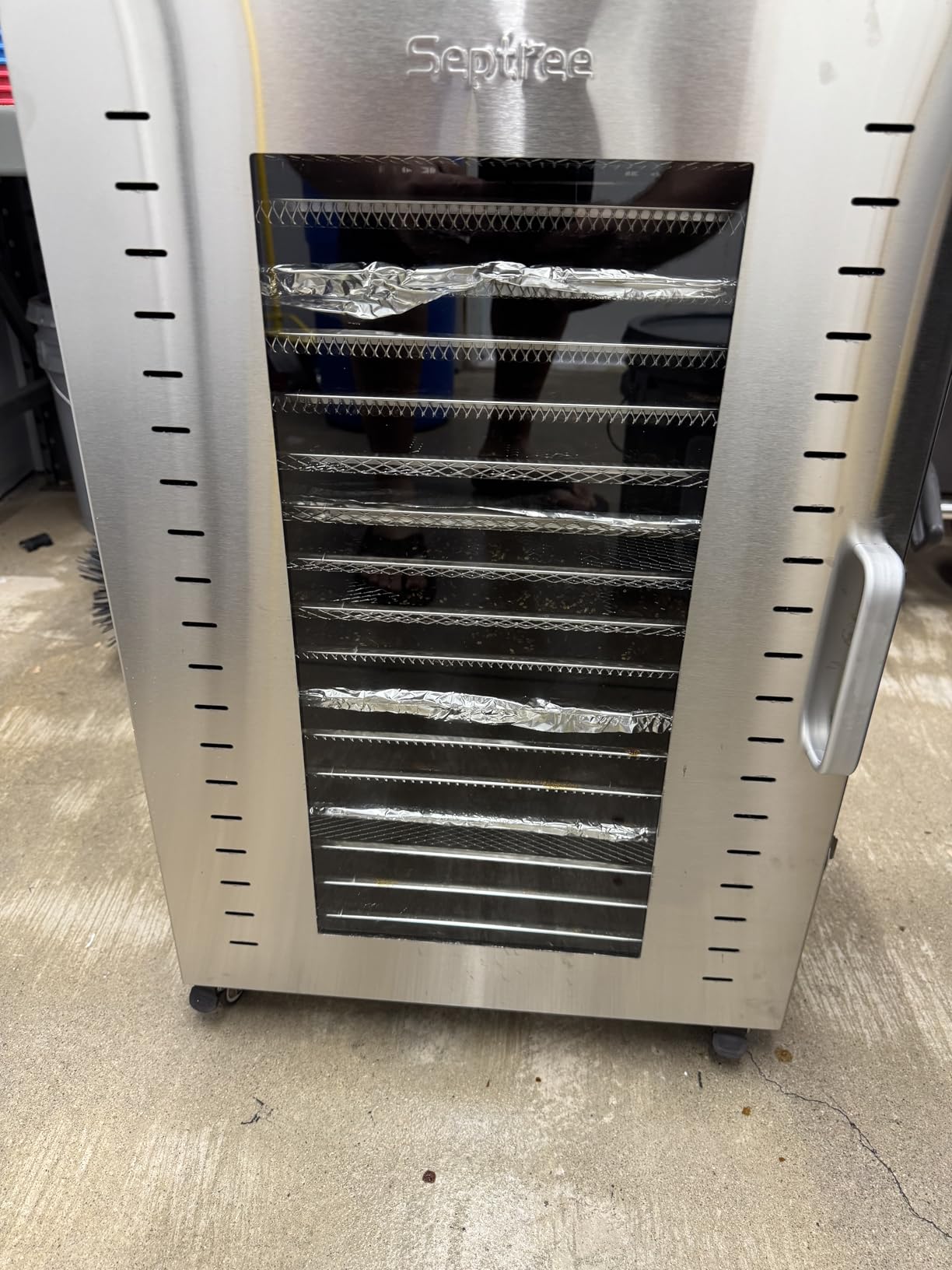
The accessory package is unusually complete for a home machine: 4 fruit roll trays, 2 hanging jerky racks, 20 hooks, a drip tray, gloves, storage containers and a recipe book. You can go from a full load of biltong to a batch of dried herbs without buying anything else.
Construction is full food-grade stainless, with dishwasher-safe trays, non-stick silicone sheets and fruit roll sheets included. Three-year after-sales service is also the longest published support commitment among the stainless cabinet models here.
The 2000W draw is the first thing to check before you buy. On a standard 15-amp kitchen circuit, a 2000W appliance is close to the limit for the circuit and the manufacturer recommends a dedicated 120V line. Check your panel before ordering, not after.
At 21.46 by 17 by 29.53 inches this is a 29.5 inch tall tower. You need vertical clearance, not just counter area, and the weight makes it a two-person lift in most cases.
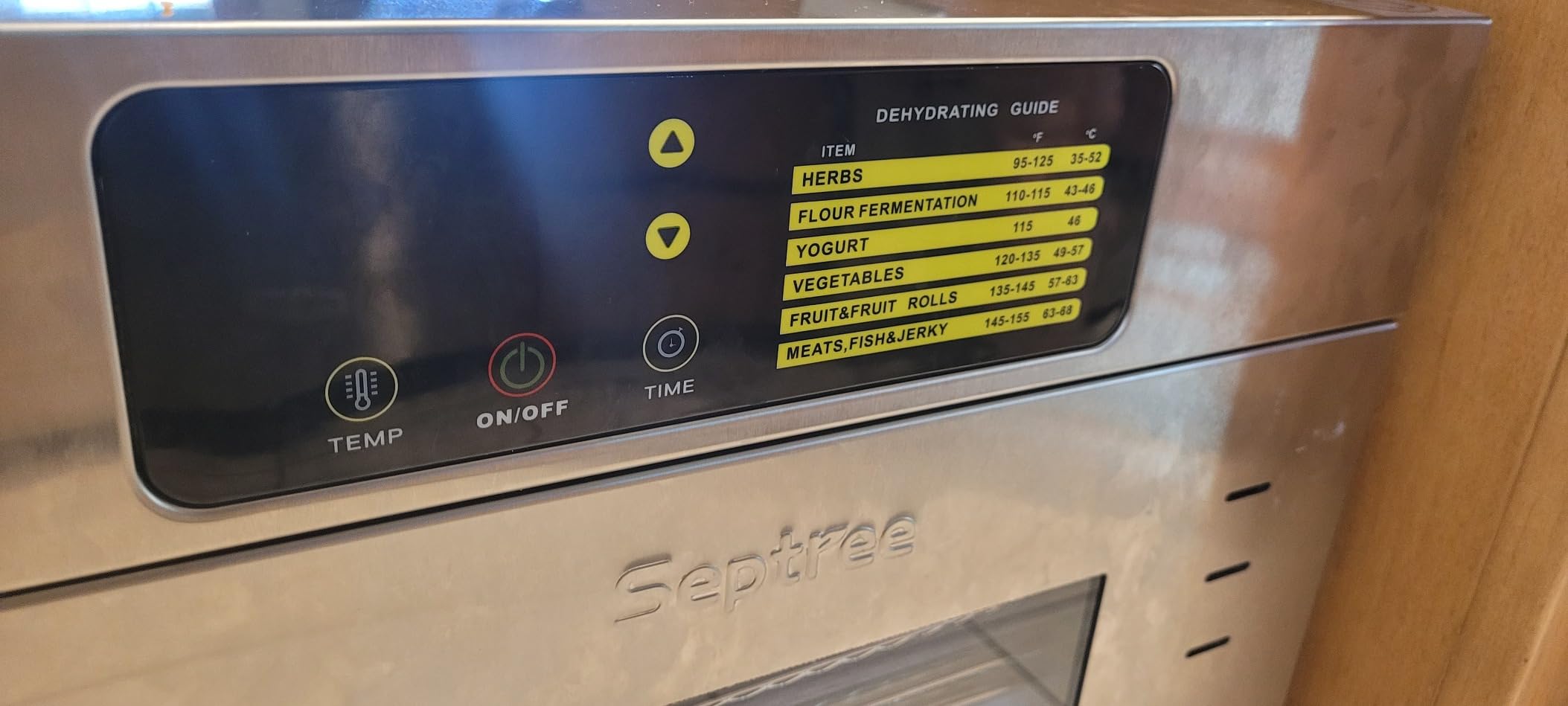
What we would dry first in this machine
Volume crops on a schedule. Potatoes, onions, peppers, beans and any crop you are working through in sequence over a week fit the continuous-run rating in a way no other machine here supports.
Jerky and biltong batches, using the included hanging racks and hooks, are the other natural fit. The high ceiling and the horizontal airflow suit a wet, dense, high-volume load.
Where it will disappoint you
Kitchens with no dedicated circuit. This is the single model in the roundup where electrical capacity is a genuine precondition rather than a preference, and adding a circuit is a job that costs real money.
Running cost is the other factor. At 2000W, an 18-hour batch consumes about 36 kilowatt-hours, and repeated continuous runs over a season make this the most expensive machine here to operate.
If your garden only produces a few bushels a year, the 18 trays will sit half-empty most of the time and the 12-tray Ausegia will do the same work at lower cost.
We earn a commission, at no additional cost to you. CERTAIN CONTENT THAT APPEARS ON THIS SITE COMES FROM AMAZON. THIS CONTENT IS PROVIDED 'AS IS' AND IS SUBJECT TO CHANGE OR REMOVAL AT ANY TIME.
8. VEVOR 10-Tray Food Dehydrator – Widest Temperature Range
VEVOR Food Dehydrator, 10 Trays Stainless Steel Food Dehydrator Machine, 1000W Dehydrators with Digital Adjustable Timer & Temp, Dehydrator for Jerky Herb Meat Beef Fruit Dog Treats and Vegetables
- 10 stainless trays
- Up to 1.7 lb per tray
- 1000W, 120V
- 86-194 F
Pros
- 194 F ceiling is the highest in this roundup
- Each tray holds up to 1.7 pounds of food
- 1000W with rear fan and 360 degree circulation
- Built-in LED interior light
- 0.5 to 48 hour digital timer
Cons
- 31.1 pounds is awkward to move
- Body is 201 stainless while trays are 304
- Higher share of 4-star reviews than the leaders
We earn a commission, at no additional cost to you. CERTAIN CONTENT THAT APPEARS ON THIS SITE COMES FROM AMAZON. THIS CONTENT IS PROVIDED 'AS IS' AND IS SUBJECT TO CHANGE OR REMOVAL AT ANY TIME.
The 86 F to 194 F range is the widest in this roundup, and it is the reason this machine is on the list. Most consumer dehydrators cap at 165 or 167 F because of jerky safety guidance, but if your drying plan includes finishing work, low-temperature fruit drying near the bottom of the range, or a hotter cabinet, this is the one that reaches.
The published per-tray load is the other number worth knowing. Each of the 10 trays holds up to 1.7 pounds, so a full cabinet is a genuinely heavy batch, and the 1000W element with a rear-mounted fan and 360 degree circulation is sized to move that much moisture.
Gardeners with a serious potato, onion or squash harvest will like the tray area, and the built-in LED interior light lets you check the lower trays without opening the door and losing chamber heat.
Trays are food-grade 304 stainless at 14.8 by 11.2 inches, dishwasher-safe, with silicone roll sheets, a mesh sieve, heat-resistant gloves and a recipe book included. The mesh sieve is useful for herbs and small seeds, which are tedious to dry on a solid tray.
The timer runs 0.5 to 48 hours on a digital control, which is long enough for thick squash or sweet potato slices that stall in shorter machines.
Note the mixed stainless build: the body is corrosion-resistant 201 stainless while the food-contact trays are 304. That is a sensible cost-saving choice and it does not affect food safety, since the trays are the part that touches produce, but it is worth knowing the two grades are not the same.
At 31.1 pounds the machine is heavy to move. The 18.1 by 15.94 by 18.3 inch footprint is manageable, but this is not a machine you reposition between the pantry and the counter every season.
What we would dry first in this machine
Thick root crops. Potatoes, sweet potatoes, onions and winter squash take 24 hours or more, and the combination of a 48-hour timer and a 194 F ceiling means you can finish crisping at high heat after a long low-temperature pull.
Loaded fruit and vegetable batches also fit well, since 1.7 pounds per tray lets you fill a tray instead of spreading slices thinly across it.
Where it will disappoint you
Anyone who needs to move the machine regularly. Thirty-one pounds of stainless with a tall body is a permanent kitchen fixture rather than a portable appliance.
The rating spread is also worth noting. A 4.6 average is strong, but this model carries a noticeably larger share of 4-star reviews than the leaders in this roundup, which points to some inconsistency between what owners expected and what they got.
We earn a commission, at no additional cost to you. CERTAIN CONTENT THAT APPEARS ON THIS SITE COMES FROM AMAZON. THIS CONTENT IS PROVIDED 'AS IS' AND IS SUBJECT TO CHANGE OR REMOVAL AT ANY TIME.
9. Excalibur 8-Tray Food Dehydrator – Longest Timer
Excalibur Food Dehydrator Select Series for Jerky, Fruit, Vegetables, Herbs, Pet Treats with Adjustable Temperature Control, 8-Tray
- 8 chrome-plated trays
- 7.2 cu ft
- 700W, 120V
- 85-165 F
Pros
- 80-hour timer is the longest in this roundup
- Hyperwave Pulse horizontal airflow dries without rotation
- Compact footprint with more space than typical boxes
- Clear glass French doors for monitoring
- Lightest stainless-tray option at 16.5 pounds
Cons
- Chrome-plated trays rather than stainless
- 165 F ceiling
- 700W is modest on large wet loads
We earn a commission, at no additional cost to you. CERTAIN CONTENT THAT APPEARS ON THIS SITE COMES FROM AMAZON. THIS CONTENT IS PROVIDED 'AS IS' AND IS SUBJECT TO CHANGE OR REMOVAL AT ANY TIME.
The 80-hour digital timer is the distinguishing feature here. It is longer than the 48-hour timers on the Cosori, Magic Mill and VEVOR units and more than three times the 24-hour maximum on the Ausegia and Septree cabinets, and for thick root crops that need two full days in the machine, that range is the difference between one overnight run and a rescheduled weekend.
The drying system is the patented Hyperwave Pulse Technology with Horizontal Parallex Air Flow, which circulates air across every tray so no rotation is needed. That matters most on the long runs this timer enables, because swapping trays at hour 30 is not something you want to be doing.
At 16.5 pounds it is the lightest stainless-tray option in the roundup, and the 17.32 by 13.39 by 14.08 inch body is genuinely compact. For a gardener drying in a garage, basement or small utility room, moving it is not a chore.
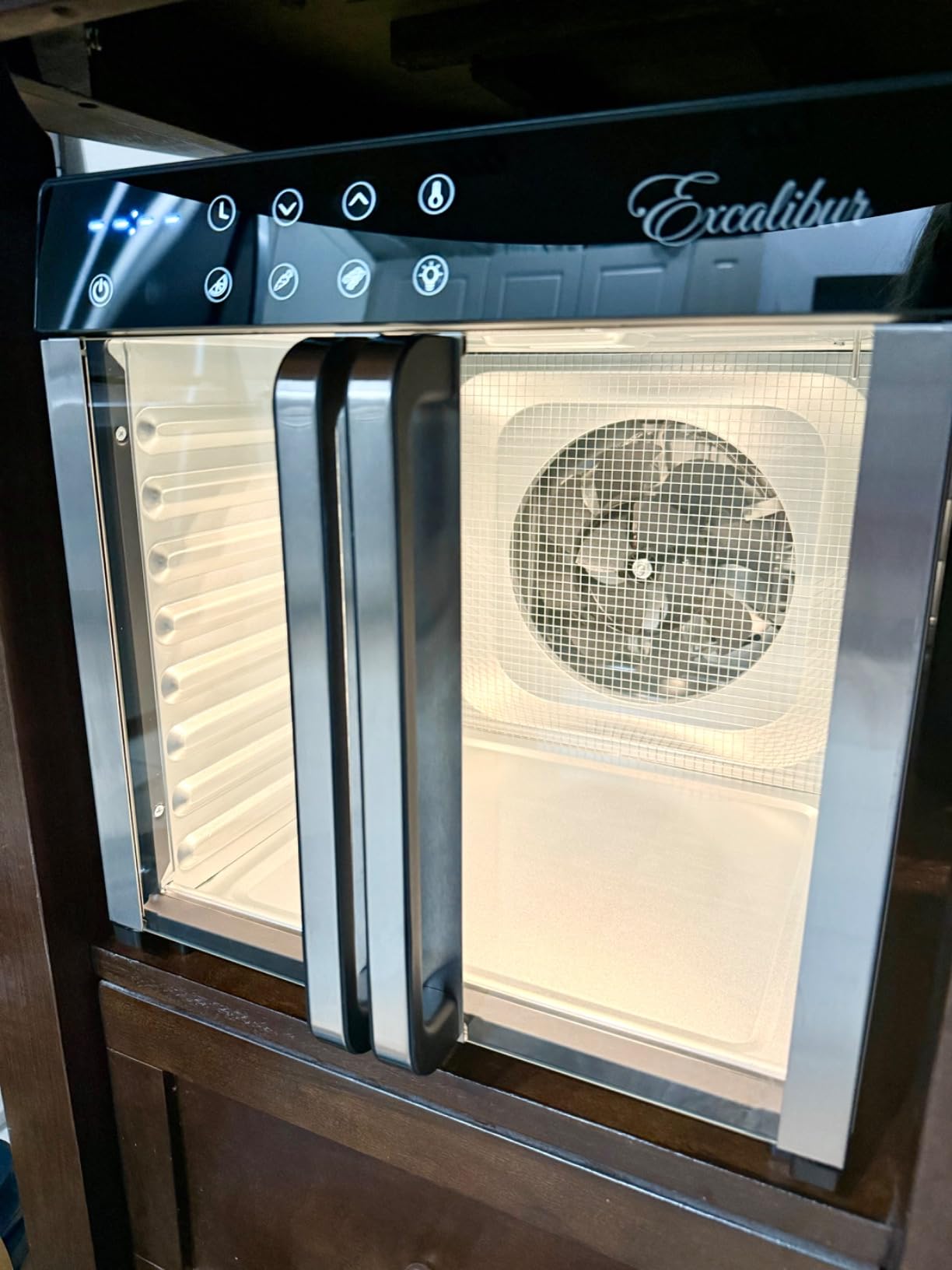
The 7.2 cu ft of drying space sits in that compact footprint, which is a good compression of capacity into a small volume. Clear glass French doors mean you can watch a full load without opening anything, useful when you are checking progress on a long unattended cycle.
The adjustable thermostat covers 85 F to 165 F, so the 85 F floor is the lowest start temperature in this roundup. That is useful for delicate herbs and low-temperature fruit work where 95 F can be too aggressive.
The real compromise is the trays. These are chrome-plated rather than full stainless steel, which is why this lands at 16.5 pounds. Chrome-plated trays handle normal fruit and vegetable drying fine, but they are the ones to watch for sticking and staining with wet, sugary loads like fruit leather or marinated jerky.
The 700W element is modest next to the 1000W and 1200W machines here. A large wet batch will take its time, and the 80-hour timer is permission to let it, not a substitute for element power.
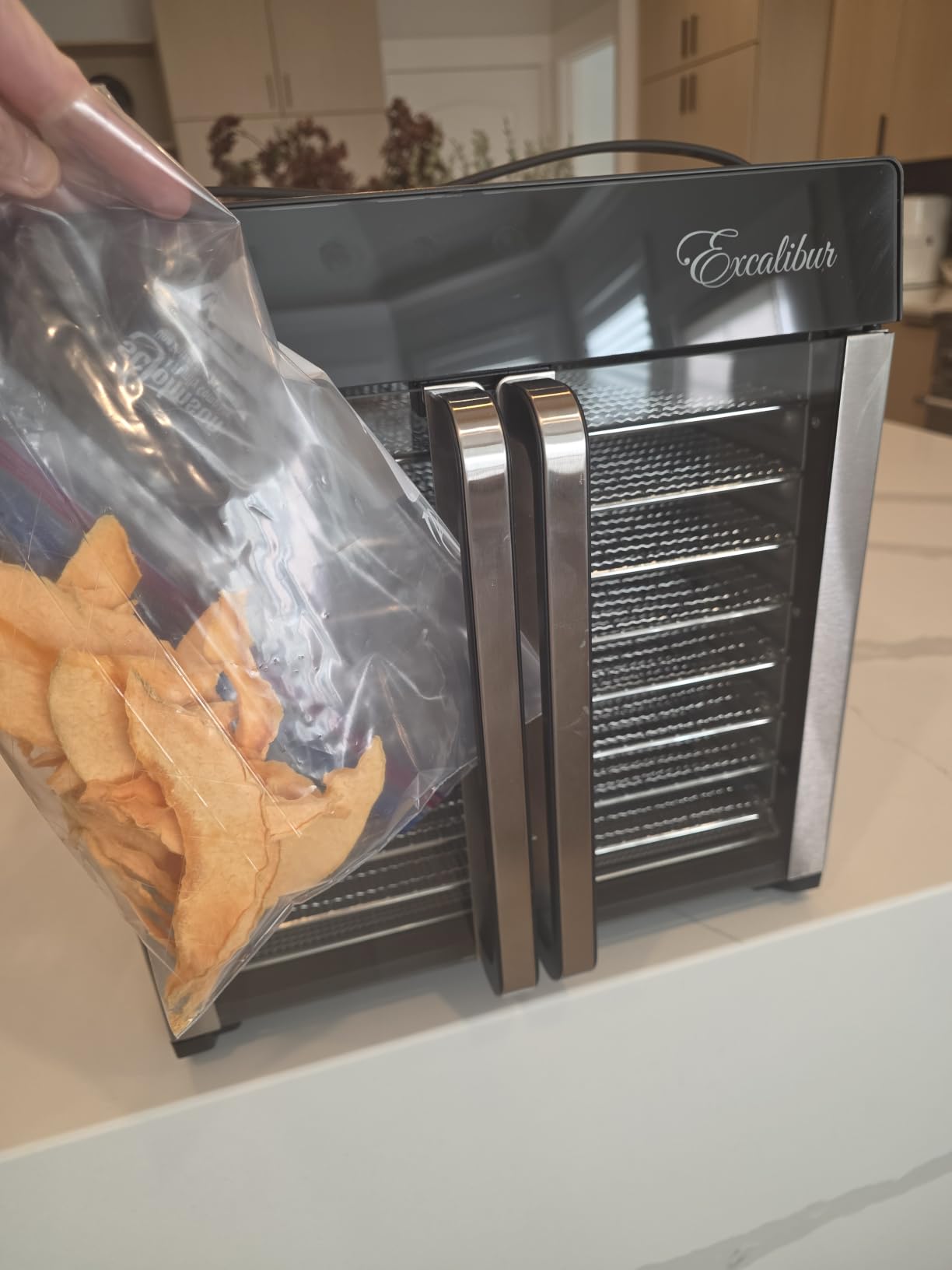
What we would dry first in this machine
Long root vegetable runs. Thick slices of potato, sweet potato or squash that need 24 to 36 hours are exactly the workload the 80-hour timer was built for.
Low-temperature herb drying also benefits from the 85 F floor, which is cooler than the 95 F minimum on most of the stainless units in this roundup.
Where it will disappoint you
Wet, sticky loads. Chrome-plated surfaces are the least forgiving in the roundup for fruit leather and wet-marinated jerky, and this is the machine to avoid if that is your main project.
The 165 F ceiling is at the low end, and 700W means a full cabinet of fresh-cut vegetables takes considerably longer than in a 1000W box. It is a patient machine rather than a fast one.
We earn a commission, at no additional cost to you. CERTAIN CONTENT THAT APPEARS ON THIS SITE COMES FROM AMAZON. THIS CONTENT IS PROVIDED 'AS IS' AND IS SUBJECT TO CHANGE OR REMOVAL AT ANY TIME.
10. Samson 9-Tray Food Dehydrator – Longest Warranty
Samson “Silent” 9 Tray Dehydrator with Stainless Steel Trays
- 9 stainless trays
- 9.6 sq ft
- 600W, 120V
- Five-year warranty
Pros
- Five-year limited warranty is the longest here
- 9 stainless trays with 9.6 sq ft of space
- Up to 1 pound of food per tray
- Top-front LCD panel is easy to read
- Food preparation chart covering over 40 foods
Cons
- 600W is the lowest wattage in this tray class
- Plastic body with stainless trays
- No published temperature range in the listing
We earn a commission, at no additional cost to you. CERTAIN CONTENT THAT APPEARS ON THIS SITE COMES FROM AMAZON. THIS CONTENT IS PROVIDED 'AS IS' AND IS SUBJECT TO CHANGE OR REMOVAL AT ANY TIME.
A five-year limited warranty is unusual in a category where one year is common, and for a machine you might run every week for a decade that coverage is a real part of the value. The warranty length is also why this model sits on the list despite a 600W element that would otherwise be a mid-pack number.
The layout is practical: nine stainless trays of 13 by 12 inches giving 9.6 sq ft, with up to 1 pound of food per tray. The push-button digital panel with an LCD sits at the top front, so you set the cycle while standing up rather than crouching to read a panel near the floor.
Buyers describe it as quiet for its size, and it runs 600W on a standard 120V outlet, so it presents no circuit concerns at all. A printed food preparation chart covering more than 40 foods is included, which is a small but real help for a first-year gardener.
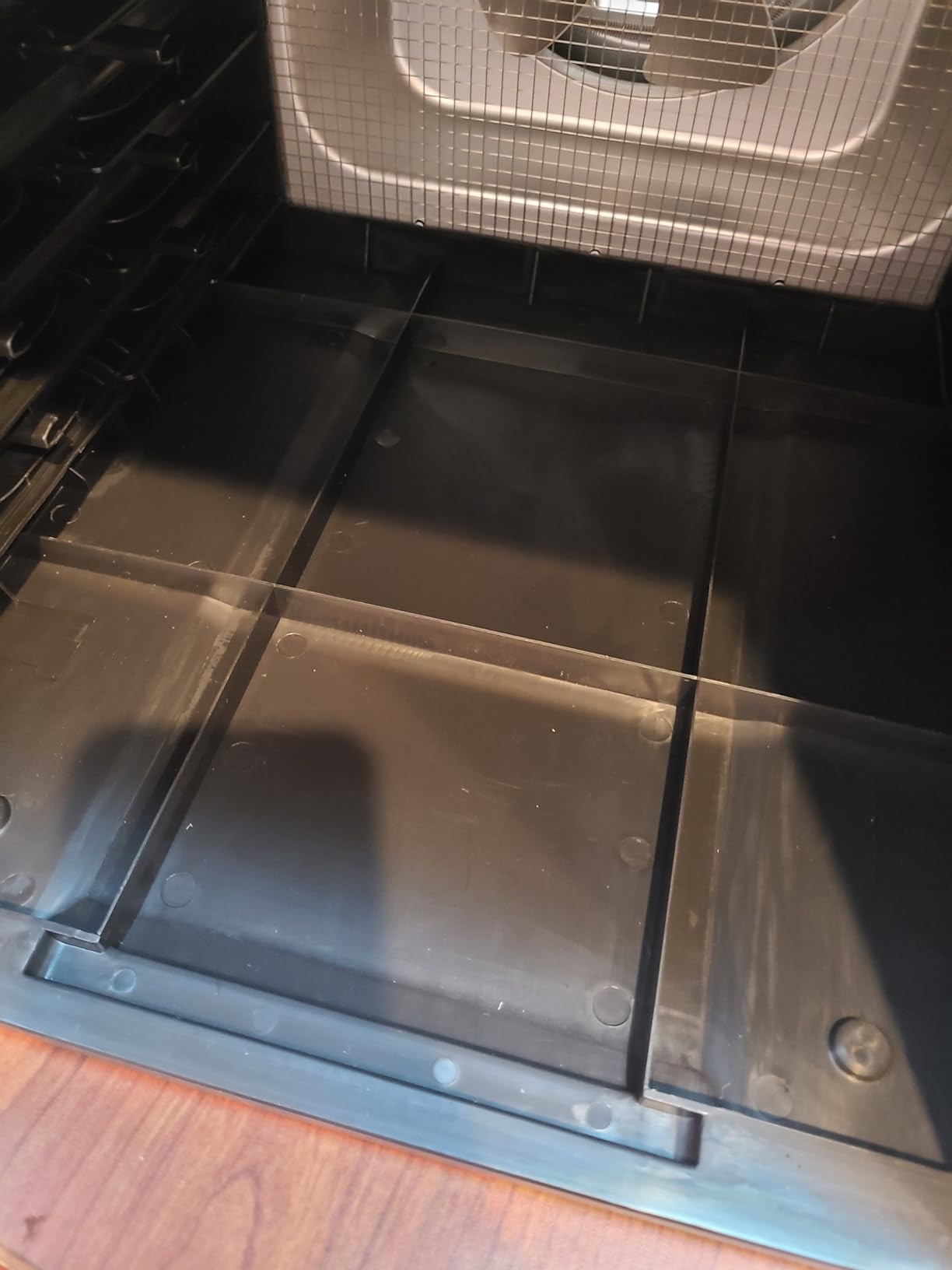
At 17.75 by 12.51 by 16.5 inches it is a reasonably compact body for 9.6 square feet of tray area, and the square trays suit flat, single-layer loads of sliced fruit and vegetables.
The 1 pound per tray figure is worth using to size your batches. A full cabinet is roughly 9 pounds of prepared produce, which is a solid weekend load for a small to medium garden.
The body is plastic with stainless trays rather than a full stainless build. Food contact is on the stainless trays, so this is a durability and staining question rather than a safety one, and it is part of why the machine is this light.
One detail to note: the listing does not publish a temperature range. For anyone drying jerky, where the target temperature is a safety requirement, an unpublished range is a genuine gap. Confirm the range with the manufacturer before relying on it for meat.
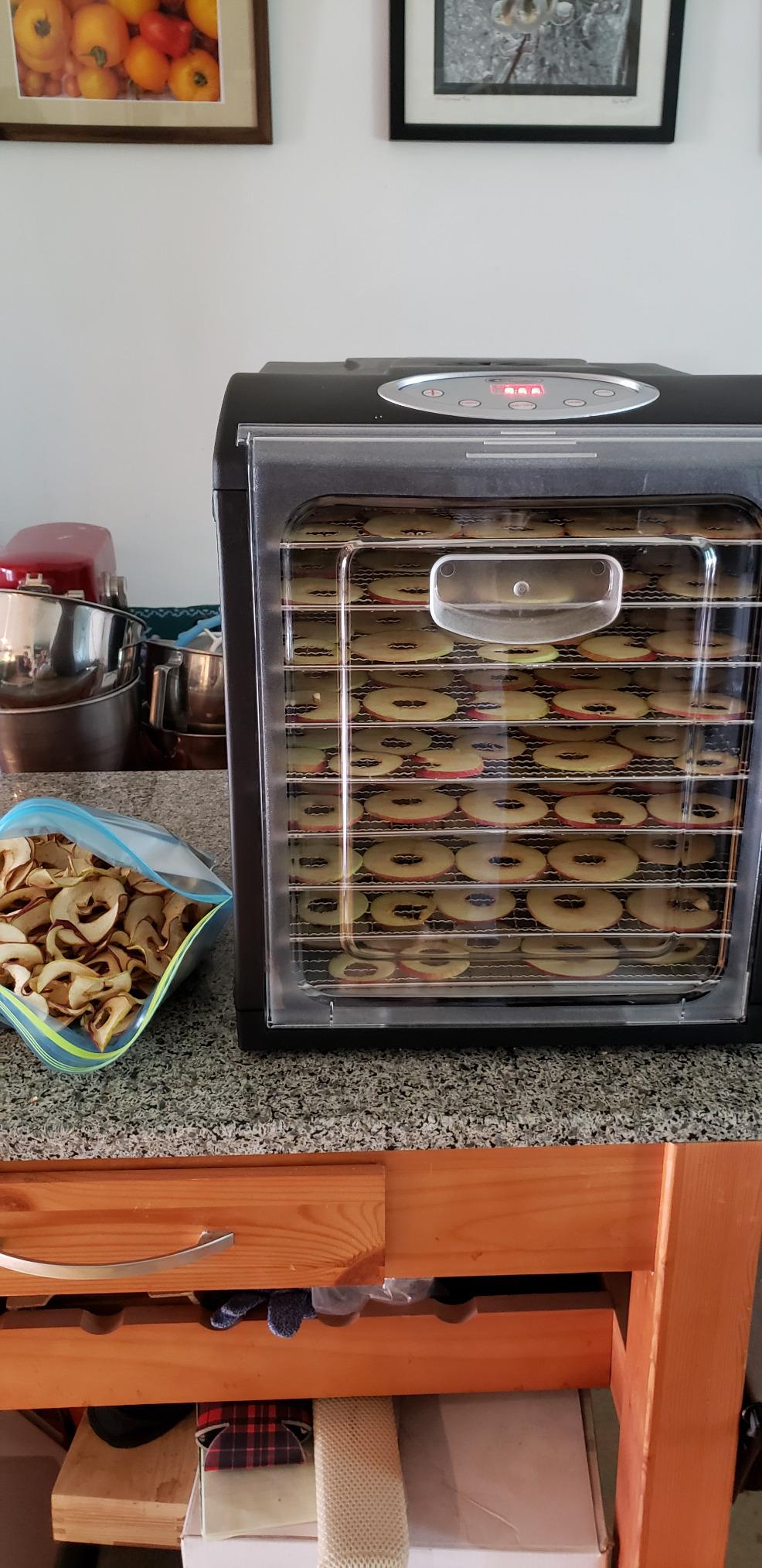
What we would dry first in this machine
Everyday cooking crops rather than hobby projects. Dried onion, carrot and pepper for a mirepoix-style base, or herb bundles for the pantry, are exactly the kind of regular use that justifies buying a machine with a five-year warranty.
Small fruit batches also work well, since 1 pound per tray leaves the pieces spaced rather than touching, which is what you want for even drying.
Where it will disappoint you
Large wet loads. At 600W across nine trays, a full cabinet of fresh-cut vegetables is the slowest dry in this roundup, and the low sales rank suggests a smaller pool of owners dealing with common problems.
The lack of a published temperature range is the bigger practical issue. If jerky is part of your plan, do not rely on an unspecified ceiling. Treat this as a fruit and vegetable machine and check the range first if meat is involved.
We earn a commission, at no additional cost to you. CERTAIN CONTENT THAT APPEARS ON THIS SITE COMES FROM AMAZON. THIS CONTENT IS PROVIDED 'AS IS' AND IS SUBJECT TO CHANGE OR REMOVAL AT ANY TIME.
How to Size a Dehydrator to Your Garden Harvest
Start with pounds, not bushels. A bushel of peppers and a bushel of apples are wildly different loads once they are sliced, because fruit dries onto a thin surface and vegetables dry through the thickness of the piece. The number that matters is prepared weight per tray, and the useful figure is how much the tray can hold before pieces start touching.
Published per-tray loads run from about 1 pound on the Samson 9-tray to 1.7 pounds on the VEVOR. If you are slicing fruit thin and spacing every piece, plan nearer the lower end. If you are drying herbs, which need almost no spacing and hold far less weight, a tray holds a fraction of either number.
Then multiply. A 20-pound Roma surplus prepared at 135 F typically needs two overnight runs on a 6.5 sq ft machine and fits in one run on a 22.67 sq ft or 34.42 sq ft cabinet. That single calculation tells you more than any tray-count comparison.
Finally, check the drying time budget honestly. A 1200W machine at 18 to 20 hours per batch and a 2000W machine at similar hours are very different propositions from a 600W machine that needs most of a day. Multiply hours per batch by batches per season and you have a rough energy figure, and a 2000W element running 18 hours burns about 36 kilowatt-hours for that load.
True Commercial vs Commercial Style: What Home Gardeners Actually Need
A true commercial food dehydrator is designed for a restaurant kitchen: 208V or 240V power, a dedicated hardwired circuit, and in many jurisdictions a licensed kitchen if you intend to sell the finished product. For home preserving, that equipment is unnecessary complexity.
A commercial style food dehydrator is the same construction idea scaled to a home electrical system. Stainless interior, a rear-mounted or top-mounted fan forcing air across the trays at once, a digital thermostat and a timer with automatic shutoff, all on a 120V plug. Every machine in this roundup is a commercial style unit in that sense.
The one exception to check is the 2000W Septree, which is 120V but close to the limit of a standard 15-amp kitchen circuit. The manufacturer recommends a dedicated line, and a 2000W heater is effectively a small dedicated appliance. Every other model here runs comfortably on a normal outlet.
There is a third category worth knowing about. Solar dehydrators are a real alternative for fall harvest when days are short and cool, and homesteaders on gardening forums use them that way. They need no power at all, but drying speed depends entirely on the weather, and you cannot hold a specific temperature for jerky work.
Pre-Treatment and the Chewy Fruit Fix
The most common complaint in dehydrating forums is not a broken machine. It is chewy, leathery fruit that never reaches the crisp texture people expect. Gardeners with perfectly capable dehydrators hit this constantly, and the fix is almost always in the preparation, not the hardware.
Slice thickness is the first variable. A uniformly thin slice dries to a crisp texture; a thick center stays leathery no matter how long you run the cycle. Cut everything to the same thickness, and treat thick vegetables separately from thin ones rather than loading them together.
Spacing is the second. Pieces touching each other create a shared pocket of trapped moisture. On a flat stainless tray, lay slices with air between every piece. The 16.2 sq ft of flat area on the Cosori 10-tray and the 22.67 sq ft on the Ausegia exist precisely so you can spread a load out instead of stacking it.
Third, pre-treatment. Blanch vegetables briefly in boiling water before loading, because blanching breaks down cell walls that otherwise hold water inside. Apples, pears, peaches and potatoes benefit from a short dip in diluted lemon or citric acid water, which slows browning and helps them keep their color.
Fourth, prevent sticking. Fruit sits stuck like glue to bare liner sheets often enough that whole batches get scraped into the bin. Use the non-stick sheets and silicone pads included with the Ausegia, the Magic Mill liner or the Cosori fruit roll sheet, and do not press soft fruit flat against the metal.
Fifth, know when to stop. A piece that bends without breaking and feels leathery is not done. A finished piece should snap cleanly, and dried herbs should crumble in your fingers. If it bends like a strap, give it more time rather than raising the temperature, because high heat drives moisture to the surface and hardens the outside while the center stays wet.
Buying Guide: What Actually Decides the Purchase
Drying space in square feet, not tray count. Two machines with the same tray count can differ by double in usable area, and square feet is the number that predicts how long a harvest takes. Use it to convert your prepared pounds per batch into the number of runs you need.
Airflow design, because it determines how much attention a batch needs. Every unit here uses a fan to move air horizontally or top-down across all trays, which is what removes the constant tray rotation that vertical-flow designs demand during long garden runs. That single feature is worth more to a gardener than any preset program.
Temperature range and increment control. 165 F is a common and safe ceiling driven by USDA jerky guidance, and it is fine for fruit, vegetables, herbs and most jerky. If you want finishing work above that, only the 190 F and 194 F machines in this roundup will do it. Degree-level increments matter most for meat, where holding a safe temperature through a long unattended run is a safety requirement rather than a preference.
Wattage relative to load size. Higher wattage does not change the physics of evaporating water, but it changes how many hours a thick wet batch occupies the machine. A 600W machine with 7 trays is a different proposition from a 2000W machine with 18, and neither is wrong. Match the element to the batch you actually intend to run.
Electrical requirements. Every model here is 120V. The 2000W Septree wants a dedicated circuit; the rest are fine on a standard kitchen outlet. If you are tempted by a true commercial cabinet, the 240V requirement is the real reason most home gardeners stop short of one.
Noise for indoor runs. The Cosori 6-tray publishes a figure below 48 dB and the Ausegia and Septree publish under 50 dB. The NESCO Gardenmaster Pro is the outlier and owners routinely move it to a garage or basement. Decide where the machine will live before choosing.
Footprint, weight and tray shape. Counters and cabinets decide how many trays you can actually use. Square flat trays suit single-layer fruit slices; round trays hold more of a thick or curved piece. And note the weights: the Cosori 10-tray is 35.8 pounds and the VEVOR is 31.1, so neither is a machine you reposition every season.
Warranty and certification, last. The Samson 9-tray carries a five-year limited warranty, the Cosori models two years, and the Magic Mill Pro 7-tray is ETL Listed, which means an independent lab has verified its electrical safety. Longer coverage matters on a machine you will run weekly for years.
Frequently Asked Questions
What size dehydrator do I need for a large garden harvest?
Size it by prepared pounds per batch and by tray area in square feet, not by tray count. Thin fruit slices need air between pieces, so a 6.5 sq ft cabinet handles a 20-pound Roma surplus in two overnight runs, while a 22.67 sq ft or 34.42 sq ft unit handles it in one. Plan for 8 to 20 hours per batch depending on crop thickness and wattage.
How many trays do I need to dehydrate a large harvest?
Count the pounds you need to move, then divide by the per-tray load, which runs from about 1 pound to 1.7 pounds depending on the machine. Multiply that by the number of days in your harvest window and you get the tray count that avoids serial all-day batches. If the result exceeds 10 trays, the expandable NESCO Gardenmaster Pro is worth a look.
Can I use a commercial style dehydrator in my home kitchen?
Yes, as long as it is a commercial style unit rather than a true commercial cabinet. Every model in this roundup runs on a standard 120V household outlet. The one exception is the 2000W Septree 18-tray, which is close to the limit of a 15-amp kitchen circuit and is best given a dedicated 120V line. True commercial units at 240V are a different category entirely.
Do food dehydrators need a dedicated circuit?
Most home-rated stainless models do not. Anything at 1000W or below fits comfortably on a standard 120V kitchen outlet. A 2000W model is the exception, since it can approach the 15-amp circuit limit on its own, so check your electrical panel and add a dedicated line if needed before ordering.
Why is my dehydrated fruit chewy instead of crisp?
Almost always a preparation problem rather than a machine problem. Cut every piece to the same thickness, leave space between slices so air can move around them, and give the batch more time rather than more heat. High heat hardens the outside while the center stays wet. Blanch vegetables first and dip cut apples, pears or peaches in diluted lemon water to improve the result.
Do I need to blanch vegetables before dehydrating them?
Yes for most vegetables. A short blanch in boiling water breaks down cell walls that otherwise trap moisture inside the piece, which is the difference between a crisp dried bean and a leathery one. Fruit does not need blanching, but a brief dip in diluted lemon or citric acid water slows browning and helps slices keep their color.
Can I run a dehydrator overnight safely?
Yes, provided the machine has automatic shutoff and overheat protection, which every model in this roundup has. Set the timer to your batch length, use the rear or top-mounted fan design that circulates air without rotation, and leave clearance around the cabinet for airflow. If noise is the concern, the Cosori 6-tray publishes a figure below 48 dB while the NESCO Gardenmaster Pro is the loudest here and is usually run in a garage or basement.
Conclusion
After working through ten commercial style food dehydrators, the Magic Mill Premium 15-Tray is the best overall pick for home gardeners. Fifteen extra-large stainless trays, a rear fan that dries every level without rotation, a 48-hour timer and a compact footprint add up to the best balance of capacity, control and convenience in the roundup, backed by 4,336 ratings.
Pick the Cosori 6-Tray instead if you are a small-volume gardener who wants quiet overnight kitchen runs, and the Cosori’s degree-level control and sub-48 dB brushless motor make it the safest, most proven choice. If your garden produces a genuine seasonal surplus, step up to the Ausegia 12-Tray for 22.67 sq ft of quiet stainless capacity, or the Septree 18-Tray if you can add a dedicated circuit and want a whole harvest in one load.
Whatever you choose, the machine is only half of it. Slice thickness, spacing between pieces and enough drying time decide the texture far more often than the hardware does. Whatever happens, those three details are what separate crisp fruit from leathery disappointment, and no dehydrator on this list will fix them for you.