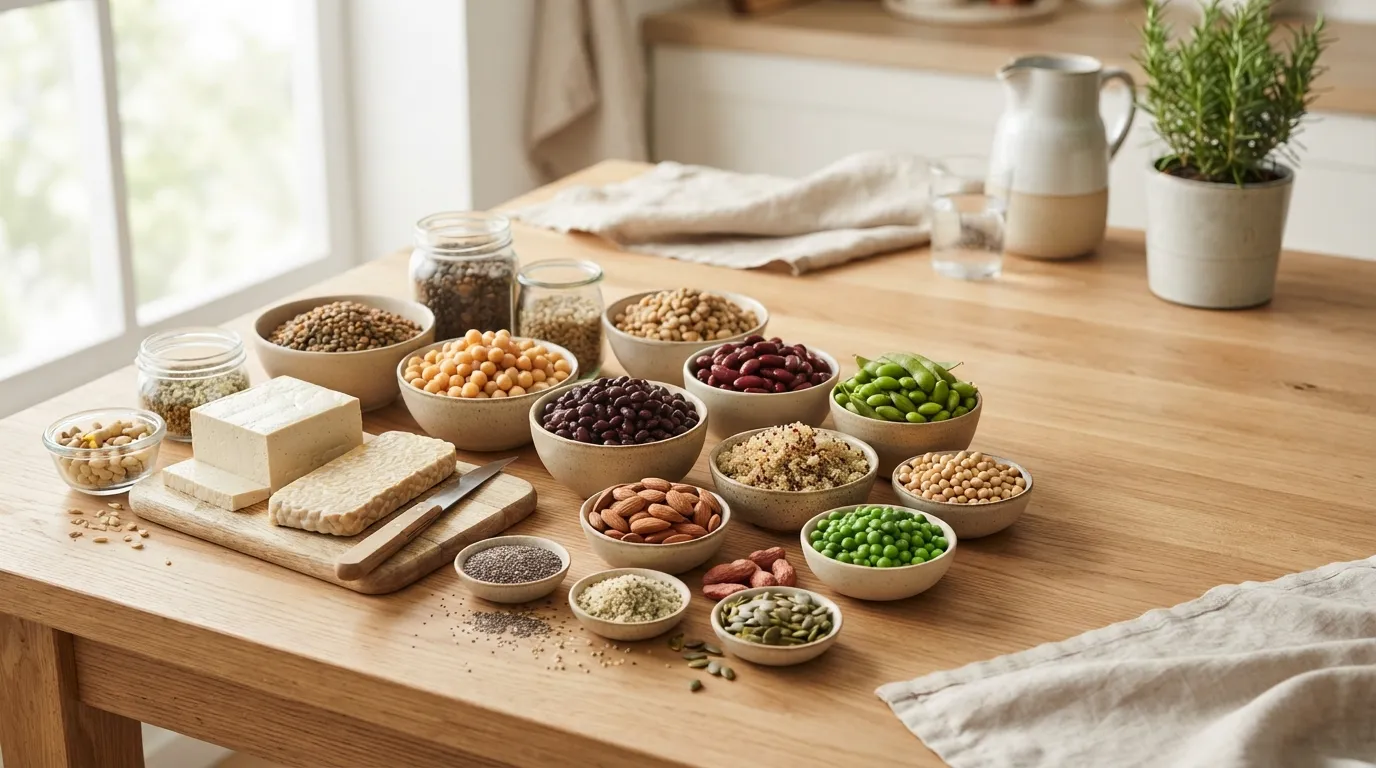
If you’ve ever wondered whether a vegan diet can really cover your protein needs, you’re asking the right question – and the answer is yes. After years of working with athletes, lifters, and everyday people moving to plant-based eating, I’ve found that the best plant-based protein sources for vegans aren’t exotic powders or niche superfoods. They’re ordinary whole foods: tofu, lentils, chickpeas, seitan, hemp seeds, and a few smart supplements when they earn their place.
Our team has spent the last several months reviewing USDA nutritional data, peer-reviewed protein-quality studies, and thousands of forum threads on r/vegan, r/veganfitness, and r/plantbaseddiet to put together this 2026 guide. We ranked each source by protein density per 100 g, leucine content (the trigger for muscle protein synthesis), PDCAAS/DIAAS quality scores, and real-world versatility in the kitchen.
Below you’ll find a quick-reference table, a deep dive on 12 of the top protein sources, the science of complete vs incomplete plant proteins, daily protein targets for both regular and athletic vegans, a sample day of eating that hits 140 g of protein, and answers to the eight questions we see most often. No products need you to buy a single thing to follow this plan – but we’ll flag when a quality protein powder makes sense for people with high targets.
ContentsTable of Contents
- 1Quick Picks: The 15 Best Plant-Based Protein Sources for Vegans→
- 2How Much Protein Do Vegans Need (and How to Hit It)→
- 3Complete vs Incomplete Plant Proteins Explained→
- 4The Best Plant-Based Protein Sources, Broken Down→
- 5Soy Foods: Tofu, Tempeh, Edamame, and Soy Milk→
- 6Seitan: The Highest-Protein Whole-Food Vegan Option→
- 7Lentils and Pulses: The Everyday Vegan Workhorse→
- 8Chickpeas, Black Beans, and Other High-Protein Beans→
- 9Peanuts and Peanut Butter→
- 10Quinoa, Oats, and Other Whole Grains→
- 11Hemp Seeds, Chia Seeds, and Pumpkin Seeds→
- 12Almonds, Pistachios, and Other Nuts→
- 13Plant-Based Protein Powders: Pea, Soy, Rice, and Hemp→
- 14Spirulina and Nutritional Yeast→
- 15Vegetables That Punch Above Their Weight→
- 16Fruits and Surprising Sources: Guava, Avocado, and More→
- 17Tips for Maximizing Plant Protein Absorption and Intake→
- 18Plant Protein for Muscle Building and Body Composition→
- 19Frequently Asked Questions→
- 20How can vegans get enough protein?→
- 21What is the highest protein plant-based food?→
- 22Do vegans need protein powder?→
- 23How much protein do vegans need per day?→
- 24What plant foods have complete protein?→
- 25Are lentils a complete protein?→
- 26Is tofu a good source of protein for vegans?→
- 27How do vegans get 100g of protein a day?→
- 28The Bottom Line→
Quick Picks: The 15 Best Plant-Based Protein Sources for Vegans
This table ranks the highest-protein whole foods by grams of protein per 100 g of edible portion, drawn from USDA FoodData Central. It also flags leucine content per serving (a key amino acid for muscle building) and whether each food is considered a complete protein. Bookmark this section if you want a fast reference.
| Rank | Food | Protein (per 100 g) | Complete Protein? | Notable For |
|---|---|---|---|---|
| 1 | Seitan (wheat gluten) | ~75 g | Yes | Highest protein density of any whole food |
| 2 | Soybeans, roasted | ~44 g | Yes | All essential amino acids in one food |
| 3 | Tempeh (fermented soy) | ~19 g | Yes | Probiotic bonus, firm texture |
| 4 | Firm tofu | ~17 g | Yes | Versatile, takes any flavor |
| 5 | Edamame (young soybeans) | ~11 g | Yes | Snackable, fiber-rich |
| 6 | Lentils, cooked | ~9 g | No (pair with grains) | Iron + folate, very affordable |
| 7 | Black beans, cooked | ~9 g | No (pair with grains) | Slow-digesting carbs |
| 8 | Chickpeas, cooked | ~9 g | No (pair with grains) | Works in everything |
| 9 | Peanuts / peanut butter | ~25 g (per 100 g PB) | No (low lysine/methionine) | Healthy fats, calorie-dense |
| 10 | Hemp seeds (hulled) | ~31 g | Yes | Omega-3 + complete protein |
| 11 | Pumpkin seeds | ~30 g | No | Zinc + magnesium |
| 12 | Chia seeds | ~17 g | No | Omega-3, fiber |
| 13 | Quinoa, cooked | ~4 g | Yes | Complete grain, gluten-free |
| 14 | Oats, rolled (dry) | ~13 g | No | Beta-glucan fiber |
| 15 | Spirulina (dried) | ~57 g | Yes | B12, iron, antioxidant |
Numbers vary slightly by brand and variety, but the order is stable: seitan and soy-based foods dominate, followed by legumes, nuts and seeds. Now let’s look at the science behind how much protein you actually need before picking your staples.
How Much Protein Do Vegans Need (and How to Hit It)
Adults of any diet need roughly 0.8 g of protein per kilogram of body weight per day, according to the current RDA set by the Institute of Medicine. For a 70 kg (about 154 lb) person, that’s about 56 g per day. Vegans don’t have a higher requirement than omnivores, but they often need to be more intentional because plant foods are usually less protein-dense per calorie than meat, eggs, or dairy.
That baseline isn’t enough for most people who train. A large 2018 meta-analysis in the British Journal of Sports Medicine found that 1.6 g/kg/day maximizes muscle protein synthesis in resistance-trained adults, and intakes up to 2.2 g/kg provide additional benefit during caloric restriction. Older adults aiming to prevent sarcopenia should target at least 1.0-1.2 g/kg, per PROT-AGE Study Group recommendations, with up to 1.5 g/kg useful for those with illness or frailty.
Three rules consistently help our vegan clients hit their targets without burning out on tofu. First, anchor every main meal around a high-density source – tofu, tempeh, seitan, lentils, or beans – rather than treating them as a side. Second, add a leucine-rich food to breakfast to fire muscle protein synthesis in the morning; a tofu scramble or soy-yogurt parfait works well. Third, keep a backup (roasted chickpeas, edamame, peanut butter on whole-grain toast) for snack gaps.
Complete vs Incomplete Plant Proteins Explained
A complete protein contains all nine essential amino acids in proportions sufficient to support human needs. Animal proteins – meat, eggs, dairy – are complete. Most plant proteins are not. They are “incomplete” because one or more essential amino acids are present in lower amounts than the body’s reference pattern.
The plant foods that are already complete proteins are soy (tofu, tempeh, edamame, soy milk), quinoa, hemp seeds, buckwheat, amaranth, chia seeds, and spirulina. Reviewers on r/veganfitness report that relying on soy as a backbone is the simplest way to cover the amino-acid spectrum without thinking about pairing. Seitan is also complete because wheat gluten itself has a full essential-amino-acid profile.
For incomplete proteins, the old “combine at the same meal” rule has been relaxed. Modern nutrition science shows that as long as you eat a variety of plant foods across the day – legumes, whole grains, nuts, seeds, and vegetables – you’ll comfortably meet your amino-acid needs. The classic pairings still work and are worth memorizing: rice and beans, hummus and whole-wheat pita, peanut butter on whole-grain bread, tofu with brown rice, lentils with barley. Good living starts with good food, and these combinations make the daily target painless.
The Best Plant-Based Protein Sources, Broken Down
The list below covers the 12 highest-value vegan protein sources, with protein per 100 g, typical serving, leucine content, and a practical way to use each one. Use the quick-picks table above for at-a-glance numbers and the deep dives here for context.
Soy Foods: Tofu, Tempeh, Edamame, and Soy Milk
Tofu delivers about 17 g of protein per 100 g of firm tofu, tempeh about 19 g per 100 g, and shelled edamame about 11 g per 100 g. All three are complete proteins with PDCAAS scores of 1.0 – the same as whey or eggs. A 100 g serving of firm tofu also brings roughly 1.0 g of leucine, which is meaningful for muscle protein synthesis and one reason why bodybuilders on vegan diets gravitate toward tofu as a staple.
Tempeh is fermented, which some users find easier to digest than plain tofu. Edamame is snackable – steamed in the pod with flaky salt, it pairs perfectly with rice bowls. Unsweetened soy milk runs about 7-9 g of protein per cup and is one of the few plant milks that genuinely rivals dairy milk for nutrition, with calcium and vitamin D added in fortified versions.
Seitan: The Highest-Protein Whole-Food Vegan Option
Seitan is pure wheat gluten, and it is shockingly dense – about 75 g of protein per 100 g dry. A 100 g cooked portion typically provides 25-30 g of protein, with a complete essential-amino-acid profile. It is the closest plant-based analog to chicken breast, both in texture and in protein-per-calorie ratio, which is why it shows up on almost every “how I hit 150 g protein as a vegan” forum post.
You can buy seitan ready-made or simmer your own from vital wheat gluten, soy sauce, and spices in under an hour. It browns beautifully in a hot pan, slices into sandwich fillings, and absorbs any marinade. The only catch is gluten: anyone with celiac disease or wheat sensitivity should skip seitan and lean on soy, lentils, or pea-protein-based foods instead.
Lentils and Pulses: The Everyday Vegan Workhorse
Cooked lentils provide about 9 g of protein per 100 g, plus high fiber, iron, and folate. Green, brown, red, and French lentils all perform similarly on protein. A 1-cup serving (about 200 g cooked) gives 18 g of protein and roughly 230 calories, which makes lentils one of the most calorie-efficient protein sources in a vegan kitchen. Long-time vegans consistently call lentils and chickpeas “workhorse staples” because they’re cheap, versatile, and shelf-stable when dry.
Lentils lack sufficient methionine to be a complete protein on their own, but pairing them with rice (methionine-rich, lysine-poor) creates a complete amino-acid profile in a single meal. Try red lentil dal over brown rice, lentil shepherd’s pie with mashed potato topping, or cold lentil salads with tahini dressing.
Chickpeas, Black Beans, and Other High-Protein Beans
Chickpeas and black beans each deliver about 8-9 g of protein per 100 g cooked. A 1-cup serving lands around 15 g of protein. Chickpeas are also a powerhouse of fiber, manganese, and folate. Black beans pair especially well with rice and salsa, and they’re the foundation of many Latin-inspired vegan meals.
Other beans worth keeping on rotation include kidney beans, pinto beans, navy beans, and lima beans – all roughly 7-9 g of protein per 100 g cooked. Canned beans are convenient but watch the sodium; rinse them before draining to cut sodium by about 40%. Buying dried beans and cooking them in bulk is the most cost-effective way to eat high-protein vegan food on a budget.
Peanuts and Peanut Butter
Peanuts are technically a legume, but nutritionally they sit closer to nuts: roughly 25 g of protein per 100 g of peanut butter, with about 8 g of protein in a 2-tablespoon serving (32 g). Peanuts are low in lysine and methionine relative to the reference pattern, so pair them with whole-grain bread or rolled oats for a complete amino-acid profile.
Peanut butter is calorie-dense, so portion control matters for anyone managing body composition. Choose natural peanut butter with no added sugar or hydrogenated oils. For people who train heavy, peanut butter is one of the easiest calorie-and-protein “boosters” – stir it into oatmeal, blend it into smoothies, or spread it on apple slices with cinnamon.
Quinoa, Oats, and Other Whole Grains
Quinoa is one of the few grains that is a complete protein, delivering roughly 4 g of protein per 100 g cooked (or 14 g per 100 g dry). A 1-cup portion contributes about 8 g of protein plus magnesium, iron, and fiber. Quinoa is also gluten-free, which makes it a versatile side for people avoiding wheat.
Oats are not complete but deliver about 13 g of protein per 100 g dry (roughly 5 g per cooked cup). Oats are also rich in beta-glucan, a soluble fiber that supports heart health and helps moderate blood sugar. Use oats in overnight oats, baked oatmeal, savory oat bowls, or homemade granola. Other grains worth mentioning for protein are amaranth (complete), buckwheat (complete), and teff.
Hemp Seeds, Chia Seeds, and Pumpkin Seeds
Hulled hemp seeds pack about 31 g of protein per 100 g – around 10 g per 3-tablespoon serving – and are a complete protein. They’re also one of the few plant sources of the omega-3 fatty acid ALA, which the body partially converts to EPA and DHA. Hemp seeds have a soft texture and a mild, nutty flavor that disappears into smoothies, oatmeal, and salad dressings.
Chia seeds deliver about 17 g of protein per 100 g (around 5 g per 2-tablespoon serving) and are extremely high in fiber and ALA omega-3s. Pumpkin seeds (pepitas) provide about 30 g of protein per 100 g, with notable amounts of zinc, magnesium, and iron – all nutrients that vegans sometimes fall short on. Toasting pumpkin seeds with a little salt makes a crunchy topping for salads, soups, and grain bowls.
Almonds, Pistachios, and Other Nuts
Almonds provide about 21 g of protein per 100 g (roughly 6 g per ounce / 28 g serving), pistachios about 20 g per 100 g, and cashews about 18 g per 100 g. Nuts are calorie-dense, so a small handful is the usual portion. They pair well with dried fruit for trail-mix-style snacks and make excellent butters for spreading on toast or blending into sauces.
Nuts are not complete proteins – they’re typically low in lysine – but they complement legumes and grains across the day. Active vegans who train hard often keep a bag of mixed nuts in their gym bag as a quick protein-and-fat snack between meals.
Plant-Based Protein Powders: Pea, Soy, Rice, and Hemp
Protein powders are concentrated, processed versions of plant foods, and they’re useful when whole-food targets are hard to meet. Pea protein typically delivers 80-85 g of protein per 100 g of powder, soy protein isolate around 90 g, brown rice protein around 75-80 g, and hemp protein around 50 g. Most powders score a PDCAAS of 0.9-1.0 after blending, with soy and pea at the top.
Pea protein has become the most popular option because it mixes well, has a mild flavor, and provides a strong leucine dose – roughly 8 g per 25 g serving. Blending pea protein with rice protein raises the overall amino-acid score to nearly 1.0. Hemp protein is fiber-rich but lower in protein per scoop, so it works better as a complement than a primary powder. Use powders in post-workout shakes, overnight oats, baked goods, and “nice cream” when whole-food protein falls short.
Spirulina and Nutritional Yeast
Spirulina – a blue-green algae – is one of the most protein-dense foods on the planet: about 57 g of protein per 100 g of dried powder, with all essential amino acids. A typical 10 g serving adds 5-6 g of protein along with iron, B vitamins (including B12 analogues), and antioxidants. Spirulina has a strong, oceanic flavor, so most people blend it into smoothies or mix it into energy balls rather than eating it on its own.
Nutritional yeast (the deactivated yeast sold in yellow flakes) provides roughly 50 g of protein per 100 g and a hefty dose of B vitamins, especially B12 in fortified versions. A 2-tablespoon serving (16 g) adds about 8 g of protein and a cheesy, nutty flavor that works well on pasta, popcorn, and tofu scrambles. It’s a near-universal staple in vegan pantries.
Vegetables That Punch Above Their Weight
Vegetables are not primary protein sources, but a few contribute meaningfully when eaten in larger portions. Broccoli, brussels sprouts, spinach, and asparagus all provide about 2-3 g of protein per 100 g cooked. Mushrooms run around 3 g per 100 g. None of these will hit your daily target on their own, but across a day of vegetable-rich meals, they add up.
The real value of including high-protein vegetables is the co-nutrients – fiber, antioxidants, and minerals like magnesium – that support training recovery and gut health. Aim for at least one leafy green and one cruciferous serving per day, and your total protein from vegetables can quietly contribute 10-15 g.
Fruits and Surprising Sources: Guava, Avocado, and More
A few fruits are surprisingly high in protein per calorie. Guava contains about 2.6 g of protein per 100 g and is exceptionally rich in vitamin C. Avocado provides roughly 2 g of protein per 100 g, with heart-healthy monounsaturated fats. Dried fruits like apricots, figs, and dates deliver small amounts of concentrated protein (about 2-3 g per 100 g) alongside fast carbs useful for endurance sessions.
Fruits aren’t going to move the needle on protein targets, but they round out a vegan diet with vitamins, fiber, and a quick energy source around training. They earn their place in this guide because athletes often under-eat fruit when they focus too hard on protein.
Tips for Maximizing Plant Protein Absorption and Intake
Eating plant protein is one thing. Absorbing it efficiently is another. A few evidence-based practices can lift the effective protein yield of your meals.
Sprouting and fermenting legumes, grains, and seeds reduces phytic acid, which can bind minerals and mildly reduce protein digestibility. Soak beans overnight, sprout them for 24-48 hours, or use fermented forms like tempeh and miso. Cook beans thoroughly – undercooked legumes contain lectins that cause GI distress. Pair iron-rich plant foods (lentils, spinach, tofu) with vitamin C sources (peppers, citrus, tomatoes) to boost non-heme iron absorption – an important secondary win for vegan athletes.
To hit leucine thresholds for muscle protein synthesis, aim for roughly 2.5-3 g of leucine per main meal. A 100 g serving of tofu provides about 1 g; a scoop of pea protein (25 g) provides about 2 g. Combining tofu with a scoop of pea protein in a stir-fry over rice easily clears the threshold. Distribute protein across 3-4 meals rather than loading one mega-meal – the muscle protein synthesis response saturates around 25-40 g per sitting for most adults.
For budget, dried legumes are the cheapest source of vegan protein on a per-gram basis, followed by peanut butter, oats, and eggs (if you’re not strict-vegan-adjacent). Hemp seeds, nuts, and ready-made seitan cost more per gram but are worth the premium for convenience and nutrient breadth. Mix tiers: rely on cheap staples for volume and rotate more expensive seeds and nuts for nutrient density.
Finally, scale bean intake gradually. The high fiber and oligosaccharides in beans can cause bloating and gas in the first 2-3 weeks. Adding 1/4 cup cooked beans per day and stepping up slowly lets your gut microbiome adapt without derailing your meal plan.
Plant Protein for Muscle Building and Body Composition
Can you build muscle on a vegan diet? Yes – and the research supports it. A 2019 meta-analysis in the Journal of the International Society of Sports Nutrition found no significant difference in strength or lean-mass gains between vegetarians/vegans and omnivores when protein intake was matched. The catch is that matching protein is harder on a vegan diet, which is why strategy matters.
To hit 100-150 g of protein per day on a vegan diet, anchor meals around soy, seitan, lentils, and beans. A typical day for a 75 kg lifter might look like: soy-milk-and-oats breakfast with hemp seeds (~30 g protein), tofu or tempeh lunch bowl over quinoa with edamame (~45 g protein), pea-protein post-workout shake (~25 g protein), and a dinner of seitan or lentil curry with chickpeas over rice (~40 g protein). That totals around 140 g – achievable without fancy ingredients.
One practical difference between plant and whey protein: per gram, plant proteins tend to be lower in leucine and slightly lower in digestibility. Compensate by eating 10-20% more total protein (so 1.8-2.0 g/kg instead of 1.6) and choosing leucine-rich sources (tofu, tempeh, soy isolate, pea protein) at every meal. Spread intake across 4-5 feedings for the highest anabolic effect.
Frequently Asked Questions
How can vegans get enough protein?
By anchoring meals around high-density sources like tofu, tempeh, seitan, lentils, chickpeas, and beans; rotating nuts, seeds, and whole grains across the day; and adding a plant protein powder when food alone falls short. A 70 kg adult can comfortably hit 1.6 g/kg (about 112 g/day) by combining two soy-based meals, one legume serving, and a scoop of pea or soy protein.
What is the highest protein plant-based food?
Seitan (cooked wheat gluten) is the highest-protein whole food at roughly 25-30 g of protein per 100 g cooked. Dried spirulina follows at about 57 g of protein per 100 g, but typical servings are much smaller (5-10 g), so the per-serving contribution is modest. Soybeans, pumpkin seeds, and hemp seeds round out the top tier.
Do vegans need protein powder?
Not necessarily. A vegan who eats a varied diet with legumes, soy foods, whole grains, nuts, and seeds can easily meet protein needs up to about 1.4 g/kg. Powders become useful for athletes aiming for 1.6-2.0 g/kg or anyone struggling with appetite, food prep time, or GI comfort when scaling whole-food protein up.
How much protein do vegans need per day?
The standard RDA is 0.8 g of protein per kilogram of body weight. Active adults benefit from 1.4-2.0 g/kg to maximize muscle protein synthesis and recovery, and older adults should target at least 1.0-1.2 g/kg to protect against sarcopenia. Vegans don’t need more than omnivores, but they usually need to be more deliberate about food choices to hit higher targets.
What plant foods have complete protein?
Soy foods (tofu, tempeh, edamame, soy milk), quinoa, hemp seeds, buckwheat, chia seeds, amaranth, spirulina, and seitan (wheat gluten) all provide all nine essential amino acids. For other plant proteins, eating a variety of legumes, whole grains, nuts, and seeds across the day covers the same ground without strict meal-by-meal pairing.
Are lentils a complete protein?
On their own, no. Lentils are lower in methionine than the human reference pattern, so they pair best with grains like rice, wheat, or oats. Eaten alongside those grains across the day, lentils easily contribute to a complete amino-acid intake. A meal of dal over brown rice is a textbook complete-protein pairing.
Is tofu a good source of protein for vegans?
Yes. Firm tofu provides about 17 g of protein per 100 g, is a complete protein with a PDCAAS of 1.0, and supplies roughly 1 g of leucine per 100 g serving. It is one of the most versatile vegan proteins – it scrambles, bakes, fries, grills, and blends into smoothies and desserts – which is why it’s the backbone of so many vegan meal plans.
How do vegans get 100g of protein a day?
A typical day might look like: overnight oats with soy milk, hemp seeds, and peanut butter (~30 g protein), a tofu or tempeh bowl with quinoa and edamame for lunch (~45 g), a pea-protein shake post-workout (~25 g), and a dinner of lentil-chickpea curry over brown rice with a side of seitan (~40 g). Total: around 140 g. Spreading intake across four meals and including a powder removes the bottleneck for most active vegans.
The Bottom Line
The best plant-based protein sources for vegans are whole foods you’ve probably already met: tofu, tempeh, seitan, lentils, chickpeas, black beans, hemp seeds, peanut butter, and quinoa. For active or older vegans, adding a clean plant protein powder (pea, soy, or a blend) removes the friction from hitting 1.6-2.0 g/kg. Variety beats perfection – rotate legumes, soy, grains, nuts, seeds, and the occasional algae or yeast product to cover both amino acids and the micronutrients vegans are most likely to miss (B12, iron, omega-3, zinc, calcium).
Updated for 2026 by our nutrition team. If you’re training seriously, track your intake for one week using any free food-tracking app and adjust portions until you hit your gram target. Most active vegans are surprised how quickly the numbers line up once high-density staples show up in every meal.