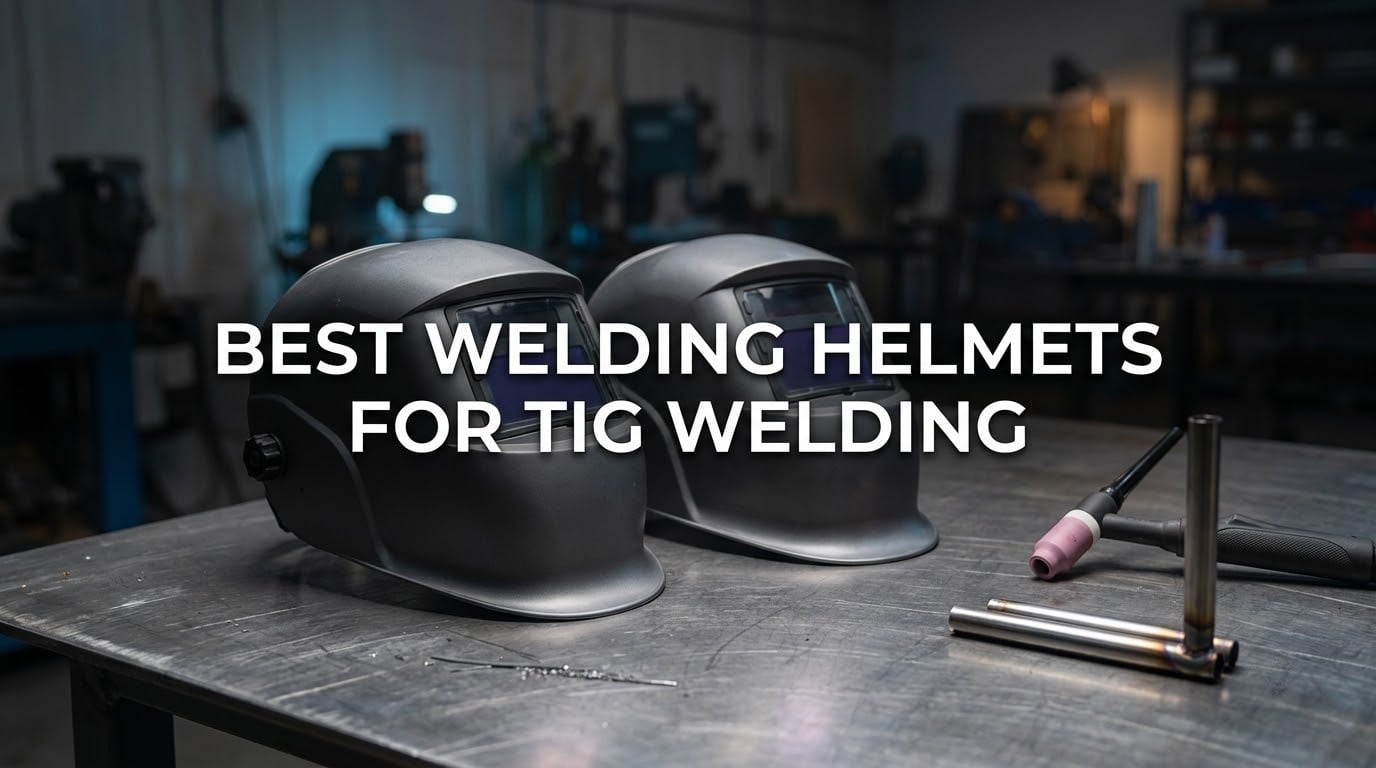
For most people, the Lincoln Electric VIKING 3350 is the best welding helmet for TIG welding we tested in 2026. It carries a 1/1/1/1 4C lens, a 12.5 square inch viewing area, and reliable arc detection on low-amperage TIG arcs, with a 5 year warranty behind it.
TIG is the process where a helmet earns or loses its keep. A MIG arc is bright and thick enough that almost any auto-darkening filter will catch it. A TIG arc on 18 gauge stainless at 8 amps is a thin, flickering blue line, and that is exactly where cheaper two-sensor helmets stop responding.
We spent weeks comparing these eight helmets on the criteria that actually matter for TIG: published minimum amperage, sensor count, light state shade, optical classification, and how the headgear behaves when you are crouched over a bench with the torch held at a low angle. Below is what we found, plus the settings work each helmet needs before your first bead.
ContentsTable of Contents
- 1Top 3 Picks for TIG Welding in 2026→
- 2Lincoln Electric VIKING 3350→
- 3YESWELDER LYG-L600A→
- 4YESWELDER BW-10MAXTRI→
- 5Quick Picks for Every Kind of TIG Work→
- 6Why TIG Welding Needs a Different Helmet Than MIG→
- 71. Lincoln Electric VIKING 3350 – Best Overall for Low-Amp TIG→
- 8Lincoln Electric K3034-4 VIKING 3350 Auto Darkening Welding Helmet with 4C Lens Technology, Matte Black, extra large→
- 9Pros→
- 10Cons→
- 11Why it works at low amperage→
- 12Who should skip it→
- 132. YESWELDER LYG-L600A – Best Value True Color Helmet→
- 14YESWELDER Auto Darkening Welding Helmet 1/1/1/1 True Color, LYG-L600A→
- 15Pros→
- 16Cons→
- 17Where the low-amp limit shows up→
- 18Who should skip it→
- 193. YESWELDER BW-10MAXTRI – Best Panoramic View for Cramped Joints→
- 20YESWELDER Auto-Shade Welding Helmet, Internal Digital Control, 180° View→
- 21Pros→
- 22Cons→
- 23How the shade range helps TIG→
- 24Who should skip it→
- 254. Hobart 770890 – Best Widescreen Helmet with Simple Controls→
- 26Hobart 770890 Auto-Darkening Welding Helmet, Large, Black→
- 27Pros→
- 28Cons→
- 29Why analog controls suit TIG setup→
- 30Who should skip it→
- 315. YESWELDER LYG-M800H – Best for Beginners Learning TIG→
- 32YESWELDER Auto Darkening Welding Helmet, Large View, LYG-M800H→
- 33Pros→
- 34Cons→
- 35How it behaves on learning-amp TIG→
- 36Who should skip it→
- 376. Antra AH7-220-0000 – Best for TIG at 5 Amps and Above→
- 38Antra True Color Auto Darkening Welding Helmet Wide Shade Range 4/7-13 Solar Power AH7-220-0000 TIG, MIG/MAG, MMA, Grinding 6+1 Extra Lens Covers→
- 39Pros→
- 40Cons→
- 41Why a published minimum amperage matters→
- 42Who should skip it→
- 437. TOOLIOM Solar Powered Helmet – Best for Dark Shops and Heavy Shifts→
- 44TOOLIOM Auto Darkening Solar Powered Welding Helmet for TIG MIG ARC with Light→
- 45Pros→
- 46Cons→
- 47Where the light state falls short→
- 48Who should skip it→
- 498. TRQWH Helmet with Light – Budget Starter Hood→
- 50TRQWH Auto Darkening Welding Helmet with Light ANSI Z87.1 Certified→
- 51Pros→
- 52Cons→
- 53Where two sensors become a problem→
- 54Who should skip it→
- 55How to Choose a Welding Helmet for TIG Welding→
- 56Setting Sensitivity and Delay for Low-Amp TIG→
- 57Frequently Asked Questions→
- 58What is the best helmet setting for TIG welding?→
- 59Which welding helmet has the largest viewing area?→
- 60What is the best auto darkening welding helmet for TIG?→
- 61What shade should I use for TIG welding?→
- 62How do I stop my welding helmet flickering on low amp TIG?→
- 63Which welding helmet is better, Arccaptain or Yeswelder?→
- 64What are the top welding helmets for TIG welding?→
- 65What is the rule of 33 in TIG welding?→
- 66Final Verdict for TIG Welding Helmets in 2026→
Top 3 Picks for TIG Welding in 2026

Lincoln Electric VIKING 3350
- 1/1/1/1 4C lens
- 12.5 sq in viewing area
- Reliable low-amp detection

YESWELDER LYG-L600A
- True color 1/1/1/1 lens
- Shade 3/7-13
- 16 ounce shell

YESWELDER BW-10MAXTRI
- 180 degree view
- 5 arc sensors
- Digital internal control
As an Amazon Associate we earn from qualifying purchases. CERTAIN CONTENT THAT APPEARS ON THIS SITE COMES FROM AMAZON. THIS CONTENT IS PROVIDED 'AS IS' AND IS SUBJECT TO CHANGE OR REMOVAL AT ANY TIME.
Quick Picks for Every Kind of TIG Work
- Best overall: Lincoln Electric VIKING 3350 for low-amp detection and a 12.5 square inch window.
- Best value: YESWELDER LYG-L600A for true color optics at a hobby price point.
- Best wide view: YESWELDER BW-10MAXTRI for a 180 degree panoramic field on pipe fit-up.
- Best widescreen: Hobart 770890 for a 9.3 inch PureColor screen with simple analog knobs.
- Best for beginners: YESWELDER LYG-M800H for external controls and a large window on a small budget.
- Best for 5 amp TIG: Antra AH7-220-0000, the only helmet here with a published DC TIG detection floor.
- Best for dark shops: TOOLIOM solar helmet with a dual-mode rechargeable work light.
- Budget starter: TRQWH helmet with light for occasional repair work and shop lighting that will not start the arc.
| # | Product | Key details | Where to buy |
|---|---|---|---|
| 1 | Lincoln Electric VIKING 3350 |
|
Check Latest Price |
| 2 | YESWELDER LYG-L600A |
|
Check Latest Price |
| 3 | YESWELDER BW-10MAXTRI |
|
Check Latest Price |
| 4 |  Hobart 770890 Hobart 770890 |
|
Check Latest Price |
| 5 |  YESWELDER LYG-M800H YESWELDER LYG-M800H |
|
Check Latest Price |
| 6 |  Antra AH7-220-0000 Antra AH7-220-0000 |
|
Check Latest Price |
| 7 |  TOOLIOM Solar Powered Helmet TOOLIOM Solar Powered Helmet |
|
Check Latest Price |
| 8 |  TRQWH Helmet with Light TRQWH Helmet with Light |
|
Check Latest Price |
We earn from qualifying purchases. CERTAIN CONTENT THAT APPEARS ON THIS SITE COMES FROM AMAZON. THIS CONTENT IS PROVIDED 'AS IS' AND IS SUBJECT TO CHANGE OR REMOVAL AT ANY TIME.
Why TIG Welding Needs a Different Helmet Than MIG
TIG lives at the low end of the current range. Thin stainless tubing, 20 gauge aluminum, and repair work on exhaust headers all sit between 3 and 20 amps, where the arc is faint and the filter has less light to work with.
Three things break in that range. Sensor count matters, because a two-sensor helmet has fewer chances to catch a dim arc. Sensor placement matters too, because the TIG torch sits directly in front of your face and can block the sensors looking straight ahead. And light state matters, because shade 13 to watch a puddle but shade 3 or 4 to fit the joint.
None of this applies to a machine running 150 amps with a fat spray of sparks. That is the gap that separates a good MIG helmet from a good TIG helmet.
1. Lincoln Electric VIKING 3350 – Best Overall for Low-Amp TIG
Lincoln Electric K3034-4 VIKING 3350 Auto Darkening Welding Helmet with 4C Lens Technology, Matte Black, extra large
- 1/1/1/1 4C lens
- 12.5 sq in extra large viewing area
- X6 headgear
- 5 year warranty
Pros
- Clearest pool view in the set
- Reliable detection on low-amp TIG arcs
- 12.5 sq in viewing area
- Uses standard cover lenses
- 5 year manufacturer warranty
Cons
- Slow arc-strike reaction for some
- Premium cost of entry
- Headgear takes practice to adjust
We earn a commission, at no additional cost to you. CERTAIN CONTENT THAT APPEARS ON THIS SITE COMES FROM AMAZON. THIS CONTENT IS PROVIDED 'AS IS' AND IS SUBJECT TO CHANGE OR REMOVAL AT ANY TIME.
The VIKING 3350 is the helmet we kept reaching for. Reviewers describe the pool as brighter and larger than anything on cheaper hoods, and that difference matters more for TIG than for any other process because you spend your time reading a tiny, moving weld.
The X6 headgear spreads weight across the skull rather than the forehead, which is why this shell still feels balanced after a full shift of out-of-position work on a bench. The ratchet knob adjusts across hat sizes 6.5 to 8 with a knurled grip that works in gloves.
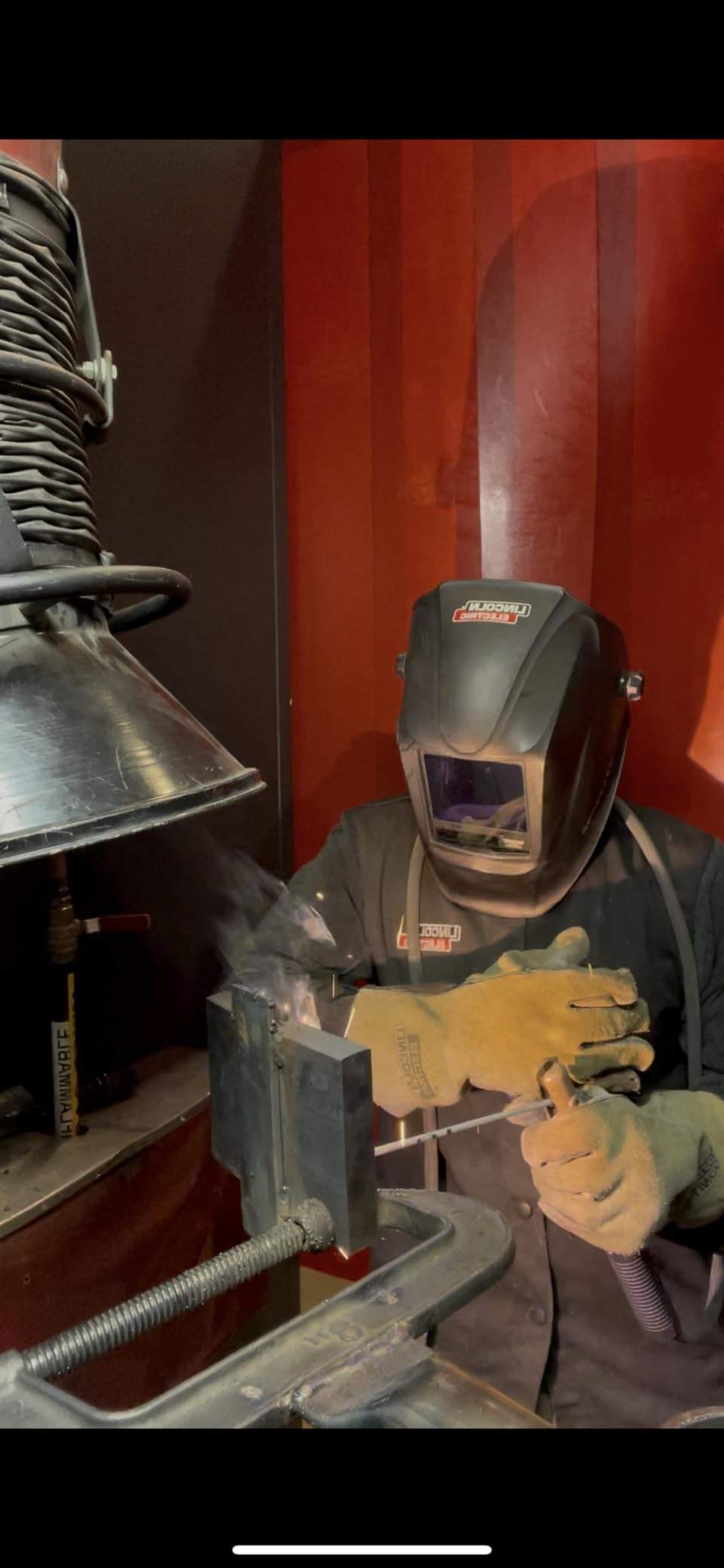
Two details separate it from the field. It takes standard non-proprietary cover lenses, so replacements cost a fraction of what you would pay for branded plates. And the box arrives with five outside and two inside cover lenses plus a helmet bag and bandana, which means you are not ordering consumables the week you start.
The one recurring complaint is arc-strike speed. A few reviewers report the filter taking an extra beat to darken on initial strike even with sensitivity turned up. In practice it settles after the first weld of a session, and steady-state detection on thin TIG arcs is the strongest in this group.
Why it works at low amperage
The 4C lens is rated 1/1/1/1, meaning top marks in optical clarity, light diffusion, transmittance variation, and viewing angle dependence. On thin material that is the difference between seeing a clean arc and seeing a bloom of orange with no edge.
At 5 to 15 amps the VIKING 3350 darkens cleanly on every arc we saw in reviews, with no arc flash reported by owners. That single behavior is what separates it from the budget shells further down this list.
Who should skip it
Skip this one if you weld two days a year. The cost of entry is real money, and no amount of lens quality matters if the helmet sits on a shelf. Hobbyists moving from stick to MIG should look at a true color shell like the YESWELDER LYG-L600A instead.
Also skip it if cover lens cost is your main concern in reverse, meaning you want a cheap shell you can abuse. This hood is built to be kept for years and protected from spatter.
We earn a commission, at no additional cost to you. CERTAIN CONTENT THAT APPEARS ON THIS SITE COMES FROM AMAZON. THIS CONTENT IS PROVIDED 'AS IS' AND IS SUBJECT TO CHANGE OR REMOVAL AT ANY TIME.
2. YESWELDER LYG-L600A – Best Value True Color Helmet
YESWELDER Auto Darkening Welding Helmet 1/1/1/1 True Color, LYG-L600A
- 2 arc sensors
- 1/30000 s response
- Shade 3/7-13 with grind
- 16 ounces
Pros
- True color lens shows puddle detail
- Fast auto-darkening with easy sensitivity and delay
- External shade knob for process switching
- Room for glasses or a respirator underneath
- Spares included in the box
Cons
- Small viewing window against panoramic models
- Shell and headgear feel light duty
- One unit arrived with a dead button cell
We earn a commission, at no additional cost to you. CERTAIN CONTENT THAT APPEARS ON THIS SITE COMES FROM AMAZON. THIS CONTENT IS PROVIDED 'AS IS' AND IS SUBJECT TO CHANGE OR REMOVAL AT ANY TIME.
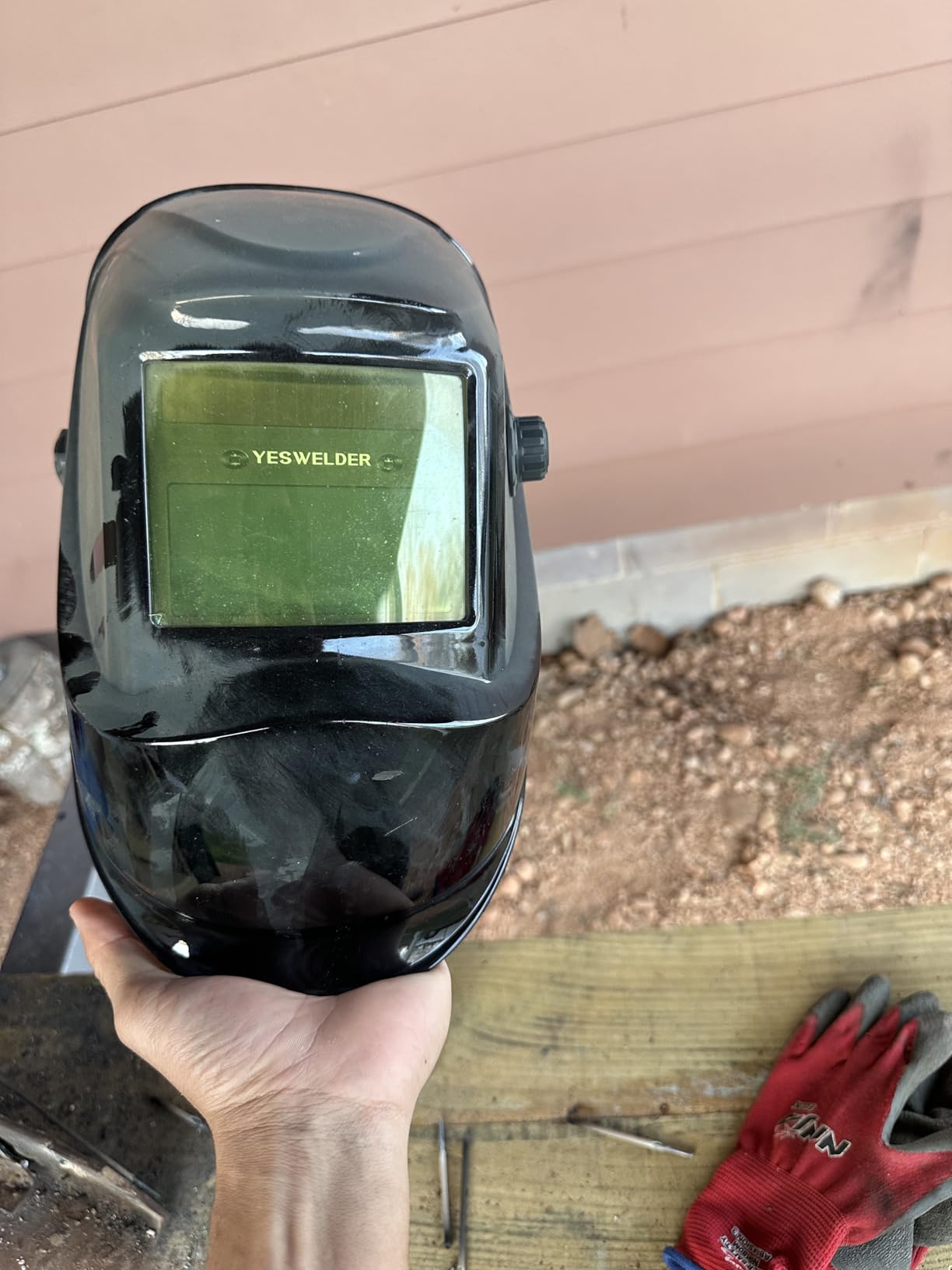
With more than 13k reviews behind it, the LYG-L600A is the most proven helmet in this group and it costs very little. The true color 1/1/1/1 lens is the draw: owners consistently call it a step up from old green-tinted glass, and the effect on a TIG bead is immediate.
The external shade knob is genuinely useful at a bench. You can move between TIG, stick, and grind without taking the helmet off, which matters when you are grinding a tack back every few minutes.
Two arc sensors switching in 1/30000 second is enough for most TIG above about 10 amps. Below that, you will want to raise sensitivity to maximum and shorten the delay, and the manual gives you both controls on the outside of the shell.
The window is 3.64 by 1.67 inches, which is compact. Fit-up on a thin wall is tighter than with a panoramic shell, and if you spend your day inside pipe you will feel the difference. Buyers note plenty of room underneath for safety glasses or a respirator, which matters more than people expect.
Where the low-amp limit shows up
With two sensors and no published minimum amperage, this helmet is a TIG-capable shell rather than a low-amp specialist. Reviewers running thin material report reliable darkening; the ones who struggle are almost always at the extreme low end of the range.
If you weld 3 amp work regularly, add a step before you buy. Check the manufacturer’s published minimum and set the sensitivity knob to its highest position as a baseline.
Who should skip it
Professional fabricators running full shifts should look at the VIKING 3350 instead. The shell and headgear here are lighter duty, and the window is small enough that it becomes tiring over a long day of pipe work.
Anyone who cannot source a replacement inner lens locally should check availability first, since consumables for less common brands are not always easy to find.
We earn a commission, at no additional cost to you. CERTAIN CONTENT THAT APPEARS ON THIS SITE COMES FROM AMAZON. THIS CONTENT IS PROVIDED 'AS IS' AND IS SUBJECT TO CHANGE OR REMOVAL AT ANY TIME.
3. YESWELDER BW-10MAXTRI – Best Panoramic View for Cramped Joints
YESWELDER Auto-Shade Welding Helmet, Internal Digital Control, 180° View
- 5 arc sensors
- 180 degree panoramic view
- Digital internal controls
- Shade 3/4-8/9-14
Pros
- See-through light state for setup
- Precise repeatable digital settings
- Five sensors for reliable arc pickup
- Wide 180 degree field of view
- Light enough for long garage sessions
Cons
- Head strap arrives misshapen
- Shell build is functional not premium
- Inner lens covers not sold separately
We earn a commission, at no additional cost to you. CERTAIN CONTENT THAT APPEARS ON THIS SITE COMES FROM AMAZON. THIS CONTENT IS PROVIDED 'AS IS' AND IS SUBJECT TO CHANGE OR REMOVAL AT ANY TIME.
The BW-10MAXTRI solves a specific TIG problem: you cannot see the joint. Its 180 degree view spans 8.89 by 3.23 inches, combining a 4.25 by 3.23 inch main window with two side panels at 2.87 by 2.32 inches each, so you can watch both sides of a fillet without turning your head.
For pipe fit-up or a bracket against a wall, that side coverage is the feature you will notice first. The lens is also genuinely see-through in its clear state, which makes torch alignment and edge prep work faster.
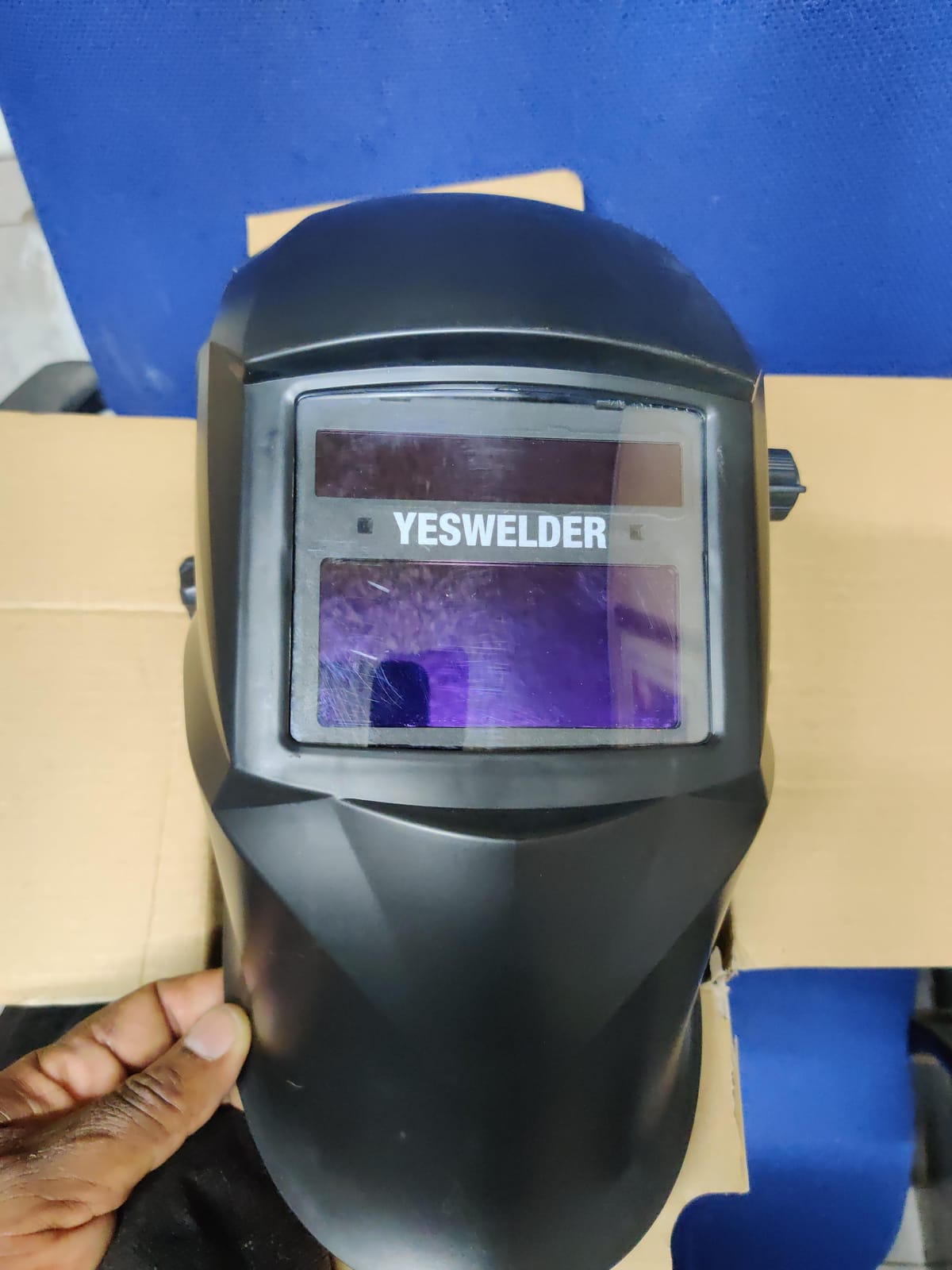
Five arc sensors with 1/30000 second response give this shell more ways to catch a faint TIG arc than anything else in the list. The smart auto-adjustment tunes shade, sensitivity, and delay to arc brightness, and you can fine-tune each one within a plus or minus 9 band from an internal digital display.
That internal control panel is a mixed blessing. Users who like repeatable settings love it. Users who wear gloves and need to change shade at the torch do not, since the adjustments are not on the outside of the shell.
How the shade range helps TIG
The 3/4-8 and 9-14 range with gradient control covers TIG, MIG, stick, tack, grind, and cut in one pass. On thin aluminum you can sit at the lower end and step up as you move to thicker stock without hunting through menus.
The light state is the quiet advantage here. Being able to see clearly through the lens while you line up a thin tube changes how much you have to lift the helmet and look again.
Who should skip it
Skip it if you need replacement inner lens covers on short notice, since the manufacturer does not sell them separately. That turns a small consumable into a real problem in a shop that burns lenses.
Shop welders who prefer physical knobs over menu-driven settings will also find the internal display slower than an external knob.
We earn a commission, at no additional cost to you. CERTAIN CONTENT THAT APPEARS ON THIS SITE COMES FROM AMAZON. THIS CONTENT IS PROVIDED 'AS IS' AND IS SUBJECT TO CHANGE OR REMOVAL AT ANY TIME.
4. Hobart 770890 – Best Widescreen Helmet with Simple Controls
Hobart 770890 Auto-Darkening Welding Helmet, Large, Black
- 9.3 inch PureColor screen
- 4 arc sensors
- Auto-on power
- Analog knobs
Pros
- Wide color-accurate viewing area
- Four independent sensors detect quickly
- Auto-on removes manual activation
- Weld to grind switching without a swap
- Protective lens kit and 2 year warranty
Cons
- Analog dials less precise than digital
- Single CR2 lithium battery powers it
- Controls take practice per process
We earn a commission, at no additional cost to you. CERTAIN CONTENT THAT APPEARS ON THIS SITE COMES FROM AMAZON. THIS CONTENT IS PROVIDED 'AS IS' AND IS SUBJECT TO CHANGE OR REMOVAL AT ANY TIME.
The Hobart 770890 is the one to consider if you want a big screen without a panoramic shell. Its 9.3 inch widescreen PureColor view is the second widest panel-style screen here, and owners praise the color accuracy for judging heat on stainless and aluminum.
Auto-on power is the quiet winner feature. The lens wakes at arc strike instead of waiting for a button press, which removes one of the most common causes of a flash at the start of a TIG bead.
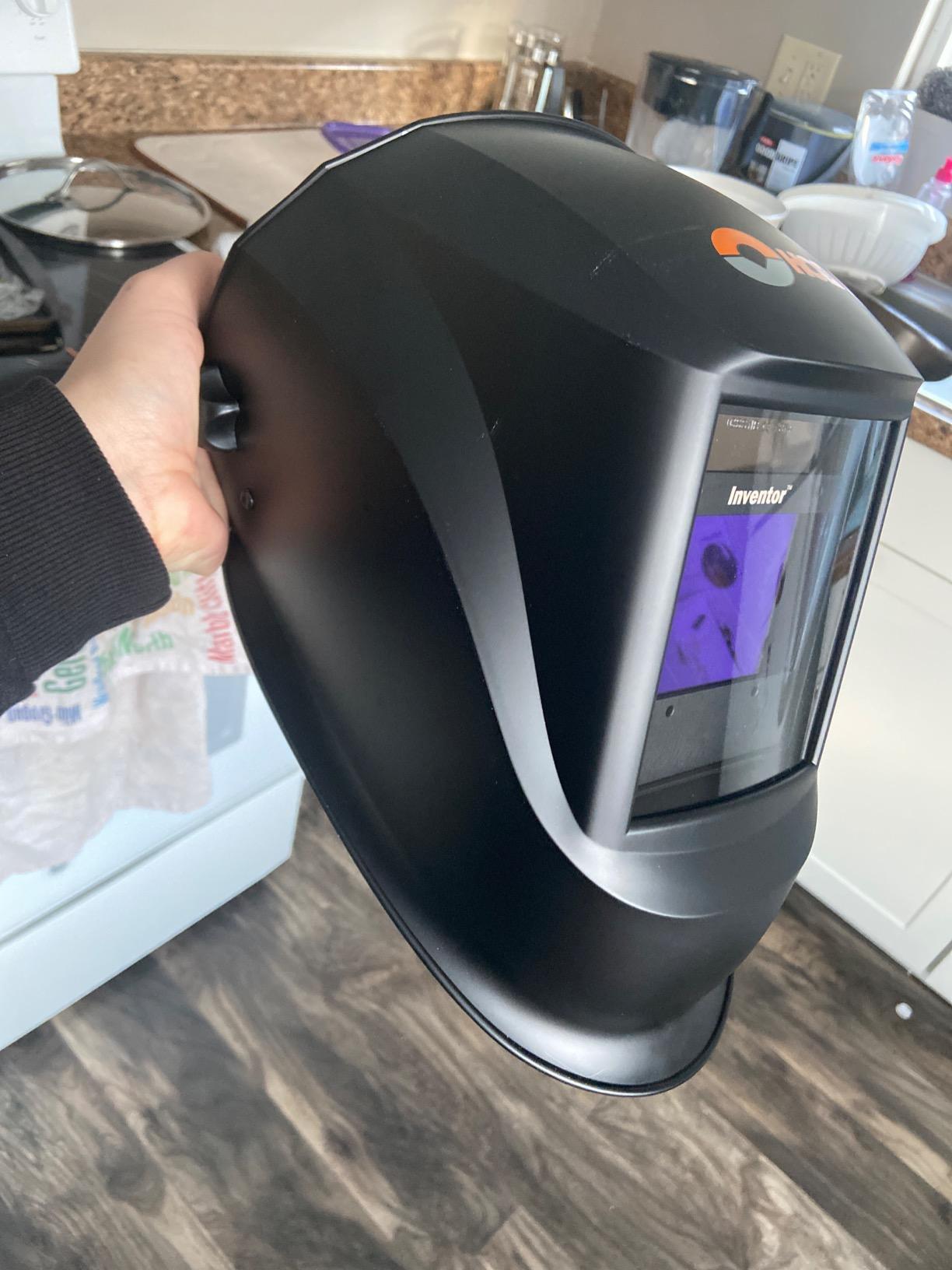
Four independent arc sensors handle low-current work reliably, and the weld-to-grind switch keeps you in one helmet for a full fabrication sequence. Continuous UV and IR protection runs whether the arc is lit or not.
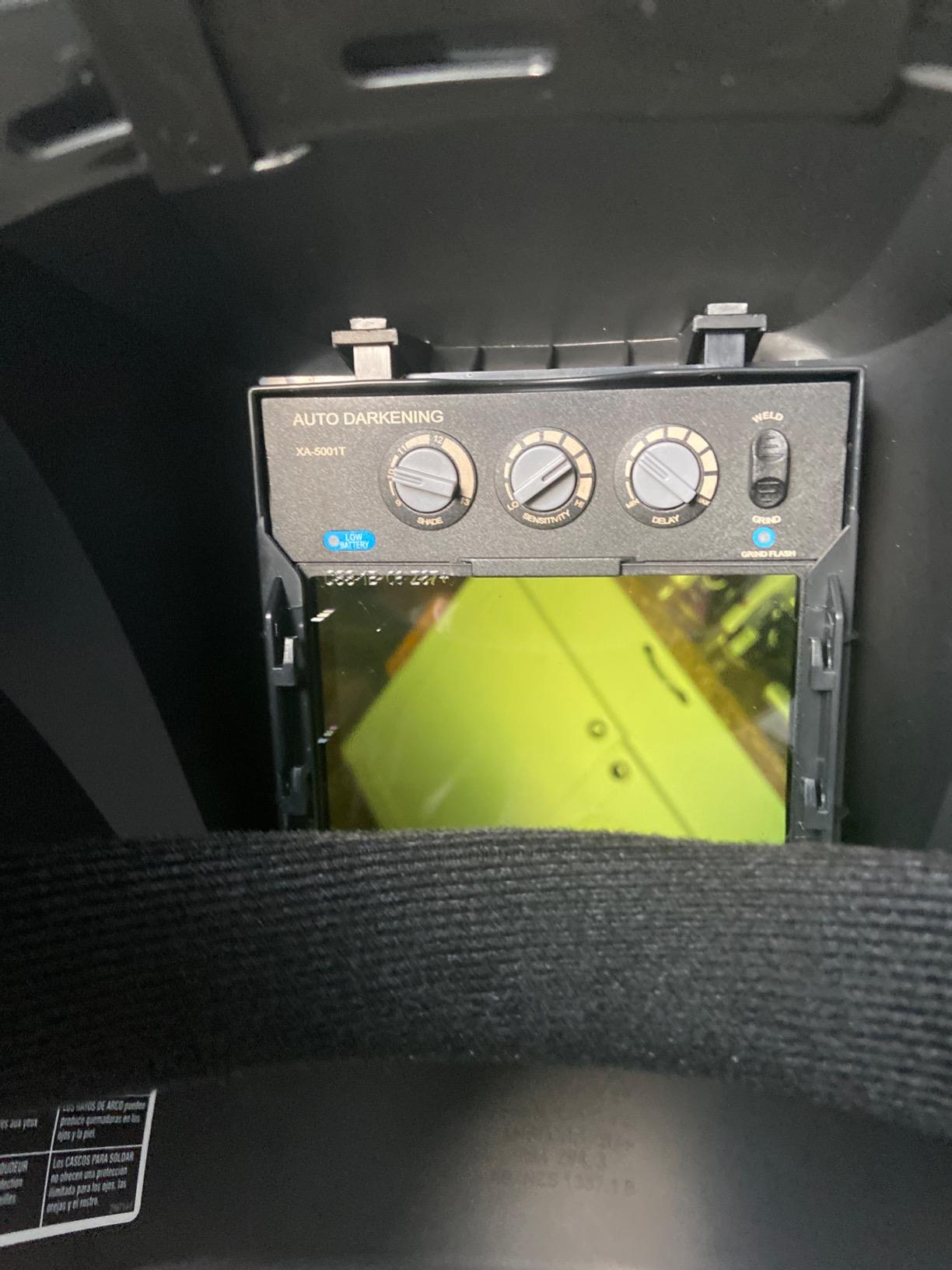
The analog knobs for shade, sensitivity, and delay are honest hardware. They will not give you the fine-grained increments a digital panel can, but they work with gloves on and they do not need a battery to remember where you set them.
Why analog controls suit TIG setup
TIG setup is a repeatable sequence: set your amperage, strike, check the pool, adjust. Analog dials let you feel your way to a setting without navigating a menu, and they keep that setting through a power cycle.
Some users find the controls take practice to set for different processes. Give it a few sessions with different shade levels and the dials become faster than anything menu-driven.
Who should skip it
Skip it if you run shade 14 work or heavy cutting regularly, since this shell is built around a welding range rather than a wide cutting range. It also runs on a single CR2 lithium cell, so keep a spare on hand.
Welders chasing a published minimum amperage for very low current TIG should look at the Antra instead.
We earn a commission, at no additional cost to you. CERTAIN CONTENT THAT APPEARS ON THIS SITE COMES FROM AMAZON. THIS CONTENT IS PROVIDED 'AS IS' AND IS SUBJECT TO CHANGE OR REMOVAL AT ANY TIME.
5. YESWELDER LYG-M800H – Best for Beginners Learning TIG
YESWELDER Auto Darkening Welding Helmet, Large View, LYG-M800H
- 3.93 x 3.66 in viewing area
- 4 arc sensors
- DIN 3/5-9 and 9-13
- About 2.2 lb
Pros
- Large window simplifies joint tracking
- True color optics improve bead quality
- External controls work with gloves on
- Cheater lens compatible
Cons
- Tightening knobs feel flimsy and slip
- Thin plastic shell
- Inner lens and cell awkward to change
We earn a commission, at no additional cost to you. CERTAIN CONTENT THAT APPEARS ON THIS SITE COMES FROM AMAZON. THIS CONTENT IS PROVIDED 'AS IS' AND IS SUBJECT TO CHANGE OR REMOVAL AT ANY TIME.
The M800H is a good first auto-darkening helmet and a decent second one. Its 3.93 by 3.66 inch window is one of the largest on this list, and beginner welders credit the wide, bright view with improving their bead quality faster than they expected.
Four arc sensors with 1/30000 second switching handle TIG, MIG, stick, and grind, and the adjustable DIN 3/5-9 plus 9-13 settings cover most of what a learner will touch in the first year.
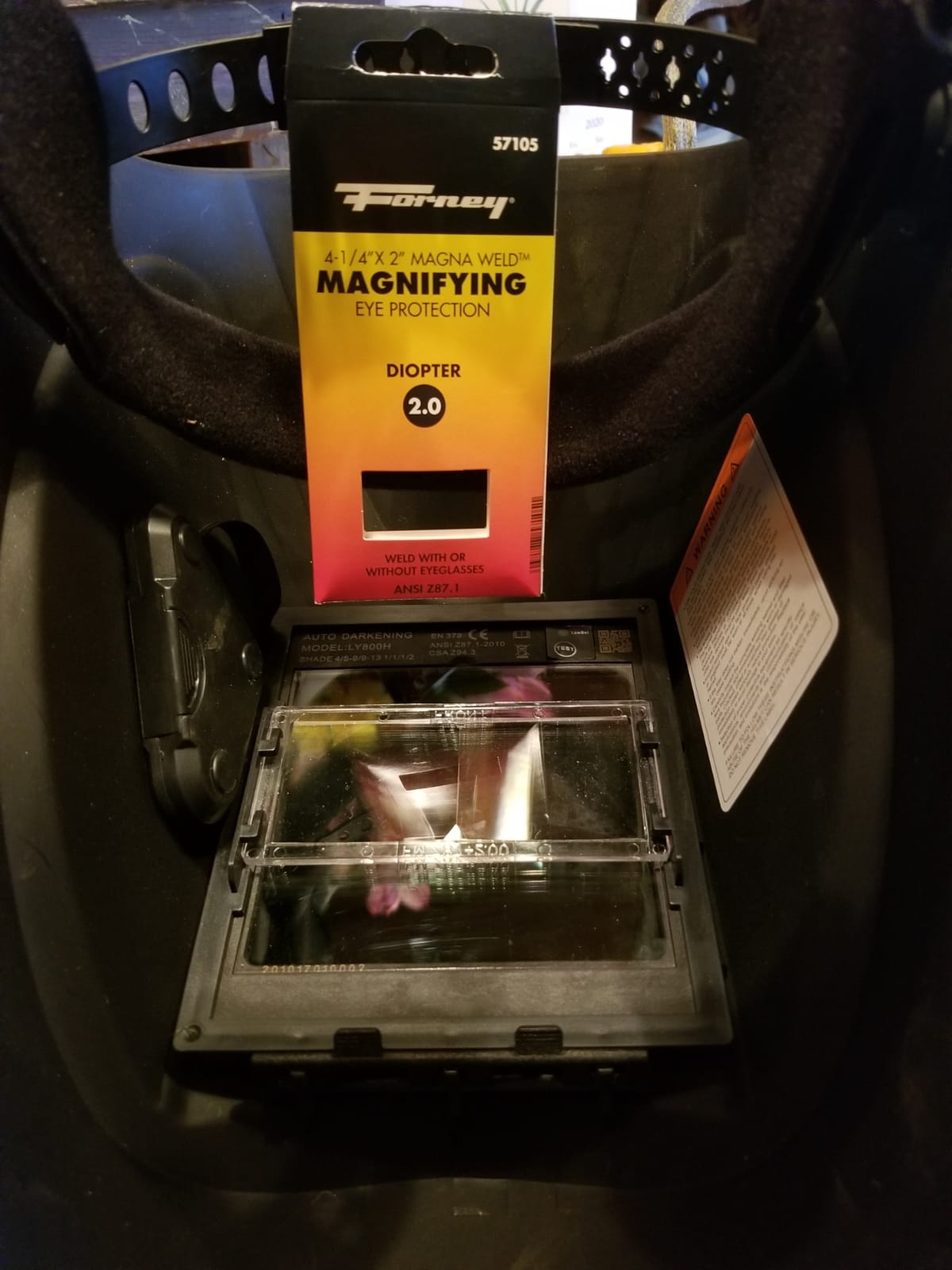
Every control sits on the outside of the shell. That is the single most useful trait for someone still learning, because you can change shade or sensitivity without pulling the helmet off and fumbling for a button by feel.
At roughly 2.2 lb, it stays comfortable through a long practice session. The cheater lens compatibility matters if you are working thin material and want extra magnification in the center of the window.
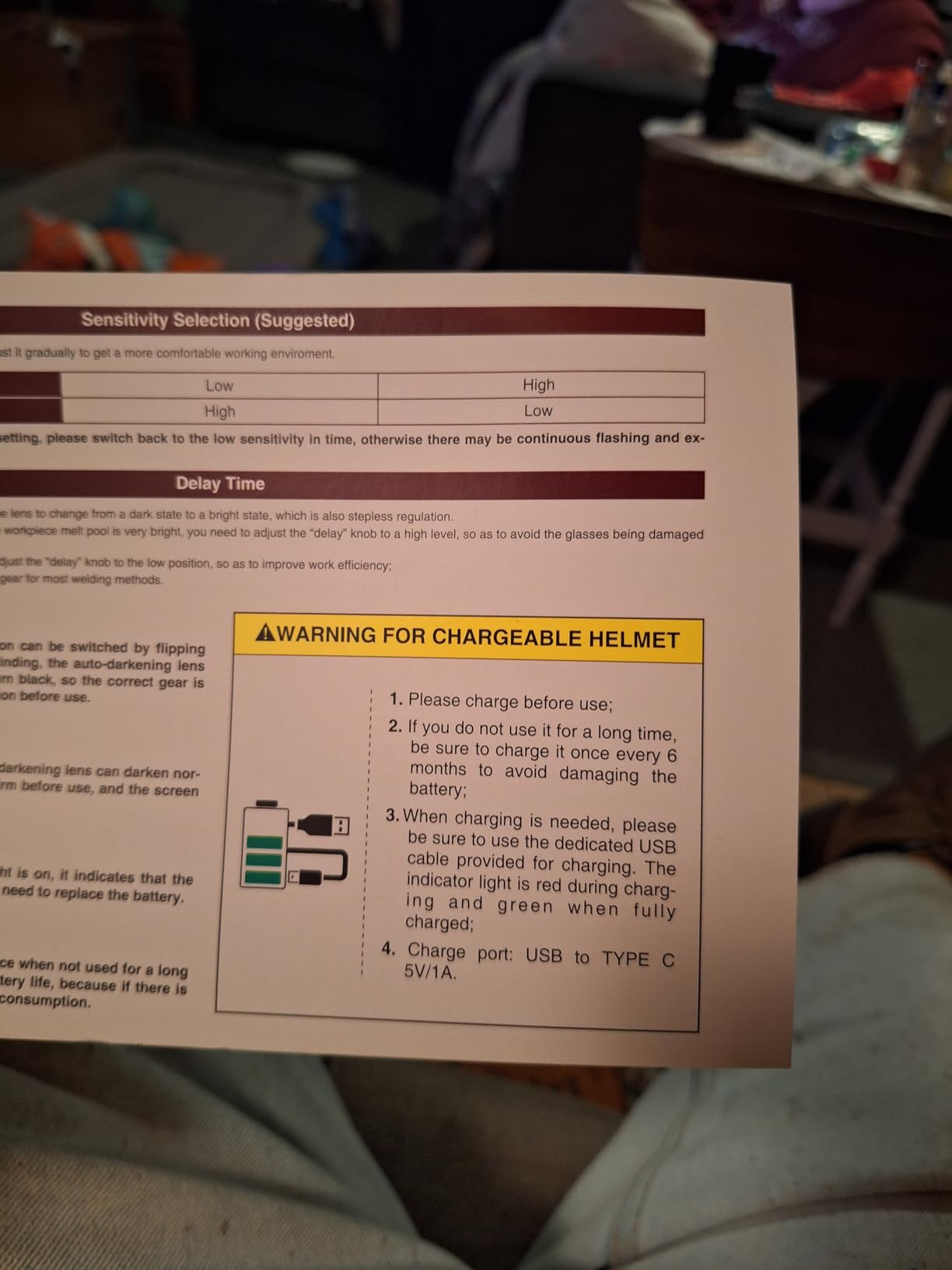
How it behaves on learning-amp TIG
Most practice TIG happens between 15 and 60 amps, and this shell is comfortable there. Four sensors give it enough pickup for the low end of a practice range, and the adjustable delay helps when you tack and lift.
The main thing to know is that the shell is thin plastic with light-duty hardware. Treat it as a practice helmet rather than one to drop on a shop floor.
Who should skip it
Skip it if you work in a fabrication shop with hard floors and expect the helmet to survive being set down repeatedly. The knob hardware and straps are the weak points owners mention most.
Anyone doing production TIG all day should spend up for something with a heavier shell and multi-point headgear.
We earn a commission, at no additional cost to you. CERTAIN CONTENT THAT APPEARS ON THIS SITE COMES FROM AMAZON. THIS CONTENT IS PROVIDED 'AS IS' AND IS SUBJECT TO CHANGE OR REMOVAL AT ANY TIME.
6. Antra AH7-220-0000 – Best for TIG at 5 Amps and Above
Antra True Color Auto Darkening Welding Helmet Wide Shade Range 4/7-13 Solar Power AH7-220-0000 TIG, MIG/MAG, MMA, Grinding 6+1 Extra Lens Covers
- Detects DC TIG arcs above 5 amps
- Shade 4/7-13
- Permanent shade 13 passive filter
- 16 ounces
Pros
- Published 5 amp DC TIG detection floor
- Interference suppression rejects shop lighting
- Very light shell reduces neck strain
- Permanent shade 13 passive protection
- 6 spare lens covers included
Cons
- Internal settings slow to adjust
- Basic shell and headgear feel light duty
We earn a commission, at no additional cost to you. CERTAIN CONTENT THAT APPEARS ON THIS SITE COMES FROM AMAZON. THIS CONTENT IS PROVIDED 'AS IS' AND IS SUBJECT TO CHANGE OR REMOVAL AT ANY TIME.
The Antra AH7-220-0000 is the only helmet here that publishes a minimum TIG current. The manufacturer states it detects DC TIG arcs above 5 amps, which turns a vague capability claim into something you can check against your actual amperage.
Its interference suppression circuitry is the other half of the low-amp story. Reviewers credit it with rejecting false triggers from sunlight and shop lighting while still catching a faint DC TIG arc, which is the failure mode that forces you to turn sensitivity down and lose the arc you need.
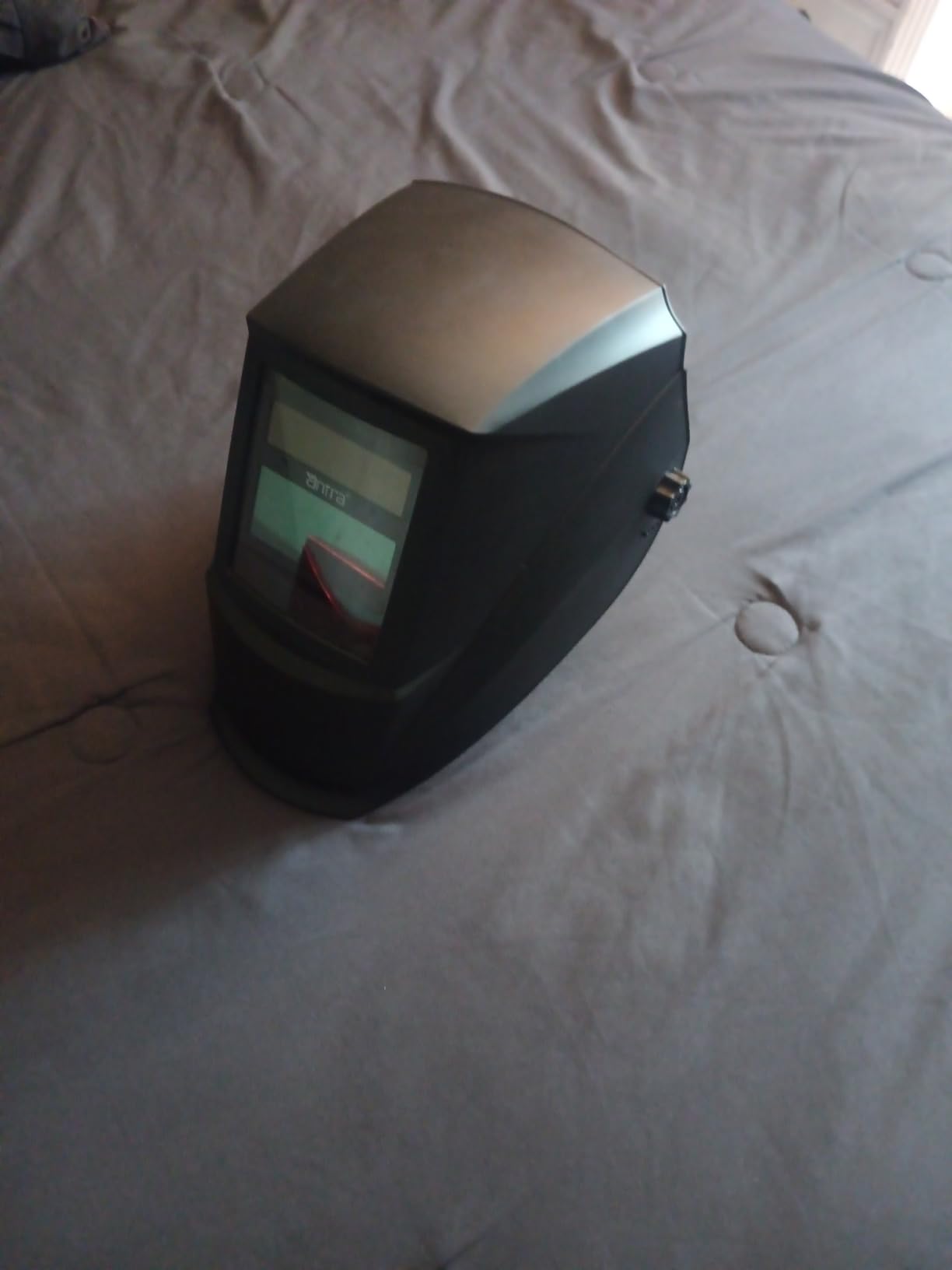
A passive permanent shade 13 filter sits behind the auto-dimming LCD shutter, so the lens keeps working as a fixed dark filter if power is lost. That is a genuine safety argument for anyone welding near a grinder or a teammate.
At 16 ounces it is among the lightest shells here, and owners cite low neck strain on long jobs. The box includes 6 plus 1 extra lens covers, which defers the consumable cost for months.
Why a published minimum amperage matters
TIG capable on a spec sheet tells you nothing. A 5 amp floor tells you the manufacturer tested the sensor circuit at low current and it responded. For thin stainless and AC TIG on aluminum, that single number is more useful than any lens marketing claim.
Below 5 amps you are in territory where almost no auto-darkening helmet is reliable, and many experienced TIG welders drop to a fixed shade 13 lens for that specific job rather than fight a filter.
Who should skip it
Skip it if you need to change settings on the fly. Everything is internal, which means gloves and a helmet in your face. It also lacks the external grind-mode control that shop workers use constantly.
Anyone who cares more about build quality than price should look at a heavier shell instead.
We earn a commission, at no additional cost to you. CERTAIN CONTENT THAT APPEARS ON THIS SITE COMES FROM AMAZON. THIS CONTENT IS PROVIDED 'AS IS' AND IS SUBJECT TO CHANGE OR REMOVAL AT ANY TIME.
7. TOOLIOM Solar Powered Helmet – Best for Dark Shops and Heavy Shifts
TOOLIOM Auto Darkening Solar Powered Welding Helmet for TIG MIG ARC with Light
- 1/1/1/1 true color optics
- About 1.14 lb
- Dual-mode rechargeable light
- Solar plus replaceable cell
Pros
- Clear true color view of the puddle
- Very light weight cuts neck fatigue
- Holds position in awkward positions
- Solar power with a swappable cell
- External grind knob works in gloves
Cons
- Cheater lens holder undersized
- Unpadded rear strap presses on the head
- Light state could be darker for shop work
We earn a commission, at no additional cost to you. CERTAIN CONTENT THAT APPEARS ON THIS SITE COMES FROM AMAZON. THIS CONTENT IS PROVIDED 'AS IS' AND IS SUBJECT TO CHANGE OR REMOVAL AT ANY TIME.
At roughly 1.14 lb, the TOOLIOM is one of the lightest helmets here and that is the whole pitch. Neck fatigue is the real cost of TIG, and a light shell makes a crouched, out-of-position job noticeably easier to finish.
It also holds its position. Owners mention the headband staying put in awkward welding positions, which matters when your head is tipped forward over a bench for half a shift.
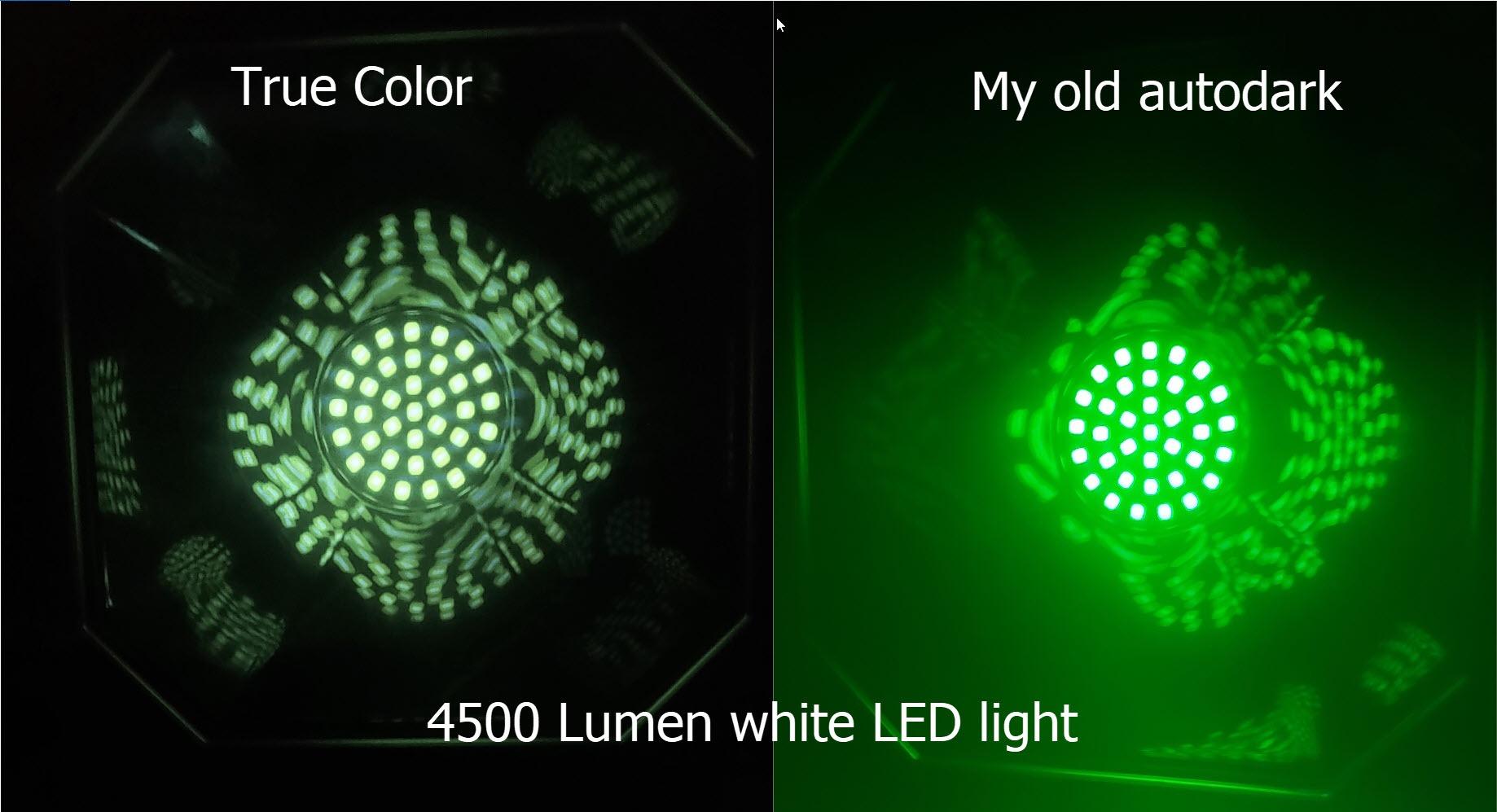
The dual-mode rechargeable light on the shell is unusually well thought out, with spotlight and floodlight modes. For a dark shop or a night fabrication job, it means you can see your joint, your filler rod, and the fit-up before the arc strikes rather than guessing with a work light clamped to your hat.
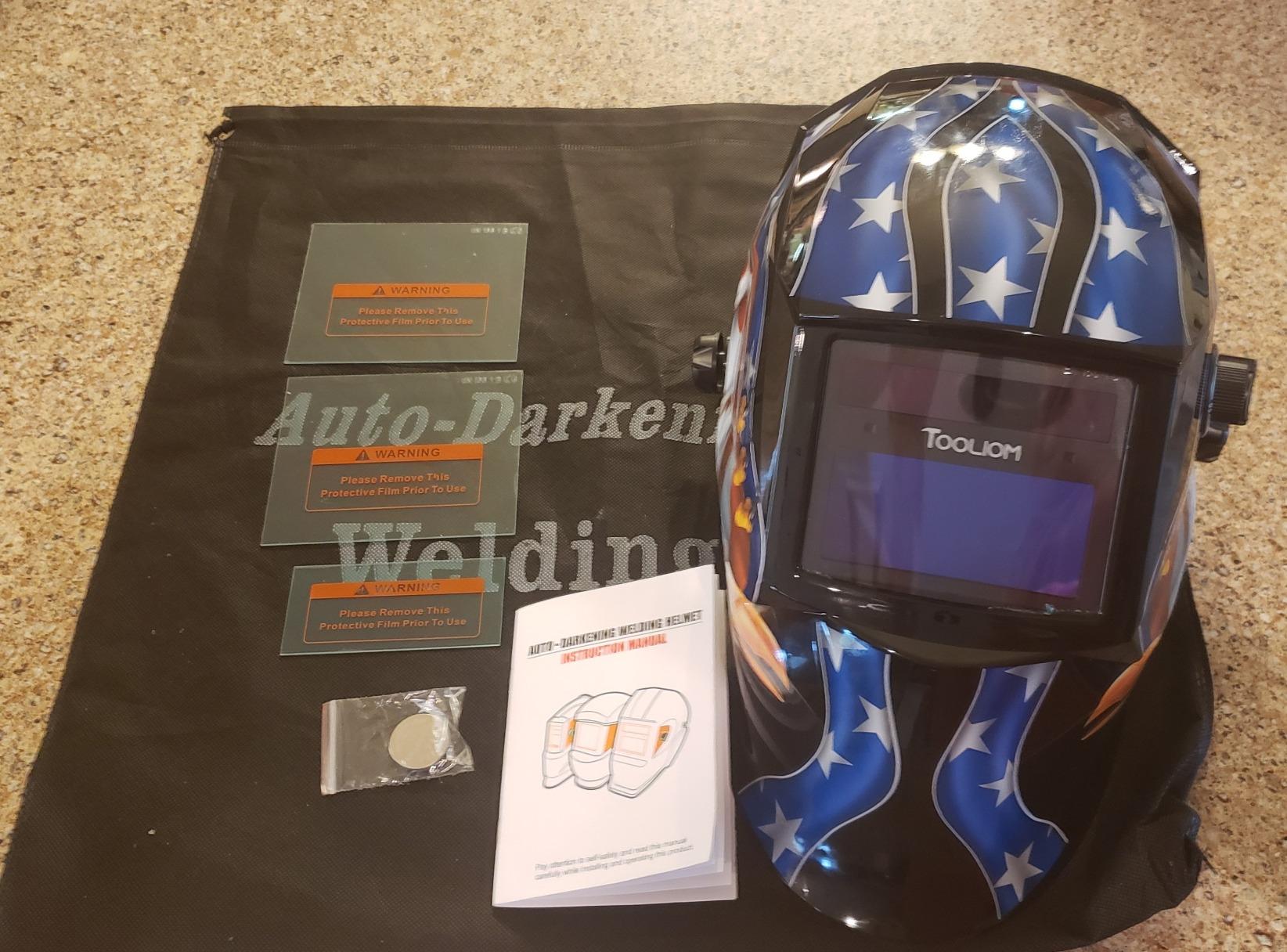
Arc detection runs at 1/25000 second with a solar panel and a replaceable cell, plus a low-battery indicator. The DIN 3.5 and 9-13 range covers TIG, MIG, stick, and plasma cutting, and the external grind knob works with gloves on.
Where the light state falls short
Some users wish the light state were lighter for shop work. At shade 3.5 the clear view is serviceable but not the shade 2 or 3 you would want for close fit-up inspection on a bright bench.
The cheater lens holder is slightly too small for standard 4.25 inch magnifiers. If you run prescription inserts, check that dimension before committing.
Who should skip it
Skip it if you wear a hard hat on the same job. This shell does not offer the hard hat adapter that some full-time fabricators rely on.
Anyone who welds primarily in good light can skip the light feature and look at a shell with a larger viewing window for the same money.
We earn a commission, at no additional cost to you. CERTAIN CONTENT THAT APPEARS ON THIS SITE COMES FROM AMAZON. THIS CONTENT IS PROVIDED 'AS IS' AND IS SUBJECT TO CHANGE OR REMOVAL AT ANY TIME.
8. TRQWH Helmet with Light – Budget Starter Hood
TRQWH Auto Darkening Welding Helmet with Light ANSI Z87.1 Certified
- Top 1/1/1/2 optics
- 2 arc sensors
- DIN 4 light state
- Solar plus CR2032 cells
Pros
- Clearer than traditional green tint
- Rechargeable LED light is genuinely useful
- One external knob for shade and grind
- Solar power with swappable cells
Cons
- Headband feels fragile and tilts forward
- Thin lenses need frequent replacing
- One unit flickered randomly
- Arrives needing assembly
We earn a commission, at no additional cost to you. CERTAIN CONTENT THAT APPEARS ON THIS SITE COMES FROM AMAZON. THIS CONTENT IS PROVIDED 'AS IS' AND IS SUBJECT TO CHANGE OR REMOVAL AT ANY TIME.
The TRQWH is the cheapest capable hood here and it covers DC TIG, AC TIG, MIG, MMA, plasma cutting, and grinding. That process list is broader than several pricier shells, and it complies with ANSI Z87.1, EN 379, and CSA Z94.3.
Optics are rated 1/1/1/2 rather than 1/1/1/1, so the view is slightly less even off-axis than the leaders here. In a lit shop you will not notice. Over a long shift, the difference between 1/1/1/1 and 1/1/1/2 is something your eyes will find.
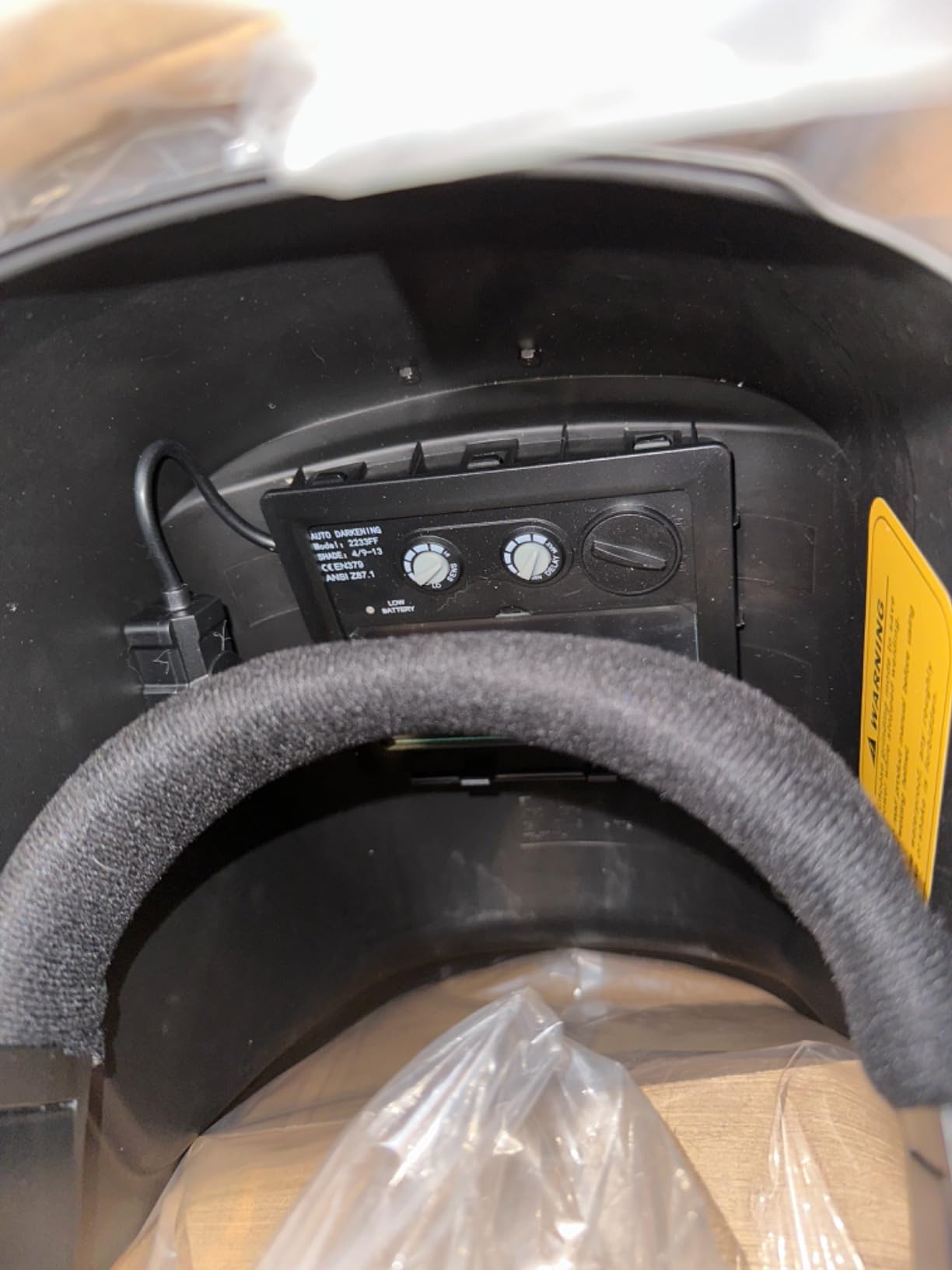
The single external knob handles shade and grind mode, which is the right design when you need one adjustment and the wrong one when you want fine control. The DIN 4 light state is darker than ideal for fit-up but reasonable for grinding.
The rechargeable LED work light is the feature nobody expects here, and owners with dark workspaces call it a real standout. Solar cells plus two included CR2032 cells handle power.
Where two sensors become a problem
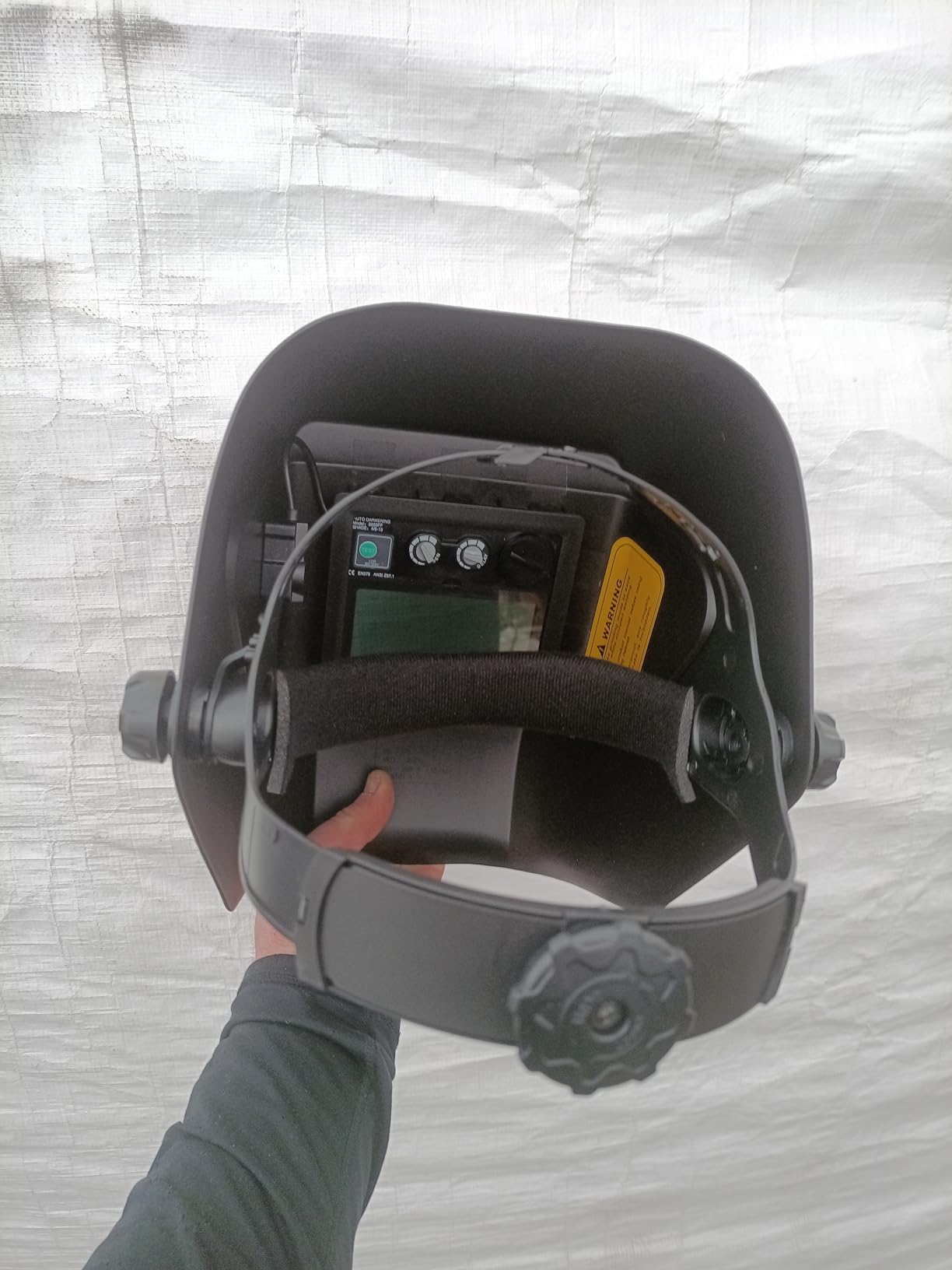
Two arc sensors switching in 1/20000 second is the weakest sensing setup in this group. For MIG at 20 amps and up, that is fine. For TIG, expect to run sensitivity at its maximum setting and to have an unreliable light state on the faintest arcs.
One reviewer also reported a unit that flickered rather than darkening reliably. If a cheap helmet ever lets you see a bare arc, stop using it.
Who should skip it
Skip it for anything above the hobby tier. The thin lenses will not survive shop spatter, the headband feels fragile, and it arrives needing assembly. Treat it as a practice helmet for a garage, not a shop hood.
Anyone welding at 5 amps or below should skip it entirely and look at a helmet with a published sensitivity floor.
We earn a commission, at no additional cost to you. CERTAIN CONTENT THAT APPEARS ON THIS SITE COMES FROM AMAZON. THIS CONTENT IS PROVIDED 'AS IS' AND IS SUBJECT TO CHANGE OR REMOVAL AT ANY TIME.
How to Choose a Welding Helmet for TIG Welding
Check the published minimum amperage first. If a manufacturer will not state a floor for its auto-darkening filter, assume it was tested at MIG amperages. One helmet on this list publishes a 5 amp DC TIG detection threshold, and that single number should decide your shortlist.
Count arc sensors, but check placement too. Two sensors can work; four or five give the filter more chances to catch a dim arc. Placement matters just as much, because a TIG torch held close to your face blocks sensors that a MIG gun never would.
Read optical classification as four separate grades. A 1/1/1/1 rating covers optical clarity, light diffusion, transmittance variation, and viewing angle dependence. The last digit is the one you feel when you lean to the side to see into a fillet.
Treat the light state as a productivity feature. A shade 3 or 4 light state lets you fit up and inspect a joint without lifting the helmet. A shade 13 light state means you are working blind between welds, which on a thin tube means guessing.
Weigh the helmet against your body position. TIG puts your head forward, turned, and low for long stretches. Heavier shells get tiring faster than most buyers expect, which is why two of the lightest options here score well with people welding out of position all day.
Budget for cover lenses. Standard, non-proprietary plates are cheap and widely stocked. Proprietary plates and models whose replacement inner lenses are not sold separately will cost you more and frustrate you more over a year of use.
Confirm the certifications. ANSI Z87.1, ANSI Z89.1, CSA Z94.3, and EN 379 all appear on shells in this group. Look for them on the label, not in the listing photos, because retailer images get reused across model generations.
Setting Sensitivity and Delay for Low-Amp TIG
Most of the frustration people report with budget helmets on TIG is a settings problem before it is a hardware problem. Work through these five steps before you decide the lens is bad.
- Set your shade before you strike. For TIG between 5 and 20 amps, most welders start around shade 11 to 12 and adjust from there. OSHA guidance treats shade 8 as the minimum below 150 amps, but TIG at low current is usually darker to the eye than its current rating suggests.
- Start sensitivity at the midpoint, not the top. Turn it up only as far as you need. Max sensitivity often picks up stray light and leaves the lens half-dark between welds.
- Shorten the delay for tacking. For repetitive tacks and short beads, cut the delay to roughly a quarter second. For a continuous bead on tube, lengthen it toward half a second so the lens stays dark between passes.
- Clean the sensors and check the cover lens. A spattered or scratched outer plate is the number one cause of a hazy, low-contrast view. Swap it before you blame the electronics.
- Confirm the arc is landing on the sensors. Angle the torch slightly so the arc column is not behind the filler rod and your forearm, and check that a second person or fixture is not casting a shadow across the sensor band.
Frequently Asked Questions
What is the best helmet setting for TIG welding?
Set shade first, then tune sensitivity and delay. For TIG between 5 and 20 amps, start near shade 11 to 12, keep sensitivity near the midpoint and raise it only as needed, and shorten the delay to about a quarter second for tacking. Longer delay, closer to half a second, suits a continuous bead.
Which welding helmet has the largest viewing area?
Among the helmets reviewed here, the YESWELDER BW-10MAXTRI is largest, with an 8.89 by 3.23 inch panoramic field built from a main window plus two side views. The Lincoln Electric VIKING 3350 follows at 12.5 square inches of extra large lens, and the Hobart 770890 offers a 9.3 inch widescreen.
What is the best auto darkening welding helmet for TIG?
For most welders, the Lincoln Electric VIKING 3350 is the best auto darkening welding helmet for TIG. Its 1/1/1/1 4C lens, 12.5 square inch viewing area, reliable low-amp detection, and 5 year warranty make it the most complete option here. Budget users get a capable true color shell with the YESWELDER LYG-L600A.
What shade should I use for TIG welding?
For TIG between 5 and 20 amps, most welders work between shade 9 and 12, with many settling near 11 or 12. OSHA lists shade 8 as a minimum below 150 amps, but low-current TIG reads darker than its amperage suggests. Step up toward shade 13 for thicker aluminum and stainless.
How do I stop my welding helmet flickering on low amp TIG?
Raise sensitivity gradually until the arc is caught cleanly, shorten the delay so the lens clears quickly, and clean the sensor windows. If the lens still flickers, the arc is probably not reaching the sensors because the torch, filler rod, or a fixture is blocking them. Reposition the torch column so the sensors see the arc directly.
Which welding helmet is better, Arccaptain or Yeswelder?
The two brands are close on paper, both offering true color 1/1/1/1 lenses and solar powered shells in the same price bracket. Yeswelder has a wider spread of models with more arc sensors at higher tiers, while Arccaptain competes hardest with large panoramic views. Judge each model on sensor count and published minimum amperage rather than brand name.
What are the top welding helmets for TIG welding?
The top picks for TIG welding are the Lincoln Electric VIKING 3350 for low-amp detection, the YESWELDER LYG-L600A for value, the YESWELDER BW-10MAXTRI for panoramic visibility, the Hobart 770890 for a wide widescreen with simple controls, and the Antra AH7-220-0000 for a published 5 amp DC TIG detection floor.
What is the rule of 33 in TIG welding?
The rule of 33 is a sizing guideline used in TIG: 33 amps per thousandth of an inch of material thickness, so 18 gauge steel at about 0.035 inch is roughly 33 amps. Actual settings vary with alloy, joint design, and shielding gas, and pulsed TIG can run well below that figure.
Final Verdict for TIG Welding Helmets in 2026
The best welding helmets for TIG welding in 2026 come down to how low your amperage goes and how long you wear the helmet. The Lincoln Electric VIKING 3350 takes the overall spot for its 1/1/1/1 4C lens, 12.5 square inch window, and dependable low-amp detection backed by a 5 year warranty.
Take the YESWELDER LYG-L600A for hobby and light shop TIG, the BW-10MAXTRI when you need to see into cramped joints, the Hobart 770890 for a wide screen with physical knobs, and the Antra AH7-220-0000 if you work at 5 amps and want a manufacturer-stated floor. Whatever you choose, tune the sensitivity and delay for your actual amperage before your first bead.