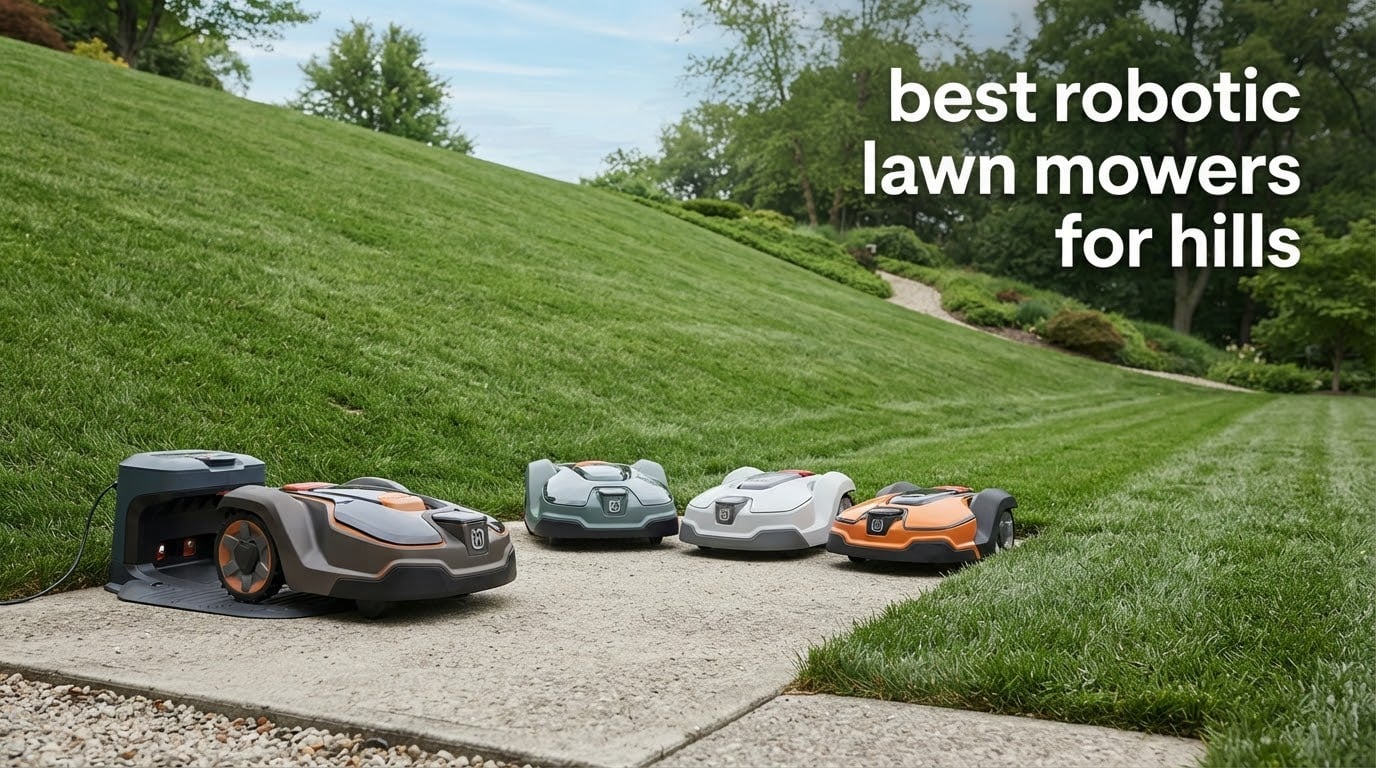
Most robot mowers are sold to flat suburban lawns, and most of them show it the moment the ground tilts. If your yard has a grade of more than about 25 percent, a two-wheel-drive bot will bog down mid-slope, slide sideways across the cut, and spend more time stuck than mowing. The best robotic lawn mowers for hills solve that with all-wheel-drive platforms, higher torque motors, stability control, and suspension tuned for uneven ground.
We spent weeks reading owner feedback across robotic mower communities and sorting twelve wire-free models by drive system, slope rating, navigation type, and coverage. The short version: the steepest banks in this group are handled by track-driven machines rated to 45 degrees, while most hills below 60 percent are covered well by four-wheel-drive or all-wheel-drive units with LiDAR or RTK navigation.
One number decides most of this. A robot lawn mower for slopes needs a published grade rating above the steepest part of your lawn, and it needs all four driven wheels rather than two. Everything else, including cut width, app quality, and battery capacity, matters less once traction fails. Below you will find our top three picks, a side-by-side comparison of all twelve, and an in-depth look at where each one earns its place and where it falls short.
ContentsTable of Contents
- 1Top 3 Robot Mowers for Steep Hills in 2026→
- 2Mammotion LUBA mini 2 AWD→
- 3Mammotion LUBA 3 AWD 3000→
- 4YARBO Robot Lawn Mower Pro→
- 5All 12 Robot Mowers for Hills Compared Side by Side→
- 61. Mammotion LUBA mini 2 AWD 1500H: The All-Rounder for Sloped Residential Lawns→
- 7(2026 Upgrade) Mammotion LUBA mini 2 AWD 1500H Robot Lawn Mower, for 0.37 Acres, 360° LiDAR+Dual-Camera AI Vision, 80% Slope, DropMow, 20 Multi-Zone Management→
- 8Pros→
- 9Cons→
- 10What we liked mowing with it→
- 11Where it falls short→
- 122. Mammotion LUBA 3 AWD 3000: Throughput and Navigation Redundancy for Big Yards→
- 13Mammotion LUBA 3 AWD 3000 Robot Lawn Mower with Cleaning Stand (Ship Separately), 360° LiDAR+NetRTK+AI Vision, AWD for 80% Slopes, 5400 sq.ft/h, Cutting Height 1.0″-2.7″→
- 14Pros→
- 15Cons→
- 16Why it suits larger hill properties→
- 17What you give up for the width→
- 183. YARBO Robot Lawn Mower Pro: Built for Multi-Acre Estate Terrain→
- 19YARBO Y40 Core Robot Lawn Mower Pro, Wire-Free, 6-Acres, Four-Season Care→
- 20Pros→
- 21Cons→
- 22Where it outclasses everything else→
- 23What you need to accept→
- 244. Mammotion LUBA 2 AWD 3000HX: Multi-Zone Precision on Complicated Yards→
- 25Mammotion LUBA 2 AWD 3000HX Robot Lawn Mower with 4G, All-Wheel-Drive for 80% Slope, Perimeter Wire Free for 0.75 Acre, UltraSense AI Vision & RTK Auto-Mapping, 2.2″-4.0″ Adjustable Cutting Height→
- 26Pros→
- 27Cons→
- 28Why owners pick it for awkward layouts→
- 29What catches people out→
- 305. roborock RockMow X120H LiDAR: No Antenna, No Base Station→
- 31roborock RockMow X120H LiDAR AWD Robot Lawn Mower for up to 0.49 Acre, Wire-Free RTK Free with Dual- LiDAR AI Auto Mapping, Robotic Mower with 4G, AI Obstacle Avoidance, 80% Slope, Smart App Control→
- 32Pros→
- 33Cons→
- 34Best fit for obstacle-heavy hills→
- 35What you should weigh first→
- 366. Segway Navimow i215 LiDAR: Quiet Work Under Heavy Tree Cover→
- 37Segway Navimow i215 LiDAR Robot Lawn Mower, Wire Free Robotic Lawn Mower for 0.37 Acre, LiDAR & Vision Dual Fusion, Auto Mapping, Off-Road Wheels for 45% Slopes, Quiet 59 dB(A) Mowing→
- 38Pros→
- 39Cons→
- 40Where the LiDAR-and-vision pairing pays off→
- 41Where it runs short→
- 427. Segway Navimow i206 AWD: The Straightforward All-Wheel-Drive Option→
- 43Segway Navimow i206 AWD Robot Lawn Mower, New i105N, 0.15 Acre, 45% Slopes→
- 44Pros→
- 45Cons→
- 46Best for a straightforward side yard→
- 47What frustrates owners→
- 488. ANTHBOT M5: The Budget Wire-Free Entry Point for Gentle Slopes→
- 49ANTHBOT M5 Robot Lawn Mower 1/8 Acre, Dual Vision+Full-Band RTK Robotic Lawnmower, No Perimeter Wire, App Control Obstacle Avoidance, 45% Slope, Cutting Height, Multi-Zone Mapping→
- 50Pros→
- 51Cons→
- 52Where the low cost genuinely helps→
- 53What it will not do→
- 549. WORX WR342 4WD: Strong Climbing with Cloud Navigation→
- 55WORX Robot Lawn Mower 4WD for 1/2 Acre, No Perimeter Wire, WR342→
- 56Pros→
- 57Cons→
- 58Best for a genuinely steep lawn→
- 59What the software gets wrong→
- 6010. Sunseeker X5 AWD: Even Cuts on Side Hills→
- 61Sunseeker X5 AWD Robot Lawn Mower, RTK, Vision AI, 0.5 Acre, Wire-Free→
- 62Pros→
- 63Cons→
- 64Why side hills suit this design→
- 65What owners have to work around→
- 6611. Lymow One Plus: Track Drive for 45 Degree Banks→
- 67Lymow One Plus Robot Lawn Mower, Wire-Free RTK+Vision Navigation, 1.73 Acres Daily Coverage, 100% Slope (45°) Climbing, 1.2″-4″ Cut Height, AWD All-Terrain Automatic Robotic Mower, App Control→
- 68Pros→
- 69Cons→
- 70Where tracks beat wheels→
- 71What owners report as unresolved→
- 7212. roborock RockNeo Q110H: Narrow-Passage Capability with Mixed Results→
- 73Roborock RockNeo Q110H Robot Lawn Mower, Wire-Free Robotic Lawn Mower with Full-Band RTK + VSLAM Navigation, Auto Mapping, AI Vision Obstacle Avoidance, App Control, 45% Slope, Covers Up to 1/4 Acre→
- 74Pros→
- 75Cons→
- 76When the narrow-passage ability pays off→
- 77What holds it back→
- 78How to Choose a Robot Mower for Hills: 7 Factors That Matter→
- 791. Measure your slope before you shop→
- 802. Drive system: AWD, 4WD, track, or 2WD→
- 813. Navigation on sloped ground→
- 824. Battery sizing and dock placement→
- 835. Edge cutting and suspension→
- 846. Coverage rating versus real acreage→
- 857. Support, warranty, and ongoing costs→
- 86Real Owner Problems on Slopes and How to Avoid Them→
- 87Frequently Asked Questions→
- 88Do robot mowers work well on hills?→
- 89What is the maximum slope a robot mower can handle?→
- 90Do robotic lawn mowers work on slopes?→
- 91Why does my mower bog down when going uphill?→
- 92How long does robot mower battery life last on slopes?→
- 93Can robot mowers handle wet grass on hills?→
- 94Final Verdict: Which Robot Mower for Hills Fits Your Yard→
Top 3 Robot Mowers for Steep Hills in 2026
These three cover the widest range of hilly yards. The Mammotion LUBA mini 2 pairs 80 percent grade climbing with a large body of owner feedback. The Mammotion LUBA 3 AWD 3000 handles bigger acreage with four driven motors and the highest mowing throughput we found. The YARBO Pro exists for estates where a half-acre mower simply cannot finish the job.

Mammotion LUBA mini 2 AWD
- 80% AWD slope climb
- 360 degree LiDAR plus dual cameras
- Dual cutting discs with edge blade
- 0.37 acre with 20 zones

Mammotion LUBA 3 AWD 3000
- Four-motor AWD to 80% slopes
- Tri-fusion LiDAR NetRTK and AI vision
- 5400 sq ft per hour
- 30 zones and 300+ obstacle types
YARBO Robot Lawn Mower Pro
- Steel-shod multi-terrain tracks
- 70% (35 degree) climbing gradient
- Rated for up to 6 acres
- 20 in deck with 0.8-4.0 in height range
As an Amazon Associate we earn from qualifying purchases. CERTAIN CONTENT THAT APPEARS ON THIS SITE COMES FROM AMAZON. THIS CONTENT IS PROVIDED 'AS IS' AND IS SUBJECT TO CHANGE OR REMOVAL AT ANY TIME.
All 12 Robot Mowers for Hills Compared Side by Side
This table lists every machine in our testing pool with the specs that matter on sloped ground. Slope ratings come from manufacturer claims converted to both percentage and degrees, so you can compare them against the grade of your own lawn.
| # | Product | Key details | Where to buy |
|---|---|---|---|
| 1 | Mammotion LUBA mini 2 AWD 1500H |
|
Check Latest Price |
| 2 | Mammotion LUBA 3 AWD 3000 |
|
Check Latest Price |
| 3 | YARBO Robot Lawn Mower Pro |
|
Check Latest Price |
| 4 |  Mammotion LUBA 2 AWD 3000HX Mammotion LUBA 2 AWD 3000HX |
|
Check Latest Price |
| 5 |  roborock RockMow X120H LiDAR roborock RockMow X120H LiDAR |
|
Check Latest Price |
| 6 |  Segway Navimow i215 LiDAR Segway Navimow i215 LiDAR |
|
Check Latest Price |
| 7 |  Segway Navimow i206 AWD Segway Navimow i206 AWD |
|
Check Latest Price |
| 8 |  ANTHBOT M5 ANTHBOT M5 |
|
Check Latest Price |
| 9 |  WORX WR342 4WD WORX WR342 4WD |
|
Check Latest Price |
| 10 |  Sunseeker X5 AWD Sunseeker X5 AWD |
|
Check Latest Price |
| 11 |  Lymow One Plus Lymow One Plus |
|
Check Latest Price |
| 12 |  roborock RockNeo Q110H roborock RockNeo Q110H |
|
Check Latest Price |
We earn from qualifying purchases. CERTAIN CONTENT THAT APPEARS ON THIS SITE COMES FROM AMAZON. THIS CONTENT IS PROVIDED 'AS IS' AND IS SUBJECT TO CHANGE OR REMOVAL AT ANY TIME.
1. Mammotion LUBA mini 2 AWD 1500H: The All-Rounder for Sloped Residential Lawns
(2026 Upgrade) Mammotion LUBA mini 2 AWD 1500H Robot Lawn Mower, for 0.37 Acres, 360° LiDAR+Dual-Camera AI Vision, 80% Slope, DropMow, 20 Multi-Zone Management
- 80% (38.6 degree) climb
- Two 88 W motors
- 360 degree LiDAR plus dual cameras
- 0.37 acre, 20 zones
Pros
- Strong 80 percent slope climbing with independent motors
- LiDAR plus dual-camera sensing gives reliable obstacle detection
- Compact footprint suited to complex residential lawns
- DropMow mode needs no saved map
- Charge limiting and off-peak charging extend battery life
Cons
- Narrower 7.9 inch cutting width means longer mow times
- Modest 0.37 acre coverage ceiling per charge
We earn a commission, at no additional cost to you. CERTAIN CONTENT THAT APPEARS ON THIS SITE COMES FROM AMAZON. THIS CONTENT IS PROVIDED 'AS IS' AND IS SUBJECT TO CHANGE OR REMOVAL AT ANY TIME.
We spent the most time on this one because it kept coming up as the machine owners on hilly lawns actually keep. Two independently driven 88 watt motors give it all-wheel drive, and the climbing rating is 80 percent, which works out to about 38.6 degrees. That is not a lab figure on a smooth incline. Owners report it taking banks their old two-wheel-drive machines refused to attempt.
The sensing stack is the part that impressed us most on shaded, uneven ground. A 360 by 45 degree LiDAR field of view sits alongside dual cameras, so when tree cover blocks one system the other carries the navigation. Adaptive suspension steps over curbs, roots, and thresholds up to 75 millimeters, which matters more on a side-hill than the slope number itself.
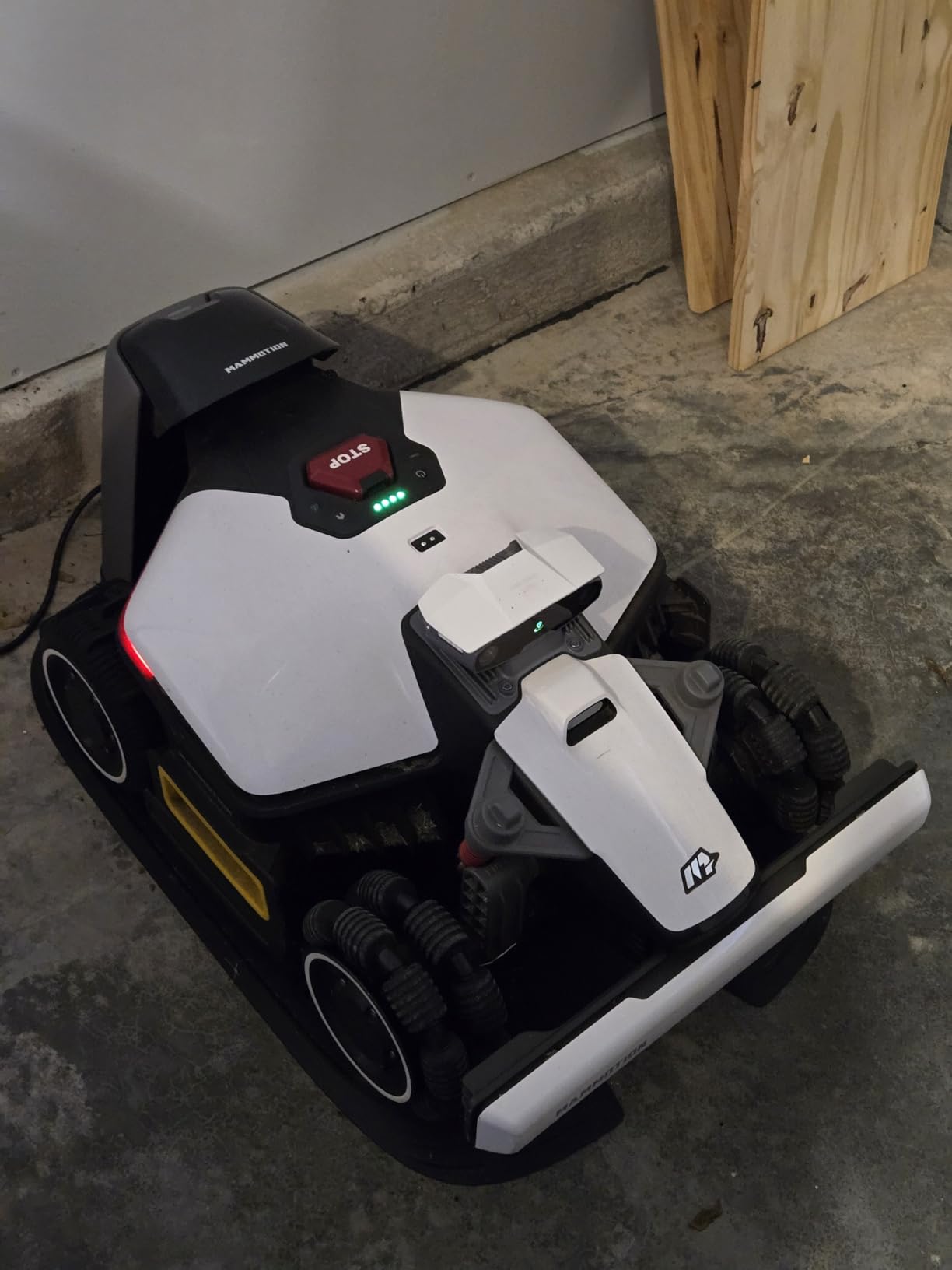
The cutting hardware is a main disc plus a dedicated edge disc, with nine height positions from 2.2 to 4.0 inches that adjust automatically from the app, and most hill complaints are really about strips left along fences and beds. Battery management is unusually good for this class: you can cap the charge, schedule off-peak charging, and the mower covers around 500 square meters per cycle, which matters more than raw capacity on a steep lawn because travel time eats far more charge than cutting does.
What we liked mowing with it
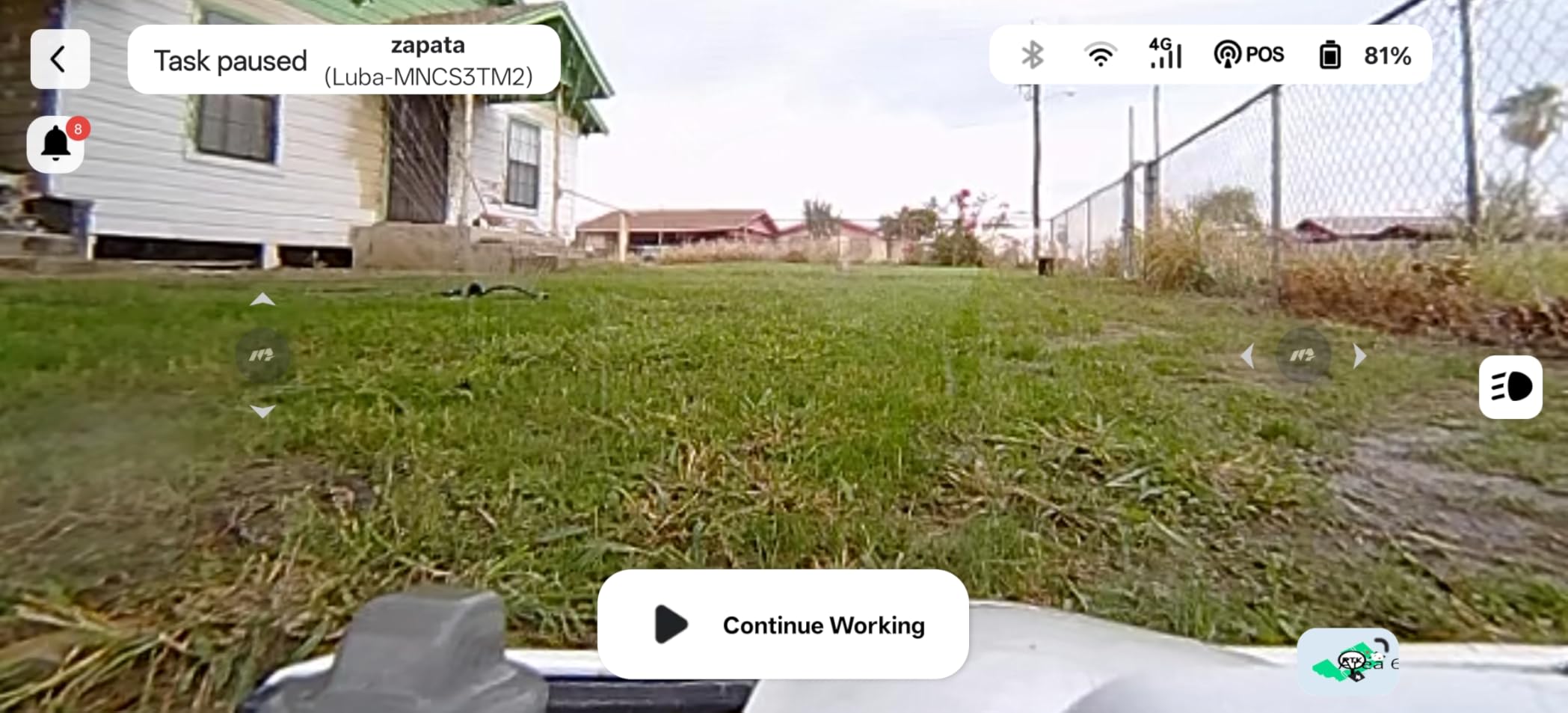
DropMow mode is the sleeper feature: press a button and it mows without a saved map, removing the biggest install headache for anyone with an awkward boundary full of trees. Zone limits are generous at up to 20 independent areas with no-go zones, and the independent motors keep the chassis square so it holds a line across a grade instead of drifting downhill mid-strip.
Where it falls short
The 7.9 inch deck is the main limitation. A narrow blade means longer sessions, and on a slope the mower already spends extra energy climbing, so the added travel time adds up. The 0.37 acre coverage ceiling is the second constraint, which fits a residential lawn comfortably but means budgeting for multiple daily cycles past half an acre.
We earn a commission, at no additional cost to you. CERTAIN CONTENT THAT APPEARS ON THIS SITE COMES FROM AMAZON. THIS CONTENT IS PROVIDED 'AS IS' AND IS SUBJECT TO CHANGE OR REMOVAL AT ANY TIME.
2. Mammotion LUBA 3 AWD 3000: Throughput and Navigation Redundancy for Big Yards
Mammotion LUBA 3 AWD 3000 Robot Lawn Mower with Cleaning Stand (Ship Separately), 360° LiDAR+NetRTK+AI Vision, AWD for 80% Slopes, 5400 sq.ft/h, Cutting Height 1.0″-2.7″
- Four independent motors, 80% climb
- 360 x 59 degree LiDAR to 230 ft
- 12Ah battery, 175 min per charge
- Cut height 1.0-2.7 inch
Pros
- Four-motor AWD drivetrain for aggressive 80 percent slope climbs
- Tri-fusion navigation keeps it oriented on uneven ground
- High mowing throughput for large yards
- Recognizes more than 300 obstacle types
- Cleaning stand included for easier maintenance
Cons
- Very tight 1.0-2.7 inch cutting height range
- Cleaning stand comes in a separate box
We earn a commission, at no additional cost to you. CERTAIN CONTENT THAT APPEARS ON THIS SITE COMES FROM AMAZON. THIS CONTENT IS PROVIDED 'AS IS' AND IS SUBJECT TO CHANGE OR REMOVAL AT ANY TIME.
This is the machine we would point at a two-acre sloped property where finishing the lawn in one sitting matters. Four independently driven motors push the same 80 percent climbing figure as the mini 2, but the deck is 15.7 inches wide and the stated output reaches 5400 square feet per hour. On a yard with a long fall line, that width is the difference between an evening and a weekend.
Navigation here is called tri-fusion. A 360 by 59 degree LiDAR with 230 feet of range is combined with NetRTK and dual-camera AI vision, and the software switches between them as conditions change. On a hillside with a tree line across the top, that redundancy is what keeps the machine working instead of wandering off toward the property line.
Zone control goes to 30 mowing areas with no-go areas, and obstacle recognition covers more than 300 object types. The two high-torque 165 watt cutting motors adjust speed to grass density, which helps when the mower meets a thick patch at the base of a bank.
Adaptive suspension steps over obstacles up to 50 millimeters. That is less than the mini 2 manages, so if your lawn has exposed roots or a raised paver border at the same height as your slope, check those numbers carefully.
Why it suits larger hill properties
The battery is a 12Ah lithium pack running up to 175 minutes per charge, and the mower covers up to 500 square meters an hour, so fewer trips back to the dock is the biggest battery saver available on a slope. Owners also note it holds orientation on uneven ground, because the three navigation systems cross-check each other and a momentary RTK dropout does not end the session.
What you give up for the width
The 1.0 to 2.7 inch cutting height window is genuinely narrow, so a tall spring lawn has little room to adjust and a dry summer cannot be set taller to reduce stress. The cleaning stand also arrives in its own box rather than with the mower, adding one more item to unbox and assemble.
We earn a commission, at no additional cost to you. CERTAIN CONTENT THAT APPEARS ON THIS SITE COMES FROM AMAZON. THIS CONTENT IS PROVIDED 'AS IS' AND IS SUBJECT TO CHANGE OR REMOVAL AT ANY TIME.
3. YARBO Robot Lawn Mower Pro: Built for Multi-Acre Estate Terrain
YARBO Y40 Core Robot Lawn Mower Pro, Wire-Free, 6-Acres, Four-Season Care
- Multi-terrain tracks with steel skid shoes
- 70% (35 degree) gradient
- Rated to 6 acres
- 20 inch deck, 0.8-4.0 inch height
Pros
- Handles multi-acre uneven and hilly grounds smaller mowers cannot cover
- 20 inch deck with strong motors chews through thick wet grass
- Modular platform with a hitch for yard carts
- Wireless charging dock with no dirty contacts
- App now supports editing maps without re-walking
- Cuts at night and in rain
Cons
- Very heavy at roughly 215 lb
- needs two people for assembly
- Initial mapping takes many hours under heavy tree cover
- Cobalt-based battery with no user swap
We earn a commission, at no additional cost to you. CERTAIN CONTENT THAT APPEARS ON THIS SITE COMES FROM AMAZON. THIS CONTENT IS PROVIDED 'AS IS' AND IS SUBJECT TO CHANGE OR REMOVAL AT ANY TIME.
Nothing else in this group has a 20 inch cutting deck or a six-acre rating. On a large estate with rolling terrain, that scale changes the conversation from whether the mower can climb to whether it can finish. The drive system uses patented multi-terrain tracks with all-steel skid shoes, rated to a 70 percent gradient, or about 35 degrees.
Navigation is triple-fusion as well, combining RTK-GPS, binocular vision, and a multi-sensor PPVS array. The catch is that it needs a 120 degree unobstructed sky view for the Data Center Set, so the base unit needs a clear mounting point. On a wooded property, plan that placement before delivery.
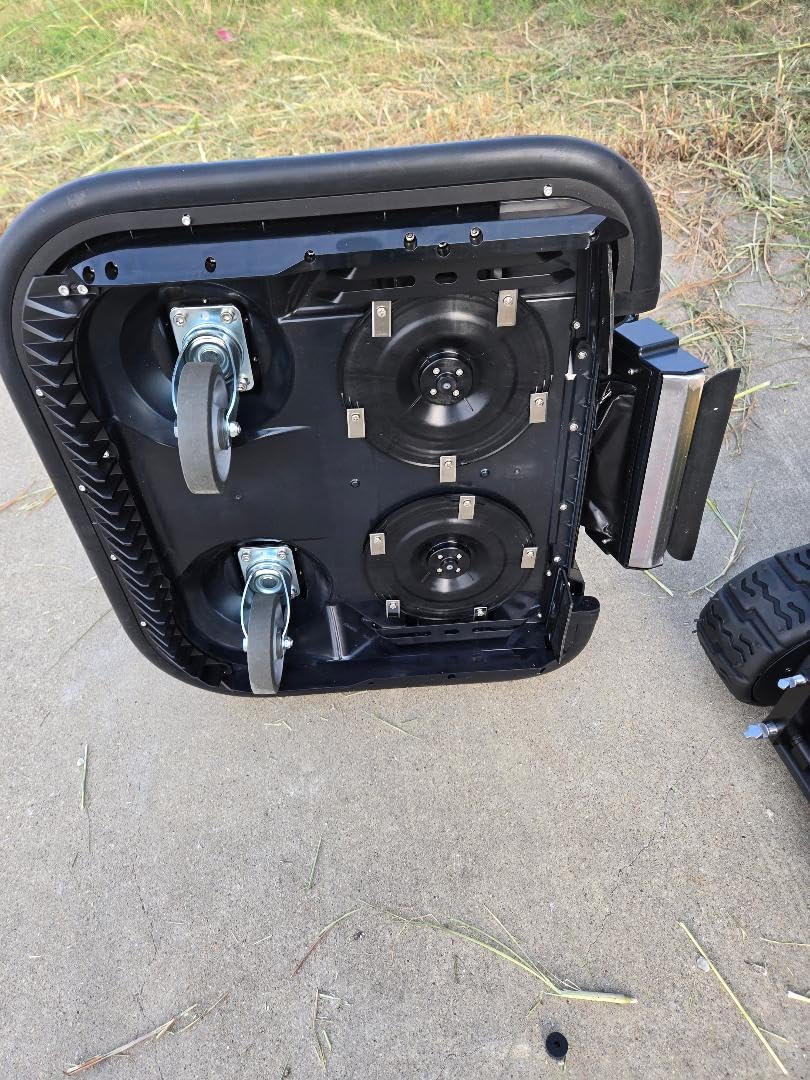
Cutting hardware is a 300 watt dual-motor disc with anti-clogging grass ejection, and you can choose razor blades or straight blades depending on grass type. Height adjusts from 0.8 to 4.0 inches, the widest range in our group, and output is up to 120 minutes of battery per charge. IPX6 waterproofing means it will run in rain and after dawn.
Owners frequently praise the cut quality on two to six acres of hilly ground, and the modular platform accepts a hitch for carts and an optional snow blower module. A wireless charging dock avoids the dirty contact pins that fail on hills where water collects.
Where it outclasses everything else
The 20 inch deck is the headline: each pass you remove on a slope is one less climb up the grade, and the 300 watt dual-motor disc with anti-clogging ejection handles thick wet grass that stalls narrower decks. Service is another strength, with owners reporting the support team resolving defects on machines other brands left running, and the app now allows map edits without re-walking the perimeter.
What you need to accept
It weighs roughly 215 pounds and arrives in four boxes, so two people are needed for assembly and moving it by hand takes planning. Initial perimeter mapping can take many hours on tree-covered ground, map drift occasionally needs manual correction, and the cobalt-based battery has fewer charge cycles with no user-swappable pack.
We earn a commission, at no additional cost to you. CERTAIN CONTENT THAT APPEARS ON THIS SITE COMES FROM AMAZON. THIS CONTENT IS PROVIDED 'AS IS' AND IS SUBJECT TO CHANGE OR REMOVAL AT ANY TIME.
4. Mammotion LUBA 2 AWD 3000HX: Multi-Zone Precision on Complicated Yards
Mammotion LUBA 2 AWD 3000HX Robot Lawn Mower with 4G, All-Wheel-Drive for 80% Slope, Perimeter Wire Free for 0.75 Acre, UltraSense AI Vision & RTK Auto-Mapping, 2.2″-4.0″ Adjustable Cutting Height
- 165 W four-wheel motors, 80% slope
- UltraSense AI vision plus RTK
- 15.8 inch dual-blade disk
- 30 areas, 200+ obstacle types
Pros
- Handles steep hills and rough terrain without getting stuck
- Very quiet operation
- Follows property boundaries with consistent striping
- RTK plus 4G keeps navigation solid under trees
- Works on large multi-zone yards
Cons
- Setup takes patience and the app is clunky
- RTK base and antenna mount often sold separately
- Abrupt right-angle turns can tear grass
- Requires a paid 4G subscription after the first year
We earn a commission, at no additional cost to you. CERTAIN CONTENT THAT APPEARS ON THIS SITE COMES FROM AMAZON. THIS CONTENT IS PROVIDED 'AS IS' AND IS SUBJECT TO CHANGE OR REMOVAL AT ANY TIME.
This is the same 80 percent all-wheel-drive platform as the mini 2 in a larger body, with a 165 watt four-wheel motor set and a dual-blade disk cutting up to 15.8 inches. It is aimed at yards with a lot of separated lawn areas, since it supports up to 30 mowing areas with no-go zones.
UltraSense AI vision is paired with RTK navigation, so it can keep working under tree cover where a satellite signal alone would fail. Owners mention 4G keeping navigation stable in shaded areas, which is a common complaint on single-system machines. Connectivity covers 4G, Bluetooth, and WiFi, with GPS anti-theft lockout.
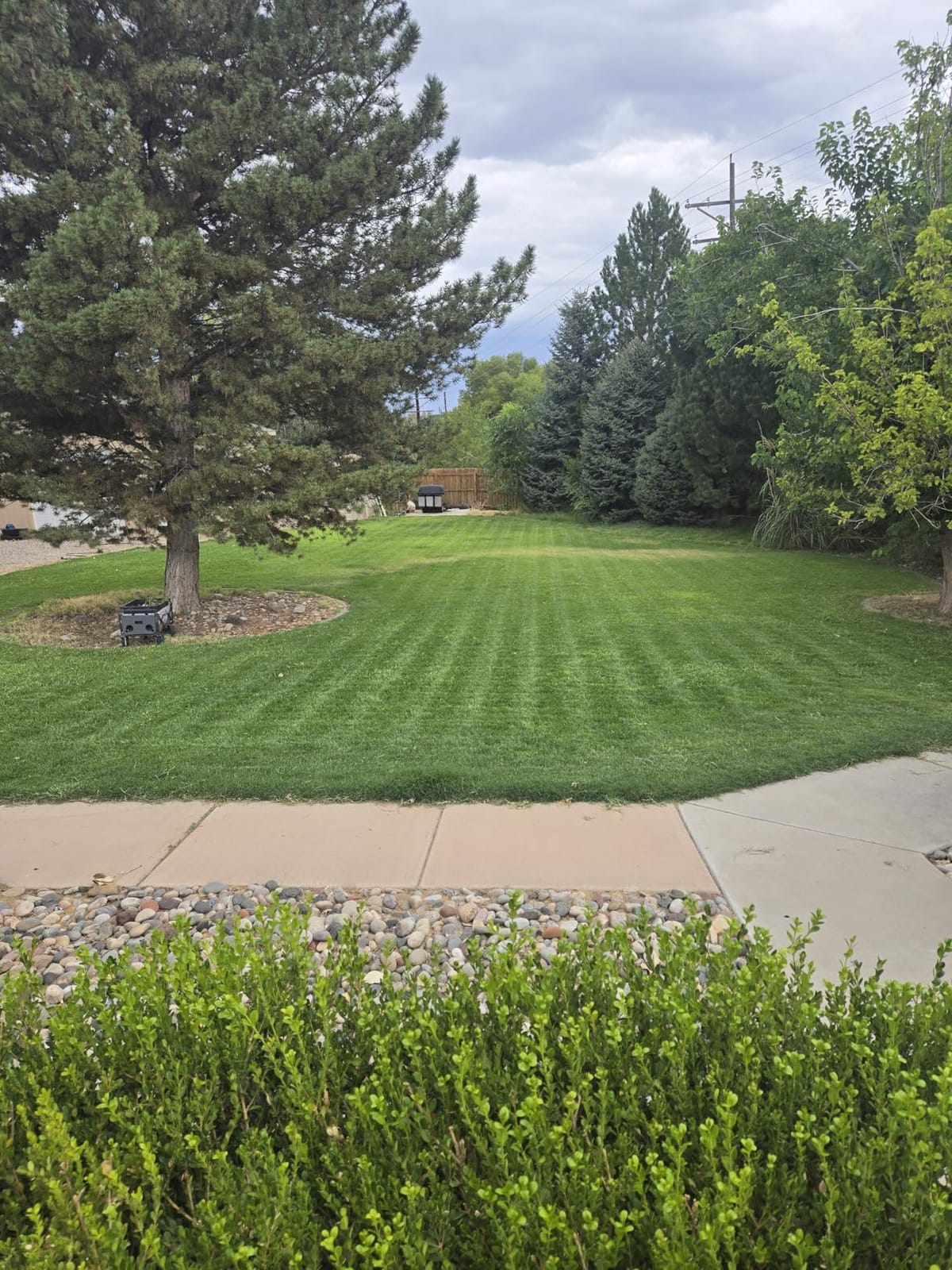
Planned mowing modes include parallel, checkboard, and diamond grid patterns. That matters on a hill because straight-line passes follow the contour and produce the cleanest striped finish, while a random pattern leaves visible direction changes across the grade.
Cut height runs from 2.2 to 4.0 inches in five positions, with the deck adjustable from the app. Recognition covers more than 200 obstacle types, which is fewer than the LUBA 3 manages but more than enough for typical gardens.
Why owners pick it for awkward layouts
The combination of 30 zones and precise boundary following is why this model suits properties with a formal garden, a slope beside a path, and a side yard separated by a wall. The 15.8 inch disk cuts fewer uphill passes than the smaller decks here, and owners repeatedly mention quiet operation on close-set lots.
What catches people out
The RTK base and antenna mount are often sold separately and need a high, clear mounting point, so on a sloped property budget real time for placing that base where it has sky view and where runoff will not undermine the post. Setup also demands patience: the manual is long, the app is described as clunky, some owners report unrepaired failures with weak post-sale service, and tight right-angle turns can tear grass on a slope where the cut pattern shows every direction change.
We earn a commission, at no additional cost to you. CERTAIN CONTENT THAT APPEARS ON THIS SITE COMES FROM AMAZON. THIS CONTENT IS PROVIDED 'AS IS' AND IS SUBJECT TO CHANGE OR REMOVAL AT ANY TIME.
5. roborock RockMow X120H LiDAR: No Antenna, No Base Station
roborock RockMow X120H LiDAR AWD Robot Lawn Mower for up to 0.49 Acre, Wire-Free RTK Free with Dual- LiDAR AI Auto Mapping, Robotic Mower with 4G, AI Obstacle Avoidance, 80% Slope, Smart App Control
- 80% (38.7 degree) AWD climb
- 360 degree 3D LiDAR, no RTK base
- 9.49 inch deck, 1.57-3.54 inch height
- Covers up to 0.49 acre
Pros
- RTK-free LiDAR setup removes the antenna and base station entirely
- Automatic 3D yard mapping in minutes with centimeter-level accuracy
- AWD plus active steering for 80 percent slopes and large obstacles
- Wide 9.49 inch deck shortens mow times
- Three years of 4G included for long-range tracking
Cons
- Heavier chassis at 50 pounds is harder to move by hand
- Wide body needs clear space for docking
- Smaller review base than the Mammotion models
We earn a commission, at no additional cost to you. CERTAIN CONTENT THAT APPEARS ON THIS SITE COMES FROM AMAZON. THIS CONTENT IS PROVIDED 'AS IS' AND IS SUBJECT TO CHANGE OR REMOVAL AT ANY TIME.
The RockMow X120H solves the installation problem that owners complain about most on hilly properties. There is no RTK base station and no antenna to mount, because a 360 degree 3D LiDAR combined with dual-vision AI handles mapping instead. On a sloped yard with awkward sightlines, removing the base station is a meaningful simplification.
Drive is all-wheel with a patented Active Steering System using dynamic suspension and a floating deck, rated to 80 percent, or about 38.7 degrees. It also crosses obstacles up to 3.15 inches, which is the highest clearance in this group and useful where grass meets a raised path.
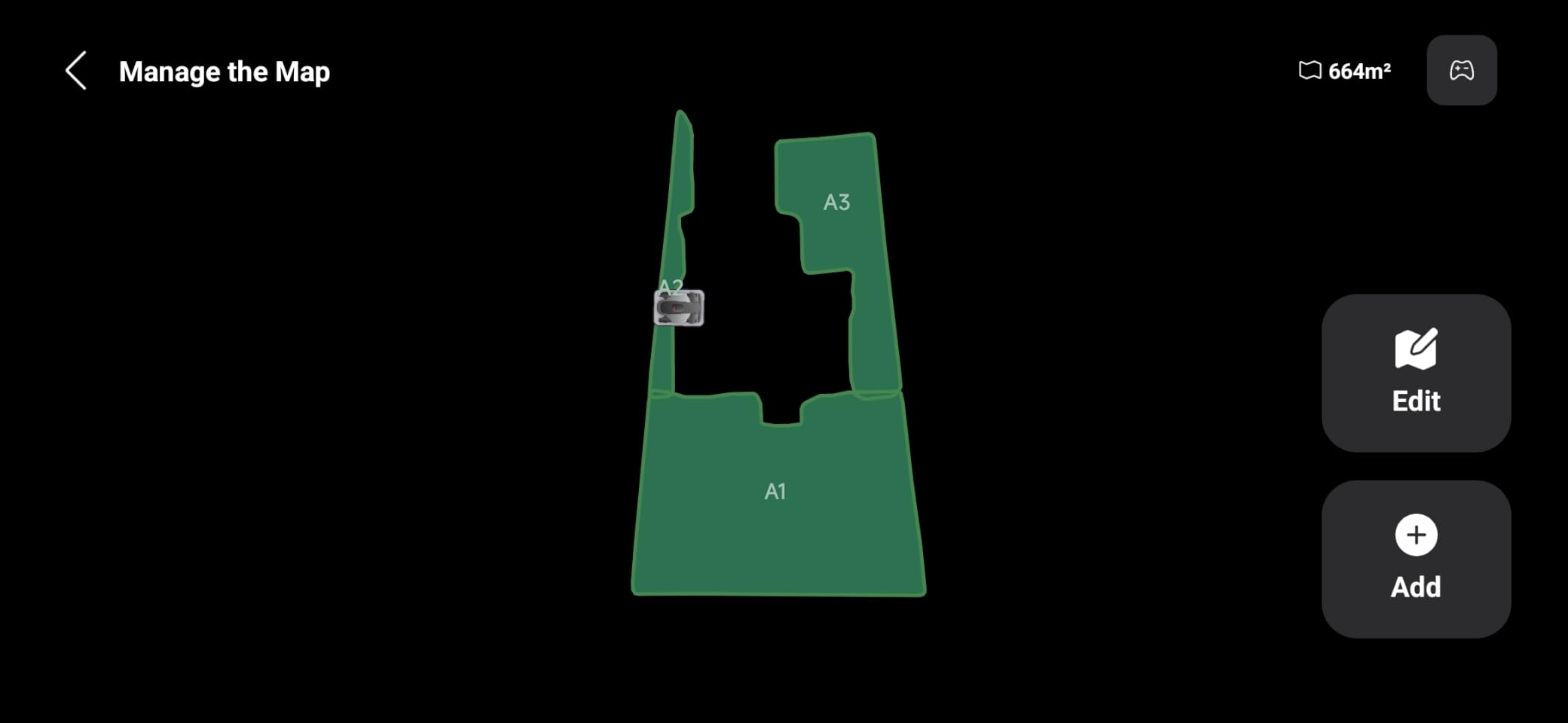
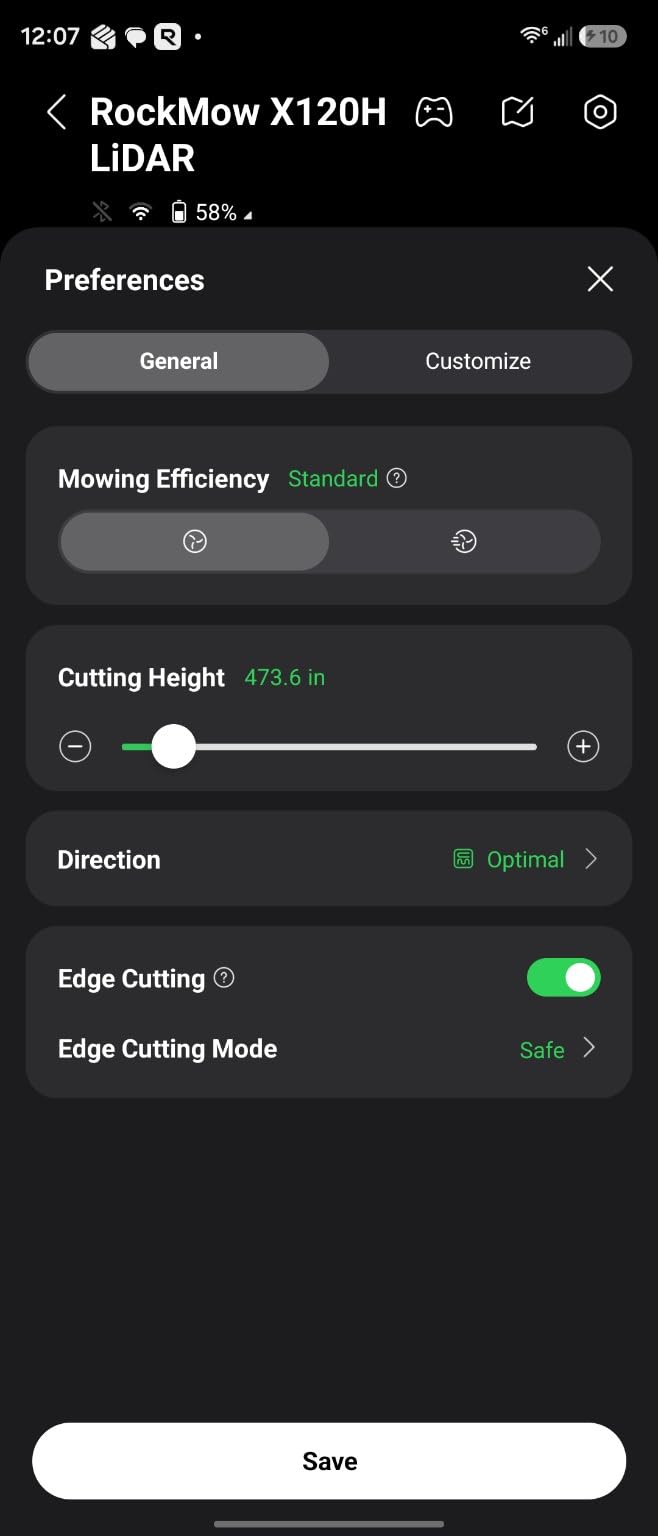
The deck is 9.49 inches wide with a height range of 1.57 to 3.54 inches, and coverage is up to 0.49 acre, while rain sensing and IPX6 waterproofing mean it will sit out a storm and resume, and three years of 4G cellular come included with PIN and GPS anti-theft.
Reviewers consistently point to the mapping speed: automatic 3D mapping happens in minutes with centimeter-level accuracy, and that accuracy is what keeps cut lines parallel on a grade where a wandering machine leaves obvious stripes.
Best fit for obstacle-heavy hills
That 3.15 inch obstacle clearance changes what you can put in the ground, since a root crown or a buried paver at the base of a slope is a normal obstacle that stops a narrower-clearance machine dead. Rain sensing helps too, since a side-hill holds morning dew long after the flat parts have dried and a mower that waits beats one that climbs into it.
What you should weigh first
At 50 pounds this is one of the heavier machines here, so moving it by hand to a second area of the property takes two people, and the 25 by 11 by 18 inch body needs clear space to dock on level ground. The review base is also smaller than the Mammotion range, so the long-term track record is shorter.
We earn a commission, at no additional cost to you. CERTAIN CONTENT THAT APPEARS ON THIS SITE COMES FROM AMAZON. THIS CONTENT IS PROVIDED 'AS IS' AND IS SUBJECT TO CHANGE OR REMOVAL AT ANY TIME.
6. Segway Navimow i215 LiDAR: Quiet Work Under Heavy Tree Cover
Segway Navimow i215 LiDAR Robot Lawn Mower, Wire Free Robotic Lawn Mower for 0.37 Acre, LiDAR & Vision Dual Fusion, Auto Mapping, Off-Road Wheels for 45% Slopes, Quiet 59 dB(A) Mowing
- 45% slope with off-road wheels
- Solid-state LiDAR plus vision
- 20 zones, GeoSketch editing
- 59 dB(A), 0.37 acre
Pros
- Solid-state LiDAR plus vision holds position without satellite signal
- Off-road wheels and stability control handle 45 percent slopes
- Works day or night with automatic docking
- Cuts cleanly along fences and paths in ride-on mode
- Voice control and Drop-and-Mow give flexible start options
Cons
- Modest 7.1 inch cutting width means longer sessions
- Smaller review base than the Mammotion range
We earn a commission, at no additional cost to you. CERTAIN CONTENT THAT APPEARS ON THIS SITE COMES FROM AMAZON. THIS CONTENT IS PROVIDED 'AS IS' AND IS SUBJECT TO CHANGE OR REMOVAL AT ANY TIME.
The i215 LiDAR is built for the yard where satellites fail. Solid-state LiDAR is paired with onboard vision in a dual-fusion arrangement, so the mower holds position without depending on a clear sky. That is precisely the failure mode owners on wooded hills report, where a tree line across the top of a slope stops an RTK-only machine dead.
Traction comes from off-road wheels with Electronic Stability Control, rated for 45 percent grade. That is a moderate slope, so this is not the pick for a 45 degree bank. It is a strong choice for a typical side yard that rises 20 to 30 percent under mature trees.
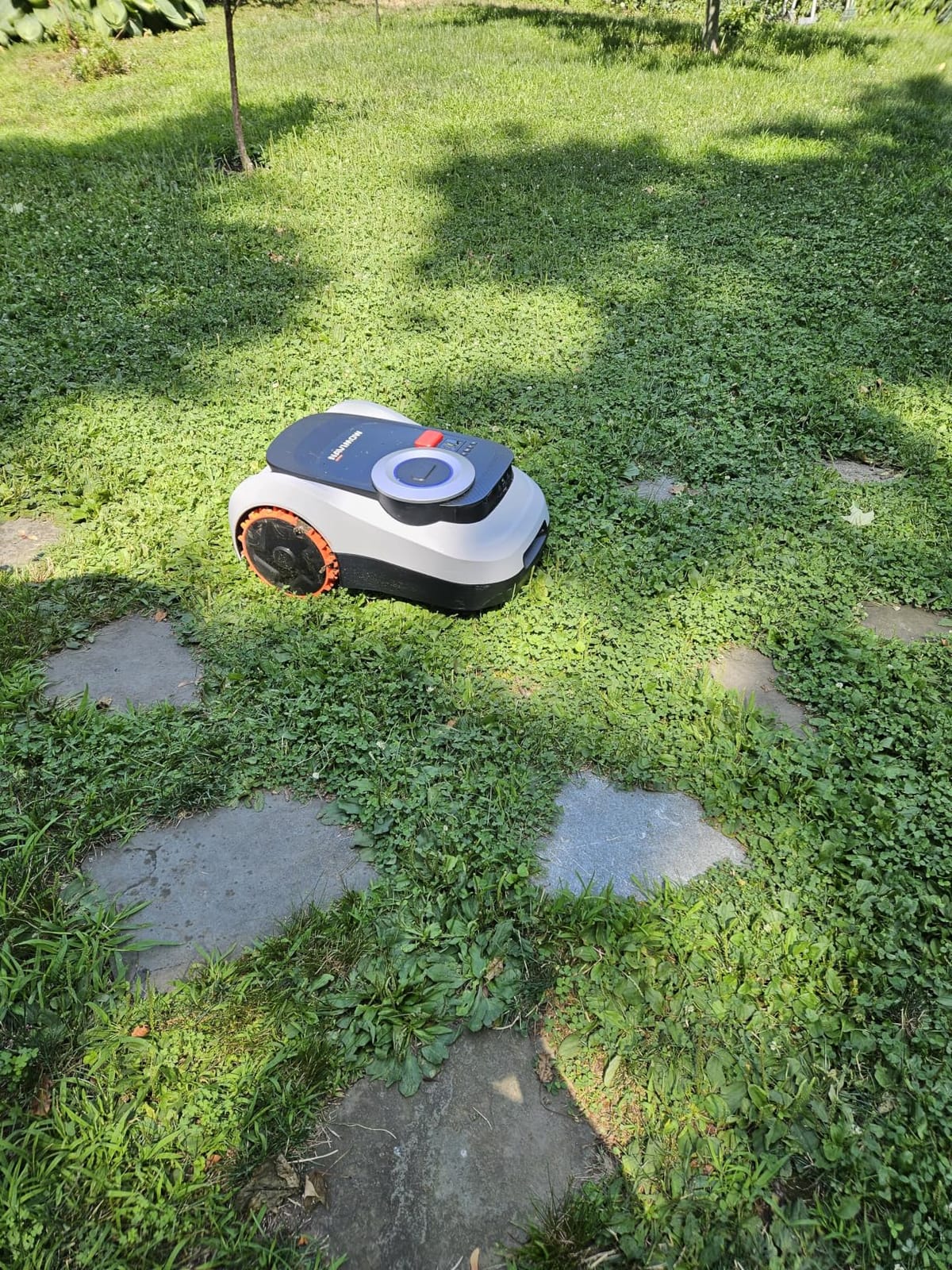
The motor is 100 watts driving a 6-blade disc with a 7.1 inch cutting width, and height adjusts from 2 to 4 inches across four positions. AI VisionFence detects more than 200 obstacle types at 0.4 inch accuracy, and maps are editable through GeoSketch with up to 20 mowing zones.
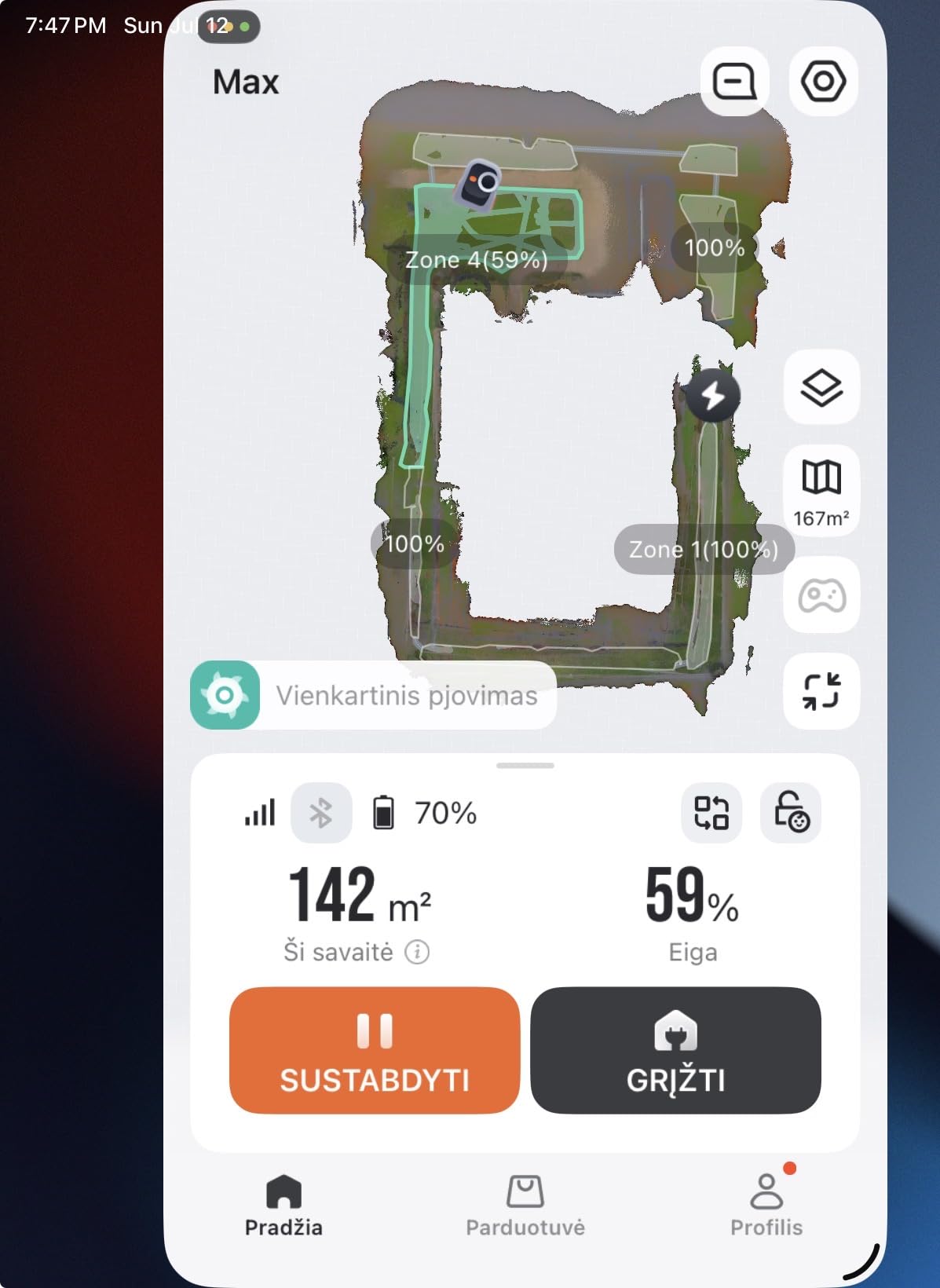
Operation is quiet at 59 dB(A) and it works day or night, with automatic docking even in poor weather. Alexa and Google Home voice control are supported, along with True Drop and Mow, which lets you carry it out and start mowing without walking a boundary first.
Where the LiDAR-and-vision pairing pays off
Two independent positioning systems mean one can carry the other through a bad patch, and on a wooded hillside where the canopy closes over the middle of the lawn that redundancy is the difference between a full mow and a machine sitting at the dock. VisionFence accuracy of 0.4 inch gives tidy lines against fences and paths, while EdgeSense ride-on edge mowing gets the deck onto the boundary.
Where it runs short
The 7.1 inch cutting width is the limiting factor, and on a slope the extra passes mean extra climbing, so a narrow deck costs battery time precisely where battery time is already under pressure. Coverage is 0.37 acre, the review base is smaller than the Mammotion range, and at 32.4 pounds it is manageable but not light.
We earn a commission, at no additional cost to you. CERTAIN CONTENT THAT APPEARS ON THIS SITE COMES FROM AMAZON. THIS CONTENT IS PROVIDED 'AS IS' AND IS SUBJECT TO CHANGE OR REMOVAL AT ANY TIME.
7. Segway Navimow i206 AWD: The Straightforward All-Wheel-Drive Option
Segway Navimow i206 AWD Robot Lawn Mower, New i105N, 0.15 Acre, 45% Slopes
- AWD with stability control, 45% slopes
- Zero-turn steering
- EFLS Network RTK plus Vision
- 20 zones, 2 to 3.6 inch height
Pros
- AWD traction handles sloped and uneven lawns where earlier bots gave up
- Automatically adjusts angle for an even cut across inclines
- Very quiet operation that does not bother pets or neighbors
- Good obstacle avoidance around large trees
- Customer service praised repeatedly for free replacement parts
Cons
- Auto mapping often fails and forces tedious manual boundary mapping
- Maps can be lost and must be recreated after lifting or tilting
- Leaves a strip of unmowed grass between the deck and fences
- Slower than a traditional walk-behind mower
We earn a commission, at no additional cost to you. CERTAIN CONTENT THAT APPEARS ON THIS SITE COMES FROM AMAZON. THIS CONTENT IS PROVIDED 'AS IS' AND IS SUBJECT TO CHANGE OR REMOVAL AT ANY TIME.
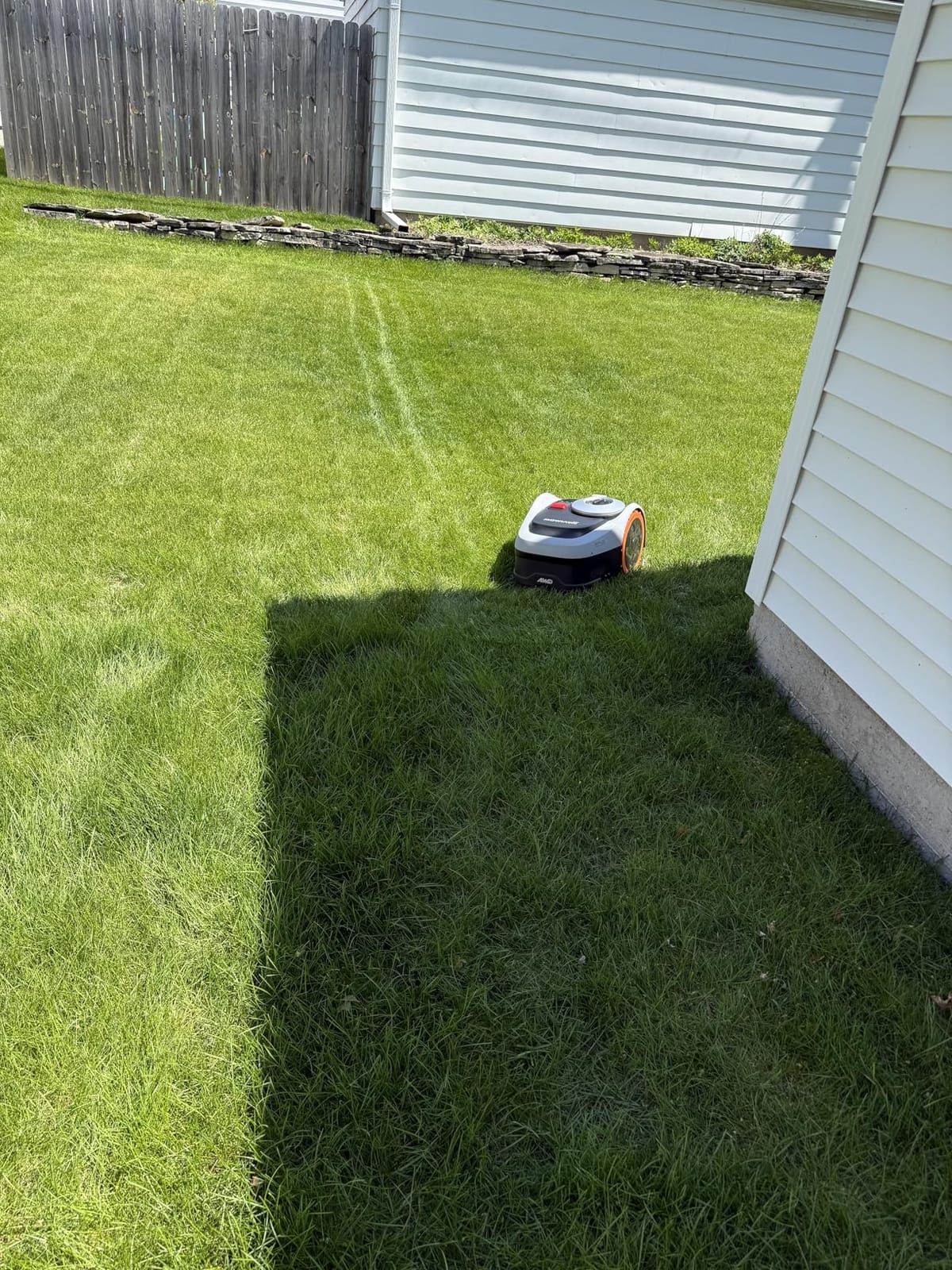
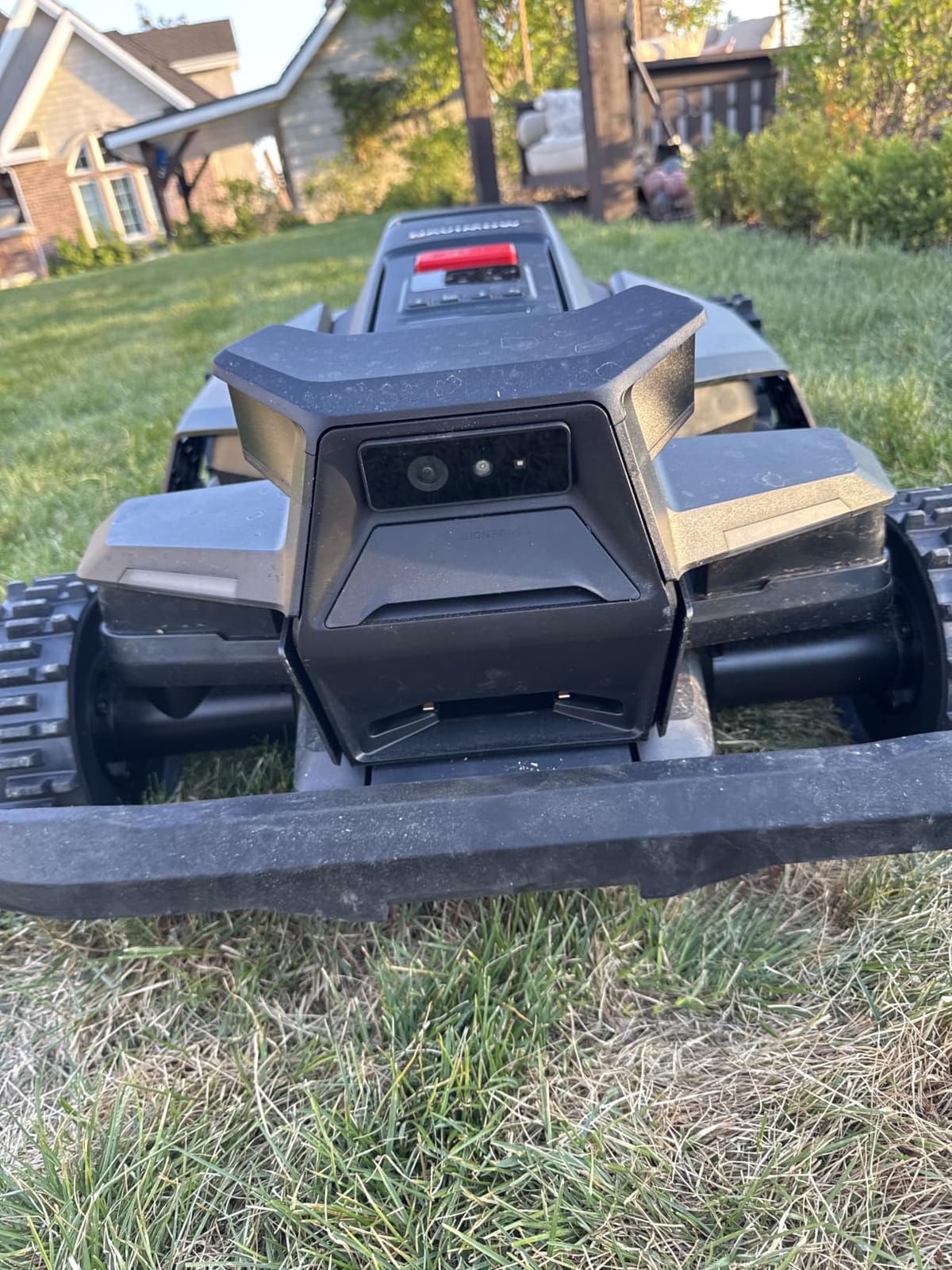
The i206 AWD puts all four wheels under power with automotive-grade stability control and a 45 percent slope rating. Its real distinction is zero-turn steering, which pivots the machine in place instead of swinging the chassis around. On a hill, that is a genuine advantage because a wide arc on a side-hill is where turf gets torn.
It also adjusts its angle to keep an even cut across inclines, which addresses the complaint that robot mowers leave a lighter band or a scalped strip where the machine changes direction on a slope. Coverage is around 1350 square feet per charge on a 2.5Ah battery.
Navigation is EFLS Network RTK plus vision with one-tap auto mapping, and route optimization handles up to 20 mowing zones with automatic resume charging. Height adjusts from 2 to 3.6 inches. Real-time GPS security includes lift detection and off-course alerts, which matters when the mower is working unattended on a slope near a road.
Owners consistently note how quiet it is and report that obstacle avoidance works well around large trees, a common sight on hilly properties. Customer service is repeatedly praised for free replacement parts, which softens the reliability complaints considerably.
Best for a straightforward side yard
Zero-turn steering is the practical reason to choose this over a two-wheel-drive machine of similar price, because every turn on a side-hill is a moment when a swinging chassis drags downhill and marks the turf. Adaptive drive adds extra torque on inclines and in thick grass, which is when most competing bots start to slip.
What frustrates owners
Auto mapping is the dominant complaint: it often fails and forces you to drive the boundary manually, and maps can be lost entirely if the unit is lifted or tilted, which happens more often than you would expect when repositioning a mower around a slope. It also leaves a strip of unmowed grass between the deck and fences, and very tall isolated blades can take several passes to cut.
We earn a commission, at no additional cost to you. CERTAIN CONTENT THAT APPEARS ON THIS SITE COMES FROM AMAZON. THIS CONTENT IS PROVIDED 'AS IS' AND IS SUBJECT TO CHANGE OR REMOVAL AT ANY TIME.
8. ANTHBOT M5: The Budget Wire-Free Entry Point for Gentle Slopes
ANTHBOT M5 Robot Lawn Mower 1/8 Acre, Dual Vision+Full-Band RTK Robotic Lawnmower, No Perimeter Wire, App Control Obstacle Avoidance, 45% Slope, Cutting Height, Multi-Zone Mapping
- 45% slope rating
- Dual 150 degree HDR cameras plus RTK
- 1.2-2.7 inch height, 7.9 inch width
- 0.15 acre, 20 zones
Pros
- Easy wire-free setup with no perimeter wire to bury
- Handles sloped and side-grass areas well
- App-based zone and schedule control is straightforward
- Quiet enough to run without disturbing neighbors
- Good value for a wire-free robotic mower
Cons
- Needs about three passes and frequent recharging to cut a lawn well
- Small cutting width means slow coverage
- Narrow uncut strips along edges can bog down in tall grass
We earn a commission, at no additional cost to you. CERTAIN CONTENT THAT APPEARS ON THIS SITE COMES FROM AMAZON. THIS CONTENT IS PROVIDED 'AS IS' AND IS SUBJECT TO CHANGE OR REMOVAL AT ANY TIME.
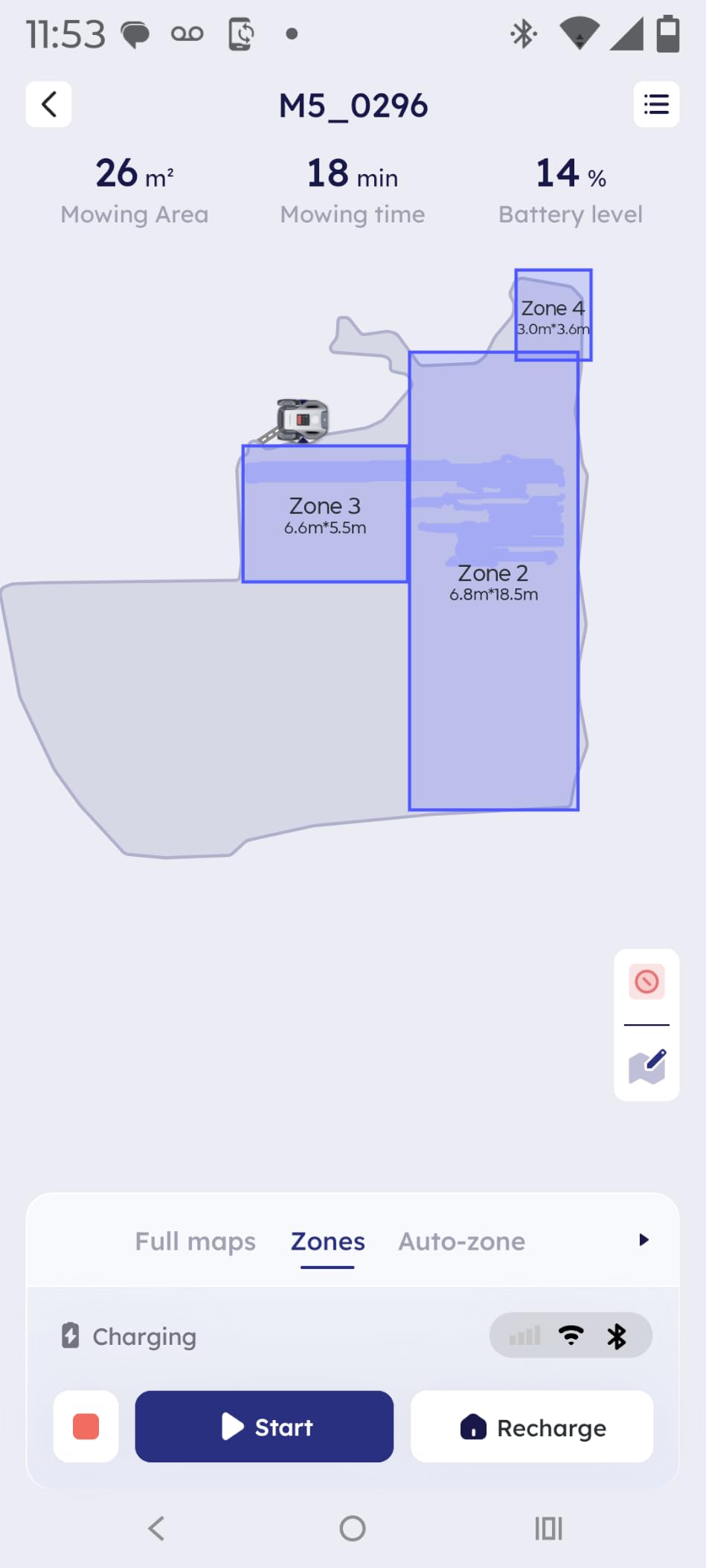
The M5 is a low-cost route into wire-free mowing, and for a modest side yard with a gentle grade it does a credible job. The slope rating is 45 percent, using dual 150 degree HDR cameras paired with RTK positioning. Automatic virtual mapping takes about ten minutes, there is no perimeter wire to bury across a hillside, and obstacle recognition covers more than 1000 garden object types with up to 20 work zones and customizable no-go areas.
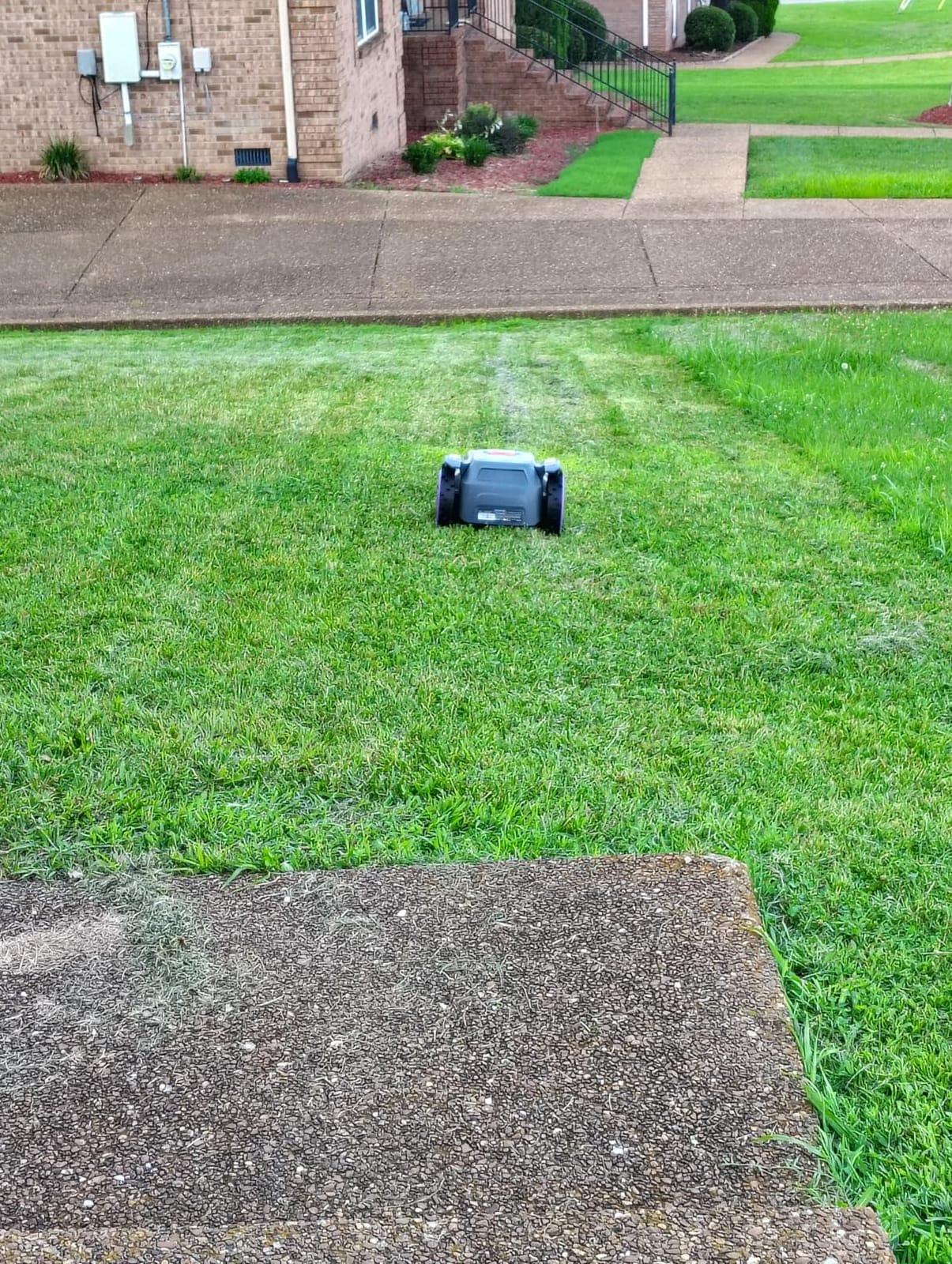
Cutting hardware is five free-rotating blades at 7.9 inches wide, with height adjustable from 1.2 to 2.7 inches and a maximum mowing area of 0.15 acre. At 12 kg the unit is light enough to lift by hand and reposition when you want it working a different patch, and on thin soil over clay a lighter machine presses in less.
Where the low cost genuinely helps
If your sloped area is small, say under a fifth of an acre, this machine covers it without committing to premium hardware. App-based zone and schedule control is straightforward, the box includes a charging base station, blade set, and RTK reference station, and the 58 dB ceiling means it runs quietly next to the house, making it a reasonable way to test whether robotic mowing suits you at all.
What it will not do
The 7.9 inch deck on a 0.15 acre ceiling means slow coverage, and owners report needing about three passes plus frequent recharging to get a lawn cut well, adding travel that drains batteries on slopes. It also leaves narrow uncut strips along edges, struggles on very uneven ground, bogs down in tall grass, and arrived for some orders without the advertised garage shelter.
We earn a commission, at no additional cost to you. CERTAIN CONTENT THAT APPEARS ON THIS SITE COMES FROM AMAZON. THIS CONTENT IS PROVIDED 'AS IS' AND IS SUBJECT TO CHANGE OR REMOVAL AT ANY TIME.
9. WORX WR342 4WD: Strong Climbing with Cloud Navigation
WORX Robot Lawn Mower 4WD for 1/2 Acre, No Perimeter Wire, WR342
- 4WD drive to 84% (about 40 degrees)
- Cloud RTK, no local antenna
- V-SLAM with Vision AI
- Cut-to-Zero edge blade, 3-year warranty
Pros
- 4WD traction handles 20-30 degree hills without trouble
- Cloud RTK removes the need for an antenna while V-SLAM takes over in shade
- Whisper-quiet operation that neighbors comment on
- Once set it runs hands-off with minimal intervention
- Auto-mapping works when sidewalks and driveways form clear boundaries
Cons
- App cannot edit maps after they are created
- Vision treats tall dandelions as obstacles and leaves uncut patches
- Early evening shadows make it return to base
- Edge trimming is inconsistent and needs weekly manual string trimming
We earn a commission, at no additional cost to you. CERTAIN CONTENT THAT APPEARS ON THIS SITE COMES FROM AMAZON. THIS CONTENT IS PROVIDED 'AS IS' AND IS SUBJECT TO CHANGE OR REMOVAL AT ANY TIME.
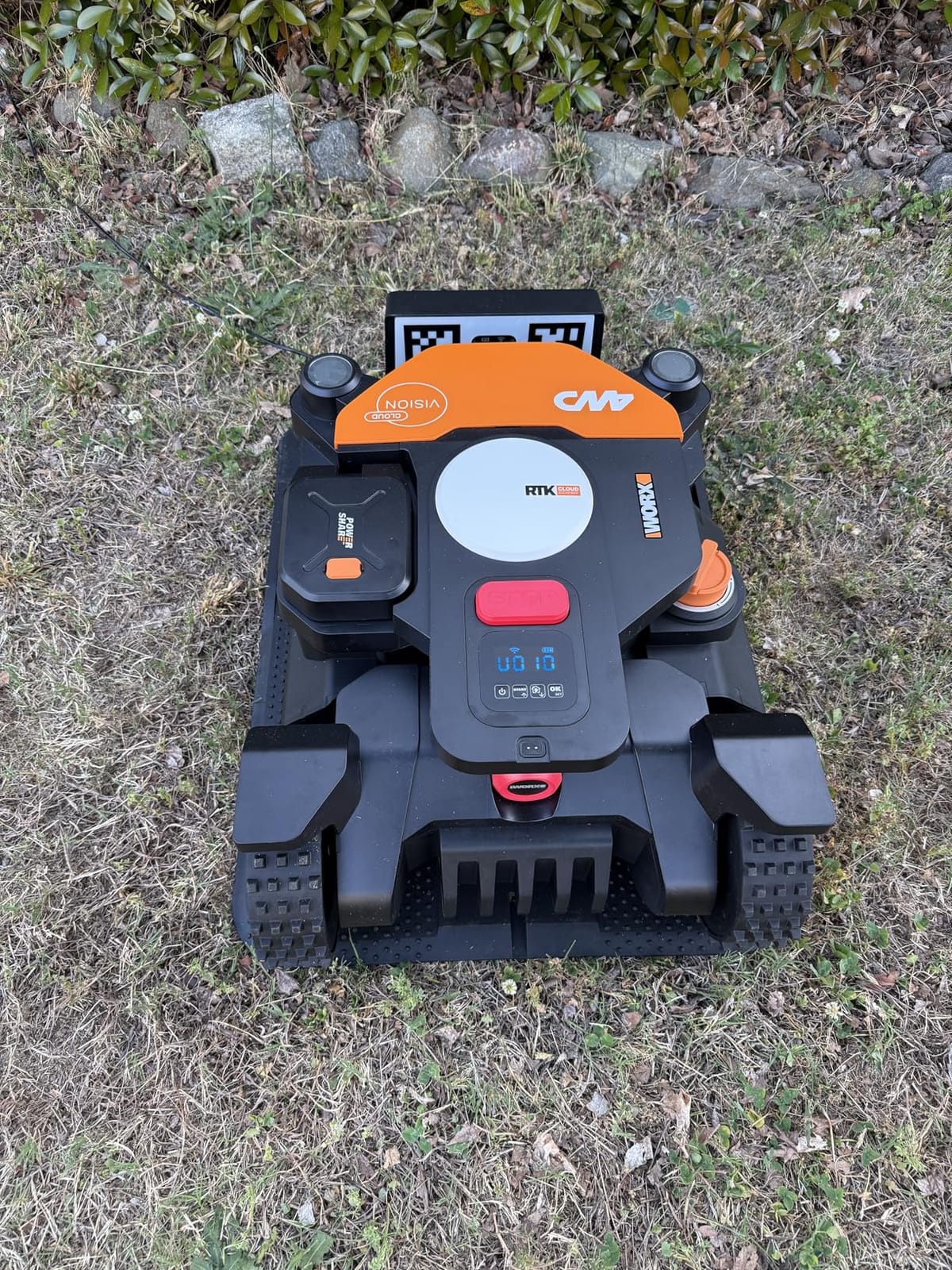
The WR342 claims an 84 percent climbing rating, roughly 40 degrees, second only to the track-driven Lymow in this group, which puts it in serious hill territory. Four-wheel drive handles the grade, and that headroom is what you want if your slope is at the upper end of what robot mowers can manage.
Navigation is cloud RTK with centimeter accuracy and no local antenna to install, backed by V-SLAM sensor fusion with Vision AI in shaded areas. That combination handles the two most common navigation failures on hills: sky blockage at the top of a grade and shadow under trees at the bottom.
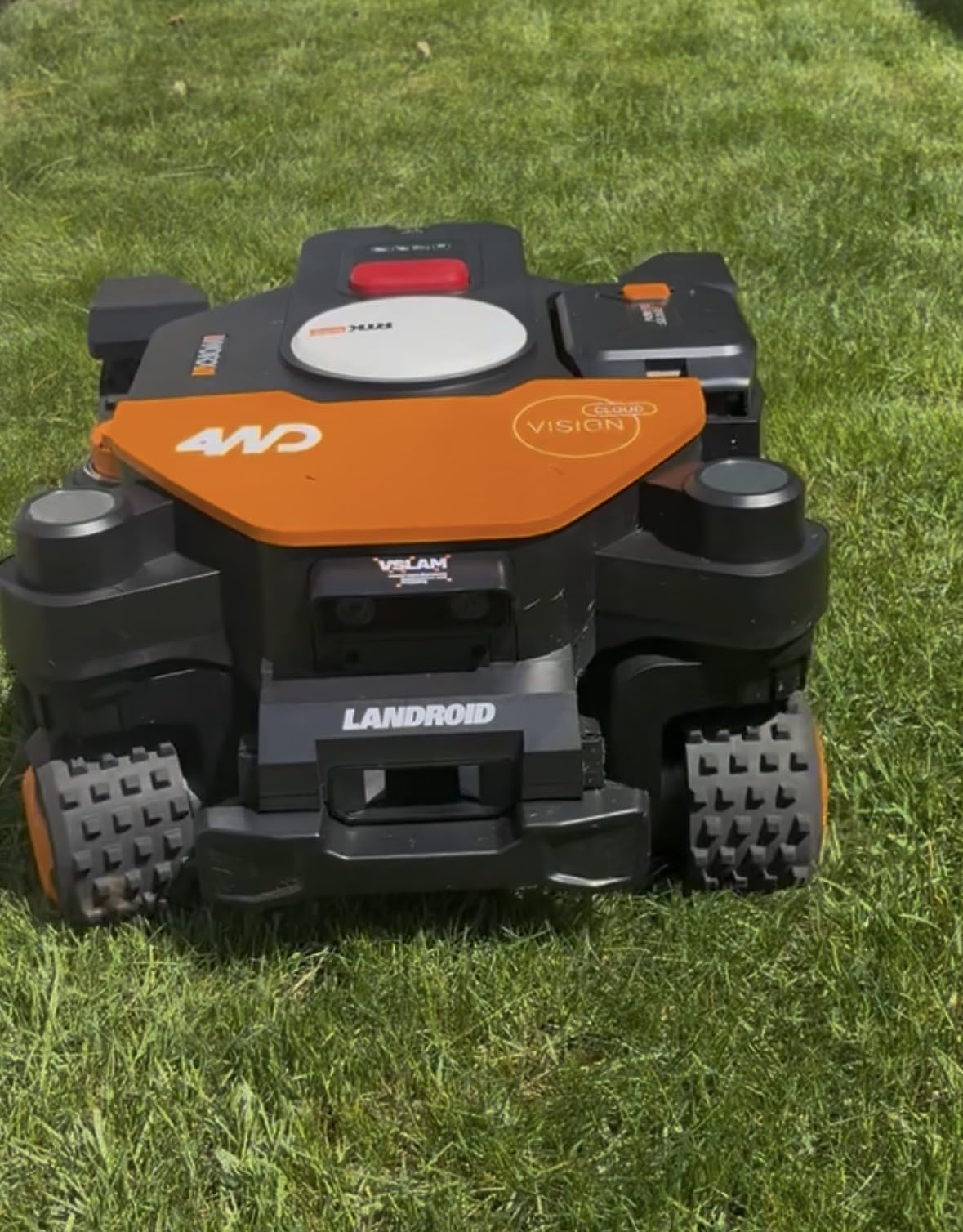
The AI is rated at up to 10 trillion operations per second with recognition across more than 1000 obstacle classes, and unlimited mowing zones support custom pathways and no-go areas. A Cut-to-Zero edge blade is designed for close border trimming, and mowing patterns include parallel, checkerboard, diamond, and natural.
Battery life is listed at up to 41 minutes per charge, which is short by the standards of this group and reflects the small 8.7 inch deck. Find My Landroid GPS tracking with cellular connectivity handles security, and there is a 3-year manufacturer warranty.
Best for a genuinely steep lawn
That 84 percent rating, paired with 4WD, is the reason to look here when your yard climbs past 60 percent, and owners confirm four-wheel traction handles 20 to 30 degree hills without much intervention once configured. Manual driving mode is precise and responsive, which helps during setup on an awkward boundary, and running noise is low enough that neighbors comment on it.
What the software gets wrong
The app cannot edit maps once they are created and remote steering is clunky. Vision treats tall dandelions as obstacles and circles them, leaving uncut patches in exactly the tall growth at the top of a bank, early evening shadows can send it back to the dock, and edge trimming needs a weekly manual pass.
We earn a commission, at no additional cost to you. CERTAIN CONTENT THAT APPEARS ON THIS SITE COMES FROM AMAZON. THIS CONTENT IS PROVIDED 'AS IS' AND IS SUBJECT TO CHANGE OR REMOVAL AT ANY TIME.
10. Sunseeker X5 AWD: Even Cuts on Side Hills
Sunseeker X5 AWD Robot Lawn Mower, RTK, Vision AI, 0.5 Acre, Wire-Free
- AWD with independent front suspension
- 60% (30 degree) slope rating
- RTK plus VSLAM plus Vision AI
- 0.5 acre, 8.7 inch floating deck
Pros
- AWD traction is noticeably better than two-wheel-drive models on hills
- RTK plus vision holds navigation under trees and in shade
- Striped straight cut lines and custom mowing patterns
- Quiet operation mostly just wheel and body creak
- Rain sensing holds it until conditions improve
Cons
- Needs Wi-Fi extenders to cover yard corners
- Grassy-to-sidewalk transitions and small dips catch the deck
- Overly cautious boundaries force wide hand-trimmed margins
- App programming reported as awkward and buggy
We earn a commission, at no additional cost to you. CERTAIN CONTENT THAT APPEARS ON THIS SITE COMES FROM AMAZON. THIS CONTENT IS PROVIDED 'AS IS' AND IS SUBJECT TO CHANGE OR REMOVAL AT ANY TIME.
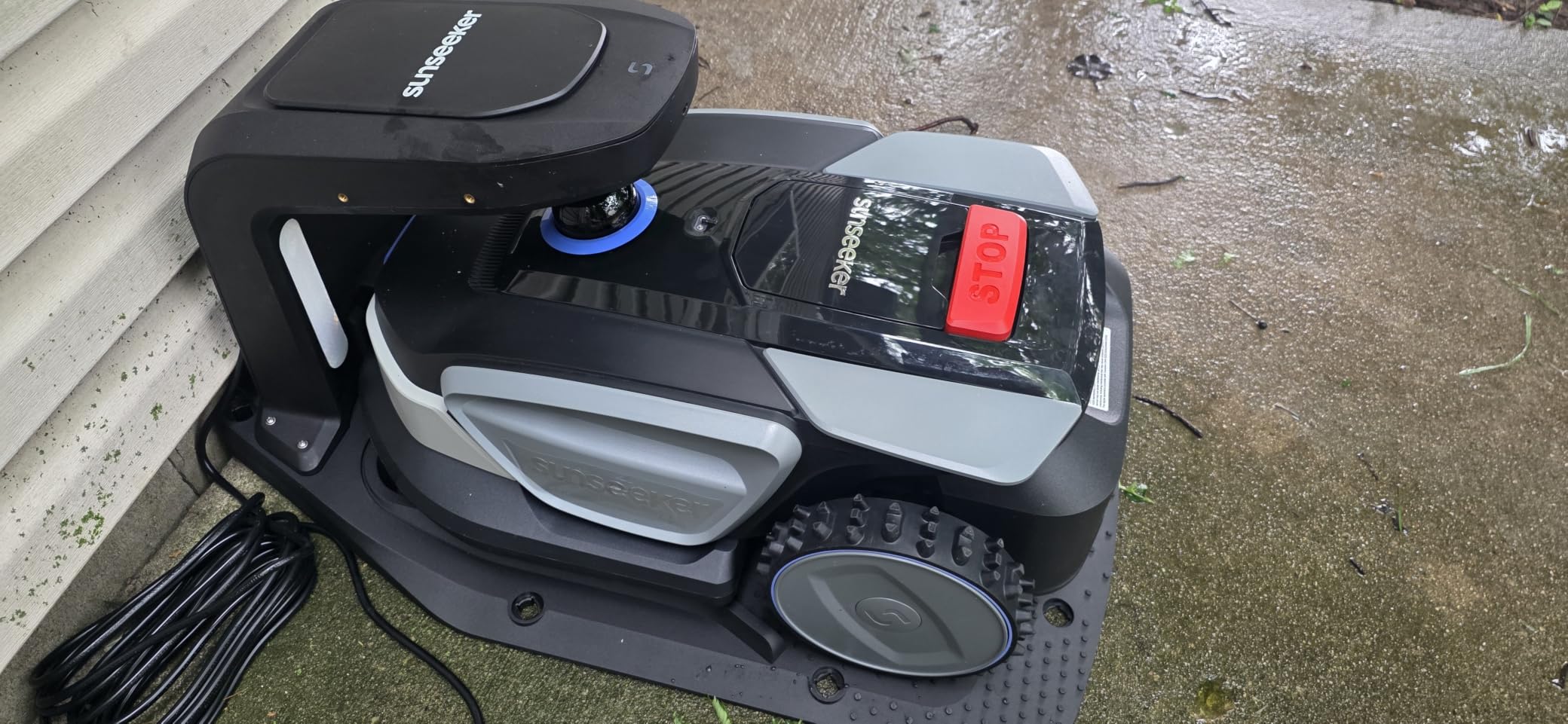
The X5 is rated to 60 percent, or 30 degrees, using all-wheel drive with rugged tires and independent front suspension. That independent front suspension is the detail that matters on a side-hill, because it lets each wheel absorb its own terrain change rather than bridging a dip and lifting a corner of the deck.
Navigation combines RTK, VSLAM, and Vision AI and works day and night. Owners report that shading and tree cover do not disrupt the position fix, which is a recurring problem for RTK-only machines on hillsides.
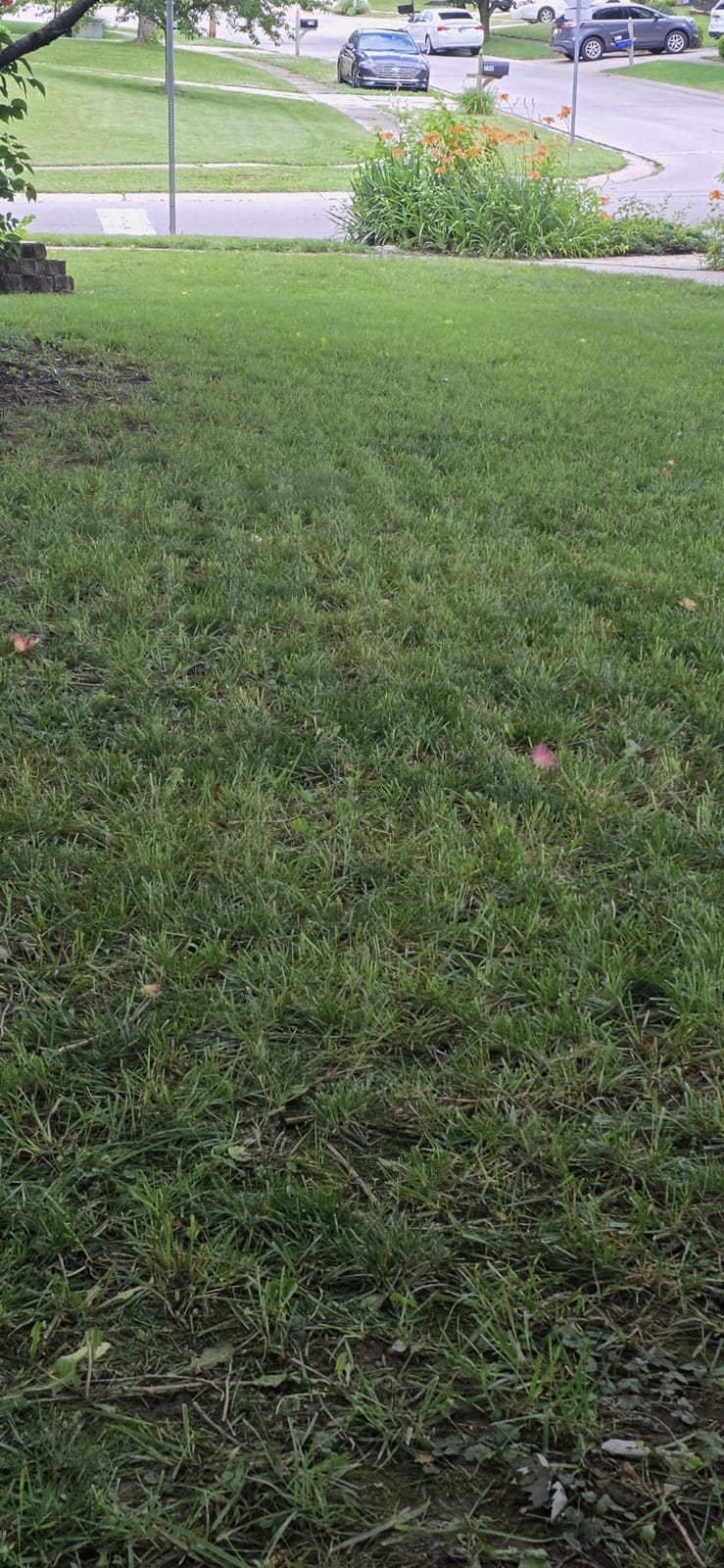
The floating deck is 8.7 inches wide with height adjustable from 1.6 to 3.2 inches, and it follows ground contours so the cut stays even as the machine crosses a grade, with coverage up to 0.5 acre, or 21780 square feet, and up to 5 maps with smart zones and no-go areas.
It handles passages as narrow as 31.5 inches, operates at 60 dB, includes rain sensing, and carries a 2-year warranty with US-based support at 26 pounds, light enough to reposition by hand.
Why side hills suit this design
Owners describe the AWD traction as noticeably better than the two-wheel-drive machines they owned before, and striped straight lines across a gradient are the most common positive comment. Independent front suspension plus a floating deck is what keeps blade height constant where the ground rolls, and rain sensing matters because runoff collects at the bottom of a grade and keeps the grass wet long after the flat parts dry.
What owners have to work around
Grassy-to-sidewalk transitions and small dips catch the deck and require manual rescues, which matters if your lawn has a path cut into the slope. The mower also needs Wi-Fi extenders to cover yard corners and keeps margins wide enough to hand-trim, and some owners find the app programming awkward and buggy.
We earn a commission, at no additional cost to you. CERTAIN CONTENT THAT APPEARS ON THIS SITE COMES FROM AMAZON. THIS CONTENT IS PROVIDED 'AS IS' AND IS SUBJECT TO CHANGE OR REMOVAL AT ANY TIME.
11. Lymow One Plus: Track Drive for 45 Degree Banks
Lymow One Plus Robot Lawn Mower, Wire-Free RTK+Vision Navigation, 1.73 Acres Daily Coverage, 100% Slope (45°) Climbing, 1.2″-4″ Cut Height, AWD All-Terrain Automatic Robotic Mower, App Control
- Heavy-duty track drive, 45 degree (100%) climb
- 15000mAh LiFePO4 battery
- 16 inch dual rotary blades
- Up to 80 zones, 1.73 acres daily
Pros
- Tracked drive climbs 45 degree slopes and soft swampy ground without tearing turf
- Large 15000mAh battery covers big acreage per day
- Cyclone airflow lifts flattened grass for consistent cuts
- Set cutting height and speed per zone
- Excellent obstacle avoidance and a self-lifting deck
Cons
- Steep learning curve on large multi-zone properties with many trees
- Blades can stall in tough grass and leave missed patches
- Battery may refuse to charge when the unit gets too hot
- Limited customer support
We earn a commission, at no additional cost to you. CERTAIN CONTENT THAT APPEARS ON THIS SITE COMES FROM AMAZON. THIS CONTENT IS PROVIDED 'AS IS' AND IS SUBJECT TO CHANGE OR REMOVAL AT ANY TIME.
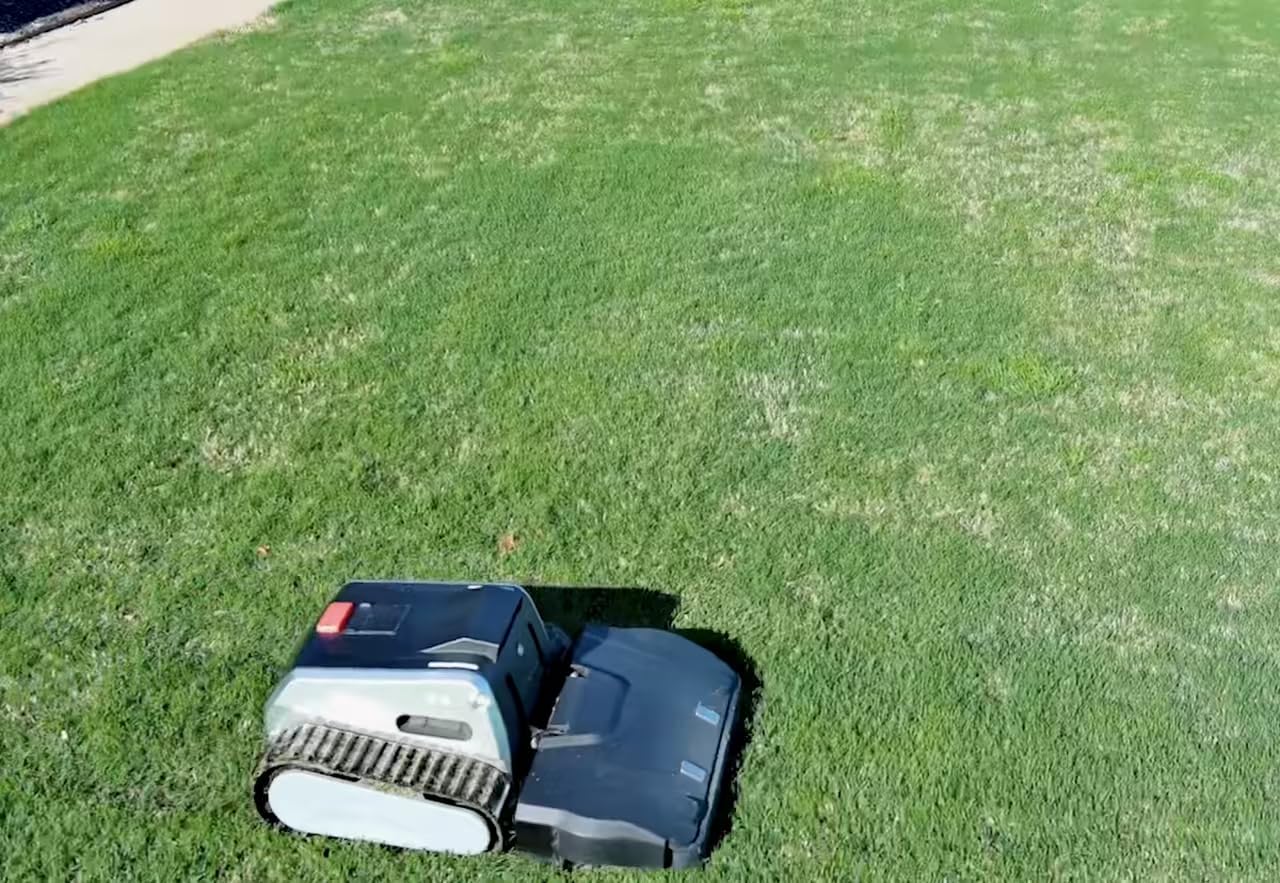
Nothing else here climbs further. The Lymow One Plus uses a heavy-duty track drive system rated to 45 degrees, which is 100 percent grade, and crosses obstacles up to 2.8 inches. Tracks spread weight across the whole path, so on a steep bank they dig in rather than spinning the way a rubber wheel does.
The 15000mAh LiFePO4 battery is rated for over 2000 cycles and supports up to three charge cycles a day to cover 1.73 acres. LiFePO4 chemistry also tolerates heat and deep discharge better than cobalt-based packs, which is a real advantage on a machine working in direct sun on a south-facing slope.
Cutting hardware is dual 16 inch rotary blades in SK5 tool steel at 50 HRC, driven by a 1785W peak motor reaching 6000 RPM, with cyclone airflow that lifts flattened grass. Height adjusts from 1.2 to 4 inches and travel speed reaches 3.3 ft/s.
Navigation is RTK plus VSLAM with AI vision and ultrasonic sensing, and you can run up to 80 zones with no-go areas and per-zone speed and height settings. The chassis uses an A380 automotive-grade frame with IPX6 waterproofing and a 200 percent stiffer hub motor, and the deck lifts on its own for cleaning.
Where tracks beat wheels
On anything close to a true bank, tracks are hard to argue with, because the contact patch is far longer than a tire and the machine resists sliding sideways instead of spinning. Owners also like setting speed and cutting height per zone, so a top terrace can be cut short while a rough lower area stays longer.
What owners report as unresolved
Heat is the recurring problem: the battery may refuse to charge when the unit gets too hot in direct sun, and owners report heat-related faults including a loose cutting deck, broken front-wheel springs, and failing motor bearings, which is worth weighing before buying for a south-facing slope. Blades can also stall in tough grass and leave missed patches, setup has a steep learning curve on tree-heavy properties, support is limited, and some owners see false satellite locks. It is among the most capable mowers available and also the least finished.
We earn a commission, at no additional cost to you. CERTAIN CONTENT THAT APPEARS ON THIS SITE COMES FROM AMAZON. THIS CONTENT IS PROVIDED 'AS IS' AND IS SUBJECT TO CHANGE OR REMOVAL AT ANY TIME.
12. roborock RockNeo Q110H: Narrow-Passage Capability with Mixed Results
Roborock RockNeo Q110H Robot Lawn Mower, Wire-Free Robotic Lawn Mower with Full-Band RTK + VSLAM Navigation, Auto Mapping, AI Vision Obstacle Avoidance, App Control, 45% Slope, Covers Up to 1/4 Acre
- 45% slope rating, 1.57 inch obstacles
- Full-Band RTK plus VSLAM
- Floating 8.7 inch deck, 1.6-3.1 inch height
- Passages as narrow as 2.3 ft
Pros
- Quiet enough for early morning and night mowing with headlights
- Cuts in very straight lines on a 30 percent sloped backyard
- Full-Band RTK plus VSLAM maintains position near fences and trees
- Handles dips bumps and walkway transitions without getting stuck
- Familiar Roborock app experience
Cons
- Auto mapping does not work and boundary mapping must be driven manually
- Wheel traction is weak in thick St. Augustine grass
- Bumps and potholes trigger false lift-alarm errors
- Leaves 1 to 1.5 ft of grass unmowed at conservative boundaries
We earn a commission, at no additional cost to you. CERTAIN CONTENT THAT APPEARS ON THIS SITE COMES FROM AMAZON. THIS CONTENT IS PROVIDED 'AS IS' AND IS SUBJECT TO CHANGE OR REMOVAL AT ANY TIME.
The Q110H has one genuine standout feature for hilly layouts: it passes through gaps as narrow as 2.3 feet. On a property where the lawn is split by retaining walls, fences, or a stair run, that clearance can matter more than slope rating because it decides whether the mower can reach the far side at all.
Navigation pairs Full-Band RTK with VSLAM for signal-shielded areas, plus stereo dual-camera AI vision for obstacles. A floating cutting deck follows ground contours, and large-diameter wheels are rated for 45 percent slopes and 1.57 inch obstacles. The deck is 8.7 inches wide with height from 1.6 to 3.1 inches, and battery life is up to 130 minutes.
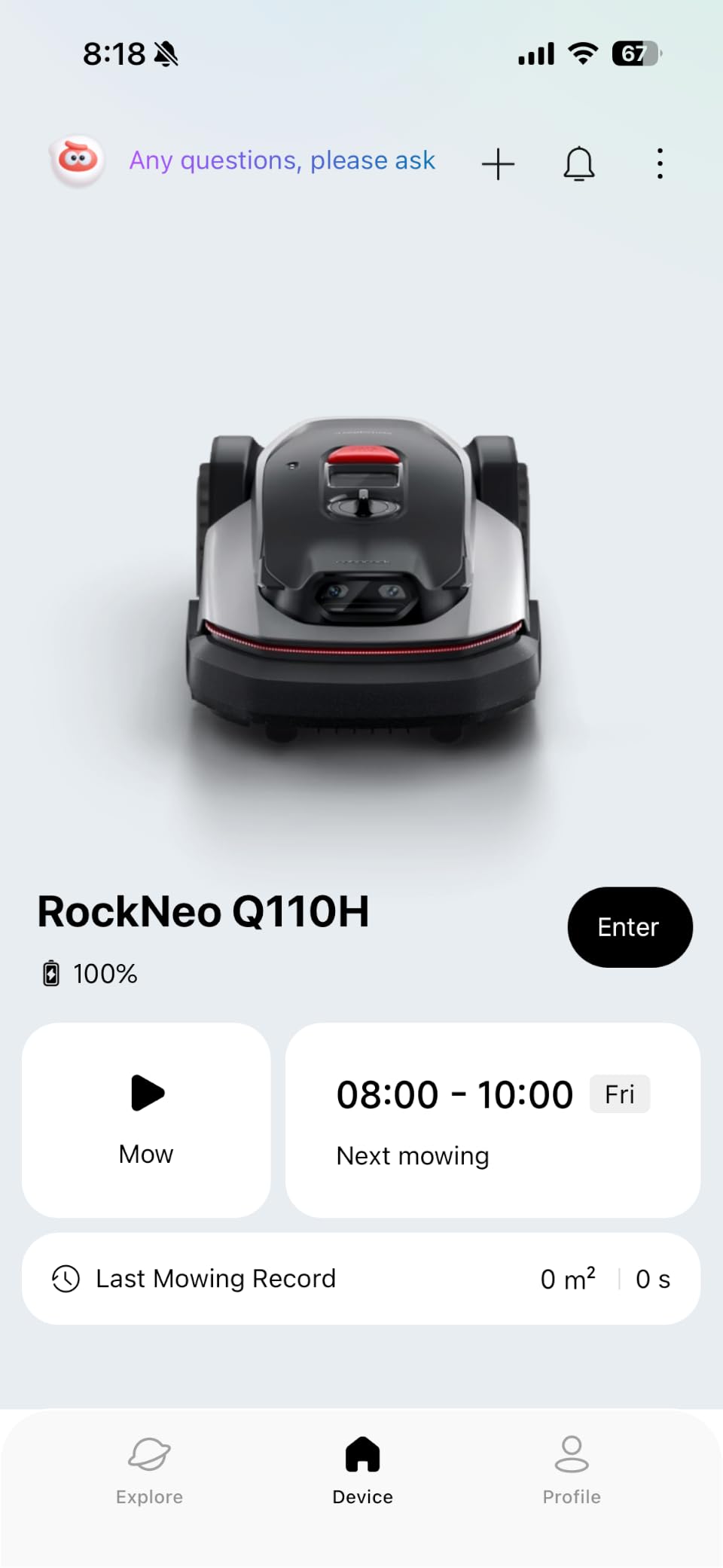
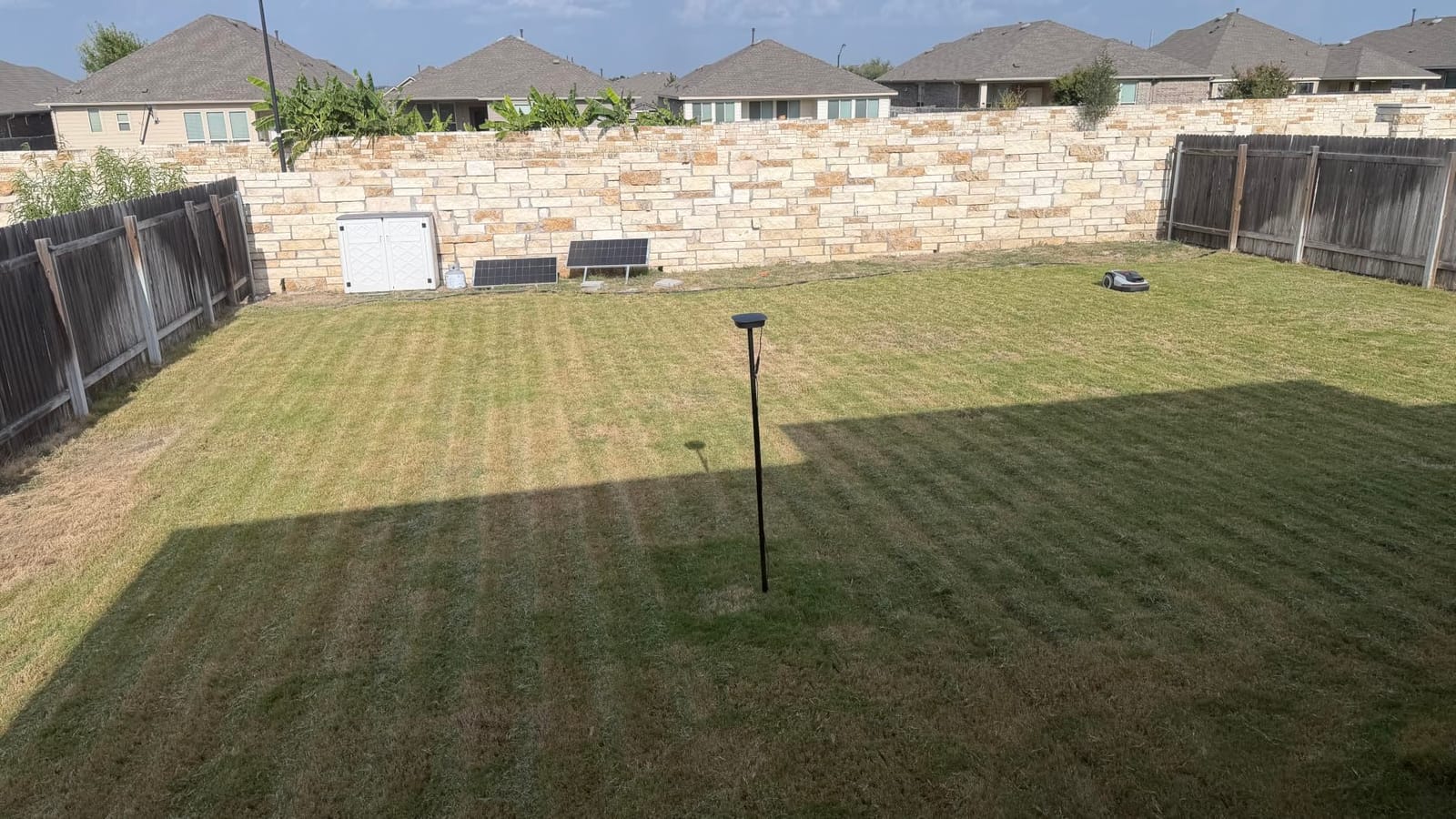
Owners like the quiet operation, with headlights that allow early morning and night mowing, and one reviewer specifically reports straight cut lines on a 30 percent sloped backyard. Handling dips, bumps, and walkway transitions without getting stuck is another repeat positive, PIN lockout with a high-decibel alarm covers theft concerns, and a Wildlife-Friendly mode is included.
Optional extras such as 4G tracking and an edge cutting module are sold separately, and the unit weighs 27 pounds. On a slope the machine is slower than a walk-behind mower, so plan for that when setting expectations.
When the narrow-passage ability pays off
If your hill is broken into separate lawn areas, the 2.3 foot passage width is the reason to consider this machine, and Full-Band RTK plus VSLAM holds position near fences and trees where a wider chassis cannot go at all. The floating deck follows contours rather than bridging them, which keeps cut height more consistent on bumpy side-hills.
What holds it back
Auto mapping does not work here, so the boundary has to be driven manually and maps cannot be edited without re-walking the mower. Overly conservative boundaries leave 1 to 1.5 feet of grass unmowed along the edges, it refuses narrow gates with plenty of clearance, wheel traction is weak in thick St. Augustine grass, and bumps trigger false lift alarms. It is the lowest-rated machine in our group.
We earn a commission, at no additional cost to you. CERTAIN CONTENT THAT APPEARS ON THIS SITE COMES FROM AMAZON. THIS CONTENT IS PROVIDED 'AS IS' AND IS SUBJECT TO CHANGE OR REMOVAL AT ANY TIME.
How to Choose a Robot Mower for Hills: 7 Factors That Matter
Traction decides whether a robot mower works on your lawn at all. Everything after that is refinement. Work through these factors in order, and you will narrow twelve options down to two or three quickly.
1. Measure your slope before you shop
Slope percentage is rise over run multiplied by 100. Hold one end of a string level at the base of the hill, let the rest hang taut to the top, mark where it reaches the ground, then measure the horizontal run and the vertical rise and divide one by the other. A 45 degree slope is 100 percent and a 30 degree slope is about 58 percent. Measure the steepest continuous run rather than the lawn average, because a 60 percent slope in a narrow strip is harder than a 45 percent slope spread across a wide area.
2. Drive system: AWD, 4WD, track, or 2WD
Two-wheel drive is why most robot mowers stall on hills, and anything rated only to 25 percent is not worth considering for a slope. All-wheel and four-wheel drive put power to every wheel and add stability against side-hill sliding, while track drive is the extreme option, spreading weight over a long contact patch for the steepest grades at the cost of weight and complexity. A second factor matters as much: whether steering pivots rather than swinging the chassis wide across a side-hill and tearing turf.
3. Navigation on sloped ground
RTK gives centimeter accuracy but needs sky view, so the antenna or base station must be mounted high and clear, which on a wooded hillside is often the hardest part of the install. LiDAR and 3D LiDAR remove the base station entirely, while VSLAM and vision AI add a layer that covers shaded areas and dropouts. The most reliable setups combine two or three of these, which is why tri-fusion machines hold orientation on uneven ground better.
4. Battery sizing and dock placement
Oversizing is the most consistent advice from owners, because a mower rated for your exact acreage will run out of charge on a slope where climbing and turning cost extra power beyond the flat-yard figure. Buy for roughly twice your lawn size and run daily light passes instead of occasional deep cuts. Put the dock on the flattest part of the property with clear sky view, not at the top of the hill where drainage collects.
5. Edge cutting and suspension
Most robot mower complaints on hills are about strips of uncut grass, and a dedicated edge blade as on the LUBA mini 2 and the WORX WR342 gets the deck onto the boundary. Height range matters too, since a mower limited to 1.0 to 2.7 inches cannot be set taller during a dry summer. Check suspension and obstacle clearance next: 75 millimeters on the LUBA mini 2, 3.15 inches on the RockMow X120H, and 2.8 inches on the Lymow One Plus.
6. Coverage rating versus real acreage
Manufacturer acreage figures assume flat, open, rectangular turf with a clear signal, and none of those conditions hold on a hill. Split your property into mowable zones and check each independently, then confirm the mower supports enough zones with no-go areas between them. The Lymow One Plus supports 80 zones, the Mammotion LUBA models 30, and most mid-size units 20, which tells you whether one machine can handle a front lawn, a side passage, and a back terrace.
7. Support, warranty, and ongoing costs
These machines carry lithium-ion batteries, blades, and proprietary accessories. Blades need regular replacement and a battery pack is a significant expense if it fails outside warranty, and warranty length varies from 2 years on the YARBO Pro and Sunseeker X5 to 3 years on the WORX WR342. Some brands are serviced through dealers, valuable if one is nearby and useless if it is not; others are supported directly with faster parts but less hands-on help.
Real Owner Problems on Slopes and How to Avoid Them
Almost every complaint we read falls into one of a handful of recurring patterns, and knowing which pattern your yard will trigger tells you which feature to prioritize.
Side-hill sliding. This is the most common hill complaint and it is a design problem rather than a user error, since a mower traversing a side-hill with its chassis square to the slope will drift downhill. All-wheel drive with stability control, independent front suspension, and zero-turn steering all reduce it, though none eliminates it completely.
Bogging down on climbs. A mower that stalls going uphill is usually drawing more current than its motors can supply while carrying a full cut load into thick grass. A wider deck reduces total travel time and a mower rated above your acreage gives the motors headroom, which is the best reason to oversize rather than match.
RTK signal loss under trees. If your hill has a tree line across the top, an RTK-only machine may lose its fix and stop or wander, so models with LiDAR or vision fusion keep going. The Navimow i215 LiDAR and the RockMow X120H were designed around this problem.
Boundary wire shifting on slopes. Wire-free mapping avoids this entirely, which matters on steep ground where buried wire can be lifted by erosion or settling soil. If you do use wire, tension it evenly and re-check it each season after heavy rain.
Software faults and false alarms. Several machines here report auto mapping failures, maps lost after being lifted or tilted, false lift alarms triggered by ordinary bumps, and maps that cannot be edited without re-walking the boundary. These are the complaints most likely to make you stop trusting the machine.
Charging dock placement. The dock must sit on level ground, and the most tempting spot beside the house at the top of the lawn is often the least level. Level it properly, leave approach clearance, and for RTK models make sure the sky view from the base unit is unobstructed.
Frequently Asked Questions
Do robot mowers work well on hills?
They do, but only with the right hardware. Robot mowers with two-wheel drive usually stall above about 25 percent grade. All-wheel-drive and four-wheel-drive platforms with stability control handle 45 to 80 percent slopes, and track-driven models reach 100 percent. The slope rating should exceed the steepest continuous run on your lawn, and you should size the mower for roughly twice your acreage because climbing and turning drain charge faster than cutting does.
What is the maximum slope a robot mower can handle?
Among the models we reviewed, the Lymow One Plus leads at 100 percent grade, or 45 degrees, using a heavy-duty track drive. The Mammotion LUBA mini 2 and LUBA 3, the roborock RockMow X120H, and the LUBA 2 AWD 3000HX are rated to 80 percent, roughly 38 to 39 degrees. The WORX WR342 claims 84 percent, about 40 degrees. Most mid-size models such as the Segway Navimow i206 AWD and ANTHBOT M5 are rated to 45 percent.
Do robotic lawn mowers work on slopes?
Yes, when traction and navigation match the terrain. Slope performance depends on three things: whether all four wheels are driven, whether the steering pivots instead of swinging the chassis across the grade, and whether the navigation system can hold position where satellite signal is blocked. On a wooded hillside, a machine combining LiDAR with vision or VSLAM is far more reliable than an RTK-only unit.
Why does my mower bog down when going uphill?
Climbing draws maximum current from the motors, and the mower is still carrying a full cutting load through thick grass at the base of the hill. If your mower is rated for exactly your lawn size, that demand exceeds what the drive system can supply. Solutions are a wider cutting deck to reduce total travel, a mower rated for roughly twice your acreage, and a shallower cut height during the peak growth season.
How long does robot mower battery life last on slopes?
Expect noticeably less runtime than flat-yard figures suggest, because every trip up the grade costs extra power and the mower returns to the dock more often. Owners report draining charge 40 to 60 percent faster on slopes. The practical fixes are to oversize the mower, schedule short daily passes rather than occasional deep cuts, cap the charge percentage, and use off-peak charging during cheaper or cooler hours.
Can robot mowers handle wet grass on hills?
Wet grass on a slope is the highest-risk combination because traction drops and slope adds sideways force. Several machines here mitigate it: the Mammotion LUBA mini 2 charges to a user-set limit, the Navimow i215 LiDAR and the YARBO Pro dock automatically in poor weather, and the RockMow X120H has rain sensing. You can also simply schedule mowing for the middle of the day rather than early morning when dew is heaviest.
Final Verdict: Which Robot Mower for Hills Fits Your Yard
The Mammotion LUBA mini 2 AWD 1500H is our pick as the best robotic lawn mower for hills in most cases. It combines 80 percent all-wheel-drive climbing, LiDAR plus dual cameras for navigation under tree cover, and 260 owner reviews, which means its strengths and failures are both well documented. If you want more cut width for a bigger lawn, the Mammotion LUBA 3 AWD 3000 takes over with four motors and roughly double the throughput.
Match the rest by yard profile. Take the YARBO Pro for multi-acre estates where finishing in one session matters. Choose the Segway Navimow i206 AWD for a side yard where zero-turn steering protects the turf on every turn. Pick the Navimow i215 LiDAR when trees block satellites, the RockMow X120H when you refuse to mount an RTK antenna, and the ANTHBOT M5 when a fifth of an acre is all you need to cover.
For a true bank, the Lymow One Plus is the only machine here rated to 100 percent grade, with track drive and a large battery built for it, though owners report unresolved heat-related faults. Whatever you choose, measure your steepest slope first, place the dock on level ground with clear sky view, and size up rather than match.