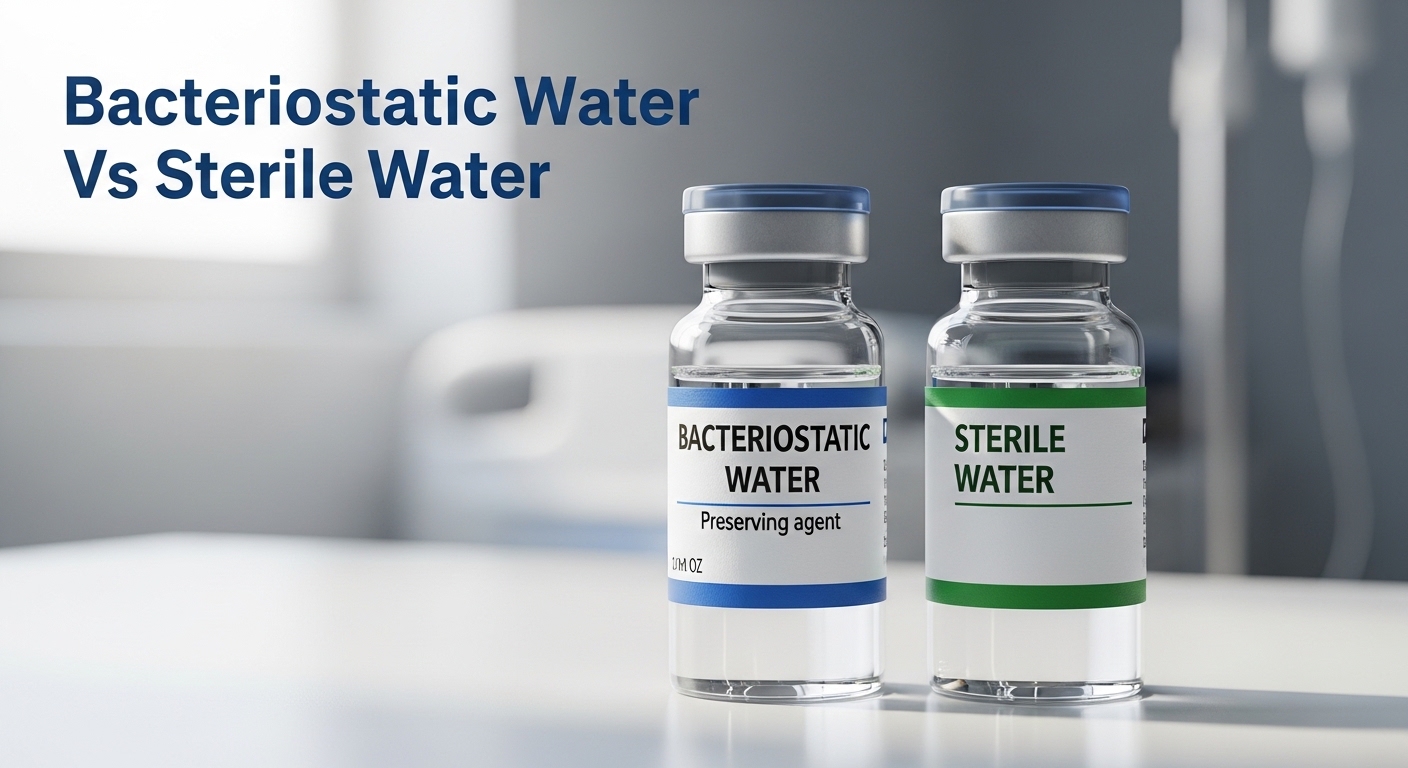
If you’re reconstituting peptides, mixing injectable medications, or preparing hormone therapy treatments, you’ve likely wondered about bacteriostatic water vs sterile water. It’s a common source of confusion, and using the wrong one can lead to contamination or wasted medication.
The key difference is that bacteriostatic water contains 0.9% benzyl alcohol as a preservative, allowing multi-dose use for up to 28 days, while sterile water has no preservatives and must be used immediately as a single-dose.
After researching both water types and comparing suppliers, I’ve put together this complete guide to help you understand exactly when to use each type and where to find quality products.
ContentsTable of Contents
- 1Quick Comparison: Bacteriostatic Water vs Sterile Water→
- 2What Is Bacteriostatic Water?→
- 3Key Properties of Bacteriostatic Water→
- 4Common Uses for Bacteriostatic Water→
- 5What Is Sterile Water?→
- 6Key Properties of Sterile Water→
- 7Common Uses for Sterile Water→
- 8Key Differences Between Bacteriostatic and Sterile Water→
- 91. Preservative Content→
- 102. Usage Timeline→
- 113. Applications and Indications→
- 124. Safety Considerations→
- 135. Storage Requirements→
- 14When to Use Each Type?→
- 15Use Bacteriostatic Water When:→
- 16Use Sterile Water When:→
- 17Common Mistakes to Avoid→
- 18Safety Considerations→
- 19Neonatal Contraindication→
- 20Allergic Reactions→
- 21Contamination Prevention→
- 22Where to Buy Bacteriostatic Water?→
- 23BacteriostaticWater.com – Best Overall Value→
- 24BacteriostaticWater.com→
- 25Pros→
- 26Cons→
- 27Best For→
- 28Skip If→
- 29Mountainside Medical Equipment – Best for Healthcare Professionals→
- 30Mountainside Medical Equipment→
- 31Pros→
- 32Cons→
- 33Best For→
- 34Skip If→
- 35Wittmer Rejuvenation Clinic – Best for Peptide Users→
- 36Wittmer Rejuvenation Clinic→
- 37Pros→
- 38Cons→
- 39Best For→
- 40Skip If→
- 41Frequently Asked Questions→
- 42Is bacteriostatic water prescription only?→
- 43Can I use sterile water instead of bacteriostatic water for peptides?→
- 44How long does bacteriostatic water last after opening?→
- 45Should I refrigerate bacteriostatic water?→
- 46Can bacteriostatic water be used for newborns?→
- 47The Bottom Line→
Quick Comparison: Bacteriostatic Water vs Sterile Water
Here’s a side-by-side breakdown of the key differences:
| Feature | Bacteriostatic Water | Sterile Water |
|---|---|---|
| Preservative | 0.9% Benzyl Alcohol | None |
| Intended Use | Multi-dose | Single-use only |
| Shelf Life After Opening | 28 days | Immediate discard |
| Common Applications | Peptides, HRT, injectable meds | IV dilution, wound irrigation |
| Neonatal Use | Contraindicated | Safe |
| Typical Price | $15-20/30mL vial | $9-12/10-20mL vial |
What Is Bacteriostatic Water?
Bacteriostatic water is sterile water containing 0.9% benzyl alcohol as a preservative. This preservative inhibits bacterial growth, making the water safe to use for multiple doses from a single vial.
The benzyl alcohol works by disrupting bacterial cell membranes, preventing any microorganisms from multiplying inside the vial. This is why you can draw from the same vial multiple times over a 28-day period.
Key Properties of Bacteriostatic Water
- Composition: Sterile water with 0.9% benzyl alcohol
- pH Level: 5.7 (range of 4.5-7.0)
- USP Standard: Meets pharmaceutical-grade requirements
- Multi-dose use: Safe for up to 28 days after first puncture
- Common sizes: 10mL and 30mL vials
Based on my research, bacteriostatic water is the preferred choice for peptide reconstitution because most peptide vials are used over several days or weeks.
Common Uses for Bacteriostatic Water
You’ll typically use bacteriostatic water for:
- Peptide reconstitution: BPC-157, TB-500, and research peptides
- GLP-1 medications: Compounded semaglutide and tirzepatide
- Hormone therapy: HGH, testosterone, and HRT preparations
- Multi-dose injectable medications: Any medication used over multiple days
What Is Sterile Water?
Sterile water is purified water that has been processed to remove all microorganisms, but contains no preservatives. Because there’s nothing to prevent bacterial growth after opening, it must be used immediately and discarded.
The lack of additives makes sterile water suitable for applications where preservatives could cause problems, such as IV administration or wound irrigation.
Key Properties of Sterile Water
- Composition: Pure water, no additives
- Single-use only: Must be discarded after opening
- Non-pyrogenic: Won’t cause fever reactions
- Common sizes: 10mL, 20mL, 50mL vials and larger IV bags
Common Uses for Sterile Water
Sterile water is appropriate for:
- Single-dose injections: When the entire solution is used at once
- IV dilution: Mixing medications for intravenous administration
- Wound irrigation: Cleaning wounds and surgical sites
- Neonatal applications: Safe for newborns (unlike bacteriostatic water)
Key Differences Between Bacteriostatic and Sterile Water
The main difference between bacteriostatic water and sterile water comes down to preservatives and intended use. Here’s what you need to know:
1. Preservative Content
Bacteriostatic water contains 0.9% benzyl alcohol, which acts as a bacteriostatic agent. Sterile water contains nothing but purified water.
This single difference determines everything else about how these products are used.
2. Usage Timeline
Because of the benzyl alcohol preservative, bacteriostatic water remains safe for use for up to 28 days after the first needle puncture. Sterile water must be used immediately and any remainder discarded.
Important: Using sterile water for multi-dose applications creates serious contamination risks. Each needle puncture can introduce bacteria, and without preservatives, they will multiply rapidly.
3. Applications and Indications
Bacteriostatic water is labeled for injection use only. Sterile water is labeled for both injections and irrigations, making it more versatile for wound care.
For peptide users, bacteriostatic water is almost always the right choice because you’ll typically draw from the same vial multiple times.
4. Safety Considerations
The benzyl alcohol in bacteriostatic water is contraindicated for neonates (newborns under 28 days). Benzyl alcohol can cause toxicity in infants, including a condition called “gasping syndrome.”
For adult use, both products are considered safe when used properly.
5. Storage Requirements
Unopened bacteriostatic water can be stored at room temperature (59-86F/15-30C). After opening, refrigeration at 36-46F (2-8C) is recommended to maximize the 28-day usability window.
Sterile water storage is less critical since it should be used immediately after opening.
When to Use Each Type?
Choosing between bacteriostatic water and sterile water depends primarily on whether you’ll use the entire solution at once or over multiple sessions.
Use Bacteriostatic Water When:
- Reconstituting peptides: You’ll draw multiple doses from the same vial
- Preparing HGH: A single vial typically lasts several days
- Mixing compounded GLP-1 medications: Semaglutide and tirzepatide vials are used over weeks
- Any multi-dose injectable: If you’re not using it all immediately
Use Sterile Water When:
- Single-dose administration: You’ll use the entire solution at once
- IV medications: Many IV preparations require preservative-free diluents
- Neonatal applications: Benzyl alcohol is toxic to newborns
- Wound irrigation: Sterile water is appropriate for cleaning wounds
Pro Tip: When in doubt for peptide use, choose bacteriostatic water. The small amount of benzyl alcohol won’t affect your peptide’s stability, and it provides important protection against contamination.
Common Mistakes to Avoid
Based on forum discussions and user reports, here are the most common mistakes people make:
- Using sterile water for multi-dose peptides: This leads to contamination and wasted medication
- Confusing bacteriostatic water with saline: They’re different products with different uses
- Keeping bacteriostatic water beyond 28 days: The preservative effectiveness diminishes
- Not refrigerating after opening: Room temperature storage shortens usability
- Using on newborns: Bacteriostatic water is contraindicated for neonates
Safety Considerations
Both water types are safe when used correctly, but there are important safety points to understand.
Neonatal Contraindication
Bacteriostatic water should never be used for newborns under 28 days old. The benzyl alcohol can cause toxicity, including metabolic acidosis and neurological problems.
If you’re preparing medications for infants, always use preservative-free sterile water.
Allergic Reactions
Some individuals may be allergic to benzyl alcohol. If you experience redness, swelling, or itching at the injection site beyond normal injection reactions, consult a healthcare provider.
Contamination Prevention
Even with bacteriostatic water, proper technique is essential:
- Always swab the vial stopper with alcohol before drawing
- Use a fresh needle for each draw
- Store opened vials in the refrigerator
- Discard after 28 days regardless of remaining volume
Where to Buy Bacteriostatic Water?
Finding quality bacteriostatic water can be challenging since many pharmacies don’t stock it regularly. Here are the top suppliers I’ve identified:
BacteriostaticWater.com – Best Overall Value
Dedicated bacteriostatic water supplier with pharmaceutical-grade products from manufacturers like Hospira.
Offers same-day shipping on orders before 2pm CST.
Pros
- Competitive pricing
- Long expiration dates (April 2027)
- Same-day shipping available
- Bulk pricing up to 40% off
Cons
- Ships without temperature control
- Prescription required
- No refunds for temperature issues
This post contains affiliate links. If you purchase through them, we may earn a commission (at no extra cost to you).
This specialized supplier offers 30mL multi-dose vials at competitive prices. They carry products from manufacturers like Hospira and Henry Schein, with expiration dates extending to April 2027.
Bulk pricing makes this option economical for regular users. A 5-pack runs $74.75, and a 25-pack drops to $323.75 (about $12.95 per vial).
Best For
Peptide users, HRT patients, and anyone needing reliable multi-dose water at a fair price.
Skip If
You need temperature-controlled shipping or prefer local pharmacy pickup.
Mountainside Medical Equipment – Best for Healthcare Professionals
Established medical equipment supplier offering Hospira and Pfizer pharmaceutical products.
Free shipping on orders over $100 with 30-day return policy.
Pros
- Professional-grade products
- Free shipping over $100
- 30-day return policy
- Licensed pharmacy
Cons
- Higher pricing
- Primarily targets healthcare professionals
This post contains affiliate links. If you purchase through them, we may earn a commission (at no extra cost to you).
Mountainside Medical is a full-service medical supply company that carries both bacteriostatic and sterile water from trusted manufacturers like Hospira and Pfizer.
Their pricing runs higher than specialty suppliers, but you get the assurance of working with an established, licensed medical equipment provider.
Best For
Healthcare professionals, clinics, and bulk purchasers who want a one-stop medical supply source.
Skip If
You’re an individual user looking for the most affordable option.
Wittmer Rejuvenation Clinic – Best for Peptide Users
Hormone and peptide therapy clinic offering bacteriostatic water with comprehensive educational resources.
Includes peptide calculator tool and reconstitution guides.
Pros
- Peptide-focused expertise
- Excellent educational content
- Peptide calculator available
- Clinic-backed credibility
Cons
- Smaller product selection
- Less established than major suppliers
This post contains affiliate links. If you purchase through them, we may earn a commission (at no extra cost to you).
Wittmer Rejuvenation Clinic specializes in peptide and hormone therapy supplies. What sets them apart is their educational approach, including guides on peptide reconstitution and a peptide calculator tool.
If you’re new to peptides and want guidance alongside your supplies, this is a solid choice.
Best For
Peptide users, hormone therapy patients, and those who value educational resources.
Skip If
You need a wide product selection or established supply chain relationships.
Frequently Asked Questions
Is bacteriostatic water prescription only?
Yes, in the United States, bacteriostatic water is generally classified as a prescription-only (Rx) product because it’s used to dilute injectable medications. However, some online medical suppliers may offer it with varying requirements. Always purchase from licensed pharmacies or medical supply companies.
Can I use sterile water instead of bacteriostatic water for peptides?
While technically possible for single-dose use, it’s not recommended. Peptide vials are typically used over multiple days or weeks. Using sterile water means you must use the entire reconstituted solution immediately, or risk contamination. Bacteriostatic water’s preservative allows safe multi-dose use for up to 28 days.
How long does bacteriostatic water last after opening?
Bacteriostatic water can be used for up to 28 days after the first needle puncture. After this period, the preservative effectiveness may diminish and contamination risk increases. Store opened vials in the refrigerator to maximize usability.
Should I refrigerate bacteriostatic water?
Unopened bacteriostatic water can be stored at room temperature (59-86F or 15-30C). After opening, refrigeration at 36-46F (2-8C) is recommended to slow any potential bacterial growth and extend the 28-day usability window.
Can bacteriostatic water be used for newborns?
No, bacteriostatic water is contraindicated for neonates (newborns under 28 days). The benzyl alcohol preservative can cause toxicity in infants, including a condition called gasping syndrome. Always use preservative-free sterile water for neonatal applications.
The Bottom Line
The choice between bacteriostatic water and sterile water comes down to one key factor: whether you need multi-dose or single-dose use. For peptides, HGH, and most injectable medications used over time, bacteriostatic water is the clear choice. Its benzyl alcohol preservative keeps your solution safe for up to 28 days.
Sterile water remains the right option for single-dose applications, IV preparations, and any use involving newborns.
Disclaimer: This content is for informational purposes only and does not constitute medical advice. Always consult a licensed healthcare provider before using any injectable medications or diluents.