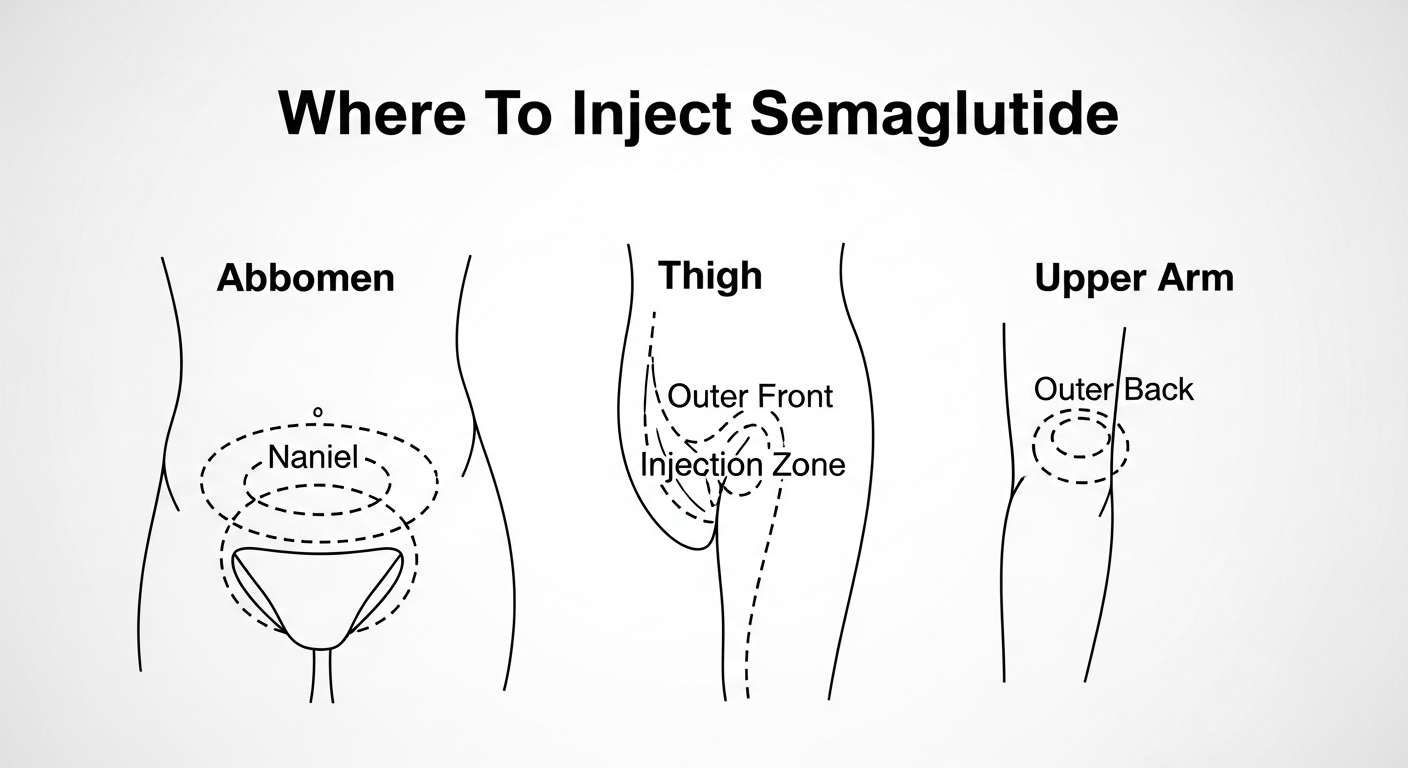
If you’re starting semaglutide (sold as Ozempic or Wegovy), knowing exactly where to inject is essential for proper absorption and minimizing discomfort.
Semaglutide is injected subcutaneously into one of three recommended sites: the stomach (abdomen), the front of the thigh, or the upper arm.
According to manufacturer guidelines, all three sites are equally effective. However, based on our research and user experiences, where you inject may affect how you experience side effects.
In this guide, I’ll walk you through each injection site, share what users report about their experiences, and provide step-by-step instructions for proper technique.
Important: This guide is based on manufacturer guidelines and user experiences. Always follow your healthcare provider’s specific instructions for your prescription.
ContentsTable of Contents
- 1What Is Semaglutide?→
- 2The Three Recommended Injection Sites→
- 3How to Inject Semaglutide in Your Stomach (Abdomen)?→
- 4Proper Abdomen Injection Technique→
- 5Why the Abdomen Is Most Popular?→
- 6How to Inject Semaglutide in Your Thigh?→
- 7Proper Thigh Injection Technique→
- 8User Experiences: Thigh Injections and Side Effects→
- 9How to Inject Semaglutide in Your Upper Arm?→
- 10Proper Upper Arm Injection Technique→
- 11How to Self-Inject in Your Arm Without Help?→
- 12Stomach vs Thigh vs Arm: Which Injection Site Is Best?→
- 13How to Rotate Injection Sites?→
- 14Why Rotation Matters?→
- 15How to Rotate Properly?→
- 16Step-by-Step Semaglutide Injection Guide→
- 17Before You Inject→
- 18The Injection Process→
- 19After You Inject→
- 20Common Semaglutide Injection Mistakes to Avoid→
- 21Mistakes That Affect Medication Delivery→
- 22Mistakes That Cause Discomfort→
- 23What to Do If You Think You Made a Mistake?→
- 24Frequently Asked Questions→
- 25Where is the best place to inject semaglutide for weight loss?→
- 26Is it better to inject Ozempic in thigh or stomach?→
- 27Is it possible to inject semaglutide wrong?→
- 28Does where you inject semaglutide matter?→
- 29How often should you rotate injection sites?→
- 30What is the least painful injection site for semaglutide?→
- 31How far from belly button should you inject semaglutide?→
- 32Final Thoughts→
What Is Semaglutide?
Semaglutide is a GLP-1 receptor agonist medication that helps regulate blood sugar and appetite.
The FDA has approved it under two brand names: Ozempic for Type 2 diabetes management and Wegovy for chronic weight management. Both contain the same active ingredient but come in different dosing strengths.
Semaglutide is administered as a once-weekly subcutaneous injection, meaning the medication goes just under the skin into the fatty tissue layer. This is different from intramuscular injections that go deeper into muscle.
Subcutaneous injection: An injection administered into the fatty tissue layer just beneath the skin, typically at a 45-90 degree angle using a short, thin needle.
The Three Recommended Injection Sites
According to Novo Nordisk (the manufacturer of Ozempic and Wegovy), you can inject semaglutide into any of these three areas:
- Stomach (Abdomen): The area around your belly, at least 2 inches from your belly button
- Front of Thigh: The upper front or outer portion of your thigh
- Upper Arm: The back or outer portion of your upper arm (often requires assistance)
All three sites provide similar absorption rates, according to clinical studies. The best site for you may depend on your comfort level, body composition, and personal preference.
How to Inject Semaglutide in Your Stomach (Abdomen)?
The abdomen is the most popular injection site for semaglutide users. It offers easy access, typically has adequate fatty tissue, and many users report it’s the least painful location.
Proper Abdomen Injection Technique
- Choose your spot: Select an area at least 2 inches (about two finger-widths) away from your belly button
- Avoid problem areas: Stay away from scars, stretch marks, bruises, or areas of hardened skin
- Clean the site: Use an alcohol swab and let it dry completely
- Pinch the skin: Gently pinch about 1-2 inches of skin and fat between your thumb and fingers
- Insert the needle: Push the needle in at a 90-degree angle (straight in) or 45-degree angle if you have less fatty tissue
- Inject slowly: Press the injection button and hold for the recommended time (usually 5-10 seconds)
Pro Tip: The lower abdomen (below the belly button, to either side) often has more fatty tissue and may be more comfortable than the upper abdomen area.
Why the Abdomen Is Most Popular?
Users report the stomach area is easiest to reach and see while self-injecting. The skin is typically looser here, making it simpler to pinch for proper technique.
Most people have adequate subcutaneous fat in this region, which is essential for proper medication absorption.
How to Inject Semaglutide in Your Thigh?
The front of the thigh is an excellent alternative injection site, especially if you experience discomfort with stomach injections.
Proper Thigh Injection Technique
- Locate the injection zone: Use the front or outer portion of your upper thigh, about halfway between your knee and hip
- Avoid muscle areas: Stay toward the outer thigh where there’s more fatty tissue rather than the top of the thigh where muscle is closer to the surface
- Clean and prep: Swab with alcohol and let dry
- Pinch if needed: If you have less thigh fat, pinch the skin before injecting
- Inject at proper angle: 90-degree angle for thicker tissue, 45-degree for thinner areas
User Experiences: Thigh Injections and Side Effects
Based on our research into user forums, some people report different side effect experiences when switching injection sites.
One user shared that they experienced severe nausea when injecting in the arm, but switching to the thigh completely eliminated their side effects, even at full dose. They reported losing 20 pounds after making this switch.
Multiple users report that thigh injections may cause fewer gastrointestinal side effects compared to stomach injections. However, this is individual, and clinical research shows the absorption rate is similar across all sites.
Worth Noting: If you’re experiencing significant side effects, experimenting with different injection sites may help. Discuss this with your healthcare provider before making changes.
How to Inject Semaglutide in Your Upper Arm?
The upper arm is a valid injection site but can be challenging for self-administration. Many users need assistance to inject in this location.
Proper Upper Arm Injection Technique
- Locate the area: Use the outer back portion of your upper arm, between your shoulder and elbow
- Avoid the muscle: Stay on the outer or back side where there’s more fatty tissue
- Have someone help: If possible, ask a family member or caregiver to administer the injection
- Self-injection tip: If injecting alone, sit at a table and rest your arm to stabilize it, using your opposite hand to inject
How to Self-Inject in Your Arm Without Help?
Self-injecting in the arm is tricky but possible with practice.
Sit down and rest your arm on a flat surface like a table. Turn your arm so you can access the outer portion. Use a mirror if needed to see the injection site clearly.
Some users find it helpful to inject in the outer arm while standing in front of a mirror, using the reflection to guide needle placement.
Stomach vs Thigh vs Arm: Which Injection Site Is Best?
According to manufacturer guidelines, there is no “best” injection site from an effectiveness standpoint. All three sites deliver the medication equally well.
However, individual experiences may vary. Here’s how the sites compare:
| Injection Site | Pros | Cons | Best For |
|---|---|---|---|
| Stomach (Abdomen) | Easy access, typically less painful, easy to see | May not work for very lean individuals | Most users, first-time injectors |
| Front of Thigh | Good for rotation, accessible, some report fewer side effects | May be more sensitive for some, closer to muscle | Rotation option, stomach sensitivity |
| Upper Arm | Good fatty tissue layer, keeps stomach/thighs free | Difficult to self-inject, usually needs assistance | With caregiver help, rotation |
The key takeaway: the best site is the one that works for you. If you experience issues with one site, trying another may help.
How to Rotate Injection Sites?
Site rotation is essential for preventing skin problems and ensuring consistent medication absorption.
Why Rotation Matters?
Injecting in the same exact spot repeatedly can cause lipohypertrophy (fatty lumps under the skin) or lipoatrophy (loss of fat tissue). These changes can affect how well the medication absorbs.
Rotating sites also helps prevent bruising, soreness, and skin irritation.
How to Rotate Properly?
You have two rotation strategies to choose from:
Option 1: Rotate within one area. If you prefer injecting in your stomach, you can rotate within that area. Use different spots at least 1 inch apart, moving clockwise or in a pattern you can remember.
Option 2: Rotate between areas. Switch between stomach, thigh, and arm on different weeks. For example: Week 1 stomach, Week 2 right thigh, Week 3 left thigh, Week 4 back to stomach.
Important: Whichever method you choose, never inject into the exact same spot two weeks in a row. Keep at least 1 inch between injection points.
Step-by-Step Semaglutide Injection Guide
Here is the complete process for administering your weekly semaglutide injection safely and effectively.
Before You Inject
- Check the medication: Inspect the pen or vial. The solution should be clear and colorless. Do not use if cloudy, discolored, or contains particles.
- Check the expiration date: Never use expired medication.
- Gather supplies: Have alcohol swabs, your pen or syringe, and a sharps container ready.
- Wash your hands: Clean hands thoroughly with soap and water.
- Let it warm up: If refrigerated, let the pen sit at room temperature for 30 minutes before injecting (cold medication may be more uncomfortable).
The Injection Process
- Choose your injection site: Select stomach, thigh, or upper arm, rotating from your last injection.
- Clean the area: Swab with alcohol and let it air dry completely (about 30 seconds).
- Prepare the pen: Attach a new needle if using a pen. Prime the pen by dialing to the flow check symbol and pressing until a drop appears.
- Set your dose: Dial to your prescribed dose.
- Pinch the skin: Gently pinch a fold of skin at the injection site.
- Insert the needle: Push the needle straight into the skin at a 90-degree angle (or 45 degrees if you have less fatty tissue).
- Inject the medication: Press the injection button and hold for at least 6 seconds (or until the dose counter shows zero).
- Remove the needle: Pull straight out and release the skin fold.
After You Inject
- Apply light pressure: If bleeding, press gently with a cotton ball. Do not rub.
- Dispose of the needle safely: Place the used needle in a sharps container immediately.
- Store the pen properly: Keep in the refrigerator (or at room temperature if using within 56 days, depending on product).
- Record your injection: Note the date, site, and any reactions for tracking purposes.
Common Semaglutide Injection Mistakes to Avoid
Yes, it is possible to inject semaglutide incorrectly. Here are the most common mistakes and how to prevent them.
Mistakes That Affect Medication Delivery
- Not holding long enough: Releasing the button too quickly can result in an incomplete dose. Hold for the full recommended time.
- Injecting into muscle: Going too deep bypasses the fatty tissue layer. Use a 45-degree angle if you have thin skin or less body fat.
- Injecting into scar tissue: Scarred or hardened areas may absorb medication unevenly.
- Skipping the prime step: Not priming a new pen needle can result in air injection instead of medication.
Mistakes That Cause Discomfort
- Injecting cold medication: Refrigerator-cold solution can cause stinging. Let the pen warm to room temperature first.
- Reusing needles: Used needles become dull and can cause more pain, bruising, and infection risk.
- Injecting through wet alcohol: Wait for the alcohol to dry completely to prevent stinging.
- Not rotating sites: Repeated injections in the same spot cause skin damage and lumps.
What to Do If You Think You Made a Mistake?
If you suspect you didn’t receive your full dose, do not inject a second dose. Wait until your next scheduled injection day and take your normal dose.
Contact your healthcare provider if you have concerns about a missed or partial dose.
Frequently Asked Questions
Where is the best place to inject semaglutide for weight loss?
The best place to inject semaglutide is typically the stomach (abdomen), at least 2 inches away from your belly button. This site is preferred because it is easily accessible, generally has adequate fatty tissue, and most users report less discomfort. However, all three approved sites (stomach, thigh, and upper arm) are equally effective for weight loss.
Is it better to inject Ozempic in thigh or stomach?
According to manufacturer guidelines, both the thigh and stomach are equally effective injection sites. However, some users report the stomach is less painful and easier to access. Others find the thigh works better for them, with some reporting fewer gastrointestinal side effects when using this site. The best choice depends on your personal comfort and body composition.
Is it possible to inject semaglutide wrong?
Yes, it is possible to inject semaglutide incorrectly. Common mistakes include not holding the needle long enough (resulting in incomplete dose), injecting too deep into muscle instead of fatty tissue, injecting into scarred areas, and not rotating sites. Following proper technique and your healthcare provider’s instructions helps ensure safe and effective administration.
Does where you inject semaglutide matter?
From an effectiveness standpoint, clinical research shows all three approved injection sites (stomach, thigh, upper arm) provide similar absorption rates. However, user experiences suggest that injection site may affect side effects for some individuals. Some users report different levels of nausea or discomfort depending on where they inject, though this varies person to person.
How often should you rotate injection sites?
You should rotate injection sites with each weekly dose. Never inject into the exact same spot two weeks in a row. Keep injection points at least 1 inch apart. You can either rotate within one area (like different spots on your stomach) or rotate between areas (stomach one week, thigh the next).
What is the least painful injection site for semaglutide?
Most users report the stomach (abdomen) is the least painful injection site for semaglutide. The skin is typically looser here, and there is usually adequate fatty tissue for comfortable injection. To minimize pain further, let the medication warm to room temperature before injecting and ensure the alcohol has dried completely.
How far from belly button should you inject semaglutide?
You should inject semaglutide at least 2 inches (about two finger-widths) away from your belly button. This area has the appropriate fatty tissue depth for subcutaneous injection. Also avoid areas with scars, stretch marks, bruises, or hardened skin.
Final Thoughts
Proper injection technique makes a real difference in your semaglutide experience. The stomach is the most popular site, but all three options work equally well according to manufacturer guidelines.
If you’re experiencing side effects or discomfort, experimenting with different injection sites may help. Some users find that switching sites significantly improves their experience with the medication.
Remember to rotate your injection sites weekly and follow proper technique to ensure safe, effective medication delivery.
Medical Disclaimer: This article is for informational purposes only and does not constitute medical advice. Semaglutide is a prescription medication that should only be used under the supervision of a licensed healthcare provider. Always follow your healthcare provider’s specific instructions for administering your medication. If you experience concerning side effects or have questions about your treatment, contact your healthcare provider immediately.