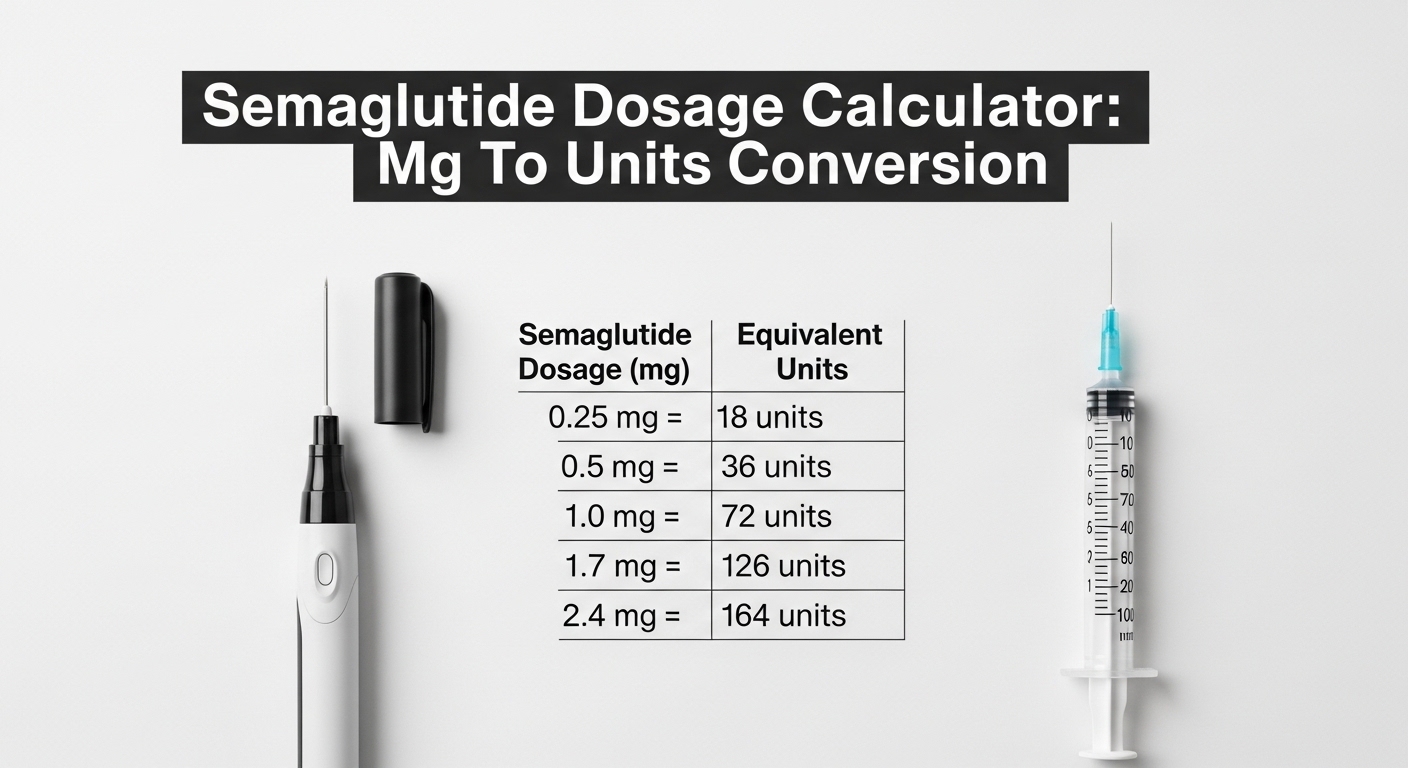
Calculating semaglutide doses can be confusing, especially when you’re working with compounded medications that come in different concentrations. I’ve seen countless questions in online communities from people struggling to figure out how many units to draw for their prescribed dose.
Use our semaglutide dosage calculator below to convert your prescribed dose in milligrams (mg) to insulin syringe units based on your vial concentration.
Based on the official Novo Nordisk prescribing information, this guide covers everything you need to know about semaglutide dosing: from using the calculator to understanding titration schedules for both Wegovy and Ozempic.
ContentsTable of Contents
- 1Semaglutide Dose Calculator→
- 2How to Use the Semaglutide Dosage Calculator?→
- 3Step 1: Find Your Vial Concentration→
- 4Step 2: Know Your Prescribed Dose→
- 5Step 3: Enter Values and Calculate→
- 6Step 4: Verify Your Result→
- 7Official Semaglutide Dosing Schedule→
- 8Wegovy Dosing Schedule for Weight Loss→
- 9Ozempic Dosing Schedule for Type 2 Diabetes→
- 10Semaglutide Titration Guide→
- 11Why Titration Matters?→
- 12Standard vs. Slower Titration→
- 13Alternative Slower Titration Example→
- 14Managing Side Effects During Titration→
- 15How to Convert Semaglutide mg to Units?→
- 16The Conversion Formula→
- 17Step-by-Step Calculation Example→
- 18Quick Reference: Semaglutide Dose Conversion Table→
- 19Semaglutide Reconstitution Calculator→
- 20Common Reconstitution Scenarios→
- 21Storage After Reconstitution→
- 22How Long Will My Vial Last?→
- 23Understanding Semaglutide Concentrations→
- 24What Does mg/mL Mean?→
- 25Which Concentration Is Better?→
- 26Frequently Asked Questions→
- 27How do I calculate my semaglutide dose?→
- 28How many units is 0.25 mg semaglutide?→
- 29What is the starting dose of semaglutide?→
- 30How to convert semaglutide mg to units?→
- 31What if I miss a semaglutide dose?→
- 32How long does a semaglutide vial last?→
- 33Is 5 mg/mL or 10 mg/mL concentration better?→
- 34Important Safety Information→
- 35Who Should Not Use Semaglutide→
- 36Common Side Effects→
- 37Final Thoughts→
Semaglutide Dose Calculator
Enter your vial concentration and desired dose below. The calculator will show you exactly how many units to draw on your insulin syringe.
Calculator Placeholder: Interactive semaglutide dosage calculator will be inserted here. The calculator accepts vial concentration (mg/mL) and desired dose (mg), then outputs units for insulin syringe.
The formula behind this calculator is straightforward: Units = (Desired Dose in mg / Concentration in mg/mL) x 100.
How to Use the Semaglutide Dosage Calculator?
Using this calculator correctly requires understanding a few key concepts. Here’s a step-by-step guide based on what I’ve learned from helping others navigate their dosing.
Step 1: Find Your Vial Concentration
Check the label on your semaglutide vial. Look for the concentration expressed as mg/mL. Common concentrations include 2.5 mg/mL, 5 mg/mL, and 10 mg/mL.
The concentration tells you how many milligrams of semaglutide are dissolved in each milliliter of liquid.
Step 2: Know Your Prescribed Dose
Your healthcare provider will prescribe a specific dose in milligrams (mg). According to official prescribing information, common doses include 0.25 mg, 0.5 mg, 1.0 mg, 1.7 mg, and 2.4 mg.
Step 3: Enter Values and Calculate
Input your concentration and desired dose into the calculator. The result shows how many units to draw on your insulin syringe.
Always use a standard U-100 insulin syringe for accurate measurements.
Step 4: Verify Your Result
Double-check the calculation manually using the formula: Units = (Dose / Concentration) x 100.
For example, for a 0.25 mg dose with a 5 mg/mL concentration: (0.25 / 5) x 100 = 5 units.
Common Mistake to Avoid: Confusing total mg in the vial with concentration (mg/mL). A 10 mg vial at 5 mg/mL concentration has 2 mL of liquid. Always use the mg/mL value for calculations.
Official Semaglutide Dosing Schedule
The FDA-approved titration schedules differ between Wegovy (weight loss) and Ozempic (diabetes). Based on official Novo Nordisk prescribing information, here are both schedules.
Wegovy Dosing Schedule for Weight Loss
Wegovy uses a 5-step titration over 16+ weeks to reach the maintenance dose of 2.4 mg weekly.
| Week | Dose (mg) | Purpose |
|---|---|---|
| Weeks 1-4 | 0.25 mg | Starting dose |
| Weeks 5-8 | 0.5 mg | Step up |
| Weeks 9-12 | 1.0 mg | Step up |
| Weeks 13-16 | 1.7 mg | Step up |
| Week 17+ | 2.4 mg | Maintenance dose |
According to official guidelines, the 2.4 mg dose is the maximum weekly dose for weight management.
Ozempic Dosing Schedule for Type 2 Diabetes
Ozempic follows a different schedule with a maximum dose of 2.0 mg weekly.
| Week | Dose (mg) | Purpose |
|---|---|---|
| Weeks 1-4 | 0.25 mg | Starting dose |
| Week 5+ | 0.5 mg | Initial therapeutic dose |
| Week 8+ (if needed) | 1.0 mg | Increased dose |
| Week 12+ (if needed) | 2.0 mg | Maximum dose |
The key difference is that Ozempic’s maximum dose is 2.0 mg, while Wegovy goes up to 2.4 mg.
Semaglutide Titration Guide
Titration means gradually increasing your dose over time. This approach helps your body adjust to the medication and may help reduce side effects.
Why Titration Matters?
Based on clinical studies, gradual dose escalation may help minimize gastrointestinal side effects like nausea and vomiting. Starting at the full dose can increase the risk of severe side effects.
The medication reaches steady-state levels in your system after approximately 4-5 weeks at each dose.
Standard vs. Slower Titration
Some users report better tolerance with a slower titration schedule. Based on forum discussions in communities like r/Semaglutide, some people titrate in smaller increments.
Pro Tip: If you experience significant side effects at a new dose level, consult your healthcare provider. They may recommend staying at your current dose longer before increasing.
Alternative Slower Titration Example
- Weeks 1-6: 0.25 mg (extended from 4 weeks)
- Weeks 7-10: 0.35 mg (intermediate step)
- Weeks 11-14: 0.5 mg
- Continue gradual increases as tolerated
Always consult your healthcare provider before modifying your titration schedule.
Managing Side Effects During Titration
Common side effects during dose increases may include nausea, diarrhea, constipation, and fatigue. Based on prescribing information, these typically improve as your body adjusts.
Staying hydrated and eating smaller meals may help manage gastrointestinal side effects.
How to Convert Semaglutide mg to Units?
Understanding the conversion formula helps you verify calculator results and dose correctly even without digital tools.
The Conversion Formula
The formula is: Units = (Desired Dose in mg / Concentration in mg/mL) x 100
This works because standard U-100 insulin syringes measure 100 units per 1 mL.
Step-by-Step Calculation Example
Let’s calculate units for a 0.5 mg dose with a 5 mg/mL concentration:
- Divide dose by concentration: 0.5 mg / 5 mg/mL = 0.1 mL
- Multiply by 100: 0.1 mL x 100 = 10 units
- Result: Draw 10 units on your insulin syringe
Quick Reference: Semaglutide Dose Conversion Table
Use this table for the most common doses across different concentrations:
| Dose (mg) | 2.5 mg/mL | 5 mg/mL | 10 mg/mL |
|---|---|---|---|
| 0.25 mg | 10 units | 5 units | 2.5 units |
| 0.5 mg | 20 units | 10 units | 5 units |
| 1.0 mg | 40 units | 20 units | 10 units |
| 1.7 mg | 68 units | 34 units | 17 units |
| 2.4 mg | 96 units | 48 units | 24 units |
Higher concentrations (10 mg/mL) require smaller injection volumes, which some users prefer.
Semaglutide Reconstitution Calculator
If you receive lyophilized (freeze-dried) semaglutide, you’ll need to reconstitute it with bacteriostatic water before use.
Common Reconstitution Scenarios
The amount of bacteriostatic water you add determines your final concentration.
| Semaglutide Amount | Add This Much BAC Water | Final Concentration |
|---|---|---|
| 5 mg vial | 1 mL | 5 mg/mL |
| 5 mg vial | 2 mL | 2.5 mg/mL |
| 10 mg vial | 1 mL | 10 mg/mL |
| 10 mg vial | 2 mL | 5 mg/mL |
| 12.5 mg vial | 5 mL | 2.5 mg/mL |
Storage After Reconstitution
Based on standard peptide handling guidelines, reconstituted semaglutide should be refrigerated at 36-46 degrees F (2-8 degrees C).
Most compounding pharmacies recommend using reconstituted semaglutide within 28 days.
Important: Never freeze reconstituted semaglutide. Protect from light and avoid shaking the vial.
How Long Will My Vial Last?
To calculate how many weeks of doses are in your vial:
- Find total mg in vial: Concentration x Volume (e.g., 5 mg/mL x 2 mL = 10 mg total)
- Divide by weekly dose: 10 mg / 0.5 mg = 20 weeks
A 10 mg vial at 0.5 mg weekly lasts approximately 20 weeks.
Understanding Semaglutide Concentrations
One of the most common points of confusion involves understanding different vial concentrations. Here’s what you need to know.
What Does mg/mL Mean?
The concentration (mg/mL) tells you how many milligrams of semaglutide are in each milliliter of liquid.
- 2.5 mg/mL: 2.5 milligrams per milliliter – lower concentration, larger injection volume
- 5 mg/mL: 5 milligrams per milliliter – mid-range concentration
- 10 mg/mL: 10 milligrams per milliliter – higher concentration, smaller injection volume
Which Concentration Is Better?
Based on user feedback in forums, preferences vary:
- Lower concentrations (2.5 mg/mL): Easier to measure small doses accurately, but larger injection volumes
- Higher concentrations (10 mg/mL): Smaller injections, but harder to measure accurately at low doses (like 0.25 mg = 2.5 units)
Most users find 5 mg/mL provides a good balance between accuracy and injection volume.
Frequently Asked Questions
How do I calculate my semaglutide dose?
Use the formula: Units = (Desired Dose in mg / Concentration in mg/mL) x 100. For example, for a 0.25 mg dose with 5 mg/mL concentration: (0.25 / 5) x 100 = 5 units on your insulin syringe.
How many units is 0.25 mg semaglutide?
It depends on your vial concentration. At 5 mg/mL, 0.25 mg equals 5 units. At 2.5 mg/mL, it equals 10 units. At 10 mg/mL, it equals 2.5 units.
What is the starting dose of semaglutide?
According to official prescribing information, both Wegovy and Ozempic start at 0.25 mg once weekly for the first 4 weeks. This allows your body to adjust before increasing to higher doses.
How to convert semaglutide mg to units?
Divide your dose in mg by your vial concentration in mg/mL, then multiply by 100. This gives you the number of units to draw on a U-100 insulin syringe.
What if I miss a semaglutide dose?
Based on prescribing information, if your next scheduled dose is more than 2 days away, take the missed dose as soon as possible. If less than 2 days remain, skip the missed dose and take your next dose on schedule.
How long does a semaglutide vial last?
Divide the total mg in your vial by your weekly dose. For example, a 10 mg vial at 0.5 mg weekly lasts 20 weeks. After reconstitution, most pharmacies recommend using within 28 days.
Is 5 mg/mL or 10 mg/mL concentration better?
Both work well. The 5 mg/mL concentration is easier to measure accurately at lower doses. The 10 mg/mL concentration requires smaller injection volumes but can be harder to measure precisely for doses like 0.25 mg.
Important Safety Information
Semaglutide is a prescription medication. Always consult your healthcare provider before starting or adjusting your dose.
Who Should Not Use Semaglutide
According to FDA prescribing information, semaglutide is contraindicated in people with:
- Personal or family history of medullary thyroid carcinoma (MTC)
- Multiple Endocrine Neoplasia syndrome type 2 (MEN 2)
- Known hypersensitivity to semaglutide or any product components
Common Side Effects
Based on clinical trials, common side effects may include nausea, diarrhea, vomiting, constipation, abdominal pain, headache, and fatigue.
Serious side effects may include pancreatitis, gallbladder problems, and changes in kidney function. Contact your healthcare provider if you experience severe symptoms.
FDA Disclaimer: Compounded semaglutide is not FDA-approved and may not be available in all states. Compounded medications are prepared by pharmacies based on individual prescriptions.
Final Thoughts
Accurate semaglutide dosing is essential for both safety and effectiveness. This calculator and guide are designed to help you understand how to convert your prescribed dose in milligrams to insulin syringe units.
The key formula to remember: Units = (Dose in mg / Concentration in mg/mL) x 100.
Always work with your healthcare provider to determine the right dose for your situation. They can help you navigate the titration schedule and adjust based on your response to the medication.
Disclaimer: This calculator and guide are for informational purposes only and do not constitute medical advice. Always consult a licensed healthcare provider before starting, stopping, or changing any medication. The information provided is based on official prescribing information and should not replace professional medical guidance.