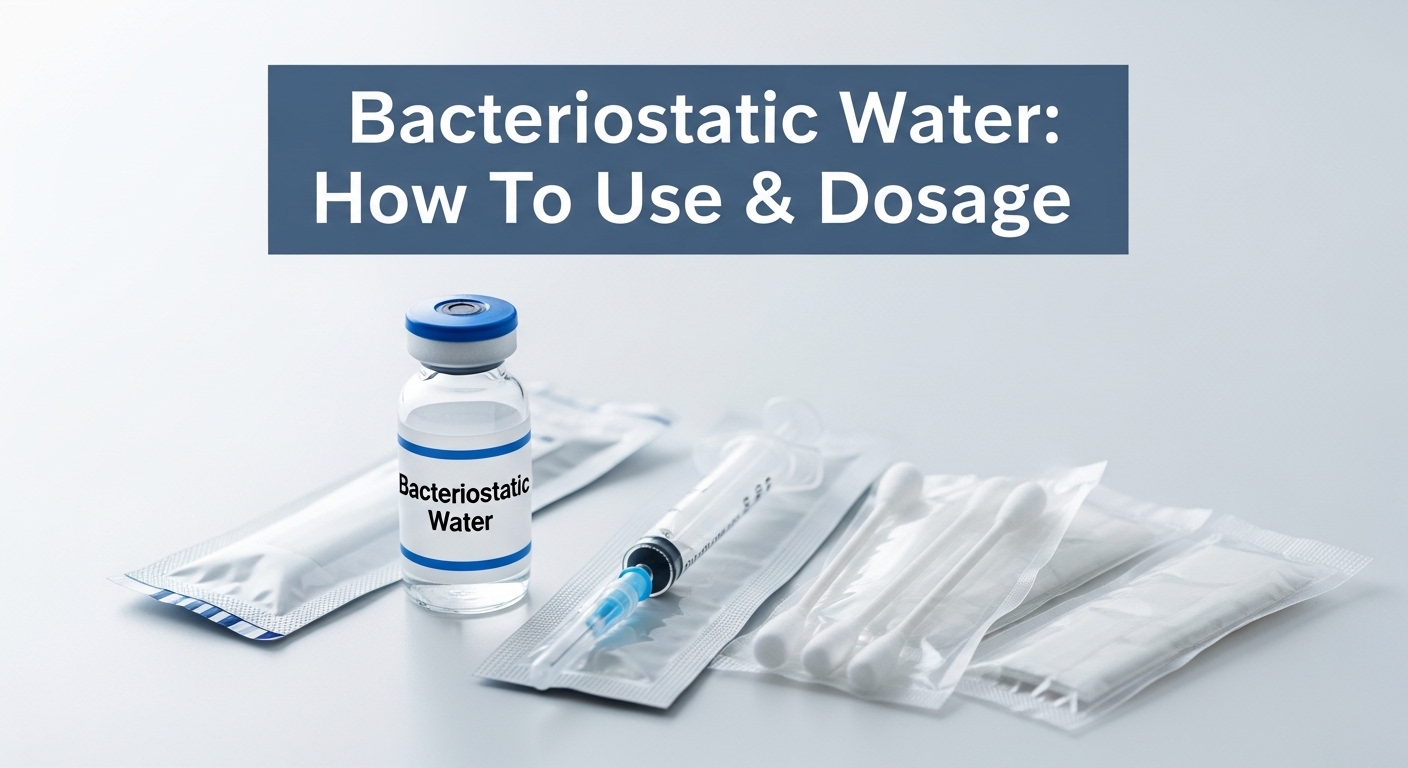
If you’ve ever stared at a vial of lyophilized peptides wondering how much bacteriostatic water to add, you’re not alone.
After helping dozens of readers navigate peptide reconstitution and testing multiple products myself, I’ve seen the same questions come up repeatedly: How much water do I use? Will I mess up my expensive peptides? How long does it last once mixed?
Bacteriostatic water is sterile water containing 0.9% benzyl alcohol that safely reconstitutes peptides and medications for multi-dose use up to 28 days.
In this guide, I’ll walk you through exactly how to use bacteriostatic water, calculate proper dosages, avoid common mistakes, and store your reconstituted medications safely.
ContentsTable of Contents
- 1What Is Bacteriostatic Water?→
- 2Key Composition Facts→
- 3What Is Bacteriostatic Water Used For?→
- 4How Does Bacteriostatic Water Work?→
- 5Why Multi-Dose Capability Matters?→
- 6How To Use Bacteriostatic Water: Step-by-Step Guide→
- 7Supplies You’ll Need→
- 8Step-by-Step Reconstitution Process→
- 9Common Mistakes To Avoid→
- 10Bacteriostatic Water Dosage Calculations→
- 11The Basic Formula→
- 12Dosage Calculation Examples→
- 13Medication-Specific Examples→
- 14Semaglutide (10mg vial)→
- 15Tirzepatide (15mg vial)→
- 16BPC-157 (5mg vial)→
- 17Storage and Shelf Life Guidelines→
- 18Before Opening→
- 19After Opening→
- 20Reconstituted Medications→
- 21Signs Your Solution May Be Compromised→
- 22Bacteriostatic Water vs Sterile Water: Key Differences→
- 23When To Use Each?→
- 24Side Effects and Safety Precautions→
- 25Potential Side Effects→
- 26Contraindications→
- 27Safety Best Practices→
- 28Where To Buy Quality Bacteriostatic Water?→
- 29What To Look For→
- 30Frequently Asked Questions→
- 31How much bacteriostatic water do I add to peptides?→
- 32What is the difference between bacteriostatic water and sterile water?→
- 33How long can you use bacteriostatic water after opening?→
- 34Is bacteriostatic water safe for injection?→
- 35Can I use sterile water instead of bacteriostatic water?→
- 36What happens if I use too much bacteriostatic water?→
- 37Final Thoughts→
What Is Bacteriostatic Water?
Bacteriostatic water is sterile water containing 0.9% benzyl alcohol as a preservative, used to dilute or reconstitute injectable medications and peptides.
Unlike regular sterile water, bacteriostatic water contains a preservative that inhibits bacterial growth. This makes it safe for multiple uses from the same vial.
Bacteriostatic Water (USP): A sterile, nonpyrogenic preparation of water for injection containing 0.9% benzyl alcohol added as a bacteriostatic preservative.
Key Composition Facts
- Benzyl Alcohol: 0.9% concentration (9mg per mL)
- Water: Sterile, nonpyrogenic (fever-free)
- pH Range: Approximately 5.7
- Sodium Content: None (unlike saline solutions)
The USP (United States Pharmacopeia) grade designation means it meets strict purity and quality standards for pharmaceutical use.
What Is Bacteriostatic Water Used For?
Bacteriostatic water serves as a diluent for reconstituting lyophilized (freeze-dried) medications.
Common applications include:
- Peptides: BPC-157, Sermorelin, CJC-1295
- GLP-1 Medications: Compounded semaglutide, tirzepatide
- Hormones: HGH, testosterone compounds
- Research Compounds: Various lyophilized research peptides
How Does Bacteriostatic Water Work?
The benzyl alcohol in bacteriostatic water prevents bacterial growth by disrupting the membrane of bacterial cells, allowing the same vial to be used multiple times for up to 28 days after opening.
Here’s the mechanism in simple terms: Benzyl alcohol penetrates bacterial cell membranes and causes them to become unstable. This bacteriostatic (bacteria-stopping) action keeps your reconstituted solution safe for repeated use.
Important: “Bacteriostatic” means it stops bacteria from multiplying – it doesn’t kill existing bacteria. This is why starting with sterile technique is essential.
Why Multi-Dose Capability Matters?
Without the benzyl alcohol preservative, each vial entry introduces contamination risk.
Bacteriostatic water solves this problem by maintaining sterility across multiple uses. This is particularly valuable when your dosing schedule requires drawing from the same vial over several weeks.
How To Use Bacteriostatic Water: Step-by-Step Guide
To use bacteriostatic water, draw the calculated amount into a sterile syringe, inject it slowly along the vial wall into your lyophilized medication, and swirl gently until dissolved.
I’ve reconstituted hundreds of peptide vials, and the process becomes second nature once you understand it. Here’s exactly what to do.
Supplies You’ll Need
- Bacteriostatic water vial (10mL or 30mL)
- Lyophilized peptide/medication vial
- Sterile insulin syringe (29-31 gauge, 1mL)
- Alcohol swabs
- Clean, flat surface
Step-by-Step Reconstitution Process
- Wash your hands thoroughly with antibacterial soap for at least 20 seconds. Let them air dry or use a clean paper towel.
- Clean both vial tops with alcohol swabs. Wipe the rubber stopper of both your bacteriostatic water and peptide vials. Let them dry for 30 seconds.
- Draw bacteriostatic water into the syringe. Insert the needle through the rubber stopper, turn the vial upside down, and draw your calculated amount of water.
- Remove air bubbles. Tap the syringe gently to move bubbles to the top. Push the plunger slightly to expel air.
- Inject water into the peptide vial slowly. Aim the needle at the vial wall, not directly at the powder. Let the water run down the side gently.
- Allow the peptide to dissolve. Swirl the vial gently – never shake. The powder should dissolve within 1-5 minutes.
- Label your vial. Write the reconstitution date, concentration, and peptide name on the vial.
- Store properly. Refrigerate immediately at 36-46 degrees F (2-8 degrees C).
Pro Tip: Never shake a reconstituted peptide vial. Aggressive shaking can damage the peptide molecules and reduce effectiveness. Gentle swirling is all you need.
Common Mistakes To Avoid
Based on forum discussions and user questions I’ve reviewed, these are the mistakes I see most often:
- Spraying water directly on powder: This can damage delicate peptides. Always aim at the vial wall.
- Using contaminated needles: Use a new, sterile syringe for every reconstitution.
- Shaking the vial: Swirl gently instead. Shaking denatures proteins.
- Skipping the alcohol wipe: This 30-second step prevents contamination.
- Incorrect storage: Room temperature storage rapidly degrades reconstituted peptides.
Bacteriostatic Water Dosage Calculations
The dosage calculation formula is simple: divide your peptide amount (mg) by the volume of bacteriostatic water (mL) to get your concentration (mg/mL).
The Basic Formula
Concentration = Peptide Amount (mg) / Water Volume (mL)
Example: 10mg peptide / 2mL water = 5mg/mL concentration
Dosage Calculation Examples
Here are practical examples I’ve worked through for common peptide amounts:
| Peptide Amount | Water Added | Concentration | 0.5mg Dose |
|---|---|---|---|
| 5mg | 2mL | 2.5mg/mL | 0.2mL (20 units) |
| 10mg | 2mL | 5mg/mL | 0.1mL (10 units) |
| 10mg | 1mL | 10mg/mL | 0.05mL (5 units) |
| 15mg | 3mL | 5mg/mL | 0.1mL (10 units) |
Medication-Specific Examples
For GLP-1 medications like compounded semaglutide or tirzepatide, here’s how the math works:
Semaglutide (10mg vial)
Add 2mL bacteriostatic water for a 5mg/mL concentration.
For a 0.25mg dose: Draw 0.05mL (5 units on an insulin syringe).
For a 0.5mg dose: Draw 0.1mL (10 units on an insulin syringe).
Tirzepatide (15mg vial)
Add 3mL bacteriostatic water for a 5mg/mL concentration.
For a 2.5mg dose: Draw 0.5mL (50 units on an insulin syringe).
For a 5mg dose: Draw 1mL (100 units on an insulin syringe).
BPC-157 (5mg vial)
Add 2mL bacteriostatic water for a 2.5mg/mL concentration.
For a 250mcg dose: Draw 0.1mL (10 units on an insulin syringe).
Time Saver: Use an online peptide calculator to double-check your math. Several free tools exist that let you input your peptide amount and desired dose.
Storage and Shelf Life Guidelines
Bacteriostatic water lasts 28 days after opening when refrigerated at 36-46 degrees F (2-8 degrees C).
Proper storage is critical for maintaining both safety and effectiveness.
Before Opening
- Shelf life: 24-36 months (check manufacturer date)
- Storage: Room temperature, away from light
- Conditions: Keep sealed until ready to use
After Opening
- Shelf life: 28 days maximum
- Storage: Refrigerate at 36-46 degrees F (2-8 degrees C)
- Important: Label with opening date
Reconstituted Medications
Once you’ve mixed your peptide with bacteriostatic water:
- Refrigerate immediately after reconstitution
- Use within 28 days (some peptides may have shorter stability)
- Never freeze reconstituted peptide solutions
- Keep away from light – store in original vial or wrap in foil
Signs Your Solution May Be Compromised
Discard your reconstituted medication if you notice:
- Cloudiness or particles floating in solution
- Color changes (solution should remain clear)
- Unusual odor
- Past the 28-day mark
Bacteriostatic Water vs Sterile Water: Key Differences
The main difference is that bacteriostatic water contains 0.9% benzyl alcohol preservative, while sterile water contains no preservative.
This single difference has major implications for how you can use each type.
| Feature | Bacteriostatic Water | Sterile Water |
|---|---|---|
| Preservative | Yes (0.9% benzyl alcohol) | No |
| Multi-Dose Use | Yes (up to 28 days) | No (single use only) |
| Shelf Life After Opening | 28 days | Use immediately |
| Safe for Neonates | No | Yes |
| Cost Efficiency | Higher (multiple uses) | Lower per vial, higher overall |
| Best For | Multi-dose peptide reconstitution | Single-dose applications |
When To Use Each?
Use bacteriostatic water when:
- You’ll draw multiple doses from one vial
- Your dosing schedule spans several days or weeks
- Cost efficiency matters
Use sterile water when:
- Single-use application only
- Patient is a neonate or has benzyl alcohol sensitivity
- Medication specifically requires preservative-free diluent
Side Effects and Safety Precautions
Bacteriostatic water is generally well-tolerated, but the benzyl alcohol preservative may cause reactions in sensitive individuals.
Potential Side Effects
Most users experience no side effects from bacteriostatic water itself. When reactions occur, they’re typically mild:
- Injection site reactions: Mild redness, swelling, or discomfort
- Allergic reactions: Rare; may include itching or rash in benzyl alcohol-sensitive individuals
- Venous irritation: If used intravenously (consult healthcare provider)
Contraindications
Warning: Bacteriostatic water should NOT be used in neonates (newborns). Benzyl alcohol has been associated with serious adverse events including “gasping syndrome” in neonates.
Avoid bacteriostatic water if you:
- Have a known allergy to benzyl alcohol
- Are administering to a neonate
- Are using a medication that specifically requires preservative-free diluent
Safety Best Practices
- Always use sterile technique – clean vial tops, use new syringes
- Never share vials between patients
- Check for particulates before each use
- Discard after 28 days even if solution looks clear
- Consult a healthcare provider before starting any injectable medication
Where To Buy Quality Bacteriostatic Water?
Quality matters when choosing bacteriostatic water. Based on my research, here are reliable suppliers offering USP-grade products.
| # | Provider | Highlights | Price | |
|---|---|---|---|---|
| 01 | Swiss Chems |
|
$9.95-$14.91 | Visit Provider → |
| 02 | Empower Pharmacy |
|
Varies (Rx required) | Visit Provider → |
| 03 | Wittmer Clinic |
|
Contact for pricing | Visit Provider → |
We may earn a commission at no extra cost to you.
What To Look For
- USP grade certification – ensures pharmaceutical purity standards
- 0.9% benzyl alcohol – standard preservative concentration
- Lab testing documentation – third-party quality verification
- Clear expiration date – ensures product freshness
- Proper packaging – sealed vials in sterile conditions
Frequently Asked Questions
How much bacteriostatic water do I add to peptides?
The amount depends on your desired concentration. A common approach is adding 2mL of bacteriostatic water to a 10mg peptide vial, creating a 5mg/mL concentration. Use the formula: Peptide (mg) divided by Water (mL) equals Concentration (mg/mL).
What is the difference between bacteriostatic water and sterile water?
Bacteriostatic water contains 0.9% benzyl alcohol preservative, allowing multi-dose use for up to 28 days. Sterile water has no preservative and must be used immediately after opening for single-dose applications only.
How long can you use bacteriostatic water after opening?
Bacteriostatic water lasts 28 days after opening when stored properly in the refrigerator at 36-46 degrees F (2-8 degrees C). After 28 days, discard any remaining solution even if it appears clear.
Is bacteriostatic water safe for injection?
Yes, bacteriostatic water is safe for subcutaneous, intramuscular, and intravenous injection when used properly. However, it should not be used in neonates due to benzyl alcohol content, and some individuals may have sensitivities to the preservative.
Can I use sterile water instead of bacteriostatic water?
You can use sterile water only if you plan to use the entire reconstituted solution immediately. Sterile water has no preservative, so it cannot prevent bacterial growth for multi-dose use. For peptides requiring multiple doses over time, bacteriostatic water is the safer choice.
What happens if I use too much bacteriostatic water?
Using too much water creates a more diluted solution, meaning you will need to inject larger volumes to achieve your desired dose. While not dangerous, this can make accurate dosing more difficult with insulin syringes and may cause more discomfort at the injection site due to larger volumes.
Final Thoughts
Using bacteriostatic water correctly comes down to three things: proper sterile technique, accurate dosage calculations, and appropriate storage.
Once you understand the 28-day shelf life rule, the simple concentration formula, and the importance of gentle swirling (never shaking), reconstituting peptides becomes a straightforward process.
If you’re new to this, I recommend starting with the step-by-step guide above and double-checking your first few calculations with an online peptide calculator. The initial learning curve is quick, and the confidence you gain will serve you well for every future reconstitution.
Disclaimer: This article is for informational purposes only and does not constitute medical advice. Always consult a licensed healthcare provider before using any injectable medication. Compounded medications are not FDA-approved and regulations vary by state.