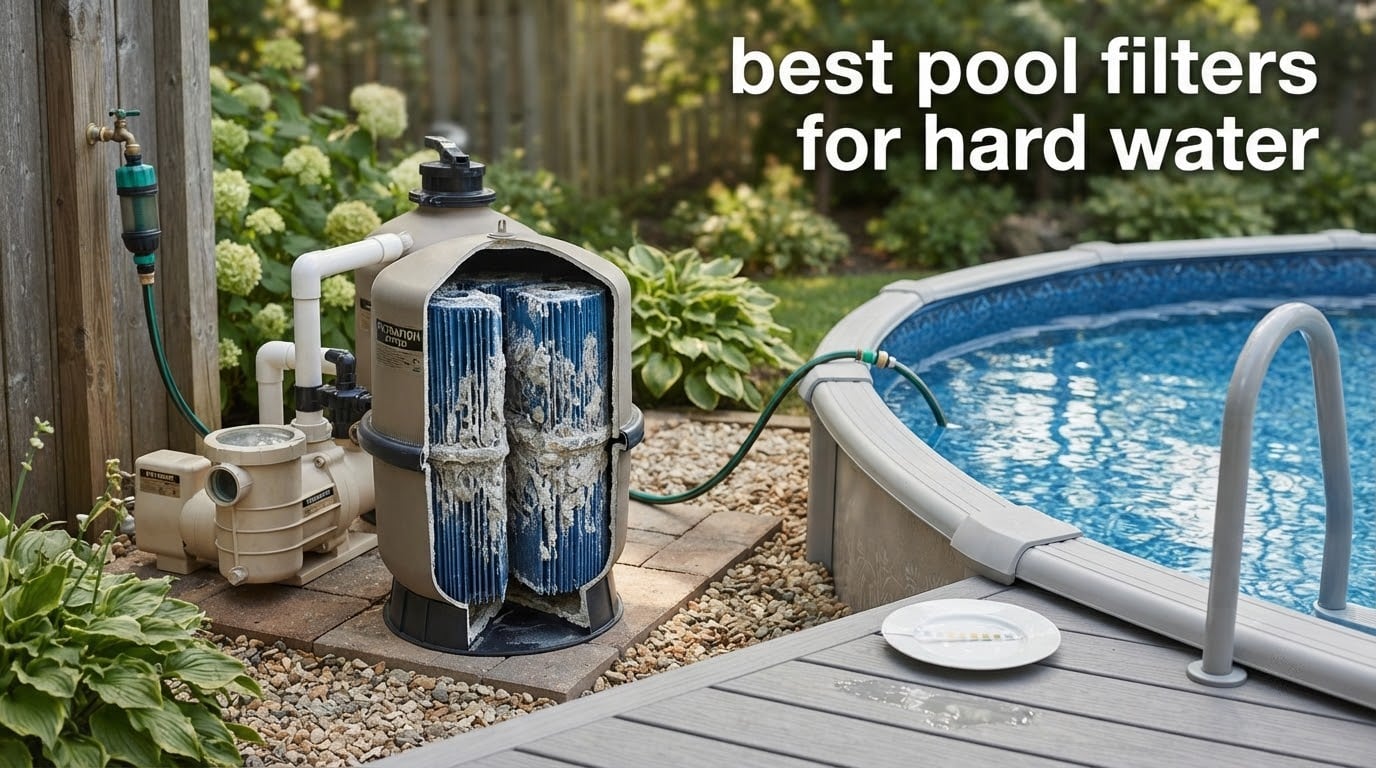
No pool filter removes calcium from water. Sand, cartridge and diatomaceous earth systems all work the same way, trapping particles between roughly 2 and 25 microns, while calcium is a dissolved ion that sails straight through any media you own. It only leaves solution when pH, alkalinity and temperature push it to precipitate as calcium carbonate scale, and that scale is what actually fouls a filter in a hard water area.
That single fact changes how you shop. The best pool filters for hard water are not filters that somehow consume calcium, because none of them can. They are the filters that hold the most filtration area per dollar, resist scale buildup longest between cleanings, and sit at the end of a water chemistry plan that keeps calcium in solution instead of letting it bake onto pleats.
We compared ten in-pool and fill-water filtration products against hard water conditions, sizing, cleaning chemistry and backwash water cost. What follows is what actually holds up when calcium hardness is high, where the honest limits of each product sit, and how to clean scale off a cartridge without destroying it.
One clarification before we go further, because it trips up more owners than anything else in this topic. A garden hose pre-filter that clips onto your hose bib is not a pool filter. It treats water on its way into the pool, and it never sees the water already in the pool. An in-pool filter sits in the equipment pad and circulates the entire body of water every day. Several picks below are in-pool filters, several are fill pre-filters, and each section says which one it is and what it does not do.
ContentsTable of Contents
- 1Top 3 Picks for Hard Water Pools in 2026→
- 2GLACIER FRESH Garden Hose Pre-Filter→
- 3Intex 29002E Type A Cartridge→
- 4POOLPURE CCP420 Cartridge 4-Pack→
- 5All 10 Filters Compared at a Glance in 2026→
- 6What Hard Water Actually Does to a Pool Filter→
- 71. GLACIER FRESH Garden Hose Pre-Filter: Best Overall for Hard Fill Water→
- 8GLACIER FRESH Garden Hose Filter Pre-Filter for Pool & Spa 1-Pack→
- 9Pros→
- 10Cons→
- 11When this pre-filter is worth it→
- 12When this pre-filter is not enough→
- 132. POOLPURE CCP420 Cartridge 4-Pack: Best Value In-Pool Filter for 420-Style Tanks→
- 14POOLPURE CCP420 Pool Filter Replaces Pentair Clean and Clear Plus 420 4Pack→
- 15Pros→
- 16Cons→
- 17What this cartridge gets right for hard water→
- 18What to watch out for→
- 193. POOLPURE Garden Hose End Pre-Filter: Budget Fill Protection for Pools and Spas→
- 20POOLPURE Garden Hose End Pre Filter for Pool, Hot Tub, Spa, 1Pack→
- 21Pros→
- 22Cons→
- 23Who this suits→
- 24Who should look elsewhere→
- 254. U.S. Pool Supply Universal Type A and C Cartridges: Best Drop-In for Above-Ground Pumps→
- 26U.S. Pool Supply Universal Replacement Filter Cartridges, Type A or C, 4 Pk→
- 27Pros→
- 28Cons→
- 29Where it earns its place→
- 30Where it will not help→
- 315. Intex Krystal Clear 2100 GPH Sand Filter Pump: Premium Sand Setup for Above-Ground Pools→
- 32INTEX Krystal Clear 2,100 GPH Sand Filter Pump for Above Ground Pools→
- 33Pros→
- 34Cons→
- 35When sand is the right call→
- 36When you should pick something else→
- 376. Hayward ProSeries 18 Inch Sand Filter: Best for Even Backwash Distribution→
- 38Hayward ProSeries Swimming Pool Sand Filter for Above Ground Pools, 18 Inch→
- 39Pros→
- 40Cons→
- 41Why distribution matters in hard water→
- 42Where the trade-offs sit→
- 437. Intex 29002E Type A Cartridge Two Pack: Top Rated for Above-Ground Pumps→
- 44INTEX 29002E Type A Pool Filter Cartridge: for INTEX Filter Pumps – Easy-to-Clean – Dacron Paper – Efficient Filtration – Two Pack→
- 45Pros→
- 46Cons→
- 47What makes this the safest pick in the list→
- 48What the high rating does not cover→
- 498. Cryspool 08055 Cartridge: Best Filter Area for Hayward C1200 Housings→
- 50Cryspool 08055 Pool Filter Cartridge Replaces CX1200RE, C1200→
- 51Pros→
- 52Cons→
- 53Why filter area is the hard water currency→
- 54What to check before ordering→
- 559. XtremepowerUS 22 Inch Sand Filter: Best for Large In-Ground Pools→
- 56XtremepowerUS 22-Inch Sand Filter for Inground & Above Ground Swimming Pools, Pool Sand Media Filtration System with 7-Way Top-Mount Multiport Valve, Up to 31,200 Gallons→
- 57Pros→
- 58Cons→
- 59Where the capacity pays off→
- 60What the low rating reflects→
- 6110. VENUSFILTER NSF Garden Hose Filter: Best Pre-Treatment for Well Water→
- 62Garden Hose Filter for Filling Hot Tub, Pool, Spa, Greatly Reduces Sediment, Chlorine, Heavy Metals and Odors, Standard 3/4″ Garden Hose Thread (1 pack)→
- 63Pros→
- 64Cons→
- 65Why well owners should care most about this one→
- 66Where it falls short of a real fix→
- 67How to Descale a Cartridge Element Without Wrecking It→
- 68How to Size a Filter for Hard Water and Why Pump Match Matters→
- 69Hard Water Symptoms, Causes and Fixes→
- 70Frequently Asked Questions→
- 71Does a pool filter remove calcium hardness?→
- 72What filters calcium in water?→
- 73How do I get rid of calcium in a pool?→
- 74What type of pool filter requires the least amount of water?→
- 75Should I use a sand filter or a cartridge filter in a hard water area?→
- 76How often should I replace pool filter media in hard water?→
- 77What’s the average lifespan of a pool filter?→
- 78Do I need a water softener for my pool?→
- 79The Bottom Line for Hard Water Pools in 2026→
Top 3 Picks for Hard Water Pools in 2026

GLACIER FRESH Garden Hose Pre-Filter
- Coconut shell carbon media
- Rated to 8000 gallons
- Adsorbs free metal ions

POOLPURE CCP420 Cartridge 4-Pack
- 105 sq ft media area
- 50 micron filtration
- Reusable rinse design
As an Amazon Associate we earn from qualifying purchases. CERTAIN CONTENT THAT APPEARS ON THIS SITE COMES FROM AMAZON. THIS CONTENT IS PROVIDED 'AS IS' AND IS SUBJECT TO CHANGE OR REMOVAL AT ANY TIME.
All 10 Filters Compared at a Glance in 2026
Filter type matters more in hard water than any other condition. Cartridge systems waste no water on backwashing and hold a large surface area, sand systems cost less up front but throw away treated water every service cycle, and fill pre-filters address the source rather than the pool. The table below covers every product in this roundup.
| # | Product | Key details | Where to buy |
|---|---|---|---|
| 1 | GLACIER FRESH Garden Hose Filter Pre-Filter |
|
Check Latest Price |
| 2 | POOLPURE CCP420 Cartridge 4-Pack |
|
Check Latest Price |
| 3 |  POOLPURE Garden Hose End Pre-Filter POOLPURE Garden Hose End Pre-Filter |
|
Check Latest Price |
| 4 |  U.S. Pool Supply Universal Cartridges Type A or C U.S. Pool Supply Universal Cartridges Type A or C |
|
Check Latest Price |
| 5 |  Intex Krystal Clear 2100 GPH Sand Filter Pump Intex Krystal Clear 2100 GPH Sand Filter Pump |
|
Check Latest Price |
| 6 |  Hayward ProSeries 18 Inch Sand Filter Hayward ProSeries 18 Inch Sand Filter |
|
Check Latest Price |
| 7 |  Intex 29002E Type A Cartridge Two Pack Intex 29002E Type A Cartridge Two Pack |
|
Check Latest Price |
| 8 |  Cryspool 08055 Cartridge 120 sq ft Cryspool 08055 Cartridge 120 sq ft |
|
Check Latest Price |
| 9 |  XtremepowerUS 22 Inch Sand Filter XtremepowerUS 22 Inch Sand Filter |
|
Check Latest Price |
| 10 |  VENUSFILTER NSF Garden Hose Filter VENUSFILTER NSF Garden Hose Filter |
|
Check Latest Price |
We earn from qualifying purchases. CERTAIN CONTENT THAT APPEARS ON THIS SITE COMES FROM AMAZON. THIS CONTENT IS PROVIDED 'AS IS' AND IS SUBJECT TO CHANGE OR REMOVAL AT ANY TIME.
What Hard Water Actually Does to a Pool Filter
Hard water is water carrying a high dissolved mineral load, and in pools the number that matters is calcium hardness, usually written CH and measured in parts per million. It is not the same as total alkalinity, which measures the water’s buffering capacity against acid, and it is not the same as pH, which measures how acidic or basic the water is. Owners routinely conflate the three, and that confusion is why scale keeps showing up in pools that were supposedly balanced.
The widely used working range for calcium hardness is 150 to 300 ppm. Below that, water can become aggressive toward plaster and liner, eating the surface instead of depositing on it. Above roughly 300 ppm, calcium carbonate scale starts forming on anything the water touches, which in a pool means heater heat exchangers, salt cells, light fixtures, ladder rails and of course filter media.
The saturation index, usually called LSI, is the number that predicts which of those two problems you have. A reading above about +0.5 means the water is supersaturated and scale is likely. A reading below about -0.5 means the water is undersaturated and corrosive. Pool service professionals run this test on every visit, and it is the single most useful diagnostic for hard water problems.
Evaporation is what makes hard water progressively worse. Water leaves the pool as vapor, but the calcium stays behind, so a pool topped off exclusively with hard water gets a little more concentrated every month. Owners on well water report test readings in the 600 ppm range, which is well past the point where any filter choice matters, and in those cases only dilution, a softener, or reverse osmosis on the pool water will bring the number down.
This is the point that roundups usually skip. A 20 micron sand filter and a 2 micron diatomaceous earth filter are equally incapable of lowering calcium hardness, because the calcium is not a particle. What differs between filter types in hard water is how much surface area they give you before the water can no longer push through, how fast pressure climbs as scale builds, and whether your cleaning cycle dumps gallons of treated water down the drain every time you service it.
1. GLACIER FRESH Garden Hose Pre-Filter: Best Overall for Hard Fill Water
GLACIER FRESH Garden Hose Filter Pre-Filter for Pool & Spa 1-Pack
- Coconut shell carbon media
- Rated to 8000 gallons
- Fits 3/4 in hose thread
Pros
- Coconut shell activated carbon media
- Reviewers report measurable hardness reduction at the tap
- Tool-free installation on a standard hose
- Handles well water and flushed city lines
Cons
- Flow slows after roughly two partial refills
- Needs purging because carbon fines exit black
- Must run 30 seconds before filling
We earn a commission, at no additional cost to you. CERTAIN CONTENT THAT APPEARS ON THIS SITE COMES FROM AMAZON. THIS CONTENT IS PROVIDED 'AS IS' AND IS SUBJECT TO CHANGE OR REMOVAL AT ANY TIME.
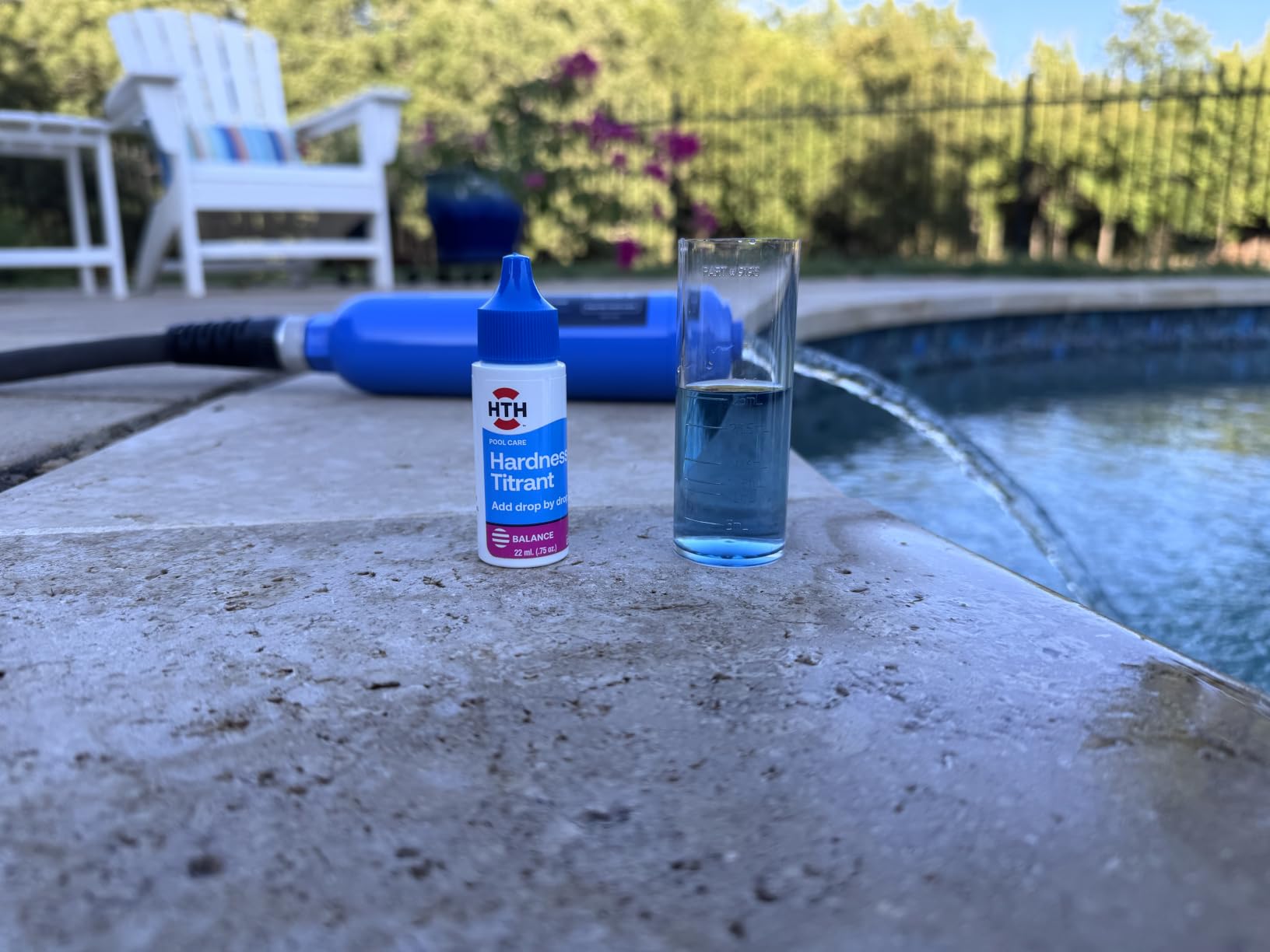
This is a fill pre-filter, not an in-pool filter, and understanding that is what makes it useful in hard water. It clamps onto a standard 3/4 inch garden hose and treats water as you fill the pool or top it off, stripping out free metal ions, sediment and chlorine before that water ever touches your plaster or liner. In a hard water region that is the cheapest possible intervention, because water that never gets in cannot scale your equipment later.
What impressed us most in the review data was a buyer who measured 250 ppm calcium at the tap and 100 ppm coming through the filter. That is not a laboratory claim, it is a home test kit reading, but it lines up with how activated carbon and the metal-adsorbing layers in this housing are supposed to behave. Owners on well water consistently report reduced rust staining on the pool bottom and noticeably clearer water after filling.
Set against that, the honest limitation is throughput. Several buyers report flow dropping noticeably after about two partial refills, which tracks with the 8000 gallon rating being an upper bound under ideal conditions rather than a guarantee. The carbon packs in a way that restricts flow if it is not seated properly, and water runs dark for the first few seconds until the loose fines clear.
Size the hose flow into your plan. Refilling a large pool through a 3/4 inch pre-filter is a slow job no matter which brand you buy, and owners who tried to fill on a schedule have discovered this the hard way. The manufacturer part number is GF36 and it fits standard plumbing, so there is no fitting guesswork. At 1.1 pounds it is trivial to move between the hose bib and a storage hook.
When this pre-filter is worth it
This earns its place if your fill water is well water, if you top off frequently, or if you have visible rust or mineral staining after a refill. It also makes sense for hot tubs and spas, where the water volume is small enough that pre-treatment is cheap and the calcium load per gallon matters more.
Pair it with a metal test on your fill water before buying. If your water reads low in iron and you are on flushed municipal supply, the marginal benefit shrinks, though the chlorine and odor removal stays useful for reducing startup chemical demand.
When this pre-filter is not enough
It will not touch calcium already dissolved in the pool. If your test shows calcium hardness above 300 ppm, this filter cannot lower it, and you still need a partial drain and refill, a sequestrant, or a softener on the fill line.
It also cannot protect the water you are already swimming in. A pool that has been running at high calcium for a season has scale inside the heater and the filter, and only an in-pool filter plus a chemistry plan addresses that. Buy one of the in-pool options for the equipment pad and keep this on the hose for fills.
We earn a commission, at no additional cost to you. CERTAIN CONTENT THAT APPEARS ON THIS SITE COMES FROM AMAZON. THIS CONTENT IS PROVIDED 'AS IS' AND IS SUBJECT TO CHANGE OR REMOVAL AT ANY TIME.
2. POOLPURE CCP420 Cartridge 4-Pack: Best Value In-Pool Filter for 420-Style Tanks
POOLPURE CCP420 Pool Filter Replaces Pentair Clean and Clear Plus 420 4Pack
- 105 sq ft media area
- 50 micron filtration
- Replaces Pentair CCP420
Pros
- Large 105 sq ft media area extends service intervals
- Trilobal fiber holds higher flow than point-bond fabric
- Releases debris with a hose rinse
- Reinforced ABS end caps and core
Cons
- Third-party brand using OEM part numbers
- Four pack is bulky to store
- 50 micron layer is coarser than polishing filters
We earn a commission, at no additional cost to you. CERTAIN CONTENT THAT APPEARS ON THIS SITE COMES FROM AMAZON. THIS CONTENT IS PROVIDED 'AS IS' AND IS SUBJECT TO CHANGE OR REMOVAL AT ANY TIME.
Filter area is the whole game in hard water. The more square feet of pleated media you have, the longer you go between cleanings before the surface area clogs enough to choke your pump. At 105 square feet per cartridge, this 4-pack gives a 420-style housing one of the larger areas available, and in a region where owners are cleaning every ten days instead of every three weeks, that margin matters more than any brand name.
The trilobal filtration fabric is the differentiator. Point-bond fabric is a flat sheet with slots cut into it, and the slots blind over permanently as fines lodge in them. Trilobal fibers create a deeper matrix that captures more while holding flow, which means the element rinses back to useful pressure instead of staying half-plugged after a wash. The dirt-locking structure is designed for exactly the rinse-and-reuse cycle hard water forces on you.
Compatibility is broad for a third-party cartridge. It replaces Pentair CCP420 and 160301, Waterway Crystal Water 425, and a list of Aladdin, Filbur and other housings. It is NSF/ANSI 50 certified by IAPMO, which matters more than it sounds, because certification covers material safety rather than marketing claims. Dimensions are 26 inches long with 7 inch outside diameter and 3 inch openings top and bottom.
The trade-off is real and worth naming. At 50 microns this is a debris filter, not a polishing filter, so it will not chase dissolved haze in hard water. And the four-pack weighs 21.3 pounds as a package, which is genuinely awkward to store for most of the year. The brand naming is also a legitimate source of confusion for buyers who search by OEM part number and expect an original housing part.
What this cartridge gets right for hard water
Media area is the single best defense against hard water scale, and 105 square feet is a lot of surface. When calcium carbonate begins to form on the pleats it does so gradually, and a larger element takes proportionally longer to reach the pressure that forces a cleaning. Owners cleaning on a pressure trigger rather than a calendar will feel this first.
It also never backwashes, so it is the right call anywhere water is expensive or restricted. If you are in a drought-restricted hard water region, that single fact can justify a cartridge over a sand filter no matter what the sand filter costs up front.
What to watch out for
The 50 micron rating is coarse by cartridge standards. Fine dust and haze pass through it, which means it will not do the visual work of a pleated high-efficiency element in a 20 micron range. If your clarity problem is fine particles rather than calcium, this is the wrong tool.
Confirm your housing model before you order. The fit list is long but specific, and returning a 21 pound four-pack is a hassle. In hard water, a cartridge that fits loosely will also leak around the edges, which lets scaled water recirculate unchecked.
We earn a commission, at no additional cost to you. CERTAIN CONTENT THAT APPEARS ON THIS SITE COMES FROM AMAZON. THIS CONTENT IS PROVIDED 'AS IS' AND IS SUBJECT TO CHANGE OR REMOVAL AT ANY TIME.
3. POOLPURE Garden Hose End Pre-Filter: Budget Fill Protection for Pools and Spas
POOLPURE Garden Hose End Pre Filter for Pool, Hot Tub, Spa, 1Pack
- Active carbon media
- Up to 8000 gallons
- Standard 3/4 in hose thread
Pros
- Reduces chlorine smell and rust color on fill
- Installs without tools in seconds
- Spas reach balanced readings without added chemicals
- Compact and hand washable
Cons
- Gallon rating disputed by owners
- Manufacturer says not for well water
- Leaks on non-standard fittings without tape
We earn a commission, at no additional cost to you. CERTAIN CONTENT THAT APPEARS ON THIS SITE COMES FROM AMAZON. THIS CONTENT IS PROVIDED 'AS IS' AND IS SUBJECT TO CHANGE OR REMOVAL AT ANY TIME.
This is the budget version of the same idea as the GLACIER FRESH, and the difference shows up mostly in capacity claims. The active carbon media reduces chlorine, taste, odor, color, VOCs, THMS, rust, sediment and turbidity on the way in, which covers the majority of what a municipal or lightly mineralized fill line throws at you. It attaches to any standard 3/4 inch hose thread with no tools.
The most useful review pattern here came from spa owners who report reaching balanced pH and alkalinity right after filling without adding a correcting chemical. That is the pre-filter argument in a nutshell. Treated fill water means less startup chemical, less balancing, and a head start on clear water instead of a cloudy first week.
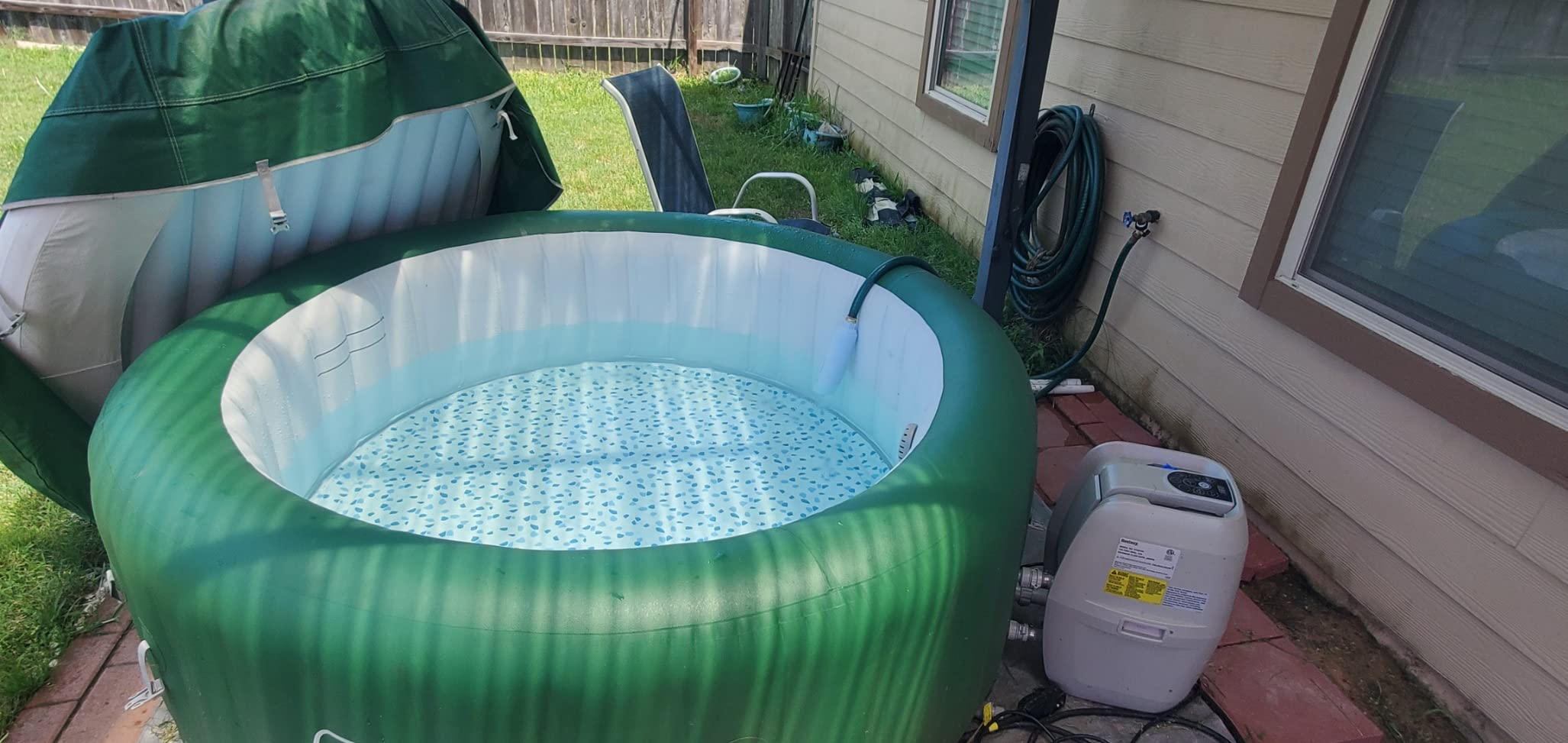
Two caveats deserve equal billing. The manufacturer states this unit is not suitable for well water, though buyers have used it on wells with good results, so treat the guidance as conservative rather than absolute. More significant is the gap between the advertised 8000 gallon rating and what owners actually see, with several reporting clogging after 1000 to 4000 gallons. At a 4.3 average with a 10 percent one-star share, this is the highest one-star rate among the hose pre-filters in this roundup.
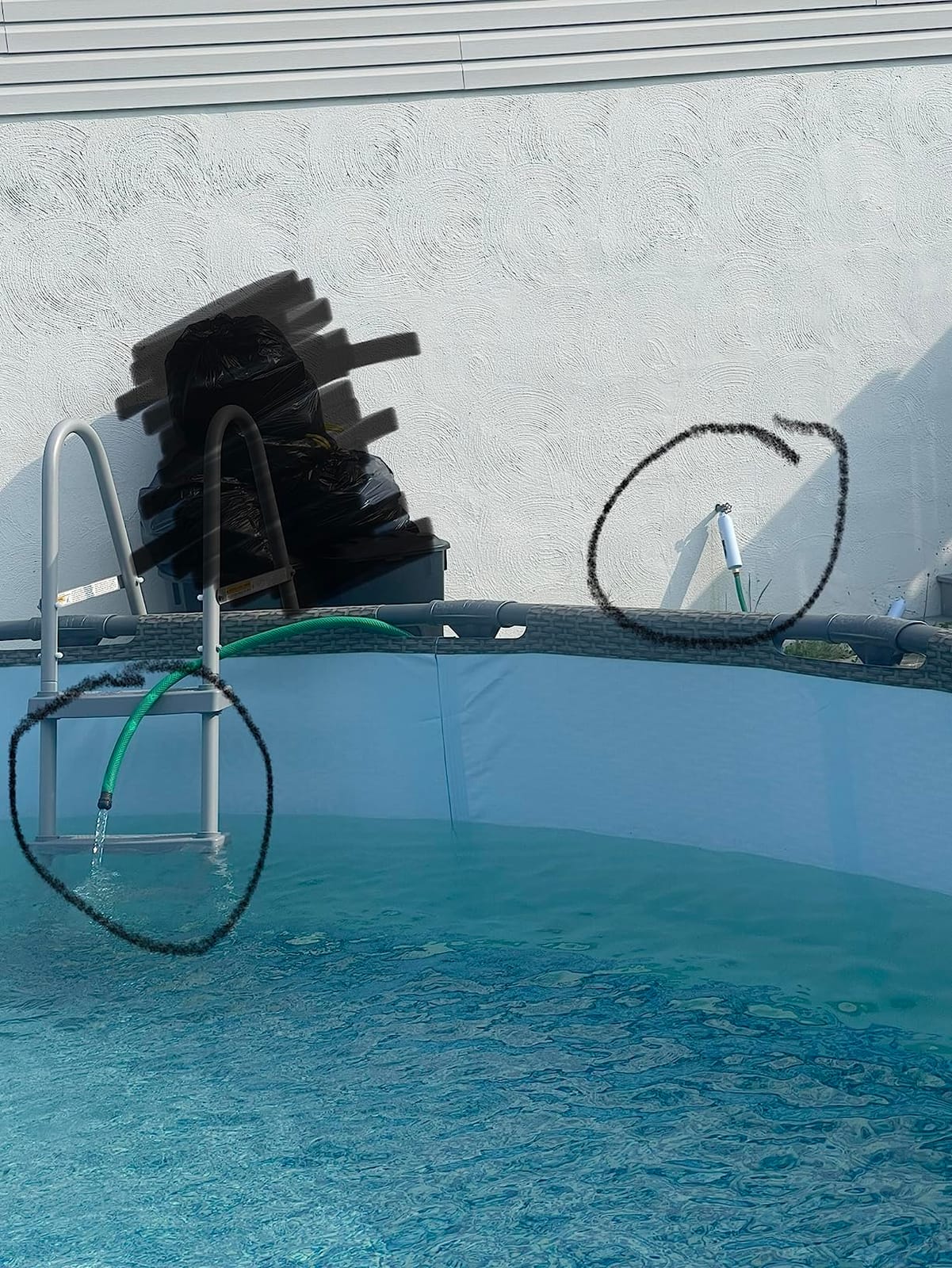
Mechanical fit is the other friction point. Non-standard tap fittings leak without PTFE tape, and the carbon needs a 30 second flush at startup because fines exit black. Neither is a dealbreaker, but both are the kind of small annoyance that decides a purchase when two products cost nearly the same.
Who this suits
Above-ground pools, kiddie pools, hot tubs and ponds on city water where the main problem is chlorine, rust color and sediment. It works well as a seasonal accessory you bring out for spring startup and a mid-season refresh rather than as a permanent installation.
Hand washing for reuse is listed in the care instructions, and a 6 by 2 by 2 inch body makes it easy to rinse and store. If you fill more than a few thousand gallons a year, budget for a replacement every couple of seasons.
Who should look elsewhere
If you are on a well with high iron or high mineral load, this is not the tool. The clogging complaints cluster with heavier sediment loads, which is exactly what wells deliver. Use the higher-capacity carbon option earlier in this list, or step up to a softener for the whole property.
It is also not an in-pool filter and will not help water that is already in the pool. Use it to protect what goes in, then pick an in-pool cartridge or sand filter for the equipment pad.
We earn a commission, at no additional cost to you. CERTAIN CONTENT THAT APPEARS ON THIS SITE COMES FROM AMAZON. THIS CONTENT IS PROVIDED 'AS IS' AND IS SUBJECT TO CHANGE OR REMOVAL AT ANY TIME.
4. U.S. Pool Supply Universal Type A and C Cartridges: Best Drop-In for Above-Ground Pumps
U.S. Pool Supply Universal Replacement Filter Cartridges, Type A or C, 4 Pk
- PET fiber media
- Type A and C fit
- 530 to 2000 GPH pumps
Pros
- Universal fit across major above ground brands
- Washable and cheap on a two week schedule
- Collapse resistant inner core
- Rinses clean without chemicals
Cons
- Fit is loose in some housings and allows bypass
- Targets particulates only not dissolved minerals
We earn a commission, at no additional cost to you. CERTAIN CONTENT THAT APPEARS ON THIS SITE COMES FROM AMAZON. THIS CONTENT IS PROVIDED 'AS IS' AND IS SUBJECT TO CHANGE OR REMOVAL AT ANY TIME.
Above-ground pools on hard water have a narrow option set, and this four-pack covers most of it. The cartridges fit Type A, Type C and Type III housings used by Intex, Bestway and Summer Waves filter pumps rated from 530 to 2000 gallons per hour. If your pump falls in that band, the fit question is basically answered before you order.
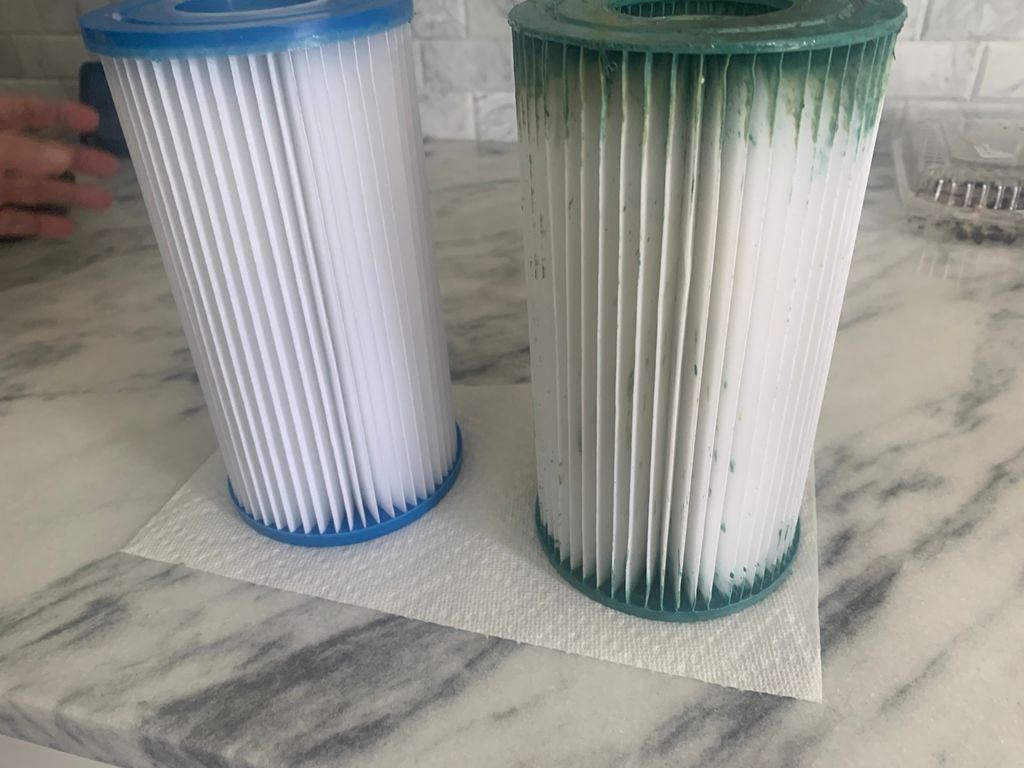
That narrow fit is also the reason to buy a four pack rather than a single. The recommended replacement interval is every two weeks, and in hard water that schedule tightens because scale and dust load up the media faster. Owners treat them as consumables, rinsing each one and swapping it in as a spare, which is far easier than cleaning a soaked element mid-swim.
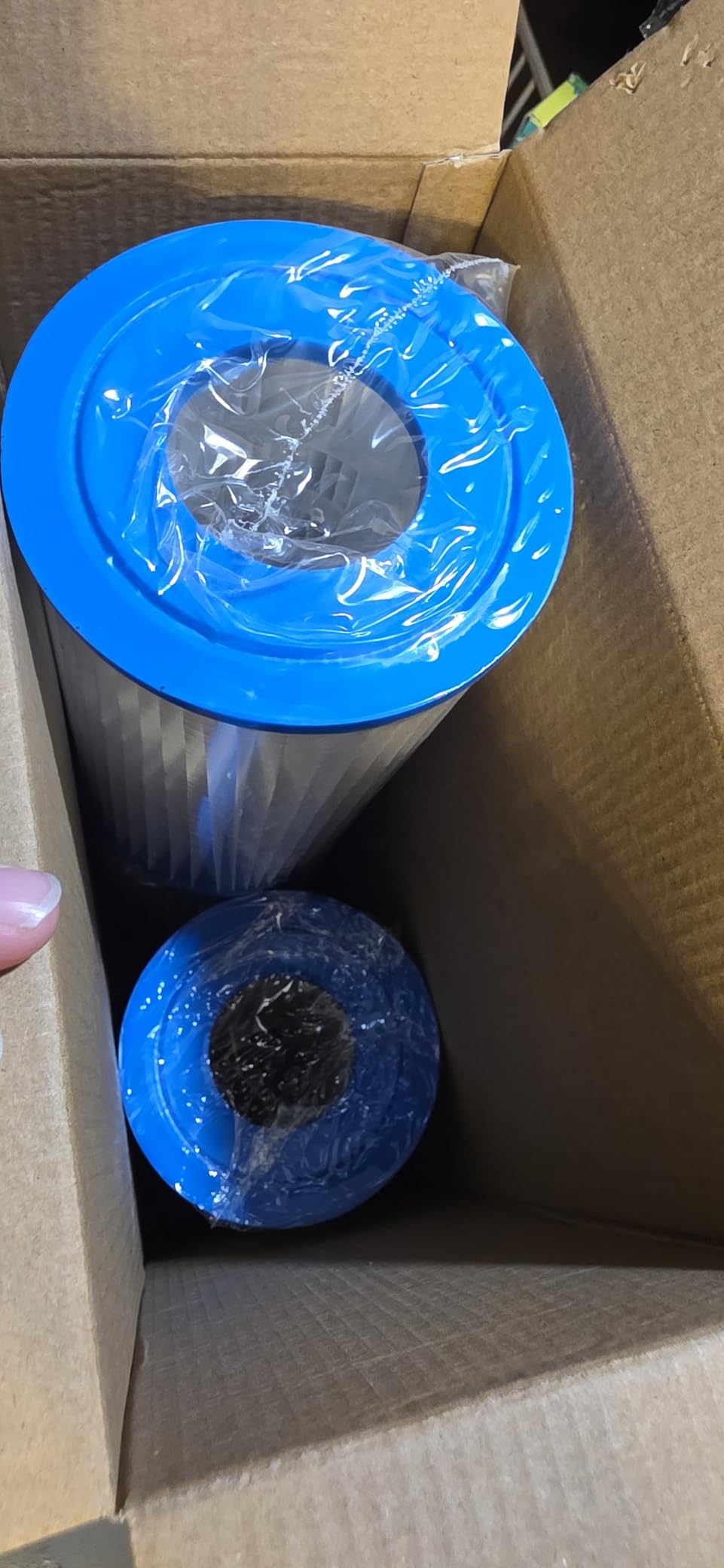
The polyethylene terephthalate fiber media catches visible dirt effectively, and the durable hard plastic inner core is collapse resistant, which matters when you rinse a lightweight element against a hose. Dimensions are 8 inches high by 4.25 inches in diameter with a nearly 2 inch center hole.
The honest weakness is fit tolerance. Reviewers repeatedly note the fit is loose rather than tight in some housings, and a loose cartridge lets water bypass the media entirely instead of passing through it. That also means some of the media area you paid for is going unused. Check your pump model against the compatibility list before ordering, and do not expect this to address a specific fitment complaint if your housing is unusual.
Where it earns its place
Owners of Intex, Bestway and Summer Waves cartridge pumps who want a cheap, dependable replacement path. At a price that supports buying on a schedule, the four-pack format is the whole value proposition, because you never run out mid-season.
It is also the right consumable if you are on a well and topping off regularly. Each rinse discards minerals that would otherwise recirculate, so a fresh cartridge every two weeks keeps sediment and precipitates from cycling through the whole pool.
Where it will not help
These are particulate filters. They do not lower calcium hardness, and a pool at 500 ppm calcium will scale these elements exactly as it scales any other cartridge. The honest fix for the calcium number is chemistry, not a different filter.
For pools above roughly 25,000 gallons, move up to a larger cartridge or a sand system. Element area in these small housings runs out well before a big pool fills, and the two week interval becomes a daily commitment.
We earn a commission, at no additional cost to you. CERTAIN CONTENT THAT APPEARS ON THIS SITE COMES FROM AMAZON. THIS CONTENT IS PROVIDED 'AS IS' AND IS SUBJECT TO CHANGE OR REMOVAL AT ANY TIME.
5. Intex Krystal Clear 2100 GPH Sand Filter Pump: Premium Sand Setup for Above-Ground Pools
INTEX Krystal Clear 2,100 GPH Sand Filter Pump for Above Ground Pools
- 2100 GPH capacity
- 1600 GPH in-pool flow
- Holds 50 lb sand
Pros
- Sand bed lasts up to five years with regular backwashing
- Six-function valve covers every service step
- Built in 24 hour timer
- Handles pools up to 12800 gallons
Cons
- Pump and tank only so it does not replace a stand-alone cartridge
- Requires partial assembly and sand before first use
We earn a commission, at no additional cost to you. CERTAIN CONTENT THAT APPEARS ON THIS SITE COMES FROM AMAZON. THIS CONTENT IS PROVIDED 'AS IS' AND IS SUBJECT TO CHANGE OR REMOVAL AT ANY TIME.
Sand filters win on media cost and media life, and this is the version most above-ground owners end up with. The tank holds 50 pounds of sand rated for up to five years with regular backwashing, which is a completely different cost profile from cartridges. If you have a large above-ground pool and hard water, the low annual consumable cost is hard to argue with, provided you can accept the backwashing.
The six-function valve covers filter, backwash, rinse, recirculate, drain and close, which means every routine service step happens at the tank. The built-in 24-hour timer with 2 to 12 hour preset cycles removes the need for a separate timer, a convenience that matters more than it sounds on a seasonal setup.
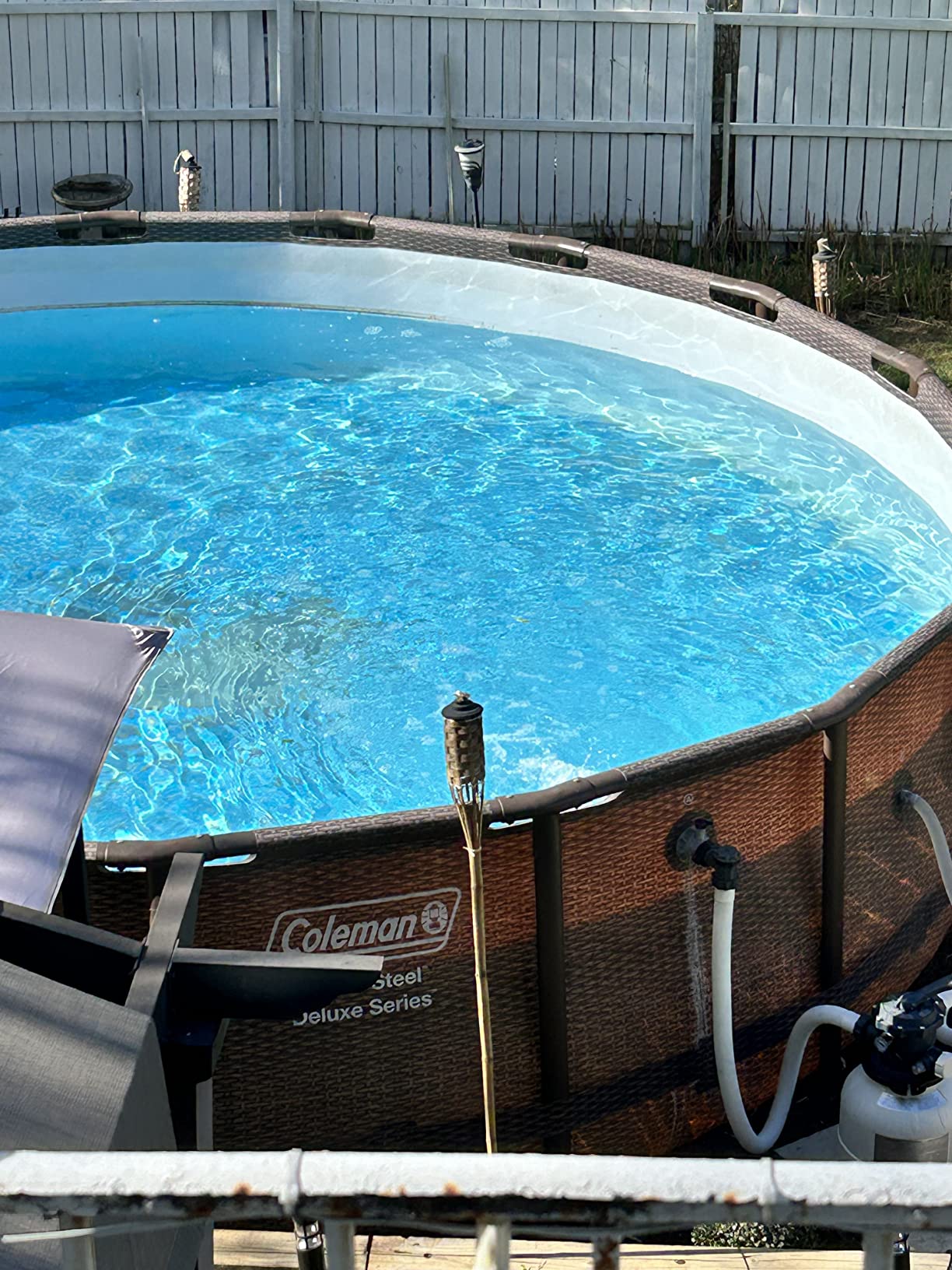
Flow figures matter for sizing. The pump is rated 2100 gallons per hour capacity with 1600 gallons per hour in-pool, and it is suitable for Intex above-ground pools up to 12800 gallons. In hard water, respect that number rather than pushing the pump harder, because excess flow through a sand bed raises pressure and drives calcium precipitation onto the media faster. HydroAeration technology is included for circulation and clarity.
The backwash trade-off in a hard water area is not a minor one. Every service cycle sends treated water to the drain, and if the water is expensive or restricted that cost compounds. Owners in dry regions have reported that a backwashing schedule plus chlorination and water replacement adds up faster than they expected. The sand media also shortens from the stated five years when the fill water carries a heavy mineral load.
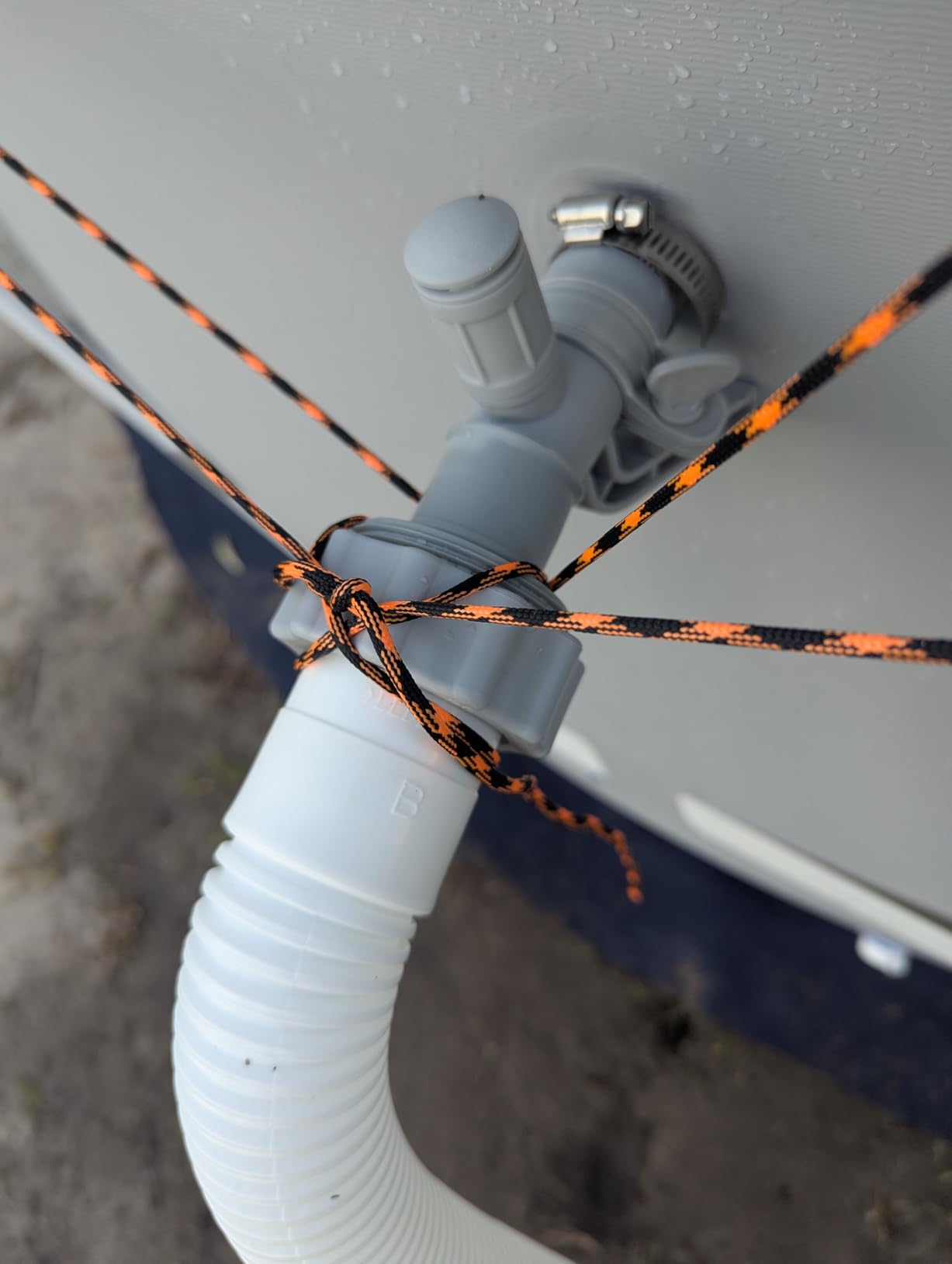
When sand is the right call
Large above-ground pools where low consumable cost beats water waste. If your fill water is plentiful and cheap, the backwash volume stops being a real cost line and the five year media life becomes the dominant advantage in the comparison.
It is also the right answer where element area is scarce. Sand provides far more filtration surface for the money than any cartridge in a small housing, and it handles heavy bather load without fouling quickly.
When you should pick something else
Skip this in a drought-restricted or high water cost region. The repeated backwash volume is the single biggest drawback for hard water owners with limited water supply, and a cartridge simply does not have that expense.
It also arrives as a pump plus filter tank, so it does not slot in as a replacement for an existing stand-alone cartridge system. Two 1.5 inch connector hoses are included and partial assembly is required, and sand media has to be added before first use.
We earn a commission, at no additional cost to you. CERTAIN CONTENT THAT APPEARS ON THIS SITE COMES FROM AMAZON. THIS CONTENT IS PROVIDED 'AS IS' AND IS SUBJECT TO CHANGE OR REMOVAL AT ANY TIME.
6. Hayward ProSeries 18 Inch Sand Filter: Best for Even Backwash Distribution
Hayward ProSeries Swimming Pool Sand Filter for Above Ground Pools, 18 Inch
- 18 inch sand tank
- 7 position VariFlo valve
- Top diffuser fitted
Pros
- Integral top diffuser reduces channeling
- Seven position valve gives lower pressure drop
- Large sand and water drain speeds winterizing
- Corrosion proof all weather tank
Cons
- Handles particulates while dissolved hardness needs separate treatment
- Weighs 32.9 pounds and needs pump horsepower
- Sand media sold separately
We earn a commission, at no additional cost to you. CERTAIN CONTENT THAT APPEARS ON THIS SITE COMES FROM AMAZON. THIS CONTENT IS PROVIDED 'AS IS' AND IS SUBJECT TO CHANGE OR REMOVAL AT ANY TIME.
This is the tank quality step up from a generic sand filter, and the difference shows in distribution. The integral top diffuser spreads incoming water evenly across the entire sand bed instead of letting it cut a single channel through the middle. Even water distribution is what makes backwashing effective, and effective backwashing is what keeps hard water from compacting scale into the top of the bed where it never gets cleaned.
The seven-position VariFlo valve is engineered for maximum flow at a lower pressure drop. That matters in hard water because lower pressure drop translates into a longer usable cycle before you hit your cleaning threshold. The self-cleaning lateral system is precision engineered for even water distribution and balanced backwashing, which extends the useful life of both the media and the laterals.
Winterizing is handled by a large pressure sand and water drain that is always ready for off-season service. On a hard water pool, draining the media properly at season end matters more than usual, because scale left sitting on sand through a winter is the hardest kind to remove. The tank is 18 inch above ground with corrosion proof all weather construction, and 16 inch and 21 inch versions exist in the same line.
Two practical notes. At 32.9 pounds it is a genuinely heavy component to lift onto an equipment pad, and it needs adequate pump horsepower to turn the media properly. Sand media is not included, so budget for that separately. The manufacturer part number is W3S180T and it pairs with Hayward above-ground pumps.
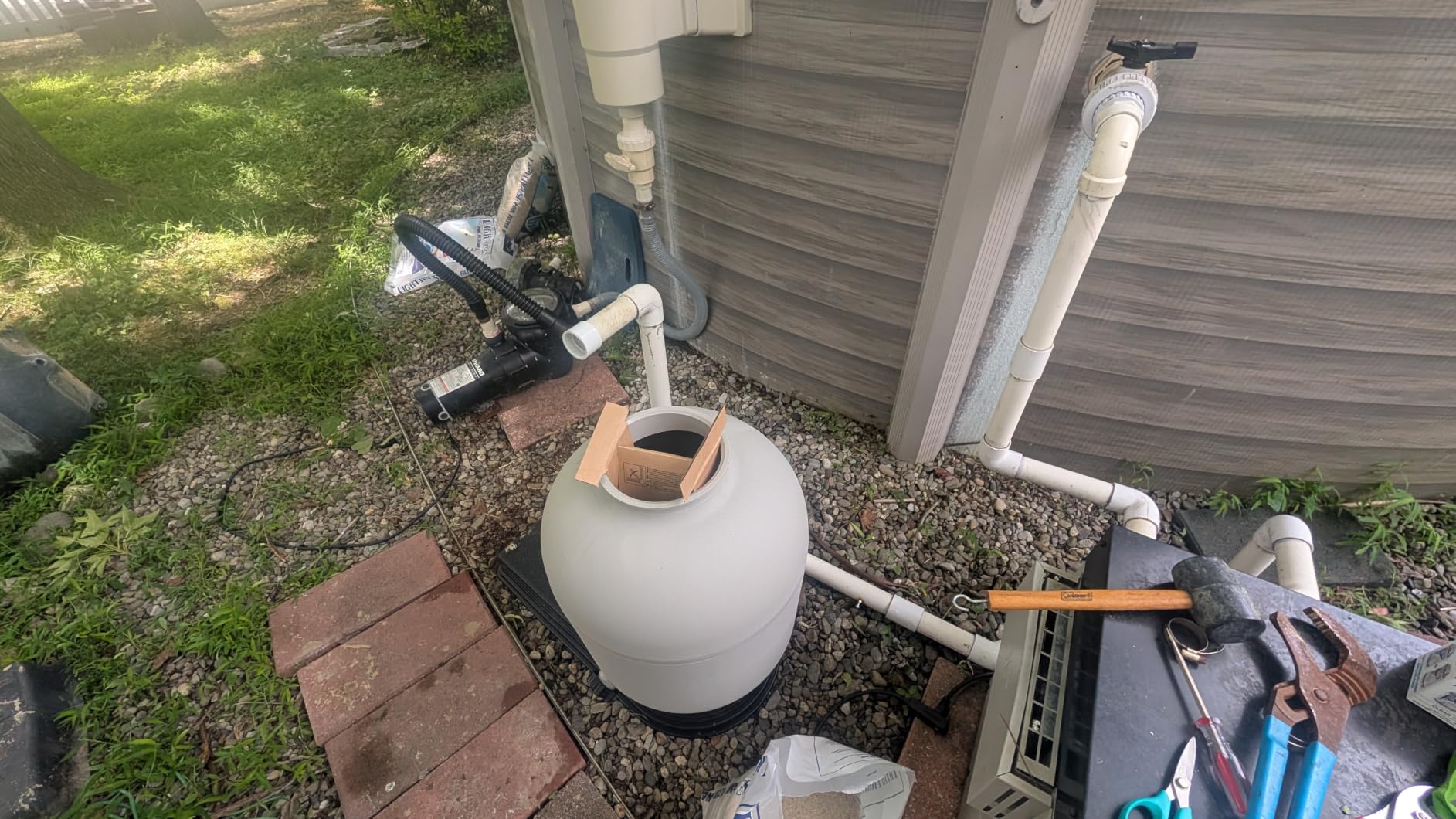
Why distribution matters in hard water
Channeling is the failure mode that shortens sand filter life, and hard water accelerates it. Scale narrows passages unevenly, water finds the path of least resistance, and the easy path gets deeper while the edges go untouched. An even diffuser slows that process by forcing water across the whole bed each cycle.
Balanced backwashing also means the scale that does lift gets carried out instead of being redistributed deeper into the media. In a hard water pool, rinse cycle discipline matters as much as backwash discipline, and this valve supports both.
Where the trade-offs sit
It is still a particulate filter. A tank of any brand captures debris and cannot lower calcium hardness, so the chemistry plan carries the same weight here as it does everywhere else in this roundup.
If your water is expensive or restricted, every backwash cycle is a real cost this tank imposes on you. It is also more of a commitment than a cartridge, since you need matching pump horsepower and separate sand media to get it running.
We earn a commission, at no additional cost to you. CERTAIN CONTENT THAT APPEARS ON THIS SITE COMES FROM AMAZON. THIS CONTENT IS PROVIDED 'AS IS' AND IS SUBJECT TO CHANGE OR REMOVAL AT ANY TIME.
7. Intex 29002E Type A Cartridge Two Pack: Top Rated for Above-Ground Pumps
INTEX 29002E Type A Pool Filter Cartridge: for INTEX Filter Pumps – Easy-to-Clean – Dacron Paper – Efficient Filtration – Two Pack
- Dacron paper media
- Fits three Intex pump models
- Two pack
Pros
- 4.7 star average across more than 54000 reviews
- Exact fit for the most common Intex cartridge pumps
- Rinses clean and reuses when dried properly
- Lowest recurring cost in the category
Cons
- Only fits three Intex pump models
- Listing imagery can suggest universal fit
- Small media area saturates quickly in dusty conditions
We earn a commission, at no additional cost to you. CERTAIN CONTENT THAT APPEARS ON THIS SITE COMES FROM AMAZON. THIS CONTENT IS PROVIDED 'AS IS' AND IS SUBJECT TO CHANGE OR REMOVAL AT ANY TIME.
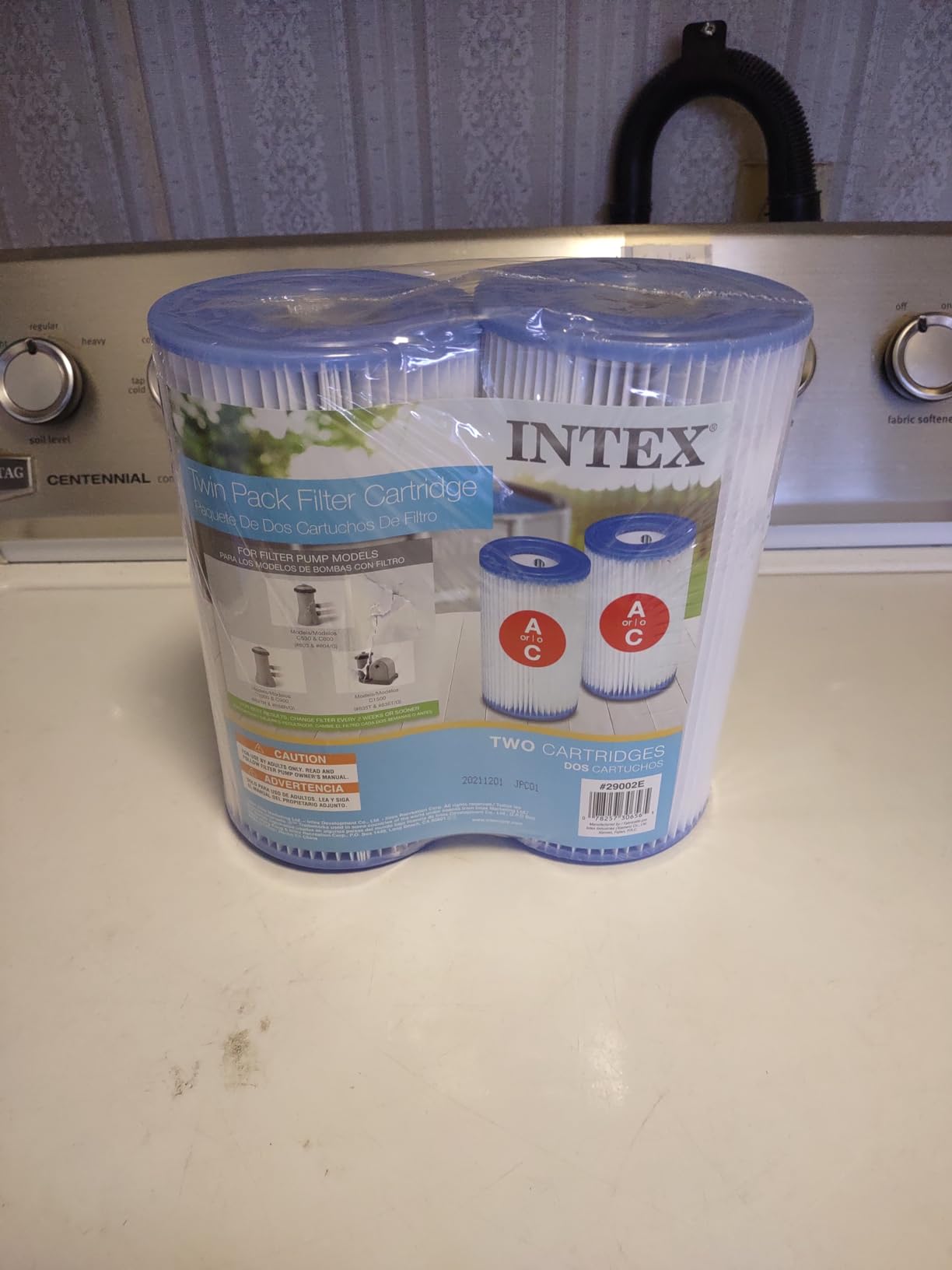
This is the best-reviewed product in the roundup by a wide margin, with a 4.7 average across more than 54000 reviews. Scale in that review base is worth pausing on, because it tells you something a star rating does not. A cartridge at this price point is not a premium purchase, so a rating that high across tens of thousands of purchases means the failure modes are small and predictable rather than hidden.
The fit is exact for Intex filter pump models 28603EG, 28637EG and 28635EG. Those three pumps cover an enormous installed base of above-ground pools, which is why this two pack shows up on so many equipment pads. It is NSF listed, and the Dacron paper media rinses clean and can be reused if you dry it properly rather than reinstalling it wet.
For hard water owners, the practical issue is media area, not quality. These are small elements, roughly 4.2 by 8.4 by 8.1 inches, and they saturate quickly when dust, sunscreen, or mineral precipitates load them up. The recommended replacement interval is every two weeks, and in hard water you should plan on that interval rather than stretching it.
That routine is not a complaint so much as a design reality. The cost per cartridge is low enough that the two week cycle is entirely affordable, and having a spare on hand means you never extend an interval past what the element can handle. Owners who treat it as a consumable report consistent results; owners who stretch intervals report hazy water.
What makes this the safest pick in the list
Review volume at this scale means fitment, durability and rinse behavior have all been tested by a very large number of people. For an above-ground pool owner who wants one less variable, that certainty is worth more than a larger element from a smaller brand.
Hose rinse and reuse is the key habit. Rinse the element, let it dry fully in the sun rather than reinstalling it damp, and you can stretch the change interval in mild conditions. In hard water, keep to the two week schedule.
What the high rating does not cover
Compatibility stops at three Intex pump models. It does not cover Coleman or other brands, and the listing imagery shows several pump models, which can mislead buyers expecting a universal fit. Confirm your pump model number before ordering.
And once again, the fundamental limit applies. No cartridge lowers calcium hardness. This one traps particles beautifully and cheaply, and your water chemistry still decides whether calcium scales your equipment.
We earn a commission, at no additional cost to you. CERTAIN CONTENT THAT APPEARS ON THIS SITE COMES FROM AMAZON. THIS CONTENT IS PROVIDED 'AS IS' AND IS SUBJECT TO CHANGE OR REMOVAL AT ANY TIME.
8. Cryspool 08055 Cartridge: Best Filter Area for Hayward C1200 Housings
Cryspool 08055 Pool Filter Cartridge Replaces CX1200RE, C1200
- 120 sq ft filtration area
- Trilobal fiber media
- Fits Hayward C1200
Pros
- 120 sq ft area gives longer service intervals
- Trilobal fiber holds higher flow under load
- Snug wobble free fit with no bypass
- Rinse clean with a garden hose
Cons
- Thinner long term durability data than OEM rivals
- Third party brand using Hayward part numbers
- Targets particulates rather than dissolved hardness
We earn a commission, at no additional cost to you. CERTAIN CONTENT THAT APPEARS ON THIS SITE COMES FROM AMAZON. THIS CONTENT IS PROVIDED 'AS IS' AND IS SUBJECT TO CHANGE OR REMOVAL AT ANY TIME.
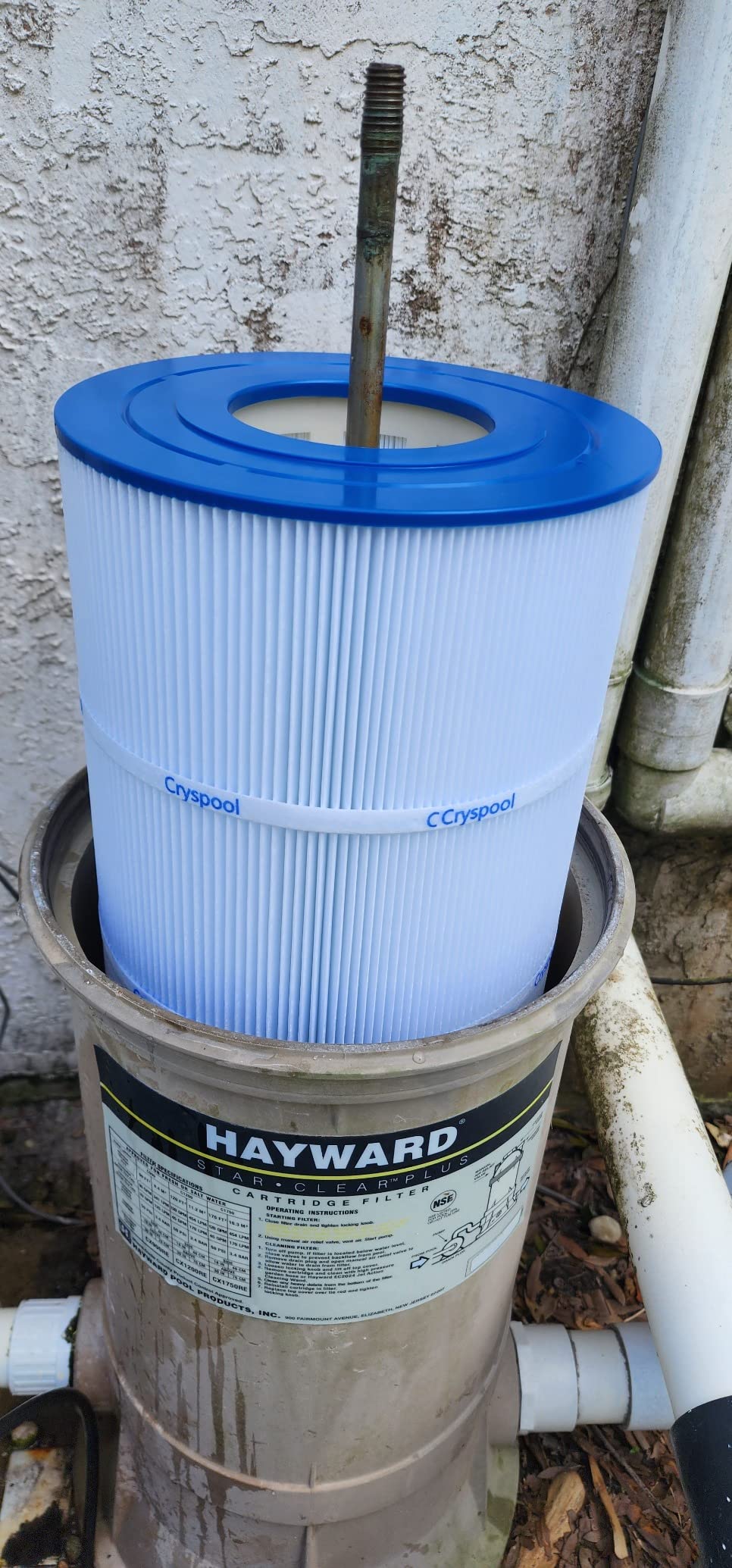
At 120 square feet this is the largest media area in the roundup, and in hard water that is the feature that matters most. A Hayward Star-Clear Plus C1200 housing is a common in-ground setup, and owners using a smaller generic replacement in that housing often find themselves cleaning weekly in high calcium conditions. More area directly extends the interval.
The trilobal fiber technology is the same approach used in the larger cartridge earlier in this list, creating a deep filtration matrix rather than the flat point-bond structure used in most budget elements. The practical result buyers report is higher flow through the same element, which in practical terms means the pressure gauge climbs more slowly and the backwash or rinse cycle takes less time.
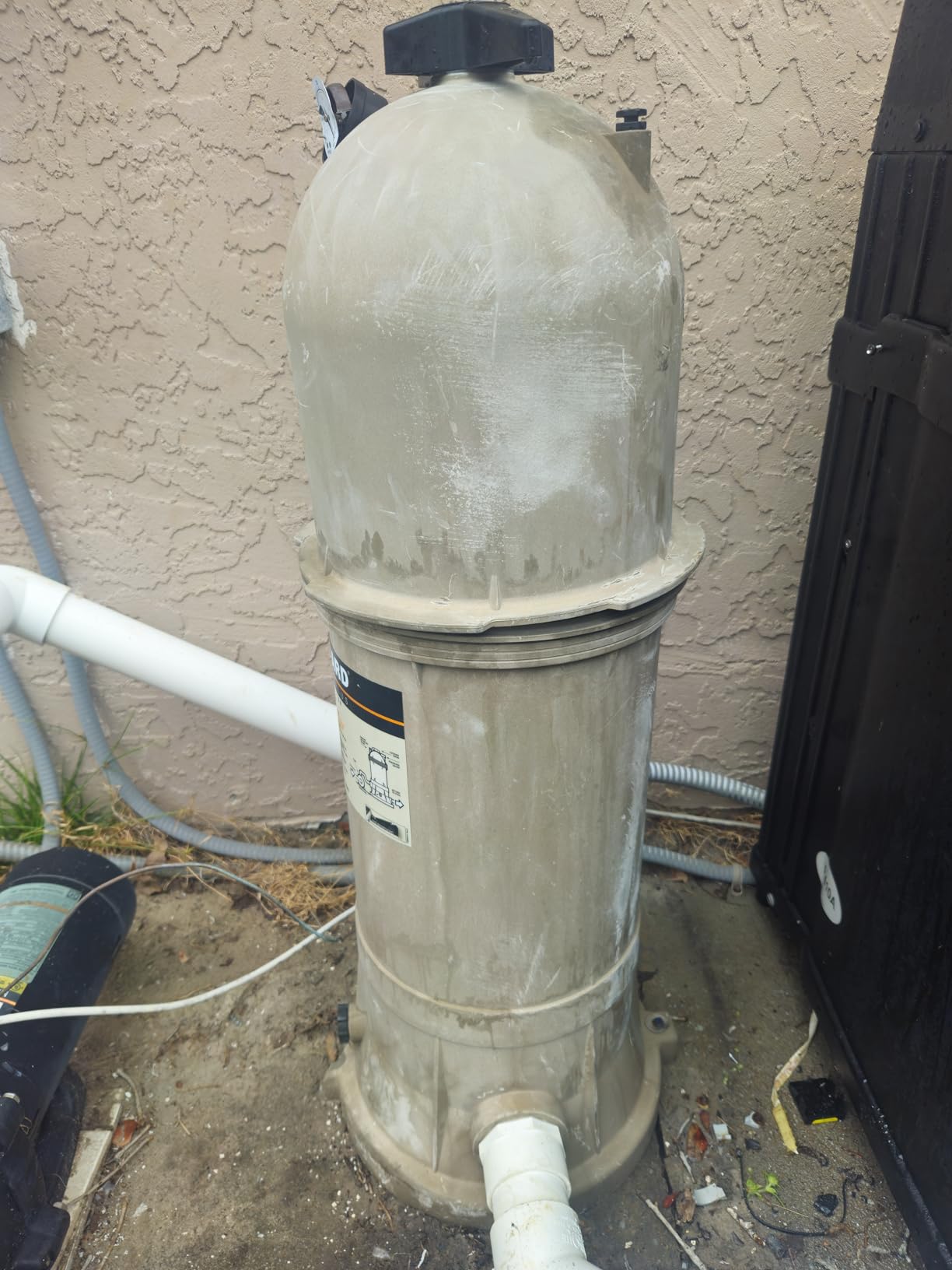
Dimensions are specific, so measure before ordering: 23-5/16 inches long, 8-15/16 inches outside diameter, 4 inch top and bottom openings. Compatibility runs beyond the Hayward housing to PA120, Unicel C-8412, Filbur FC-1293, Waterway Clearwater II 125, Pro Clean PCCF-125 and several Aladdin and AKM models. Reinforced end caps and pleat bands hold position and resist separation under high flow, which is what stops a loaded element from blowing apart at the ends.
The honest caveat is data depth. With 932 reviews the average is excellent at 4.7, but it is a thinner long term record than the established OEM cartridges. Like every other pleated element here, it targets particulates and not dissolved hardness, and the brand using Hayward part numbers for reference can confuse fitment if you are not careful.
Why filter area is the hard water currency
Scale accumulates on media surface as a function of time and calcium load, not as a function of brand. More surface area means the same amount of deposit spreads across more material, and the element keeps usable flow for longer before you have to intervene. On a high calcium pool, doubling your area roughly halves how often you are standing over a disassembled tank with a hose.
Combined with a no-backwash design, that is the cleanest hard water story available: no water waste, longest intervals, and a hose rinse as the entire cleaning routine.
What to check before ordering
Confirm the physical dimensions against your housing and locate the 4 inch openings top and bottom. A cartridge that does not seat fully will let water bypass the pleats, and in hard water that also gives scale a protected edge to grow at the gasket.
Set a pressure baseline when the element is new and clean at a defined increase above it rather than on a calendar. Reviewers commonly report cleaning at 8 to 10 PSI above the clean reading, or about a 20 percent rise, whichever comes first.
We earn a commission, at no additional cost to you. CERTAIN CONTENT THAT APPEARS ON THIS SITE COMES FROM AMAZON. THIS CONTENT IS PROVIDED 'AS IS' AND IS SUBJECT TO CHANGE OR REMOVAL AT ANY TIME.
9. XtremepowerUS 22 Inch Sand Filter: Best for Large In-Ground Pools
XtremepowerUS 22-Inch Sand Filter for Inground & Above Ground Swimming Pools, Pool Sand Media Filtration System with 7-Way Top-Mount Multiport Valve, Up to 31,200 Gallons
- 22 inch tank
- 250 lb sand capacity
- Seven position valve
Pros
- 250 lb sand capacity for large pools
- Seven position valve covers every service mode
- Umbrella fold laterals improve backwash evenness
- Stand base and manual included
Cons
- Pump not included so system cost runs higher
- Lowest average rating here with a 12 percent one star share
- Sand media purchased separately
We earn a commission, at no additional cost to you. CERTAIN CONTENT THAT APPEARS ON THIS SITE COMES FROM AMAZON. THIS CONTENT IS PROVIDED 'AS IS' AND IS SUBJECT TO CHANGE OR REMOVAL AT ANY TIME.
For a large in-ground pool on a budget, a big sand tank still wins on cost per gallon filtered. This 22 inch tank is rated to 37200 gallons and holds 250 pounds of sand, which is a media volume most cartridge systems simply cannot approach. If you have a big pool, a high calcium reading, and no problem with the water bill, the arithmetic favors sand.
The umbrella fold self-cleaning lateral system is the part worth understanding. It keeps sand level across the tank, which exposes water to the maximum sand surface and produces even backwashing. Even distribution is what prevents channeling, and channeling is the failure that quietly ruins a sand bed in hard water over a season.
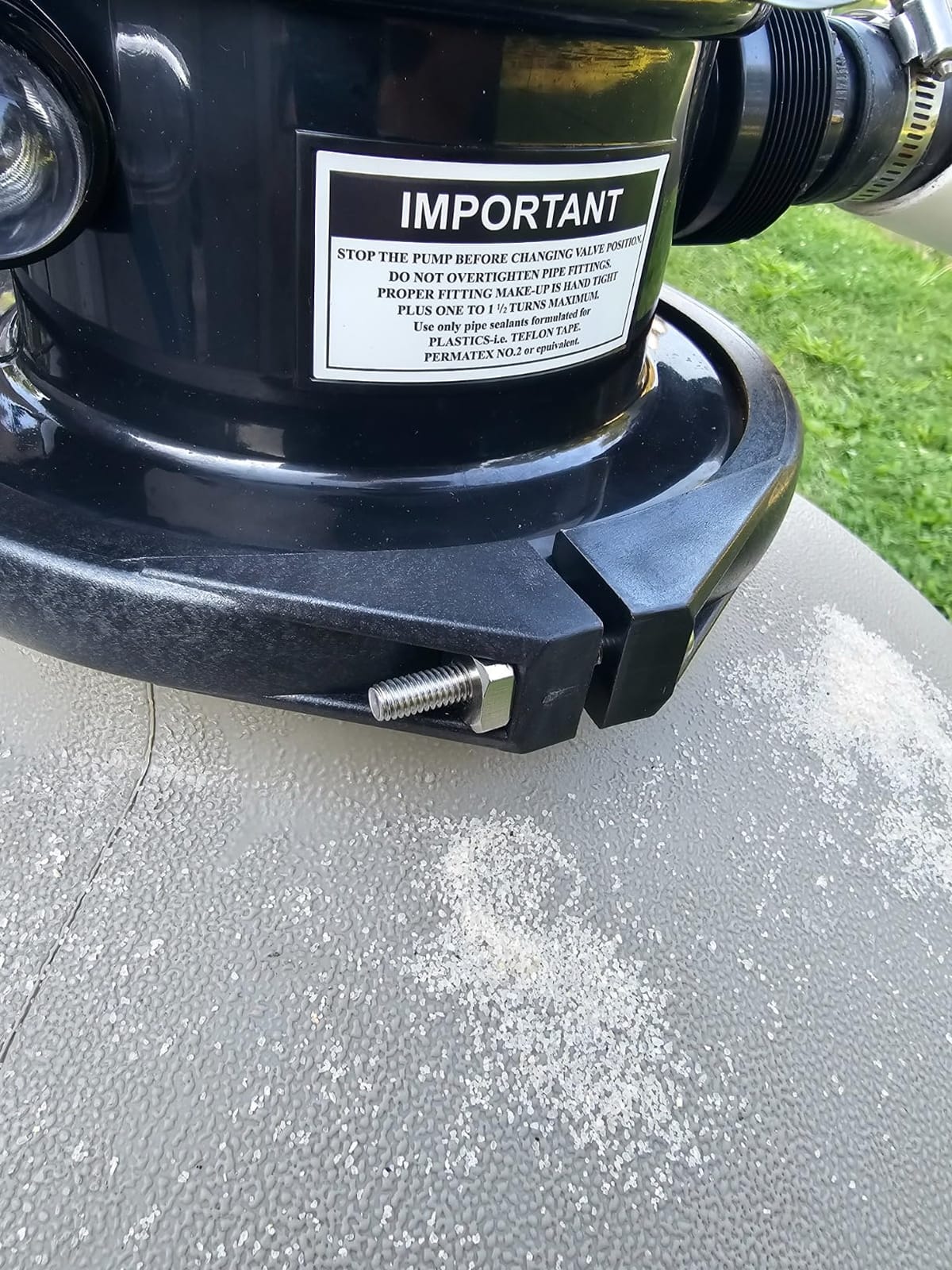
The seven position valve covers filter, backwash, winter, recirculate, closed, rinse and waste, which is a full service set. The brass insert impeller is a genuine durability upgrade over all plastic valve assemblies, and since the valve is the component most likely to fail from mineral corrosion, that detail is worth more in a hard water region than it would be elsewhere. Each tank is individually tested, and the stand, base and manual are included.
Overall dimensions are 22 inches wide by 22 inches long by 37.5 inches high, with threaded connections. The pump is not included and sand must be purchased separately, so the real system cost is meaningfully higher than the tank alone suggests. At 4.2 stars with a 12 percent one-star share, this is the lowest average rating in the group, with complaints clustering around assembly and fitting problems.
Where the capacity pays off
Large pools with high bather load benefit most from the sheer media volume. 250 pounds of sand is a deep bed, and a deep bed holds a lot of debris before pressure becomes a problem, which means fewer service cycles across a busy summer.
The self-cleaning laterals and brass impeller are the two features that matter most in hard water specifically. Corrosion-resistant internals resist the mineral environment, and level media means scale gets lifted out on backwash instead of compacting into dead zones.
What the low rating reflects
Assembly and fitment complaints dominate, along with the missing pump. Budget for threaded fittings, Teflon tape and a proper union, and follow the manual closely on the lateral assembly, because most of the negative reviews trace back to setup rather than the tank itself.
Also weigh the backwash volume honestly. A tank this size moves a lot of water per cycle, and in a water-restricted hard water region that cost recurs all season. A large cartridge array avoids it entirely.
We earn a commission, at no additional cost to you. CERTAIN CONTENT THAT APPEARS ON THIS SITE COMES FROM AMAZON. THIS CONTENT IS PROVIDED 'AS IS' AND IS SUBJECT TO CHANGE OR REMOVAL AT ANY TIME.
10. VENUSFILTER NSF Garden Hose Filter: Best Pre-Treatment for Well Water
Garden Hose Filter for Filling Hot Tub, Pool, Spa, Greatly Reduces Sediment, Chlorine, Heavy Metals and Odors, Standard 3/4″ Garden Hose Thread (1 pack)
- NSF certified
- KDF multi stage carbon
- Standard 3/4 in hose thread
Pros
- NSF certification is unusual at this price point
- Strong iron and rust removal on well fills
- Does not choke flow for most users
- Reduces hot tub startup chemical needs
Cons
- Some units restricted flow severely
- Loose carbon fines require a 30 second flush
- Actual capacity varies widely with sediment load
We earn a commission, at no additional cost to you. CERTAIN CONTENT THAT APPEARS ON THIS SITE COMES FROM AMAZON. THIS CONTENT IS PROVIDED 'AS IS' AND IS SUBJECT TO CHANGE OR REMOVAL AT ANY TIME.
The distinguishing feature here is certification. This is NSF certified and uses Kinetic Degradation Fluxion multi-stage filtration alongside natural coconut shell activated carbon, a combination that is uncommon among carbon hose pre-filters at this level. For a well owner, iron and rust sediment are the main thing standing between you and a clean fill, and that is exactly what these buyers report removing.
Flow behavior is the bigger story in the reviews. Most owners report no meaningful pressure or flow reduction even across repeated weekly use, which is not a given with carbon pre-filters. For hot tubs and pools, the reported reduction in startup chemical needs and balanced pH readings right after filling makes this a practical addition to a fill routine.
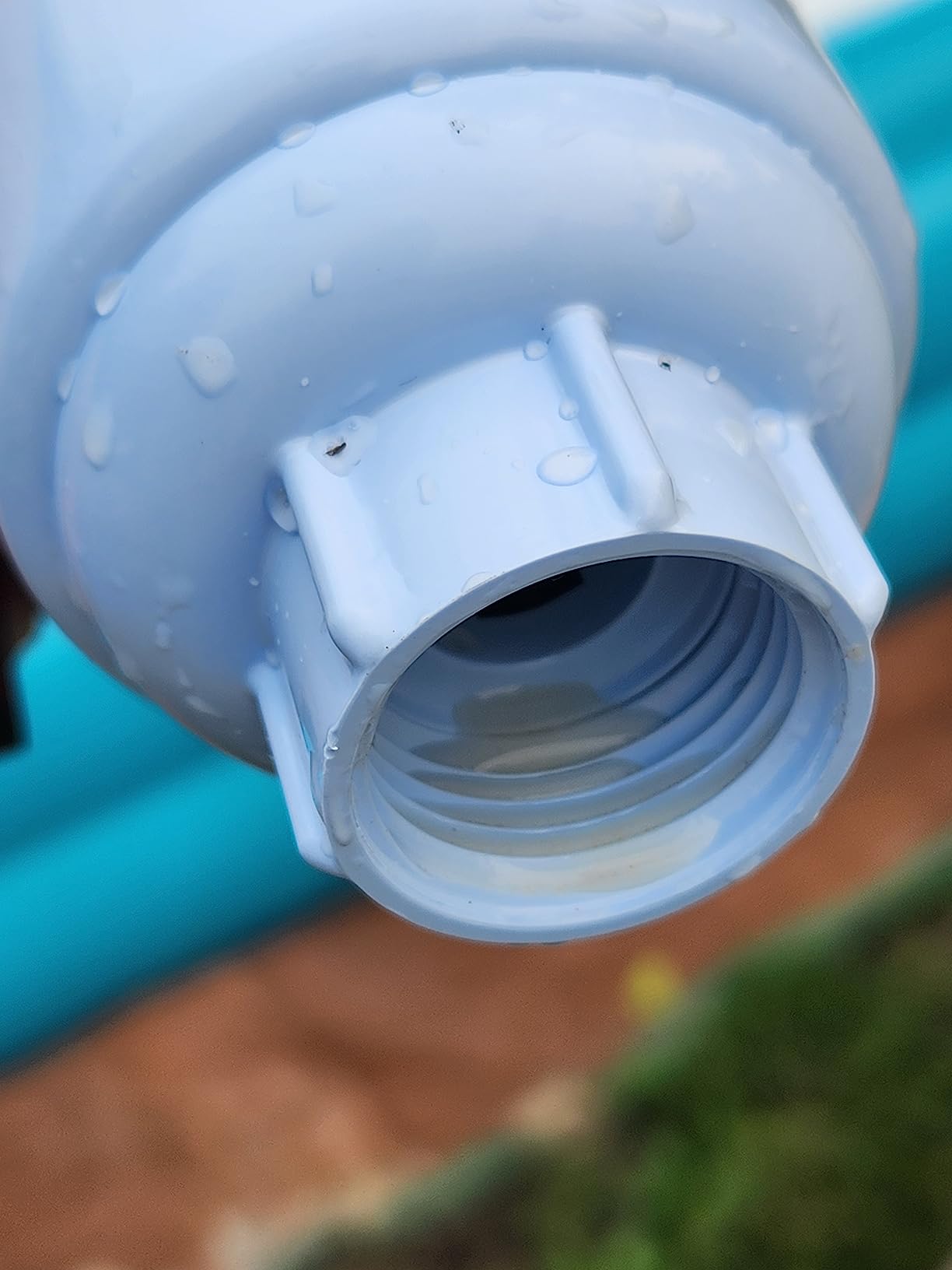
Two things to plan for. The 30 second flush is not optional, because loose carbon fines leaving on first use will stain a pool liner or plaster. And the 8000 gallon rating varies widely in practice depending on sediment load, with the manufacturer recommending replacement at roughly three months rather than at a specific volume.
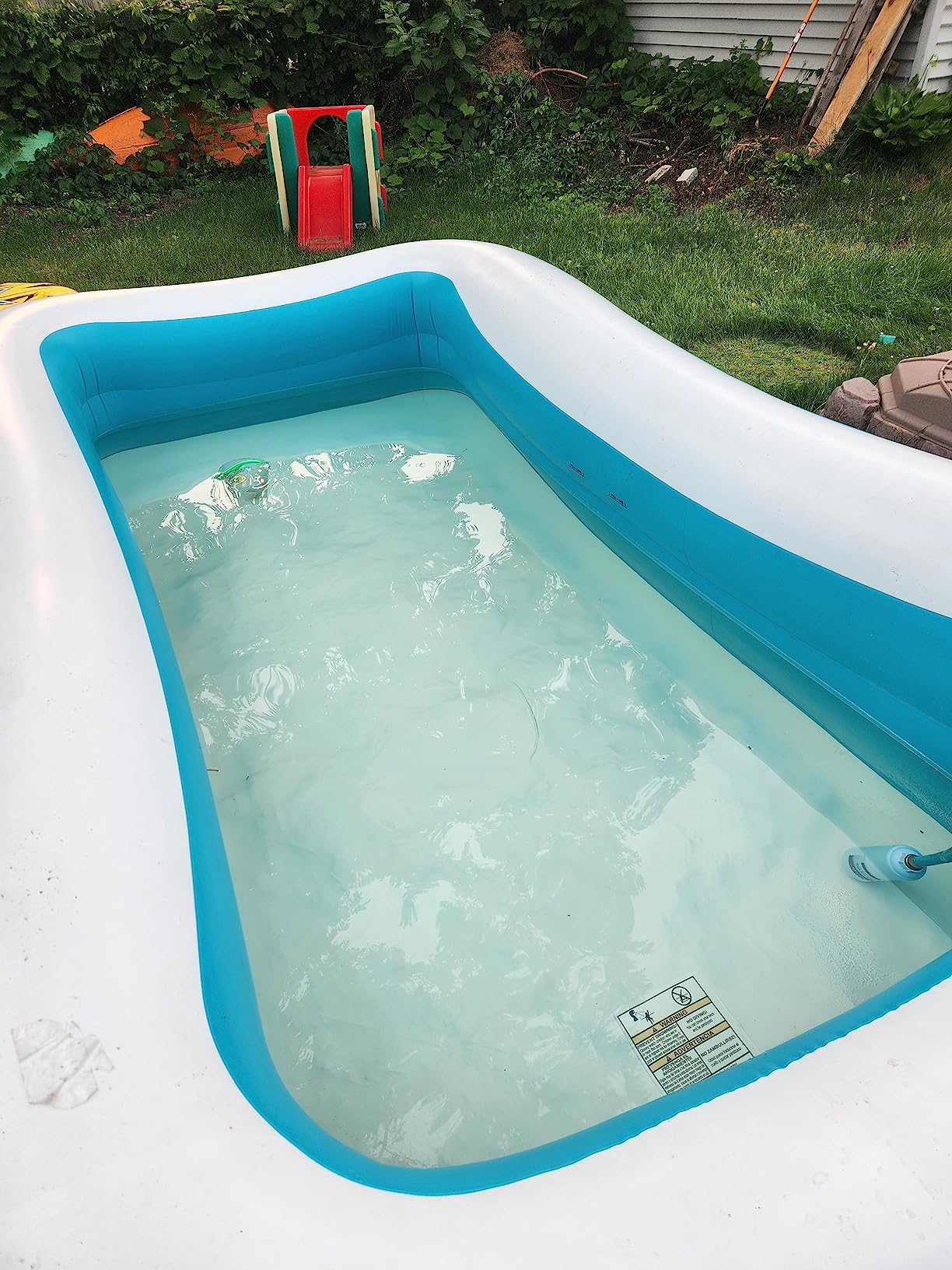
A small number of owners reported severe flow restriction, in one case down to a trickle that turned a fill into a multi-week project. That is the minority outcome, but it is the failure mode to watch for. Check flow at the start of every fill rather than assuming it is holding, and keep a spare so a restriction never blocks a refill you need promptly.
Why well owners should care most about this one
Well water is where hard water problems start. It carries dissolved iron, manganese and often high hardness at the same time, and it arrives with no chlorine to knock anything down. A carbon and KDF pre-filter addresses the metals portion of that load before it reaches the pool, which is the part pre-filters are genuinely good at.
The housing is durable enough to survive repeated removal and reinstallation, and it fits any standard 3/4 inch garden hose thread, so it works for hot tubs, above-ground pools, spas, ponds and car washing alike.
Where it falls short of a real fix
No hose pre-filter lowers calcium hardness in a pool that is already full. If your calcium reading is high, this protects future fills and nothing more. Getting the existing number down takes dilution, a sequestrant, or a softener.
For a property with genuinely hard water, a whole-property softener is the better investment than any number of hose filters, because it treats every fixture and every fill at once. Use the pre-filter as a stopgap or for occasional top-offs rather than as the long term answer.
We earn a commission, at no additional cost to you. CERTAIN CONTENT THAT APPEARS ON THIS SITE COMES FROM AMAZON. THIS CONTENT IS PROVIDED 'AS IS' AND IS SUBJECT TO CHANGE OR REMOVAL AT ANY TIME.
How to Descale a Cartridge Element Without Wrecking It
White crust on the pleats is the most common hard water complaint, and it appears within days of a hose rinse for owners in high calcium areas. A rinse removes loose dirt. It does nothing about calcium carbonate that has bonded to the fiber, which is why the same element goes back in and comes out fouled again. An acid soak is the fix.
Remove the element and let it dry. Wet media is harder to soak evenly and the acid solution gets diluted unpredictably. A dry element also lets you see the scale clearly, which is how you know how long to soak.
Mix a solution of roughly one part muriatic acid to ten parts water, and always add acid to water, never the reverse. Submerge the element completely in a plastic container in a ventilated area. Wear gloves and eye protection, and never mix acid with chlorine, since the combination produces a toxic gas.
Soak for four to twelve hours, agitating the element every thirty minutes or so to let the solution reach inside the pleats. Long scale deposits need the longer end of that range. A light crust on an element cleaned regularly can come out in four hours.
Rinse thoroughly with a garden hose, then run a neutralizing wash or a trisodium phosphate solution through it and rinse again, and only then reinstall. Residual acid in the housing will attack metal fittings and kill your sanitizer balance, so the rinse is not optional.
Two situations where you should not acid wash at all. If your pool is plaster and the plaster is not fully cured, acidic water from an incompletely rinsed element can etch the surface, and the same caution applies if you cannot identify the media type in the housing. Never put diatomaceous earth filter aid powder into a cartridge filter, because the fines permanently blind the pleats and the element will not recover.
Store elements dry through the off-season, laid on their side rather than stacked, and a pleated element in good condition will outlive several seasons of soak cycles even in hard water. Replace it when the pleats feel brittle, when the media tears on a normal rinse, or when it no longer returns to your clean pressure baseline.
How to Size a Filter for Hard Water and Why Pump Match Matters
Start with gallons. Multiply the pool’s average depth by its length and width in feet, and remember that most shapes hold about 60 percent of the rectangular calculation. Every rating on a product page assumes a pool within its stated capacity, and the tank should be sized so the equipment pad does not dominate the pool footprint.
Next pick your turnover target. The standard for residential pools is one full turnover every six to eight hours, and pool service professionals aim for the shorter end of that range in hot climates or high bather load situations. Divide gallons by hours to get the required GPM, then add roughly 25 percent as a margin.
That margin is a hard water consideration more than a general one. A filter running exactly at its rated flow in high calcium water builds pressure faster because precipitation begins sooner, and a system that sits at its limit from day one has no headroom for the scaling curve. Oversizing the filter slightly is cheaper than cleaning it twice as often.
For cartridge systems, the common target is about 60 square feet of media per GPM of pump capacity, and more media area translates directly into longer intervals in high calcium water. For sand, one square foot of tank surface per GPM is a common starting point, though a deeper bed in a taller tank generally filters better per square foot. DE systems typically target about 10 square feet of grid area per GPM, with a charge of one pound of DE powder per ten square feet.
Match the pump to the filter rather than the other way around, and this is where most hard water frustration starts. A pump that pushes far more GPM than the filter is rated for raises pressure, generates more turbulence at the media, and raises local temperature at the media surface, all of which accelerate calcium carbonate precipitation. A variable speed pump helps most when you run it longer at a lower rate, which improves turnover without increasing pressure.
Finally, weigh the water cost. A sand or DE backwash cycle can move 300 to 500 gallons per cycle, several times a month in a hard water area, and treated water is not cheap to replace. A cartridge filter discards no water at all, which is why it is the default recommendation in drought-restricted regions and the reason most of the in-pool picks in this roundup are cartridges.
Hard Water Symptoms, Causes and Fixes
White crust on pleats after a rinse is calcium carbonate precipitating onto media, not dirt. The cause is high calcium hardness combined with pH and alkalinity that push the water past saturation. Clean more often to restore flow, then soak the element in diluted acid as described above and correct the chemistry so it does not immediately return.
Pressure climbing 8 to 10 PSI above your clean reading, or roughly 20 percent, faster than usual points at the same problem. Scale is narrowing the flow path, so the gauge responds before the water looks bad. Clean on the pressure trigger rather than on a calendar, and treat a rising baseline as a chemistry symptom worth correcting.
Cloudy water immediately after a backwash is a different failure. Backwashing redistributes the least dense material, including precipitated calcium, right back into the pool. A clarifying step, a longer settling period, or a skimmer net removes it, and correcting the calcium reading is the durable fix.
Scale on a heat exchanger or salt cell means the water is supersaturated at temperature, and no filter in this roundup will prevent it. Lower calcium hardness, keep pH between 7.2 and 7.6 with total alkalinity between 80 and 120 ppm, and use a scale inhibitor as a defensive measure. Flushing a heat exchanger with muriatic acid is a technician job, not a weekend project.
Staining or cloudiness appearing right after a refill points at fill water rather than the pool. Pre-filter every fill through a carbon and KDF unit, run the 30 second flush first, and test the fill water for iron and hardness so you know what you are adding. If the reading is high, a partial drain and refill with softer water is the only move that actually changes the number.
Frequently Asked Questions
Does a pool filter remove calcium hardness?
No. Sand, cartridge and DE filters capture particles between roughly 2 and 25 microns. Calcium is a dissolved ion that passes through any media, and it only leaves solution as calcium carbonate scale when pH, alkalinity and temperature push it past saturation. Lower it by dilution, a chelating sequestrant, or softening the source water.
What filters calcium in water?
A pool filter does not. Home and commercial filtration media trap particulates, not dissolved ions. The only ways to remove calcium from pool water are diluting it with softer water, chelating what remains with a sequestrant so it stays in solution, softening the fill water at the source, or reverse osmosis on the pool water itself.
How do I get rid of calcium in a pool?
Test calcium hardness and pH first, then target a range of 150 to 300 ppm. If you are above it, partially drain and refill with softer water, add a calcium chelator or sequestrant to hold the remainder in solution, and treat fill water at the hose bib or with a softener so you do not add the problem back. Keep pH between 7.2 and 7.6 and alkalinity between 80 and 120 ppm so calcium stays soluble.
What type of pool filter requires the least amount of water?
Cartridge filters. They never backwash, so they discard no treated pool water during routine service and cleaning is done with a garden hose at the equipment pad. Sand and DE filters each throw away several hundred gallons per backwash cycle, typically several times a month, which matters most in drought-restricted regions where water is expensive and hard.
Should I use a sand filter or a cartridge filter in a hard water area?
Use a cartridge in hard water if water is expensive or restricted, because it discards no water and large media areas give longer intervals between cleanings. Use sand if your pool is large, your water is plentiful, and you want the lowest annual media cost, since sand lasts years while cartridges need routine replacement. Neither lowers calcium hardness.
How often should I replace pool filter media in hard water?
Cartridge elements in high calcium water typically need replacing every 6 to 8 months rather than the usual 12 to 18, and small above-ground elements on a two week schedule are consumables. Sand media lasts 3 to 5 years in hard water rather than the usual 5 to 7. Cleaning on a pressure trigger, and acid soaking cartridges to remove scale, will extend both.
What’s the average lifespan of a pool filter?
Filter tanks last 10 years or more, sand media runs 5 to 7 years in normal water, and DE grids 2 to 3 years. Replacement cartridges are usually rated 12 to 18 months, but in hard water that often drops to 6 to 8 months because scale attacks the pleats faster. A scaled element that no longer returns to your clean pressure baseline is finished regardless of age.
Do I need a water softener for my pool?
If your fill water tests above roughly 300 ppm calcium hardness, a softener on the fill line is worthwhile, and a hose-end mineral pre-filter covers occasional top-offs. A whole-property softener makes more sense if hardness also shows up in household fixtures, since it treats every fill at once. Remember that no in-pool filter lowers the calcium already in the water.
The Bottom Line for Hard Water Pools in 2026
No filter on this list removes calcium, and any roundup that implies otherwise is selling you something. What separates a good hard water setup is filter area, a cleaning routine built around scale rather than dirt, and a chemistry plan that holds calcium hardness between 150 and 300 ppm.
Our top pick for hard water is the GLACIER FRESH garden hose pre-filter, because treating water before it enters the pool solves the problem at a point where it costs you almost nothing, and buyers report measurable hardness reduction at the tap. For the in-pool side, the POOLPURE CCP420 four pack gives you 105 square feet per element in a widely compatible housing, and the Cryspool 08055 pushes to 120 square feet for Hayward C1200 setups. Above ground, the Intex 29002E two pack is the safest fit you can buy, and the Hayward ProSeries 18 inch tank is the better sand box if water is plentiful.
Whatever you choose, clean on a pressure trigger, soak cartridges in diluted acid when crust appears, and test your calcium hardness every month. This roundup was updated for 2026 and reflects the current product lineup available at the time of writing.