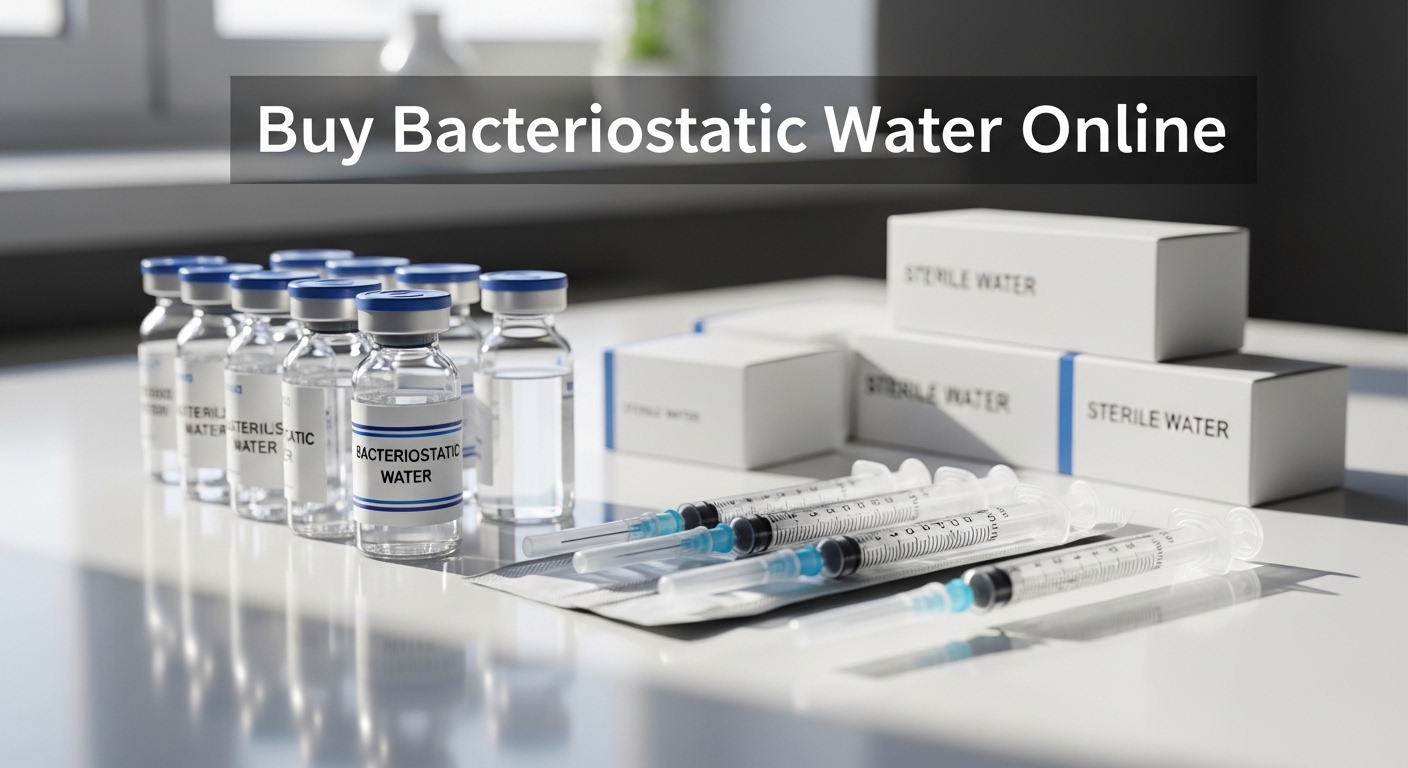
If you have tried to buy bacteriostatic water online in the last year, you have probably noticed something odd: the product everyone writes about is the hardest one to find. Thirty-plus searches across major marketplaces turned up humidifier additives, empty cosmetic bottles, peptide storage cases, and laboratory water stamped for research use only. Not one genuine Hospira 30 mL multiple-dose vial containing 0.9% benzyl alcohol. This guide explains that shortage, then works with what is actually purchasable today.
What follows is a desk-research roundup rather than a test report. We compared manufacturer labelling, checked live listings and review counts on a stated date, read the packaging and category data Amazon publishes for each item, and cross-checked what buyers actually report in peptide communities. Prices move constantly in this category, so every listing below should be treated as a starting point for your own comparison rather than a quote.
Two things are worth saying up front. First, this is a research and educational page, not medical advice, and nothing here should guide how you handle prescription injectable medication. Second, we are not going to dress up a glass bottle of plain water as something it is not. Several picks in this roundup are sterile water, empty vials, syringes, alcohol pads, or a disposal container, and each is labelled honestly. Only one listing in the whole set states 0.9% benzyl alcohol on the product page, and we tell you which one.
ContentsTable of Contents
- 1Top 3 Picks for 2026→
- 22-Pack 30 mL Reconstitution Water→
- 33-Pack With 0.9% Benzyl Alcohol Stated→
- 4B-Braun Sterile Water, 1 L→
- 5Quick Comparison: Where to Buy Bacteriostatic Water Online in 2026→
- 6What Is Bacteriostatic Water?→
- 71. 2-Pack 30 mL Reconstitution Water – Best Overall 30 mL Option→
- 82 Pack 30ml, Premium Glass Bottle→
- 9Pros→
- 10Cons→
- 11Check the physical label before you rely on it→
- 12When to choose a different pick→
- 132. 3-Pack Naming 0.9% Benzyl Alcohol – Best Value per mL→
- 14Nootlyn 3 Pack 30ml, Premium Glass Bottle→
- 15Pros→
- 16Cons→
- 17Why the chemistry claim matters more than the review count→
- 18When three reviews is too few→
- 193. 30 mL Deionized Water Single Vial – The No-Preservative Contrast→
- 2030ML-1Pack Ultra Pure Deionized Water→
- 21Pros→
- 22Cons→
- 23When a single-use vial is the right answer→
- 24Why this is not a cheap Hospira replacement→
- 254. B-Braun Sterile Water, 1 L – Top Rated and the Only Real Manufacturer→
- 26Sterile Water, 1000ml→
- 27Pros→
- 28Cons→
- 29The 24-hour rule and why it is not flexible→
- 30When this is the pick you want→
- 315. SurgiMac Sterile Water for Irrigation – Budget Reference Point→
- 32SurgiMac Sterile Water for Irrigation Pour Bottle (250 mL)→
- 33Pros→
- 34Cons→
- 35How to use this product honestly→
- 36Why it is in the roundup anyway→
- 376. Ks-Tek 10-Pack Empty 30 mL Vials – Best Value Multipack→
- 38Ks-Tek Sterile Empty Vials with Self Healing Injection Port,with Flip Off Aluminum Cap,Sterile Package (30ml,10)→
- 39Pros→
- 40Cons→
- 41When aliquoting and decanting is what you are doing→
- 42Where the line is, and why it exists→
- 437. 1 mL 29G Syringes, 100 Pack – Best Companion Supply→
- 441ML Syringe, Lab Supplies Syringes 29G 5/16 Inch, Individually Wrapped, Pack of 100→
- 45Pros→
- 46Cons→
- 47Why the needle gauge is not a detail→
- 48When a hundred-count pack is the wrong maths→
- 498. U-100 30G Syringes, 20 Pack – Best Value Supporting Supply→
- 5020 Pack U-100 1ML with 30 Ga 1/2 Inch,Individually Sealed Diameter 0.3mm/0.011Inch→
- 51Pros→
- 52Cons→
- 53Matching gauge to vial size→
- 54Why there is no genuine reconstitution kit on Amazon→
- 559. Alcohol Prep Pads, 100 Count – Best Sterile Skin Prep→
- 56Alcohol Wipes for Injections – 100 Sterile Alcohol Prep Pads, Large Swabs→
- 57Pros→
- 58Cons→
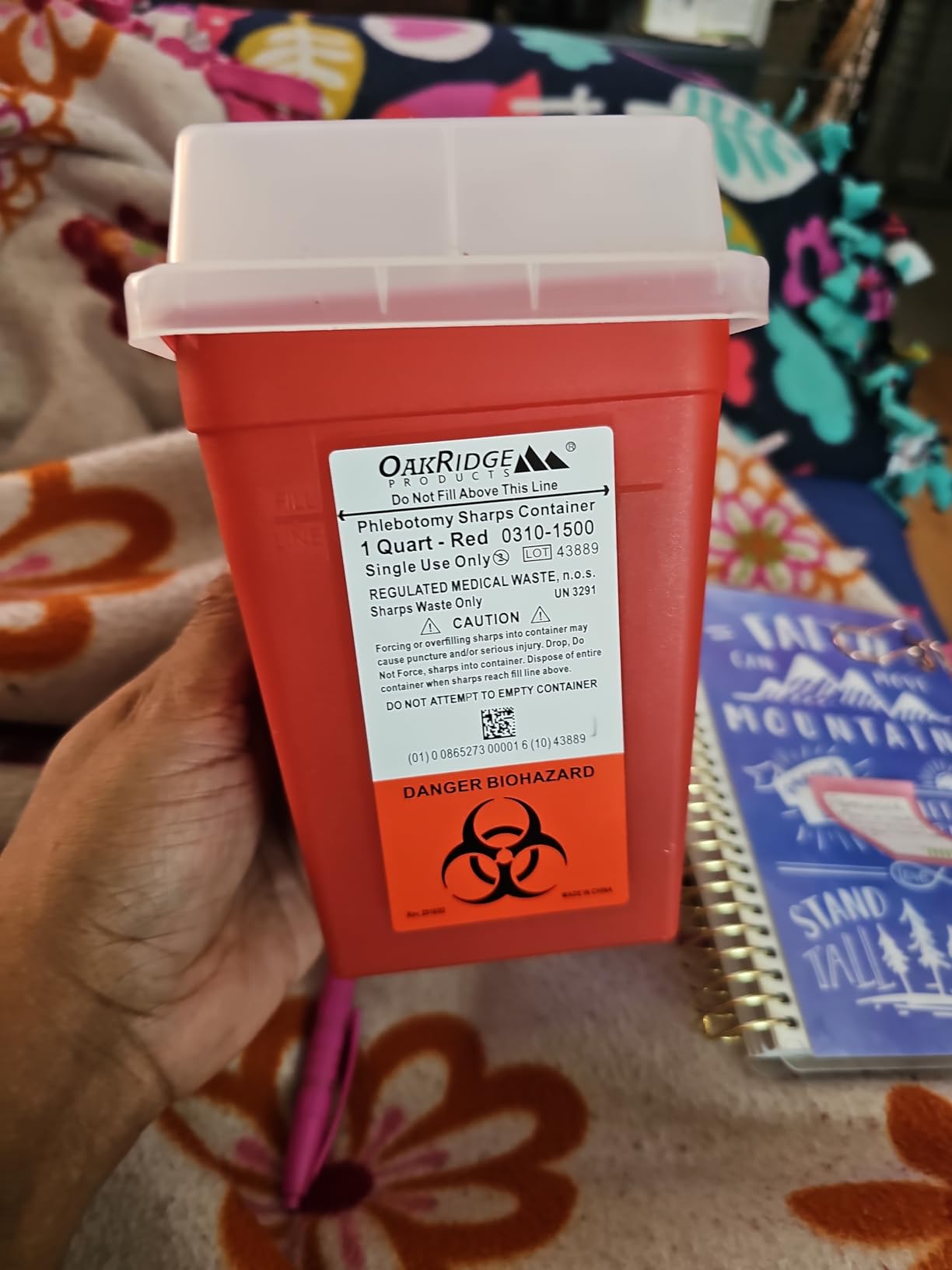
- 59The correct order of operations for skin prep→
- 60What alcohol pads do not do→
- 6110. Oakridge 1 Quart Sharps Container – Best Safety Pick→
- 62Oakridge Products Sharps Container for Home Use and Professional 1 Quart, Biohazard Needle and Syringe Disposal, Small Portable Container for Travel, CDC Certified→
- 63Pros→
- 64Cons→
- 65What disposal actually requires of you→
- 66The drawbacks reviewers actually report→
- 67Why Hospira Water Is Hard to Find in 2026→
- 68How to check live stock before you commit→
- 69What this means for what you should buy→
- 70How to Verify a Bacteriostatic Water Vial Is Real→
- 71The five-point label check→
- 72What no amount of labelling can tell you→
- 73Bacteriostatic Water vs. Sterile Water vs. Bacteriostatic Saline→
- 74The one rule that never changes→
- 75Storage, Refrigeration and Shelf Life→
- 76The two storage states at a glance→
- 77How many vials you actually need→
- 78Where Else to Buy Genuine Bacteriostatic Water→
- 79Pharmacies and prescription routes→
- 80What buyers worry about most, and why→
- 81Frequently Asked Questions→
- 82Where can I buy bacteriostatic water for injection?→
- 83Do I need a prescription for bacteriostatic water?→
- 84Is bacteriostatic water available over the counter?→
- 85Can I buy bacteriostatic water at CVS, Walgreens, or Walmart?→
- 86Why is Hospira bacteriostatic water hard to find?→
- 87Does bacteriostatic water need to be refrigerated?→
- 88Can I use sterile water instead?→
- 89How much bacteriostatic water do I actually need?→
- 90How can I tell if a bacteriostatic water vial is genuine?→
- 91Final Verdict: What to Buy and What to Skip→
Top 3 Picks for 2026
These three earned the top slots on evidence rather than on brand recognition: the strongest 30 mL reconstitution-water listing, the only listing that names its preservative concentration, and the only pick manufactured by a pharmaceutical company rather than a lab-supply seller.

2-Pack 30 mL Reconstitution Water
- 30 mL glass vial 2-pack
- Prime eligible
- 4.7 stars from 21 reviews
- Reviews confirm reconstitution use

3-Pack With 0.9% Benzyl Alcohol Stated
- Listing names 0.9% benzyl alcohol
- Lowest cost per mL in the set
- Reviewers confirm the formula
- Thick protective packaging
B-Braun Sterile Water, 1 L
- Named pharmaceutical manufacturer
- 4.7 stars from 207 reviews
- Blister-packed 1 L bottle
- The sterile-water comparator
As an Amazon Associate we earn from qualifying purchases. CERTAIN CONTENT THAT APPEARS ON THIS SITE COMES FROM AMAZON. THIS CONTENT IS PROVIDED 'AS IS' AND IS SUBJECT TO CHANGE OR REMOVAL AT ANY TIME.
Quick Comparison: Where to Buy Bacteriostatic Water Online in 2026
Every row below is a live marketplace listing, not a vendor website. Read the key features column carefully, because four of these ten products contain no bacteriostatic water at all. They are sterile water, empty vials, syringes, skin-prep pads, and a disposal container, and they are here because the reconstitution workflow needs them.
| # | Product | Key details | Where to buy |
|---|---|---|---|
| 1 | 2-Pack 30 mL Reconstitution Water |
|
Check Latest Price |
| 2 | 3-Pack Naming 0.9% Benzyl Alcohol |
|
Check Latest Price |
| 3 |  30 mL Deionized Water Single Vial 30 mL Deionized Water Single Vial |
|
Check Latest Price |
| 4 | B-Braun Sterile Water 1 L |
|
Check Latest Price |
| 5 |  SurgiMac Sterile Water for Irrigation SurgiMac Sterile Water for Irrigation |
|
Check Latest Price |
| 6 |  Ks-Tek 10-Pack Empty 30 mL Vials Ks-Tek 10-Pack Empty 30 mL Vials |
|
Check Latest Price |
| 7 |  1 mL 29G Syringes, 100 Pack 1 mL 29G Syringes, 100 Pack |
|
Check Latest Price |
| 8 |  U-100 30G Syringes, 20 Pack U-100 30G Syringes, 20 Pack |
|
Check Latest Price |
| 9 |  Alcohol Prep Pads, 100 Count Alcohol Prep Pads, 100 Count |
|
Check Latest Price |
| 10 |  Oakridge 1 Qt Sharps Container Oakridge 1 Qt Sharps Container |
|
Check Latest Price |
We earn from qualifying purchases. CERTAIN CONTENT THAT APPEARS ON THIS SITE COMES FROM AMAZON. THIS CONTENT IS PROVIDED 'AS IS' AND IS SUBJECT TO CHANGE OR REMOVAL AT ANY TIME.
What Is Bacteriostatic Water?
Bacteriostatic water is sterile, non-pyrogenic water for injection containing 0.9% benzyl alcohol as a preservative. That single addition is what separates it from plain sterile water, and it is the reason a 30 mL vial can be punctured repeatedly instead of thrown away after one use.
The mechanism is worth understanding because it sets hard limits. Benzyl alcohol disrupts cell membrane integrity and interferes with enzymatic replication in bacteria. It suppresses growth; it does not reliably kill what is already there, which is why the label language is bacteriostatic rather than bactericidal. A vial that already carries a heavy load has defeated the preservative before you ever touched it.
The 0.9% figure is a deliberate balance point rather than a round number chosen by habit. Higher concentrations of benzyl alcohol can interact with some lyophilised sequences and raise the risk of visible precipitation after reconstitution. Lower concentrations do not reliably suppress contamination. Most reconstitution guidance still assumes a 0.9% solution, so check what the vial actually says before you rely on a multi-dose window.
Common applications include reconstituting lyophilised peptides, diluting injectable hormones, and laboratory compound dissolution. The standard container is a 30 mL multiple-dose vial with a flip-off aluminum cap over a self-healing rubber septum.
1. 2-Pack 30 mL Reconstitution Water – Best Overall 30 mL Option
2 Pack 30ml, Premium Glass Bottle
- 30 mL glass reconstitution vial 2-pack
- Prime delivery
- 4.7 stars, 21 reviews
- Reconstitution use in buyer reviews
Pros
- Closest genuine 30 mL reconstitution-water listing available today
- Reviews confirm peptide-reconstitution use
- Two-pack improves cost per mL
- Prime eligible with strong recent sales
Cons
- Listing copy never states 0.9% benzyl alcohol
- Catalogued under cosmetic refill bottles
- Only 21 reviews and no customer photos
- No manufacturer name or NDC
- so no lot traceability
We earn a commission, at no additional cost to you. CERTAIN CONTENT THAT APPEARS ON THIS SITE COMES FROM AMAZON. THIS CONTENT IS PROVIDED 'AS IS' AND IS SUBJECT TO CHANGE OR REMOVAL AT ANY TIME.
Of everything we could actually purchase, this is the listing that comes closest to the article everyone expected. Two 30 mL glass vials, delivered through Prime, with enough buyer history to say something about it. The reviews are not generic five-star noise either; several buyers describe pulling the vial specifically for peptide reconstitution, which is the use case you care about.
The honest catch is on the product page itself. The listing title reads like a refillable glass bottle, which is roughly what Amazon’s category data says it is, and nowhere in the copy does it state a preservative concentration. That single missing sentence is why this sits at number one on availability and rating but cannot be called a substitute for a labelled 0.9% benzyl-alcohol vial.
There is also no named manufacturer, no NDC, and no lot number to photograph before you open the box. That matters more than the star rating. A lot number paired with an expiry date is what lets you trace a problem back to a batch, and without it you have no recourse if something is wrong.
Read the physical vial before you draw anything from it. If the label on the bottle names a concentration, record it. If the label says ultra-clean or sterile without a concentration, treat it as unpreserved and follow the single-use rule instead of the 28-day rule.
Check the physical label before you rely on it
Amazon listing copy and product photography are not the same as the printed label, and in this category the difference has decided real purchases. Zoom in on the bottle photo first, then confirm against the bottle that arrives.
Look for three specific things: a stated preservative concentration, a lot number, and an expiry date in the standard month and year format. A vial with all three is doing something meaningful. A vial with none is an unlabelled liquid in glass.
When to choose a different pick
Choose something else if preserving a multi-dose window matters to your workflow, since this listing gives you no documented basis for one. If you intend to draw from a vial over several weeks, an unpreserved liquid is the wrong purchase no matter how good the price looks.
Skip it as well if lot traceability is non-negotiable for your records, or if a cosmetic-category listing makes you uncomfortable on principle. The review base is also thin enough that a single bad batch would not show up in the average.
We earn a commission, at no additional cost to you. CERTAIN CONTENT THAT APPEARS ON THIS SITE COMES FROM AMAZON. THIS CONTENT IS PROVIDED 'AS IS' AND IS SUBJECT TO CHANGE OR REMOVAL AT ANY TIME.
2. 3-Pack Naming 0.9% Benzyl Alcohol – Best Value per mL
Nootlyn 3 Pack 30ml, Premium Glass Bottle
- 30 mL glass vials 3-pack
- Listing states 0.9% benzyl alcohol
- Lowest cost per mL in this set
- Reviewers confirm no sediment
Pros
- Only listing in the set that names 0.9% benzyl alcohol outright
- Lowest cost per mL of any pick here
- Reviewers independently confirm the formula
- Reported thick protective packaging with no breakage
Cons
- Only 3 reviews
- the thinnest evidence base of the water picks
- Not Prime eligible
- so slower shipping
- Thin review base means the claim rests on the seller's word
We earn a commission, at no additional cost to you. CERTAIN CONTENT THAT APPEARS ON THIS SITE COMES FROM AMAZON. THIS CONTENT IS PROVIDED 'AS IS' AND IS SUBJECT TO CHANGE OR REMOVAL AT ANY TIME.
This is the listing we would most want a chemist to read, because it is the only one that states its own chemistry. The product specification names 0.9% benzyl alcohol rather than leaving the buyer to infer it, and three separate reviewers independently confirm the concentration and report no sediment and no breakage in transit.
On a per-millilitre basis it is the cheapest genuine 30 mL water in this roundup by a wide margin, and that gap is large enough to notice. Three vials at that rate work out to several months of supply for someone using roughly one 30 mL vial every six to eight weeks.
Everything about the evidence here is thin, and we want to be direct about that. Three reviews is not a track record, the brand is not a pharmaceutical manufacturer, and no customer photos exist to cross-check the label against. The five-star average is three data points, not a consensus.
It is also not Prime eligible, which matters when the product is a sterile liquid arriving in glass. You are choosing a longer transit in exchange for the only documented concentration in the set, and glass plus slower shipping is a combination that occasionally arrives damaged.
Why the chemistry claim matters more than the review count
A stated preservative concentration is a falsifiable claim you can check against the bottle in your hand. A five-star average is not. When the two conflict, trust the label and treat the rating as noise from a very small sample.
That is also why this pick appears above the better-reviewed listings in the ranking. The reviews are there to corroborate the formulation, not to carry it.
When three reviews is too few
If you are buying for someone else, for a clinic, or for any purpose where a documentation trail exists, three reviews will not satisfy a records check. In that situation the same money spent on a pick from a named pharmaceutical manufacturer is the defensible decision.
There is a practical middle ground too. Order one pack, read the label in full, and record what it says before you commit to the second.
We earn a commission, at no additional cost to you. CERTAIN CONTENT THAT APPEARS ON THIS SITE COMES FROM AMAZON. THIS CONTENT IS PROVIDED 'AS IS' AND IS SUBJECT TO CHANGE OR REMOVAL AT ANY TIME.
3. 30 mL Deionized Water Single Vial – The No-Preservative Contrast
30ML-1Pack Ultra Pure Deionized Water
- 30 mL single vial of deionized water
- No preservative present
- Prime eligible
- Lab-grade aqueous solution
Pros
- Standard 30 mL single-vial format matching the Hospira footprint
- Ultra-pure deionized base chemistry
- Prime eligible and ships fast
- Useful as a deliberate single-use contrast
Cons
- Deionized water
- NOT bacteriostatic
- with no benzyl alcohol at all
- No 28-day multi-dose window applies
- Only 2 reviews
- Generic multi-purpose labelling with no USP or injection statement
We earn a commission, at no additional cost to you. CERTAIN CONTENT THAT APPEARS ON THIS SITE COMES FROM AMAZON. THIS CONTENT IS PROVIDED 'AS IS' AND IS SUBJECT TO CHANGE OR REMOVAL AT ANY TIME.
This pick is here to make one point that no amount of marketing copy will make for you: the difference between preserved and unpreserved water is the whole ballgame. It is a 30 mL vial of ultra-pure deionized water in the exact format reconstitution users expect, and it contains no preservative whatsoever.
Deionized water is a sound base chemistry for a diluent. The problem is not purity, it is time. Without benzyl alcohol there is nothing suppressing growth once the container is open, so this is a single-use product. You use it once and you discard what remains.
That is why saving money by switching to an unpreserved 30 mL vial is false economy in any workflow involving repeat draws. You are not buying the same product cheaper, you are buying a different product with a shorter usable life and a higher real cost per reconstitution.
The evidence base is also the thinnest in the roundup at two reviews, and the listing uses multi-purpose language with no USP reference and no injection claim. Treat it as a lab-grade aqueous solution and nothing more.
When a single-use vial is the right answer
Single-use logic applies whenever you prepare one small amount and nothing will be drawn again, or when the material is sensitive to a preservative you would rather avoid. In those situations an unpreserved 30 mL vial is not a compromise, it is the correct choice.
It also applies when you are working from a genuinely sterile starting point and have no way to establish an aseptic multi-access routine.
Why this is not a cheap Hospira replacement
The two are not interchangeable and the reasoning is chemical rather than marketing. Benzyl alcohol is what makes a vial multi-dose; remove it and the 28-day refrigerated window disappears along with every safety assumption attached to it.
If you are currently planning around repeated withdrawals from a 30 mL bottle, this pick does not serve that plan. Buy a preserved vial from a documented source, or buy sterile water sized to single use.
We earn a commission, at no additional cost to you. CERTAIN CONTENT THAT APPEARS ON THIS SITE COMES FROM AMAZON. THIS CONTENT IS PROVIDED 'AS IS' AND IS SUBJECT TO CHANGE OR REMOVAL AT ANY TIME.
4. B-Braun Sterile Water, 1 L – Top Rated and the Only Real Manufacturer
Sterile Water, 1000ml
- Sterile water from B-Braun, a named manufacturer
- 1 L bottle, blister packed
- 4.7 stars from 207 reviews
- Clear bottle for monitoring volume
Pros
- Largest and strongest review base among the water picks
- Manufactured by a real pharmaceutical company
- Verifiable manufacturer rather than a relabelled lab supply
- Sterile water is the correct comparator for the diluent question
Cons
- Contains no benzyl alcohol
- so it is not bacteriostatic
- Carries a 24-hour in-use window rather than 28 days
- Not Prime eligible
- 1 L format is wound-care sized
- not reconstitution sized
We earn a commission, at no additional cost to you. CERTAIN CONTENT THAT APPEARS ON THIS SITE COMES FROM AMAZON. THIS CONTENT IS PROVIDED 'AS IS' AND IS SUBJECT TO CHANGE OR REMOVAL AT ANY TIME.
This is the pick that passes the authenticity checklist without argument. B-Braun is a named pharmaceutical manufacturer with a documented facility, which means the water has a traceable origin and a manufacturer whose regulatory footprint you can look up. Nothing else in the water-adjacent set offers that.
The support for it is also the deepest. Two hundred and seven reviews at 4.7 stars, with verified-purchase entries running through the past several months, gives you a picture of consistency over time rather than a snapshot. The bottle is clear so you can see the remaining volume, and it arrives individually blister-packed.
It is sterile water, not bacteriostatic water, and the two carry different rules. With no preservative in the bottle, opened sterile water carries a 24-hour in-use window. Refrigeration does not extend that window the way refrigeration underpins the 28-day multi-use rule for a preserved vial.
The litre format is wound-care and irrigation sized rather than reconstitution sized, and it is not Prime eligible. Neither point is disqualifying, but both mean it belongs in a clinic, a supply room, or a bulk sterile-water budget rather than next to a 30 mL reconstitution vial.
The 24-hour rule and why it is not flexible
Sterile water is single-use by definition once opened. There is no preservative doing work in the background, so the 24-hour window is the entire margin you get, and cooling the bottle does not convert it into a multi-dose product.
Plan single-use sterile water around the size you actually need. A 30 mL volume you will touch once and abandon for three weeks is waste you paid for in full.
When this is the pick you want
Choose this when documentation and manufacturer traceability matter more than multi-use convenience. Clinics, practices, and anyone filling a records requirement should start here, because the manufacturer name alone removes most of the anxiety buyers describe online.
Choose it too as the reference point for what a legitimate sterile water product looks like: named maker, printed lot and expiry, sealed container, and hundreds of reviews describing the same experience.
We earn a commission, at no additional cost to you. CERTAIN CONTENT THAT APPEARS ON THIS SITE COMES FROM AMAZON. THIS CONTENT IS PROVIDED 'AS IS' AND IS SUBJECT TO CHANGE OR REMOVAL AT ANY TIME.
5. SurgiMac Sterile Water for Irrigation – Budget Reference Point
SurgiMac Sterile Water for Irrigation Pour Bottle (250 mL)
- Sterile pour bottle, 250 mL
- Labeled FOR IRRIGATION, not injection
- SurgiMac medical supply manufacturer
- Prime eligible, 94 reviews
Pros
- Genuine branded medical supply from a real manufacturer
- Prime eligible
- the cheapest genuine sterile water here
- 94 reviews is well above a token review count
- 250 mL avoids duplicating the 1 L pick
Cons
- Labeled for irrigation and NOT for injection
- Distilled rather than water-for-injection grade
- Contains no preservative and is not bacteriostatic
- Never describe this product as an injectable diluent
We earn a commission, at no additional cost to you. CERTAIN CONTENT THAT APPEARS ON THIS SITE COMES FROM AMAZON. THIS CONTENT IS PROVIDED 'AS IS' AND IS SUBJECT TO CHANGE OR REMOVAL AT ANY TIME.
Take one thing from this listing and leave the rest: it is the cheapest genuine sterile water in the roundup and it is Prime eligible, which is genuinely useful for anyone trying to establish what sterile water costs per millilitre on a shelf.
The closure is well designed. A threaded screw cap sits over a recessed non-drip set port, so the pour stays clean without a stream of exposed liquid collecting around the neck. That design is why irrigation bottles are the format clinicians reach for when they want a controlled pour.
Now the part that cannot be softened. The label says for irrigation, not for injection, and the water is distilled rather than pharmaceutical-grade water for injection. There is a real regulatory and practical difference between the two, and it is the difference between something you can irrigate a wound with and something that went through a validated injectable process.
It also has no preservative. This is a single-use product with a 24-hour in-use window, and it is not bacteriostatic water under any definition.
How to use this product honestly
Use it for its stated purpose: topical cleansing, irrigation, rinsing, or any task where a controlled sterile pour is wanted. The 250 mL bottle with a set port is well suited to wound care and general clinic supply.
Do not carry it into a reconstitution workflow as a diluent. The label is the instruction, and the label says irrigation.
Why it is in the roundup anyway
Because price transparency needs a floor. Buyers comparing a 30 mL preserved vial against a large volume of sterile water need a real number from a real manufacturer, and this is the most credible low-cost one we could verify.
It is also a clean example of reading a label before buying, which is the single habit that prevents most of the mistakes buyers describe in peptide forums.
We earn a commission, at no additional cost to you. CERTAIN CONTENT THAT APPEARS ON THIS SITE COMES FROM AMAZON. THIS CONTENT IS PROVIDED 'AS IS' AND IS SUBJECT TO CHANGE OR REMOVAL AT ANY TIME.
6. Ks-Tek 10-Pack Empty 30 mL Vials – Best Value Multipack
Ks-Tek Sterile Empty Vials with Self Healing Injection Port,with Flip Off Aluminum Cap,Sterile Package (30ml,10)
- 10 sterile 30 mL glass vials per pack
- Self-healing septum, flip-off cap
- Steam sterilized, Type 1 borosilicate
- 4.5 stars from 1,583 reviews
Pros
- Strongest review base of any vial in the roundup
- Exact 30 mL size and septum matching Hospira geometry
- Ten vials for a fraction of single-vial cost
- Prime eligible and Amazon's Choice
Cons
- These vials are EMPTY
- containing no water and no drug
- Filling them is compounding and needs a sterile hood
- Lab-grade glass
- not a pharmaceutical diluent container
- Single-dose once punctured
- so no 28-day window applies
We earn a commission, at no additional cost to you. CERTAIN CONTENT THAT APPEARS ON THIS SITE COMES FROM AMAZON. THIS CONTENT IS PROVIDED 'AS IS' AND IS SUBJECT TO CHANGE OR REMOVAL AT ANY TIME.
A true 25-pack of preserved bacteriostatic water does not exist on any major marketplace right now, so this fills the gap that multipack buyers would otherwise fill with something worse. Ten empty 30 mL vials, steam sterilized, each one individually sterile packaged, in Type 1 borosilicate glass.
The geometry is the point. These match the 30 mL multiple-dose footprint: a self-healing rubber septum under a flip-off aluminum cap, exactly what a needle punctures when you draw from a standard reconstitution vial. If you are aliquoting a larger volume into smaller units, this is the container that behaves the way your equipment expects.
What you cannot do is treat it as a diluent. The vials are empty. There is no water, no preservative, and no drug inside them, and filling one in an ordinary room is compounding, which is a controlled process performed under a validated sterile hood by someone qualified to do it.
With 1,583 reviews behind it, this is also the best-evidenced item in the whole roundup, and the same pack is available in 3, 5, 10, 15, 20, 50, and 100 mL if you want to match the volume you actually aliquot.
When aliquoting and decanting is what you are doing
Splitting a bulk purchase into single-use units is the legitimate use for these vials. Each one is single-dose by nature, so the discipline is simple: fill under proper aseptic conditions, label with a date, and discard what is not used.
The ten-pack format also suits anyone who wants a small number of vials on hand rather than a 25-vial case they will not finish before expiry.
Where the line is, and why it exists
Amateur filling is the reason this category is regulated. Contamination introduced during filling is invisible in a clear vial, and the resulting liquid looks identical to a correctly prepared one.
There is also a drug-stability question that only a compounding pharmacist can answer, since most lyophilised peptides have their own storage requirements once liquid. Buying the containers does not solve either problem.
We earn a commission, at no additional cost to you. CERTAIN CONTENT THAT APPEARS ON THIS SITE COMES FROM AMAZON. THIS CONTENT IS PROVIDED 'AS IS' AND IS SUBJECT TO CHANGE OR REMOVAL AT ANY TIME.
7. 1 mL 29G Syringes, 100 Pack – Best Companion Supply
1ML Syringe, Lab Supplies Syringes 29G 5/16 Inch, Individually Wrapped, Pack of 100
- 1 mL capacity with 29G x 5/16 in needle
- 100 individually wrapped sterile syringes
- Leak-proof plunger, bold graduations
- 4.5 stars from 1,605 reviews
Pros
- Among the most-validated picks in the roundup
- Individually sterile wrapped
- which matters at every draw
- 29G x 5/16 in suits drawing from a self-healing septum
- Prime eligible at under $0.19 each
Cons
- Lab-supply syringe
- listed as not intended for professional medical use
- 100 syringes is far more than most readers need
- No needle guard or bacteriostatic pen included
- No customer photos available
We earn a commission, at no additional cost to you. CERTAIN CONTENT THAT APPEARS ON THIS SITE COMES FROM AMAZON. THIS CONTENT IS PROVIDED 'AS IS' AND IS SUBJECT TO CHANGE OR REMOVAL AT ANY TIME.
Water is one part of a reconstitution workflow and this is the part people forget until they are mid-protocol with nothing to draw with. A 1 mL capacity with a 29G by 5/16 inch needle is the standard configuration for reconstitution and withdrawal, and this pack holds one hundred of them.
The individually blister-wrapped detail is the one that matters. Every draw from a multi-dose vial punctures the septum, and the 28-day window assumes each puncture is clean. A fresh wrapped syringe per draw is the physical expression of that assumption, and a loose bulk syringe cannot offer it.
Read the listing description carefully before you buy, because the honesty here matters. It is a lab-supply syringe and it says explicitly that it is not intended for professional medical use. If your workflow has any clinical or documentation component, this is not the correct syringe for it.
One hundred is also a lot. Most people drawing from a single 30 mL vial over a two-month window will use a small fraction of that, and unused syringes do not improve with age. Twenty-five or fifty is the rational buy for most readers, which is why the next pick is on this list.
Why the needle gauge is not a detail
Gauge is the diameter of the bore, and a smaller gauge means a narrower needle that causes less tissue trauma and suits small-volume reconstitution draws. Twenty-nine gauge is a common default for drawing from a standard 30 mL vial with a self-healing septum.
For smaller 3 mL to 10 mL vials, a 31G needle is often the better fit. Several gauge and length variants of this product exist, and the listing confirms the one here is 29G by 5/16 inch.
When a hundred-count pack is the wrong maths
Count your actual draws before you buy. A 30 mL vial reconstituted at a typical volume produces a small number of doses, and the community consensus is closer to one vial every six to eight weeks for a modest protocol.
That works out to well under a hundred draws. Buy the smaller pack, keep it sealed, and you will spend less and keep a fresher supply.
We earn a commission, at no additional cost to you. CERTAIN CONTENT THAT APPEARS ON THIS SITE COMES FROM AMAZON. THIS CONTENT IS PROVIDED 'AS IS' AND IS SUBJECT TO CHANGE OR REMOVAL AT ANY TIME.
8. U-100 30G Syringes, 20 Pack – Best Value Supporting Supply
20 Pack U-100 1ML with 30 Ga 1/2 Inch,Individually Sealed Diameter 0.3mm/0.011Inch
- 1 mL U-100 with integrated 30G needle
- 20 individually sealed syringes
- Available in 29G, 30G and 31G
- 4.7 stars from 391 reviews
Pros
- Strong review base at 391 reviews and 4.7 stars
- Individually sealed
- Prime eligible with high recent sales volume
- Under $10
- so it ships alongside the water
- 30G suits drawing from a 30 mL reconstitution vial
Cons
- A standalone supply
- not a bundled kit
- One reviewer finds the 30G needle thicker than expected
- Gauge and needle length are buyer choices
- No customer photos available
We earn a commission, at no additional cost to you. CERTAIN CONTENT THAT APPEARS ON THIS SITE COMES FROM AMAZON. THIS CONTENT IS PROVIDED 'AS IS' AND IS SUBJECT TO CHANGE OR REMOVAL AT ANY TIME.
This is the pick for readers who do not want a hundred-count box. Twenty U-100 insulin syringes with an integrated 30G by half-inch needle, individually sealed, Prime eligible, and backed by 391 reviews at 4.7 stars.
Thirty gauge on a half-inch needle is a sensible default for drawing from a 30 mL reconstitution vial, and the same product is offered in 29G and 31G so you can match the guidance to your vial size. The 1 mL U-100 barrel is the format reconstitution use assumes.
Twenty is a genuinely better number than a hundred for most people. It fits inside the 28-day window of a single preserved vial, which means the syringes you own are roughly the same age as the water you use them with. That alignment is a small but real advantage.
One reviewer notes the 30G needle feels a little thicker than expected, which is normal for anyone moving up from a thinner 31G. If needle feel is a factor for you, go to the 31G variant for small-volume work.
Matching gauge to vial size
The rule of thumb is straightforward. Thirty to thirty-one gauge for small vials in the 3 mL to 10 mL range, where you want minimal dead space, and around 29G to 30G with a longer needle for a 30 mL bottle where the septum sits deeper.
Buying both variants is the practical route. The listing covers 29G, 30G, and 31G, so a single order can cover the whole size range you might encounter.
Why there is no genuine reconstitution kit on Amazon
Searches for a pre-bundled kit return loose sterile vials and syringes sold separately, with no water component meeting a genuine standard. Presenting the workflow as assembled parts is therefore the honest description rather than a workaround.
Building the kit yourself also lets you choose each component on its own merits, which is what this whole roundup is for. Water in one box, vials in another, syringes in a third, and disposal when you are finished.
We earn a commission, at no additional cost to you. CERTAIN CONTENT THAT APPEARS ON THIS SITE COMES FROM AMAZON. THIS CONTENT IS PROVIDED 'AS IS' AND IS SUBJECT TO CHANGE OR REMOVAL AT ANY TIME.
9. Alcohol Prep Pads, 100 Count – Best Sterile Skin Prep
Alcohol Wipes for Injections – 100 Sterile Alcohol Prep Pads, Large Swabs
- 70% isopropyl alcohol, individually wrapped
- 100 large injection-size pads
- 4.8 stars from 1,772 reviews
- Available in 100 to 1,000 count
Pros
- Largest review base among the water-adjacent picks
- Explicitly positioned for injection skin prep
- Individually wrapped
- matching fresh-swatch discipline
- Under $7 for a full box
Cons
- Generic medical-supply brand
- not a named sterile manufacturer
- One verified review reports four packets with alcohol but no pad
- No customer photo reviews exist for this listing
- Skin prep only
- not a substitute for hand hygiene
We earn a commission, at no additional cost to you. CERTAIN CONTENT THAT APPEARS ON THIS SITE COMES FROM AMAZON. THIS CONTENT IS PROVIDED 'AS IS' AND IS SUBJECT TO CHANGE OR REMOVAL AT ANY TIME.
Injection technique starts before the needle does, and this is the step people skip. Seventy percent isopropyl alcohol, individually wrapped, one hundred large pads per box, rated 4.8 stars across 1,772 reviews with more than ten thousand boxes sold in the past month alone.
The size matters more than it sounds. These are injection-prep pads, not fingernail-swab sized. A swab that is too small leaves the edges of an injection site untreated, and the edges are where surface contamination lives.
Individually wrapping matters for the same reason individually wrapped syringes do. One swab per site, per session, and never a swab that has been anywhere else. It is a cheap discipline that costs a fraction of a dollar and removes a whole category of avoidable risk.
One verified review reports receiving four packets that contained alcohol but no pad, which is worth mentioning because it is exactly the sort of defect that a large review count does not catch. Check the first packet when the box opens rather than assuming the rest match it.
The correct order of operations for skin prep
Clean the site, let it dry fully, and only then inject. Wiping and immediately injecting traps the alcohol under the skin rather than evaporating it, which causes irritation and defeats the purpose of the clean.
Use a new swab every time. Reusing a swab across sites or across sessions is the practice that converts a safety step into a liability.
What alcohol pads do not do
They do not make a contaminated vial clean, and no amount of skin prepping compensates for a vial that was handled badly. Your vial handling and your skin prep are two separate controls, and both have to hold.
They are also not a hand-hygiene substitute. Wash or sanitise your hands before you touch anything, then use the pad for the site only.
We earn a commission, at no additional cost to you. CERTAIN CONTENT THAT APPEARS ON THIS SITE COMES FROM AMAZON. THIS CONTENT IS PROVIDED 'AS IS' AND IS SUBJECT TO CHANGE OR REMOVAL AT ANY TIME.
10. Oakridge 1 Quart Sharps Container – Best Safety Pick
Oakridge Products Sharps Container for Home Use and Professional 1 Quart, Biohazard Needle and Syringe Disposal, Small Portable Container for Travel, CDC Certified
- CDC-certified 1 quart biohazard container
- Needle unwinder port and cap holder
- Clear lid with a visible fill line
- 4.7 stars from 15,292 reviews
Pros
- Largest review base in the roundup by an order of magnitude
- The only pick here with genuine customer-submitted photos
- CDC certification and OSHA and EPA compliance
- One-handed re-capping design
- Verified reviewers use it for at-home injectable disposal
Cons
- Disposal is a legal responsibility
- not just a purchase
- Some reviewers find the slide lid feels cheap
- A few international buyers reported missing lids
- Not a reconstitution input and adds nothing to the liquid
We earn a commission, at no additional cost to you. CERTAIN CONTENT THAT APPEARS ON THIS SITE COMES FROM AMAZON. THIS CONTENT IS PROVIDED 'AS IS' AND IS SUBJECT TO CHANGE OR REMOVAL AT ANY TIME.
Both syringe picks in this roundup tell you to use a fresh sterile syringe for every draw, which is where most of the safety argument lives. Nothing answered the question that comes next: where does the used syringe go. Loose sharps in household rubbish is both a safety problem and, in many jurisdictions, a legal one.
This is a CDC-certified one-quart container rated for puncture and impact resistance, and the design is built around the moment of disposal rather than the storage. A slide-access opening with a built-in holder lets you re-cap a used needle one-handed, and a separate port unwinds it from the syringe so the sharp never travels by hand.
The clear lid carries a visible fill line, which matters more than it sounds. An overfilled sharps container is one that cannot be closed properly, and a container that cannot be closed is a container that gets put on the counter instead of being sealed.
With 15,292 reviews at 4.7 stars, this has more real-world history behind it than anything else we looked at, and it is the one product in the entire roundup with genuine customer-submitted photographs. The images show real units in real homes, which is more informative about this category than a studio render ever is.
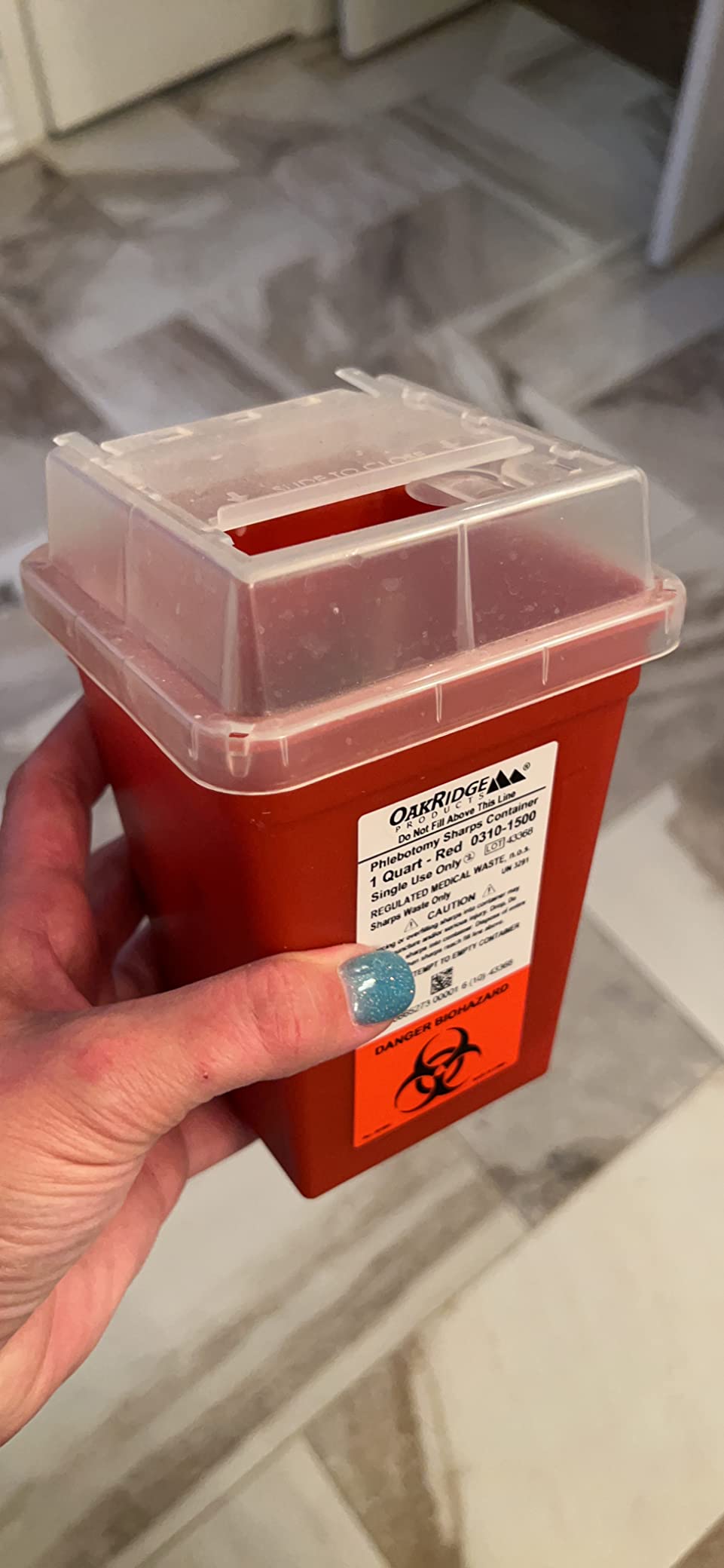
Certification and compliance are concrete here rather than decorative. The container is stated to meet or exceed OSHA and EPA requirements for local biohazard waste collection, and several configurations qualify for FSA or HSA reimbursement, which is worth checking against your plan before you pay full price.
Verified reviewers describe it as their standing container for disposing of at-home injectable medication, and the recurring comments are practical rather than promotional: it holds a sensible number of draws, the lid shuts properly once full, and the unwinder port does what it claims.
What disposal actually requires of you
Buying the container is the easy half. Local rules on sealing, transporting, and discarding a filled sharps container vary by state and by country, and in some places a specific approved mail-back program is required rather than household disposal.
Check your local public health or waste authority guidance before you fill anything. The container gives you a compliant way to store sharps; it does not decide what happens to them next.
The drawbacks reviewers actually report
The most common criticism is that the slide lid feels inexpensive, which is a reasonable complaint at this price point. A small number of international buyers reported receiving units with the lid missing, so inspect the package on arrival and confirm the parts are there.
Remember that no mail-back service is included with the purchase. If your area requires one, budget for that separately rather than assuming the container covers it.
We earn a commission, at no additional cost to you. CERTAIN CONTENT THAT APPEARS ON THIS SITE COMES FROM AMAZON. THIS CONTENT IS PROVIDED 'AS IS' AND IS SUBJECT TO CHANGE OR REMOVAL AT ANY TIME.
Why Hospira Water Is Hard to Find in 2026
The reason this article cannot simply recommend a Hospira 30 mL vial is the single most useful thing we can tell you. It is not a matter of picking a better search term or a better marketplace. Genuine Hospira bacteriostatic water in 30 mL multiple-dose vials is currently subject to an allocation constraint and backorder, and the effect is visible across the supply chain.
What that means in practice is a change in how shortages work. Instead of a product disappearing from shelves and returning when restocked, manufacturers and distributors allocate limited quantities across customers. A medical supplier that historically carried cases of these vials may be able to offer only partial quantities, and a supplier that always had stock may now show none. One well-known bacteriostatic water retailer documented a specific medical supplier’s Hospira 30 mL as backordered during the current constraint.
This is why search results look so strange. Query a marketplace for bacteriostatic water and you get humidifier treatments, peptide storage cases, empty glass bottles, and laboratory water labelled for research use only. Some of those are irrelevant. Others appear in search results precisely because they contain the words, not the substance.
It also explains a community observation that seemed like a conspiracy to some readers: major listings apparently vanishing from marketplaces, and payment processors shutting vendors down without notice. Both are consistent with a constrained, tightly regulated supply chain rather than a demand story.
How to check live stock before you commit
Ask the supplier directly whether the specific lot and quantity you need is in stock, and get the answer in writing before you pay. During an allocation, a listing page showing a price is not evidence that a unit is available to you.
Ask which labeler and manufacturer will ship the product, and ask for the lot number and expiry range in advance. A supplier that cannot name a manufacturer for bacteriostatic water is telling you something you need to know before you spend money.
What this means for what you should buy
It means the generic and unbranded options are having a moment, and it also means the gap between a documented preserved vial and a plain glass bottle has never been more important to check. The chemistry has not changed; the availability has.
If you genuinely need Hospira-labelled product, the realistic routes are a pharmacy with a prescription, a licensed compounding pharmacy, or a medical distributor that can account for its stock. If you can work with a preserved vial from another manufacturer, read the label and verify the concentration yourself.
How to Verify a Bacteriostatic Water Vial Is Real
Legitimacy, not price, is the question people actually bring to this category. Nearly every thread on the subject is titled around whether a source is real, and the reason is straightforward: the failure mode is a bottle of clear liquid that looks exactly like the good version.
Start with the manufacturer. Hospira, now part of Pfizer, uses the 0409 labeler series in its NDC, so an NDC beginning 0409 on a Hospira-labelled product is consistent. Fresenius Kabi and Hikma are the other named manufacturers worth recognising in this category. An anonymous research-lab brand with no facility designation is a different proposition entirely.
Then check the numbers. A lot number and an expiry date should appear together, both legible, in the standard format. They should not be printed on a sticker added after manufacture, and the label typography should match the rest of the label rather than looking pasted on.
Finally, read what the label claims. One forum user received a bottle whose label said only that the contents were ultra-clean, not that they were sterile. That is a meaningful distinction: ultra-clean is not a sterility claim, and a product that avoids making one is telling you something.
The five-point label check
- Named manufacturer with an identifiable facility, not an anonymous research-lab brand.
- NDC on the label, with a 0409 prefix consistent with Pfizer and Hospira products.
- Lot number and expiry date printed together, both legible and matching.
- An explicit sterility statement, not vague language like ultra-clean or pharmaceutical grade.
- A stated preservative concentration, 0.9% benzyl alcohol for bacteriostatic water.
If a listing photograph and the bottle that arrives disagree on any of those five points, the bottle wins. Listing copy is written by sellers; the printed label is the controlled document.
What no amount of labelling can tell you
None of this proves sterility. A label check tells you who made the product and what they claimed about it, which is meaningful but not the same as a sterility test. Container closure integrity and validated manufacturing are what actually establish sterility, and you cannot see either from the outside.
This is also why the visual check below matters as a warning signal rather than a guarantee. Cloudiness, particulate, colour change, or sediment after preparation tells you to discard. A clear vial tells you almost nothing.
Bacteriostatic Water vs. Sterile Water vs. Bacteriostatic Saline
Sterile water and bacteriostatic water get confused constantly, including at the pharmacy counter, and bacteriostatic saline is a third thing again. The differences are short once you see them side by side.
The preservative is the whole distinction. Bacteriostatic water is 0.9% benzyl alcohol in sterile water, and that preservative is what supports a 28-day multiple-use window under USP . Sterile water has no preservative and carries a 24-hour in-use window once opened, with refrigeration not extending it.
Bacteriostatic saline is the same preservation idea applied to 0.9% sodium chloride rather than to plain water. The salt content changes the ionic environment, which affects how some materials dissolve and how stable they stay in solution. A saline flush sold for intravenous lines is a different product from a bacteriostatic diluent and should not be substituted for one.
One safety note belongs here specifically. Benzyl alcohol has been associated with gasping syndrome in low-weight premature neonates, which is why sterile water without preservative is the mandated diluent in neonatal and many pediatric settings. Any benzyl-alcohol-containing product is the wrong choice in those contexts regardless of how convenient it is.
The one rule that never changes
Unpreserved water is single-use, and preserved water is multi-use within its window. Mixing those two assumptions is the mistake behind most of the safety questions we see, and it is worth deciding which category your product falls into before you open it.
That decision comes from the label, not from the bottle shape, the volume, or the listing title.
Storage, Refrigeration and Shelf Life
Storage guidance for this category is where a lot of published advice is wrong, so here is the version anchored to the standard rather than to habit. There are two states, and they have different rules.
Unopened, follow the package insert. Controlled room temperature, roughly 20 to 25 degrees Celsius, applies to sealed product, and unopened stock is good until the printed expiry date, typically two or more years from manufacture. Protect it from light and do not freeze it.
After first puncture, the picture changes. The 28-day multiple-use window is a beyond-use date defined under USP , and that window is anchored to refrigerated storage at 2 to 8 degrees Celsius. A vial kept at room temperature after opening is not operating inside the conditions the window assumes. Write the date of first access on the vial and count from that date, not from when you ordered it.
Two things people consistently get wrong are worth separating out. The first is that refrigeration is unnecessary after opening. It is not optional under the standard the 28-day rule comes from. The second is that a vial which looks clear is clean. Visual clarity is not a sterility test, and contamination can reach levels that change nothing you can see.
What you can see is still useful as a discard signal. Cloudiness, suspended particulate, colour change, or sediment appearing after reconstitution all mean stop and discard. Sediment in particular can indicate an incompatibility between the preservative and the material you added, and using that solution is not a risk worth taking.
The two storage states at a glance
Sealed and unopened means controlled room temperature until the printed expiry, and refrigeration is not part of the instruction. Opened and punctured means refrigerated at 2 to 8 degrees Celsius with a 28-day clock that starts at first access for a true 0.9% benzyl-alcohol vial.
Unopened sterile water behaves like any unopened product. Opened sterile water has no preservative behind it and gets 24 hours, not 28 days, and chilling it does not change that number.
How many vials you actually need
Community reports are consistent on this: one 30 mL vial covers roughly six to eight weeks for a modest protocol. That is the number that should govern your order, and it is the reason buying a 25-vial case is usually a mistake rather than a saving.
Buy what you will use before the expiry date, keep the rest sealed, and let unopened stock sit at room temperature until you need it.
Where Else to Buy Genuine Bacteriostatic Water
Because the branded product is constrained on marketplaces right now, the named specialist suppliers remain the more realistic route to documented Hospira stock. These are suppliers rather than products, so they are kept separate from the ranked picks above.
Farris Laboratories is a long-standing supplier of medical and laboratory stock and has historically carried Hospira bacteriostatic water with a sample pack for first-time buyers. During the current supply constraint its Hospira 30 mL has been reported as backordered, so confirm availability before you rely on it.
BacteriostaticWater.com is a dedicated supplier based in Fort Worth, Texas, selling Hospira and Henry Schein product alongside complete injection bundles that combine water, syringes, alcohol pads, and empty sterile vials. Bundles are the practical option when you want the whole workflow in one shipment.
Atlantic Med Supply has traded since 1997 and runs buy-more-save-more tiers on vial purchases with free USPS shipping on vial orders. BactWater.com competes on the purchasing experience, with cleaner checkout, educational material, and flexible payment options, at a slightly higher single-vial price and a higher free-shipping threshold.
Mountainside Medical Equipment is the professional route, carrying Hospira product at strong bulk pricing but requiring a prescription or medical licence, which puts it out of reach for individual buyers. MedExSupply sells case quantities for regular users and practices. Community reports put a 25-vial Hospira case in the low hundreds, so treat older bulk figures as dated and confirm the live price.
Pharmacies and prescription routes
Bacteriostatic water is a prescription item in the United States, so retail pharmacies including CVS, Walgreens, and Walmart can supply it against a valid prescription, subject to their own stock. A licensed compounding pharmacy is the other professional route and can also prepare an appropriately preserved formulation to a specification.
GoodRx belongs in that sentence rather than in any supplier list. It is a coupon comparison tool that requires a valid prescription, not a supplier and not a product, and its prices only apply once you have one.
What buyers worry about most, and why
The recurring concern in peptide communities is sourcing transparency. The question is not whether a cheap vial exists, it is whether the seller can say where the vial came from and who filled it. Suppliers that name the manufacturer, the lot, and the facility earn trust; vague premium-grade marketing language actively costs it.
That is the standard worth applying everywhere on this page, including to the ten picks above. A listing that will not name what is in the bottle is telling you something worth hearing before you order.
Frequently Asked Questions
Where can I buy bacteriostatic water for injection?
In the United States the prescription route is through a retail pharmacy such as CVS, Walgreens, or Walmart, or through a licensed compounding pharmacy, with a valid prescription. Research-supply equivalents are sold without a prescription, but check the label for an explicit sterility statement and a stated preservative concentration. On marketplaces the branded Hospira 30 mL vial is currently allocation-constrained, so specialist medical suppliers and distributors are the more realistic source right now.
Do I need a prescription for bacteriostatic water?
Hospira Bacteriostatic Water for Injection is prescription-only in the United States, so retail pharmacy purchases require a valid prescription. Items sold without a prescription are generally research-supply equivalents or lab-grade formulations, and those may carry no sterility claim at all. Read the label before use: if it says ultra-clean rather than sterile, or states no preservative concentration, treat it as an unpreserved product.
Is bacteriostatic water available over the counter?
Not the genuine prescription product. What circulates without a prescription is usually research-use or lab-grade water, which is frequently labelled for research use only and not for human or animal consumption or injection. Occasionally a listing says ultra-clean instead of sterile, which is not a sterility claim. The distinction matters most for multi-use, so an unpreserved bottle gets a single use rather than a 28-day window.
Can I buy bacteriostatic water at CVS, Walgreens, or Walmart?
These pharmacies can supply it against a valid prescription, and stock varies by location. Prescription coupon tools such as GoodRx can be used to compare local pharmacy pricing, but GoodRx is a comparison service rather than a supplier and requires the prescription. Without a prescription you are looking at research-supply equivalents or a specialist medical supplier, with the labelling caveats above.
Why is Hospira bacteriostatic water hard to find?
Supply of the branded 30 mL vial has been constrained by an allocation and backorder situation. During an allocation, stock is distributed in limited quantities across customers rather than simply restocked when it runs out, so a long-established medical supplier may show partial or no stock. That is why marketplace searches for the words return humidifier additives, empty vials, and laboratory water rather than the product you want.
Does bacteriostatic water need to be refrigerated?
It depends on the state of the vial. Unopened, follow the package insert, which is controlled room temperature around 20 to 25 degrees Celsius, and the product is good until its printed expiry. After first puncture, the 28-day multiple-use window is a beyond-use date under USP anchored to refrigerated storage at 2 to 8 degrees Celsius, so refrigeration is part of the rule rather than an optional extra. Record the date of first access and count from that date.
Can I use sterile water instead?
Only in situations that suit single use. Sterile water has no preservative, so it carries a 24-hour in-use window once opened, and refrigeration does not extend that. Use it when you are preparing a single amount with no repeat draws. For anything involving multiple withdrawals from one vial, you need a preserved 0.9% benzyl-alcohol product, and in neonatal and many pediatric contexts sterile water is the mandated diluent because benzyl alcohol has been linked to gasping syndrome in low-weight premature infants.
How much bacteriostatic water do I actually need?
Most people go through roughly one 30 mL vial every six to eight weeks for a modest protocol, which is why a single vial or a two or three pack is usually the right order. A 25-vial case is generally over-buying and risks stock going past its expiry before use. Note also that small vial sizes are frequently more expensive per millilitre than the 30 mL format, so the cheapest headline price is often not the cheapest per millilitre.
How can I tell if a bacteriostatic water vial is genuine?
Check five things on the label. Look for a named manufacturer with an identifiable facility rather than an anonymous research-lab brand, an NDC on the label with a 0409 prefix consistent with Pfizer and Hospira products, a lot number printed together with an expiry date, an explicit sterility statement rather than vague wording, and a stated preservative concentration of 0.9% benzyl alcohol. Keep in mind that none of this proves sterility, and that a clear vial is not a sterility test.
Final Verdict: What to Buy and What to Skip
No single pick in this roundup replaces Hospira-labelled bacteriostatic water, and any article that says otherwise is selling you something. What the ten products do is give you a complete, honestly labelled workflow assembled from what is actually purchasable today.
For water itself, the 2-pack 30 mL reconstitution listing is the most usable option with a real review base, and the 3-pack that states 0.9% benzyl alcohol is the only one whose chemistry is documented on the page. For anything you can verify rather than infer, B-Braun sterile water is the pick, with a named manufacturer behind it. For the parts around the water, the 20-count 30G syringes, the alcohol prep pads, and a CDC-certified sharps container cover the workflow from reconstitution to lawful disposal.
And if you need the branded product specifically, buy bacteriostatic water online through a pharmacy with a prescription, a compounding pharmacy, or a named medical supplier who can tell you the lot and the manufacturer before you pay. Verify the label, keep the opened vial refrigerated, count 28 days from first access, and discard anything that clouds or precipitates.
Disclaimer: This article is for informational and research purposes only and is not medical advice. It does not authorise the purchase, storage, or use of any injectable medication or diluent. Always work with a licensed healthcare provider and follow the labelling for the specific product you are handling.