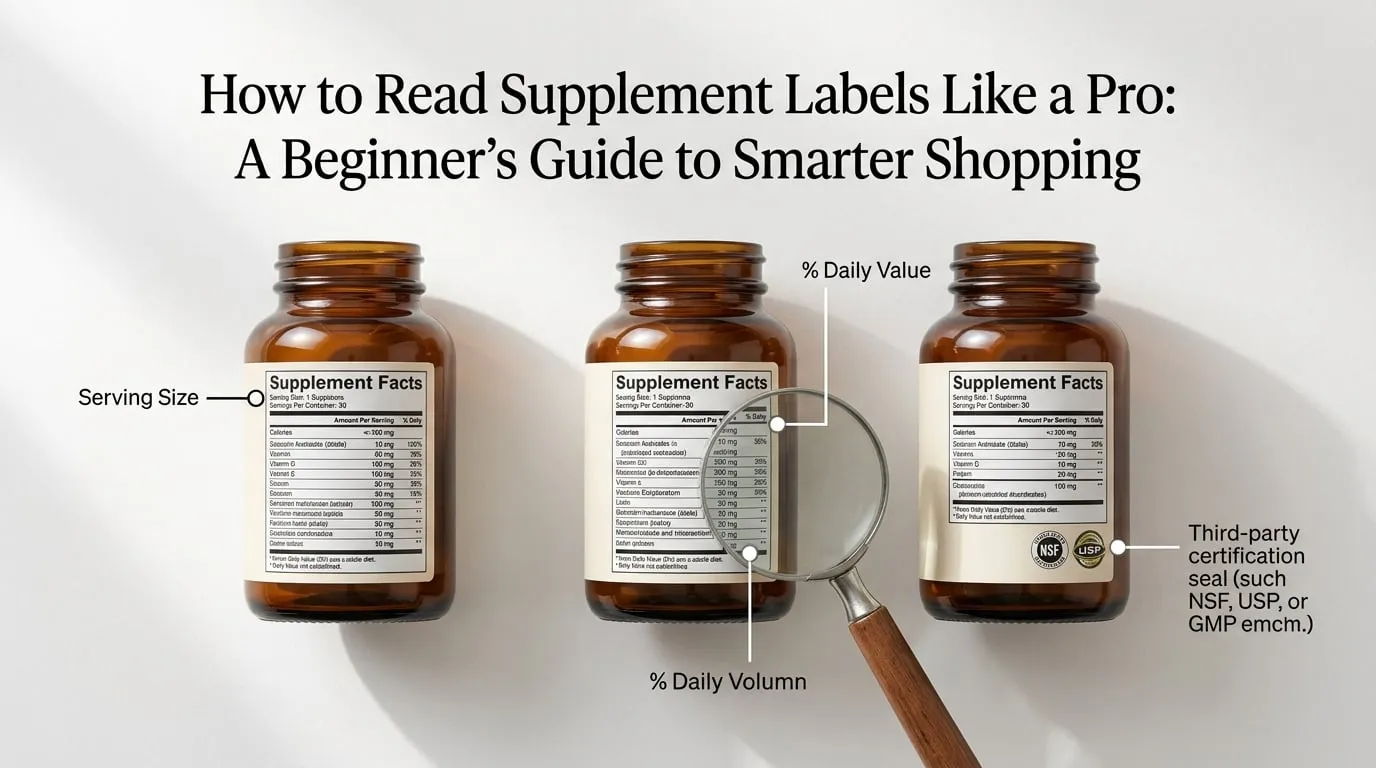
If you’ve ever stood in the supplement aisle, twisted a bottle around in your hands, and felt like you were reading a foreign language, you’re not alone. Learning how to read supplement labels is the single fastest way to stop wasting money on weak products and start buying supplements that actually do what they promise.
I’ve spent years reading, comparing, and (honestly) being burned by bottles that looked great on the front and disappointing on the back. In this guide, I’ll walk you through every inch of a supplement label the way I wish someone had walked me through it on day one. By the end, you’ll be able to scan any bottle in under a minute and know whether it’s worth your money in 2026.
ContentsTable of Contents
- 1Key Takeaways: How to Read Supplement Labels in 60 Seconds→
- 2What a Supplement Label Actually Is and Why It Matters→
- 3Step-By-Step: How to Read a Supplement Label in 7 Steps→
- 4Step 1: Start With the Serving Size→
- 5Step 2: Count the Servings Per Container→
- 6Step 3: Read the Amount Per Serving→
- 7Step 4: Understand % Daily Value (%DV)→
- 8Step 5: Decode the Units (mg, mcg, IU)→
- 9Step 6: Read the “Other Ingredients” Section Below the Panel→
- 10Step 7: Check Manufacturer Info, Lot Number, and Expiration Date→
- 11Active vs Other Ingredients: What Goes Where on the Label→
- 12% Daily Value Explained: What Those Percentages Really Mean→
- 13Proprietary Blends: When They’re Fine and When to Walk Away→
- 14Third-Party Testing and Certifications: USP, NSF, ConsumerLab→
- 15Common Additives, Fillers, and Preservatives Glossary→
- 16Red Flags and Misleading Claims on the Front of the Bottle→
- 17Allergens and Dietary Restrictions: Where to Find Them→
- 18Reading Labels by Goal: Energy, Sleep, Gym, and Nootropics→
- 19Frequently Asked Questions→
- 20How do I read a supplement label?→
- 21What are the biggest red flags on a supplement label?→
- 22How can I tell if a supplement is third-party tested?→
- 23What does proprietary blend mean on a supplement label?→
- 24How are supplement facts and nutrition facts labels different?→
- 25Why do some supplements contain more than 100% daily value?→
- 26Final Thoughts: Make the Label Your Default Filter→
Key Takeaways: How to Read Supplement Labels in 60 Seconds
If you only have a minute, here’s the cheat sheet. A supplement label tells you six things: how big a serving is, how many servings are in the bottle, how much of each active ingredient is in one serving, what percentage of your Daily Value (%DV) that represents, what else is in the capsule besides the active ingredients, and whether the product has been independently verified by a trusted third party. Ignore the front-of-bottle hype, and let the Supplement Facts panel do the talking.
What a Supplement Label Actually Is and Why It Matters
A supplement label is the FDA-required information panel printed on every dietary supplement bottle. It includes the Supplement Facts panel, a list of dietary (active) ingredients, an “other ingredients” list, allergen disclosures, manufacturer contact information, and any third-party certification marks. Front-of-bottle marketing is largely unregulated, which is why the back label is the only place you’ll find verified information about what’s in the bottle.
The FDA regulates dietary supplements as a subcategory of food, not drugs. That means the agency does not review supplements for safety or effectiveness before they hit store shelves. Manufacturers are responsible for making sure their products are safe and accurately labeled, and the FDA steps in only after problems are reported. The label is therefore your main line of defense. Reading it carefully is the difference between buying a genuinely well-made product and one that’s mostly filler dressed up in fancy packaging.
Step-By-Step: How to Read a Supplement Label in 7 Steps
Reading a supplement label becomes second nature once you walk through it in the same order every time. I use these seven steps in 2026 whenever I’m comparing two products or evaluating a new brand, and they catch about 90 percent of the marketing fluff before I ever open my wallet.
Step 1: Start With the Serving Size
The serving size sits at the top of the Supplement Facts panel and tells you exactly what counts as “one dose.” It’s not necessarily one pill or one scoop. It could be two capsules, three tablets, or one rounded teaspoon of powder. Every number below it on the panel refers to that one serving, so misreading the serving size is the easiest way to think you’re getting more of an ingredient than you actually are.
Step 2: Count the Servings Per Container
Right under the serving size you’ll find “Servings Per Container” (sometimes called “Servings Per Bottle”). This tells you how many doses are in the package, and it’s the key to figuring out real value. Divide the bottle’s total cost by the servings per container to get your cost per serving, which is the only number that lets you compare two different-sized bottles fairly.
Step 3: Read the Amount Per Serving
Below the serving info, each dietary ingredient is listed with its exact weight in milligrams (mg), micrograms (mcg), or International Units (IU). This is where proprietary blends cause problems: if the label just says “Energy Blend 850 mg” without listing each compound, you cannot tell how much of the active ingredient you’re actually getting. Always look for the line-by-line breakdown.
Step 4: Understand % Daily Value (%DV)
The right-hand column of the Supplement Facts panel shows the % Daily Value (%DV) for each ingredient. %DV tells you how much of a nutrient one serving contributes toward the daily target used on all nutrition labels. As a general rule, 5% DV is considered low and 20% DV is considered high. For nutrients you want more of (fiber, calcium, vitamin D), look for 20% DV or higher per serving.
Step 5: Decode the Units (mg, mcg, IU)
Different ingredients use different units, and mixing them up can lead to confusing comparisons. Milligrams (mg) are used for most minerals, herbal extracts, and amino acids. Micrograms (mcg) are used for vitamins like B12, folate, and vitamin D, as well as trace minerals like selenium. International Units (IU) are still used for fat-soluble vitamins A, D, and E. 1,000 mcg equals 1 mg, and IU conversions vary by nutrient, so always check the panel rather than trying to convert in your head.
Step 6: Read the “Other Ingredients” Section Below the Panel
Below the Supplement Facts panel you’ll find a separate “Other Ingredients” list. This is where binders, fillers, disintegrants, coatings, colors, flavors, and preservatives live. Most of these are harmless in small amounts, but they’re worth scanning if you have allergies, follow a vegan or kosher diet, or simply want a cleaner product. The other ingredients list is also where hidden allergens like soy lecithin or dairy derivatives tend to show up.
Step 7: Check Manufacturer Info, Lot Number, and Expiration Date
Every legitimate supplement label includes the manufacturer’s name and contact info, a lot or batch number, and an expiration or “best by” date. The lot number is how you trace the product back to a specific Certificate of Analysis (COA) if the brand publishes one, and the expiration date tells you how long the company guarantees potency. If any of these are missing, that’s a small but real red flag.
Active vs Other Ingredients: What Goes Where on the Label
The Supplement Facts panel is split into two clearly labeled zones, and confusing them is one of the most common beginner mistakes. “Dietary ingredients” (sometimes called “active ingredients”) are the compounds the product is designed to deliver, things like vitamin C, magnesium, curcumin, ashwagandha, or creatine. The FDA requires these to be listed with exact amounts per serving.
“Other ingredients” is everything else used to make the capsule, tablet, softgel, or powder. That includes fillers like cellulose or dicalcium phosphate, binders that hold tablets together, lubricants like magnesium stearate that keep machinery running, coatings, colors, flavors, and preservatives. None of these are automatically bad, and a long “other ingredients” list isn’t automatically a sign of poor quality. But if you can’t pronounce most of the list or the product is dominated by sugars and starches, you might be paying for filler instead of active compounds.
% Daily Value Explained: What Those Percentages Really Mean
% Daily Value (%DV) is the FDA’s standardized way of putting every nutrient on the same scale so you can compare products at a glance. The reference diet is 2,000 calories a day for a healthy adult, which is why the %DV on the label won’t match your personal needs if you eat more or fewer calories. The FDA uses “DV” instead of “RDA” because the older Recommended Dietary Allowance figures were age- and sex-specific, while DV gives one consistent number for everyone over four years old.
A few rules of thumb make %DV easier to interpret. 5% DV or less is considered low, and 20% DV or more is considered high. For nutrients you want to limit, like sodium or added sugars, you want a low %DV. For nutrients you want more of, like fiber, calcium, iron, or vitamin D, aim for high. Some ingredients, especially water-soluble vitamins like vitamin C and B-complex, often appear at well over 100% DV because any excess is excreted in urine and high doses are generally safe. Fat-soluble vitamins (A, D, E, K), on the other hand, can build up in the body, which is why those labels respect the Tolerable Upper Intake Level (UL) more strictly.
Proprietary Blends: When They’re Fine and When to Walk Away
A proprietary blend is a group of ingredients listed under a single name (like “Cognitive Blend 600 mg”) without disclosing how much of each one is included. Brands use them to protect their “secret formula,” but they also hide the fact that the cheapest, most abundant ingredient might dominate the blend while the marquee compound is barely present.
There are a few cases where a proprietary blend is reasonable. In whole-herb extracts standardized to active compounds, or in traditional formulas like Ayurvedic or Chinese blends, exact milligram disclosures aren’t always meaningful because the synergy matters more than the individual doses. There are also some categories, like probiotic strains, where the colony-forming unit (CFU) total is more useful than per-strain breakdowns.
Most of the time, though, a proprietary blend is a red flag. If you’re buying a pre-workout, fat burner, nootropic, or testosterone booster and the active ingredients are hidden in a blend, you have no way to know if the dose is clinically effective. My rule in 2026: if the brand won’t tell me what’s in the bottle, I won’t put the bottle in my cart.
Third-Party Testing and Certifications: USP, NSF, ConsumerLab
Third-party testing means an independent lab, not the manufacturer, has verified that the product contains what the label claims, is free from common contaminants, and was made under sanitary conditions. The three most recognized certifiers in the U.S. are USP (U.S. Pharmacopeia), NSF International, and ConsumerLab. USP runs the gold-standard Dietary Supplement Verification Program, NSF runs both general and sport-specific certification, and ConsumerLab publishes independent test results for subscribers.
A few other seals are worth knowing. BSCG (Banned Substances Control Group) is the go-to for serious drug-tested athletes. Informed Sport and Informed Choice certify products lot by lot for athletes. IFOS specifically tests fish oil for potency and heavy metals. Underwriters Laboratories (UL) registers supplement manufacturing facilities, and any product made in a cGMP-compliant facility will say so on the label.
The single best sign of a trustworthy brand in 2026 is a publicly available Certificate of Analysis (COA) for each batch, ideally accessed through a QR code printed on the bottle. A COA shows the lab results for identity, potency, heavy metals, microbials, and contaminants. If a brand publishes COAs for the actual lot number you have in your hand, that’s the gold standard. If they only talk about “tested in a lab” without showing the report, treat that as marketing, not verification.
Common Additives, Fillers, and Preservatives Glossary
Scanning the “other ingredients” list is much easier when you know what the most common additives actually do. Cellulose and microcrystalline cellulose are plant-based fillers and binders that hold tablets together. Magnesium stearate is a lubricant that keeps powders flowing through manufacturing equipment and is generally recognized as safe. Silicon dioxide prevents caking in powders. Gelatin is the most common capsule material, so look for “vegan” or “pullulan” capsules if you avoid animal products. Maltodextrin and modified food starch add bulk cheaply and can spike blood sugar. Titanium dioxide is a whitening agent, increasingly avoided in Europe. Potassium sorbate and sodium benzoate are preservatives that extend shelf life. None of these are automatically dangerous, but a long list of cheap fillers with very little of the active ingredient is a sign to keep shopping.
Red Flags and Misleading Claims on the Front of the Bottle
The front of a supplement bottle is built for marketing, not for accuracy, and certain phrases almost always mean the company is trying to sell you a story rather than a product. Watch out for “doctor formulated,” “scientific breakthrough,” “ancient remedy,” “secret ingredient,” “guaranteed results,” “exclusive formula,” and “risk-free” – none of these are FDA-regulated terms, and none of them mean the product works. Any claim that the product treats, diagnoses, cures, or prevents a disease is illegal without FDA drug approval and is an immediate red flag.
The FDA also requires a specific disclaimer line on every supplement that makes a structure/function claim: “This statement has not been evaluated by the FDA. This product is not intended to diagnose, treat, cure, or prevent any disease.” If that disclaimer is missing, the product is misbranded. Structure/function claims themselves (like “supports immune health” or “promotes joint comfort”) are legal, but they’re not held to the same standard as drug claims. Treat them as marketing until you see the doses and the third-party verification.
Other red flags in 2026 include proprietary blends without disclosure, no lot number or expiration date, vague company contact info, and any product that promises a “quick fix” for a serious medical condition. None of these alone mean the supplement is bad, but together they paint a picture of a brand that isn’t focused on transparency.
Allergens and Dietary Restrictions: Where to Find Them
Allergen information lives in two places on a supplement label. The “other ingredients” list will name any allergens used as fillers, coatings, or carriers (soy lecithin, fish gelatin, dairy derivatives, wheat starch, and so on). Below that, the FDA requires disclosure of the “Big 9” allergens – milk, eggs, fish, shellfish, tree nuts, peanuts, wheat, soybeans, and sesame – if they’re present in any form, even as part of a flavor or coating.
If you need gluten-free, vegan, kosher, halal, or non-GMO products, look for the corresponding certification seal on the label. “Gluten-free” without a third-party seal is a self-declared claim. The Non-GMO Project Verified seal, the USDA Organic seal, and a Certified Vegan logo all require independent audits. These seals are useful because they save you from having to decode the full ingredient list on your own.
Reading Labels by Goal: Energy, Sleep, Gym, and Nootropics
Once you know the basics, the next level of how to read supplement labels is tuning your eye to whatever goal you’re shopping for. For pre-workouts, look for the exact caffeine dose per serving (most clinical doses sit between 200 and 400 mg), beta-alanine at 3.2 to 6.4 grams, and citrulline malate at 6 to 8 grams. If those numbers are hidden in a proprietary blend, you can’t tell whether the dose is effective or just decorative. For protein powders, the most important number is grams of protein per serving relative to the serving size, and “amino spiking” is a real issue – if the ingredient list is dominated by individual amino acids like glycine and taurine, the actual whey or plant protein content may be lower than advertised.
For nootropics like L-theanine, alpha-GPC, phosphatidylserine, or lion’s mane, per-compound dosages matter more than anything else on the label, because the clinical research is built on specific doses. For fish oil, ignore the total “fish oil” weight and look at the combined EPA + DHA on the back – most brands bury it in tiny print, but that’s the only number that matters for cardiovascular and cognitive benefits. For sleep supplements, melatonin dosing has a sweet spot (most research supports 0.3 to 1 mg; 5 to 10 mg is overkill for most people), and magnesium glycinate or L-theanine doses should be clearly listed.
Across every category, the same principle applies: cost per serving, per-compound dosages, third-party verification, and a transparent “other ingredients” list. If those four check out, the rest of the front-of-bottle story usually falls into place.
Frequently Asked Questions
How do I read a supplement label?
Start at the top of the Supplement Facts panel. Check the serving size first, then note the servings per container, read each dietary ingredient and its amount per serving, look at the % Daily Value on the right, and finally scan the other ingredients list below the panel for fillers, allergens, and additives. Also check the manufacturer info, lot number, and expiration date.
What are the biggest red flags on a supplement label?
Skip the product if you see proprietary blends hiding individual dosages, vague marketing phrases like doctor formulated or ancient remedy, missing FDA disclaimer, no lot number or expiration date, no manufacturer contact info, or any claim that the product treats or cures a disease. Front-of-bottle claims are largely unregulated, so the back label is the only reliable source.
How can I tell if a supplement is third-party tested?
Look for recognized certification seals on the label, including USP Verified, NSF International, ConsumerLab, BSCG, Informed Sport, or Informed Choice. The strongest signal is a publicly available Certificate of Analysis (COA) for your specific lot number, ideally accessed by scanning a QR code printed on the bottle.
What does proprietary blend mean on a supplement label?
A proprietary blend groups several ingredients under one name and total weight without disclosing how much of each is included. It protects the brand’s formula but also hides whether the active ingredients are properly dosed. In most cases, especially for pre-workouts, fat burners, and nootropics, a proprietary blend is a reason to choose a different brand.
How are supplement facts and nutrition facts labels different?
Nutrition Facts labels are required on conventional foods and focus on calories, fats, carbohydrates, and sodium. Supplement Facts labels are required on dietary supplements and list dietary ingredients like vitamins, minerals, herbs, and amino acids with their % Daily Value. Both use the same %DV reference (2,000-calorie diet) but the ingredient lists and categories differ.
Why do some supplements contain more than 100% daily value?
% Daily Value is based on a 2,000-calorie reference diet, and many ingredients are intentionally dosed above 100% DV because the recommended amount for a therapeutic effect is higher than the daily minimum. Water-soluble vitamins like vitamin C and most B vitamins are commonly listed well above 100% DV because excess is excreted safely, while fat-soluble vitamins (A, D, E, K) stick closer to 100% to avoid reaching the Tolerable Upper Intake Level.
Final Thoughts: Make the Label Your Default Filter
Learning how to read supplement labels turns shopping from a guessing game into a quick, repeatable check. Once you know the seven steps, the active vs. other ingredient split, what %DV actually means, and which third-party seals to trust, you’ll spot a great product and a dud from across the aisle in 2026. Pick up the bottle, flip it over, and let the Supplement Facts panel tell you the truth – everything else on the package is just decoration.