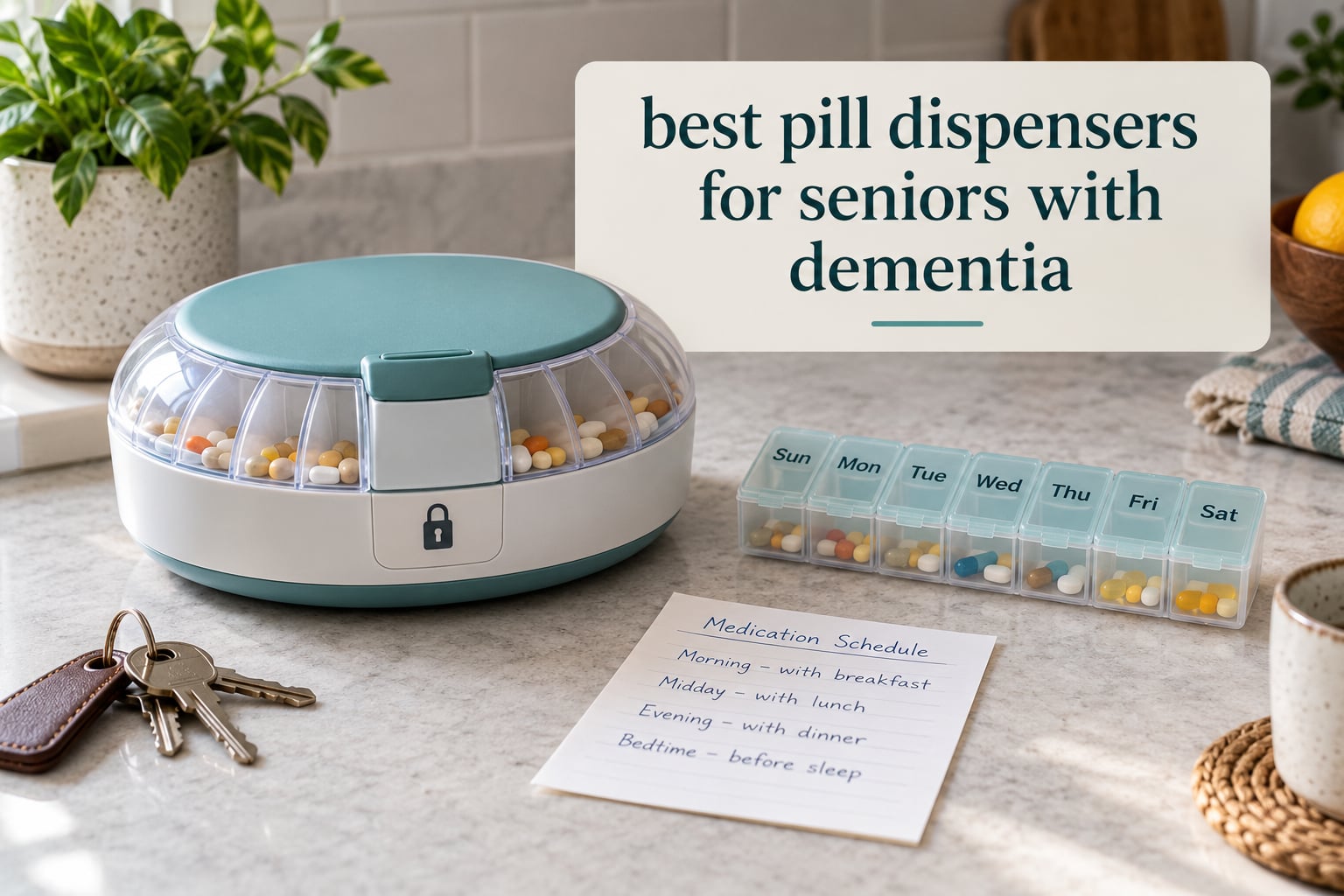
The best pill dispensers for seniors with dementia are the ones that physically stop a person from reaching tomorrow’s dose today. That single failure mode, described over and over by caregivers on r/dementia, is what separates a locked automatic carousel from the plastic weekly organizer sitting in a kitchen drawer.
A man in independent living with an aide visiting a few hours a day managed fine on a clearly labelled organizer until he took every one of his Friday pills at Thursday bedtime. That story is why we treat the lock as the deciding feature rather than the alarm, the app or the number of compartments. Non-adherence in older adults approaches 50% according to the Agency for Healthcare Research and Quality, and the Alzheimer’s Association estimates that roughly a third of hospitalizations involving people with dementia include a preventable medication error.
Our picks below are the locking dispensers that held up to that standard. We looked at which ones actually keep future doses sealed, which alarms a hard-of-hearing senior will notice, how much work the refill takes, and whether the unit keeps working when the internet does not. Every product here is a real dispenser we compared on published specifications and thousands of buyer reports, updated for 2026.
One honest caveat before we start. These devices help with early-stage and mid-stage dementia at home. In late-stage dementia, when the person cannot reliably operate even a simple lid or follow an alarm, a consumer dispenser is no longer enough and you need a pharmacy lockbox program or in-home nursing support. We explain where that line sits further down.
ContentsTable of Contents
- 1Top 3 Pill Dispensers for Dementia Care in 2026→
- 2Windtrace Automatic Pill Dispenser→
- 3LiveFine 28-Day Locking Dispenser→
- 4Betife 2nd Gen Dispenser→
- 5All 12 Dispensers Compared Side by Side→
- 61. Windtrace Automatic Pill Dispenser – Best Overall Locked Carousel→
- 7Windtrace Automatic Pill Dispenser for Elderly with Alarm→
- 8Pros→
- 9Cons→
- 10When the Windtrace is the right choice→
- 11When to look elsewhere→
- 122. LiveFine 28-Day Dispenser – Best Value Key-Locked Unit→
- 13LiveFine Automatic Pill Dispenser for Elderly, 28-Day Supply, Locking Lid→
- 14Pros→
- 15Cons→
- 16Who it fits best→
- 17Who should skip it→
- 183. Betife 2nd Gen Dispenser – Best Built-In Dementia Lock→
- 19Betife 2nd Gen Automatic Pill Dispenser for Elderly with Alarm→
- 20Pros→
- 21Cons→
- 22Why caregivers pick this one→
- 23When something else suits you better→
- 244. EziMedPil 28-Day Locked Dispenser – Best Privacy Lid and Pill Capacity→
- 25EziMedPil 28-Day Locked Automatic Pill Dispenser with Frosted Privacy Lid→
- 26Pros→
- 27Cons→
- 28Best used when visibility is the trigger→
- 29Where it falls short→
- 305. Colorwing 31-Slot Smart Dispenser – Best for Arthritis-Ridden Hands→
- 31Colorwing® 2025 Smart Pill Dispenser for Seniors – 31-Slot Automatic Medication Organizer with Bluetooth Alarms, Fingerprint & Mechanical Dual Lock, Daily Timed Dispenser (Elderly-Friendly Design)→
- 32Pros→
- 33Cons→
- 34Who should buy it→
- 35Who should not→
- 366. Ideerfit 28-Day No-App Dispenser – Best When WiFi Is Unreliable→
- 37Ideerfit 28-Day Automatic Pill Dispenser – One-Press Daily Dispense, Easy-to-Use Slide-Door Cup, Sound & Light Alerts, Moisture-Proof Dual Desiccants, Large Compartments for Tablets & Capsules→
- 38Pros→
- 39Cons→
- 40Where it earns its place→
- 41Where it does not→
- 427. Daviky Smart Pill Organizer – Budget Pick for Travel and Day Trips→
- 43Daviky Automatic Pill Dispenser, Smart Pill Organizer with Alarm→
- 44Pros→
- 45Cons→
- 46Who it suits→
- 47Who should skip it→
- 488. Ideerfit Expandable App Dispenser – Best for Long-Distance Caregivers→
- 4928-Day(1X) Automatic Pill Dispenser (Expandable Tray) – App & On-Device Setup by Family, LCD Display, Digital Lock, Sound & Light Alerts- Safe Medication Organizer for Dementia Seniors(2-Tray, White)→
- 50Pros→
- 51Cons→
- 52When remote oversight is the priority→
- 53When it is the wrong choice→
- 549. Senyerkare Safety-Lock Dispenser – Best for Two or Three Doses a Day→
- 55SenyerKare Automatic Pill Dispenser with Safety Lock for Seniors, Dementia→
- 56Pros→
- 57Cons→
- 58Good fit for smaller regimens→
- 59Poor fit for a determined user→
- 6010. MedReady Alarm and Flashing Light Dispenser – Best for Hearing Loss→
- 61MedReady Automatic Pill Dispenser — Alarm Sound and Flashing Light, Elderly→
- 62Pros→
- 63Cons→
- 64Why hearing loss changes the pick→
- 65What it cannot do→
- 6611. e-Pill MedSmart Voice – Best for Spoken Reminders→
- 67e-Pill MedSmart Voice Automatic Pill Dispenser with English or Spanish Voice Alerts – Locked Medication Reminder & Pill Organizer for Seniors, Dementia, Alzheimer’s, Caregivers & Assisted Living→
- 68Pros→
- 69Cons→
- 70Who benefits most→
- 71Where speech is not enough→
- 7212. Bloom Flower Locked 28-Day Dispenser – Best for Simple Locked Setup→
- 73Automatic Pill Dispenser for Elderly with Alarm, Lock 28-Day Medication Dispenser, 6 Dosage Templates, Sound & Light Alerts & Key for Vitamins, Supplements (Clear Lid)→
- 74Pros→
- 75Cons→
- 76Why it is still worth a look→
- 77Why we would hesitate→
- 78How to Choose a Pill Dispenser for Dementia Care→
- 791. The lock is the whole point→
- 802. Match the alert to the hearing, not the spec sheet→
- 813. How many doses, and how often does someone refill→
- 824. What your regimen does to a carousel→
- 835. Match the device to the dementia stage→
- 846. Power, connectivity and what happens when it fails→
- 857. How you introduce it decides whether it works→
- 86What not to buy→
- 87Insurance, savings and who pays→
- 88Frequently Asked Questions→
- 89Which pill dispenser is best for people with dementia?→
- 90Are automatic pill dispensers safe for Alzheimer’s patients?→
- 91Are there pill dispenser machines specifically designed for seniors?→
- 92How does a medication dispenser work?→
- 93What to do if a dementia patient takes tomorrow’s pills today→
- 94Will Medicare pay for a medication dispenser?→
- 95Conclusion: The Best Pill Dispensers for Seniors With Dementia in 2026→
Top 3 Pill Dispensers for Dementia Care in 2026

Windtrace Automatic Pill Dispenser
- 28-compartment removable tray
- 6 daily alarm rings
- loud alarm plus flashing blue light
- locking lid
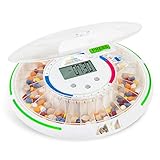
LiveFine 28-Day Locking Dispenser
- 9 dosage rings
- jumbo LCD with three volume levels
- 18 pills per slot
- key-operated cover

Betife 2nd Gen Dispenser
- Built-in dementia-proof lock
- six-button senior console
- 5000-cycle gearbox
- XL LCD screen
As an Amazon Associate we earn from qualifying purchases. CERTAIN CONTENT THAT APPEARS ON THIS SITE COMES FROM AMAZON. THIS CONTENT IS PROVIDED 'AS IS' AND IS SUBJECT TO CHANGE OR REMOVAL AT ANY TIME.
All 12 Dispensers Compared Side by Side
| # | Product | Key details | Where to buy |
|---|---|---|---|
| 1 | Windtrace Automatic Pill Dispenser for Elderly with Alarm |
|
Check Latest Price |
| 2 | LiveFine Automatic Pill Dispenser, Locking Lid |
|
Check Latest Price |
| 3 | Betife 2nd Gen Automatic Pill Dispenser |
|
Check Latest Price |
| 4 | 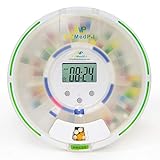 EziMedPil 28-Day Locked Dispenser with Frosted Privacy Lid EziMedPil 28-Day Locked Dispenser with Frosted Privacy Lid |
|
Check Latest Price |
| 5 |  Colorwing 31-Slot Smart Pill Dispenser Colorwing 31-Slot Smart Pill Dispenser |
|
Check Latest Price |
| 6 |  Ideerfit 28-Day Dispenser, No App Ideerfit 28-Day Dispenser, No App |
|
Check Latest Price |
| 7 |  Daviky Smart Pill Organizer with Alarm Daviky Smart Pill Organizer with Alarm |
|
Check Latest Price |
| 8 |  Ideerfit Expandable App Dispenser, 2-Tray Ideerfit Expandable App Dispenser, 2-Tray |
|
Check Latest Price |
| 9 | 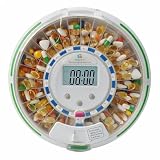 Senyerkare Automatic Pill Dispenser with Safety Lock Senyerkare Automatic Pill Dispenser with Safety Lock |
|
Check Latest Price |
| 10 |  MedReady Alarm and Flashing Light Dispenser MedReady Alarm and Flashing Light Dispenser |
|
Check Latest Price |
| 11 |  e-Pill MedSmart Voice Automatic Pill Dispenser e-Pill MedSmart Voice Automatic Pill Dispenser |
|
Check Latest Price |
| 12 |  Bloom Flower Locked 28-Day Dispenser Bloom Flower Locked 28-Day Dispenser |
|
Check Latest Price |
We earn from qualifying purchases. CERTAIN CONTENT THAT APPEARS ON THIS SITE COMES FROM AMAZON. THIS CONTENT IS PROVIDED 'AS IS' AND IS SUBJECT TO CHANGE OR REMOVAL AT ANY TIME.
1. Windtrace Automatic Pill Dispenser – Best Overall Locked Carousel
Windtrace Automatic Pill Dispenser for Elderly with Alarm
- 28 compartments
- 6 daily alarm rings
- Loud alarm plus blue flashing light
- 2.13 lbs
Pros
- Locking tray stopped future doses being reached
- Build survived rough physical handling
- One refill every 28 days
- Easy to confirm whether a dose was taken
- Accurate clock with a reliable battery meter
Cons
- Programming needs the manual
- Small pills can jam the tray if stored upside down
- Alarm runs about an hour with no remote snooze
We earn a commission, at no additional cost to you. CERTAIN CONTENT THAT APPEARS ON THIS SITE COMES FROM AMAZON. THIS CONTENT IS PROVIDED 'AS IS' AND IS SUBJECT TO CHANGE OR REMOVAL AT ANY TIME.
With 3445 ratings averaging 4.4 stars, the Windtrace is the best-supported lock on the market and the unit we would put on a kitchen counter first. The 28 compartments sit in a removable food-grade tray, six dosage rings let you schedule anywhere from one to six alarm times a day, and the lid locks so only the current dose can be reached.
What stands out during use is the alert. It is a genuinely loud alarm paired with a bright flashing blue light, which matters more than most spec sheets admit because age-related hearing loss usually eats the high frequencies first. The LCD is large and easy to read, and the sliding retrieval window means the dose is exposed without lifting anything.
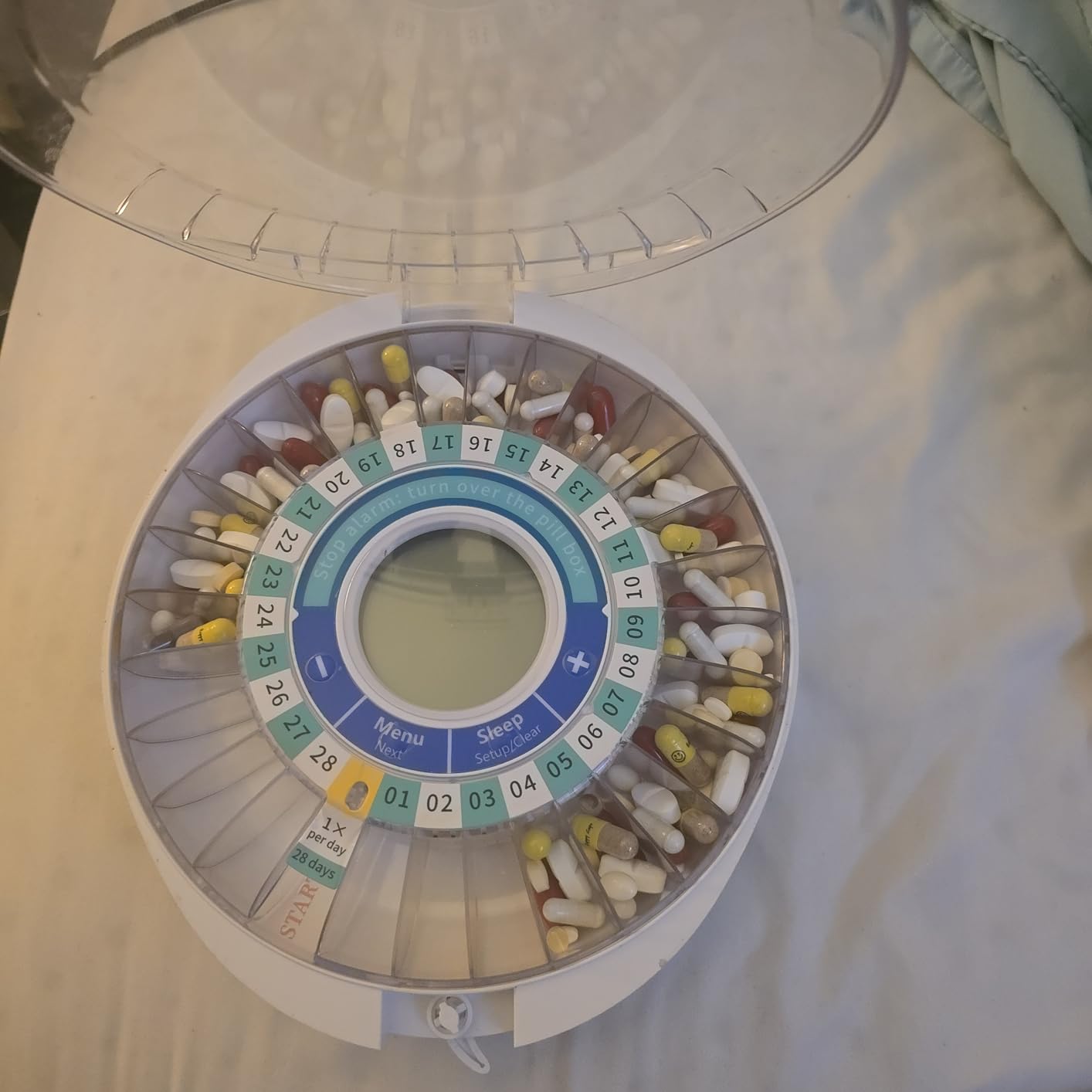
Caregiver reports describe this unit cutting double-dosing and wrong-day dosing in households where a plastic organizer had already failed. The tray survived rough handling, and the single monthly refill instead of four weekly top-ups removes a failure point that catches most families out.
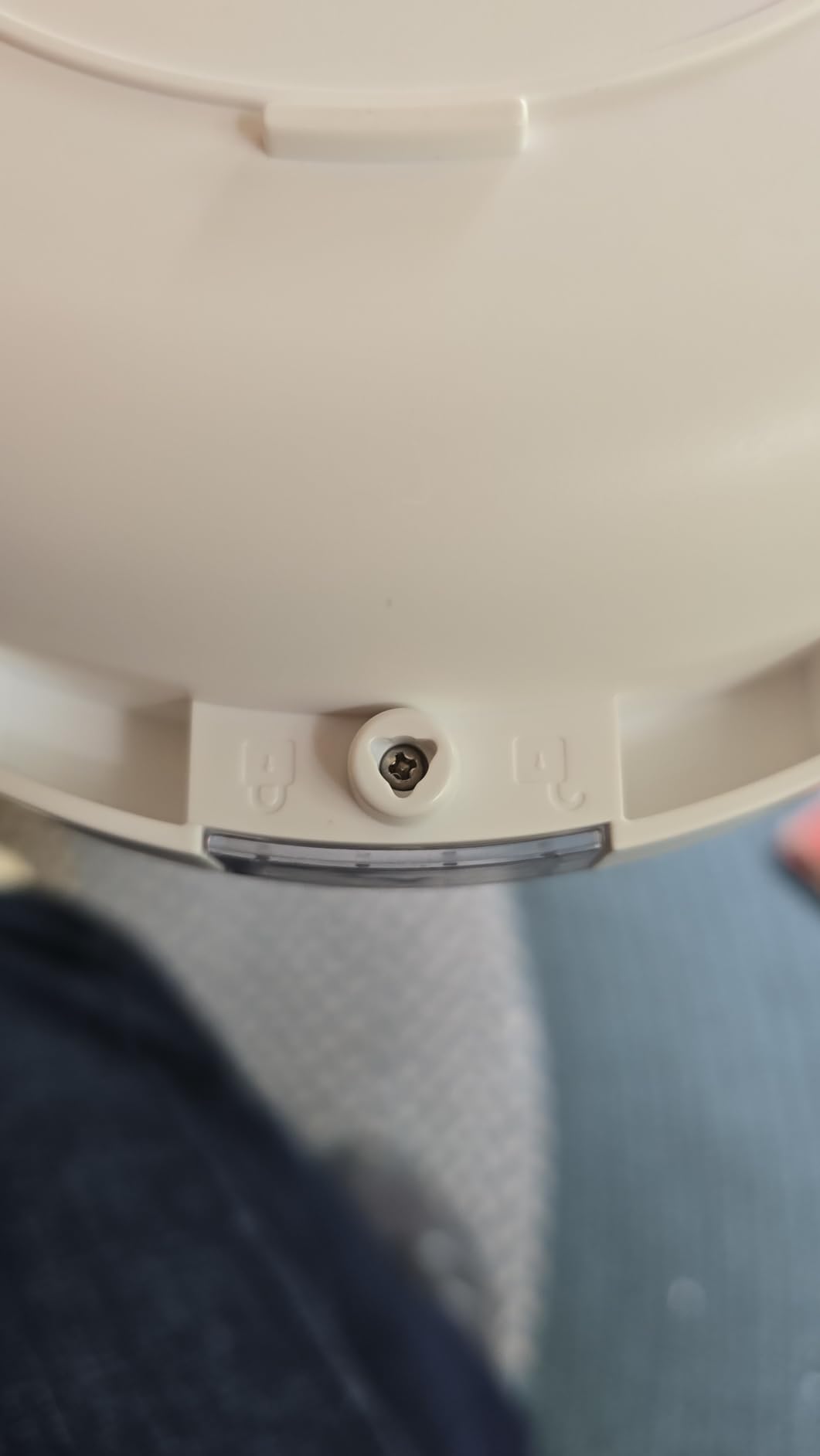
Its weaknesses are real but small. Setting the clock and alarm times is not intuitive, so you should sit down with the instructions rather than assume. Small pills can lodge and block the rotating tray if the dispenser is stored upside down, and the keyhole is basic security rather than institutional-grade. The alarm also keeps going for roughly an hour with no way to silence it from a phone.
When the Windtrace is the right choice
Choose it when the person still responds to a loud alarm, can tip or pick up a dose, and lives somewhere the unit can stay plugged in on a counter. The 10.3 by 9.6 inch footprint and simple three-part setup suit a bathroom or kitchen surface rather than a nightstand.
It is the safest first purchase for early-stage or mid-stage dementia where the main worry is taking the wrong day’s pills rather than refusing the device entirely.
When to look elsewhere
Skip it if the person has significantly impaired hearing and will not respond to sound, because no light pattern fully replaces an alarm they cannot hear. It is also the wrong tool if as-needed medications make up a large share of the regimen, since a carousel cannot hold a dose that is only taken occasionally.
If you need a caregiver to be told remotely when a dose is missed, this unit does not do that and you should look at the app-connected models further down the list.
We may earn a commission at no additional cost to you. As an Amazon Associate I earn from qualifying purchases. CERTAIN CONTENT THAT APPEARS ON THIS SITE COMES FROM AMAZON. THIS CONTENT IS PROVIDED 'AS IS' AND IS SUBJECT TO CHANGE OR REMOVAL AT ANY TIME.
2. LiveFine 28-Day Dispenser – Best Value Key-Locked Unit
LiveFine Automatic Pill Dispenser for Elderly, 28-Day Supply, Locking Lid
- 28-day capacity
- 9 dosage rings
- Jumbo LCD, 3 volume levels
- Up to 18 pills per slot
Pros
- Holds up to 18 pills per dose slot
- Three-button setup most users learn quickly
- Key-operated locking cover adds real security
- Runs on batteries so it travels well
Cons
- Programming takes more patience than a manual box
- Locking lid can feel finicky
- Some boxes arrived with missing keys or accessories
We earn a commission, at no additional cost to you. CERTAIN CONTENT THAT APPEARS ON THIS SITE COMES FROM AMAZON. THIS CONTENT IS PROVIDED 'AS IS' AND IS SUBJECT TO CHANGE OR REMOVAL AT ANY TIME.
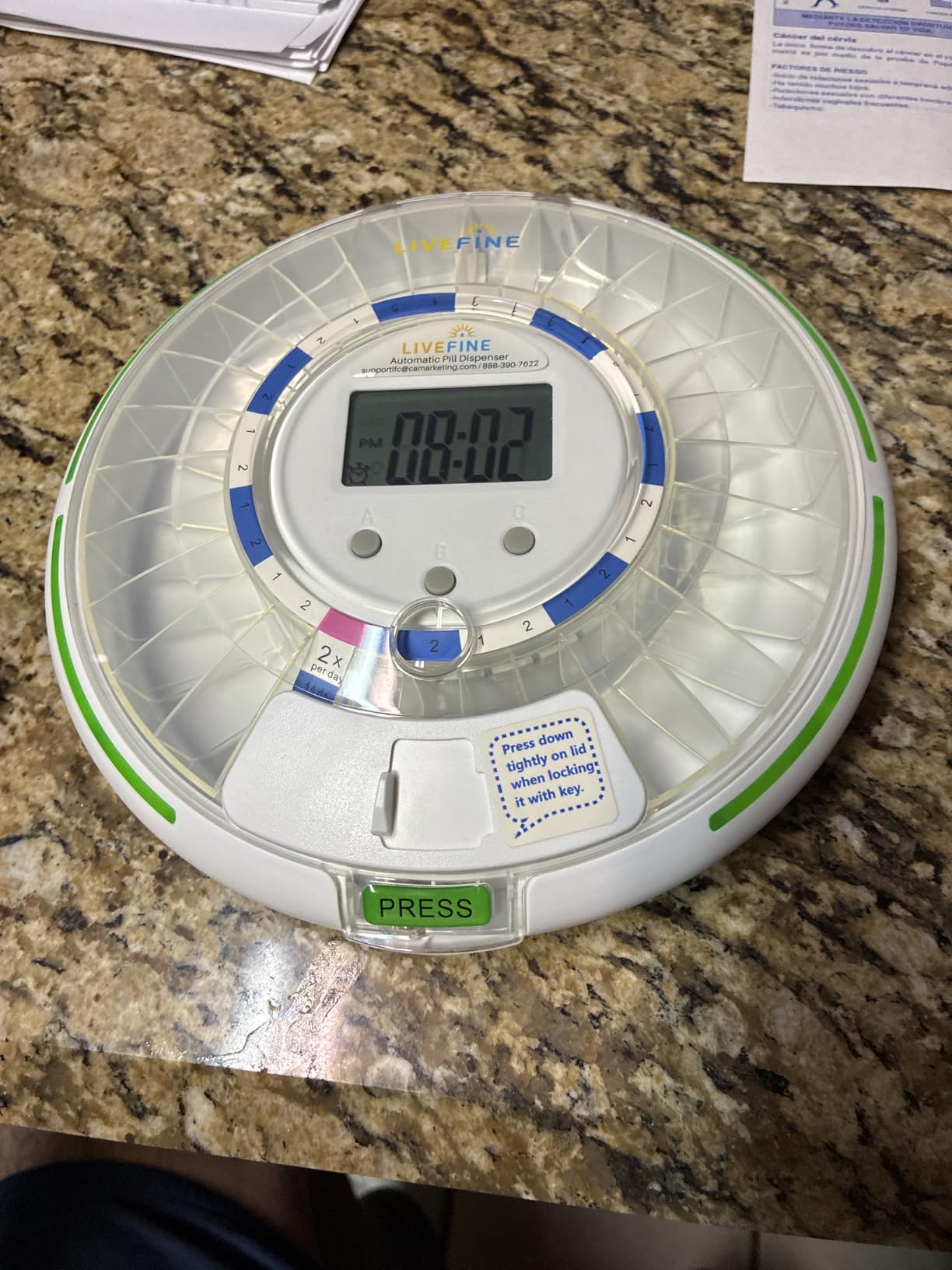
The LiveFine covers the same ground as the Windtrace at a lower tier, and it is the one we suggest when a family wants a key lock without spending on app features. Capacity is the headline: up to 18 pills per carousel slot, which matters for complex multi-drug regimens.
Nine interchangeable dosage rings allow up to nine alerts a day, and the jumbo LCD with three volume levels is unusually readable at arm’s length for someone with poor vision. The three-button interface is the part users like most, because there is less to learn than with a four-button console.
Buyers credit it with holding high pill volumes per dose and with a straightforward setup, while acknowledging that programming needs patience the first time. Battery operation also makes it a reasonable pick for someone who travels or splits time between two homes.
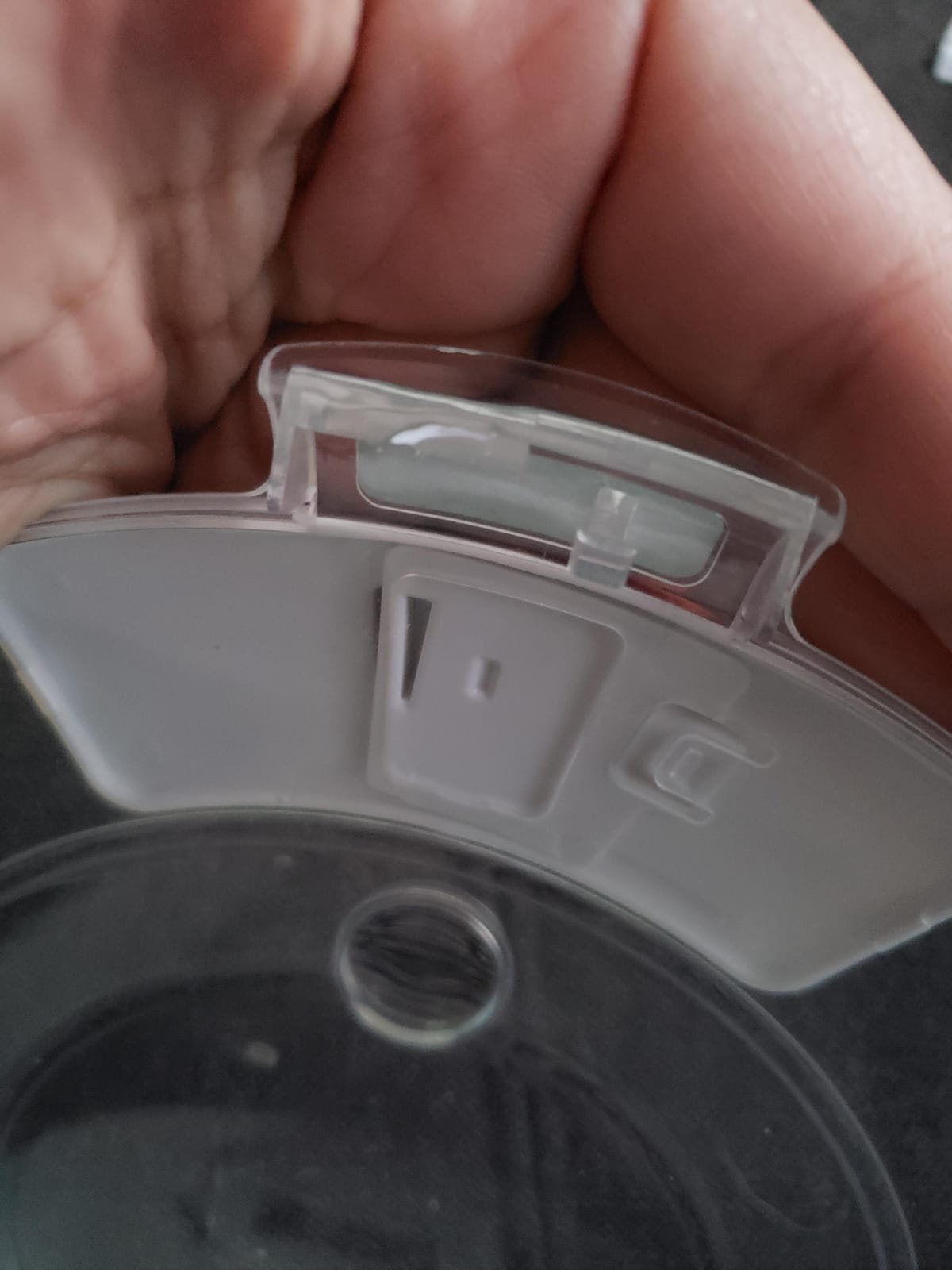
Two practical warnings. Some buyers received models missing the key or other accessories in the box, so check the contents on arrival. And a few reviewers describe the locking lid as finicky to operate, which is exactly the mechanism doing the most important work here.
Who it fits best
This suits a senior with mild to moderate memory loss who takes four or more pills at a time and needs the future doses physically sealed. It also works well in a two-caregiver household where someone refills monthly and someone else just listens for the alarm.
For anyone who cannot manage fine motor control at the pill moment but can still hear and respond, the sliding retrieval window keeps the physical demand low.
Who should skip it
Pass on it if your main worry is a determined person forcing the lid open over weeks of unsupervised access. A basic keyed cover resists casual opening, not sustained effort, and a fingerprint or PIN model resists more.
It also offers no remote notification, so a long-distance caregiver will not learn about a missed dose from this device.
We may earn a commission at no additional cost to you. As an Amazon Associate I earn from qualifying purchases. CERTAIN CONTENT THAT APPEARS ON THIS SITE COMES FROM AMAZON. THIS CONTENT IS PROVIDED 'AS IS' AND IS SUBJECT TO CHANGE OR REMOVAL AT ANY TIME.
3. Betife 2nd Gen Dispenser – Best Built-In Dementia Lock
Betife 2nd Gen Automatic Pill Dispenser for Elderly with Alarm
- Built-in dementia-proof lock
- Six-button console with XL LCD
- Sub-2mm tray-to-cover seal
- 2.14 lbs
Pros
- Beeps until the dose is removed
- Easy to program several daily alarm times
- Works well for Parkinson's and memory issues
- Large compartments
- Letting a caregiver be away with confidence
Cons
- Flipping the unit to silence can misalign the tray
- Some buyers report the rotation mechanism sticking
- Replacement units have failed to turn
We earn a commission, at no additional cost to you. CERTAIN CONTENT THAT APPEARS ON THIS SITE COMES FROM AMAZON. THIS CONTENT IS PROVIDED 'AS IS' AND IS SUBJECT TO CHANGE OR REMOVAL AT ANY TIME.
The Betife is designed with dementia explicitly in mind rather than adapted to it. The manufacturer states the lock is meant to block children, addicts or dementia patients, and the seal between tray and cover measures under 2 mm specifically to stop pills migrating between slots overnight.
The gearbox was lab-tested for more than 5000 carousel rotations, which is roughly the point where cheaper mechanisms start skipping days. The six-button console has one function per key and oversized icons, and the extra-large LCD is legible from across a room.
Users caring for people with Parkinson’s, dementia and memory loss consistently praise the persistent alarm that keeps sounding until the dose is actually taken. That persistence matters, because caregiver groups report that most people learn to ignore a short beep within a couple of weeks.
The honest problem is mechanical. To silence the alarm you turn the unit over, and in doing so the tray can pull out of alignment and stop advancing to the next day. Several buyers also report the rotation mechanism sticking, including on a replacement unit.
Why caregivers pick this one
It is the strongest option when the diagnosis is firm and you expect the person to keep testing the system for months. The seal, the lock and the tested gearbox are the three features we would want in a unit that a non-dementia adult might try to defeat.
For households where the person takes three or four separate doses daily, the multi-time programming and large compartments handle a busy regimen well.
When something else suits you better
Do not choose it if the person is likely to flip or lift the unit in frustration, since that is exactly the failure mode reviewers describe. If a mechanical stop means a missed day of medication with no remote alert to tell you, that risk is too high.
The unit also has no app monitoring, so it works well only when someone is physically present or nearby.
We may earn a commission at no additional cost to you. As an Amazon Associate I earn from qualifying purchases. CERTAIN CONTENT THAT APPEARS ON THIS SITE COMES FROM AMAZON. THIS CONTENT IS PROVIDED 'AS IS' AND IS SUBJECT TO CHANGE OR REMOVAL AT ANY TIME.
4. EziMedPil 28-Day Locked Dispenser – Best Privacy Lid and Pill Capacity
EziMedPil 28-Day Locked Automatic Pill Dispenser with Frosted Privacy Lid
- Lockable frosted privacy lid
- 672 pills total capacity
- 6 dosage rings
- Built-in magnifying glass
Pros
- Cut missed doses dramatically for a dementia patient
- Fewer refills thanks to large capacity
- Solid build for the money
- Handles Parkinson's and multiple daily doses
- Responsive customer service
Cons
- Some boxes arrived without the promised batteries or a second key
- The supplied key is basic and did not stop a child opening the lid
- High-pitched alarm may not be audible with hearing loss
- Tipping pills out can lose small tablets
We earn a commission, at no additional cost to you. CERTAIN CONTENT THAT APPEARS ON THIS SITE COMES FROM AMAZON. THIS CONTENT IS PROVIDED 'AS IS' AND IS SUBJECT TO CHANGE OR REMOVAL AT ANY TIME.
The EziMedPil is the one to consider when the wrong-day problem is driven as much by curiosity as by forgetting. A person who can see a full tray of future doses will look at them, and the frosted privacy lid removes that visual cue entirely while keeping the current dose reachable.
Capacity is the second reason it stands out: 28 compartments holding up to 24 aspirin-sized tablets each, 672 pills in total. For someone on a heavy regimen, that is the difference between a monthly fill and two refills a month.
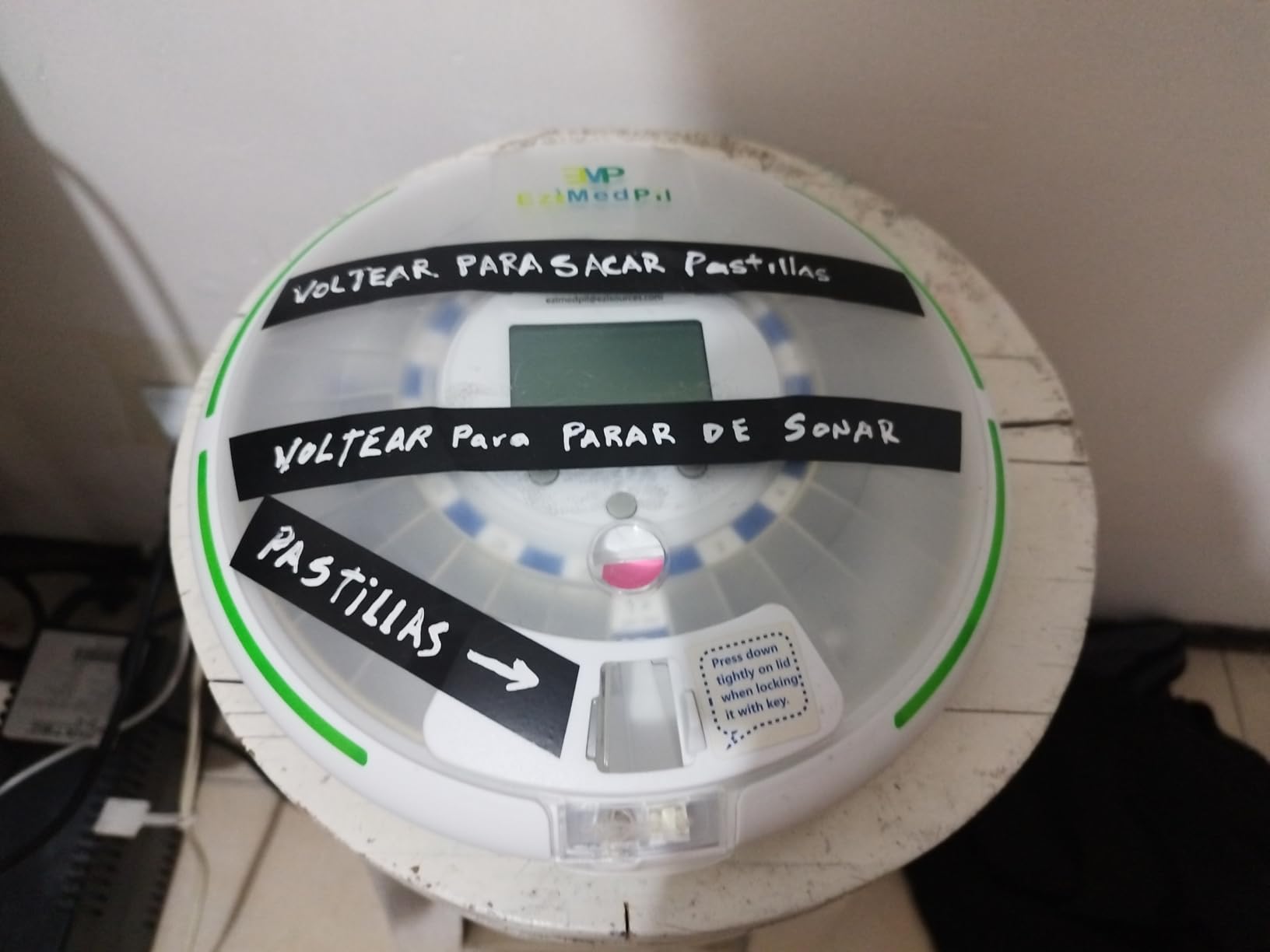
Long-term caregivers report a large drop in missed and doubled doses. The built-in mini magnifying glass is a small touch that matters for a senior reading fine print on a tablet, and two anti-slip grips stop the unit sliding when someone pulls at it.
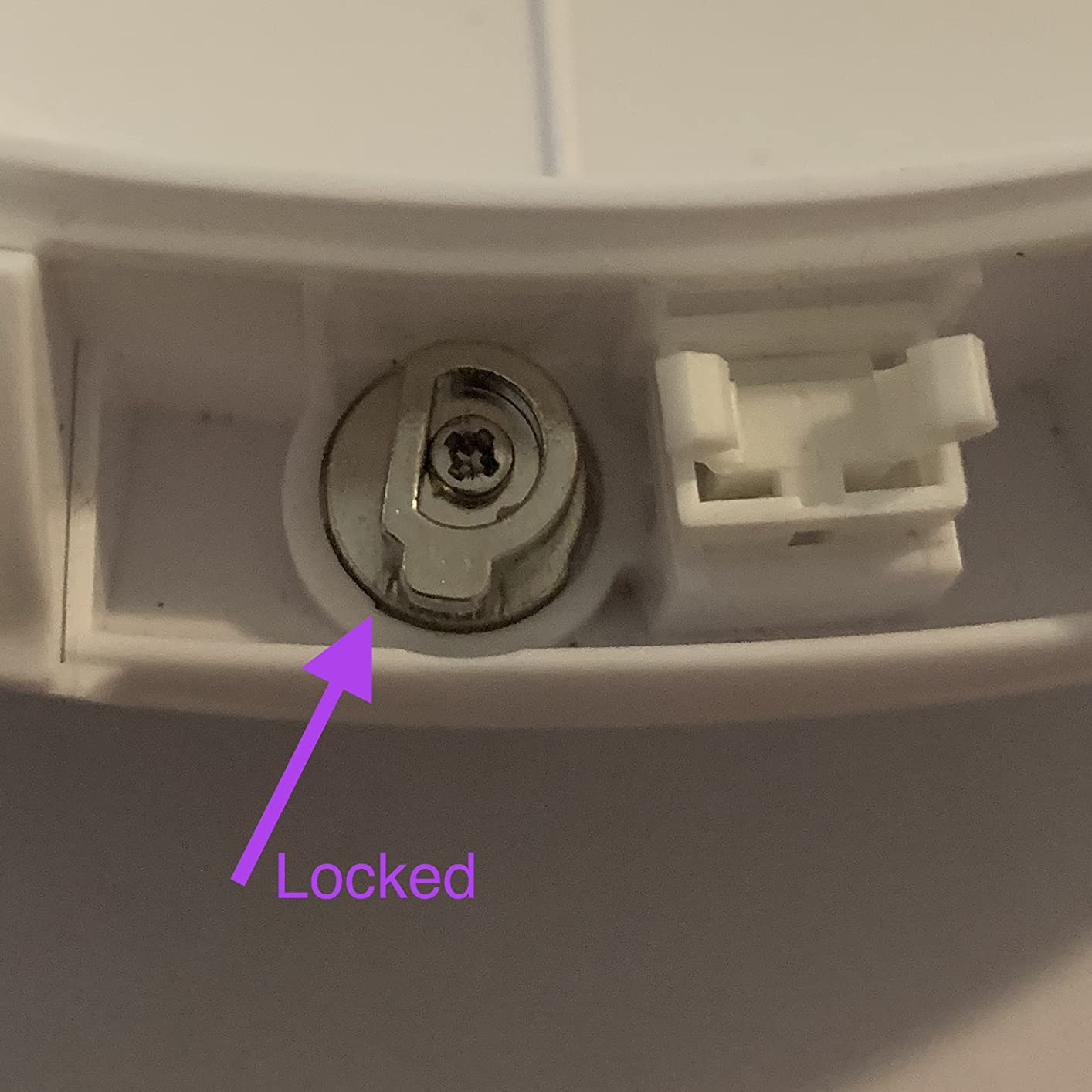
Three caveats matter more than the average rating suggests. Some boxes arrived without the advertised AA batteries and with only one key, so verify on arrival. The included key is a basic hex-nut style that at least one reviewer said did not stop a child opening the lid. And because pills must be tipped or shaken out, tiny tablets can be lost.
One owner also reported an error code after 11 months with no motor function. Long-term mechanical failure is the least-discussed risk in this whole category.
Best used when visibility is the trigger
It fits early-stage dementia patients who are still independent but treat a visible pill tray as a menu rather than a barrier. Privacy plus a key means you can leave the unit on the counter and still control access.
Families managing a large number of daily tablets will appreciate the refill efficiency more than almost anything else on this list.
Where it falls short
If your relative has progressed to pulling open anything reachable, a frosted lid alone is decoration and the basic key will not hold. Pair it with a locked cabinet or move to a fingerprint model.
The high-pitched alarm is also a poor match for age-related hearing loss, where low-frequency tones are heard long after high ones disappear.
We may earn a commission at no additional cost to you. As an Amazon Associate I earn from qualifying purchases. CERTAIN CONTENT THAT APPEARS ON THIS SITE COMES FROM AMAZON. THIS CONTENT IS PROVIDED 'AS IS' AND IS SUBJECT TO CHANGE OR REMOVAL AT ANY TIME.
5. Colorwing 31-Slot Smart Dispenser – Best for Arthritis-Ridden Hands
Colorwing® 2025 Smart Pill Dispenser for Seniors – 31-Slot Automatic Medication Organizer with Bluetooth Alarms, Fingerprint & Mechanical Dual Lock, Daily Timed Dispenser (Elderly-Friendly Design)
- 31 slots with 7 dose rings
- Fingerprint plus key dual lock
- Bluetooth app sync
- Rechargeable 1200mAh battery
Pros
- Palm-activated opening needs no lifting
- Fingerprint lock blocks impulsive access to future doses
- App syncing confirms intake remotely
- Battery runs a month or more per charge
Cons
- Carousel has stopped mid-rotation and required a factory reset
- One tiny pill lodged in the mechanism and shut the unit down
- Emergency key failed to open a jammed lid
- Bigger than expected
We earn a commission, at no additional cost to you. CERTAIN CONTENT THAT APPEARS ON THIS SITE COMES FROM AMAZON. THIS CONTENT IS PROVIDED 'AS IS' AND IS SUBJECT TO CHANGE OR REMOVAL AT ANY TIME.
The Colorwing takes a different approach to locking. Instead of a key alone, it pairs fingerprint scanning with a mechanical backup key, and the patented press-release picker box opens from a palm rather than a fingertip. For a senior with arthritis who cannot pinch or twist, that is the feature that matters.
It also has the longest capacity on the list at 31 slots, seven reversible dose rings for weekly or monthly plans, and Bluetooth 5.0 syncing with a free companion app so a caregiver can confirm from a distance that the dose was taken.
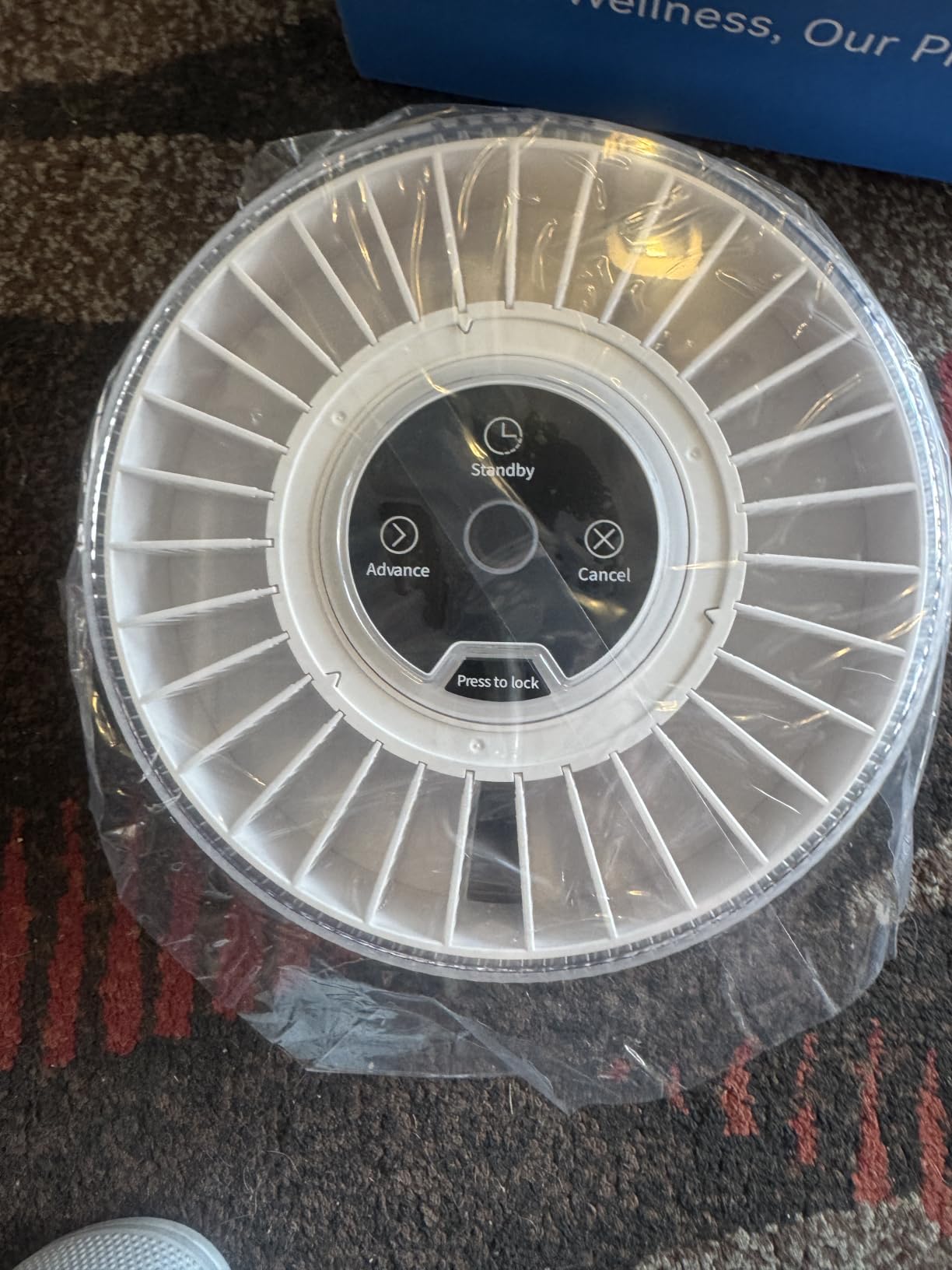
The rechargeable 1200mAh battery takes about two hours to charge and runs 30 or more days in energy-smart mode, which removes the weekly battery routine. Voice reminders are customisable, or you can pick from three alert tones, and a large red LED covers the visual side.
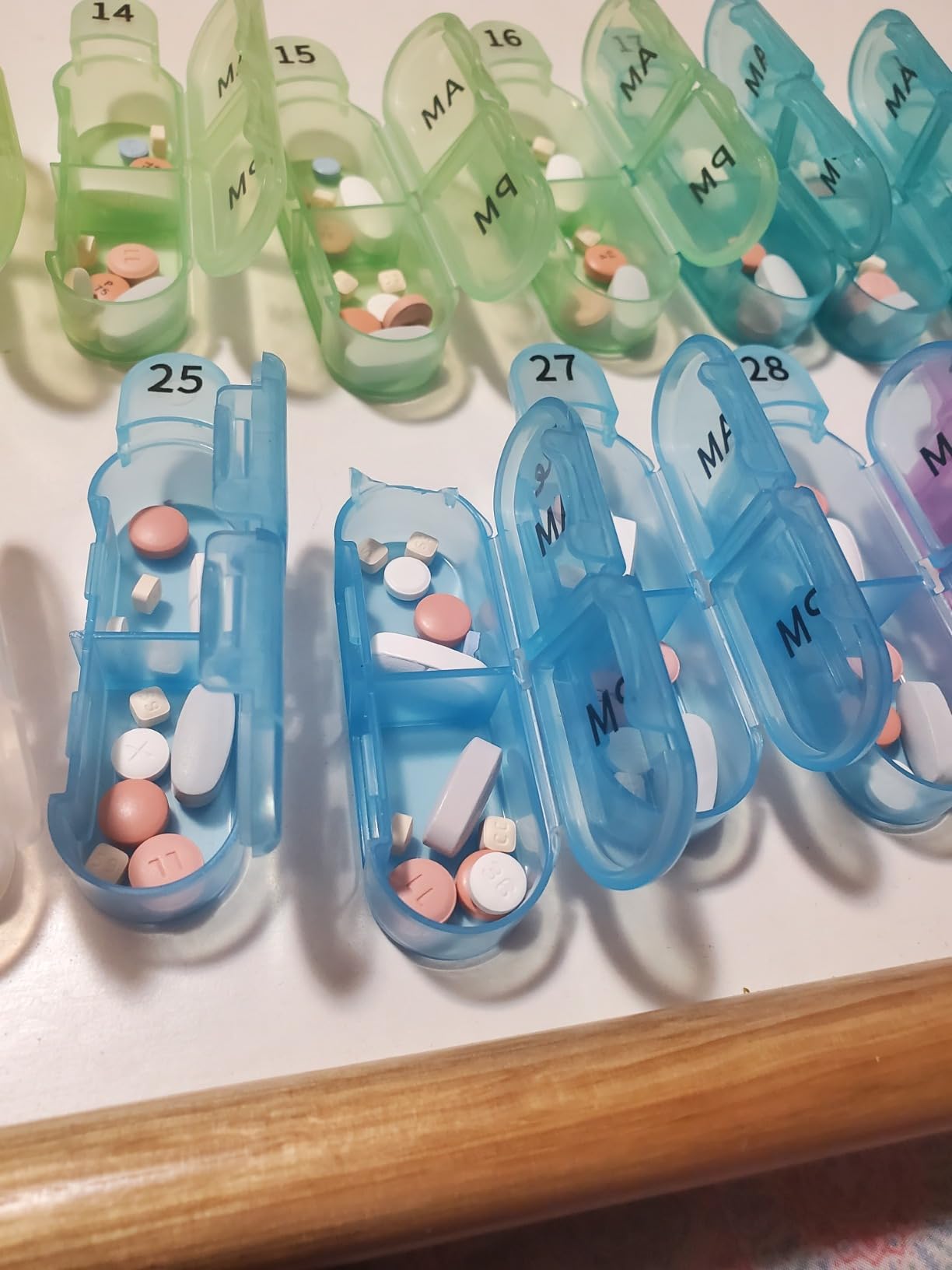
Reliability is the concern, and it is a serious one. Multiple reviews describe the carousel stopping mid-rotation and needing a factory reset that wiped the schedule. Another reports a tiny pill lodged between the drawer and the motor that shut the unit down entirely, with the emergency key unable to free a jammed lid.
For someone with early Alzheimer’s who cannot intervene when a device fails, a jam without a remote alert is the worst-case outcome in this category.
Who should buy it
It is built for the specific combination of limited dexterity and early cognitive decline. Someone who can operate a smartphone at a basic level, or has a family member willing to enrol their fingerprint, will get the most from the app and remote confirmation.
It also suits a household where someone lives alone but a sibling wants a daily record rather than a weekly phone call.
Who should not
If the person lives alone with no one able to physically reach the unit within a day, a documented jam history is a reason to choose a simpler mechanical model instead. Buyers expecting a small bedside unit should also note the 5.4 inch depth and 3 lb weight.
The app needs a phone and a stable Bluetooth link, so it is not the answer for a household without either.
We may earn a commission at no additional cost to you. As an Amazon Associate I earn from qualifying purchases. CERTAIN CONTENT THAT APPEARS ON THIS SITE COMES FROM AMAZON. THIS CONTENT IS PROVIDED 'AS IS' AND IS SUBJECT TO CHANGE OR REMOVAL AT ANY TIME.
6. Ideerfit 28-Day No-App Dispenser – Best When WiFi Is Unreliable
Ideerfit 28-Day Automatic Pill Dispenser – One-Press Daily Dispense, Easy-to-Use Slide-Door Cup, Sound & Light Alerts, Moisture-Proof Dual Desiccants, Large Compartments for Tablets & Capsules
- One-press dispense
- Slide-door catch tray
- Sound-only or light-only alerts
- 3.62 lbs
Pros
- Stops out-of-order and repeated dosing
- Light-only alert option lowers anxiety
- Pills land cleanly in the cup with no tipping
- Locking blocks access to the programming buttons
- Simpler setup than app models
Cons
- Catch tray tab needs real finger strength
- Pills can bounce out of the tray
- Bottomless tray mixes everything when removed
- Backup batteries needed and the charger brick is not included
We earn a commission, at no additional cost to you. CERTAIN CONTENT THAT APPEARS ON THIS SITE COMES FROM AMAZON. THIS CONTENT IS PROVIDED 'AS IS' AND IS SUBJECT TO CHANGE OR REMOVAL AT ANY TIME.
Most connected dispensers are useless the moment the internet drops. This one runs entirely on the device, which makes it a sensible choice for rural homes, weak broadband or simply a person who will never open an app. The dose window even allows dispensing 15 minutes early or 30 minutes late.
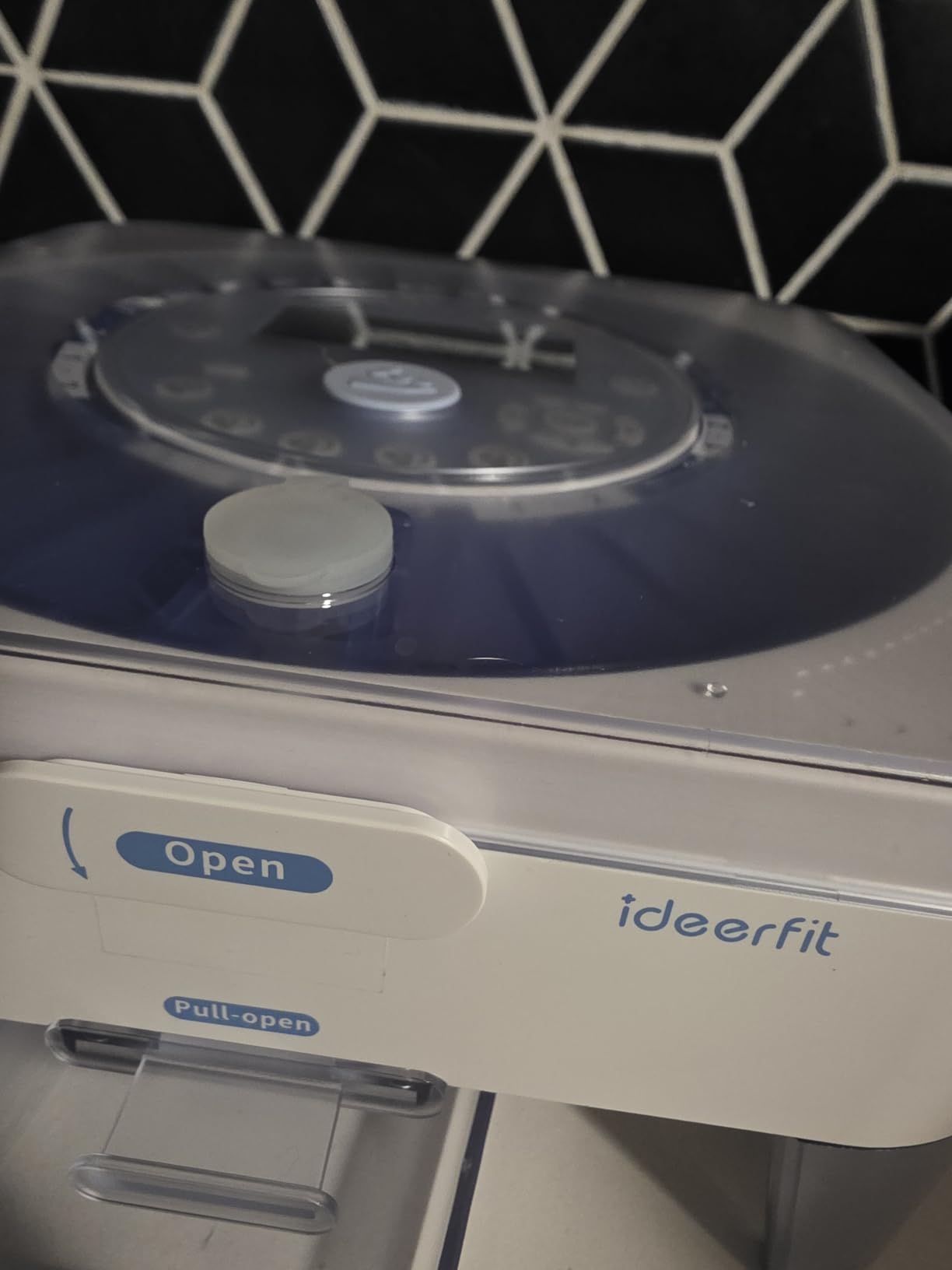
The mechanism is different from a rotating carousel. A slide-door tray drops pills straight into a cup with a one-press dispense and no manual rotation, so nothing needs lifting, tipping or shaking. That design is why pills land cleanly and why dementia patients are less likely to miss them.
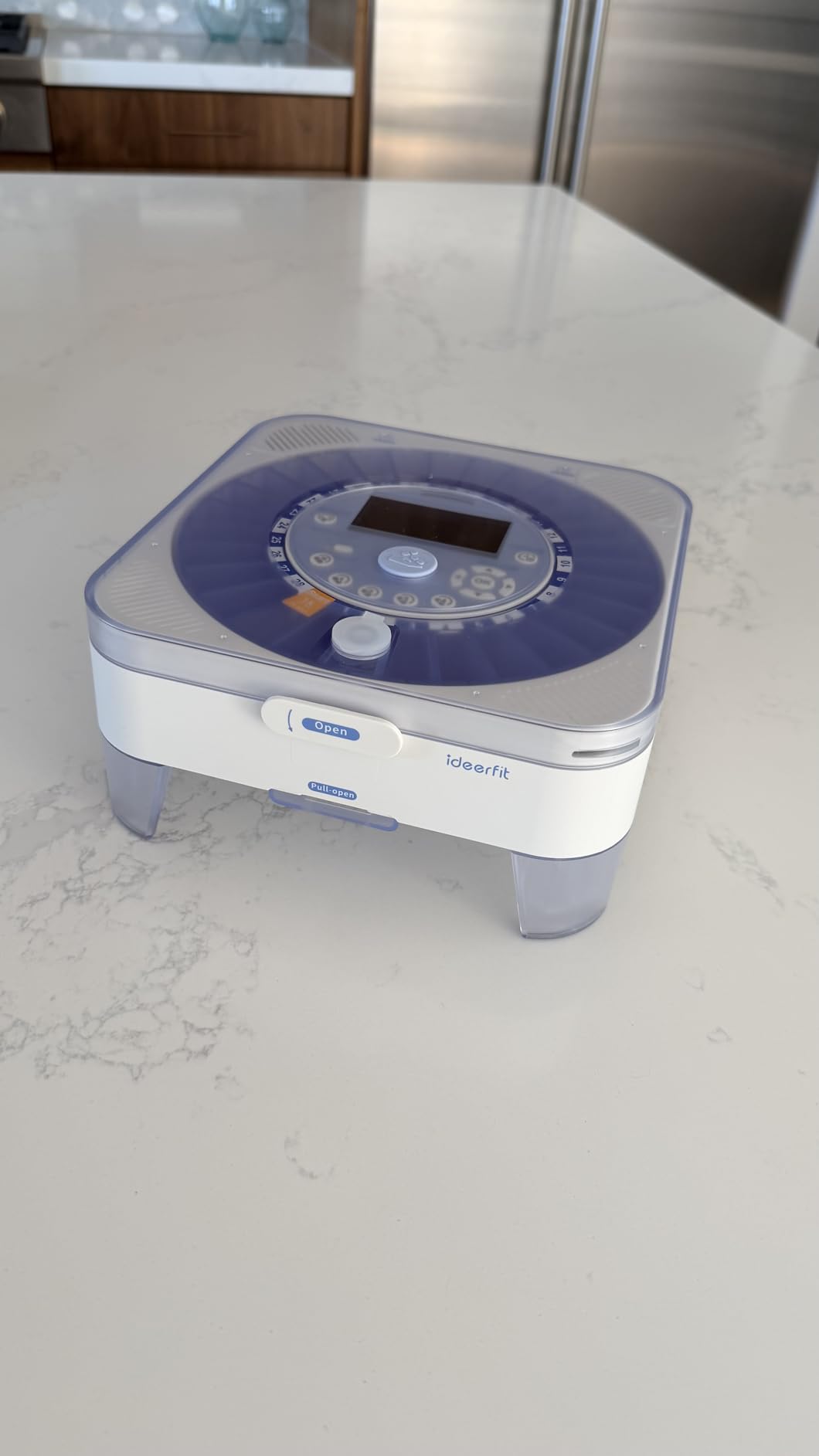
Caregivers of people with dementia report that this design ended pill anxiety and out-of-order dosing, and the light-only alert option is a genuine kindness for someone who becomes distressed by a repeated buzzer. The lock also blocks access to the programming buttons, so the schedule itself cannot be altered.
The physical weakness is the catch tray tab. Pulling it out takes real finger strength, and elderly hands often lack it, so a dose can sit undispensed without anyone noticing. Pills can also bounce out of the tray if it is not replaced after each dose.
Two more caveats: the bottomless tray means removing it mixes all the pills together, and the schedule cannot be advanced mid-cycle, so it has to start on day one of the fill.
Where it earns its place
It fits a household without reliable connectivity, or a caregiver who does not want to maintain a phone and app. The humidity control, with a water-resistant lid, silicone sealing and dual desiccant chambers, also protects tablets in a bathroom where a carousel would suffer.
Light-only mode suits a person sensitive to sound who still needs a visual prompt every dose.
Where it does not
Not a good fit for a person whose hand strength is already declining, since the whole dispense depends on pulling a small tab. It also offers no record of doses for anyone who needs to show a doctor or a distant relative what has been taken.
Plan the refill around a fixed start date, because mid-cycle changes are not supported.
We may earn a commission at no additional cost to you. As an Amazon Associate I earn from qualifying purchases. CERTAIN CONTENT THAT APPEARS ON THIS SITE COMES FROM AMAZON. THIS CONTENT IS PROVIDED 'AS IS' AND IS SUBJECT TO CHANGE OR REMOVAL AT ANY TIME.
7. Daviky Smart Pill Organizer – Budget Pick for Travel and Day Trips
Daviky Automatic Pill Dispenser, Smart Pill Organizer with Alarm
- Compact and rechargeable
- Multiple daily reminders
- Smooth easy-open lid
- 9.88 oz
Pros
- Light and compact enough for a travel bag
- Rechargeable battery avoids routine replacements
- Multiple reminders suit varied schedules
- Lid opens smoothly for stiff hands
Cons
- Locking strength is not detailed in the listing
- Lower rating suggests less consistent results than locked carousels
We earn a commission, at no additional cost to you. CERTAIN CONTENT THAT APPEARS ON THIS SITE COMES FROM AMAZON. THIS CONTENT IS PROVIDED 'AS IS' AND IS SUBJECT TO CHANGE OR REMOVAL AT ANY TIME.
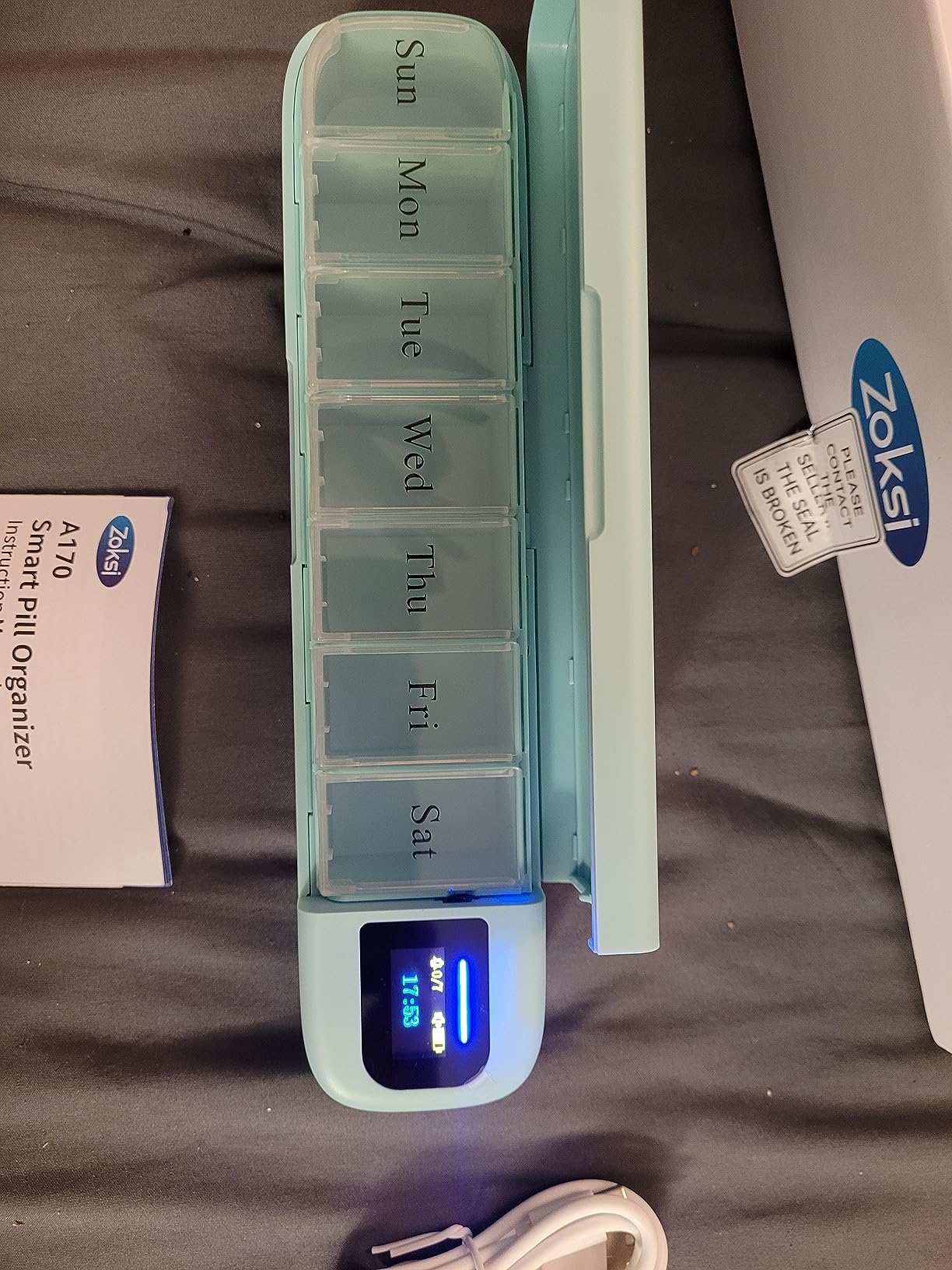
The Daviky is not a locked carousel and we would not position it as the answer for mid-stage dementia. What it is good at is the opposite problem: a person in early-stage memory loss who travels, goes to day clubs or splits the week between two homes.
At under 10 ounces and roughly 11 inches long, it fits a handbag or a jacket pocket in a way no carousel on this list does. The rechargeable lithium battery runs up to a month per charge, so there is no battery routine to forget.
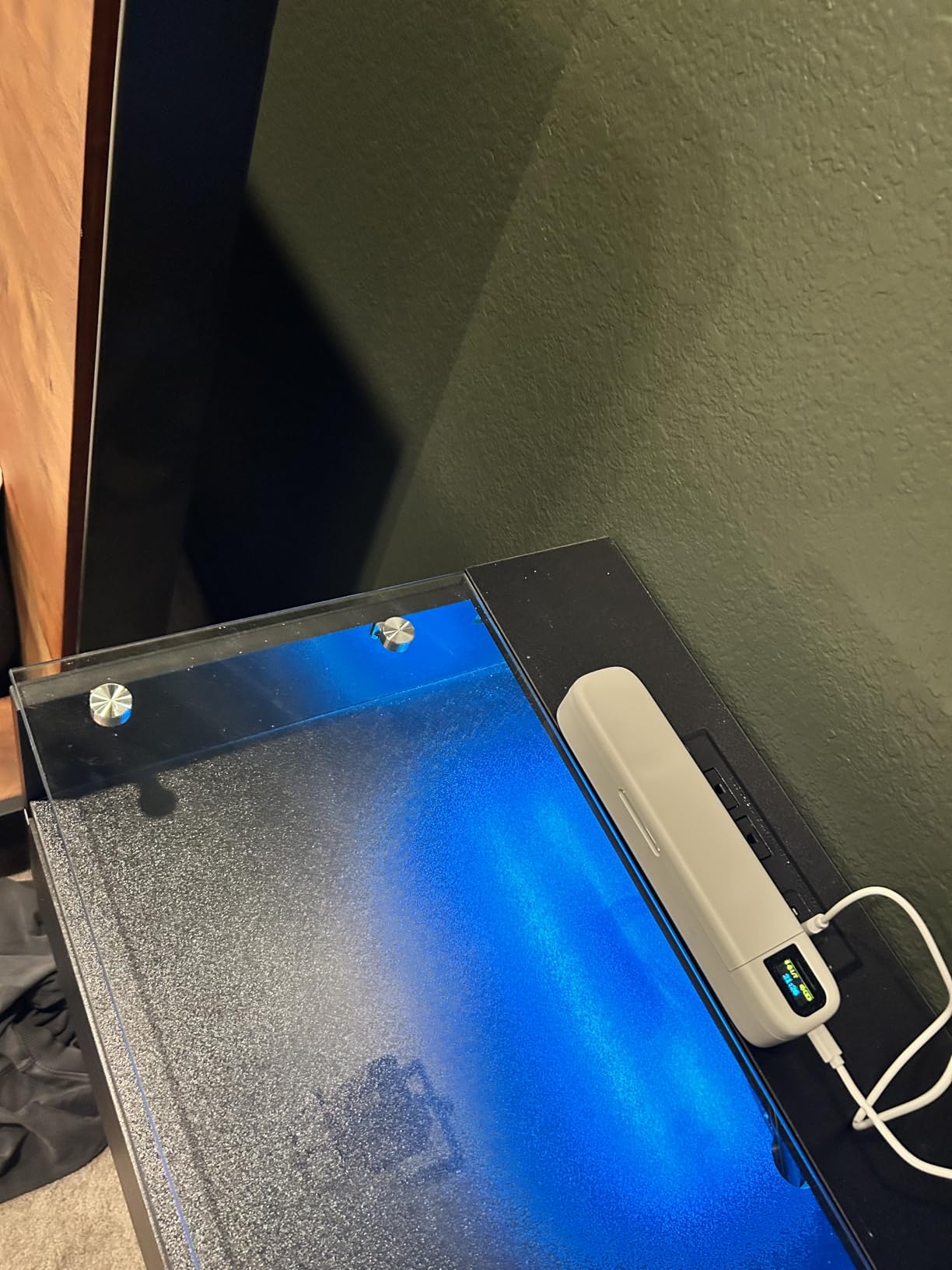
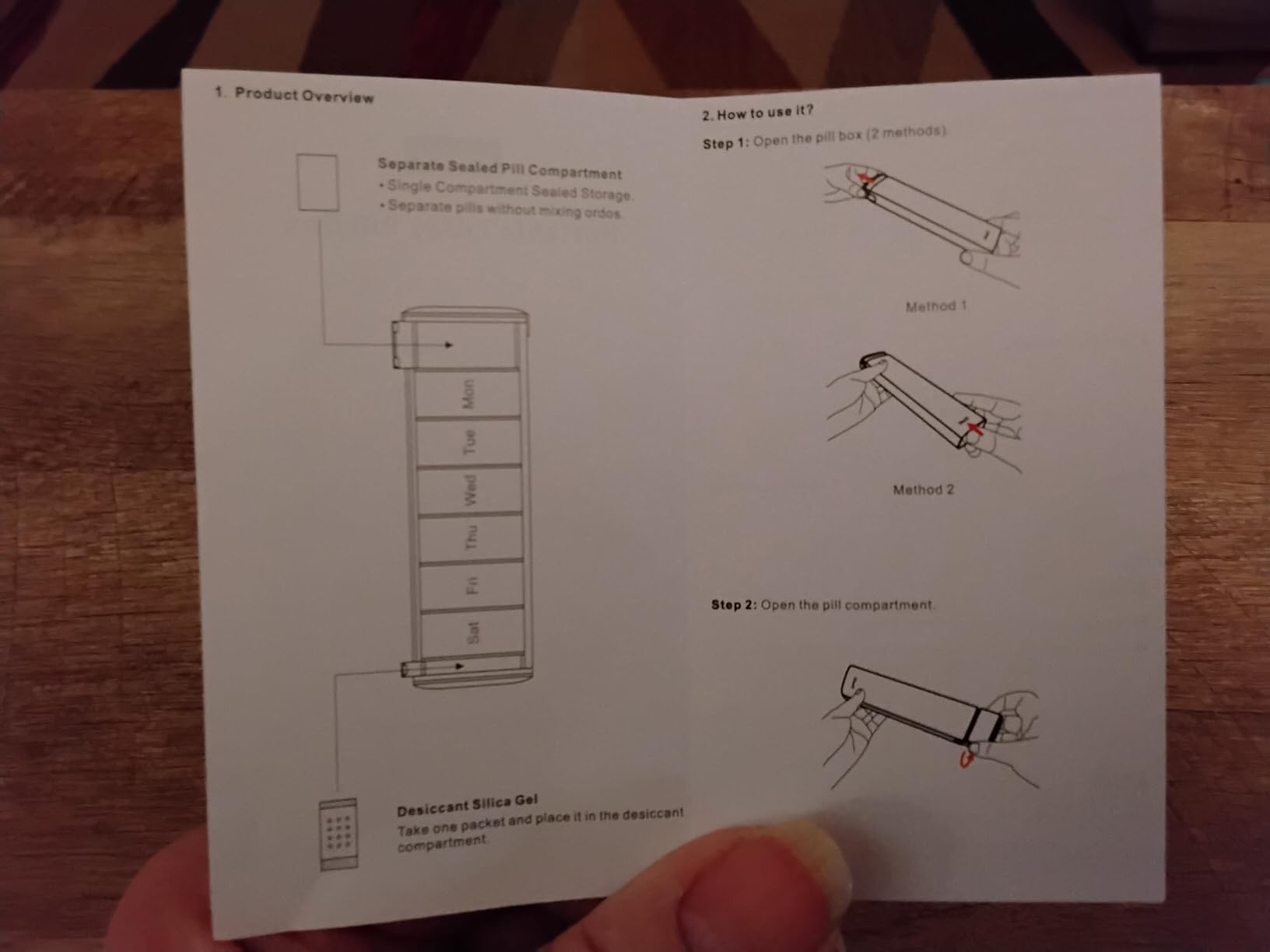
The smooth opening and closing lid is designed for arthritis, and reviewers single that out as a real advantage over stiff snap lids. Multiple programmed reminders per day handle a varied schedule, and four colour options help the user recognise their own unit.
Be clear about the limitation: the listing does not spell out the locking security or dose timing in the detail we would want before trusting it to someone who will go looking for future doses. The 4.0 average across 329 reviews is decent but sits below the locked models here, which is consistent with less specific praise for locking strength.
Use it as a companion for day trips while a locked dispenser stays at home, not as a replacement for one.
Who it suits
It fits someone in mild cognitive impairment who still initiates their own medication but needs a nudge on the days they are out of routine. Grandchildren doing sleepovers and weekend visits are a good example.
It also works as a secondary unit so a full month of medication is not sitting in a bag in a hot car.
Who should skip it
Skip it entirely if there is any history of taking extra doses or emptying a compartment by hand. This category of device is a reminder, and reminders fail with dementia.
If the goal is a caregiver to be alerted when a dose is missed, this unit cannot do that at all.
We may earn a commission at no additional cost to you. As an Amazon Associate I earn from qualifying purchases. CERTAIN CONTENT THAT APPEARS ON THIS SITE COMES FROM AMAZON. THIS CONTENT IS PROVIDED 'AS IS' AND IS SUBJECT TO CHANGE OR REMOVAL AT ANY TIME.
8. Ideerfit Expandable App Dispenser – Best for Long-Distance Caregivers
28-Day(1X) Automatic Pill Dispenser (Expandable Tray) – App & On-Device Setup by Family, LCD Display, Digital Lock, Sound & Light Alerts- Safe Medication Organizer for Dementia Seniors(2-Tray, White)
- Two programmable trays
- Free app with remote monitoring
- Digital lock with remote opening
- Dose history logs
Pros
- Remote monitoring gives real peace of mind
- Stopped a 94-year-old patient taking too much or too little
- Friendly voice alerts
- Each tray programs separately
- Heavy enough not to slide
Cons
- Lock mechanism feels too difficult for mild cognitive impairment
- Control panel separates from the body confusingly
- Dispense button is not visually obvious
- Extra trays cost more
- App lacks multi-user notifications
We earn a commission, at no additional cost to you. CERTAIN CONTENT THAT APPEARS ON THIS SITE COMES FROM AMAZON. THIS CONTENT IS PROVIDED 'AS IS' AND IS SUBJECT TO CHANGE OR REMOVAL AT ANY TIME.
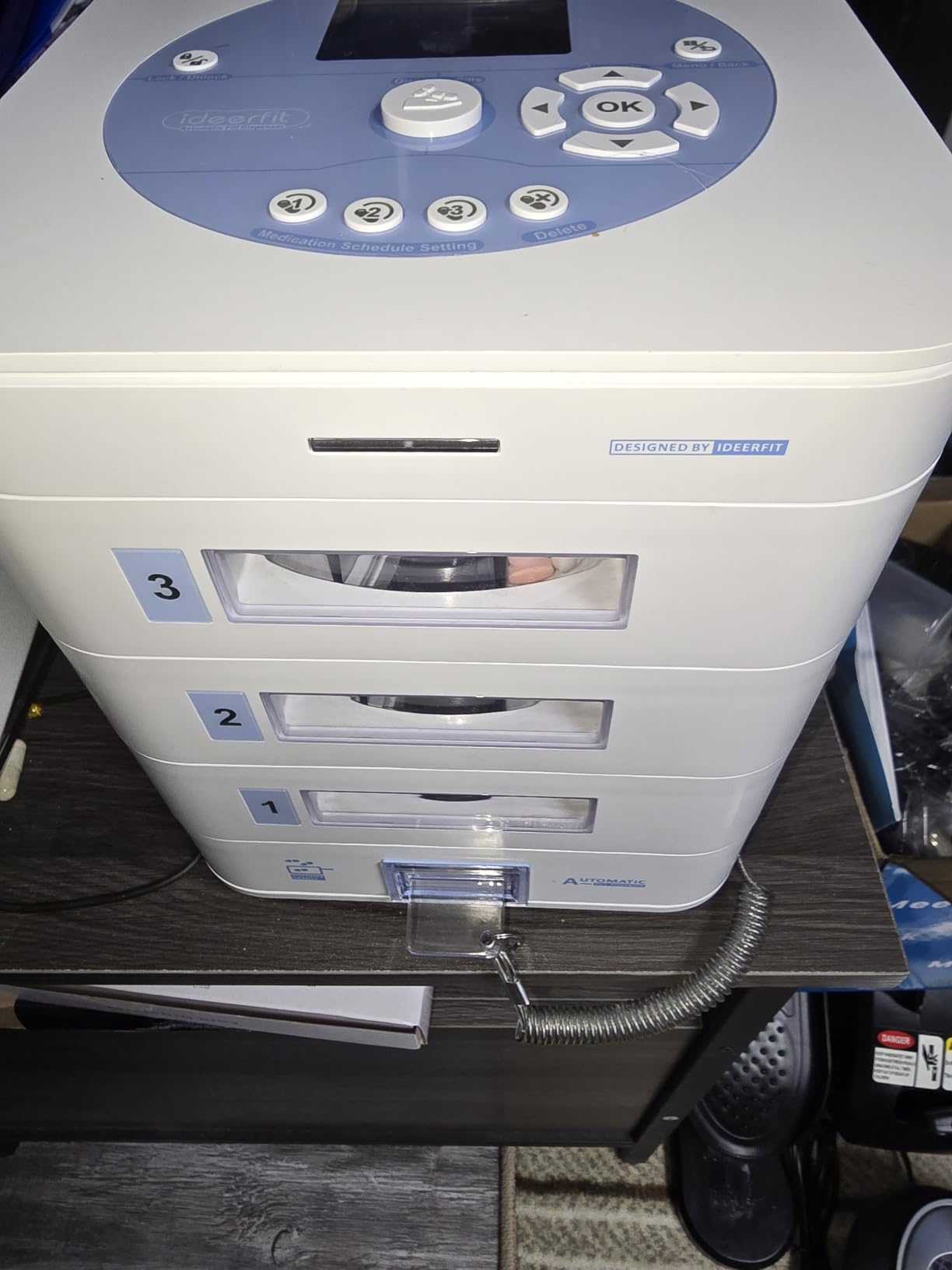
This is the only unit in our lineup built around a caregiver who is not in the house. The free companion app carries no subscription, sends missed-dose alerts, and shares dose history and adherence logs that you can hand to a doctor at the next appointment.
Two-tray modular design gives 14 slots per tray with one slot per dose, and each tray programs separately, which suits alternating-day medications such as some anticoagulants or osteoporosis treatments. There is no manual ring rotation, and setup can be done through the app or on the device with voice guidance.
Long-distance caregivers report that the notifications, voice alerts and remote dispensing function genuinely reduce missed and doubled doses. One owner describes it stopping a 94-year-old dementia patient from taking too much or too little, and reviewers note the unit is heavy enough not to slide across a counter.
The criticism is all about the patient end of the experience. The digital lock is described as feeling like a bank vault to someone with mild cognitive impairment, the top control panel separates from the dispenser in a confusing way, and the dispense button is not visually obvious enough, so people press the wrong one.
It also needs a WiFi connection and a technically capable caregiver, and tray capacity cannot be increased without buying another layer.
When remote oversight is the priority
It fits a family where one child manages the care from another state and wants evidence rather than a phone call. The adherence logs also matter for post-discharge transitions, when a hospital team asks whether medication was actually taken at home.
The second tray earns its keep for alternating-day regimens, and the remote opening function means nobody has to be present to hand over a dose.
When it is the wrong choice
Do not buy it for someone with early dementia living alone. A lock that feels like a vault to a mildly impaired user is a lock that stays shut with the dose inside, and the app will only report a missed dose after the fact.
If more than one caregiver needs to receive alerts, note that multi-user notifications are not supported yet.
We may earn a commission at no additional cost to you. As an Amazon Associate I earn from qualifying purchases. CERTAIN CONTENT THAT APPEARS ON THIS SITE COMES FROM AMAZON. THIS CONTENT IS PROVIDED 'AS IS' AND IS SUBJECT TO CHANGE OR REMOVAL AT ANY TIME.
9. Senyerkare Safety-Lock Dispenser – Best for Two or Three Doses a Day
SenyerKare Automatic Pill Dispenser with Safety Lock for Seniors, Dementia
- 80dB alarm plus flashing light
- Up to 6 daily alarms
- Two backup keys
- Settings survive battery changes
Pros
- Stopped repeated dosing for a dementia patient
- Visual-only mode when sound is unwanted
- Alarm runs 30 minutes if pills are not removed
- Settings survive a battery change
- Two keys supplied
Cons
- Plastic lock is cheap and one owner reported it breaking within four months
- Lock can be broken off
- Careless refilling lets a blank slot rotate instead of the dose
- Larger footprint than older models
- Setup confused older family members
We earn a commission, at no additional cost to you. CERTAIN CONTENT THAT APPEARS ON THIS SITE COMES FROM AMAZON. THIS CONTENT IS PROVIDED 'AS IS' AND IS SUBJECT TO CHANGE OR REMOVAL AT ANY TIME.
The Senyerkare is a straightforward 28-day carousel that fits smaller regimens. Capacity is stated for single daily dosing, and shorter cycles handle two- or three-times-daily plans, which is where it is most at home.
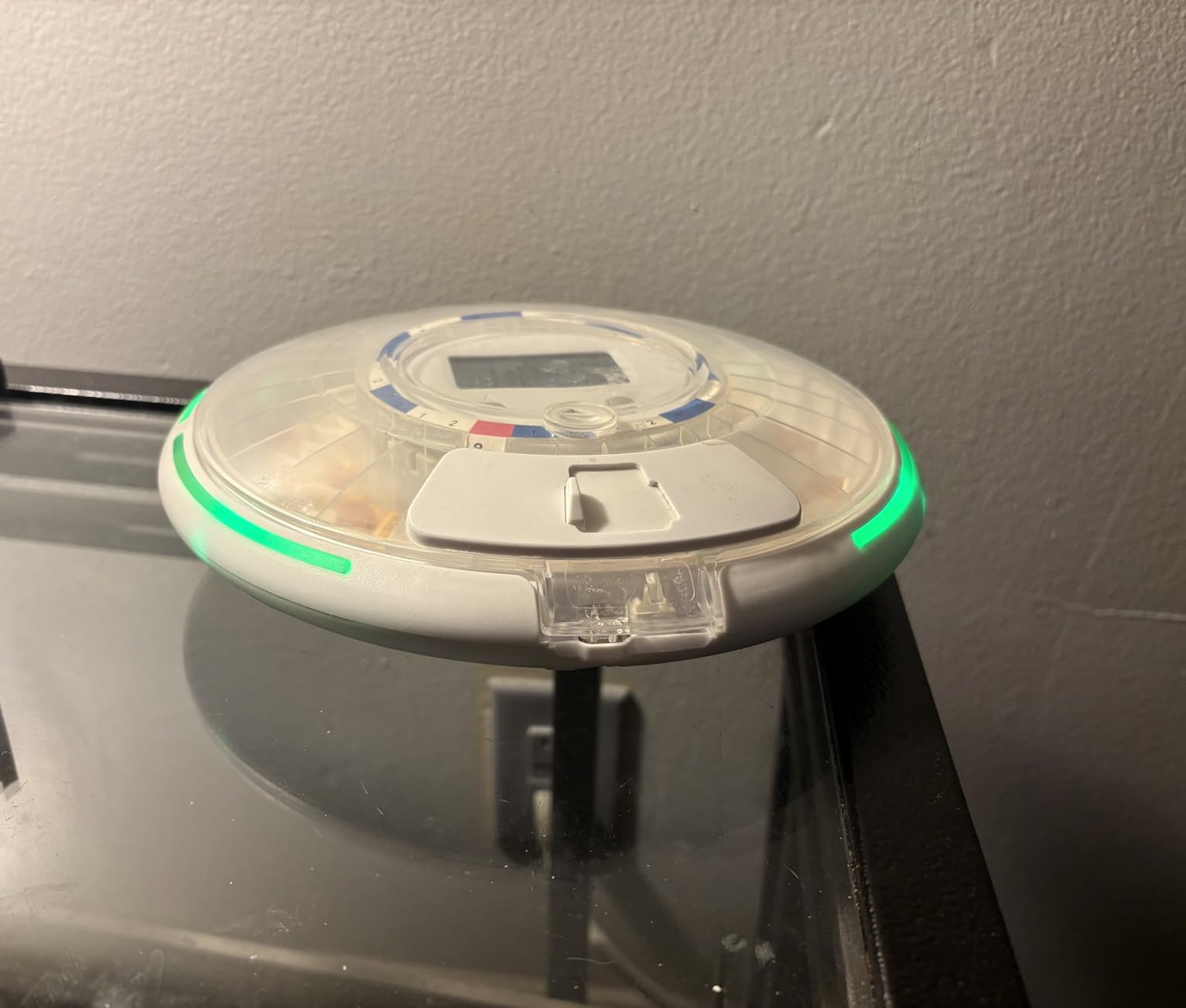
The 80dB alarm with a bright flashing light is loud on paper, and the alert runs for 30 minutes when the dose is not removed. That persistence is exactly what caregiver groups say separates a working dispenser from one that gets ignored. Visual-only mode is available for someone who finds alarms distressing.
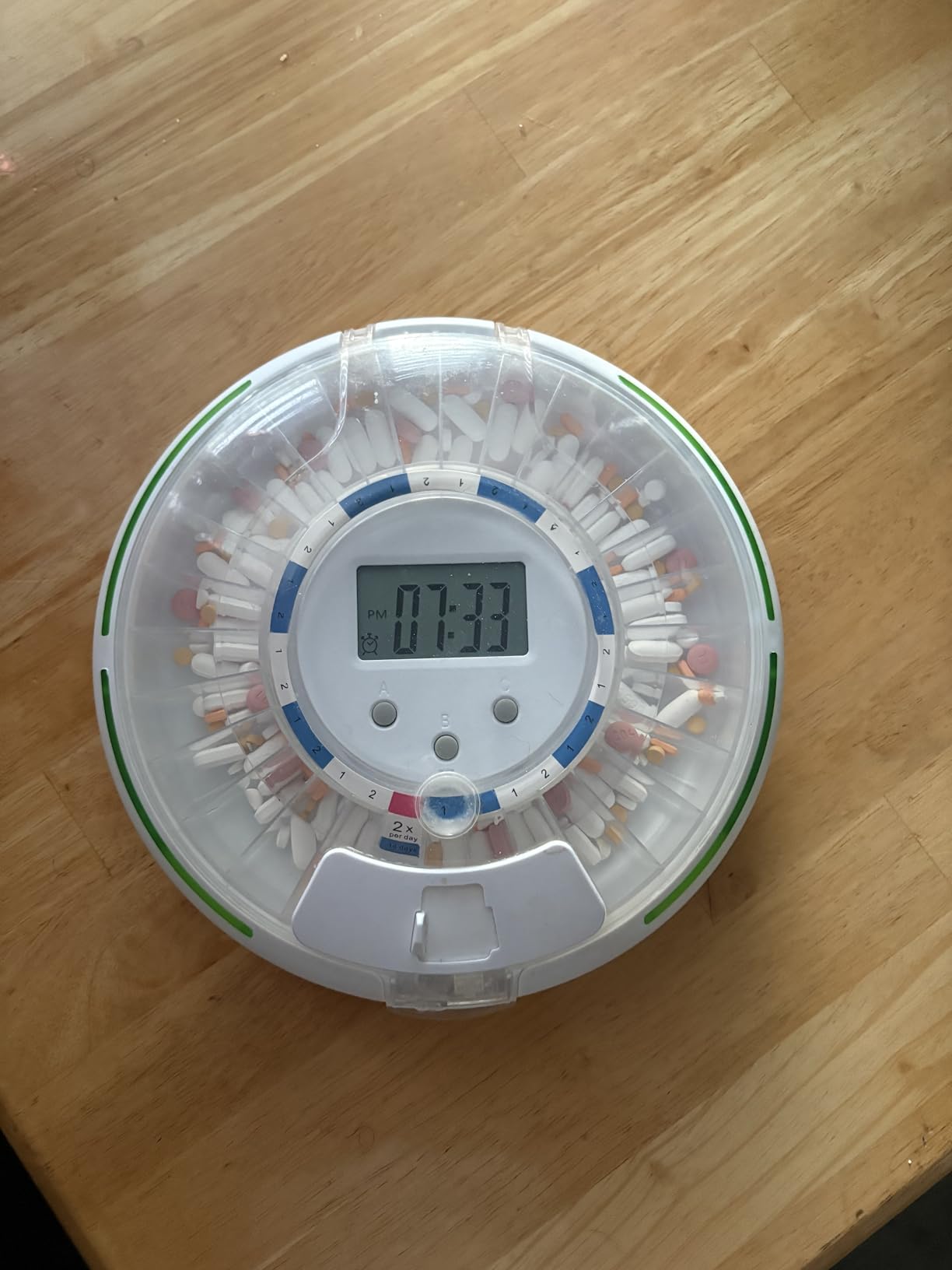
One feature deserves more attention than its listing suggests: the programming settings are saved after a battery change, so a routine four-AA swap does not mean reprogramming the whole month. The large super-bright LCD with large letters helps with vision, and the transparent lid lets a caregiver check upcoming doses.
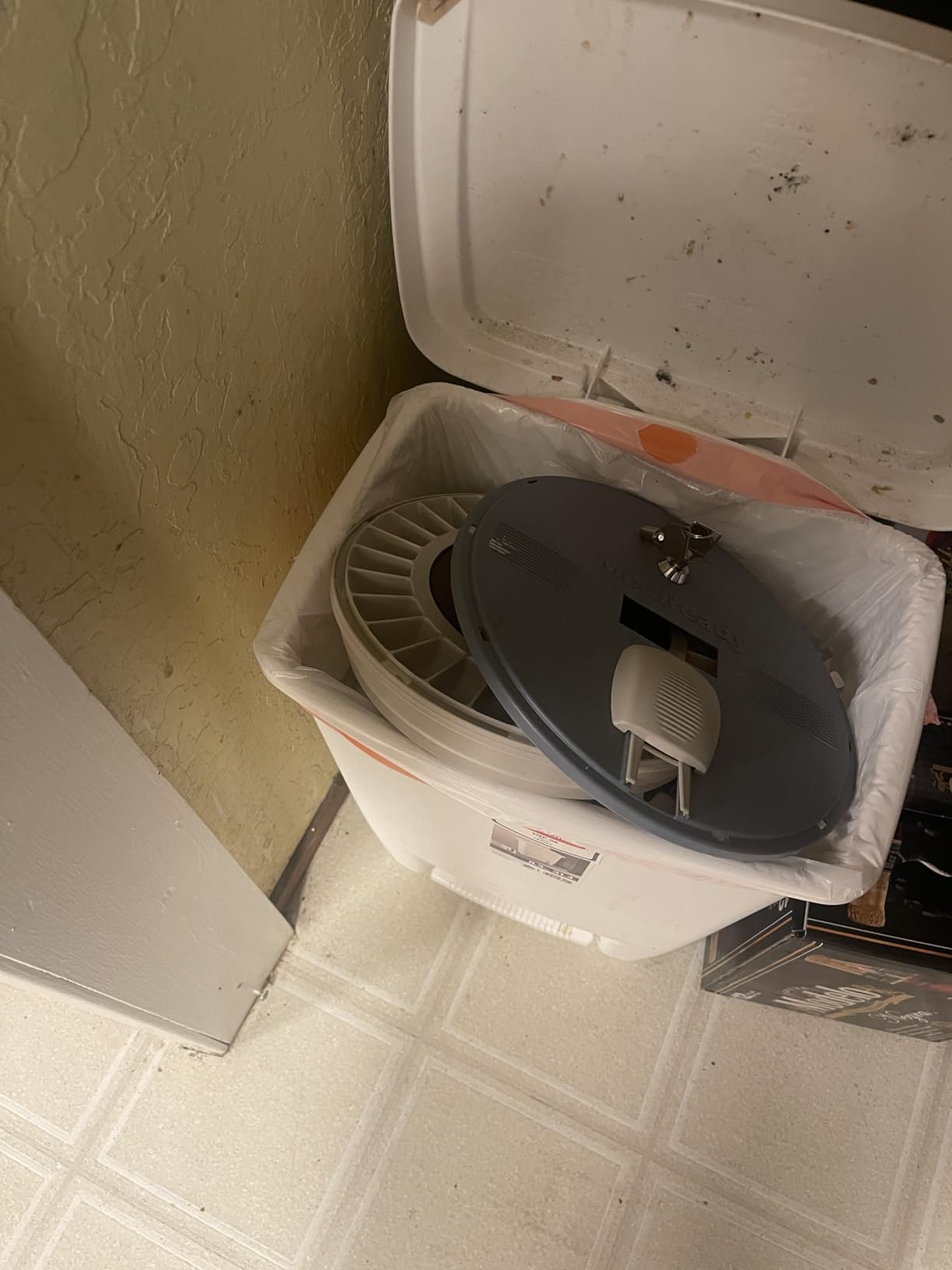
The lock is the problem. Several reviewers describe the plastic mechanism as cheap, one owner reported the lock breaking off within four months, and others say it could be forced open. That is precisely the mechanism you are relying on in mid-stage dementia.
There is also a filling error to avoid: if a plastic blank starting slot is left in place and the tray is refilled carelessly, the blank can rotate instead of a real dose.
Good fit for smaller regimens
It works for someone taking one to three doses a day whose main risk is forgetting a morning dose rather than deliberately seeking future ones. The battery-change memory also suits households where the person themselves replaces the batteries.
Choose it where a loud alarm is welcome and the household tolerates noise, since it is hard to ignore.
Poor fit for a determined user
Skip it if there is a pattern of pulling, prying or hitting devices. A plastic lock that can break off in four months will not survive that, and a failed lock is worse than no lock because it creates false confidence.
The larger footprint compared with older models also eats counter space in a small kitchen.
We may earn a commission at no additional cost to you. As an Amazon Associate I earn from qualifying purchases. CERTAIN CONTENT THAT APPEARS ON THIS SITE COMES FROM AMAZON. THIS CONTENT IS PROVIDED 'AS IS' AND IS SUBJECT TO CHANGE OR REMOVAL AT ANY TIME.
10. MedReady Alarm and Flashing Light Dispenser – Best for Hearing Loss
MedReady Automatic Pill Dispenser — Alarm Sound and Flashing Light, Elderly
- 85dB low-frequency alarm
- Bright red flashing LED
- Auto-lock after a missed dose
- NiMH backup battery
Pros
- Low-frequency 85dB alarm plus red light covers hearing and vision
- Missed doses lock automatically so they cannot be doubled
- Sloped exit ramp helps hands with arthritis
- Battery backup survives a power outage
- Self-illuminating display reads in any lighting
Cons
- Large footprint compared with compact carousels
- No remote or cellular monitoring on this model
- Only four dosing times per day
We earn a commission, at no additional cost to you. CERTAIN CONTENT THAT APPEARS ON THIS SITE COMES FROM AMAZON. THIS CONTENT IS PROVIDED 'AS IS' AND IS SUBJECT TO CHANGE OR REMOVAL AT ANY TIME.
If your relative has age-related hearing loss, this is the dispenser we would shortlist first, and the reason is the tone rather than the volume. An 85dB alarm in the low-frequency range is still detectable long after high-pitched beeps stop registering, which is exactly what several of the cheaper units on this list get wrong.
The bright red flashing LED runs alongside it, and both sound and light alerts adjust independently. Up to 9 standard-sized pills fit per compartment, with a 28-compartment tray dispensing one to four times per day.
The automatic lock after a missed dose is the standout behaviour here. When the tray moves past a dose without it being taken, the compartment locks, so the pills cannot be taken late and doubled. That directly answers the failure mode caregivers describe most.
The sloped exit ramp helps a senior with arthritis retrieve pills without lifting or tipping, and the rechargeable NiMH battery gives up to 48 hours of backup during a power cut. The self-illuminating display stays readable in any lighting.
The trade-offs are size and silence. At 14.5 by 12 inches it takes real counter space, and there is no remote or cellular monitoring, so a distant caregiver is not alerted when a dose is missed.
Why hearing loss changes the pick
Test the alarm before you commit. Stand in the room where the unit will sit and have someone switch it on at the far end. If it is not clearly audible, a high-pitched model will fail quietly, and a failing alarm is indistinguishable from no device at all.
This unit suits a senior who lives alone, is hard of hearing, and has a neighbour or family member who visits daily.
What it cannot do
With four dosing times available, it will not serve a regimen needing six or more alerts a day. And for long-distance caregiving it offers nothing, so a sibling in another city will not know whether the dose was taken.
Only four dosing times also means any as-needed medication cannot be scheduled here at all.
We may earn a commission at no additional cost to you. As an Amazon Associate I earn from qualifying purchases. CERTAIN CONTENT THAT APPEARS ON THIS SITE COMES FROM AMAZON. THIS CONTENT IS PROVIDED 'AS IS' AND IS SUBJECT TO CHANGE OR REMOVAL AT ANY TIME.
11. e-Pill MedSmart Voice – Best for Spoken Reminders
e-Pill MedSmart Voice Automatic Pill Dispenser with English or Spanish Voice Alerts – Locked Medication Reminder & Pill Organizer for Seniors, Dementia, Alzheimer’s, Caregivers & Assisted Living
- English or Spanish voice alerts
- Up to 9 daily reminders
- Keyed locking cover
- AC power plus AA backup
Pros
- Spoken reminders clearer than a beep for hearing or vision loss
- English and Spanish voice options for bilingual households
- Locking cover and keys prevent out-of-sequence access
- AC power with AA backup runs through outages
- 30-day money-back guarantee and one-year warranty
Cons
- Among the more expensive units in this group
- Voice-only alerts may go unnoticed by someone who does not process speech well
We earn a commission, at no additional cost to you. CERTAIN CONTENT THAT APPEARS ON THIS SITE COMES FROM AMAZON. THIS CONTENT IS PROVIDED 'AS IS' AND IS SUBJECT TO CHANGE OR REMOVAL AT ANY TIME.
The e-Pill MedSmart Voice is the pick when tone-based alarms are not landing. It speaks the reminder in English or Spanish, paired with flashing LED lights, which reaches a senior who has lost both hearing and the ability to parse a small display quickly.
The 28-compartment removable tray allows up to 9 daily reminders, and the secure locking cover with included keys prevents access to doses out of sequence. It runs on an AC adapter with 4 AA batteries as backup and gives a low battery alert, and an easy-fill guide is included.
Caregivers find the spoken reminders clearer than a tone, particularly for someone with hearing or vision loss, and bilingual households can match the language the person actually thinks in. e-Pill has supplied hospitals and pharmacies for decades, and the 30-day money-back guarantee plus one-year warranty reduces the risk of a senior’s first experience with a device.
The cost sits well above the mechanical carousels here, and buyers accept that trade for the voice alerts. The second limitation matters: someone with advanced cognitive impairment may not process or retain a spoken instruction, in which case the words pass over without producing a dose taken.
Who benefits most
It fits a Spanish or English-speaking senior with moderate hearing loss who still follows verbal instructions reliably but ignores beeps. Bilingual households are a specific and often overlooked fit for this unit.
The backup power also suits homes where outages are frequent.
Where speech is not enough
Skip it for someone whose short-term memory is significantly impaired, because a spoken reminder is only as good as the ability to act within a minute of hearing it. In that situation a persistent tone plus a flashing light serves better.
It also has no app or remote monitoring, so it works only for households with in-person oversight.
We may earn a commission at no additional cost to you. As an Amazon Associate I earn from qualifying purchases. CERTAIN CONTENT THAT APPEARS ON THIS SITE COMES FROM AMAZON. THIS CONTENT IS PROVIDED 'AS IS' AND IS SUBJECT TO CHANGE OR REMOVAL AT ANY TIME.
12. Bloom Flower Locked 28-Day Dispenser – Best for Simple Locked Setup
Automatic Pill Dispenser for Elderly with Alarm, Lock 28-Day Medication Dispenser, 6 Dosage Templates, Sound & Light Alerts & Key for Vitamins, Supplements (Clear Lid)
- Locked 28-day carousel
- 6 dosage templates
- Key included
- Sound and light alerts
Pros
- Highest proportion of five-star ratings among the units we reviewed
- Lock keeps a dementia patient from reaching future doses
- Sound and light alerts support hearing or vision loss
- Six templates adapt to different schedules
Cons
- Smallest review base here so long-term reliability is unproven
- Alarm volume
- capacity and power details are not stated
We earn a commission, at no additional cost to you. CERTAIN CONTENT THAT APPEARS ON THIS SITE COMES FROM AMAZON. THIS CONTENT IS PROVIDED 'AS IS' AND IS SUBJECT TO CHANGE OR REMOVAL AT ANY TIME.
The Bloom Flower does the fundamentals and nothing more: a locked 28-day carousel, six dosage templates covering one to six daily doses, sound and light alerts, and a key for the lid. It weighs 1.87 pounds and measures 8.86 inches square, so it is compact and easy to place.
Its 4.4 average comes with the highest proportion of five-star ratings of any unit we reviewed, so sentiment is strongly positive. The locked design does the core job of keeping a dementia patient away from future doses.
The honest limitation is the sample size. With 42 reviews, long-term reliability is simply not established, and a handful of years of daily use is a long time to run a motorised mechanism on that little evidence.
The published detail is thin too, with only one bullet point, so alarm volume, per-slot capacity and power source are not stated. We would want to confirm those before committing.
Why it is still worth a look
If you want a plain locked carousel with no app, no rechargeable battery and no complicated interface, this is a clean starting point. Six templates are enough for most regimens, and the key keeps future doses sealed.
It also suits a family testing whether a dispenser is acceptable to their parent before investing in a more elaborate unit.
Why we would hesitate
With under 50 reviews and no stated capacity or volume details, we would not hand this to someone whose medication includes a blood thinner, insulin or anything where a missed or doubled dose is dangerous.
Confirm the alarm is audible where the unit will sit before filling it, since volume is not published.
We may earn a commission at no additional cost to you. As an Amazon Associate I earn from qualifying purchases. CERTAIN CONTENT THAT APPEARS ON THIS SITE COMES FROM AMAZON. THIS CONTENT IS PROVIDED 'AS IS' AND IS SUBJECT TO CHANGE OR REMOVAL AT ANY TIME.
How to Choose a Pill Dispenser for Dementia Care
The difference between a dispenser that helps and one that gets abandoned in a drawer is almost never the feature list. It is whether the lock holds, whether the alarm is heard, and whether the person accepts the device. Work through these seven points in order.
1. The lock is the whole point
A physical key lock, PIN pad or fingerprint scanner is the only category that reliably stops a person with dementia reaching future doses. Child-resistant squeeze-and-turn lids are designed to slow a determined four-year-old, not an adult who has been told the pills are not theirs. Two reviewers here reported plastic locks breaking or being forced, and one supplied key failed even against a child.
One-way dispense matters just as much. If the current dose sits exposed in a slot and everything else stays sealed, the failure mode is designed out. Dispensers that tip the whole unit or remove a full tray reintroduce the problem.
2. Match the alert to the hearing, not the spec sheet
Age-related hearing loss typically removes high frequencies first, so a thin beeping tone may be inaudible while a low-frequency rumble still registers. The 85dB low-frequency alarm on the MedReady and the spoken alerts on the e-Pill both address this; the high-pitched alarm reviewers criticised elsewhere does not.
Pair sound with a flashing light, check that the alert runs continuously rather than for a few seconds, and test it from the far side of the room before you fill the tray. Caregivers also report that a persistent alarm gets ignored after a few weeks, so anything that stops on its own is a liability.
3. How many doses, and how often does someone refill
Most carousels cover 28 days, which is one refill a month instead of four weekly top-ups. Refill discipline is where these devices quietly fail: a carousel that runs out is more dangerous than no device at all, because the person believes their medication is handled.
Put a recurring reminder in the caregiver’s own calendar, and check the unit yourself on a fixed weekly basis.
4. What your regimen does to a carousel
Two limits catch families out. As-needed medications cannot go in a carousel, because it schedules a dose whether or not it is needed, so keep PRN prescriptions in a locked pouch in the same room. And cup-drop or tip-out dispensers cannot dispense a half-dose from a tablet cut in two, so any split tablet needs a separate locked storage solution.
Injections, inhalers and drops that are not oral tablets are outside what any of these machines handle. Ask your pharmacist for a written schedule, then program only the fixed oral doses.
5. Match the device to the dementia stage
In early-stage dementia or mild cognitive impairment, a plain locked carousel is usually enough, and a portable reminder unit can cover days out of the house. In mid-stage dementia, you want a keyed lock, a persistent alarm, and ideally a caregiver who checks in daily. In late-stage dementia, a consumer dispenser is no longer sufficient and the right move is a pharmacy lockbox program, in-home nursing or a Medicaid HCBS waiver assessment.
Late-stage escalation is not giving up. It is the point where professional medication administration replaces consumer hardware.
6. Power, connectivity and what happens when it fails
Decide whether your household has reliable WiFi before buying anything app-based, because a connected dispenser that loses its link is just a locked box. Units that run entirely on the device keep working through an outage, and AC-powered models with AA backup are worth it if outages are common.
Then think about failure. A mechanical carousel that jams at 2am with no remote alert is a genuine safety risk for someone living alone, so weight the documented reliability history heavily for single-occupant homes.
7. How you introduce it decides whether it works
Caregiver groups frame this as less about the device and more about whether the loved one accepts it, because people with dementia often read a locked dispenser as a statement that they are no longer trusted with their own medication.
Frame it as convenience rather than control. Something along the lines of this works well: the alarm means nobody has to drive over to check whether you took your tablets. Position the unit as something that removes a chore, set it up while doing something else so it is not a ceremony, and let the first month be collaborative. If the person pushes the reset button repeatedly, work out which button resets it and cover it before that becomes a habit.
What not to buy
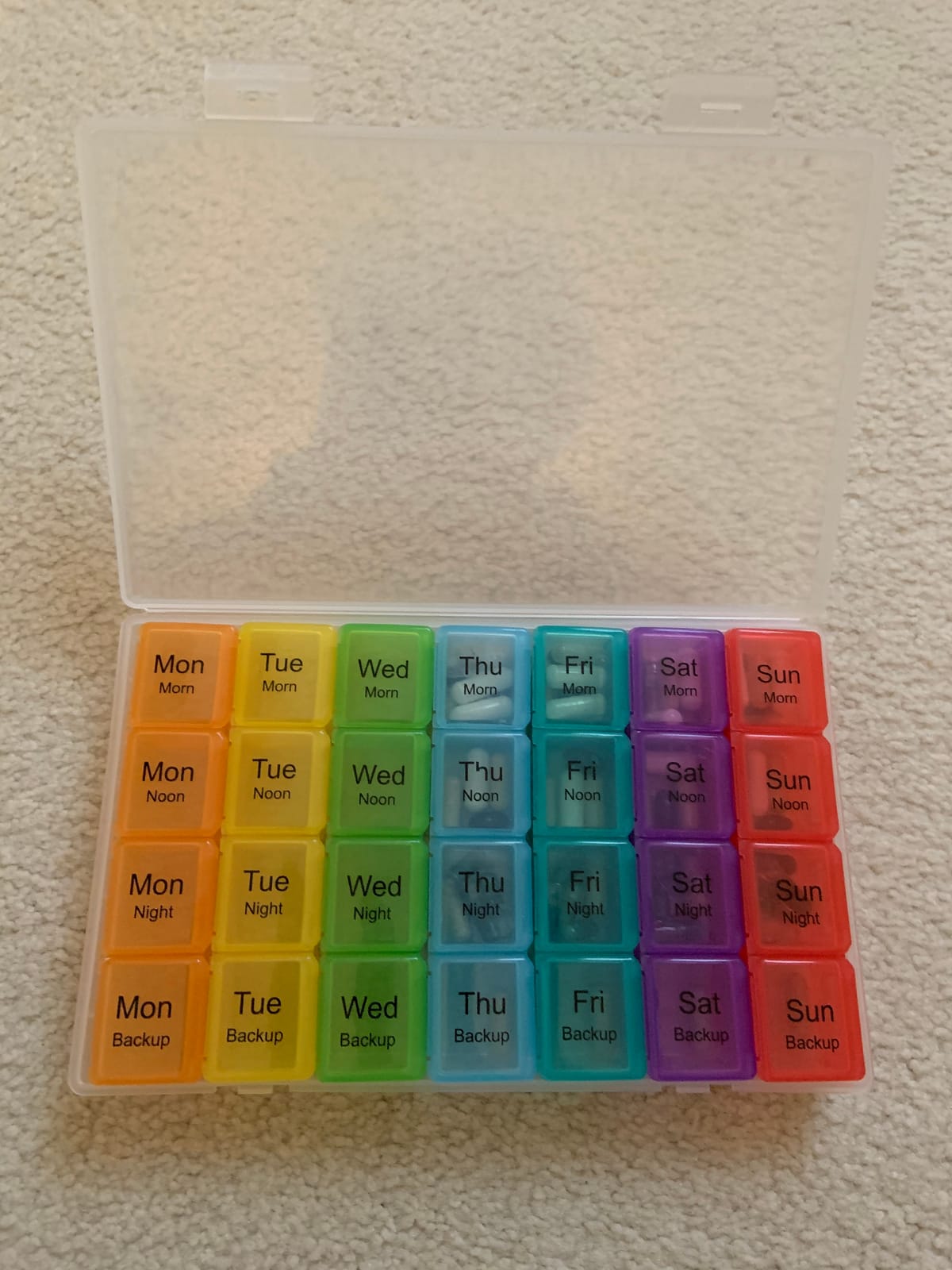
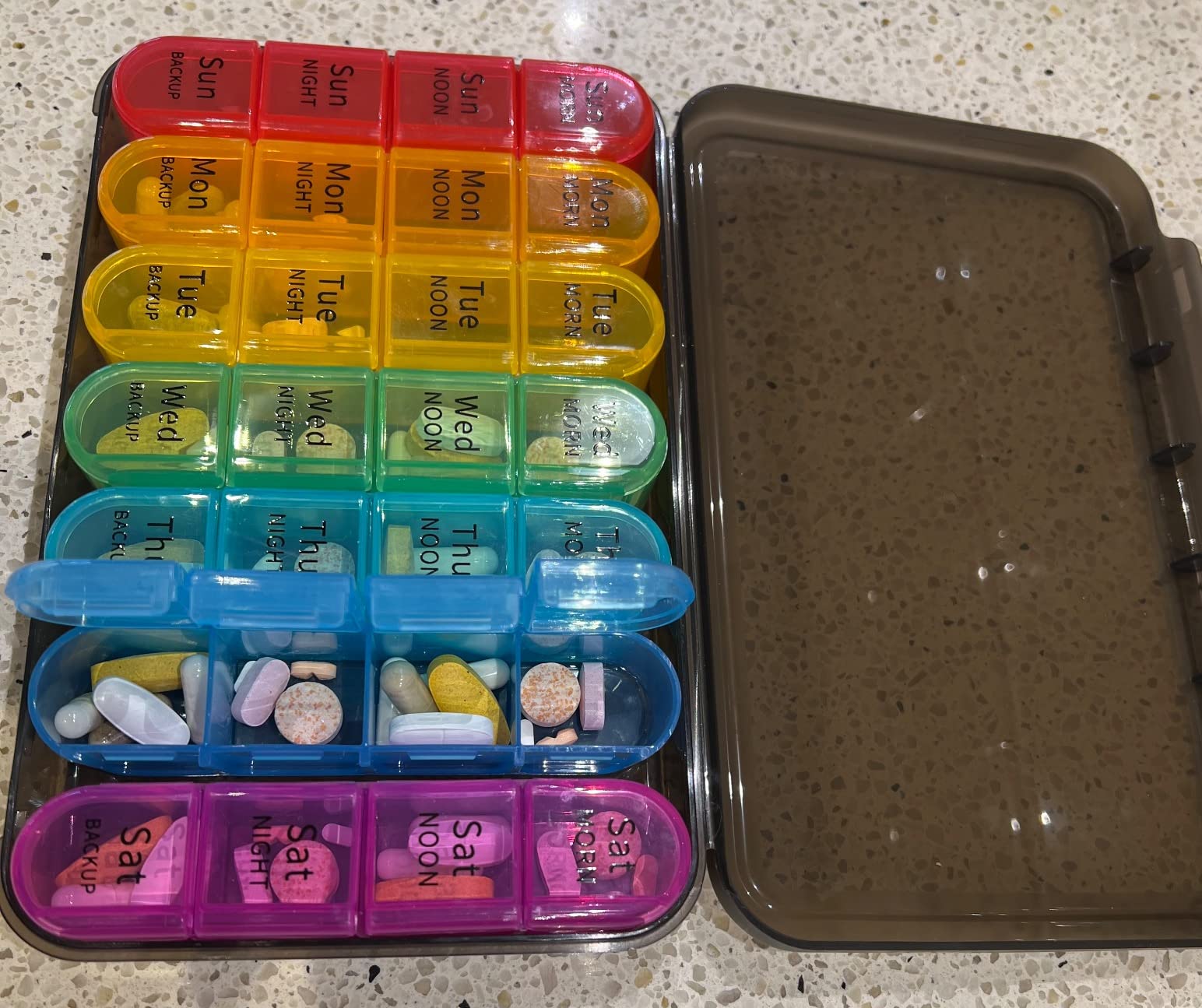
Skip the non-locking weekly plastic organiser once double-dosing has happened even once. It is not a cheaper version of a locked carousel, because it solves none of the problems that led you to look. Also avoid any product whose listing does not state its locking mechanism in plain language, since that is the feature manufacturers describe most vaguely.
Insurance, savings and who pays
Original Medicare Part B generally does not cover an automatic pill dispenser as durable medical equipment. There are four routes worth checking, and they are real. A Medicare Advantage plan may offer a supplemental benefit allowance that could apply. A Medicaid HCBS waiver can fund medication management services in some states. Health savings accounts and flexible spending accounts may reimburse an item recommended in writing by a clinician, and a Letter of Medical Necessity plus a Schedule A medical deduction can help at tax time. Veterans may have Aid and Attendance support routed through a VA primary care provider.
Ask the clinician for the letter before you buy, not after. It changes both the account reimbursement and the tax position.
Frequently Asked Questions
Which pill dispenser is best for people with dementia?
The best pill dispensers for seniors with dementia are locked 28-day automatic carousels that expose only the current dose, alert with both sound and a flashing light, and keep future compartments sealed with a key or fingerprint lock. For most households we recommend the Windtrace, which pairs a keyed 28-compartment tray with a loud alarm and flashing blue light. Caregivers who cannot be present daily should add a model with remote caregiver alerts on top of the lock.
Are automatic pill dispensers safe for Alzheimer’s patients?
They are safer than an unlocked organizer for early-stage and mid-stage Alzheimer’s, because they prevent a person from taking tomorrow’s dose today or double-dosing after a forgotten one. They are not a complete safety solution. The lock must be a real key, PIN or fingerprint rather than a child-resistant lid, and the alarm must be audible to the person. In late-stage dementia a consumer dispenser is no longer sufficient and professional medication administration is needed.
Are there pill dispenser machines specifically designed for seniors?
Yes. They fall into three tiers: simple locked 28-day carousels with an alarm, which suit most early and mid-stage cases; larger dispensers built for limited dexterity with fingerprint or palm-activated access; and connected dispensers that notify a caregiver’s phone app when a dose is missed. The second and third tiers cost more but reduce caregiver workload considerably.
How does a medication dispenser work?
A caregiver fills a rotating tray with 28 pre-sorted single-dose compartments, then locks the lid. At each programmed time the unit sounds an alarm and flashes a light, and the tray rotates one dose into an exposed slot. The person takes that dose and the remaining compartments stay sealed until the key is used. Only the current dose is ever reachable, which is what prevents double-dosing and wrong-day errors.
What to do if a dementia patient takes tomorrow’s pills today
Treat it as a safety event rather than a mistake. Call the prescribing pharmacist or doctor the same day, because a doubled dose of many common medicines is dangerous even when the person feels fine. Then change the storage system, since an unlocked organizer cannot prevent this. Move to a keyed or fingerprint dispenser where only one dose is exposed at a time, and keep a written record of doses taken until a professional review.
Will Medicare pay for a medication dispenser?
Original Medicare Part B does not generally cover an automatic pill dispenser as durable medical equipment. A Medicare Advantage plan may offer a supplemental benefit that applies, a Medicaid HCBS waiver can fund medication management services in some states, and health savings accounts or flexible spending accounts may reimburse the unit when a clinician documents the need in a letter. Veterans can ask a VA primary care provider about Aid and Attendance support.
Conclusion: The Best Pill Dispensers for Seniors With Dementia in 2026
If you are starting from scratch in 2026, the Windtrace is where we would start, because it pairs the largest volume of real-world feedback with a genuine keyed lock and an alarm that carries both sound and light. If cost or hand strength is the deciding factor, the LiveFine gives you a key lock, nine dosing rings and 18 pills per slot at a lower tier.
Add the Betife when you need the strongest dementia-specific locking and the tightest seal against pills migrating between slots. Move up to the Colorwing for fingerprint access and a palm-activated opening if arthritis is the barrier. Choose the MedReady when hearing loss is the primary problem, the e-Pill when spoken reminders land better than tones, and the app-connected Ideerfit two-tray unit when the caregiver is not in the house.
Whichever you choose, the lock and the alarm decide whether it works, and the conversation you have introducing it decides whether it stays on the counter. If you are already past double-dosing, replace the plastic organiser this week rather than next week, and ask your pharmacist for a written schedule plus a letter of medical necessity while you are there.