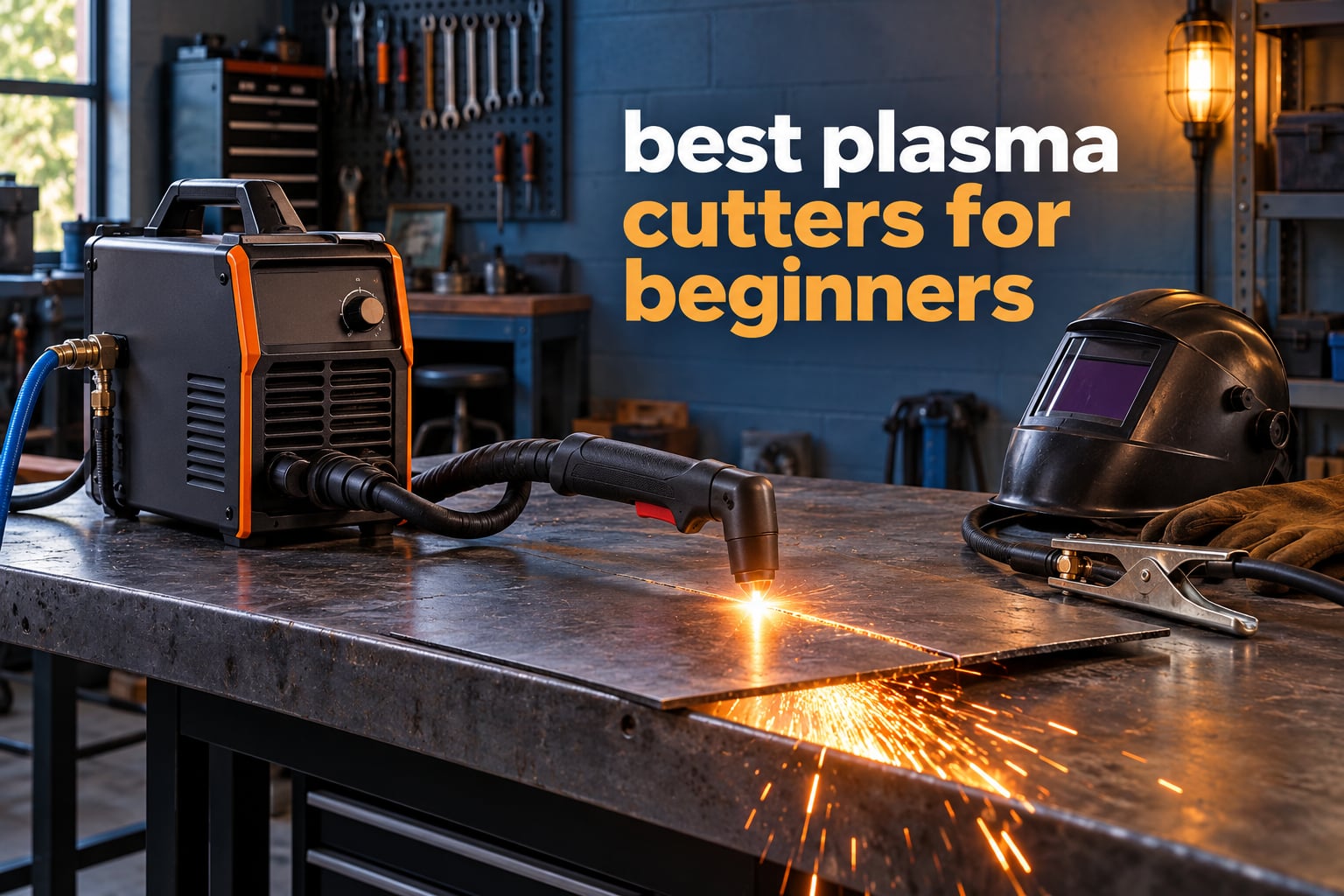
A plasma cutter is the single biggest upgrade a garage hobbyist can make, and also the fastest way to waste a Saturday if you buy the wrong machine. The best plasma cutters for beginners share a few traits that matter more than headline wattage: a pilot arc torch that starts without touching the metal, automatic 110V/220V switching so you are not rewiring a circuit, and a duty cycle your air compressor can actually keep up with.
Plasma cutting itself is simple physics. A torch sends an arc through compressed air, the arc ionizes that air into plasma, and the superheated jet melts the metal while blowing the molten material away. That is why a plasma cutter slices clean through 1/4 inch steel in a way an acetylene torch never will, and why it works on aluminum and stainless as well as mild steel.
We spent weeks reading owner feedback, comparing published cut capacities, amperage, torch types, and air requirements across ten machines in the entry-level bracket where most beginners actually start. The result is a roundup that skips the spec-sheet fluff and focuses on what changes your cuts: pilot arc reliability, whether the rated output matches what you get, and how fast the consumables burn through.
If the terminology is unfamiliar, the buying guide further down covers the fundamentals before you come back for the individual verdicts.
ContentsTable of Contents
- 1Top 3 Best Plasma Cutters for Beginners in 2026→
- 2LOTOS LTP5505D 55A→
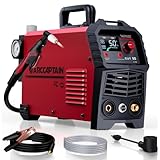
- 3ARCCAPTAIN CUT50 50A→
- 4YESWELDER CUT-60DS 60A→
- 5All 10 Plasma Cutters Compared in 2026→
- 61. LOTOS LTP5505D 55A Pilot Arc Cutter – The Most Proven Beginner Machine→
- 7LOTOS LTP5505D 55A Pilot Arc Plasma Cutter with Rust Removal Mode→
- 8Pros→
- 9Cons→
- 10What You Get Right With the LTP5505D→
- 11Where the LTP5505D Falls Short→
- 122. S7 50A Dual Voltage Cutter – Low Cost With a Simpler Torch→
- 1350A Plasma Cutter with LED Display, Dual Voltage 110V/220V, Clean Metal Cutting up to 1/2″ Steel, Easy Setup PT31 Torch, Lightweight for DIY & Home Workshops→
- 14Pros→
- 15Cons→
- 16Who This S7 Cutter Suits Best→
- 17Where It Falls Short→
- 183. ARCCAPTAIN CUT50 50A – Best Value With Error Code Readouts→
- 19ARCCAPTAIN 50A Plasma Cutter Machine, 110V/220V Dual Voltage, 2/3″ Max Cut→
- 20Pros→
- 21Cons→
- 22Why the Error Codes Matter for a Beginner→
- 23Where the CUT50 Loses Points→
- 244. Bestarc 50A IGBT 7Gen – Fastest Path From Box to First Cut→
- 25Bestarc Plasma Cutter Machine, Pilot Arc, 50A IGBT 110V 220V Dual Voltage→
- 26Pros→
- 27Cons→
- 28Best Features for Someone Learning→
- 29Where the Bestarc Falls Short→
- 305. PRIMEWELD CUT50D 50A – Best Warranty and After-Sales Support→
- 31PrimeWeld 50A Air Inverter Plasma Cutter, Portable Plasma Cutting Machine, Premium and Rugged Plasma Cutter Kit, Automatic Dual Voltage 110V/220V AC with Plasma Torch, 1/2″ Clean Cut, CUT50D→
- 32Pros→
- 33Cons→
- 34What You Give Up Compared With the Others→
- 35Why the Support Story Decides This One→
- 366. ARCCAPTAIN iControl CUT55 Pro – Best for Heavy Plate Without an Upgrade→
- 37ARCCAPTAIN iControl CUT55 Pro Plasma Cutter Machine, 55Amp, 120V/240V→
- 38Pros→
- 39Cons→
- 40Where the Extra Amperage Pays Off→
- 41Where the CUT55 Pro Is the Wrong Choice→
- 427. GZ GUOZHI CUT-50 50A – Built for Cold-Weather and Outdoor Work→
- 43GZ GUOZHI Plasma Cutter, 50 Amp Air Inverter Plasma Cut, 110V/220V Dual Voltage Digital Display IGBT Inverter Plasma Cutting Machine with 2T/4T/TEST Function→
- 44Pros→
- 45Cons→
- 46Why the Duty Cycle Number Matters→
- 47What to Watch Before You Buy→
- 488. YESWELDER CUT-60DS 60A – Best Non-HF Start for CNC Work→
- 49YESWELDER 60A Non-HF Plasma Cutter, Non-Torch Pilot Arc, 110/220V→
- 50Pros→
- 51Cons→
- 52When Blowback Beats High-Frequency Start→
- 53Where the CUT-60DS Falls Short→
- 549. ARCCAPTAIN CUT55 55A – Simplest Settings for a Total Beginner→
- 55ARCCAPTAIN 55A Plasma Cutter Machine, Non-Touch Pilot Arc, 120V/240V→
- 56Pros→
- 57Cons→
- 58Why Defaults Beat a Feature List for Newcomers→
- 59What the Reviews Flag→
- 6010. DNYKER CUT50 50A MOS – The Lowest-Cost Way to Make a First Cut→
- 61Plasma Cutter, CUT50 50Amp 110V/220V Dual Voltage Cutting Machine, Non-Touch Pilot Arc Plasma Cutter Machine Air Plasma Cutter with High-Frequency Start, Portable Plasma Cutter MOS Type→
- 62Pros→
- 63Cons→
- 64What You Get for the Entry Cost→
- 65Where the DNYKER Falls Short→
- 66How to Choose a Plasma Cutter: Buying Guide for Beginners in 2026→
- 67What Size Plasma Cutter Do I Need?→
- 68Will a 20 Gallon Air Compressor Run a Plasma Cutter?→
- 69Pilot Arc vs Contact Start: Which Is Better for Beginners?→
- 70High-Frequency Start vs Blowback Start for CNC Tables→
- 71Dual Voltage and Your Electrical Setup→
- 72What 2T/4T Mode and Post-Flow Actually Do→
- 73Consumables Cost and Availability→
- 74Safety Gear You Actually Need→
- 75Used vs New: A Quick Framework→
- 76Frequently Asked Questions→
- 77What size plasma cutter do I need as a beginner?→
- 78Will a 20 gallon air compressor run a plasma cutter?→
- 79Is a Harbor Freight plasma cutter any good?→
- 80What is a good and cheap plasma cutter for a first cut?→
- 81Are Hypertherm plasma cutters better than budget brands?→
- 82Final Verdict: The Best Plasma Cutters for Beginners in 2026→
Top 3 Best Plasma Cutters for Beginners in 2026

LOTOS LTP5505D 55A
- Non-touch pilot arc
- 55A inverter
- 5/8 inch clean cut
- Automatic 110V/220V
ARCCAPTAIN CUT50 50A
- 1/2 inch clean cut
- 2T/4T modes
- LED error codes
- 13 lb portable

YESWELDER CUT-60DS 60A
- Non-HF blowback start
- 60A output
- ETL certified
- Digital readout
As an Amazon Associate we earn from qualifying purchases. CERTAIN CONTENT THAT APPEARS ON THIS SITE COMES FROM AMAZON. THIS CONTENT IS PROVIDED 'AS IS' AND IS SUBJECT TO CHANGE OR REMOVAL AT ANY TIME.
These three cover the realistic beginner scenarios. The LOTOS LTP5505D is the safest first machine because it has the largest owner base in the group and nothing in it is unusual to service. The ARCCAPTAIN CUT50 is the option with the clearest diagnostics and one of the lightest bodies in the group, and the YESWELDER CUT-60DS exists for one specific reason: a blowback start that will not interfere with a CNC controller.
All 10 Plasma Cutters Compared in 2026
| # | Product | Key details | Where to buy |
|---|---|---|---|
| 1 | LOTOS LTP5505D 55A Pilot Arc |
|
Check Latest Price |
| 2 |  S7 50A Dual Voltage with LED Display S7 50A Dual Voltage with LED Display |
|
Check Latest Price |
| 3 | ARCCAPTAIN CUT50 50A |
|
Check Latest Price |
| 4 | 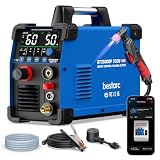 Bestarc 50A IGBT with App Control Bestarc 50A IGBT with App Control |
|
Check Latest Price |
| 5 |  PRIMEWELD CUT50D 50A PRIMEWELD CUT50D 50A |
|
Check Latest Price |
| 6 |  ARCCAPTAIN iControl CUT55 Pro ARCCAPTAIN iControl CUT55 Pro |
|
Check Latest Price |
| 7 |  GZ GUOZHI CUT-50 50A GZ GUOZHI CUT-50 50A |
|
Check Latest Price |
| 8 | YESWELDER CUT-60DS 60A |
|
Check Latest Price |
| 9 |  ARCCAPTAIN CUT55 55A Pilot Arc ARCCAPTAIN CUT55 55A Pilot Arc |
|
Check Latest Price |
| 10 |  DNYKER CUT50 50A MOS DNYKER CUT50 50A MOS |
|
Check Latest Price |
We earn from qualifying purchases. CERTAIN CONTENT THAT APPEARS ON THIS SITE COMES FROM AMAZON. THIS CONTENT IS PROVIDED 'AS IS' AND IS SUBJECT TO CHANGE OR REMOVAL AT ANY TIME.
Two things jump out of the comparison. Every machine here is a genuine inverter unit, not an old transformer design, and every one runs dual voltage. The real differences are amperage, start type, and how much the manufacturer supports after the sale.
1. LOTOS LTP5505D 55A Pilot Arc Cutter – The Most Proven Beginner Machine
LOTOS LTP5505D 55A Pilot Arc Plasma Cutter with Rust Removal Mode
- 55A inverter
- Non-touch pilot arc
- 5/8 inch clean cut
- Auto 110V/220V
Pros
- Non-touch pilot arc starts without touching the work
- Automatic 110V/220V sensing works on household circuits
- Front-mounted air regulator with pre-fitted leak-free Type-D plug
- Cuts 1/2 inch steel with little dross
- 16 lb body is easy to carry
Cons
- Ground cable is shorter than the torch lead
- Air fittings may need extra thread seal tape
- Documentation is thin on air pressure and amperage
- Consumables wear faster at full power
We earn a commission, at no additional cost to you. CERTAIN CONTENT THAT APPEARS ON THIS SITE COMES FROM AMAZON. THIS CONTENT IS PROVIDED 'AS IS' AND IS SUBJECT TO CHANGE OR REMOVAL AT ANY TIME.
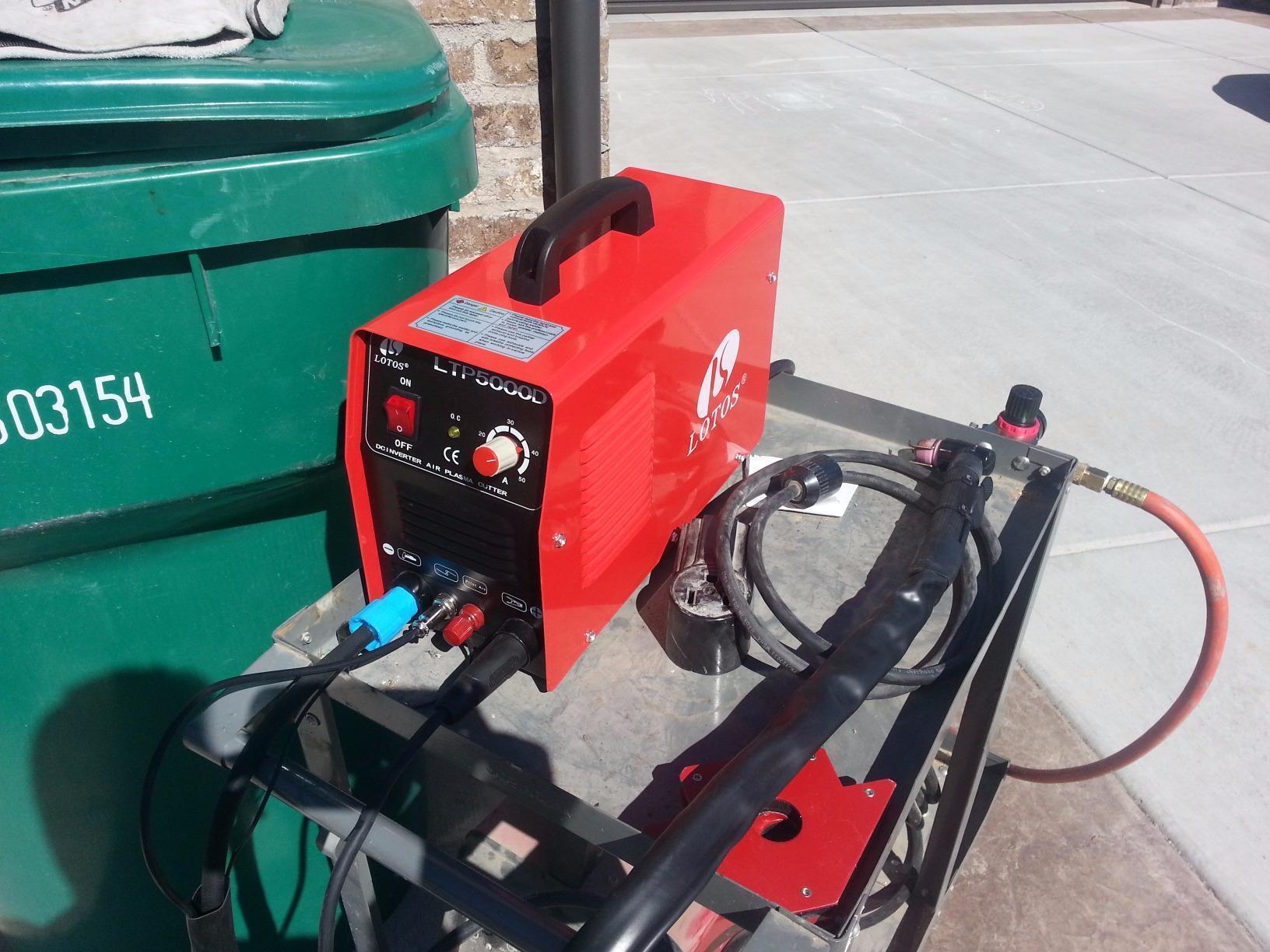
This is the machine we keep coming back to for a first cut, and the reason is the owner base rather than the spec sheet. With 2400 reviews averaging 4.4 stars, there is simply more evidence about how this cutter behaves after six months of garage use than about any other machine in this group.
The pilot arc lights without touching the workpiece, which matters more than beginners expect. On thin plate you can start the arc, push it through a line, and close the trigger at the end. On rusty or painted metal you are not dragging a copper tip across scale to trigger the arc, which is what wears tips and produces ragged starts.
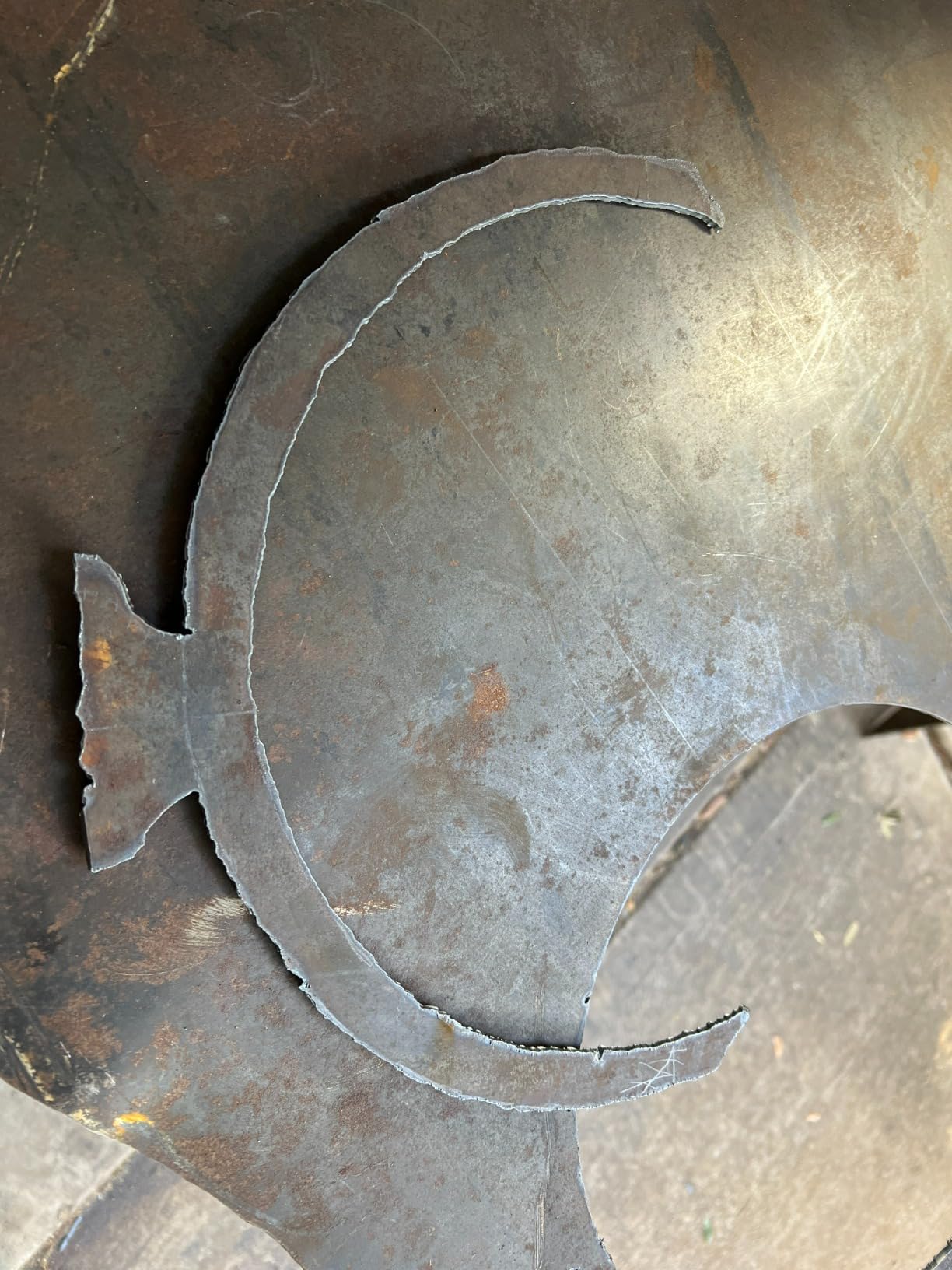
Rated cut capacity is the thickness at which the machine makes a fast, square, dross-free cut. It is not the same as the maximum cut figure, which is the point where you can still force a cut but the edge quality has fallen apart. This machine rates 5/8 inch clean, so 1/4 inch and 3/8 inch mild steel is routine rather than a fight.
Automatic 110V/220V switching means you can start on a 120V household circuit and move to a 240V branch later without a converter. On 220V you get the full output that makes 1/2 inch cuts quick. The front-mounted air regulator with a pre-fitted NPT 1/4 inch Type-D plug is a small detail that saves real time, because a loose air fitting is the most common reason a plasma arc will not strike.
What You Get Right With the LTP5505D
Owners consistently describe an easy first experience and strong value against commercial machines, and the pilot arc gets specific credit for extending consumable life. The rust removal mode adjusts the pilot current for dirty metal, which is the feature that keeps the arc stable when you are cutting through a truck floor pan instead of clean new steel.
At 16 pounds, this is light enough to carry with one hand between a workbench and a sawhorse setup. The 10 x 10 x 10 inch footprint means it does not take over a small bench, and dual voltage means the same machine works in a rented shop bay or your own garage.
Where the LTP5505D Falls Short
The ground cable is noticeably shorter than the torch lead, and that imbalance causes awkward setups where the work sits at the far end of a table. Measure your typical workpiece before you buy and plan to add a heavier ground clamp if you cut large plate.
Consumables are consumed relatively quickly when you run it at full power, and the included documentation is thin on air pressure and amperage guidance. A small minority of owners reported a failure within a month that the manufacturer replaced, which is worth knowing but is not the pattern across 2400 reviews.
We earn a commission, at no additional cost to you. CERTAIN CONTENT THAT APPEARS ON THIS SITE COMES FROM AMAZON. THIS CONTENT IS PROVIDED 'AS IS' AND IS SUBJECT TO CHANGE OR REMOVAL AT ANY TIME.
2. S7 50A Dual Voltage Cutter – Low Cost With a Simpler Torch
50A Plasma Cutter with LED Display, Dual Voltage 110V/220V, Clean Metal Cutting up to 1/2″ Steel, Easy Setup PT31 Torch, Lightweight for DIY & Home Workshops
- 50A output
- 110V/220V dual voltage
- PT31 torch
- 18.5 lb body
Pros
- Very low entry cost for a dual-voltage 50A machine
- Clean 1/2 inch cuts on 220V
- PT31 consumables are cheap and widely available
- 18.5 lb portable body with paddle trigger
Cons
- Ground lead is only about 3 feet long
- PT31 contact start struggles on rusty metal
- Included tip wears faster than spares
- Output falls short of advertised 1/2 inch on thick plate
We earn a commission, at no additional cost to you. CERTAIN CONTENT THAT APPEARS ON THIS SITE COMES FROM AMAZON. THIS CONTENT IS PROVIDED 'AS IS' AND IS SUBJECT TO CHANGE OR REMOVAL AT ANY TIME.
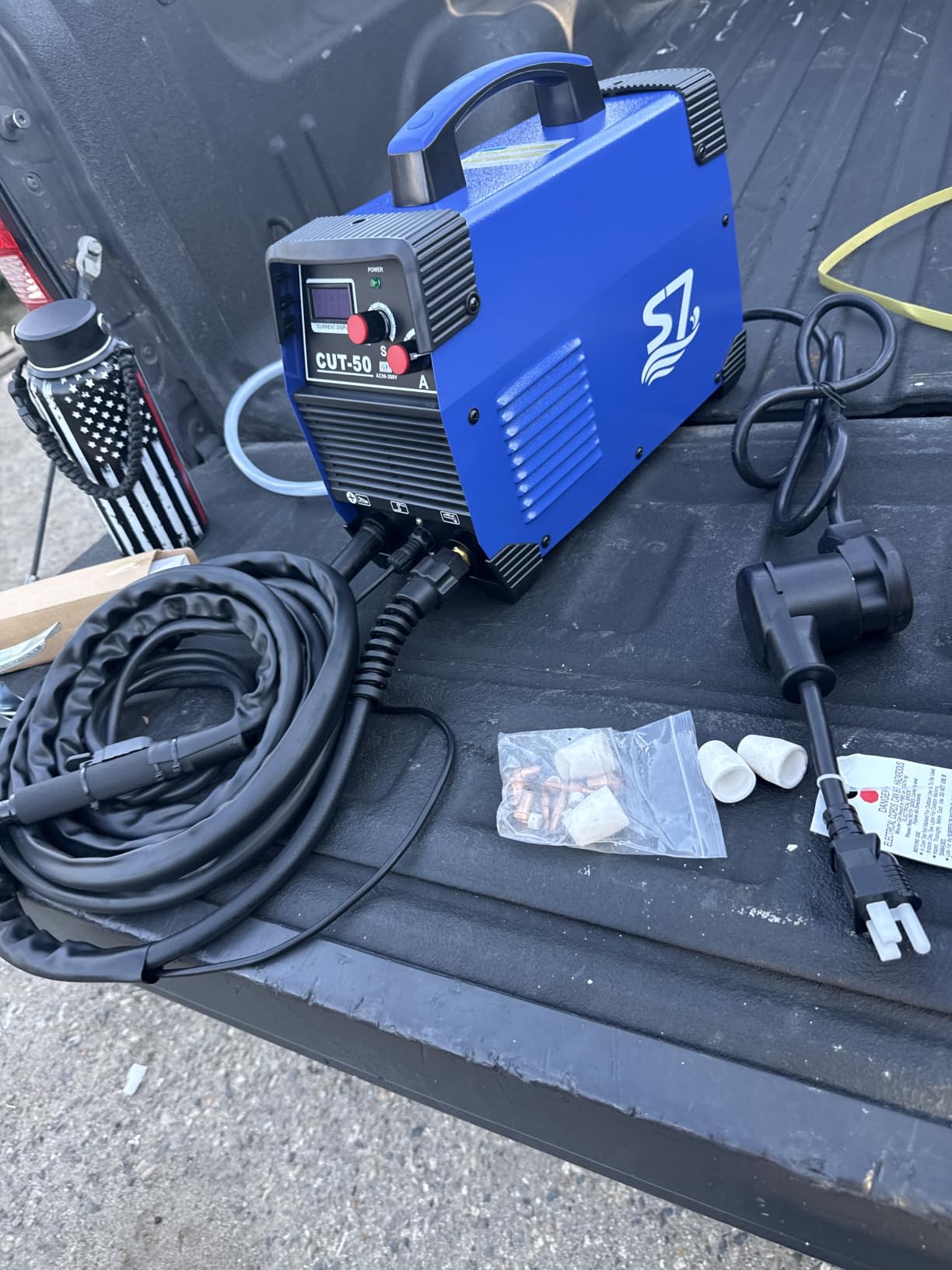
This machine exists to answer one question: can a beginner get a real cut for very little money? The answer is yes, with a caveat about torch type that we will get to. It carries 1837 reviews at 4.2 stars, and several owners describe multi-year daily use on car restoration and home steelwork.
On 220V it makes clean 1/2 inch cuts, and on 110V it still handles 3/8 inch. That dual capability is what makes it useful in a house garage, where you may only have a standard receptacle in reach. The compact LED current display gives you a rough sense of output setting, and the paddle-style trigger is simple enough that no instruction manual is required.
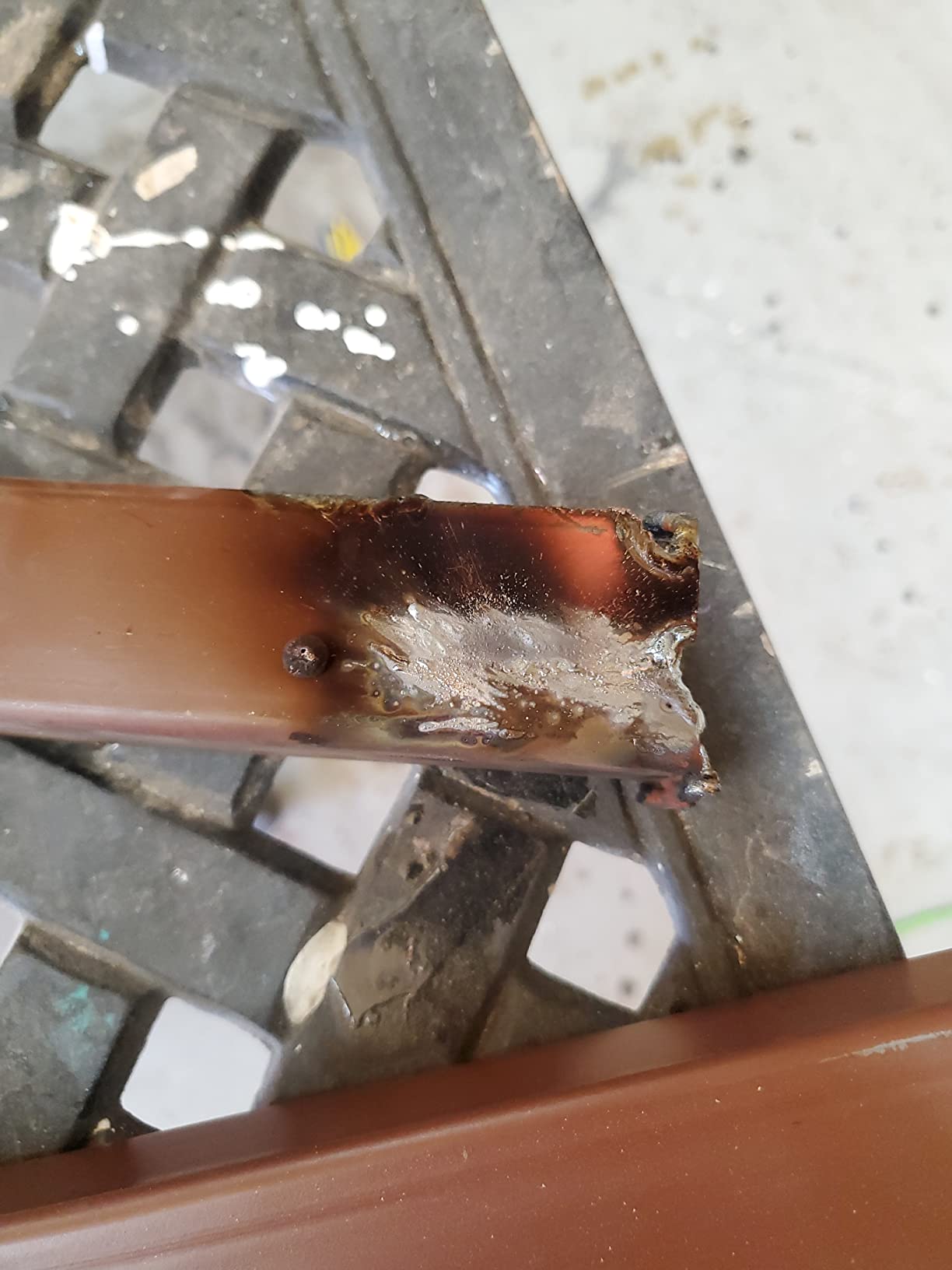
The most important thing about this cutter is the PT31 torch. It is a contact-start torch, meaning you touch the tip to the metal to strike the arc. That works fine on clean, flat metal, but on rusty or painted material the initial strike is unreliable and it eats consumables faster than a pilot arc torch would. If your project list is mostly rusty brackets, old frames, and trailer steel, look at a machine with a non-touch pilot arc instead.
On the positive side, PT31 consumables are inexpensive and available almost everywhere, including local welding shops. When the tip dulls, you replace it in a minute and for pennies rather than tracking down a proprietary part. That availability matters more to a beginner than the small quality difference between brands.
Who This S7 Cutter Suits Best
If your material is clean sheet metal, perforated panel, or mild steel bar and your budget is the deciding factor, this does the job without much fuss. Several owners use it as a secondary machine and keep a higher-amperage cutter for thick plate. The 17 x 14 x 10 inch body fits on a rolling cart without dominating the workspace.
It also works as a learning machine. Because consumables are cheap and plentiful, you can afford to make the mistakes a first-timer makes. Wrong amperage, wrong travel speed, and sloppy edge prep cost you a cheap tip rather than an expensive consumable kit.
Where It Falls Short
The 3 foot ground lead is the most common complaint and it is a real constraint. You will constantly reposition the work to stay within reach of the clamp, or you will buy an aftermarket ground clamp with a longer lead.
Second, actual output on thick plate falls short of the advertised 1/2 inch capacity. Owners consistently report good performance up to around 3/8 inch and a noticeable slowdown and messier edge beyond that. The included tip also wears faster than the spare consumables, so budget for replacements from the start.
We earn a commission, at no additional cost to you. CERTAIN CONTENT THAT APPEARS ON THIS SITE COMES FROM AMAZON. THIS CONTENT IS PROVIDED 'AS IS' AND IS SUBJECT TO CHANGE OR REMOVAL AT ANY TIME.
3. ARCCAPTAIN CUT50 50A – Best Value With Error Code Readouts
ARCCAPTAIN 50A Plasma Cutter Machine, 110V/220V Dual Voltage, 2/3″ Max Cut
- 50A output
- 1/2 inch clean cut
- LED error codes
- 13 lb with strap
Pros
- Only 13 lb with a shoulder strap for job site moves
- Pre-installed air filter and quick connect mean no setup guesswork
- LED display and error codes make troubleshooting straightforward
- Cuts 1/2 inch steel smoothly on 240V
- IGBT protection against overload and overheating
Cons
- Some owners report an inconsistent arc that stops mid-cut
- No laminated settings chart for amperage and PSI
- Cut finish on thin material is less clean than heavier machines
- Air hose is short
We earn a commission, at no additional cost to you. CERTAIN CONTENT THAT APPEARS ON THIS SITE COMES FROM AMAZON. THIS CONTENT IS PROVIDED 'AS IS' AND IS SUBJECT TO CHANGE OR REMOVAL AT ANY TIME.
The ARCCAPTAIN CUT50 is the machine we recommend when someone wants a well-engineered feel without stepping up a class. At 4.5 stars across 1307 reviews, it matches the highest rating among the most-reviewed machines here, and the design decisions are aimed squarely at someone learning as they cut.
Two details set it apart. The LED screen shows live voltage and current plus specific error codes, so when something goes wrong you get a reason instead of a blinking light. And the pre-installed metal-cased air filter with a quick-connect 1/4 inch NPT fitting means the air path is sealed from the factory, which removes the most common first-week failure mode of budget cutters.
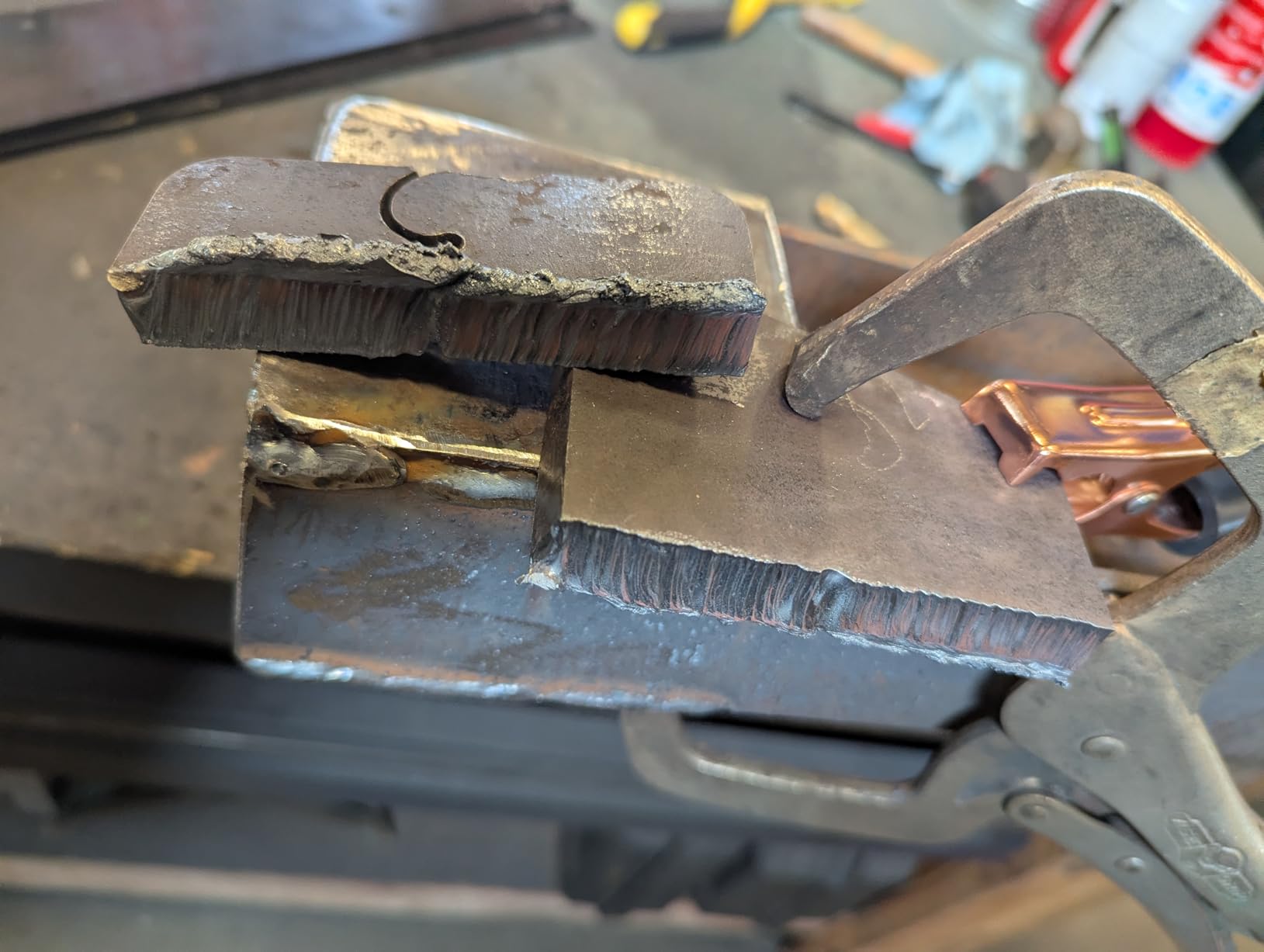
Recommended capacity is 12mm at 35A on 110V at 55 PSI, and 18mm at 50A on 220V at 75 PSI. The listed 2/3 inch maximum is a severance figure; the 1/2 inch clean cut is what you should plan your projects around. Owners confirm 1/2 inch steel cuts smoothly on 240V with little dross.
At 13 pounds with a shoulder strap, this is one of the easiest machines in the roundup to move from a garage to a driveway job. The 13 x 6 x 8 inch body is small enough to sit on a shelf, and IGBT modules with overload, overheat, and overcurrent protection give you some confidence that a stalled cut will not cook the electronics.
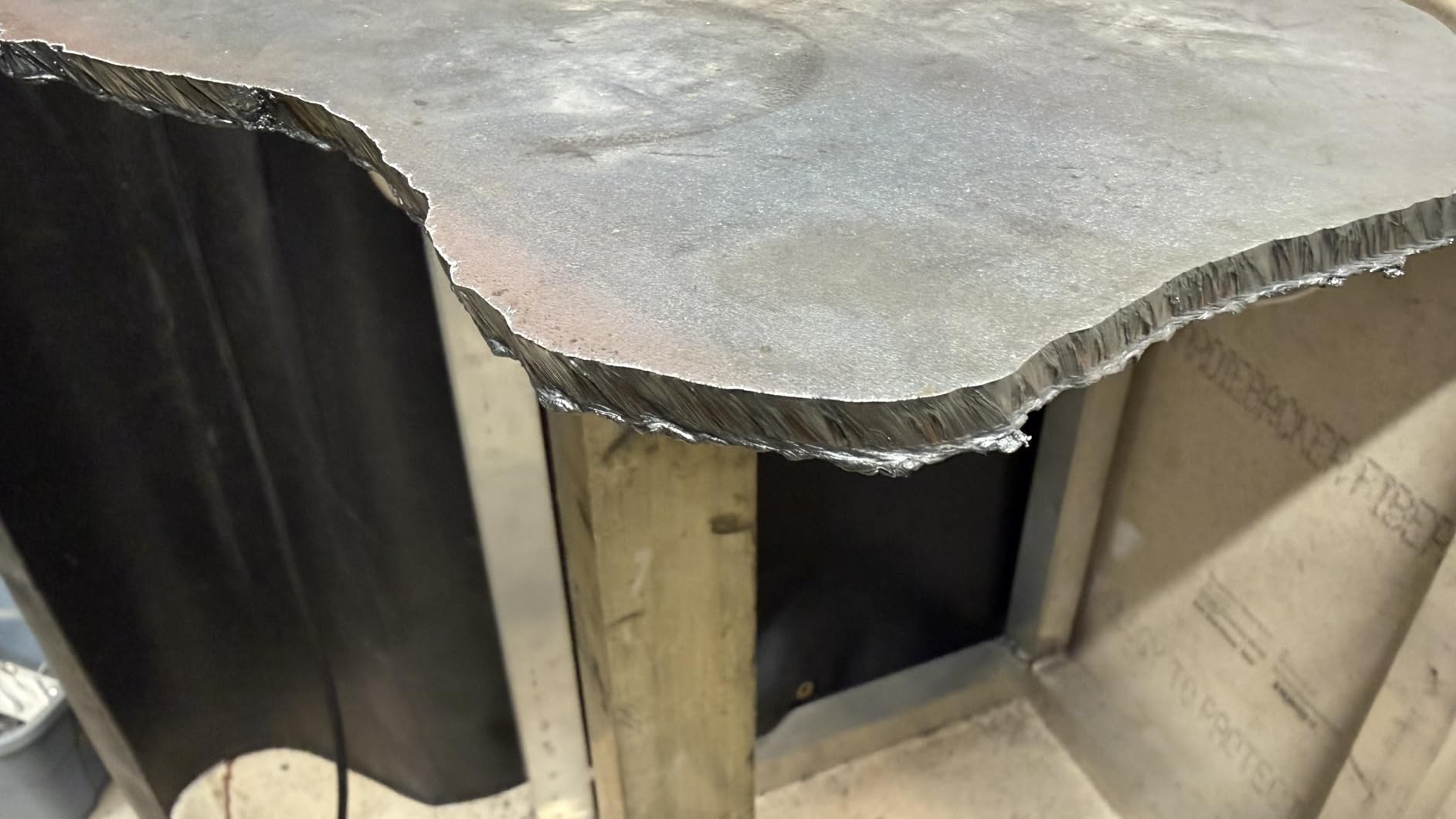
Why the Error Codes Matter for a Beginner
Every new plasma cutter owner eventually hits a cut that will not start or stops mid-pass. On a machine with no diagnostics, that becomes a guessing game involving air pressure, consumables, and cable connections. On this one, the display names the fault, which turns an hour of frustration into a two-minute fix.
Owners also praise how little setup is needed. The pre-installed filter and quick connect mean you connect air, attach the ground clamp, and cut. Several reviewers mention that consumables only needed changing once after a heavy session, which is better consumable behaviour than most machines in this bracket.
Where the CUT50 Loses Points
Some users report an inconsistent arc that starts and stops in the middle of a cut, particularly on thin material. This is the most common negative across the reviews. Thin sheet also shows a less clean finish than on the heavier machines here, because the minimum output still pushes more amperage than a 1/16 inch edge needs.
There is no laminated settings chart for amperage and PSI by material thickness, and the air hose is short. Write the settings down on your own first afternoon, because the machine will not hand you a reference card.
We earn a commission, at no additional cost to you. CERTAIN CONTENT THAT APPEARS ON THIS SITE COMES FROM AMAZON. THIS CONTENT IS PROVIDED 'AS IS' AND IS SUBJECT TO CHANGE OR REMOVAL AT ANY TIME.
4. Bestarc 50A IGBT 7Gen – Fastest Path From Box to First Cut
Bestarc Plasma Cutter Machine, Pilot Arc, 50A IGBT 110V 220V Dual Voltage
- 50A IGBT
- 2/3 inch max cut at 220V
- App control to 98 ft
- Built-in air sensor
Pros
- Pilot arc lights reliably on rusted and painted metal with no prep
- Built-in air pressure sensor removes guesswork from setup
- App control changes settings without walking back to the machine
- Owners report setup and cutting within minutes
- 15 lb body at 18.5 x 13.25 x 11.25 inches
Cons
- Ground lead and torch cables feel thin and could be longer
- Supplied air line and fittings are low quality
- One owner reported the air regulator blowing out
- Not suited to heavy continuous shop duty cycles
We earn a commission, at no additional cost to you. CERTAIN CONTENT THAT APPEARS ON THIS SITE COMES FROM AMAZON. THIS CONTENT IS PROVIDED 'AS IS' AND IS SUBJECT TO CHANGE OR REMOVAL AT ANY TIME.
This is the machine for someone who dreads setup. The combination of a built-in air pressure sensor, a centrally placed LED readout, and app control removes almost every decision a first-timer would otherwise have to guess at. Owners consistently describe going from unboxing to cutting within minutes.
The app is genuinely useful rather than a gimmick. It controls current, cutting mode, and error codes from up to 98 feet away, so you can set amperage for 1/4 inch mild steel from beside the workpiece instead of crouching over the machine. For someone cutting a stack of identical brackets, that convenience compounds quickly.
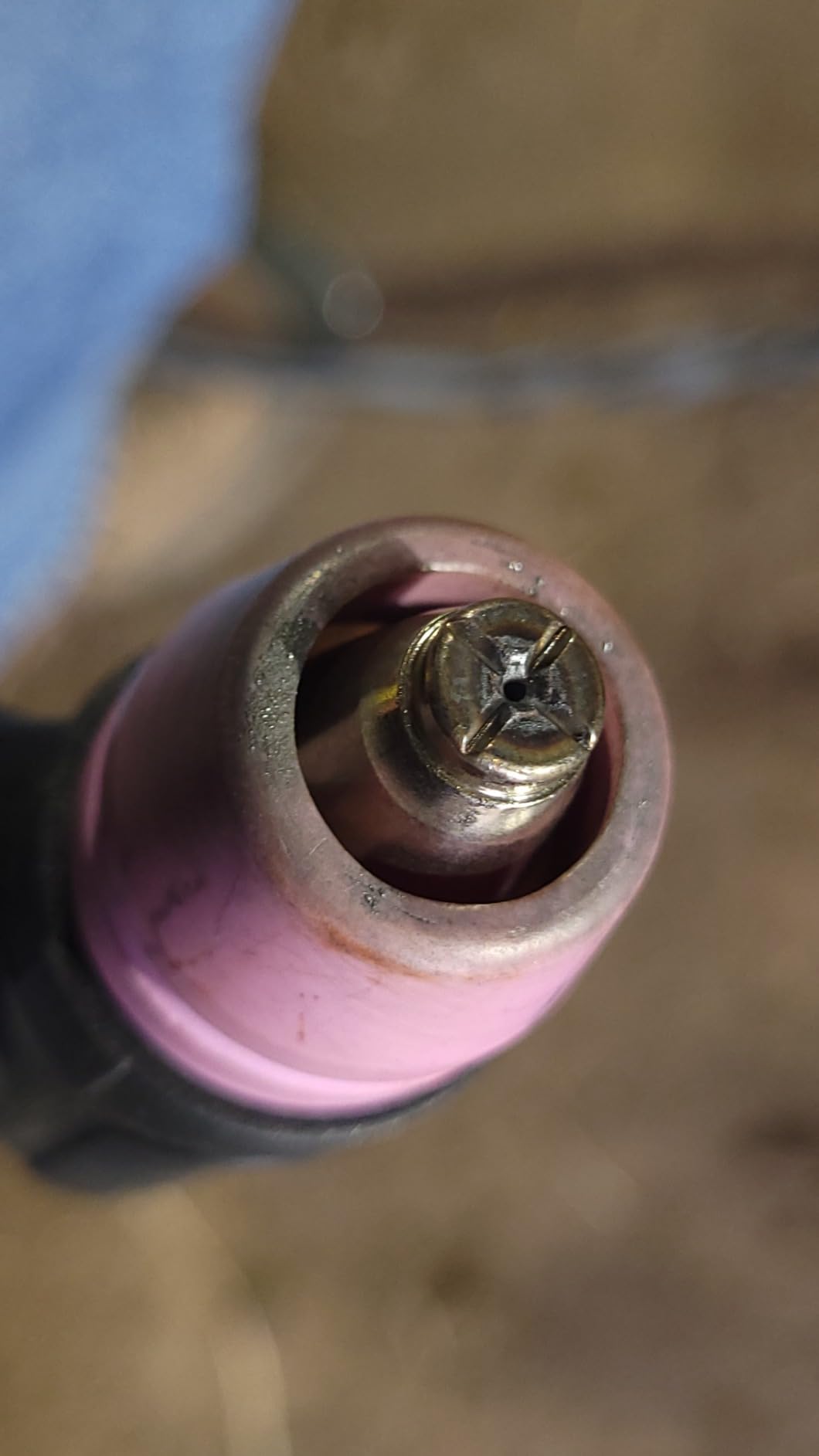
Output is 1/2 inch at 35A on 110V at 50 PSI, and 2/3 inch at 50A on 220V at 65 PSI. The non-touch pilot arc has a dedicated rust removal mode with pilot time adjustable up to 15 seconds, which is the figure that keeps the arc alive when you start on dirty metal and the cut needs to stabilize. Recommended air is 50 to 80 PSI, and the metal air filter is built in.
One owner reported replacing a 20-year-old commercial machine with this one at a fraction of the cost and half the weight. Experienced fabricators and first-timers both use it, and the 4.5 star average reflects that range of owners.
Best Features for Someone Learning
The built-in air sensor is the feature nobody thinks about until they have been fighting an arc that will not strike because a tiny moisture separator was saturated. This machine reports the pressure problem as a number instead of a failure. The LED display shows air pressure, voltage, and current together, so you can see all three cause and effect in one glance.
Post-flow cooling is adjustable from 3 to 15 seconds, and 2T/4T modes are present, so it can drive a CNC table later without replacing the machine. The pilot arc is what makes it usable on painted and rusty material, which is most of what a garage hobbyist actually cuts.
Where the Bestarc Falls Short
Owners repeatedly describe the ground lead and torch cables as thin and short. Included air line and fittings are also criticised as low quality, and one owner had the air regulator blow out after regular use. Budget for a better regulator and hose rather than trusting the supplied set.
It is also not a production machine. The reviews specifically note it is not suitable for heavy continuous shop duty cycles, so if you plan to cut plate for hours a day, this is the wrong class of tool. At 15.2 pounds it stays portable, which is the trade you are making.
We earn a commission, at no additional cost to you. CERTAIN CONTENT THAT APPEARS ON THIS SITE COMES FROM AMAZON. THIS CONTENT IS PROVIDED 'AS IS' AND IS SUBJECT TO CHANGE OR REMOVAL AT ANY TIME.
5. PRIMEWELD CUT50D 50A – Best Warranty and After-Sales Support
PrimeWeld 50A Air Inverter Plasma Cutter, Portable Plasma Cutting Machine, Premium and Rugged Plasma Cutter Kit, Automatic Dual Voltage 110V/220V AC with Plasma Torch, 1/2″ Clean Cut, CUT50D
- 50A air inverter
- 1/2 inch clean cut
- Pre-plumbed quick connect
- AG60 torch
Pros
- Highest average rating among these ten machines at 4.7 stars
- Responsive factory support including paid return shipping and repaired units
- Back panel pre-plumbed with a brass quick connect
- AG60 torch with a solid trigger feel
- Outperforms machines many times its cost
Cons
- Some early production units had air fitting leaks
- Power cord is short and often needs a NEMA 14-50 adapter
- Instruction manual is poor for beginners
- One owner had a torch develop a hole after two years
We earn a commission, at no additional cost to you. CERTAIN CONTENT THAT APPEARS ON THIS SITE COMES FROM AMAZON. THIS CONTENT IS PROVIDED 'AS IS' AND IS SUBJECT TO CHANGE OR REMOVAL AT ANY TIME.
The PRIMEWELD CUT50D is rated 4.7 stars, and the reason is not the spec sheet. It is the after-sales service. Owners describe factory support answering questions quickly, paying return shipping, and returning machines repaired with new torches and consumables, which is genuinely rare at this price level.
That matters for a beginner more than it would for a fabricator who already knows their machine. The first year with a plasma cutter involves some mistakes, and knowing the manufacturer will help you through them rather than replace you with a new unit changes the ownership experience completely.
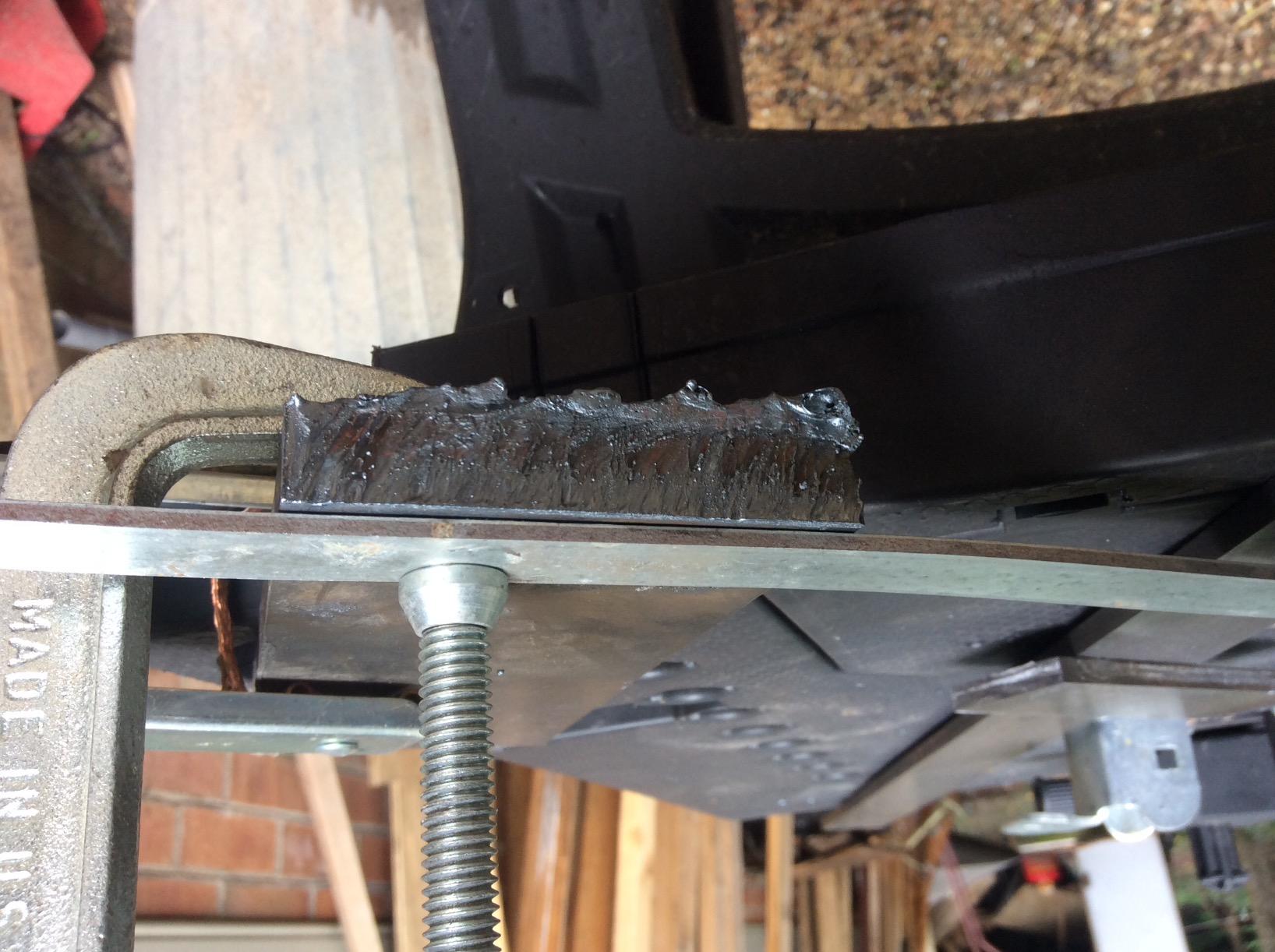
The machine itself is a 50A air inverter with a 1/2 inch clean cut and automatic 110V/220V AC input. The back panel is pre-plumbed with a brass quick connect and a pre-installed air filter and regulator, so there is no external hose setup to figure out. A 220V cord comes pre-installed with a 110V adapter for the smaller circuit.
The AG60 torch comes with a trigger guard, and owners comment on the trigger feel specifically. Several reviews note that this machine outperforms machines many times its cost, which tracks with what we have seen from quality 50A inverter units using proper consumables and clean air.
What You Give Up Compared With the Others
Weight and dimensions are not listed by the manufacturer, so you cannot compare portability on paper. The same applies to duty cycle, which is a gap if you intend to do long production cuts. The 4.7 average comes from 668 reviews, a solid base but smaller than the machines leading this roundup.
Some early production runs had internal and external air fitting leaks, and the instruction manual is weak for beginners. Later production runs largely resolved the leak issue, so if you buy one today you are unlikely to hit it.
Why the Support Story Decides This One
A short cord and a NEMA 14-50 adapter are the kind of detail that should not influence a buying decision, and on most machines we would ignore them. Here they barely register against a 4.7 rating built on service.
If you are buying your first plasma cutter and you are not confident yet in diagnosing an arc problem, having a manufacturer who will troubleshoot with you by email is worth more than a marginally better spec. That is why this is our pick for anyone who wants the most reassuring ownership experience in the group.
We earn a commission, at no additional cost to you. CERTAIN CONTENT THAT APPEARS ON THIS SITE COMES FROM AMAZON. THIS CONTENT IS PROVIDED 'AS IS' AND IS SUBJECT TO CHANGE OR REMOVAL AT ANY TIME.
6. ARCCAPTAIN iControl CUT55 Pro – Best for Heavy Plate Without an Upgrade
ARCCAPTAIN iControl CUT55 Pro Plasma Cutter Machine, 55Amp, 120V/240V
- 55A output
- 3/4 inch max cut
- MCU digital control
- 3-year warranty
Pros
- Digital MCU control keeps cuts stable and repeatable
- Non-touch pilot arc handles dirty and coated steel without prep
- Automatic post-blow timing removes manual cooling adjustments
- Pre-installed regulator and filter get you cutting within a minute
- 3-year warranty with ANSI certification
Cons
- Heavier and bulkier than 50A alternatives in this range
- App control limited to roughly 10 meters
- 19.46 lb body is among the heavier machines here
We earn a commission, at no additional cost to you. CERTAIN CONTENT THAT APPEARS ON THIS SITE COMES FROM AMAZON. THIS CONTENT IS PROVIDED 'AS IS' AND IS SUBJECT TO CHANGE OR REMOVAL AT ANY TIME.
If your project list involves 1/2 inch plate or heavier structural steel, this is the machine that gets the job done without an upgrade conversation later. It delivers 55A with a 12mm quality cut and a 20mm maximum cut, and the MCU digital control regulates current and voltage closely enough to keep a cut consistent across a long plate.
Automatic intelligent post-blow scaled to cutting current is a nicer implementation than a fixed timer. The machine decides how long to keep air flowing after the arc stops based on how hard you were driving it, which protects the tip and nozzle on thick cuts. You do not have to learn the setting.
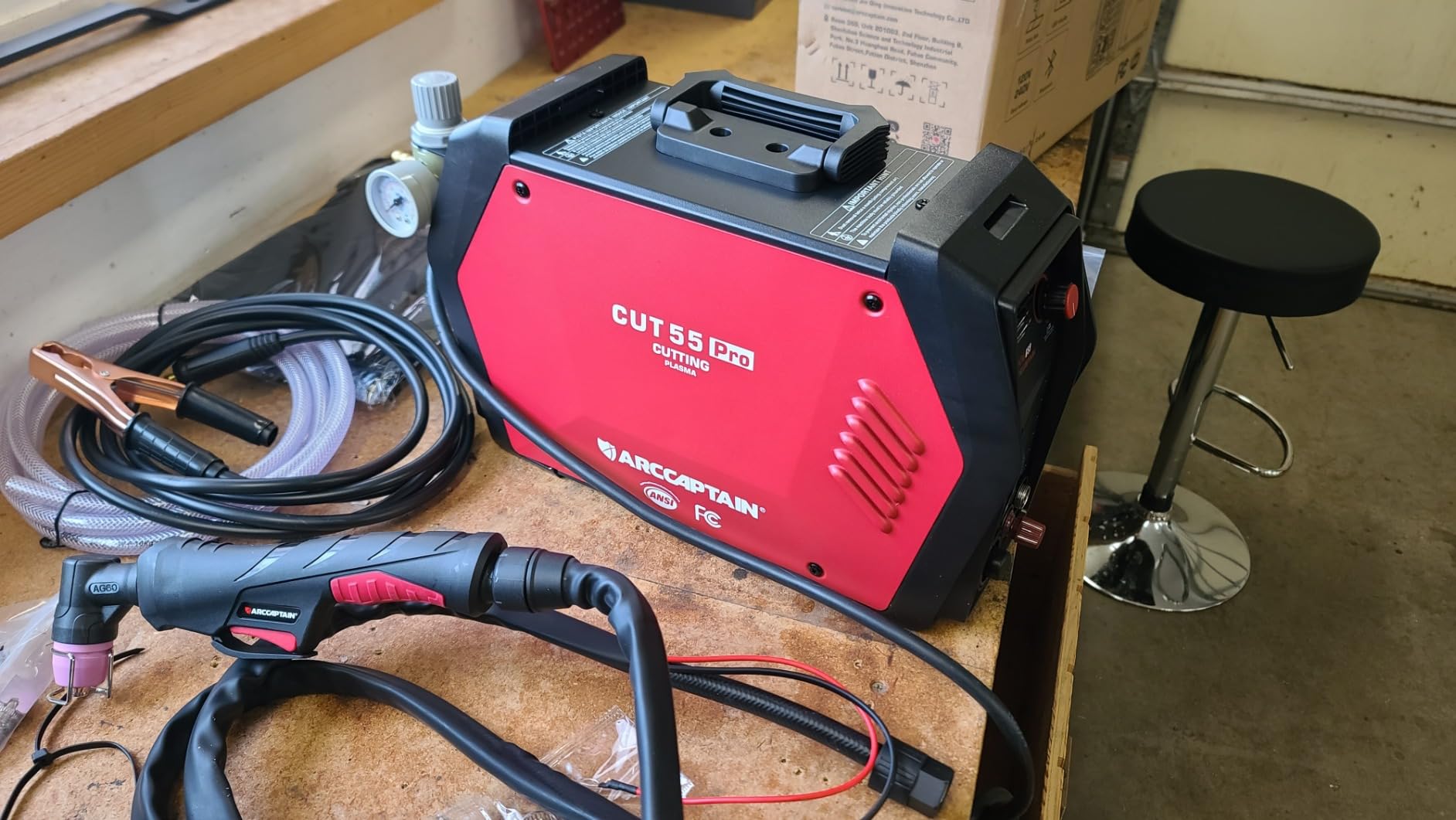
The package is well thought out for a first machine: a 10 foot AG60 cutting torch, 10 foot air hose, 10 foot earth clamp, a 120/240V power adapter, and a pre-installed regulator and filter. Setup takes about a minute. Smart fan cooling, ANSI certification, and fault alarms for overcurrent, overheat, overload, and overvoltage cover the failure modes beginners hit.
App control reaches roughly 10 meters, enough to change settings from a workbench but not across a yard. The 3-year warranty is the longest in this roundup, which is a real advantage on a higher-amperage machine with more electronics to fail.
Where the Extra Amperage Pays Off
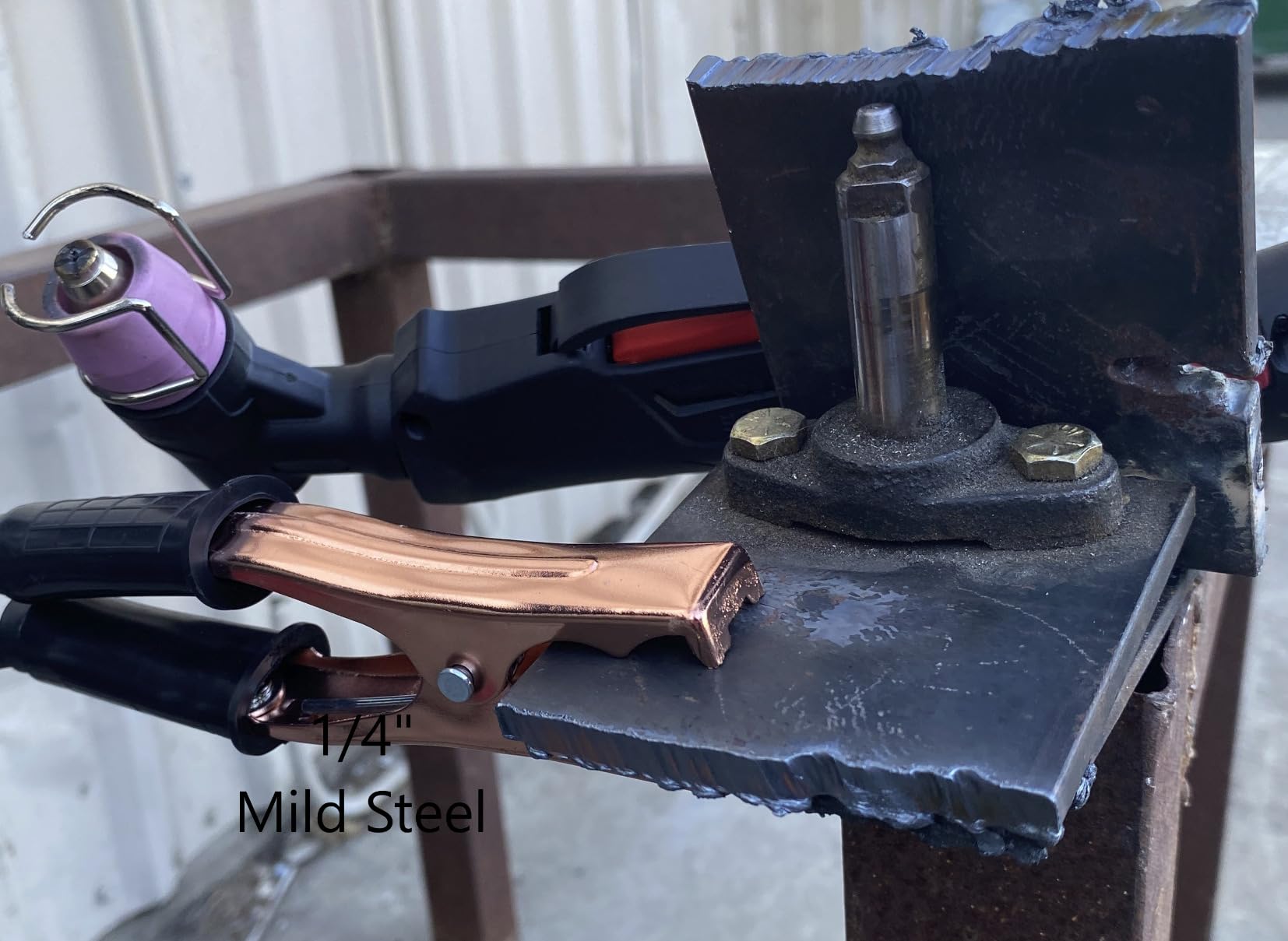
Clean cut versus maximum cut is the distinction beginners miss. A 1/2 inch quality cut means the machine produces a square, near-dross-free edge at that thickness with acceptable travel speed. The 3/4 inch maximum is where you can still force through the metal but the edge is ugly and the cut is slow. This machine does the first one at 1/2 inch.
Digital current regulation also means repeatable results. If you are cutting 20 identical brackets, every hole lands in the same place because the arc does not wander between passes. That predictability is what separates a hobby machine from a shop tool, and it is why this one suits people who plan to make sets of parts.
Where the CUT55 Pro Is the Wrong Choice
It weighs 19.46 lb and measures 19.2 x 15.7 x 8 inches, making it one of the heavier and most bulky machines in this group. If you want to carry a cutter to a driveway job or up a set of stairs, that is a real cost. The 50A machines at 13 to 15 pounds are noticeably easier to manage.
The short app range is the other limitation, and there are only two downsides recorded in the reviews: bulk and app distance. With a 3-year warranty behind it, that is a reasonable trade for the extra cutting authority.
We earn a commission, at no additional cost to you. CERTAIN CONTENT THAT APPEARS ON THIS SITE COMES FROM AMAZON. THIS CONTENT IS PROVIDED 'AS IS' AND IS SUBJECT TO CHANGE OR REMOVAL AT ANY TIME.
7. GZ GUOZHI CUT-50 50A – Built for Cold-Weather and Outdoor Work
GZ GUOZHI Plasma Cutter, 50 Amp Air Inverter Plasma Cut, 110V/220V Dual Voltage Digital Display IGBT Inverter Plasma Cutting Machine with 2T/4T/TEST Function
- 50A IGBT
- Pilot arc
- 2T/4T/TEST functions
- 60 percent duty cycle
Pros
- Compact body for tight-space work
- Pilot arc cuts painted and rusty surfaces with minimal slag
- One-minute setup with pre-fitted Type-D air plug
- 2T/4T/TEST modes plus overheat and overcurrent protection
- Rated for operation down to minus 20 degrees
Cons
- Listed weight conflicts with the 13 lb claim
- 1-year manufacturer warranty is among the shortest here
- Digital display functions add cost without clear beginner benefit
We earn a commission, at no additional cost to you. CERTAIN CONTENT THAT APPEARS ON THIS SITE COMES FROM AMAZON. THIS CONTENT IS PROVIDED 'AS IS' AND IS SUBJECT TO CHANGE OR REMOVAL AT ANY TIME.
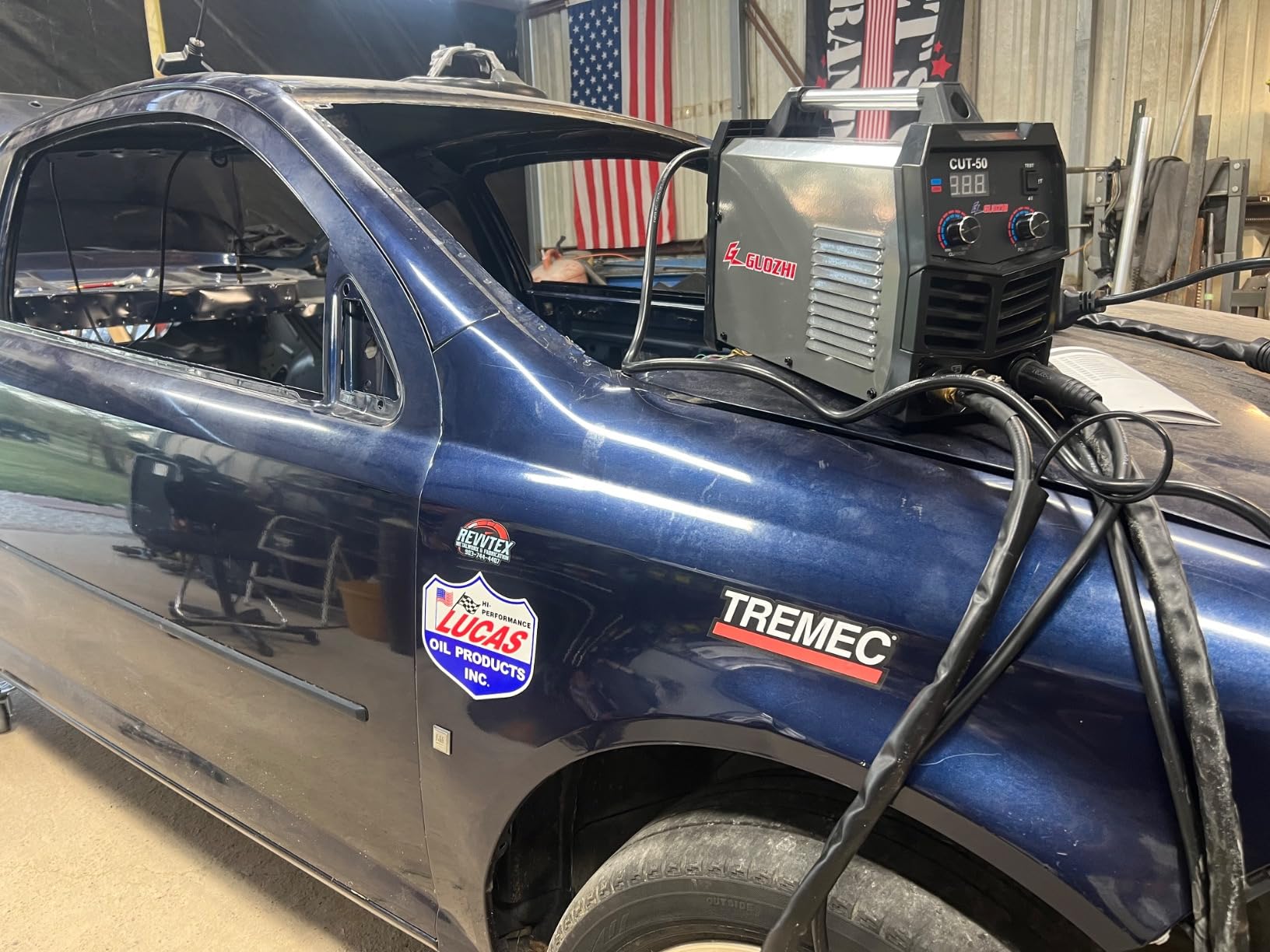
This machine is differentiated by one specification: it is rated for operation down to minus 20 degrees. If you cut outside in winter, work on farm equipment, or repair trucks in an unheated yard, that rating is not marketing filler. Most competitors say nothing about low-temperature performance, which usually means they have not tested it.
Output is 1/4 inch recommended at 35A on 110V at 50 PSI, and 3/4 inch at 50A on 220V at 65 PSI. The 60% duty cycle is a published figure, and at 50/60Hz output it will hold that rating in ordinary conditions. The 2T/4T/TEST functions are a superset of what most machines offer, with a test mode for checking settings without arcing.
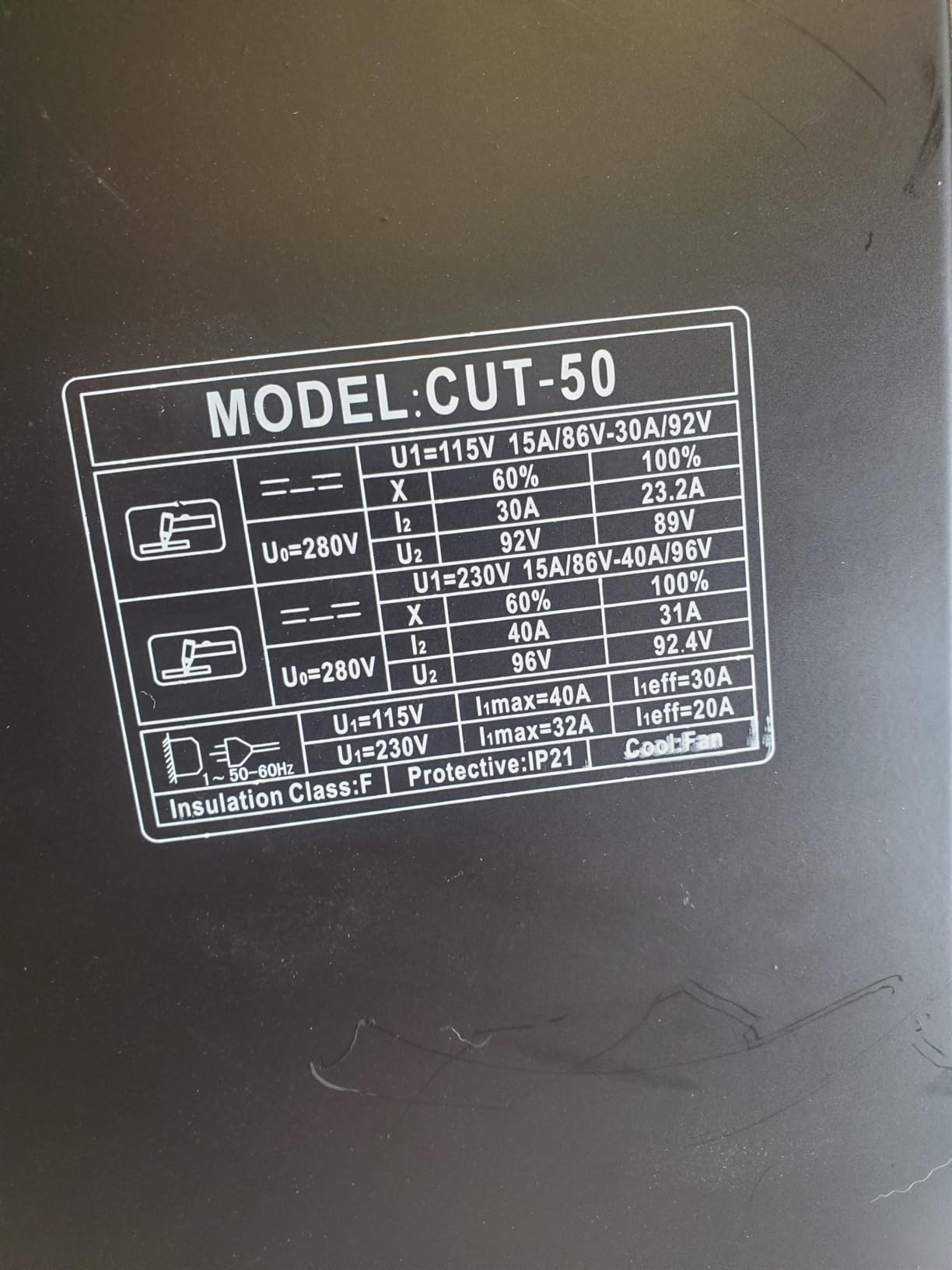
Setup is a one-minute job because a 1/4 inch industrial Type-D plug comes pre-fitted, and the box includes a 220V-to-100V adapter, cutting gun head, earth clamp, and manual. The pilot arc handles rough, painted, and rusty surfaces with minimal slag, which is the everyday use case for anyone cutting salvaged metal.
Overheat and overcurrent protection are present, and the IGBT inverter platform handles the power conversion. At 251 reviews this machine has less owner feedback behind it than the machines leading this roundup, so treat the enthusiasm with normal caution.
Why the Duty Cycle Number Matters
Duty cycle is the percentage of a 10-minute period during which the machine can cut at its rated output. A 60% duty cycle means 6 minutes of cutting and 4 minutes of cooling in a 10-minute window. For a beginner cutting a few pieces an hour, you will never approach that limit, which means duty cycle is really a buying criterion for shop use.
If your plan is production work later, look at this number before anything else. The 60% figure here is documented rather than vague, and the overheat and overcurrent protection means the machine protects itself when you do push it.
What to Watch Before You Buy
The listed weight of about 19 lb contradicts the 13 lb claim in the specifications, and the dimensions of 17.5 x 13 x 8 inches suggest a larger body than the marketing implies. Verify the physical size before ordering if your bench space is tight.
The 1-year manufacturer warranty is among the shortest in this group, against 2 and 3 years on comparable ARCCAPTAIN models. Reviews also question whether the digital display justifies its cost for beginners. The cold-weather rating and the pilot arc are the two reasons to choose it; the warranty is the reason to think twice.
We earn a commission, at no additional cost to you. CERTAIN CONTENT THAT APPEARS ON THIS SITE COMES FROM AMAZON. THIS CONTENT IS PROVIDED 'AS IS' AND IS SUBJECT TO CHANGE OR REMOVAL AT ANY TIME.
8. YESWELDER CUT-60DS 60A – Best Non-HF Start for CNC Work
YESWELDER 60A Non-HF Plasma Cutter, Non-Torch Pilot Arc, 110/220V
- 60A output
- Non-HF blowback start
- IPT40 pilot arc torch
- ETL certified IP21
Pros
- Blowback start avoids interference with CNC controllers and shop electronics
- 60A output is the highest amperage listed in this roundup
- Built-in rear air filter extends consumable life
- IPT40 non-touch pilot arc starts on rusty and painted surfaces
- ETL certified with IP21 water rating and overload protection
Cons
- 1-year warranty is shorter than most machines here
- Zero-current minimum on 110V limits thin material work
- Model listing varies between CUT-60DS and CUT-65DS part numbers
We earn a commission, at no additional cost to you. CERTAIN CONTENT THAT APPEARS ON THIS SITE COMES FROM AMAZON. THIS CONTENT IS PROVIDED 'AS IS' AND IS SUBJECT TO CHANGE OR REMOVAL AT ANY TIME.
Most plasma cutters in this price range use a high-frequency start, and high-frequency starts radiate enough electrical noise to upset CNC controllers, touchscreens, and radio equipment. This machine deliberately does not. The non-high-frequency blowback start ignites without that interference, which makes it the safe choice if a CNC plasma table is anywhere in your future.
The payoff is more than compatibility. A blowback start is gentler on the electrode because it does not run a high-frequency strike before the pilot arc forms, so consumables generally last longer. It is also the reason the built-in rear air filter is worth having, since the whole system runs cleaner.
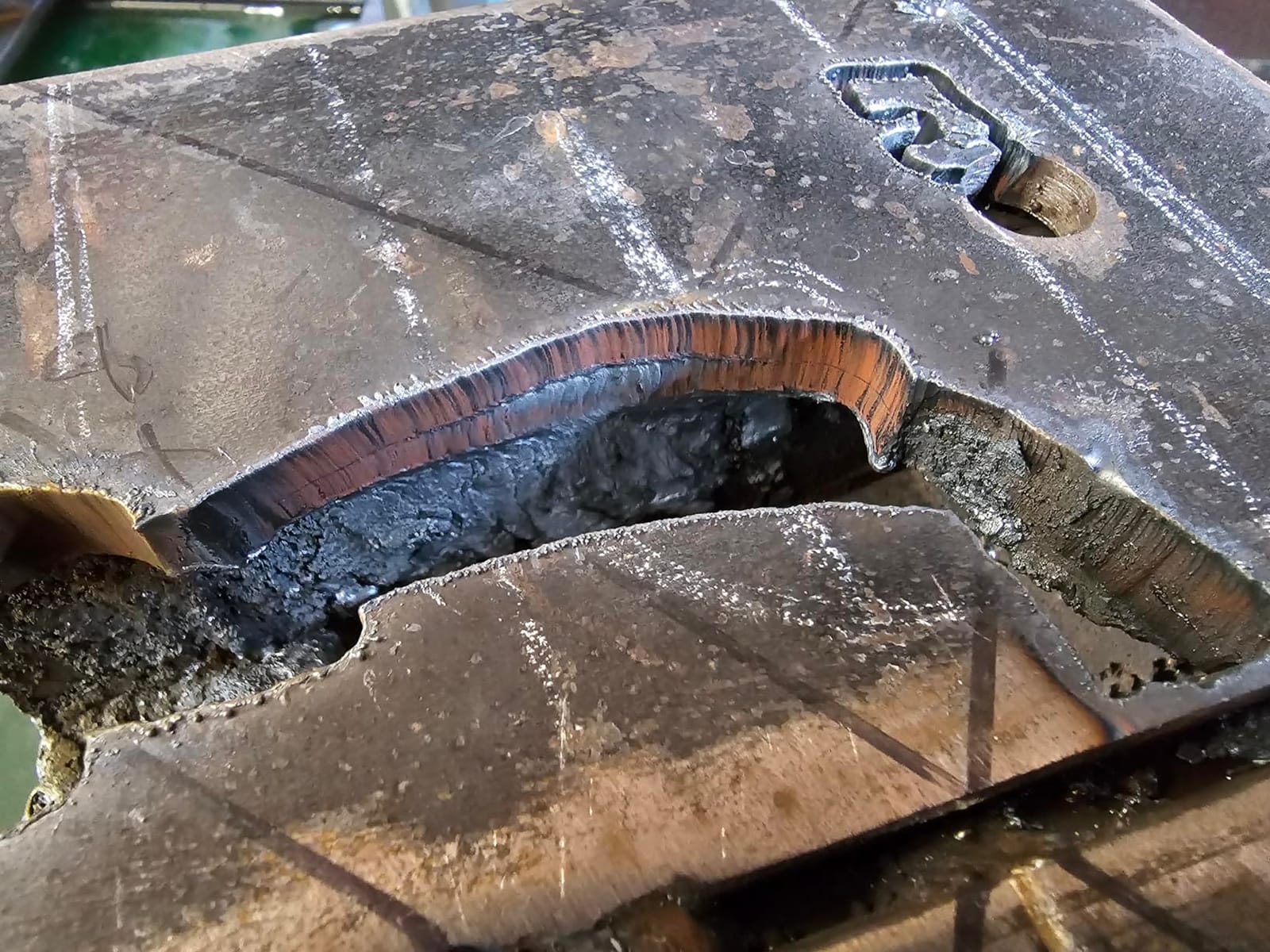
Output is 60A, with a 5/16 inch ideal clean cut at 110V and 5/8 inch at 220V, plus maximum cut figures of 1/2 inch at 110V and 63/64 inch at 220V. MCU intelligent digital control and a digital display showing air pressure, voltage, and current with error codes give you a clear picture of what the machine is doing. The IPT40 torch provides non-touch pilot arc ignition.
It is ETL certified and rated IP21 for water resistance, which matters if you cut near a wet surface or work in a garage where the floor is not bone dry. Overload and overheat protection are standard. 2T/4T modes with 5 to 20 second post-flow adjustment are present, and the dimensions are 15.75 inches long by 5.91 wide by 11.81 high.
When Blowback Beats High-Frequency Start
Choose blowback when electronics are nearby, when you plan to automate, or when you are cutting near a radio, a laptop, or a modern plasma table. High-frequency start is not inherently bad, but it is a genuine source of interference, and forum discussions on CNC builds repeatedly trace erratic controller behaviour back to it.
At 60 amps this machine also has the cutting authority to handle plate that the 50A units in this roundup only graze. If you are building a plasma table rather than just cutting in a garage, 60 amps with 63/64 inch maximum cut at 220V is about as far as this price class goes.
Where the CUT-60DS Falls Short
The 1-year warranty is shorter than most machines here, and a couple of competing models carry longer coverage. If you are buying this for CNC work, a longer warranty would be sensible, so factor that into the decision.
On 110V the zero-current minimum limits how thin you can cut, which is awkward if your work is mostly light gauge sheet. Use 220V for thin material. Also note the listing inconsistency between the CUT-60DS model name and the CUT-65DS part number, which causes confusion when ordering parts.
We earn a commission, at no additional cost to you. CERTAIN CONTENT THAT APPEARS ON THIS SITE COMES FROM AMAZON. THIS CONTENT IS PROVIDED 'AS IS' AND IS SUBJECT TO CHANGE OR REMOVAL AT ANY TIME.
9. ARCCAPTAIN CUT55 55A – Simplest Settings for a Total Beginner
ARCCAPTAIN 55A Plasma Cutter Machine, Non-Touch Pilot Arc, 120V/240V
- 55A output
- Pre-set air and post-flow
- 2T/4T auto cutting
- Shoulder strap included
Pros
- Pre-set default parameters reduce setup to choosing a voltage and turning a knob
- Non-touch pilot arc extends consumable life
- 2T/4T automatic cutting frees your finger on long cuts
- Shoulder strap and compact body make it easy to carry
- FCC and ANSI certified
Cons
- Listed weight and dimensions do not match the actual machine
- Voltage cannot be switched until the screen goes off and the fan stops
- 1-year warranty is among the shortest ARCCAPTAIN offers
We earn a commission, at no additional cost to you. CERTAIN CONTENT THAT APPEARS ON THIS SITE COMES FROM AMAZON. THIS CONTENT IS PROVIDED 'AS IS' AND IS SUBJECT TO CHANGE OR REMOVAL AT ANY TIME.
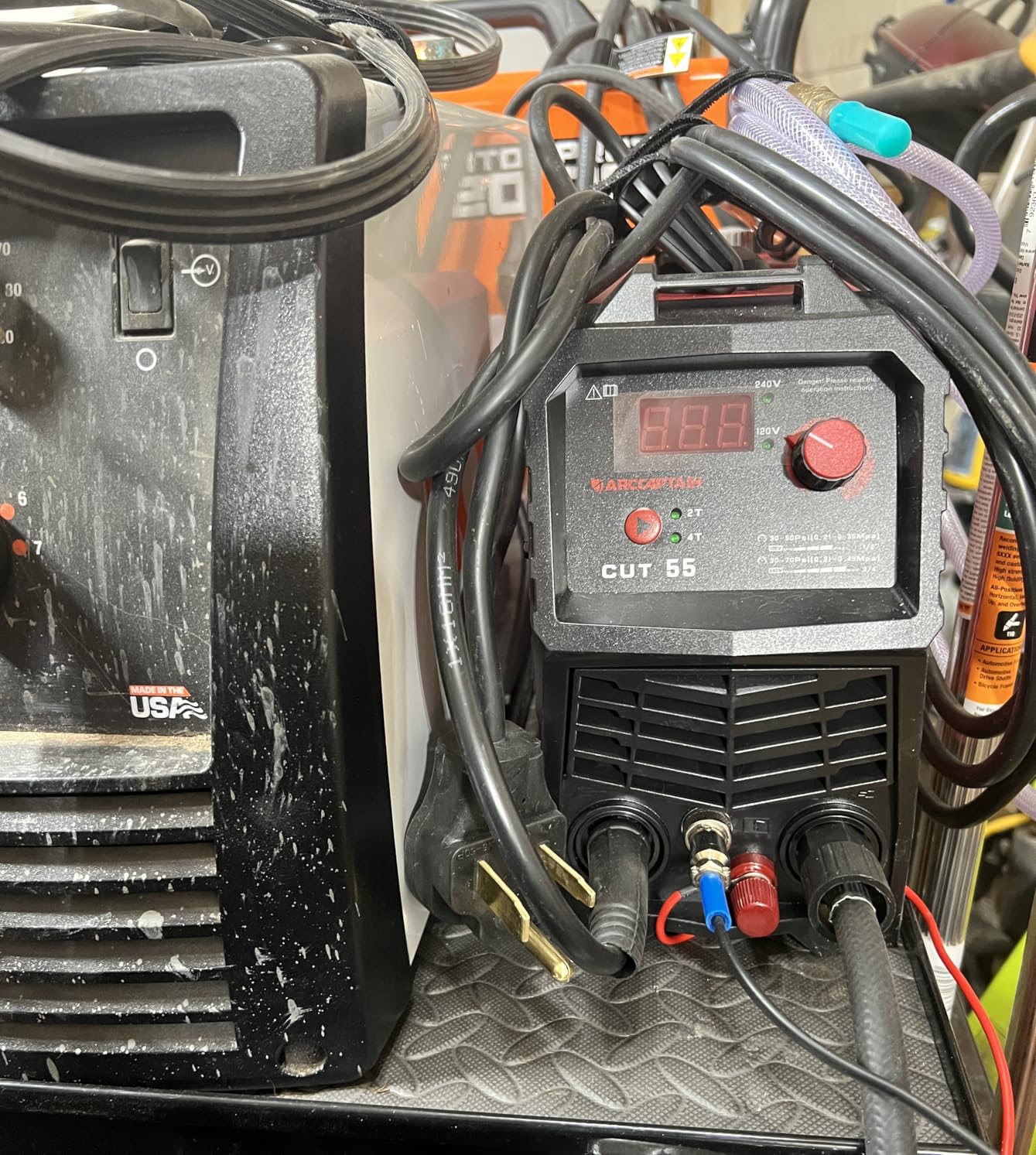
This machine’s selling point is restraint. It ships with pre-set default parameters of 60 PSI air and 5 second post-flow, so the two settings beginners get wrong most often are already correct out of the box. You choose a voltage, set the current for your material thickness, and cut.
That approach has real appeal for someone who does not yet understand why post-flow time matters. The 2T/4T automatic cutting function handles longer cuts without a held trigger, and the non-touch pilot arc reduces electrode burn, which means fewer consumable changes in the first months.
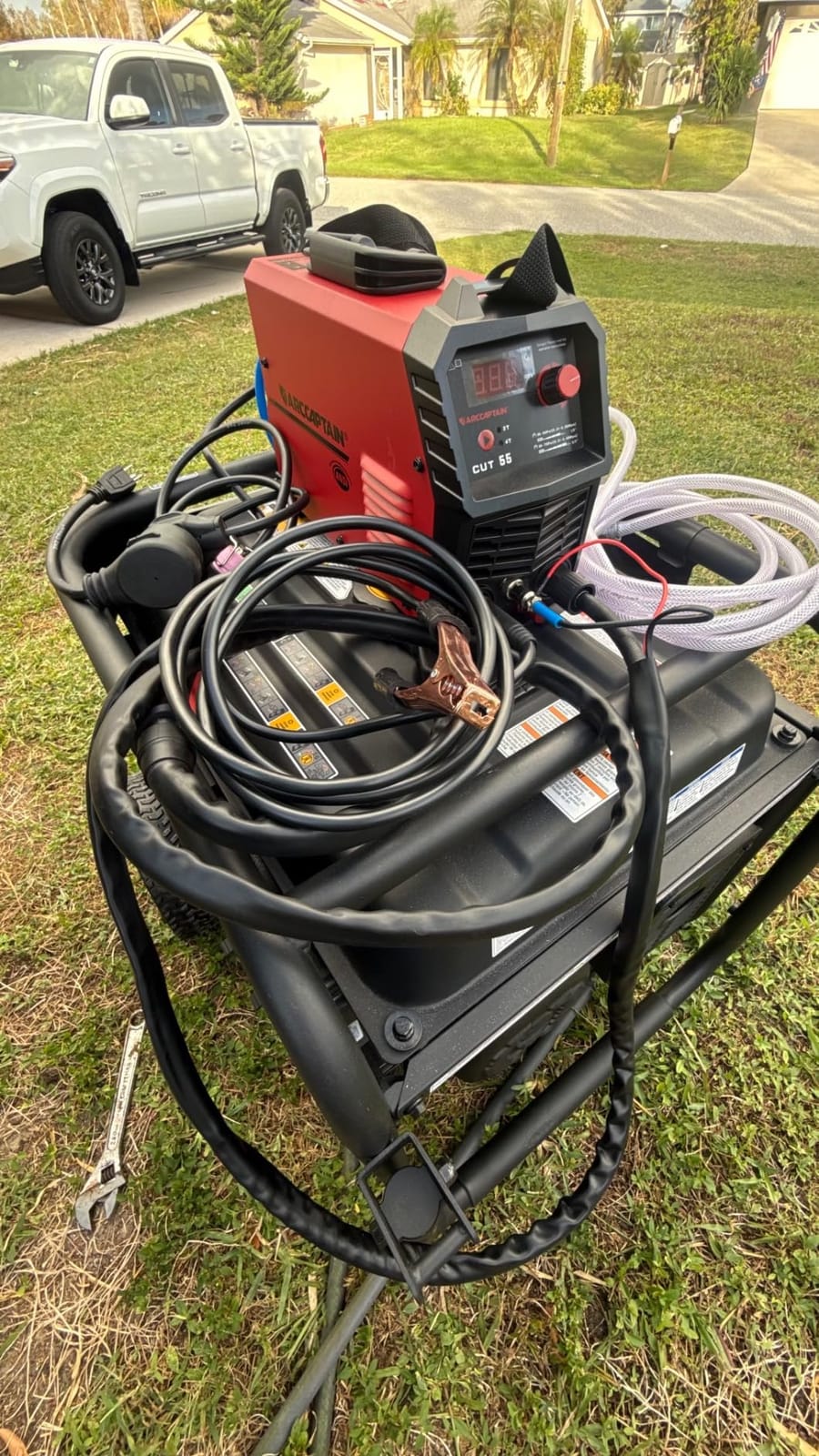
Output is 55A with a 3/4 inch maximum cut and a 1/2 inch ideal clean cut at 240V. The IGBT inverter runs 50/60Hz with a 60% duty cycle on 120V/240V dual voltage. Recommended air is 60 PSI with an airflow of 5.3 CFM, and the built-in air pressure sensor monitors supply with a rear-mounted filter.
The package includes 10 foot air hose, 10 foot cutting torch, 10 foot earth clamp, the machine, an air regulator and filter, plus a shoulder strap. FCC and ANSI certification is listed, a reasonable signal of electromagnetic and safety compliance.
Why Defaults Beat a Feature List for Newcomers
Post-flow time is the setting that extends nozzle life, and getting it wrong is one of the most common beginner mistakes. A machine that ships with a sensible default removes the failure mode entirely. The same logic applies to air pressure, where the manufacturer pre-sets a working figure rather than leaving it as a guess.
That CFM figure is worth knowing for compressor planning. Around 5 CFM at 60 PSI is the working airflow for a machine in this class, and if your compressor delivers less, the arc will not sustain a cut on thick material. See the air supply section below.
What the Reviews Flag
The listed item weight of 14.1 ounces and the dimensions of 7.09 x 5.12 x 2.76 inches clearly do not describe a 55A machine, so ignore the size data on this listing. The voltage switch also only becomes active after the screen goes off and the fan stops, which is mildly confusing until you learn it.
Ratings trail the brand’s other models at 4.3 stars across 316 reviews, and the 1-year warranty is among the shortest among the ARCCAPTAIN machines here. The default parameters are what we are recommending this for; the specification inconsistencies are why it is not higher.
We earn a commission, at no additional cost to you. CERTAIN CONTENT THAT APPEARS ON THIS SITE COMES FROM AMAZON. THIS CONTENT IS PROVIDED 'AS IS' AND IS SUBJECT TO CHANGE OR REMOVAL AT ANY TIME.
10. DNYKER CUT50 50A MOS – The Lowest-Cost Way to Make a First Cut
Plasma Cutter, CUT50 50Amp 110V/220V Dual Voltage Cutting Machine, Non-Touch Pilot Arc Plasma Cutter Machine Air Plasma Cutter with High-Frequency Start, Portable Plasma Cutter MOS Type
- 50A MOS output
- Non-touch pilot arc
- Auto-detecting display
- 13 lb with handle
Pros
- Lowest entry cost in this roundup
- Pilot arc starts without touching the metal
- 13 lb body with a carry handle for garage work
- Digital display auto-identifies input voltage and current
- Cuts stainless
- alloy
- mild steel
- copper and aluminum
Cons
- Actual cutting thickness falls short of the advertised figure
- One owner had a machine trip the breaker and never power on again
- Included air regulator is weak and worth replacing
- Listing implies TIG and MMA capability the manual does not cover
We earn a commission, at no additional cost to you. CERTAIN CONTENT THAT APPEARS ON THIS SITE COMES FROM AMAZON. THIS CONTENT IS PROVIDED 'AS IS' AND IS SUBJECT TO CHANGE OR REMOVAL AT ANY TIME.
If your goal is to find out whether you even like plasma cutting before spending real money, this is the machine to start on. It sits at the low end of the price range in this roundup and does the one thing that matters: it starts a pilot arc without touching the metal and cuts light metal reliably.
Maximum average cut is 1/3 inch at 110V and 2/5 inch at 220V, with maximum cut thickness of 3/8 inch at 110V and 1/2 inch at 220V. Recommended air is 60 to 70 PSI. The digital display auto-detects input voltage and current, so the dual voltage switch is handled for you.
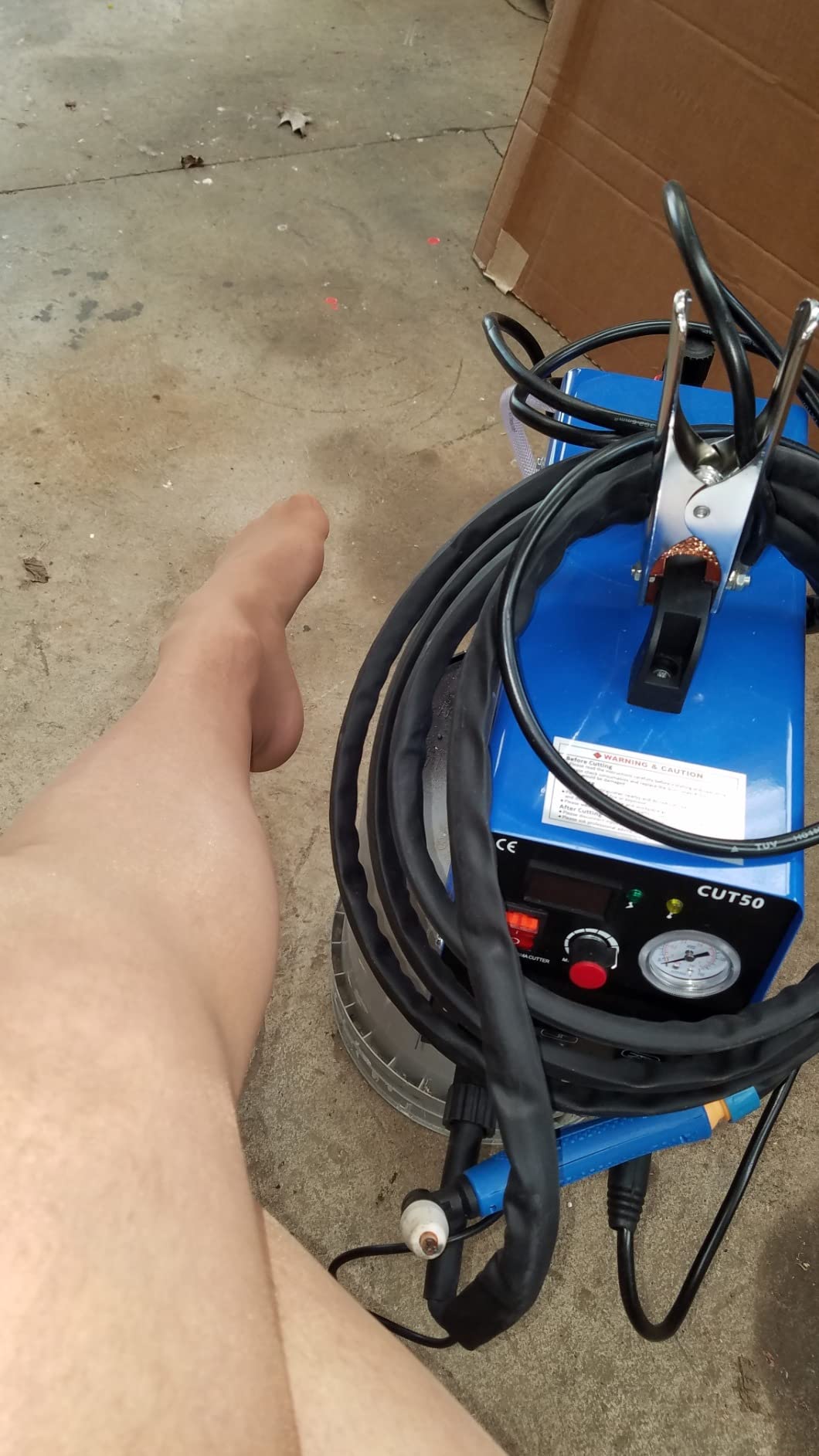
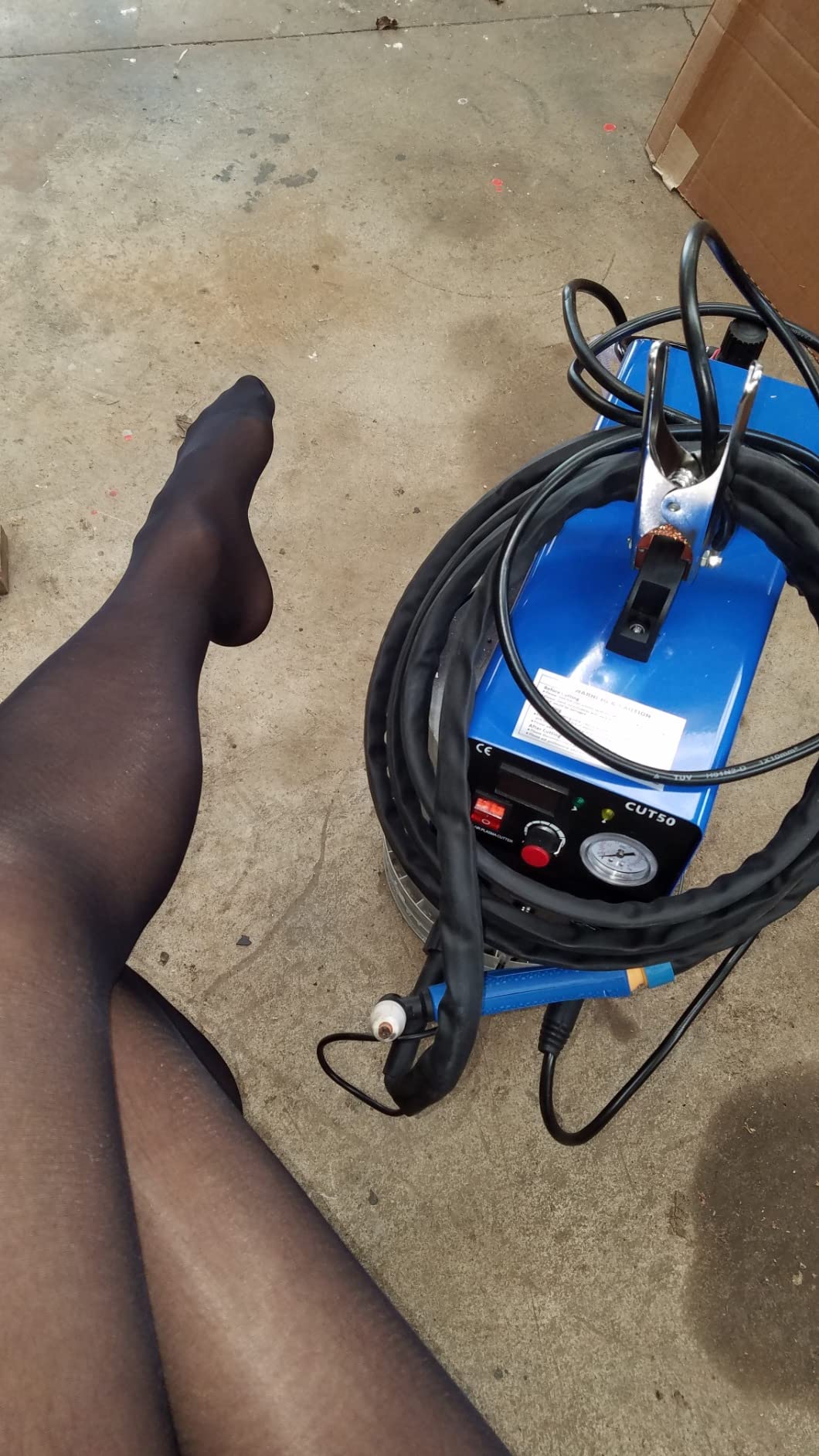
The 13 lb body with a carry handle makes it genuinely portable between a bench and a driveway, and overheat, overcurrent, overload, and overvoltage protection are all present with multiple exhaust windows for cooling. Users report it cutting 3/8 inch steel without issue, which is more than enough for sheet metal, thin structural work, and hobby art.
It cuts stainless steel, alloy steel, mild steel, copper, and aluminum, which covers the material list a beginner is likely to encounter. At 207 reviews this is the machine in the group with the fewest owner reports, so treat every positive and negative note as a single data point.
What You Get for the Entry Cost
A genuine non-touch pilot arc on a machine at this price point is unusual, and it is the reason we prefer this over a contact-start alternative. You can start on rusted or painted metal without dragging a tip across it, which is exactly what a first-time user will attempt on day one.
The MOS type output platform and the four-layer protection suite are both more than a typical budget machine advertises. The digital display auto-identifying the input voltage removes one small frustration that catches out first-time owners on manual machines.
Where the DNYKER Falls Short
The most consistent complaint is that real cutting thickness falls short of the advertised figure, so plan your project list around the lower numbers rather than the maximum. One owner had the machine trip a breaker after about an hour of total use and it never powered on again.
The included air regulator is weak and worth replacing, and the listing implies TIG and MMA capability that the instructions do not cover. This is a plasma cutter and nothing more. If the pilot arc starts failing or the breaker trips, stop cutting and check the air supply and consumables before trying again.
We earn a commission, at no additional cost to you. CERTAIN CONTENT THAT APPEARS ON THIS SITE COMES FROM AMAZON. THIS CONTENT IS PROVIDED 'AS IS' AND IS SUBJECT TO CHANGE OR REMOVAL AT ANY TIME.
How to Choose a Plasma Cutter: Buying Guide for Beginners in 2026
Every machine in this roundup shares the same core specification class, so the features below are the ones that actually differentiate them in a home garage. Read this section before you buy and you will know which two or three on this list fit the work you plan to do.
What Size Plasma Cutter Do I Need?
Most beginners need a 50A to 60A machine, and that is the entire range covered here. A 50A cutter handles 1/4 inch mild steel as routine work and 1/2 inch with a slower travel speed. A 55A to 60A machine gives you 1/2 inch clean cuts more comfortably and pushes to 3/4 inch maximum cuts.
Below 40A you are looking at a machine for thin sheet, and above 80A you are moving into shop territory with 240V circuits and a much larger compressor requirement. The clean cut rating is the number to read, not the maximum cut. Clean cut is where the edge is square and dross-free. Maximum cut is where the machine can still force through, usually slowly and with a messier edge.
Will a 20 Gallon Air Compressor Run a Plasma Cutter?
A 20 gallon tank can run a plasma cutter, but tank size is the wrong number to look at. What matters is free air delivery, measured in CFM at pressure. For the machines in this roundup, plan on about 5 CFM at 60 PSI for a 50A unit, and more for a 60A machine.
A small pancake compressor rated at low single-digit CFM will not keep up with a 60A cutter, even though its tank is 20 gallons. Check the CFM rating on the compressor nameplate, not the tank capacity. If your compressor delivers less than the cutter needs, the arc will weaken mid-pass and the cut will drag on thick material.
Always run a moisture separator or water trap between the compressor and the cutter. Moisture in the plasma stream causes erratic starts and accelerates electrode wear, and a cheap inline filter fixes more problems than any machine change. The ARCCAPTAIN CUT50, CUT55 Pro, and PRIMEWELD CUT50D all ship with a pre-installed filter, which is why they are easier to set up than models without one.
Pilot Arc vs Contact Start: Which Is Better for Beginners?
Contact start means you touch the torch tip to the metal to strike the arc, and pull it back to begin the cut. Pilot arc means the machine runs a low current arc through air before it touches the workpiece, so you start the cut from a standoff distance of roughly 1/8 inch without any contact.
For beginners, pilot arc is the better choice in every scenario. It saves consumables, starts on rusty and painted metal without grinding, and lets you start a cut at the edge of a plate rather than needing a scratch line on the surface. Only the S7 machine in this roundup uses a contact-start torch, and that is the one we would skip for a first machine if your work is mostly salvaged metal.
High-Frequency Start vs Blowback Start for CNC Tables
A high-frequency start runs a brief high-voltage discharge to ignite the pilot arc, and it is fast and reliable on clean metal. The problem is electrical noise, which interferes with CNC controllers, plasma table height controls, and anything else sensitive on the same circuit. Forum discussions on CNC builds repeatedly trace erratic behaviour back to HF start machines.
A blowback start achieves ignition by briefly routing current differently, producing far less radiated interference and gentler electrode wear. If you are cutting by hand today but building a plasma table within a year, buy the blowback machine. The YESWELDER CUT-60DS is the only non-HF option in this roundup. For manual-only work, either start type is fine and this decision can be ignored.
Dual Voltage and Your Electrical Setup
Every machine here runs on both 110V and 220V, which means you can start on a household circuit and move up. On 110V expect meaningfully less than the rated output and a reduced maximum cut thickness, so treat 220V as the machine’s real capability.
Plan the circuit before you buy. A 50A machine at 220V typically needs a 30A dedicated branch, and a 60A machine generally calls for a 50A breaker. If your electrical panel does not have room, an electrician can add a subpanel. The PRIMEWELD CUT50D ships with a pre-installed 220V cord and a 110V adapter, while others include an adapter you may need a NEMA 14-50R receptacle for.
Do not use extension cords on a 220V plasma cutter. Voltage drop at the cable reduces effective output and makes the arc unstable, and this is a leading cause of the inconsistent arc behaviour some owners report. Run the machine from the receptacle directly.
What 2T/4T Mode and Post-Flow Actually Do
2T/4T refers to how the trigger controls the arc. In 2T mode you press to start and press again to stop, which means holding the trigger for a long cut causes hand fatigue. In 4T mode you press once to start, release, and press again to stop, so the torch runs without a held finger. For long cuts, 4T is much more comfortable.
Post-flow, also called post-blow, is the period after the arc stops during which air keeps flowing to cool the nozzle and electrode. Too short and the consumable burns and distorts. Too long and you waste air and cycle time. The Bestarc lets you set 3 to 15 seconds, the ARCCAPTAIN CUT55 Pro scales it automatically to cutting current, and the CUT55 Pilot Arc ships pre-set to 5 seconds. None of these need changing on day one.
Consumables Cost and Availability
Consumables are the electrode, nozzle, and shield cup, and they are a recurring cost you should price in before buying. PT31 style consumables, as on the S7 machine, sit at the inexpensive and widely available end of the range and can be replaced almost anywhere. AG60 style consumables, as on the PRIMEWELD CUT50D and the ARCCAPTAIN CUT55 Pro, cost more and are still easy to find.
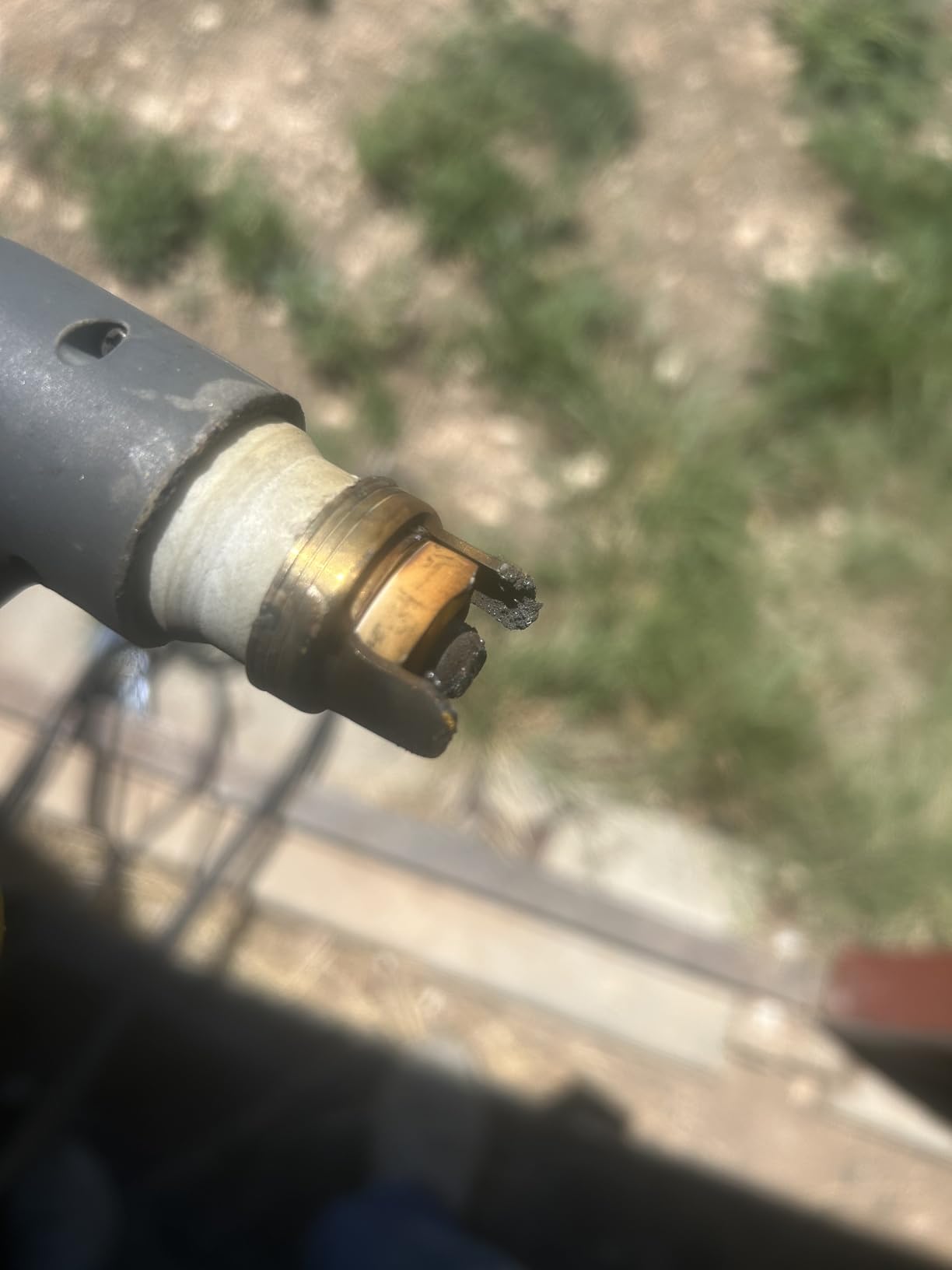
The recurring beginner complaint across this class is that budget machines consume consumables faster. Running at full power for thin material is the usual cause, because high amperage on light plate burns the electrode quickly. Turn the current down to match the material and the consumable life improves immediately. Buying a spare kit before you need one also saves a frustrating afternoon.
Safety Gear You Actually Need
A plasma cutter produces a UV-rich arc, hot spatter, and noise levels that damage hearing, and the arc is far brighter than sunlight. Start with a welding helmet rated for the shade your machine produces, cut-resistant gloves, flame-resistant clothing, and safety glasses worn under the helmet as a baseline.
Add hearing protection, steel-toed boots, and a fire blanket or non-combustible surface for the cut area. Ventilate the workspace, because plasma cutting produces metal fumes and the coating on painted metal is a serious inhalation hazard. Cut painted or galvanised metal outdoors or with local extraction running. Keep a fire extinguisher within reach and clear scrap and paper off the bench.
Used vs New: A Quick Framework
A used machine makes sense if you can verify three things before you buy: the hours of use if a meter exists, the condition of the torch and consumables, and evidence that the machine powers on with a clean arc. Ask for a video of it cutting before you commit, and check that consumables for the model are still available, since discontinued models are harder to support.
Buy new if you cannot test the machine, if the consumable supply is uncertain, or if a warranty matters to you. Budget brands often carry a 1-year warranty against 2 to 3 years on some models here, and that difference decides the outcome when something fails in month fourteen. A verified used professional machine can be excellent value, but only if you test it in person.
Frequently Asked Questions
What size plasma cutter do I need as a beginner?
A 50A to 60A machine covers almost all first-time cutting. A 50A unit makes 1/4 inch mild steel routine and 1/2 inch at a slower speed, while a 55A to 60A unit gives cleaner 1/2 inch cuts and reaches 3/4 inch maximum. Read the clean cut rating rather than the maximum cut rating, since clean cut is where the edge stays square and dross-free.
Will a 20 gallon air compressor run a plasma cutter?
Yes, if the compressor delivers enough free air. Look for at least 5 CFM at 60 PSI for a 50A machine and more for a 60A machine. Tank capacity is not the same as airflow, so a small pancake compressor will not keep up even with a large tank. Add a moisture separator or water trap between the compressor and the cutter.
Is a Harbor Freight plasma cutter any good?
Harbor Freight options such as the Titanium 45 generally receive mixed feedback, with some owners getting good machines and others receiving ones that need early return. The bigger issue is the 1-year warranty and proprietary consumable sourcing. The budget machines in this roundup cover similar ground with 2 to 3 year warranties and more widely available parts.
What is a good and cheap plasma cutter for a first cut?
The DNYKER CUT50 is the lowest cost entry point here and still uses a non-touch pilot arc, which most budget machines skip. If you want better build quality and a warranty behind it, the ARCCAPTAIN CUT50 adds error code diagnostics, a 2-year warranty, and a pre-installed air filter. If reliable support matters more than lowest cost, the PRIMEWELD CUT50D carries a 4.7 star average.
Are Hypertherm plasma cutters better than budget brands?
Professional Hypertherm machines deliver their rated output more consistently and their consumables last several times longer, which is why shops buy them. For a beginner doing occasional garage work, the 50A and 60A inverter machines in this roundup deliver clean 1/4 inch and 1/2 inch cuts at a fraction of the cost, and the pilot arc advantage is mostly wasted on a shop machine that already has it.
Final Verdict: The Best Plasma Cutters for Beginners in 2026
The LOTOS LTP5505D takes our editor’s choice because it has the largest owner base in the group, a non-touch pilot arc, automatic dual voltage, and a clean cut rating with real headroom over what most beginners will ever cut. The ARCCAPTAIN CUT50 is the pick if you want error code diagnostics in a 13 lb package, and the YESWELDER CUT-60DS is the one to buy if a CNC table is in your future.
Whatever you choose, budget for a moisture separator, a spare consumable kit, and a proper welding helmet on the same day you buy the machine. Those three items fix more first-week plasma cutting problems than any machine upgrade will.