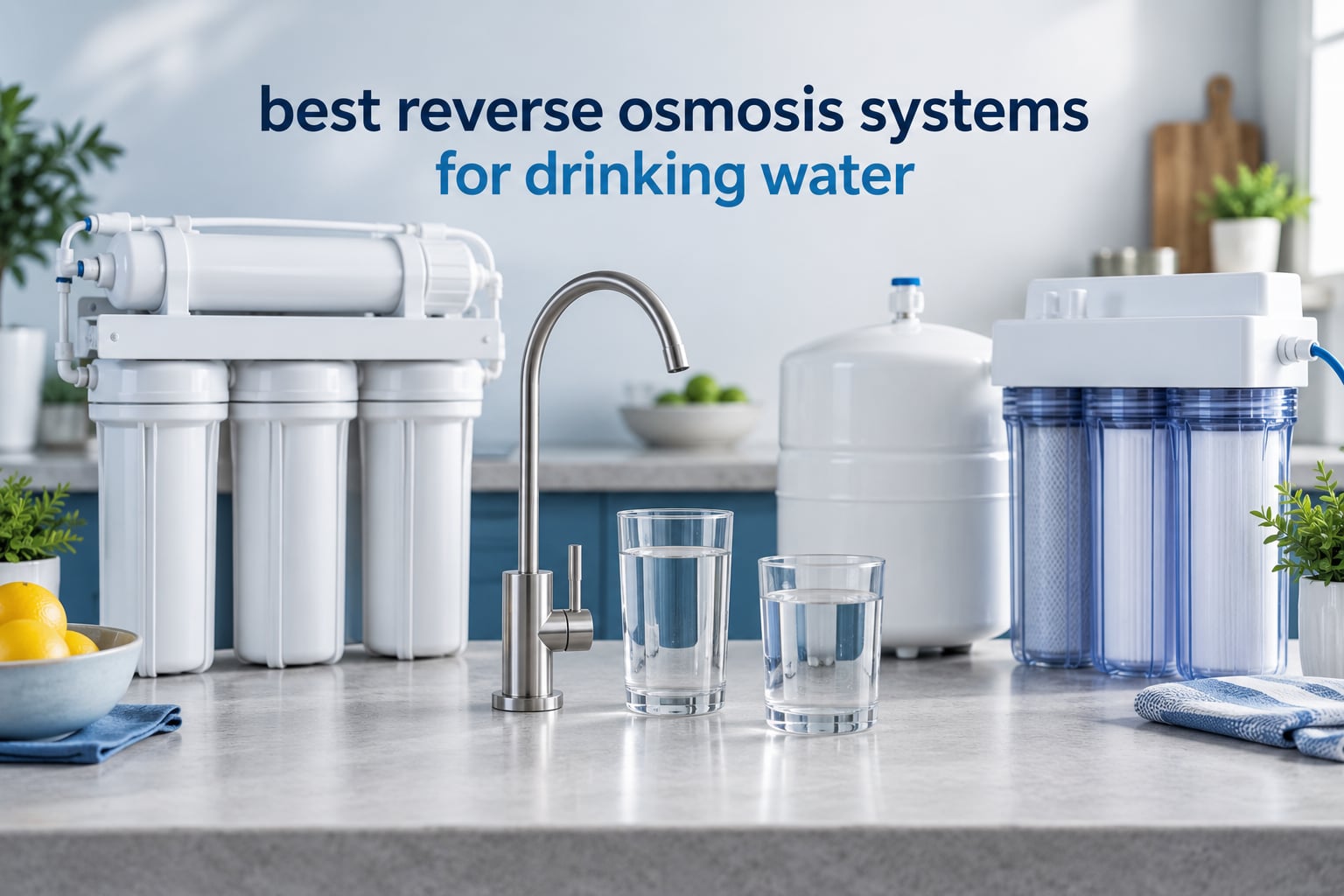
If you want one answer right now: the iSpring RCC7AK-BN is the best reverse osmosis system for drinking water in 2026 for most households. It carries the largest verified review base in this roundup, holds whole-system NSF/ANSI 58 certification, hits a 75 GPD rated output, and installs without electricity or a plumber. If your cabinet is tight or you want no storage tank at all, the Waterdrop G3P600 is the pick instead.
That said, “best” depends heavily on your water, your under-sink cabinet, and whether you have an electrical outlet down there. A 600 GPD tankless unit that fills a glass in five seconds is a poor fit in a narrow cabinet with no outlet. A 50 GPD tanked system is a poor fit for a family of five that drinks a gallon a day.
We spent six weeks reading verified buyer feedback, laboratory certification records, and spec sheets on twelve systems, then ranked them on the things that actually break an RO system: contaminant removal, water efficiency, install friction, and what the filters cost you every year. Last updated for 2026.
ContentsTable of Contents
- 1Top 3 Reverse Osmosis Picks for Drinking Water in 2026→
- 2iSpring RCC7AK-BN 75 GPD→
- 3Waterdrop G3P600→
- 4Waterdrop G3P800→
- 5All 12 Reverse Osmosis Systems Compared in 2026→
- 61. iSpring RCC7AK-BN 75 GPD Review – The Best Reverse Osmosis System Overall→
- 7iSpring RCC7AK-BN NSF Certified, 75 GPD, Alkaline 6-Stage Reverse Osmosis System, pH+ Remineralization RO Water Filter System Under Sink Patented Top-Mounted Faucet Design for Easy Installation→
- 8Pros→
- 9Cons→
- 10Who this reverse osmosis system suits→
- 11Who should skip it→
- 122. Waterdrop G3P600 Review – The Best Tankless Reverse Osmosis System→
- 13Waterdrop G3P600 Tankless Reverse Osmosis Water Filter System, 600 GPD→
- 14Pros→
- 15Cons→
- 16Who this tankless RO system suits→
- 17Who should skip it→
- 183. Waterdrop G3P800 Review – The Best Reverse Osmosis System for Heavy Daily Use→
- 19Waterdrop G3P800 Tankless Reverse Osmosis Water Filter System, 800 GPD→
- 20Pros→
- 21Cons→
- 22Who this high-output RO system suits→
- 23Who should skip it→
- 244. iSpring RCC7P-AK Review – The Best RO System for Low Water Pressure Homes→
- 25iSpring RCC7P-AK, 6-Stage Reverse Osmosis System Under Sink Alkaline Water Filter and Pump, RO Drinking Water Filtration System, Patented Top-Mounted Faucet Design for Easy Installation→
- 26Pros→
- 27Cons→
- 28Who this low-pressure RO system suits→
- 29Who should skip it→
- 305. Home Master TMAFC Review – The Best Reverse Osmosis System for Mineral Taste→
- 31Home Master TMAFC Artesian Full Contact Reverse Osmosis System, 7-stages, Patented 2-Pass Alkaline Remineralization, Fast 4.5s Fill Rate, 8.5” catalytic carbon, 5-year limited parts→
- 32Pros→
- 33Cons→
- 34Who this mineral-taste RO system suits→
- 35Who should skip it→
- 366. APEC ROES-50 Review – The Best Value Reverse Osmosis System→
- 37APEC Water ROES-50, 5-Stage Under Sink Reverse Osmosis System, 50 GPD→
- 38Pros→
- 39Cons→
- 40Who this value RO system suits→
- 41Who should skip it→
- 427. Waterdrop G2P600 Review – The Most Affordable Tankless RO System→
- 43Waterdrop G2P600 Under-Sink RO System, 600 GPD Tankless Water Filtration→
- 44Pros→
- 45Cons→
- 46Who this budget tankless system suits→
- 47Who should skip it→
- 488. Bluevua RO100ROPOT Review – The Best Countertop RO With Glass Storage→
- 49Bluevua RO100ROPOT Countertop Reverse Osmosis Water Filter System→
- 50Pros→
- 51Cons→
- 52Who this countertop RO system suits→
- 53Who should skip it→
- 549. DREO Countertop RO Review – The Best Reverse Osmosis System for Apartments→
- 55DREO Reverse Osmosis Water Filter Countertop, RO Filtration System, 3:1 Pure to Drain, TDS & Filter Life & 2 Autofill Pitchers, Install-Free, Self-Cleaning Water Purifier, RO Water Filter→
- 56Pros→
- 57Cons→
- 58Who this apartment RO system suits→
- 59Who should skip it→
- 6010. SimPure Y7P-BW Review – The Best Countertop RO With UV Disinfection→
- 61SimPure Y7P-BW UV Countertop Reverse Osmosis Water Filter, 5 Stage RO→
- 62Pros→
- 63Cons→
- 64Who this countertop UV RO system suits→
- 65Who should skip it→
- 6611. FS-TFC 100 GPD Review – The Best Budget Reverse Osmosis System→
- 67FS-TFC 5-Stage Reverse Osmosis Water Filter System, NSF Certified 100GPD RO Water Purifier Under Sink Reduces 99.999% Impurities, with 4 Extra Replacement Filters Free for Home Drinking→
- 68Pros→
- 69Cons→
- 70Who this budget RO system suits→
- 71Who should skip it→
- 7212. AquaTru Glass Carafe Review – The Best Countertop RO for Confirmed PFOA Removal→
- 73AquaTru Glass Carafe | Countertop Reverse Osmosis Water Filter Countertop RO System Water Purifier | 4 Stage Reverse Osmosis Filtration | Removes 84 Contaminants Like PFOA + PFOS, Lead, Microplastics→
- 74Pros→
- 75Cons→
- 76Who this glass-carafe RO system suits→
- 77Who should skip it→
- 78How We Picked and Ranked These Systems→
- 79Reverse Osmosis Buying Guide: What Actually Matters→
- 80What the certifications actually cover→
- 81Tankless or tank-based: which should you buy→
- 82What GPD and flow rate mean in practice→
- 83Pure-to-drain ratio and why it hits your water bill→
- 84Water pressure and booster pumps→
- 85Remineralisation and why water tastes flat→
- 86Under-sink space, faucet holes, and outlets→
- 87Filter replacement cost and total cost of ownership→
- 88Countertop, under-sink, or whole house→
- 89Matching feed water TDS to the system→
- 90Stage count is mostly a marketing number→
- 91Is RO water safe to drink→
- 92Troubleshooting: Why Your Reverse Osmosis System Stops Making Water→
- 93Frequently Asked Questions→
- 94What is the absolute best reverse osmosis system?→
- 95Which brand of reverse osmosis is best?→
- 96Should I get a tank or tankless reverse osmosis system?→
- 97Do tankless reverse osmosis systems work well?→
- 98Why avoid reverse osmosis water?→
- 99Is RO water hard on the kidneys?→
- 100Which is better, RO or UV?→
- 101How much water does a reverse osmosis system waste?→
- 102How often do reverse osmosis filters need to be replaced?→
- 103Final Verdict→
Top 3 Reverse Osmosis Picks for Drinking Water in 2026
These three cover the widest range of buyer situations. If you are still undecided, start here and read the full review further down.

iSpring RCC7AK-BN 75 GPD
- NSF/ANSI 58 whole system
- 75 GPD at 70 psi
- Mineral boost pH+ stage
- Top-mounted faucet fastener

Waterdrop G3P600
- 600 GPD tankless
- 2:1 pure-to-drain
- Smart TDS faucet
- Three-second filter changes

Waterdrop G3P800
- 800 GPD capacity
- 3:1 pure-to-drain
- 10-stage filtration
- 5-second cup fill
As an Amazon Associate we earn from qualifying purchases. CERTAIN CONTENT THAT APPEARS ON THIS SITE COMES FROM AMAZON. THIS CONTENT IS PROVIDED 'AS IS' AND IS SUBJECT TO CHANGE OR REMOVAL AT ANY TIME.
All 12 Reverse Osmosis Systems Compared in 2026
Every system below appears in ranked order, with its certification status, rated output, and the design detail that separates it from the pack.
| # | Product | Key details | Where to buy |
|---|---|---|---|
| 1 | iSpring RCC7AK-BN 75 GPD Alkaline RO |
|
Check Latest Price |
| 2 | Waterdrop G3P600 Tankless 600 GPD |
|
Check Latest Price |
| 3 | Waterdrop G3P800 Tankless 800 GPD |
|
Check Latest Price |
| 4 |  iSpring RCC7P-AK 75 GPD with Pump iSpring RCC7P-AK 75 GPD with Pump |
|
Check Latest Price |
| 5 |  Home Master TMAFC Artesian 7-Stage Home Master TMAFC Artesian 7-Stage |
|
Check Latest Price |
| 6 |  APEC ROES-50 50 GPD 5-Stage APEC ROES-50 50 GPD 5-Stage |
|
Check Latest Price |
| 7 |  Waterdrop G2P600 Tankless 600 GPD Waterdrop G2P600 Tankless 600 GPD |
|
Check Latest Price |
| 8 |  Bluevua RO100ROPOT Countertop RO Bluevua RO100ROPOT Countertop RO |
|
Check Latest Price |
| 9 |  DREO Countertop RO 5 L DREO Countertop RO 5 L |
|
Check Latest Price |
| 10 |  SimPure Y7P-BW Countertop RO with UV SimPure Y7P-BW Countertop RO with UV |
|
Check Latest Price |
| 11 |  FS-TFC 100 GPD 5-Stage RO FS-TFC 100 GPD 5-Stage RO |
|
Check Latest Price |
| 12 |  AquaTru Glass Carafe Countertop RO AquaTru Glass Carafe Countertop RO |
|
Check Latest Price |
We earn from qualifying purchases. CERTAIN CONTENT THAT APPEARS ON THIS SITE COMES FROM AMAZON. THIS CONTENT IS PROVIDED 'AS IS' AND IS SUBJECT TO CHANGE OR REMOVAL AT ANY TIME.
1. iSpring RCC7AK-BN 75 GPD Review – The Best Reverse Osmosis System Overall
iSpring RCC7AK-BN NSF Certified, 75 GPD, Alkaline 6-Stage Reverse Osmosis System, pH+ Remineralization RO Water Filter System Under Sink Patented Top-Mounted Faucet Design for Easy Installation
- 75 GPD at 70 psi
- Feed TDS up to 750 ppm
- 15.5 x 16 x 18 inches
- No electricity needed
Pros
- NSF/ANSI 58 certified for the whole system
- Top-mounted faucet fastener installs from above the sink
- Transparent first-stage housing
- Mineral boost pH+ stage
- No power required
Cons
- Storage tank means waiting to refill between draws
- Filter sets needed every 6 to 12 months
- Needs at least 70 psi to hit rated capacity
We earn a commission, at no additional cost to you. CERTAIN CONTENT THAT APPEARS ON THIS SITE COMES FROM AMAZON. THIS CONTENT IS PROVIDED 'AS IS' AND IS SUBJECT TO CHANGE OR REMOVAL AT ANY TIME.
Six weeks of reading buyer feedback on the RCC7AK-BN turned up one recurring theme: people finish the install themselves in an evening and then stop thinking about it. That is exactly what you want from a drinking water system. The unit ships with the faucet, the storage tank, and a tool set, so there is nothing to source separately before you start.
Output is rated at 75 GPD at 70 psi line pressure, which is more than a two-person household needs for drinking and cooking water. The feed water ceiling is 750 ppm TDS, well above a typical municipal supply, so this is not a well-water-only unit.
The part that sets this unit apart from cheaper five-stage systems is the certification. NSF/ANSI 58 covers the entire assembled system rather than only the membrane, with published reduction claims of 93-98% for TDS, 96-99% for PFAS, 95-99% for chlorine, over 99.7% for asbestos, and over 98.9% for lead.
The sixth stage is a mineral boost alkaline cartridge. Reverse osmosis strips dissolved solids indiscriminately, and the result tastes flat until something puts a little calcium and magnesium back. Owners consistently describe the taste as clean rather than empty.
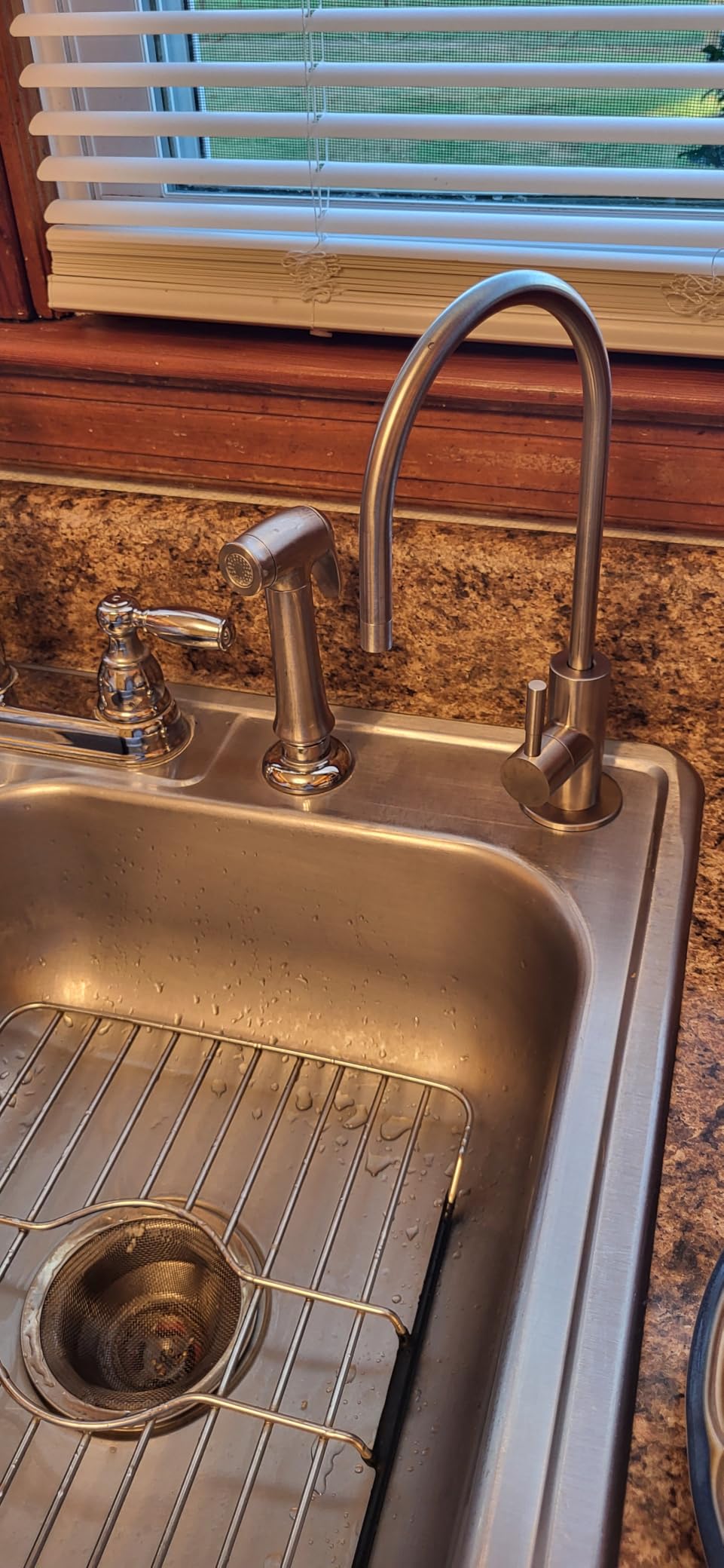
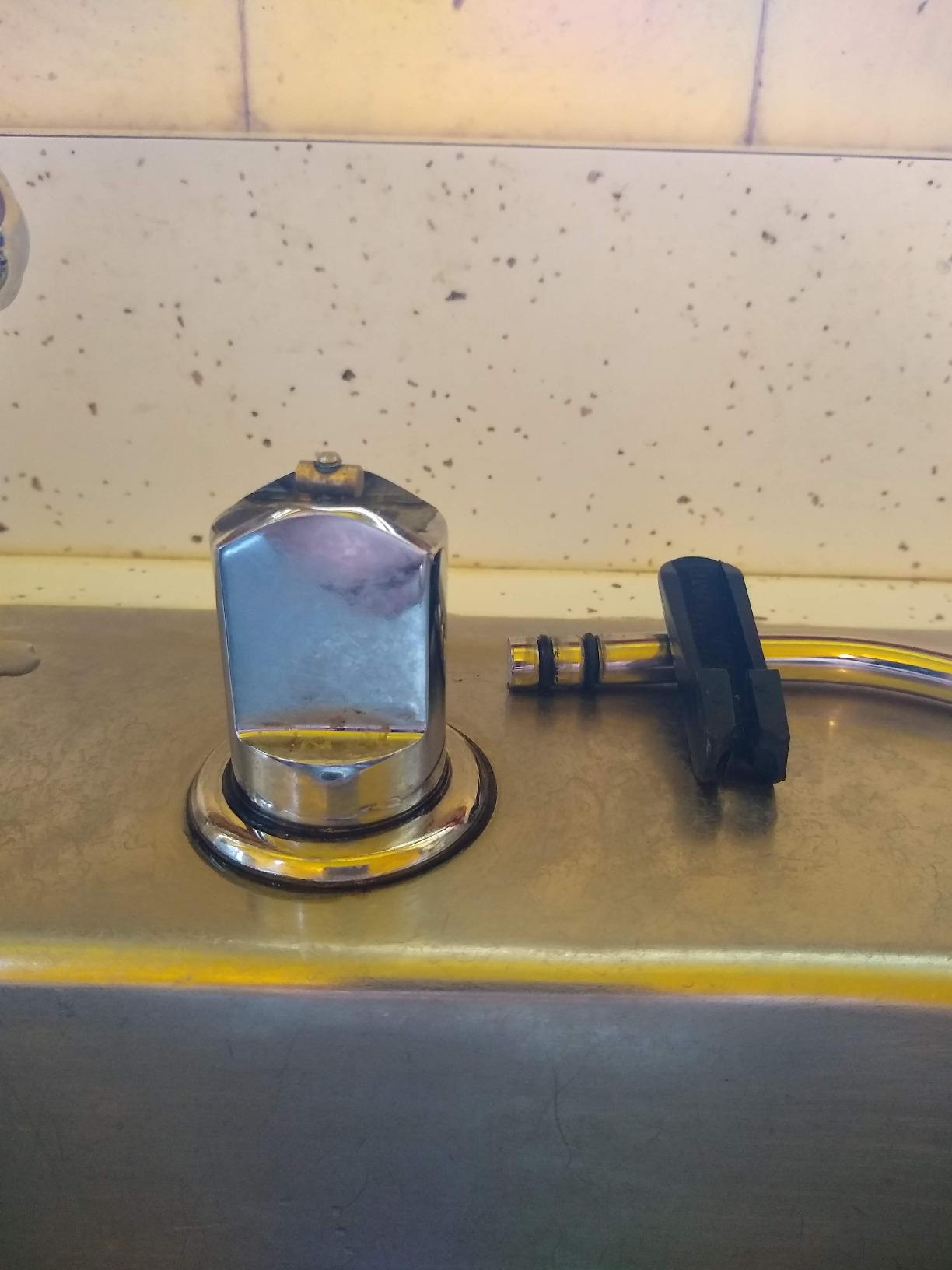
The patented top-mounted faucet fastener is the quiet hero here. You seat the fastener from above the countertop instead of trying to thread a nut onto a stem from a cramped cabinet. If the base plate ever has to come off, you can reach it without dismantling the sink.
Who this reverse osmosis system suits
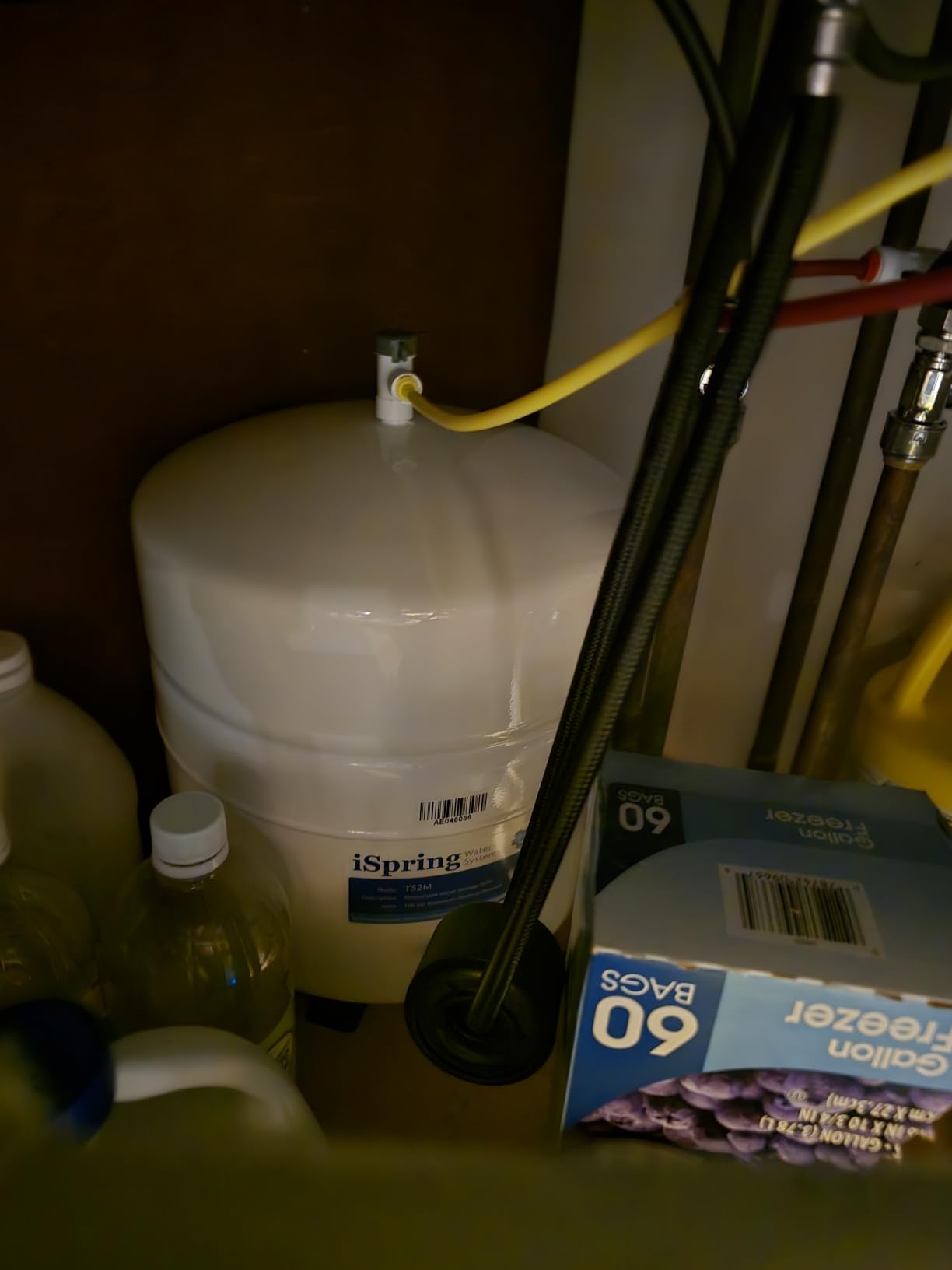
It suits anyone on municipal water who wants a dedicated drinking tap with whole-system certification and no electrical work. The 15.5 x 16 x 18 inch footprint plus tank fits most standard under-sink cabinets, and a homeowner with basic tools can complete the install.
It also suits buyers who want transparent housings on the sediment stage. Seeing brown grit accumulate is how you know a pre-filter is doing its job before the membrane sees that load.
Who should skip it
Skip it if your line pressure regularly sits below 70 psi, because you will see far less than the rated 75 GPD without a booster pump. If that is your situation, the pumped sibling in this list handles low pressure better.
Also skip it if you dislike waiting. A storage tank means the first glass after a long gap takes time to push through. For anyone who wants instant flow at the tap, a tankless design is the better fit.
We earn a commission, at no additional cost to you. CERTAIN CONTENT THAT APPEARS ON THIS SITE COMES FROM AMAZON. THIS CONTENT IS PROVIDED 'AS IS' AND IS SUBJECT TO CHANGE OR REMOVAL AT ANY TIME.
2. Waterdrop G3P600 Review – The Best Tankless Reverse Osmosis System
Waterdrop G3P600 Tankless Reverse Osmosis Water Filter System, 600 GPD
- 600 GPD tankless
- 2:1 pure-to-drain
- 18.12 x 5.67 x 17.72 inches
- 87 psi operating pressure
Pros
- Tankless layout frees roughly 70 percent of cabinet space
- 2:1 drain ratio cuts wastewater
- Smart faucet shows live TDS and filter status
- Front-facing filters change in about three seconds
- Certified to NSF/ANSI 42 53 58 and 372
Cons
- Replacement cartridges are among the priciest in this roundup
- Needs an always-live outlet under the sink
- TDS readout can read wrong right after a filter change
We earn a commission, at no additional cost to you. CERTAIN CONTENT THAT APPEARS ON THIS SITE COMES FROM AMAZON. THIS CONTENT IS PROVIDED 'AS IS' AND IS SUBJECT TO CHANGE OR REMOVAL AT ANY TIME.
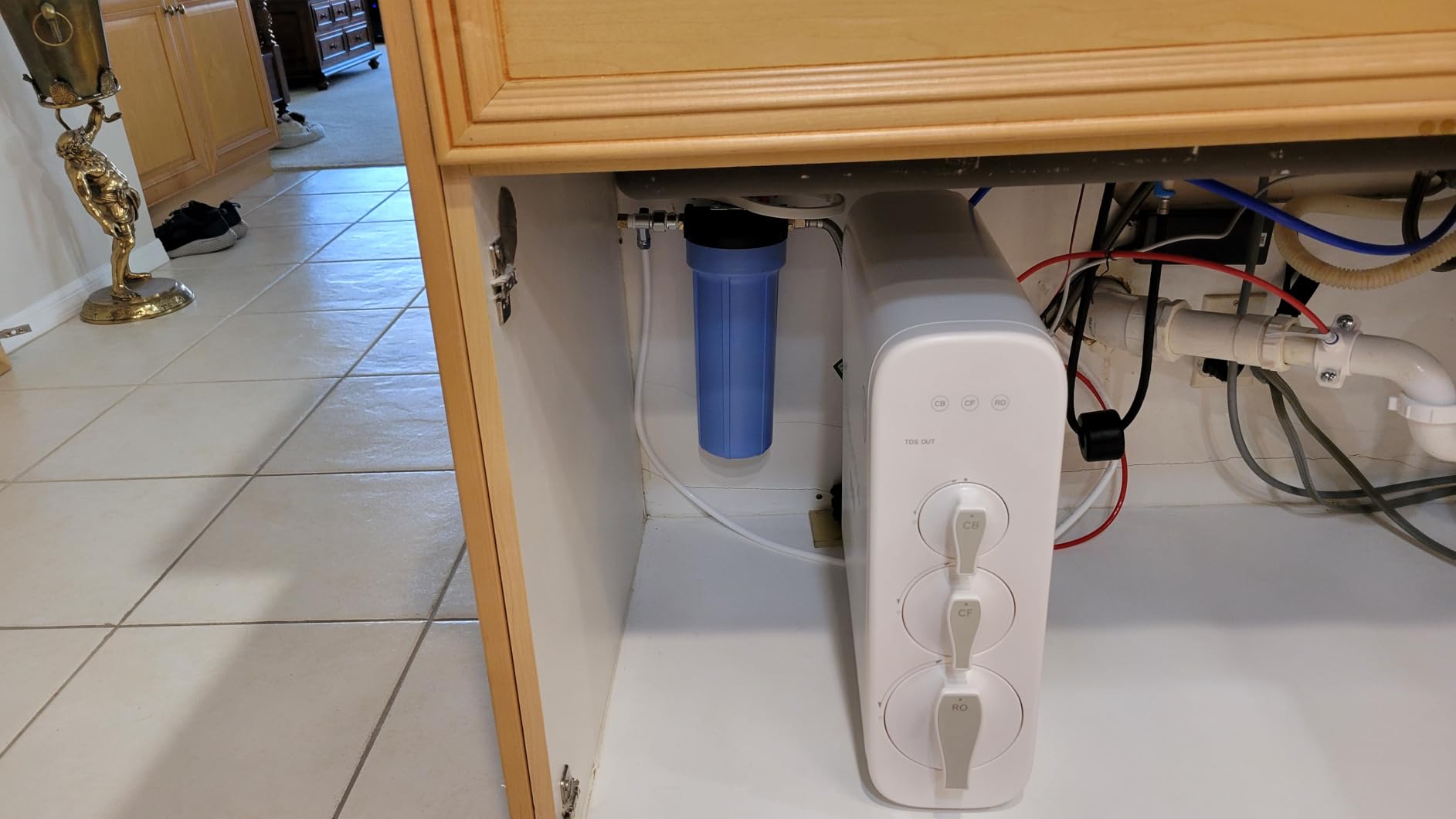
The G3P600 is the design we recommend to anyone who has ever been annoyed by a slow glass of water. There is no storage tank. A permeate pump pushes purified water straight to the faucet, so the first pour is as fast as the hundredth.
Rated output is 600 GPD with a maximum flow rate of 0.42 gpm, and the drain ratio is 2:1 pure to drain. That ratio matters on a water bill, because conventional tankless designs run closer to 4:1. Owners report TDS moving from roughly 99 ppm on municipal supply to about 12 ppm through the membrane.
Certification is the strongest in this group: NSF/ANSI 42, 53, 58 and 372, with 372 covering lead-free materials in the wetted path. For a buyer who wants a certificate number rather than a marketing claim, that matters more than stage count.
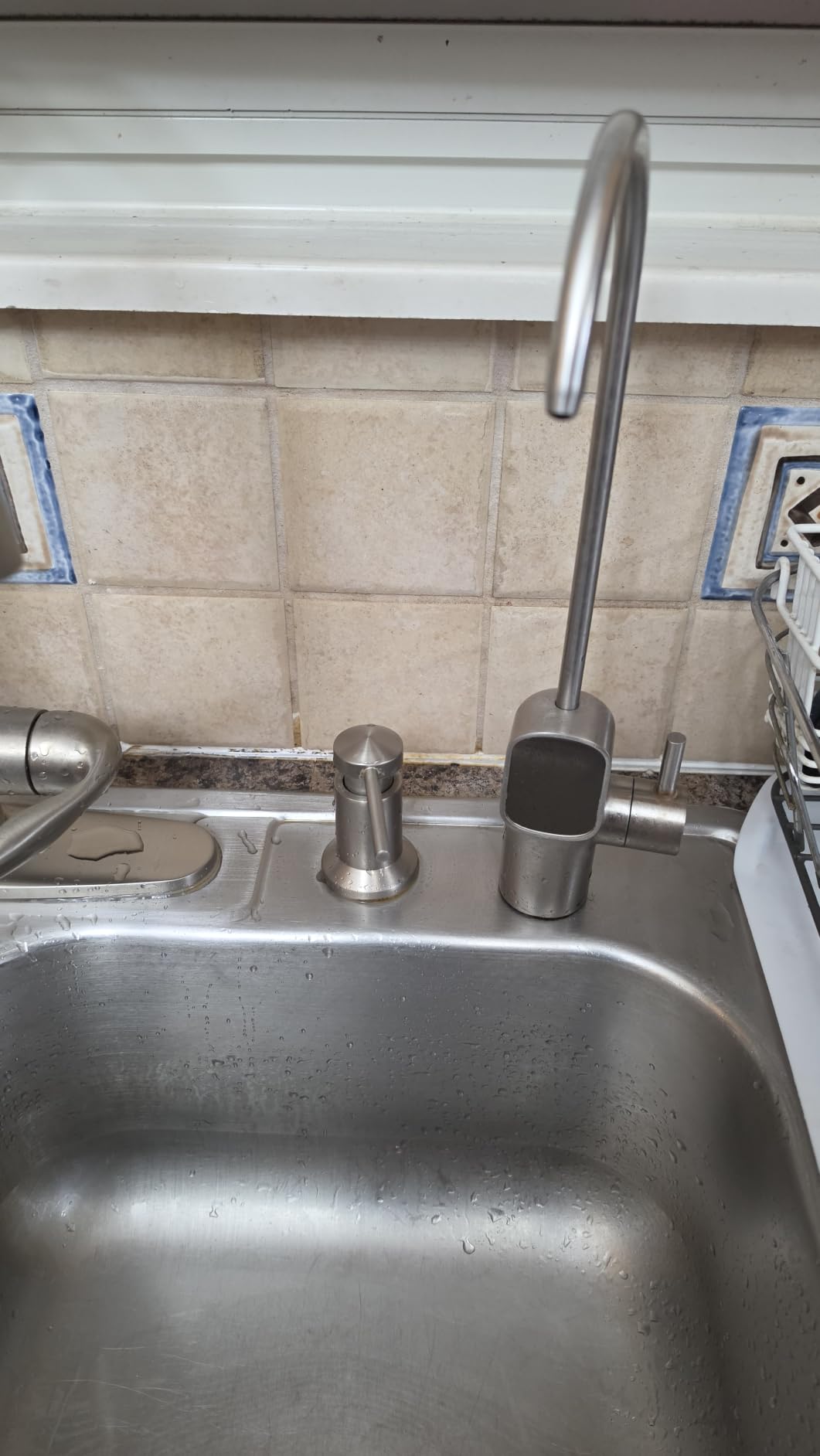
The filter layout is the other reason owners stick with it. Three pre-installed cartridges sit behind a front panel and twist out in about three seconds, so you are not crawling under a sink with a wrench every six months. A smart faucet displays live TDS and color-coded filter life status.
Measure before you buy. At 18.12 x 5.67 x 17.72 inches and 31 pounds, this is the tallest unit in the roundup. If your cabinet cannot clear that height, the G2P600 in this list sits several inches shorter.
Who this tankless RO system suits
It suits households that drink a lot of water, run an ice maker, or simply hate waiting on a storage tank. It also suits anyone whose cabinet has been colonized by plumbing and a recycling bin, because dropping the tank frees a large chunk of usable space.
Removing the tank removes a bacterial-growth risk too. A storage tank is a sealed plastic vessel holding still water, and it needs periodic flushing. No tank, no reservoir, no stale water sitting in the cabinet.
Who should skip it
Skip it if you have no electrical outlet under the sink. The pump needs continuous power, and unlike a tanked unit this design stops entirely in a blackout. That is also the reason to think twice about feeding a refrigerator from it.
Skip it if filter running cost is your top concern. Owners report recurring cartridge costs that run well above budget models. That is the trade for tool-free changes and a display faucet.
We earn a commission, at no additional cost to you. CERTAIN CONTENT THAT APPEARS ON THIS SITE COMES FROM AMAZON. THIS CONTENT IS PROVIDED 'AS IS' AND IS SUBJECT TO CHANGE OR REMOVAL AT ANY TIME.
3. Waterdrop G3P800 Review – The Best Reverse Osmosis System for Heavy Daily Use
Waterdrop G3P800 Tankless Reverse Osmosis Water Filter System, 800 GPD
- 800 GPD output
- 3:1 pure-to-drain
- 5-second cup fill
- Feed TDS up to 500 ppm
Pros
- Highest rated capacity in the roundup at 800 GPD
- 3:1 drain ratio uses less wastewater per cup
- Certified to NSF/ANSI 42 53 58 and 372
- Smart LED faucet with TDS and filter status
- Quiet enough to feed a refrigerator
Cons
- Highest purchase price of the group
- Filters cost more than competing brands over time
- Requires an always-powered outlet
- Automatic flush can start after light use
We earn a commission, at no additional cost to you. CERTAIN CONTENT THAT APPEARS ON THIS SITE COMES FROM AMAZON. THIS CONTENT IS PROVIDED 'AS IS' AND IS SUBJECT TO CHANGE OR REMOVAL AT ANY TIME.
The G3P800 is the output king of this list. Rated at 800 GPD, it fills a cup in about five seconds and carries a 3:1 pure-to-drain ratio, so it uses less wastewater per glass than the 2:1 models that sit next to it.
Filtration runs ten stages, tested by SGS for PFAS, fluoride, heavy metals, and radium. IAPMO R&T certified to NSF/ANSI 42, 53, 58 and 372. A 5,242-review base at a 4.5 average with a top-five category sales rank makes this the most widely owned premium unit we examined.
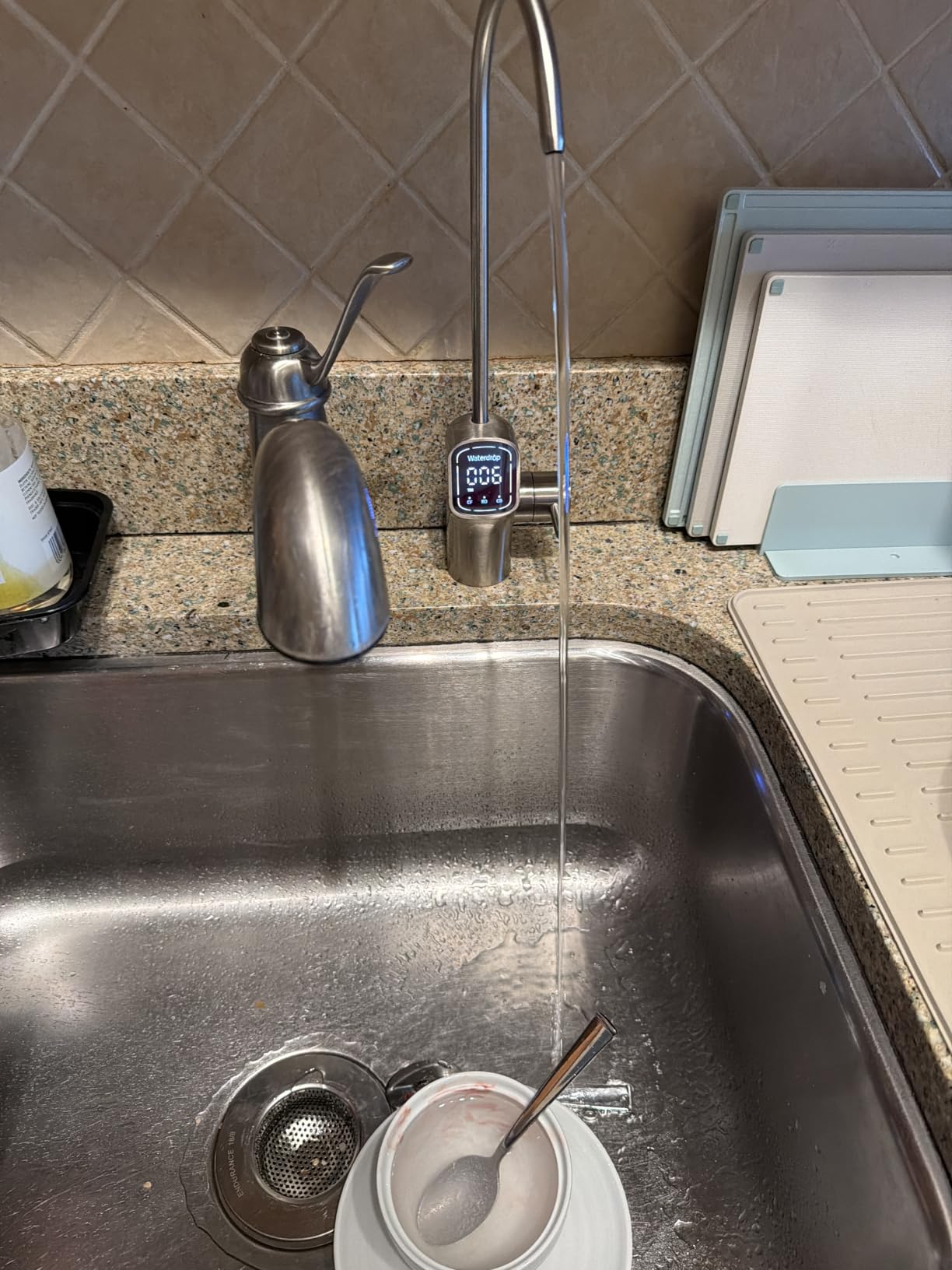
Where the G3P600 shows a simple status screen, this one shows live TDS and filter condition on an LED faucet with a lamp rated for up to 50 years. For a household running an ice maker off the same line, having the numbers visible at the tap is genuinely useful.
Long-term owners rate water quality and reliability highly and are just as direct about the running cost, citing roughly the same annual filter spend as the G3P600. Waterdrop support is repeatedly praised for replacing pumps and filters when faults appear.
One quirk worth knowing: an automatic flush cycle can trigger unexpectedly after only light use. If your kitchen is next to where you work, expect the occasional brief surge of the drain line.
Who this high-output RO system suits
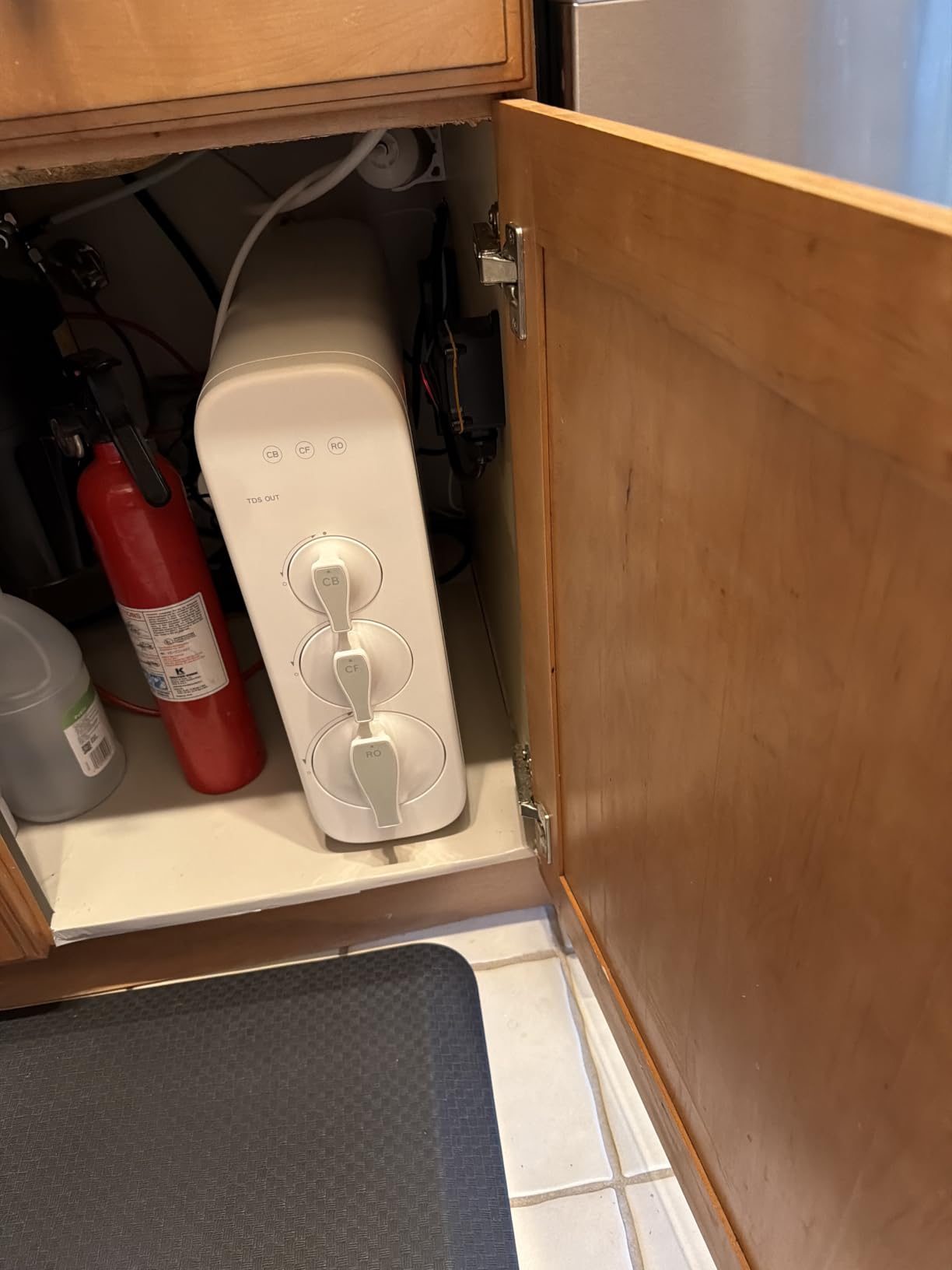
It suits large families, households that cook constantly, and anyone connecting an ice maker or refrigerator line. Five seconds per cup means nobody waits while a kettle boils or a coffee machine fills.
It also suits owners who want the quietest premium option here. Buyers describe it as running quietly enough for a kitchen where conversation matters.
Who should skip it
Skip it if you are a household of one or two drinking only for cooking. The capacity far exceeds the need and you pay for headroom you will not use. The iSpring at number one covers the same use case for far less.
Skip it if you have a tight budget for the appliance itself. This is the priciest unit in the roundup, roughly double what the 400-class models command, and the filter cost is not the cheap part either.
We earn a commission, at no additional cost to you. CERTAIN CONTENT THAT APPEARS ON THIS SITE COMES FROM AMAZON. THIS CONTENT IS PROVIDED 'AS IS' AND IS SUBJECT TO CHANGE OR REMOVAL AT ANY TIME.
4. iSpring RCC7P-AK Review – The Best RO System for Low Water Pressure Homes
iSpring RCC7P-AK, 6-Stage Reverse Osmosis System Under Sink Alkaline Water Filter and Pump, RO Drinking Water Filtration System, Patented Top-Mounted Faucet Design for Easy Installation
- Integrated booster pump
- 75 GPD alkaline RO
- Feed TDS up to 2000 ppm
- 100-240V universal adapter
Pros
- Booster pump holds output steady in low-pressure homes
- Pump also cuts wastewater volume
- 4.7 average across 1663 reviews
- Handles feed water up to 2000 ppm TDS
- Universal 100-240V power adapter
Cons
- Needs an electrical outlet under the sink
- Costs more than the pump-free iSpring model
- Same slow tank refill as other tanked systems
We earn a commission, at no additional cost to you. CERTAIN CONTENT THAT APPEARS ON THIS SITE COMES FROM AMAZON. THIS CONTENT IS PROVIDED 'AS IS' AND IS SUBJECT TO CHANGE OR REMOVAL AT ANY TIME.
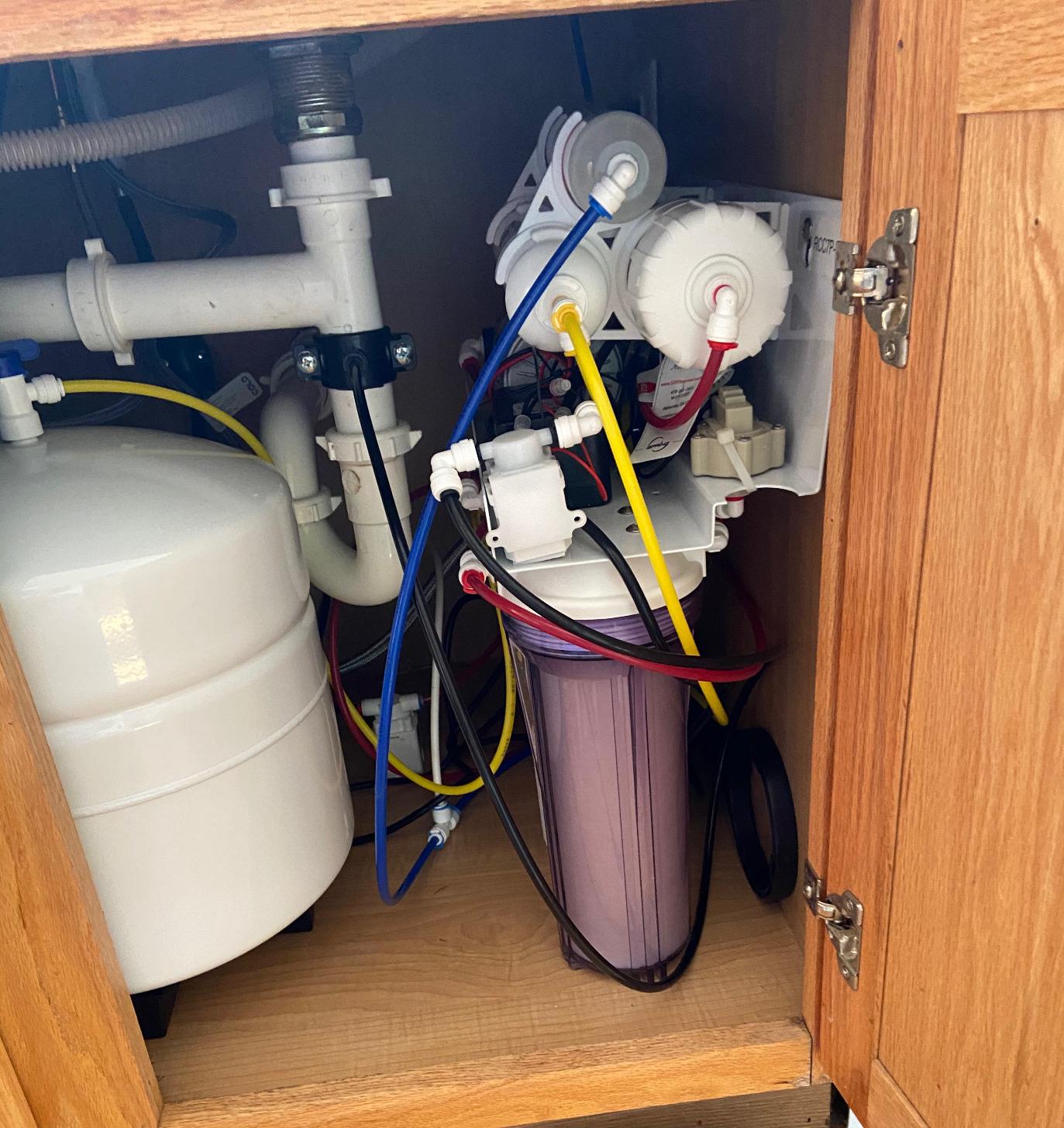
If your household pressure is marginal, this is the system to buy. Low line pressure is the single most common reason owners report an under-sink RO producing almost nothing, and the integrated booster pump here is the direct fix.
Beyond the pump, the sixth stage is an alkaline remineralizing cartridge that adds minerals and lifts pH compared with the slightly acidic output of standard five-stage units. Claims cover up to 99% reduction across 1000-plus contaminants including 98% lead reduction.
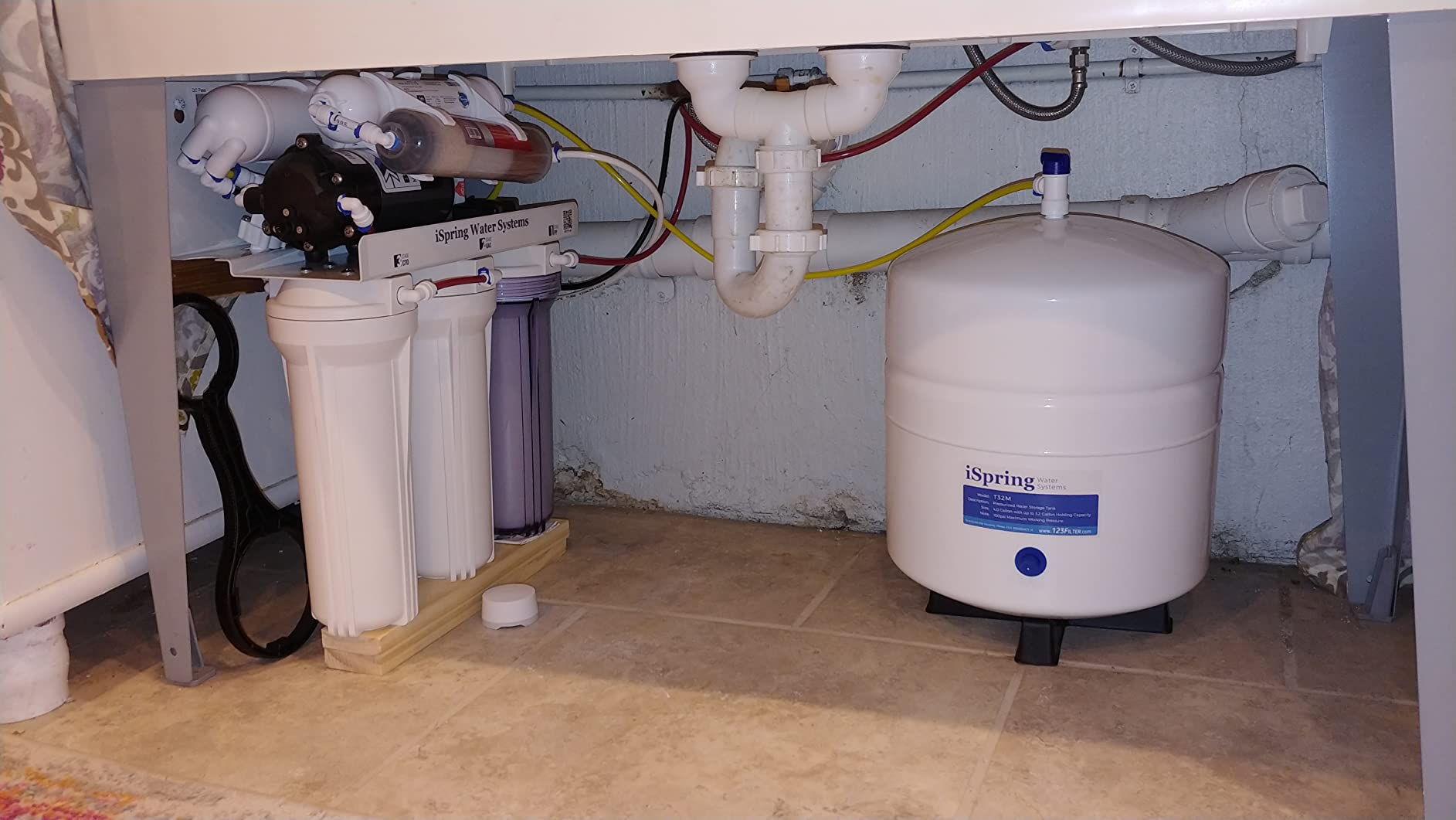
Owners consistently name the pump as the decisive feature rather than the filtration. In older homes with galvanised plumbing and low static pressure, a pump-free 75 GPD system will underperform badly against its rating. This one does not.
The pump also has a second benefit most buyers do not expect. Running the membrane at higher effective pressure improves its rejection rate, which cuts the wastewater going down the drain line for every gallon produced.
The universal 100-240V 50/60Hz adapter means the same unit works across regions, and technical support is based in Atlanta, Georgia. The tradeoff is real: you give up the plug-and-play simplicity of the pump-free model in this list.
Who this low-pressure RO system suits
It suits older homes, apartments with weak municipal pressure, and anyone who has already installed a tanked RO and watched it underperform. The 2000 ppm feed TDS ceiling also makes it more tolerant of hard, high-mineral supply than most competitors.
It suits households who care about both water waste and water quality, since the pump improves efficiency as well as flow.
Who should skip it
Skip it if you have measured good pressure and want zero electrical work. The number-one pick in this roundup hits its 75 GPD rating at 70 psi with no outlet required, which is the simpler path.
Skip it if you want the fastest possible flow. A 75 GPD tanked design still has the refill delay after heavy use, no matter how good the pump is.
We earn a commission, at no additional cost to you. CERTAIN CONTENT THAT APPEARS ON THIS SITE COMES FROM AMAZON. THIS CONTENT IS PROVIDED 'AS IS' AND IS SUBJECT TO CHANGE OR REMOVAL AT ANY TIME.
5. Home Master TMAFC Review – The Best Reverse Osmosis System for Mineral Taste
Home Master TMAFC Artesian Full Contact Reverse Osmosis System, 7-stages, Patented 2-Pass Alkaline Remineralization, Fast 4.5s Fill Rate, 8.5” catalytic carbon, 5-year limited parts
- 50 GPD DOW membrane
- 4.5-second fill rate
- 8.5 inch catalytic carbon
- 5-year parts warranty
Pros
- 4.7 average rating with 88 percent five-star reviews
- Two-pass remineralization adds calcium and magnesium twice
- 4.5-second fill rate is roughly double conventional designs
- Tool-free annual filter changes
- Five-year parts warranty and spare part availability
Cons
- 50 GPD output is modest next to 600 to 800 GPD units
- US-made units usually cost more than imported competitors
- Not NSF certified as a complete system for TDS
We earn a commission, at no additional cost to you. CERTAIN CONTENT THAT APPEARS ON THIS SITE COMES FROM AMAZON. THIS CONTENT IS PROVIDED 'AS IS' AND IS SUBJECT TO CHANGE OR REMOVAL AT ANY TIME.
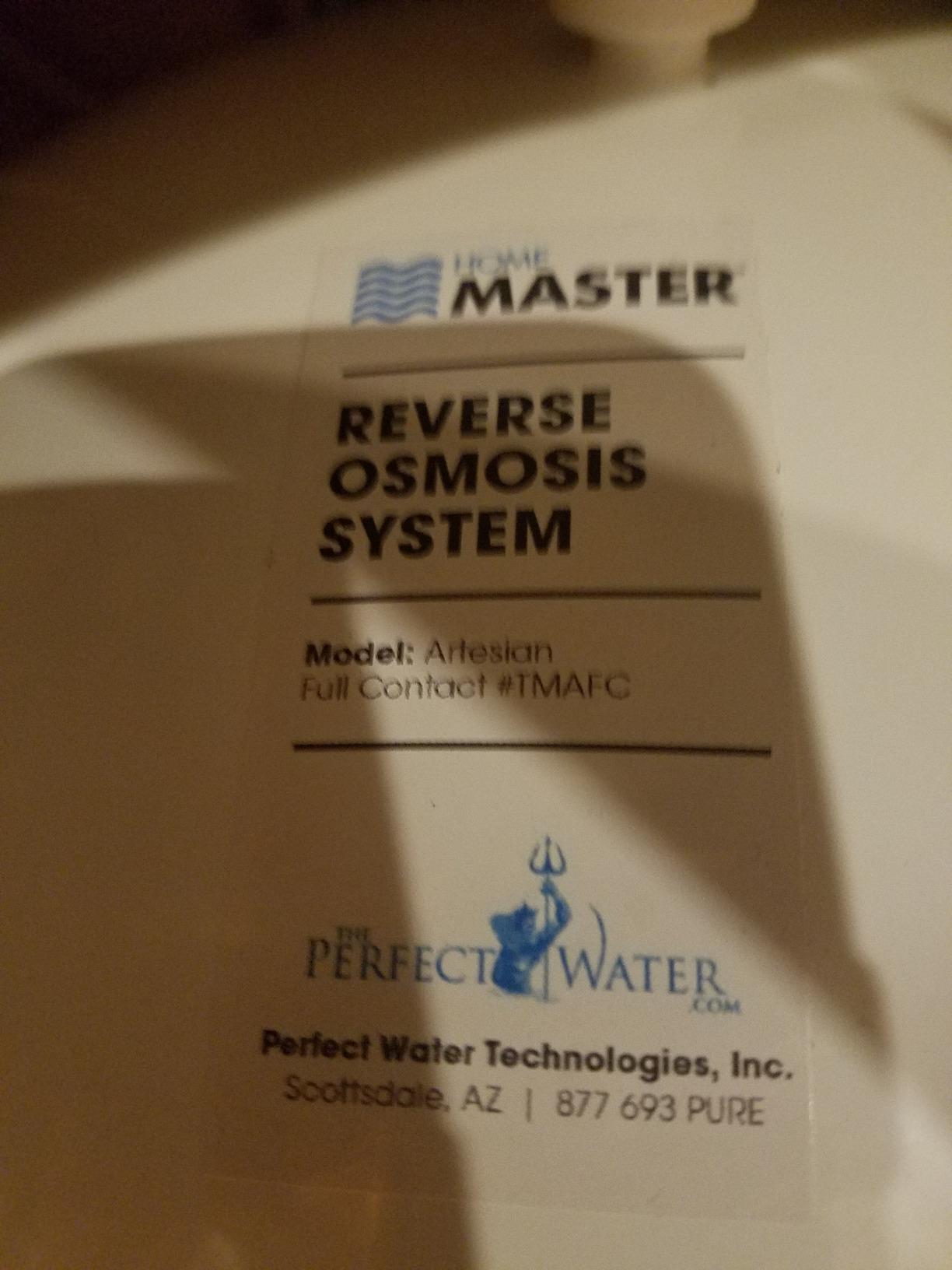
The TMAFC answers the most common complaint about reverse osmosis: water that tastes clean but empty. Its patented two-pass alkaline remineralization adds calcium and magnesium twice, once before and once after the storage tank, which also protects the tank from the aggressive low-mineral water.
The second differentiator is speed. A 4.5-second fill for an 8 ounce glass is roughly double a conventional unit and considerably faster than most tankless designs in this roundup, which is unusual for a 50 GPD system with a tank.
That speed comes from 3/8 inch fittings and tubing rather than the standard 1/4 inch, plus an 8.5 inch catalytic carbon block per pass for chlorine and taste reduction. The membrane itself is a DOW thin-film composite rated 0.0001 micron at 50 GPD.
Durability is the quiet strength here. You get a five-year limited parts warranty, five years of spare part availability, tool-free annual filter changes, and a modular design that accepts upgrades later. Long-term buyers in r/BuyItForLife style forums consistently favour brands with widely available parts and clear warranties over the highest-spec smart units.
The reservation is certification. Unlike most systems here, this one is not NSF certified as a complete assembly for TDS reduction, so you are relying on component claims. That is a real trade when your main reason for buying RO is contaminant removal.
Who this mineral-taste RO system suits
It suits drinkers who find plain demineralised water unpalatable and who want taste to be the deciding factor. It also suits owners who plan to keep a system for a decade rather than a few years, given the parts availability commitment.
It suits anyone without an under-sink outlet. This unit runs on pressure alone, with no pump and no power draw.
Who should skip it
Skip it if you need high daily production. A 50 GPD membrane is modest next to the 600 and 800 GPD tankless designs here, so a large household will outgrow it.
Skip it if certified whole-system removal is your priority. If a certificate number matters more to you than taste profile, pick one of the NSF/ANSI 58 certified units instead.
We earn a commission, at no additional cost to you. CERTAIN CONTENT THAT APPEARS ON THIS SITE COMES FROM AMAZON. THIS CONTENT IS PROVIDED 'AS IS' AND IS SUBJECT TO CHANGE OR REMOVAL AT ANY TIME.
6. APEC ROES-50 Review – The Best Value Reverse Osmosis System
APEC Water ROES-50, 5-Stage Under Sink Reverse Osmosis System, 50 GPD
- 50 GPD production
- NSF/ANSI 372 and 58 certified
- 40-85 psi operating range
- Feed TDS up to 2000 ppm
Pros
- Industry-standard 1/4 inch fittings with widely available cartridges
- Quick-connect push fittings simplify install and service
- Ten-year ownership reports from reviewers
- Consistently drives TDS to single digits
- Support has resolved parts issues for long-term owners
Cons
- Housing caps can crack if over-tightened during a cartridge change
- Faucet has no air gap
- 50 GPD means a slow initial fill
We earn a commission, at no additional cost to you. CERTAIN CONTENT THAT APPEARS ON THIS SITE COMES FROM AMAZON. THIS CONTENT IS PROVIDED 'AS IS' AND IS SUBJECT TO CHANGE OR REMOVAL AT ANY TIME.
The ROES-50 is the one we would buy for a rental, a guest house, or a first apartment. It costs little, uses standard quarter-inch fittings, and has the second-largest review base of any under-sink system here at more than 9400 ratings.
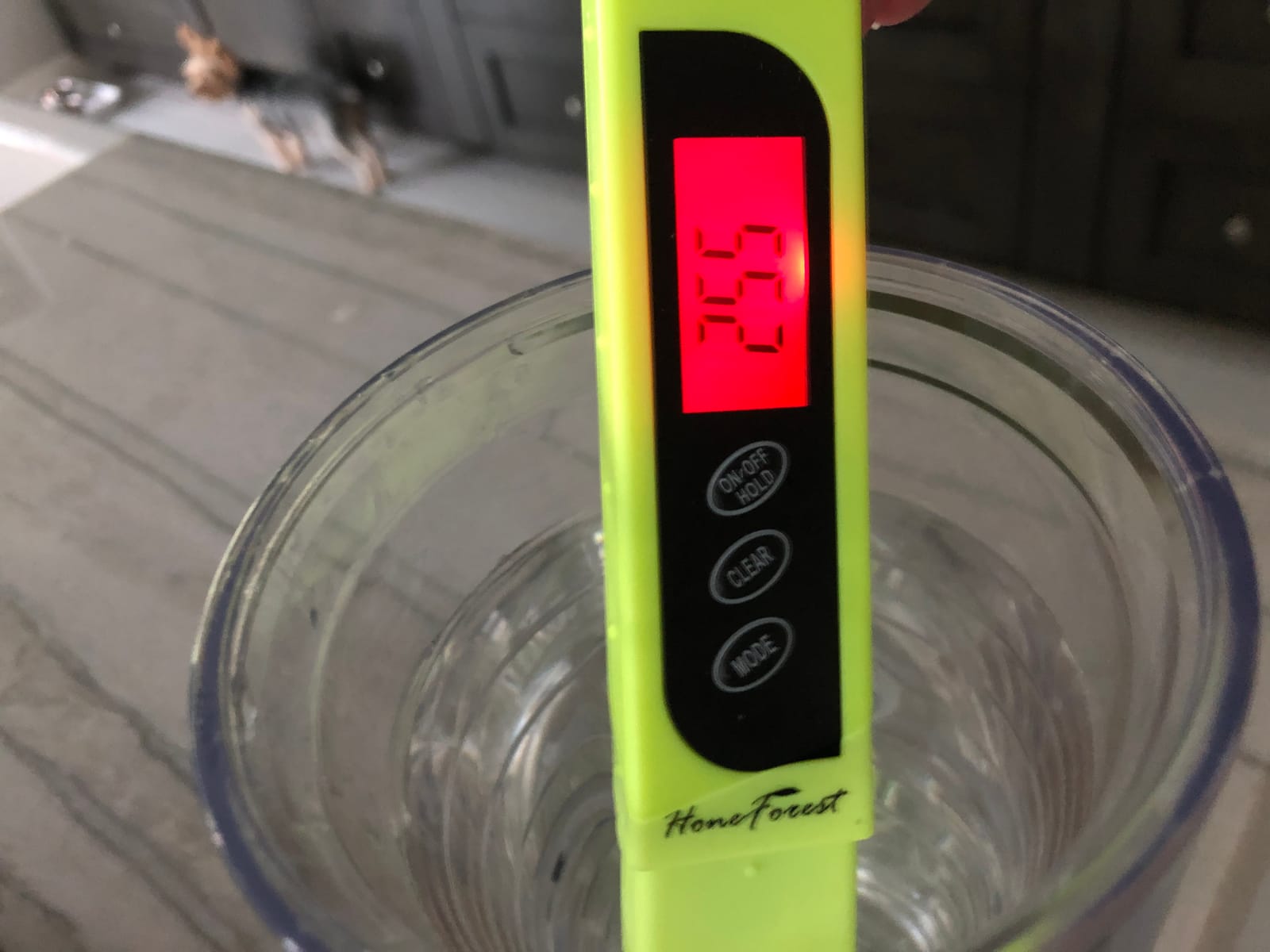
Buyers report tap TDS readings between roughly 120 and 380 ppm dropping to under 10 ppm, with 79% of reviews at five stars. The system is certified to NSF/ANSI 372 and 58 and claims removal of up to 99.99% of impurities.
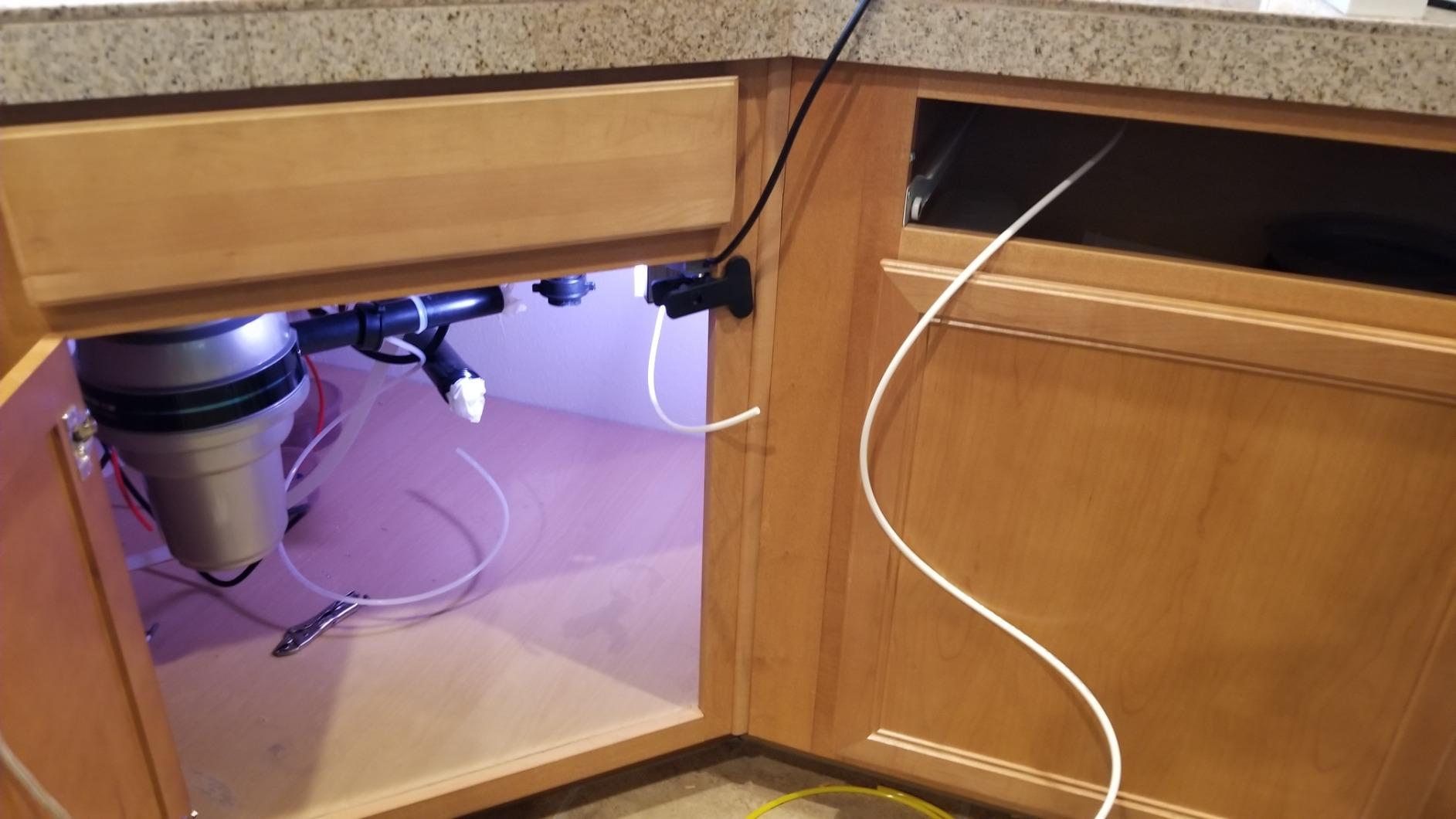
The reason it lasts is boring, and that is the point. Standard one-quarter inch tubing and common filter housings mean a plumber or a handy homeowner can source parts years later. One reviewer documents ten years of continuous service on the same unit.
The operating range is unusually wide at 40 to 85 psi, and the feed water ceiling of 2000 ppm TDS makes it tolerant of harder municipal supplies. Filter replacement runs every 6 to 24 months depending on feed water.
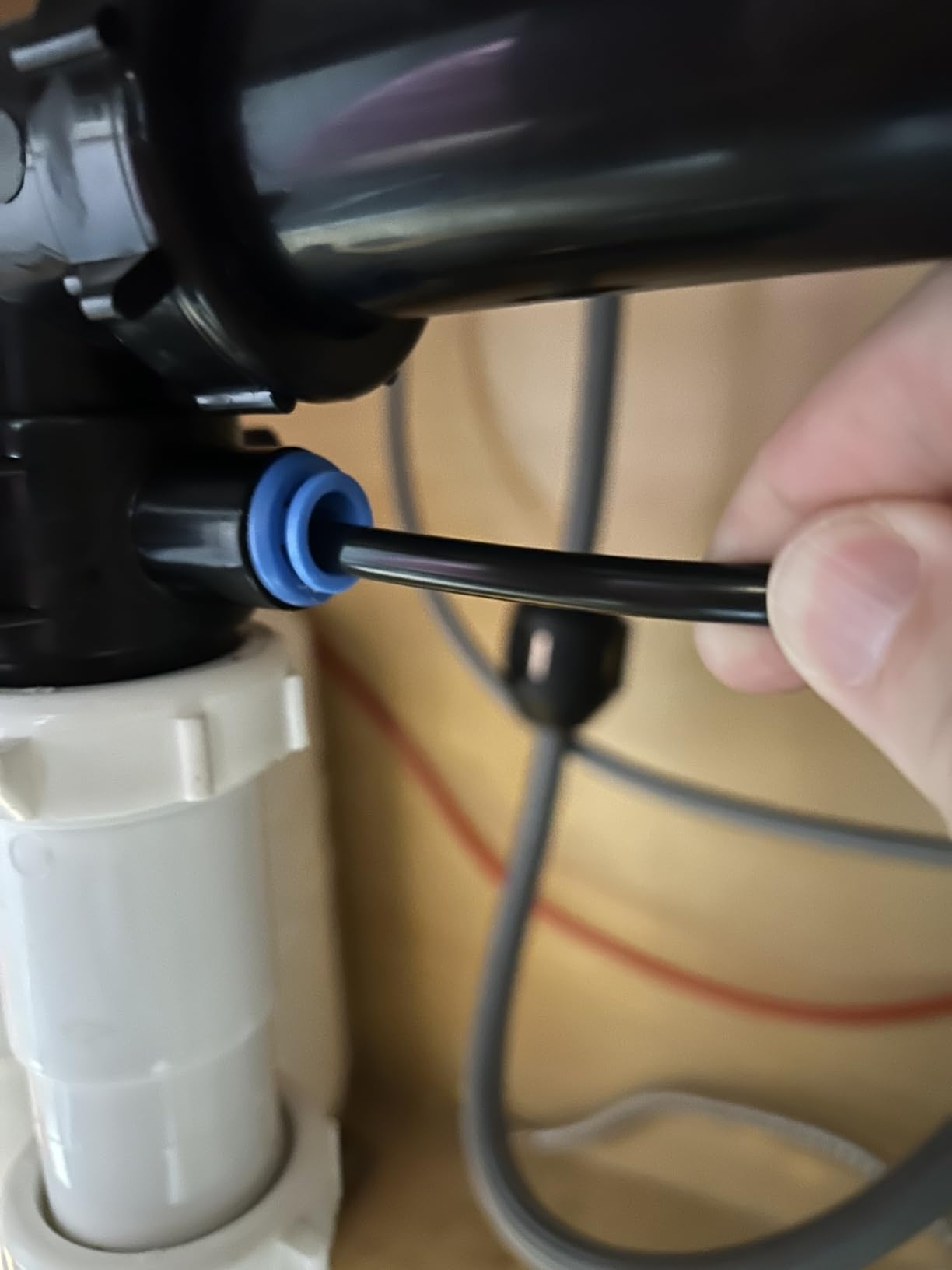
The most common negative thread is mechanical rather than filtration related. Housing caps can crack when over-tightened during a cartridge change, and the included faucet has no air gap, so adding a separate air-gap device is sensible if your plumbing code requires one.
Who this value RO system suits
It suits first-time buyers, renters, and anyone who wants a certified system without research. The colour-coded quick-connect tubing means the install is close to plug-and-play for anyone who has assembled flat-pack furniture.
It suits buyers who plan to keep the system a long time and want parts to stay available. Nothing about this design is proprietary.
Who should skip it
Skip it if you drink more than a gallon a day. At 50 GPD with a small tank, the recovery after the tank empties is slow, and you will notice the wait.
Skip it if taste is the deciding factor. This is a five-stage system with no remineralisation cartridge, so the output is the flat, slightly acidic water many people describe as tasting like nothing.
We earn a commission, at no additional cost to you. CERTAIN CONTENT THAT APPEARS ON THIS SITE COMES FROM AMAZON. THIS CONTENT IS PROVIDED 'AS IS' AND IS SUBJECT TO CHANGE OR REMOVAL AT ANY TIME.
7. Waterdrop G2P600 Review – The Most Affordable Tankless RO System
Waterdrop G2P600 Under-Sink RO System, 600 GPD Tankless Water Filtration
- 600 GPD tankless
- 2:1 pure-to-drain
- 17.3 x 5.9 x 14 inches
- 7-stage filtration
Pros
- Tankless 600 GPD output below the G3 price point
- 2:1 drain ratio saves water versus traditional systems
- Twist-and-pull filters change in three seconds
- Filter life indicators warn before exhaustion
- About a 30-minute self-install
Cons
- Included faucet has no digital TDS readout
- Needs under-sink electrical power
- Cartridge costs run above budget models
We earn a commission, at no additional cost to you. CERTAIN CONTENT THAT APPEARS ON THIS SITE COMES FROM AMAZON. THIS CONTENT IS PROVIDED 'AS IS' AND IS SUBJECT TO CHANGE OR REMOVAL AT ANY TIME.
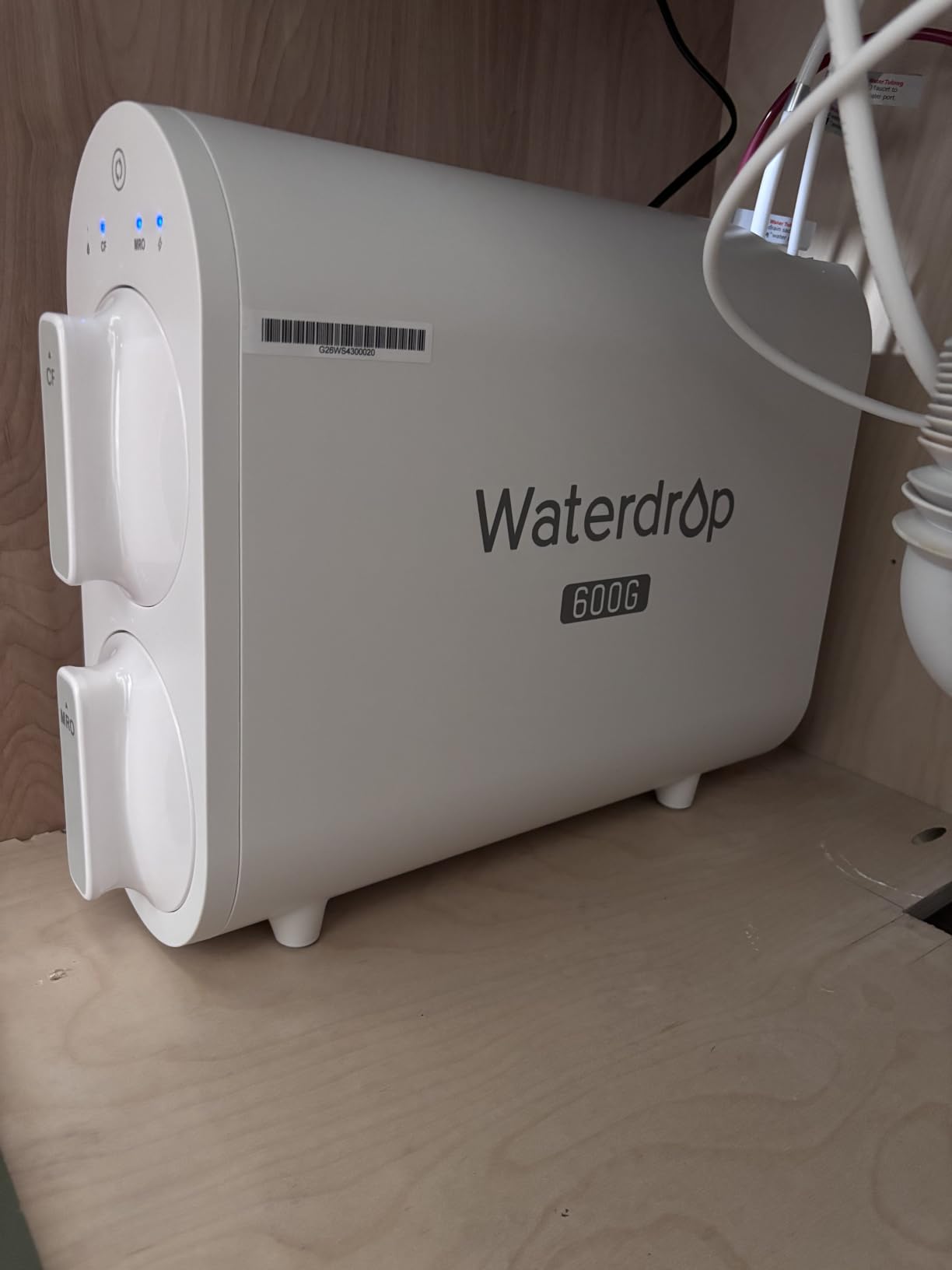
The G2P600 is how you get into tankless RO without paying for a smart faucet. It carries the same 600 GPD rated output and 2:1 drain ratio as the G3P600 at a noticeably lower appliance cost, and it holds a 4.6 average across 1742 reviews with 81% at five stars.
What you give up is the display. The included mechanical faucet has no live TDS readout and no filter status screen, so you track changes by calendar rather than by indicator.
What you keep is the good part of the G3 design. Seven stages of filtration, NSF/ANSI 372 certification for lead-free materials, twist-and-pull front-facing cartridge changes in about three seconds, and filter life indicators on the unit itself.
At 17.3 x 5.9 x 14 inches this is shorter than the G3 models, which matters in cabinets with a low shelf or a raised drain. Feed water ceiling is 500 ppm TDS, so it suits municipal water rather than high-TDS well supply.
Owners position it as the value entry point into tankless, and the feedback centres on flow rate and water savings rather than on any water quality complaint. Filter cartridges still add recurring cost above budget systems.
Who this budget tankless system suits
It suits buyers who want the tankless footprint and low drain ratio but do not care about a screen. It also suits anyone whose cabinet height rules out the taller G3 units.
It suits households comfortable replacing cartridges on a schedule instead of waiting for an indicator. Front access means the job takes seconds once you know the routine.
Who should skip it
Skip it if you like data at the tap. Without a TDS readout you are guessing whether the membrane is still performing, and a meter only tells you the state of one measurement anyway.
Skip it if your feed water exceeds 500 ppm TDS. That ceiling covers most city supply but excludes many well systems.
We earn a commission, at no additional cost to you. CERTAIN CONTENT THAT APPEARS ON THIS SITE COMES FROM AMAZON. THIS CONTENT IS PROVIDED 'AS IS' AND IS SUBJECT TO CHANGE OR REMOVAL AT ANY TIME.
8. Bluevua RO100ROPOT Review – The Best Countertop RO With Glass Storage
Bluevua RO100ROPOT Countertop Reverse Osmosis Water Filter System
- 5-stage RO with minerals
- 2:1 pure-to-drain
- Glass carafe included
- Filter life 12 to 24 months
Pros
- Borosilicate glass carafe avoids plastic storage
- Filter life rated at 12 to 24 months
- 2:1 drain ratio with automatic standby mode
- Display shows filter life and water quality
- Remineralisation filter improves taste
Cons
- Countertop footprint is wider than most tankless designs
- No hot or chilled output
- Carters must come from the manufacturer
We earn a commission, at no additional cost to you. CERTAIN CONTENT THAT APPEARS ON THIS SITE COMES FROM AMAZON. THIS CONTENT IS PROVIDED 'AS IS' AND IS SUBJECT TO CHANGE OR REMOVAL AT ANY TIME.
The Bluevua is the countertop option for people who object to storing purified water in plastic. The collection vessel is high borosilicate glass, which removes the secondary contamination question entirely from the equation.
It also runs on the longest cartridge interval in this group at 12 to 24 months, roughly double the 6-month norm most countertop units follow. That single change cuts how often you handle filters and how often your reservoir goes stale.
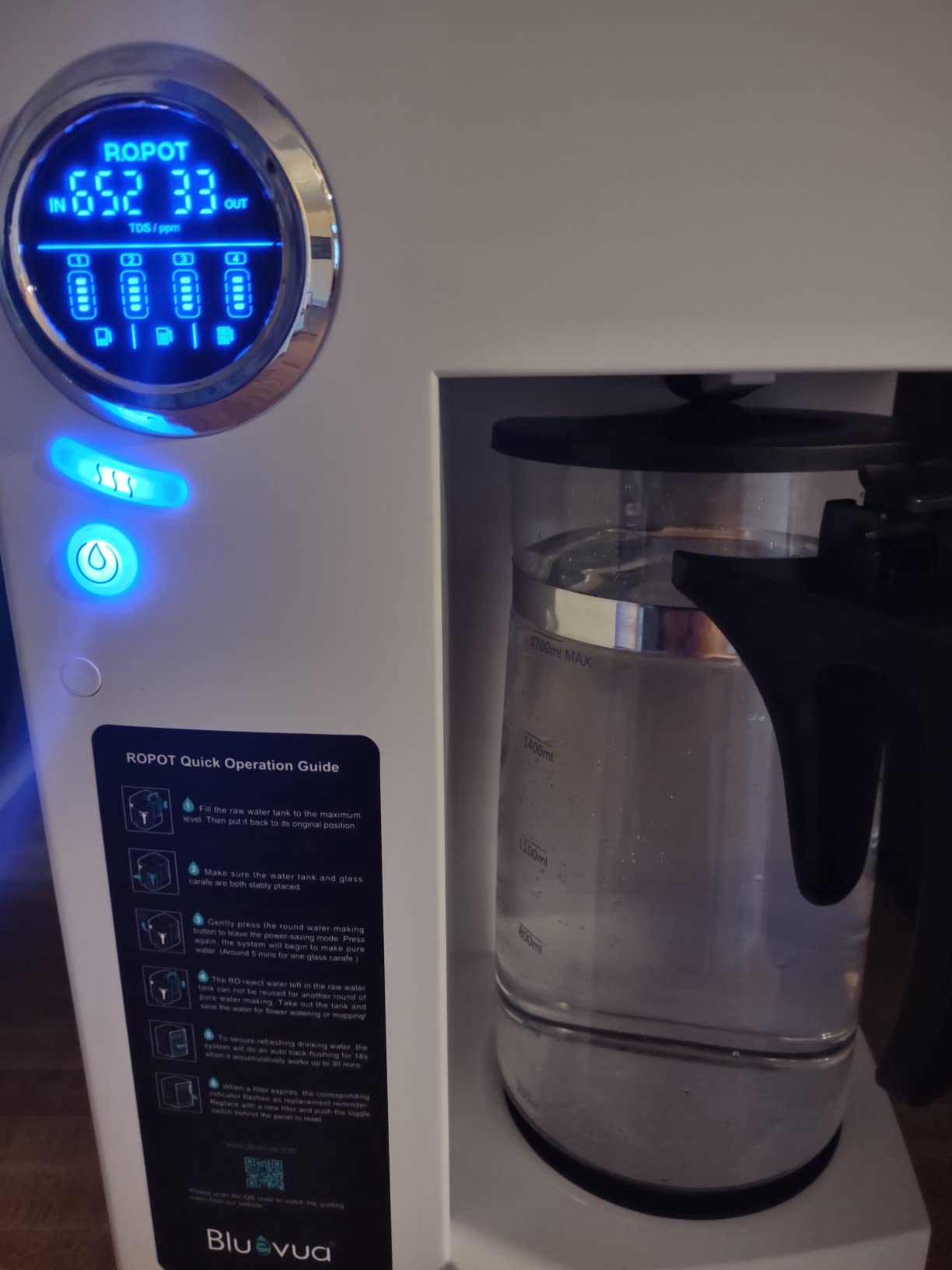
Water efficiency is the other quiet strength. A 2:1 pure-to-drain ratio with automatic standby mode limits both power and water use, and the feed water ceiling of 1000 ppm TDS is more generous than most countertop competitors allow.
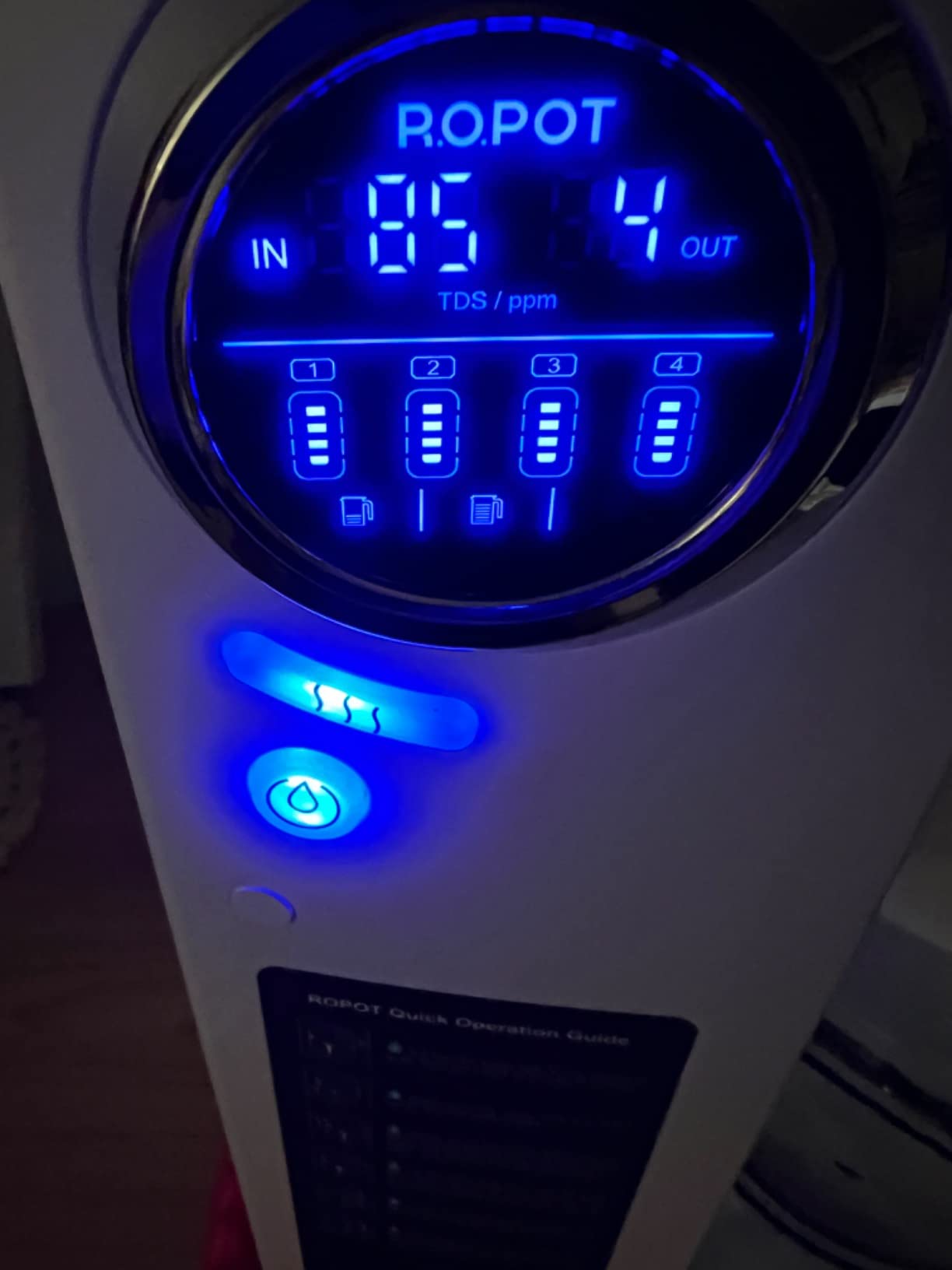
A built-in monitor displays remaining filter life and water quality status, and a remineralisation filter adds minerals back for taste. The claim is 99.9% contaminant reduction with WQA and NSF certification noted.
At 5 kg and 10.9 x 15.4 x 14.3 inches, it is compact in weight but wide in footprint. The one-year manufacturer warranty applies once you register the unit, so do that early.
Who this countertop RO system suits
It suits apartment dwellers, office kitchens, and RV or travel setups where drilling a faucet hole is not an option. Plug it into any outlet and it works.
It suits anyone who wants long intervals between cartridge changes, and anyone who would rather drink from glass than plastic.
Who should skip it
Skip it if counter space is at a premium. The width is the most common complaint in reviews, and it is noticeably wider than slim tankless designs.
Skip it if you want temperature control. Output is room temperature only, with no hot or chilled dispensing.
We earn a commission, at no additional cost to you. CERTAIN CONTENT THAT APPEARS ON THIS SITE COMES FROM AMAZON. THIS CONTENT IS PROVIDED 'AS IS' AND IS SUBJECT TO CHANGE OR REMOVAL AT ANY TIME.
9. DREO Countertop RO Review – The Best Reverse Osmosis System for Apartments
DREO Reverse Osmosis Water Filter Countertop, RO Filtration System, 3:1 Pure to Drain, TDS & Filter Life & 2 Autofill Pitchers, Install-Free, Self-Cleaning Water Purifier, RO Water Filter
- 3:1 pure-to-drain
- Built-in TDS meter
- 5 liter reservoir
- Two autofill pitchers included
Pros
- Install-free countertop operation with no plumbing
- 3:1 drain ratio plus a self-cleaning cycle
- Built-in TDS meter and filter life indicator
- Two autofill pitchers remove the need for a separate container
- SGS tested to NSF/ANSI 58 for 99.9 percent reduction
Cons
- Newer listing with a smaller review base than established brands
- Replacement pitcher is proprietary
- 5 liter reservoir is tight for larger households
We earn a commission, at no additional cost to you. CERTAIN CONTENT THAT APPEARS ON THIS SITE COMES FROM AMAZON. THIS CONTENT IS PROVIDED 'AS IS' AND IS SUBJECT TO CHANGE OR REMOVAL AT ANY TIME.
The DREO solves a problem the other countertop units create. Most require you to pour purified water into a separate jug, then find room under the dispenser for that jug. This one includes two autofill pitchers that the machine fills directly.
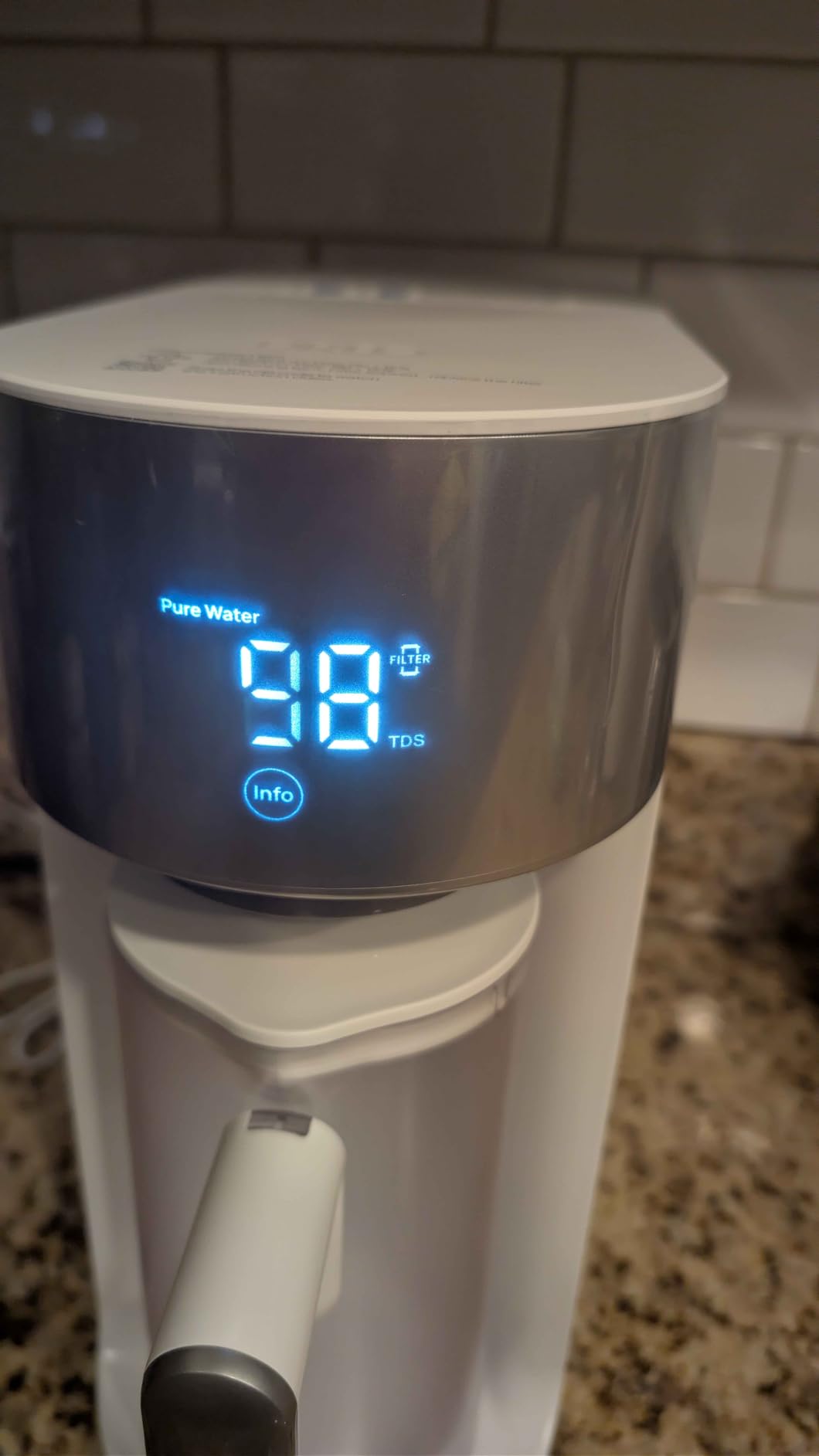
The 3:1 pure-to-drain ratio is better than most countertop designs, and a self-cleaning cycle handles the internal lines between uses. A built-in TDS meter and filter life indicator remove the guesswork around cartridge timing.
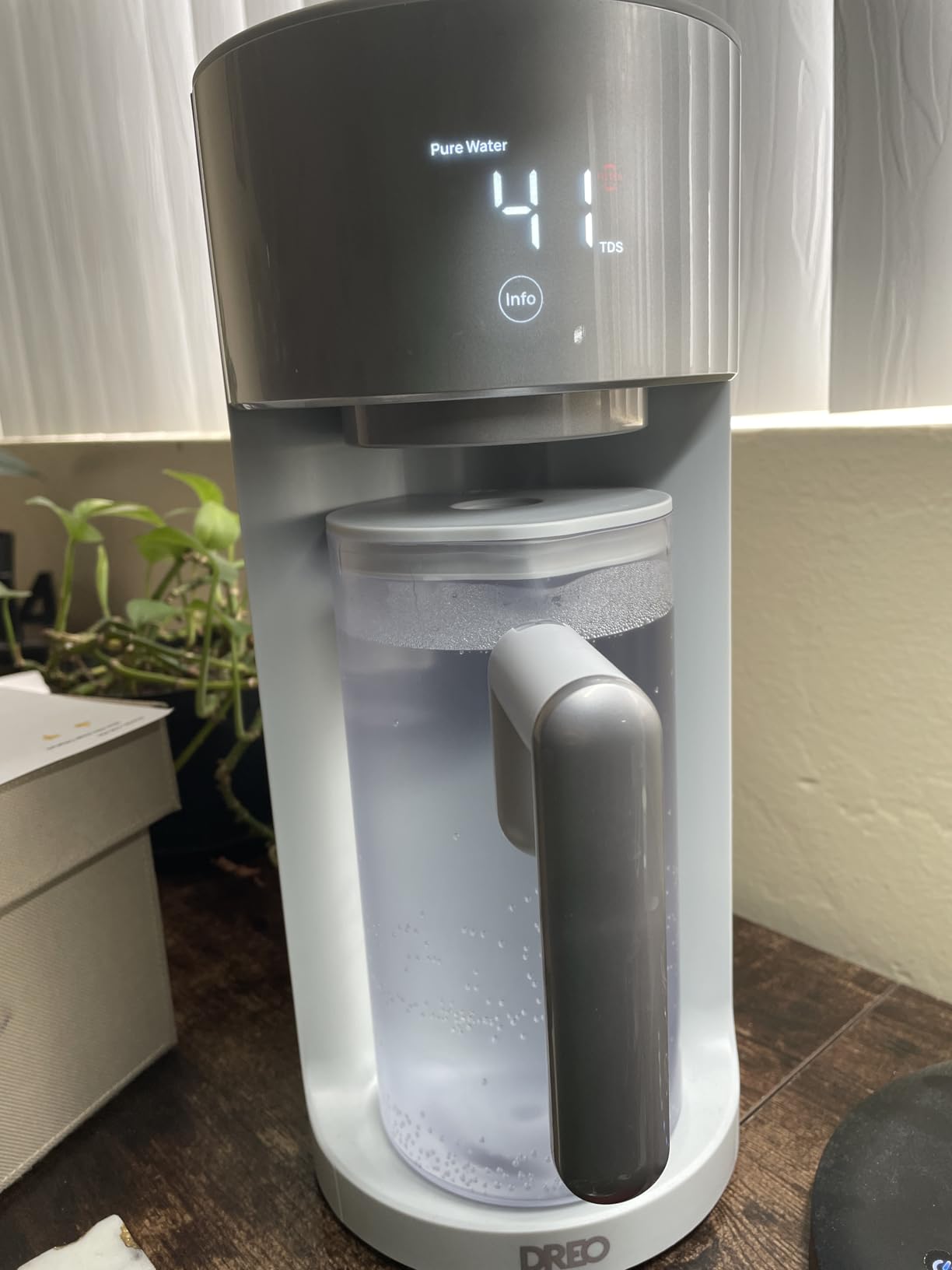
Testing is SGS against NSF/ANSI 58 for 99.9% reduction including PFOA, PFOS, chlorine and fluoride. At 15.7 x 6.7 x 13.4 inches and 10.8 pounds it fits most counters without crowding them.
The honest caveat is maturity. With 870 reviews at a 4.4 average, this is the newest listing here, and it currently ranks first in its category by sales rank, which signals demand rather than longevity. Long-term durability history is simply not available yet.
The other caveat is the pitcher. Replacement pitchers are proprietary rather than standard carafes, so you are buying into a closed ecosystem for the container as well as the filters.
Who this apartment RO system suits
It suits renters, students, and anyone who cannot drill a countertop hole or run a drain line. Touch control and plug-in power mean setup takes minutes.
It suits people who want to see their water quality without buying a separate meter. The readout is the reason many owners mention the unit first.
Who should skip it
Skip it if you want a long ownership record. Choosing an established brand with thousands of reviews tells you more about how the unit ages than a strong current sales rank does.
Skip it if a large household. A 5 litre reservoir refills several times a day under heavy use, and the proprietary pitcher adds a cost most people do not anticipate.
We earn a commission, at no additional cost to you. CERTAIN CONTENT THAT APPEARS ON THIS SITE COMES FROM AMAZON. THIS CONTENT IS PROVIDED 'AS IS' AND IS SUBJECT TO CHANGE OR REMOVAL AT ANY TIME.
10. SimPure Y7P-BW Review – The Best Countertop RO With UV Disinfection
SimPure Y7P-BW UV Countertop Reverse Osmosis Water Filter, 5 Stage RO
- UV stage with 0.0001 micron RO
- 4:1 pure-to-drain
- 528 gallons per set
- Plug and play countertop
Pros
- UV stage adds disinfection after the membrane
- 4:1 drain ratio is the best efficiency among countertop units here
- Large reported TDS drops from well and city water
- Glass dispensing pitcher avoids plastic storage
- No plumbing or drilling required
Cons
- Small reservoir means frequent refills
- Plastic reservoir can lend a plastic taste after extended use
- Initial flush runs about 45 minutes
- Needs descaling every few weeks
We earn a commission, at no additional cost to you. CERTAIN CONTENT THAT APPEARS ON THIS SITE COMES FROM AMAZON. THIS CONTENT IS PROVIDED 'AS IS' AND IS SUBJECT TO CHANGE OR REMOVAL AT ANY TIME.
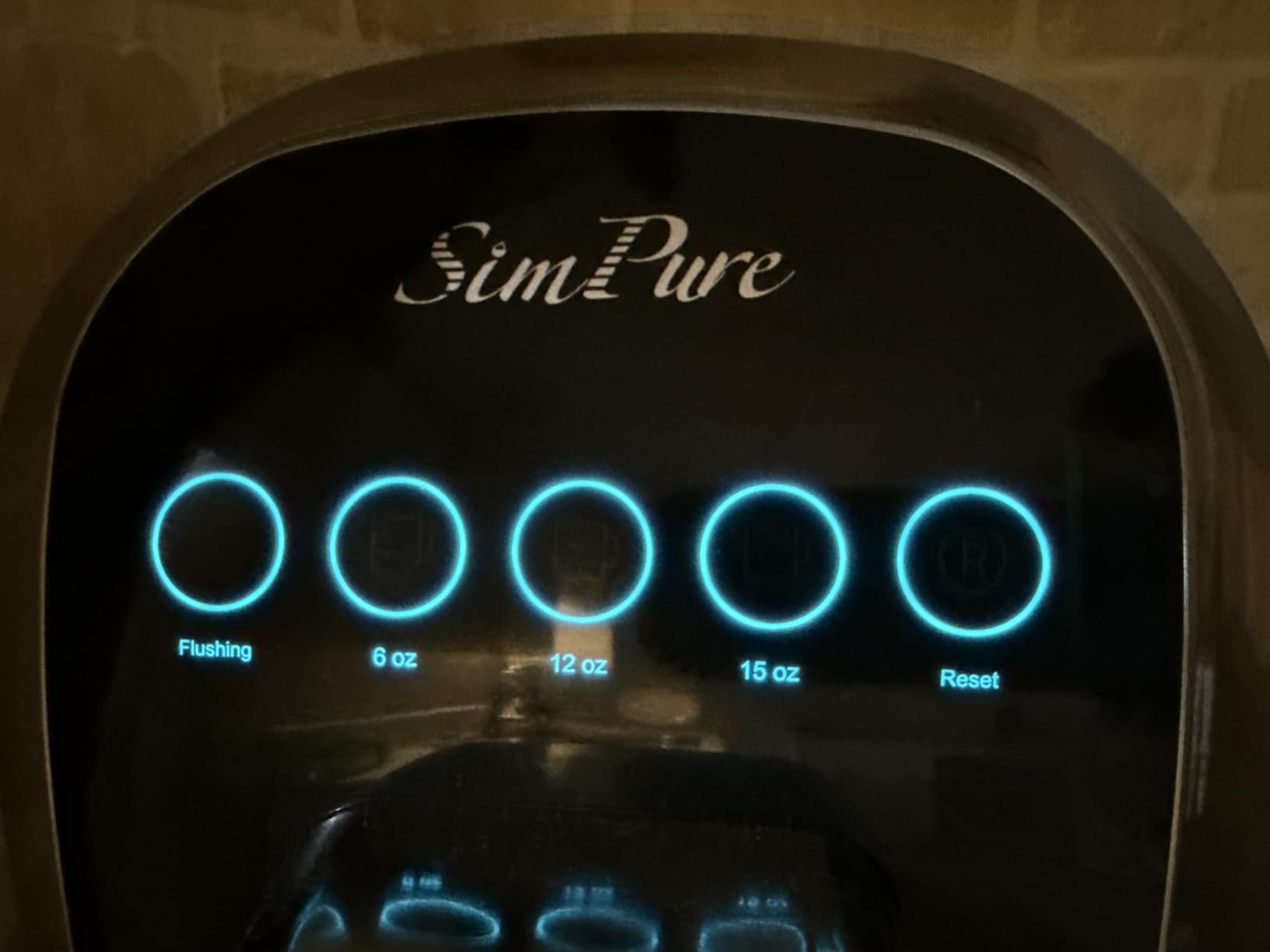
The Y7P-BW is the only unit here that layers UV disinfection onto the membrane. RO already removes bacteria and viruses physically, so UV is redundant in most homes, but it gives an extra barrier if you are feeding a shared space or a room that sits humid.
Water efficiency is the real headline for this unit. A 4:1 pure-to-drain ratio beats every other countertop model in this roundup, and each filter set delivers 528 gallons of purified water.
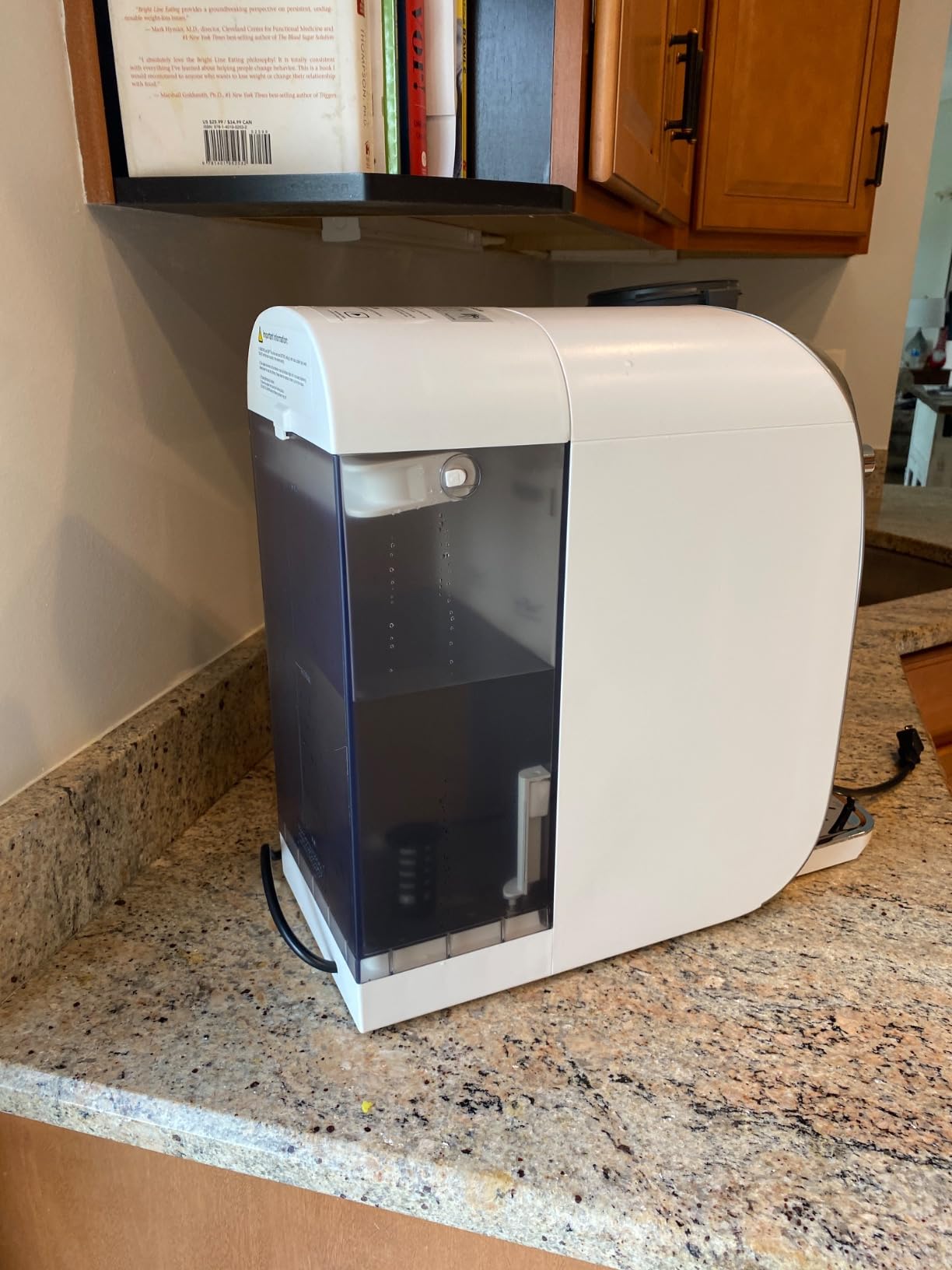
Owners report the largest measured drops of any countertop unit here, including 849 ppm well water down to about 30 ppm and 110 ppm city water down to 6 to 7 ppm. The membrane is 0.0001 micron, and SGS testing covers 1000-plus contaminants including PFAS.
This is also one of the lowest-rated units in the group at 4.2, driven by 11% one-star reviews. The most common complaint is an off-flavour from the internal plastic reservoir after about a month of use, plus the manual task of descaling every few weeks.
At 4.2 the ratings reflect the daily-use friction rather than filtration quality. Countertop experience is widely described as convenient at first and then frustrating, with constant reservoir refills and manual wastewater disposal.
Who this countertop UV RO system suits
It suits households on well water with elevated mineral content, where the reported reduction figures are strongest. It also suits anyone who wants a UV step as an added precaution beyond physical removal.
It suits renters and travel setups, since it needs nothing but an outlet and dispenses into a glass pitcher at room temperature.
Who should skip it
Skip it if the daily refill cycle will annoy you. The reservoir is small, and the manual descaling step every few weeks is not optional if you want to keep flow and taste steady.
Skip it if you care more about taste ratings than filtration. The 4.2 average and the plastic-reservoir reviews are the reason this unit sits below the pack despite solid contaminant claims.
We earn a commission, at no additional cost to you. CERTAIN CONTENT THAT APPEARS ON THIS SITE COMES FROM AMAZON. THIS CONTENT IS PROVIDED 'AS IS' AND IS SUBJECT TO CHANGE OR REMOVAL AT ANY TIME.
11. FS-TFC 100 GPD Review – The Best Budget Reverse Osmosis System
FS-TFC 5-Stage Reverse Osmosis Water Filter System, NSF Certified 100GPD RO Water Purifier Under Sink Reduces 99.999% Impurities, with 4 Extra Replacement Filters Free for Home Drinking
- 100 GPD capacity
- 1:1 drain ratio
- Four spare cartridges included
- 30-85 psi range
Pros
- Lowest appliance cost in this roundup
- Compact 11.5 inch footprint fits most cabinets
- Four spare cartridges cover about a year of use
- No electricity and a 1:1 drain ratio
- Owners on hard water report TDS below 10 ppm
Cons
- Quick-connect fittings reported as lower quality
- Condensation collects on the lower housings
- No remineralisation stage so water tastes flat
- Slower output than high-flow units once the tank is pressurised
We earn a commission, at no additional cost to you. CERTAIN CONTENT THAT APPEARS ON THIS SITE COMES FROM AMAZON. THIS CONTENT IS PROVIDED 'AS IS' AND IS SUBJECT TO CHANGE OR REMOVAL AT ANY TIME.
The FS-TFC is the cheapest way to get real RO filtration, and at 100 GPD it produces more water than the 50 GPD units at roughly the same class of price. Flow is quoted at 18 litres per hour, or a 200 ml cup in about five seconds at 60 psi.
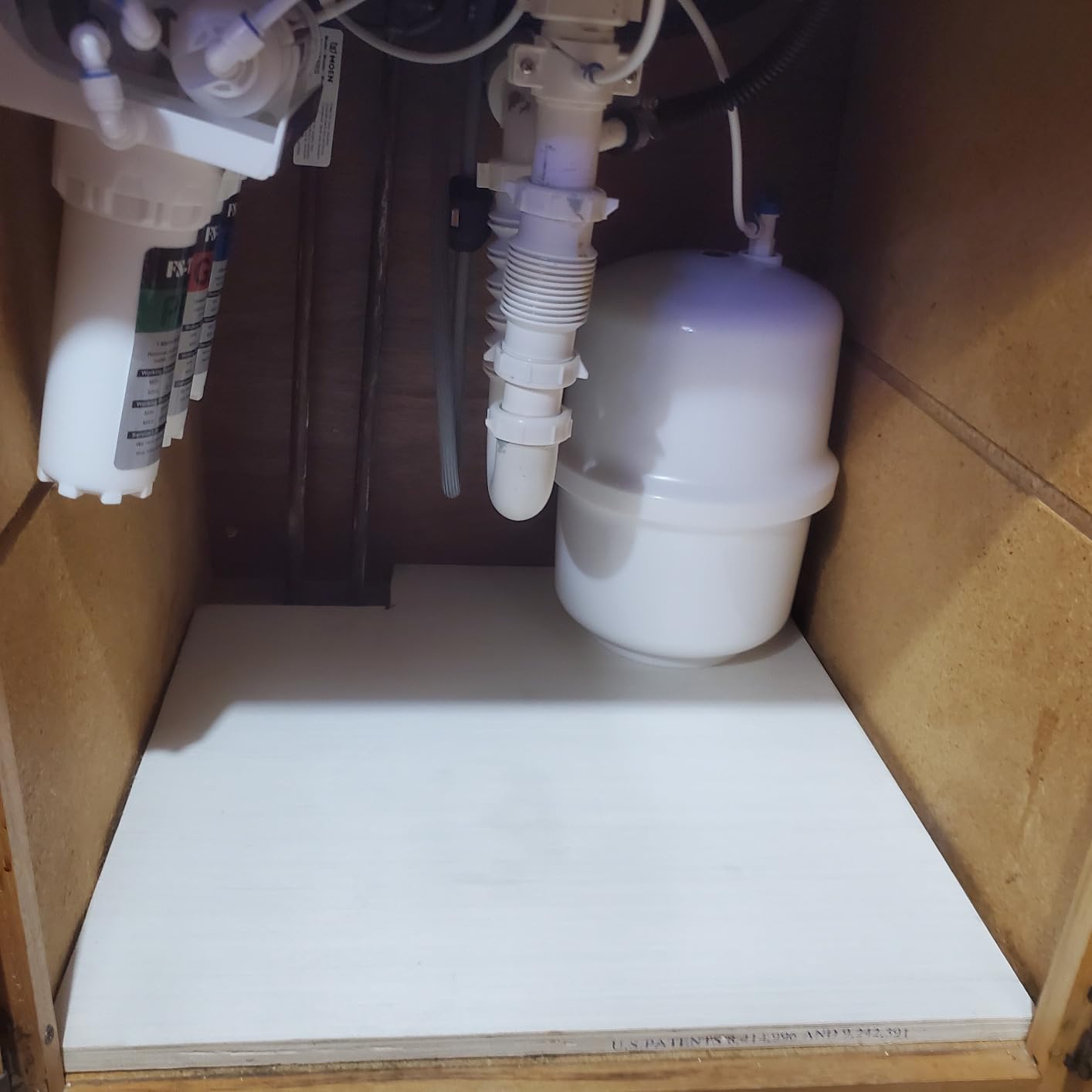
Four replacement cartridges are included in the box, which covers roughly a year of use before you need to order anything. The 11.5 x 5 x 11.5 inch footprint is the smallest in this roundup and fits narrow cabinets easily.
Certification is the weak point. The listing claims 99.999% reduction across 1000-plus contaminants, but this unit does not carry the whole-system NSF/ANSI 58 certification that most competitors here hold. If certification matters to your decision, that is a meaningful gap.
There is no remineralisation stage, so the output tastes flat next to an alkaline model. Owners on hard water do report TDS readings consistently below 10 ppm, so filtration performance itself is not the weakness.
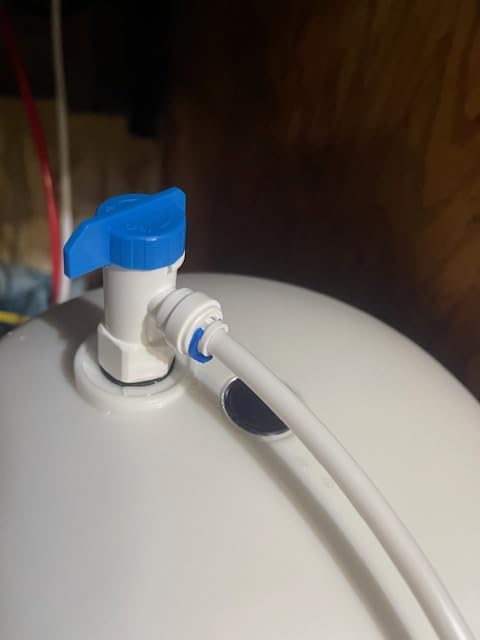
Build quality is where reviewers push back. The mounting brackets and quick-connect fittings are described as flimsier than competitors, and one owner replaced connectors with parts from a premium brand. Condensation also collects on the bottom three housings and can need a drip trough.
Who this budget RO system suits
It suits buyers on a fixed budget who still want membrane-level filtration and a decent daily output. It also suits small kitchens where cabinet width is the constraint.
It suits anyone who wants zero electrical work and a 1:1 drain ratio, which is the most efficient figure among the tanked designs here.
Who should skip it
Skip it if certified whole-system removal is your reason for buying. Without the NSF/ANSI 58 listing you cannot point to a certificate number, and that is exactly what a buyer chasing lead or PFAS removal needs.
Skip it if you dislike flat water or fiddly maintenance. There is no mineral stage, and the fittings are the part most likely to need replacing early.
We earn a commission, at no additional cost to you. CERTAIN CONTENT THAT APPEARS ON THIS SITE COMES FROM AMAZON. THIS CONTENT IS PROVIDED 'AS IS' AND IS SUBJECT TO CHANGE OR REMOVAL AT ANY TIME.
12. AquaTru Glass Carafe Review – The Best Countertop RO for Confirmed PFOA Removal
AquaTru Glass Carafe | Countertop Reverse Osmosis Water Filter Countertop RO System Water Purifier | 4 Stage Reverse Osmosis Filtration | Removes 84 Contaminants Like PFOA + PFOS, Lead, Microplastics
- Removes 84 contaminants
- Glass carafe with auto shutoff
- IAPMO certified to NSF standards
- 0.5 gpm flow
Pros
- Borosilicate glass carafe with magnetic auto shutoff
- No plumbing drilling or installation
- Owners report zero readings on TDS meters and strips
- Fills a full carafe in about eight minutes
- IAPMO certified to NSF standards
Cons
- Input tank cannot be topped up mid-cycle
- Glass carafes reported to break easily
- RO filter has failed well under one year for some owners
- Descaling kits hard to obtain outside the US
We earn a commission, at no additional cost to you. CERTAIN CONTENT THAT APPEARS ON THIS SITE COMES FROM AMAZON. THIS CONTENT IS PROVIDED 'AS IS' AND IS SUBJECT TO CHANGE OR REMOVAL AT ANY TIME.
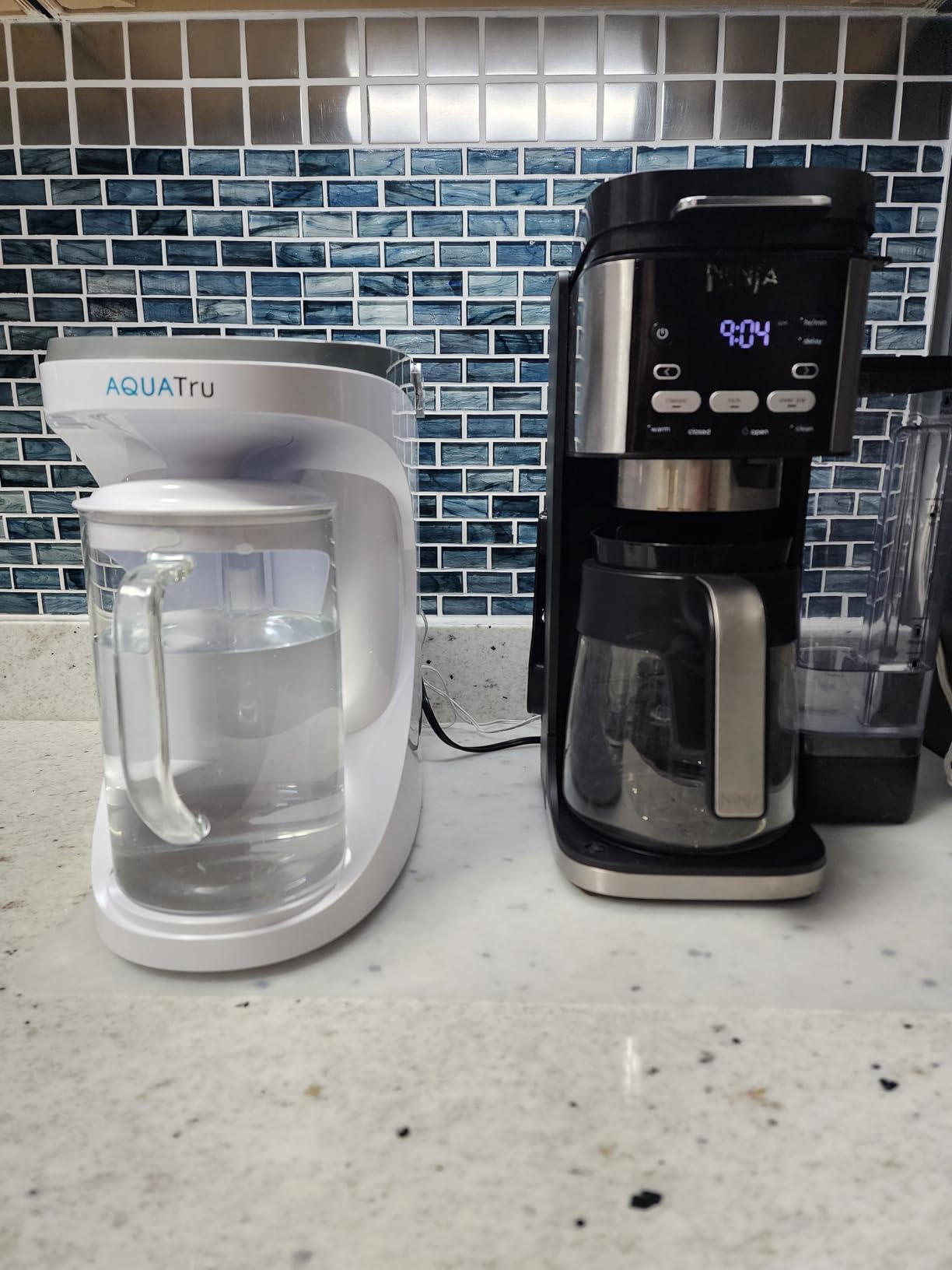
The AquaTru Carafe is built around one idea: no plastic anywhere in the water path. A borosilicate glass carafe sits on a magnetic base and fills in about eight minutes, then lifts away. There is no reservoir you can leave water standing in.
Filtration is four stages across pre-filter and carbon, RO, and a VOC carbon stage, with claims covering 84 contaminants including PFOA, PFOS, lead, microplastics, fluoride and chromium-6. It is IAPMO certified to NSF standards.
Filter intervals are spelled out clearly: pre and carbon at 6 months or 300 gallons, RO at 1 year or 600 gallons, VOC carbon at 1 year or 300 gallons. That clarity is unusual and makes budgeting straightforward.
This is the lowest-rated unit in the roundup at 4.1, with 14% one-star reviews. The loudest themes are early RO filter failure, fragile carafes, and an input tank that must be emptied and refilled rather than topped up mid-cycle.
Hard water is another reported weak spot. Owners say the unit struggles with scale unless descaled regularly, and descaling kits are described as hard to obtain outside the US. The supplied plug also does not fit UK or Mexican outlets.
Who this glass-carafe RO system suits
It suits anyone who wants glass storage and confirmed PFOA and PFOS reduction without touching plumbing. At 0.5 gpm it is the fastest countertop flow in this roundup on paper.
It suits owners who value a simple, one-carafe routine and do not mind a short cleaning cycle on hard water.
Who should skip it
Skip it if you have hard water and do not want to descale. The reports on scale performance are consistent enough that this is not a unit to buy and forget.
Skip it if you need international support or plug compatibility. Service responsiveness and plug fit are both flagged as problems outside the US market.
We earn a commission, at no additional cost to you. CERTAIN CONTENT THAT APPEARS ON THIS SITE COMES FROM AMAZON. THIS CONTENT IS PROVIDED 'AS IS' AND IS SUBJECT TO CHANGE OR REMOVAL AT ANY TIME.
How We Picked and Ranked These Systems
No single body governs all reverse osmosis systems, and the certification labs do not publish a category winner. Consumer testing organisations rank the small number of units they lab test, which is not the same as ranking everything a buyer can install on a weekend. We ranked on four things instead.
First, certification scope. A whole-system NSF/ANSI 58 listing outranks a membrane-only claim, because a system can only remove what every stage was tested for. Second, measured output against rated output, which exposes systems sold on headline GPD that never reach it at real household pressure. Third, water efficiency, since a 4:1 drain ratio wastes four times what a 1:1 design does.
Fourth and most important, install and ownership friction: cabinet fit, outlet requirements, filter change time, parts availability, and what the cartridges cost every year. Where the review base was thin, we said so rather than filling the gap with inference.
Reverse Osmosis Buying Guide: What Actually Matters
Before you pick a system, check these specifications in this order. Stage count is not on the list, for reasons explained below.
What the certifications actually cover
NSF/ANSI 42 covers aesthetic effects: taste, odour, and sediment. NSF/ANSI 53 covers health effects, including lead and cryptosporidium. NSF/ANSI 58 covers reverse osmosis systems specifically, which is the baseline standard for anything you install. NSF/ANSI 372 covers lead-free materials in the wetted path. NSF/ANSI 401 covers emerging contaminants such as PFOA and PFOS.
The important distinction: certified for TDS reduction is not the same as certified for lead or PFAS. A seller claiming broad contaminant removal should name the standard and the certificate number, which you can verify yourself in the certification database rather than taking the listing at face value.
Tankless or tank-based: which should you buy
Tank-based systems are simpler, quieter, and cheaper to run. A tankless system delivers instant flow and frees cabinet space, but needs an outlet, makes noise, and needs a pump that can fail.
For a normal family on municipal water, a tank-based unit is the lower-risk choice and the one most long-term owners recommend. Tankless designs make sense when cabinet space is genuinely scarce or you want instant flow and plan to feed a refrigerator.
One warning that appears repeatedly in homeowner forums: feeding a refrigerator from a tankless unit usually requires adding a secondary pressure tank, which partly defeats the reason for going tankless. Plan for that cost before you commit.
What GPD and flow rate mean in practice
GPD is the daily output measured under ideal pressure and temperature. A household of one to two drinks well under 20 gallons a day for drinking and cooking. A family of four cooking constantly might use 40 to 60. Rated 50 GPD units are sufficient for most homes, and 600 to 800 GPD units are sized for households that also fill ice makers and run coffee machines.
Flow rate in GPM matters more than GPD for the experience at the tap. A tanked 50 GPD system with good fittings can beat a 600 GPD tankless unit on the first glass of the day, because the tank is already pressurised.
Pure-to-drain ratio and why it hits your water bill
The pure-to-drain ratio is how many gallons of rejected water go down the drain for every gallon you drink. A 1:1 system wastes one gallon per gallon. A 4:1 system wastes four. On municipal water that difference shows up on your next statement.
Roughly 1:1 to 2:1 is good, 3:1 is acceptable, and 4:1 is expensive over years of use. Booster pumps improve rejection and therefore improve the ratio.
Water pressure and booster pumps
Most under-sink RO systems assume roughly 60 to 70 psi at the feed. Below that, output falls and rejection drops. Test yours with a kitchen tap gauge before you buy, and if you are marginal, either choose a system with an integrated pump or plan to add one.
Low pressure is the most common cause of the complaint that a new RO system produces almost no water. It is also the easiest problem to diagnose in advance, which is why the pressure test comes before the purchase rather than after.
Remineralisation and why water tastes flat
An RO membrane removes dissolved solids indiscriminately, so output is very low in minerals. That is why it tastes flat to some people and slightly sour to others. A mineral cartridge adds calcium and magnesium back and often raises pH.
Scepticism is reasonable here. Users in hard-water areas report alkaline cartridges passing more TDS than expected, and some mineral sources are unverified. If you care, check whether the cartridge is a real two-pass design, such as the one in the Home Master unit, rather than a single small media bed.
Under-sink space, faucet holes, and outlets
Measure the cabinet before ordering anything. Most systems here need 14 to 18 inches of depth and up to 18 inches of height, and a tank adds width. Older homes with sink cabinets under 18.5 inches are tight for a tanked unit plus a recycling bin.
Check the faucet hole too. Most RO faucets need a standard three-eighth-inch hole, and a hole that will not take the baseplate is a deal-breaker that stops the install cold. Finally, any pump-equipped unit needs a live outlet under the sink.
Filter replacement cost and total cost of ownership
Compare cartridges on cost per year and on cost per gallon of treated water, not on the sticker price of the system. Budget tanks commonly land near 50 dollars a year in filters; premium tankless systems with composite cartridges and display faucets run meaningfully higher, often two to three times that.
Add the cartridges to the appliance cost and divide by realistic yearly consumption. That single number predicts long-term cost better than anything else on the spec sheet, and it is the one most roundups leave out.
Countertop, under-sink, or whole house
Under-sink is the standard and best-performing path. Countertop suits renters and travel, at the cost of constant reservoir refilling and manual wastewater disposal. Whole-house treatment is not what these products do: they are point-of-use filtration for a single tap, not whole-home treatment.
If your goal is water at every tap, you want a different product category entirely. RO at the drinking tap is the highest-value use for the technology.
Matching feed water TDS to the system
Every system has a maximum feed TDS, and exceeding it shortens membrane life and reduces rejection. Municipal supply often sits between 100 and 300 ppm, while well water can exceed 500 ppm or reach 1000 or more.
Match the ceiling to your source with headroom. The units rated for 750 to 2000 ppm give you more margin than the 300 to 500 ppm designs, which is why they suit well water and hard municipal lines better.
Stage count is mostly a marketing number
Stage counts are inflated by counting the same carbon block twice or by counting the membrane itself as two stages. What actually determines performance is the membrane quality and surface area, the pre-filter that protects it, and the post-filter that fixes taste.
A six-stage system with a cheap membrane and no pre-filter will lose capacity faster than a five-stage system with a good membrane and a sediment stage. Read the certifications and the filter part numbers, not the stage number.
Is RO water safe to drink
RO water is safe to drink. The mineral question is separate: because the membrane strips dissolved minerals, long-term exclusive use raises questions for people who get all their minerals from food, which is a minority of drinkers in most diets.
Two practical responses: use a remineralising cartridge, or make sure you are eating a normal diet and not relying on water as a mineral source. If you are on a restricted diet, kidney condition, or otherwise managing electrolytes, ask your clinician rather than a product listing.
Troubleshooting: Why Your Reverse Osmosis System Stops Making Water
Almost every complaint in owner forums falls into one of six buckets. Check them in order before replacing parts.
No water or a tank that will not fill. Low line pressure is the usual cause. Close valves reopened after a vacation, a closed feed adapter, or a tank bladder that has lost its air charge are the other three. Test pressure at the sink first.
Slow flow at the tap. A membrane left unflushed after a filter change clogs within hours. Run the system for 20 to 30 minutes before judging flow, and confirm the storage tank valve is fully open.
TDS reading rises over months. That is the membrane ageing, and no household filter lasts forever. Check the feed TDS limit against your supply and replace on the schedule the display or manual gives you.
Flat or metallic taste. A spent post-carbon cartridge tastes metallic, and a missing mineral stage tastes flat. Both are cartridge problems, not membrane problems, and both are the cheapest fix in this list.
Leaks under the sink. Almost always a housing cap over-tightened during a change, or a push-fit connector not seated fully. Hand-tight plus a quarter turn is the rule; a wrench is not.
Cloudy or plastic-tasting water from a countertop unit. That is the internal reservoir. Clean or descale it on the schedule the manual gives you, and expect a plastic taste after extended storage.
One note on refrigerators: owners who feed a fridge with RO water report ice maker problems in the weeks after installing. Flush the line properly before connecting and run several full cycles first.
Frequently Asked Questions
What is the absolute best reverse osmosis system?
The iSpring RCC7AK-BN is the best all-round reverse osmosis system for most households. It holds whole-system NSF/ANSI 58 certification with published claims covering TDS, PFAS, chlorine, asbestos and lead, produces a rated 75 GPD at 70 psi, adds minerals back with a pH+ stage, and needs no electricity. For instant flow with no storage tank, the Waterdrop G3P600 is the alternative.
Which brand of reverse osmosis is best?
Brand matters less than certification scope and parts availability. Look first for a whole-system NSF/ANSI 58 listing with a certificate number you can verify, then for standard quarter-inch fittings and cartridges that will still be sold in five years. The systems here from iSpring, APEC and Waterdrop all meet that bar to varying degrees.
Should I get a tank or tankless reverse osmosis system?
Choose a tank-based system if you want the fewest failure points, no electrical outlet, and quiet operation. Choose tankless if cabinet space is scarce or you want instant flow and plan to feed a refrigerator. Tankless units need a live outlet under the sink, and feeding a fridge usually means adding a secondary pressure tank.
Do tankless reverse osmosis systems work well?
Yes, when your line pressure and outlet access support them. The 600 and 800 GPD tankless units here run at 2:1 and 3:1 pure-to-drain ratios, which waste less water than conventional tankless designs, and swap filters in about three seconds. They stop entirely in a blackout, and their composite cartridges cost more per year than budget tanked systems.
Why avoid reverse osmosis water?
The main reasons people avoid it are that it strips dissolved minerals, producing flat or slightly acidic water, and that it sends a portion of every gallon down the drain. Neither makes it unsafe. A remineralising cartridge addresses taste, and choosing a system with a 1:1 to 2:1 drain ratio addresses water waste.
Is RO water hard on the kidneys?
There is no established evidence that drinking properly produced RO water harms healthy kidneys. The genuine consideration is that demineralised water contains very little calcium and magnesium, so people who get all their minerals from water alone are not meeting daily intake through that source. Most people get those minerals from food. If you have a kidney condition, ask your clinician.
Which is better, RO or UV?
They are not alternatives. UV is a disinfection step layered onto filtration, and it inactivates bacteria and viruses that pass through. RO removes contaminants physically, including bacteria, to over 99 percent. Choose RO for chemical and mineral removal; add a UV stage only if you want an extra barrier in a shared or humid space.
How much water does a reverse osmosis system waste?
It depends entirely on the pure-to-drain ratio. A 1:1 system sends one gallon of wastewater per gallon produced, 2:1 sends two, and 4:1 sends four. Household use is often 0.5 to 1 gallon per person per day, so a family of four can put 8 to 16 gallons of purified water down the drain daily on a poor-ratio system.
How often do reverse osmosis filters need to be replaced?
Sediment and carbon pre-filters run 6 to 12 months depending on feed water, and RO membranes typically last 1 to 2 years. Budget tanked systems often land near 50 dollars a year in cartridges, while premium tankless units with composite filters and display faucets can run two to three times that. Check the gallon ratings, not just the calendar.
Final Verdict
The best reverse osmosis systems for drinking water in 2026 come down to two honest questions. Do you want the simplest unit that works, or the fastest one that fits? For the simplest, the iSpring RCC7AK-BN pairs whole-system NSF/ANSI 58 certification, a 75 GPD rating, and a mineral stage with no electrical requirement and the largest verified review base here.
For speed and no storage tank, the Waterdrop G3P600 gives you 600 GPD, a 2:1 drain ratio, and three-second filter changes, provided you have cabinet height and a live outlet. The G3P800 steps that up to 800 GPD for households that also feed an ice maker.
Whatever you choose, measure your cabinet, test your line pressure, and check the certification standard before you order. Those three checks prevent nearly every complaint we found in six weeks of reading buyer reports.