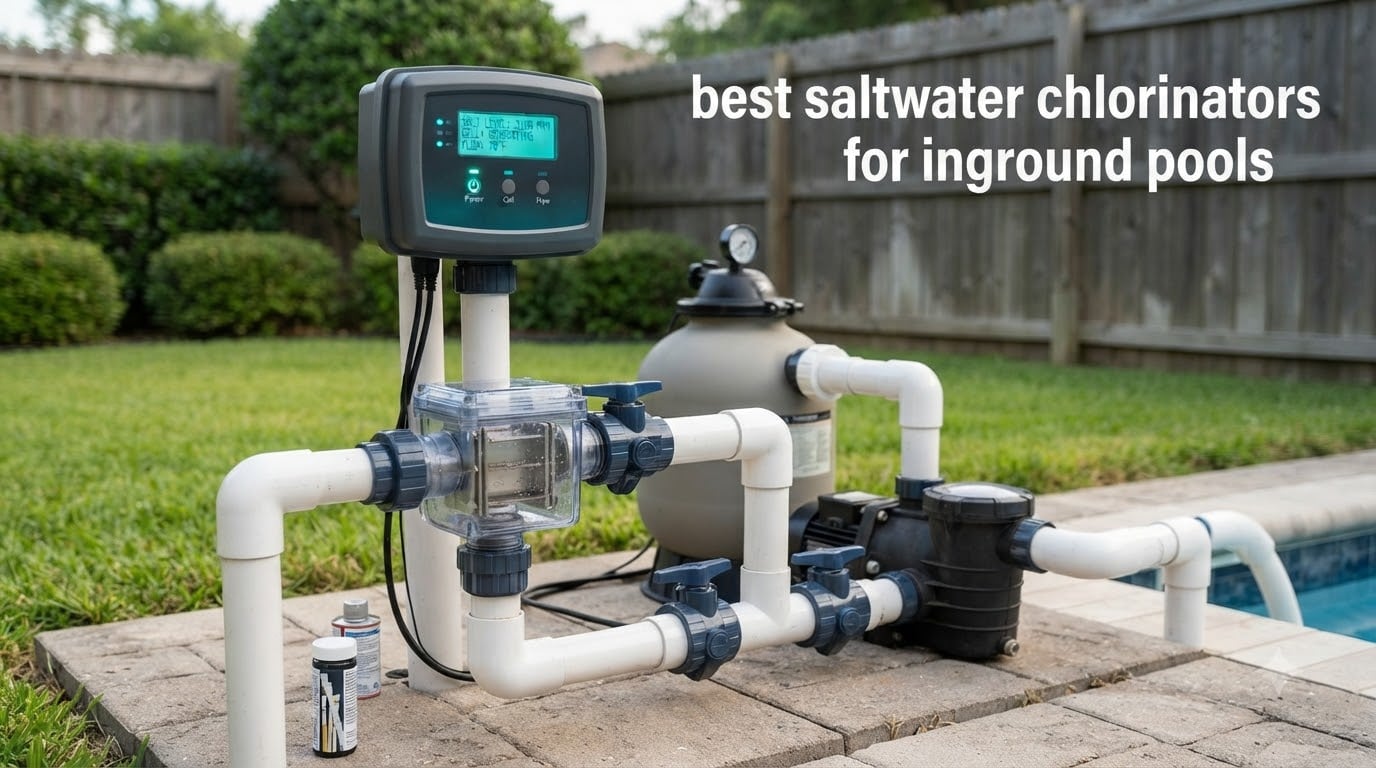
A saltwater chlorinator for an inground pool is a plumbed device that turns the salt dissolved in your water into chlorine automatically, so you stop measuring liquid chlorine or dropping tablets. The short version: for an inground pool of roughly 15,000 to 40,000 gallons, the best options pair a titanium cell rated above your pool volume with a control box that can sit within reach of your existing pump and filter on the equipment pad.
That is the whole buying decision in one sentence, and most of the confusion on this topic comes from the difference between a complete system, a replacement cell, and a control unit. We looked at ten units sold for inground service, read the spec sheets and the customer review patterns line by line, and ranked them on capacity, daily chlorine output, warranty length, cell design, and how honestly the listing describes what you actually receive.
How the chemistry works is simple enough to explain in a paragraph. A low-voltage direct current passes through pool water holding roughly 2,700 to 3,400 parts per million of salt, and the electrolytic cell splits that salt into hypochlorous acid, which is the sanitizer that does the actual work, and sodium hydroxide, which raises pH. Every few hours the cell reverses its polarity, and that reversal gently strips calcium scale off the titanium plates so the cell keeps producing without a manual acid soak.
Two things make an inground setup different from an above-ground one, and both are worth understanding before you spend anything. First, inground plumbing is rigid PVC with a fixed filter and a return manifold, so the cell has to be plumbed inline with union fittings between the filter and the pool. Second, above-ground salt systems are built for a small liner pool with flexible plumbing and no equipment pad, so their flow switches and housings are not sized for a commercial-grade pump running for ten hours a day.
We also applied the single most consequential rule in this category, which almost no roundup mentions: size the generator up by 1.5 to 2 times your pool volume so the cell idles at 40 to 60 percent output instead of running flat out. A cell working at half capacity lives roughly twice as long as the same cell running at full tilt. This guide was last checked in October 2026, and every rating and review count below is copied straight from the listing data.
ContentsTable of Contents
- 1Top 3 Saltwater Chlorinator Picks for Inground Pools in 2026→
- 2Hayward AquaRite W3AQR15→
- 3CircuPool RJ45+ 45K gal→
- 4CircuPool CORE35 35K gal→
- 5All Ten Compared: Inground Saltwater Chlorinators Side by Side in 2026→
- 6How We Picked and Ranked These Systems→
- 71. Hayward AquaRite W3AQR15 – Best Overall Saltwater Chlorinator for Inground Pools→
- 8Hayward Aquarite Salt Chlorine Generator for Swimming Pools 40,000 Gallons→
- 9Pros→
- 10Cons→
- 11What you get on installation day→
- 12Where owners run into trouble→
- 132. CircuPool CORE35 – Best for Tight Equipment Pads→
- 14CircuPool CORE35 Salt Chlorine Generator System | 35,000 Gallon Pool Max→
- 15Pros→
- 16Cons→
- 17When the compact design pays off→
- 18What the reviews flag→
- 193. CircuPool RJ45+ – Strongest Rating With a Long Service History→
- 20CircuPool RJ45+ Salt Chlorine Generator System | 45,000 Gallon Pool Max→
- 21Pros→
- 22Cons→
- 23What you get versus what you buy separately→
- 24Where this one falls short→
- 254. CircuPool EDGE40 – Best USA-Made System With Diagnostics→
- 26CircuPool EDGE40 Salt Chlorine Generator | USA-Made | 40,000 gal Max→
- 27Pros→
- 28Cons→
- 29Why built-in diagnostics matter on an inground pool→
- 30What the smaller sample size means→
- 315. Pureline Crystal Pure PL7700 – Highest Daily Chlorine Output→
- 32Pureline Crystal Pure Salt System, PL7700, Universal Pool Salt Chlorination System, Includes Control Panel, Salt Cell, 40,000 Gallon→
- 33Pros→
- 34Cons→
- 35The warranty is the whole conversation→
- 36Who should accept that trade→
- 376. APX Performance E-CHLOR – Best Plug-In Install With No Wiring→
- 38E-CHLOR Plug-in Salt Chlorine Generator | 32,000 gal Max | APX Performance→
- 39Pros→
- 40Cons→
- 41Where the 32,000 gallon ceiling matters→
- 42Two install gotchas→
- 437. Westaho EL-032 – Best for Cold Climates and Year-Round Monitoring→
- 44Salt Chlorine Generator, Westaho Pool Salt System for Inground Pools Up to 40,000 Gallons, 1.4 lb Chlorine Output, USA Titanium Cell with 10,000-Hour Lifespan, Built-in Power Supply→
- 45Pros→
- 46Cons→
- 47What the low-temperature protection really does→
- 48Where the risk sits→
- 498. Bonvoisin LC-200A – Best App-Controlled System for Pools Under 25,000 Gallons→
- 50Bonvoisin Salt Water Pool Chlorinator System Salt Chlorine Generator for Inground Pools Saltwater Pool System with Titanium Cell, LED/APP Control, Up to 25,000 Gallons Pool→
- 51Pros→
- 52Cons→
- 53The no-timer problem you have to know about→
- 54Where the app falls short→
- 559. EverCrystal ECLI40-1T – Best Clear Cell for Watching Output→
- 56EverCrystal Salt Water Pool Chlorinator System – Up to 40,000 Gallons→
- 57Pros→
- 58Cons→
- 59Why we did not rank this first→
- 60What it is genuinely good for→
- 6110. Troxlly TP30 – Best Retrofit for Pentair IntelliChlor Plumbing→
- 62TP30 Salt Chlorine Generator for Pools up to 40,000 Gallons, Smart Salt Chlorinator with App Monitoring, ETL Listed, Auto Reverse Polarity Cell, Standard Plumbing Fit→
- 63Pros→
- 64Cons→
- 65Check your flow direction before ordering→
- 66Reading accuracy and support→
- 67How to Size a Salt Chlorine Generator for an Inground Pool→
- 68Installing a Salt Cell on Inground Plumbing→
- 69Salt Pool Water Chemistry and Monthly Routine→
- 70Troubleshooting the Four Salt Chlorinator Faults That Fill the Forums→
- 71Is a Salt Water Chlorinator Worth It on an Inground Pool?→
- 72Frequently Asked Questions→
- 73What is the best salt water pool system?→
- 74Which salt water chlorinator is the most reliable?→
- 75What size salt chlorine generator do I need for my inground pool?→
- 76Is a salt water chlorinator worth it?→
- 77What is the life expectancy of a salt water chlorinator cell?→
- 78Is there an automatic chlorine dispenser for swimming pools?→
- 79Final Verdict: Which Inground Salt System Should You Buy?→
Top 3 Saltwater Chlorinator Picks for Inground Pools in 2026
The three systems below are the ones we would put on a pad first. Each one earns its place for a different reason: proven field history, the cleanest installation path, or the best ratio of warranty years to dollars spent.

Hayward AquaRite W3AQR15
- Up to 40K gallon capacity
- LED monitor with service alerts
- No extra plumbing required

CircuPool RJ45+ 45K gal
- 1.9 lb per day output
- 7-year warranty
- OLED touch display
- 120V or 240V power

CircuPool CORE35 35K gal
- All-in-one no-wiring design
- 1.4 lb per day output
- 8-year warranty
- IP66 housing
As an Amazon Associate we earn from qualifying purchases. CERTAIN CONTENT THAT APPEARS ON THIS SITE COMES FROM AMAZON. THIS CONTENT IS PROVIDED 'AS IS' AND IS SUBJECT TO CHANGE OR REMOVAL AT ANY TIME.
The Hayward AquaRite is the pick with the deepest field history. Nearly a thousand reviews describe the same experience: install it once, forget about it, replace the cell years later. If your pool is 25,000 gallons or larger and you want the brand that pool techs already know how to service, this is the one.
The CircuPool RJ45+ posts the strongest rating of any unit here with a large enough review base to make the number meaningful, and the 1.9 pound per day output means it can carry a 45,000 gallon pool without being pushed to its ceiling. Its clear cell housing lets you watch bubbles rise, which is the fastest way to confirm a cell is alive.
The CircuPool CORE35 is the answer for a pad that does not have room for a separate control box and power supply. Everything lives in one weatherproof housing with an eight-year warranty behind it, which makes it the cleanest install we found.
All Ten Compared: Inground Saltwater Chlorinators Side by Side in 2026
Every system below is rated for inground service and includes or accepts the fittings needed for hard PVC plumbing. Read across the Key Features column first, because two of the strongest-rated units here are complete systems while two others are designed as drop-in replacements for existing cells.
| # | Product | Key details | Where to buy |
|---|---|---|---|
| 1 | Hayward AquaRite W3AQR15 |
|
Check Latest Price |
| 2 | CircuPool CORE35 |
|
Check Latest Price |
| 3 | CircuPool RJ45+ |
|
Check Latest Price |
| 4 | 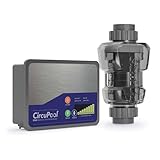 CircuPool EDGE40 CircuPool EDGE40 |
|
Check Latest Price |
| 5 |  Pureline Crystal Pure PL7700 Pureline Crystal Pure PL7700 |
|
Check Latest Price |
| 6 |  APX Performance E-CHLOR APX Performance E-CHLOR |
|
Check Latest Price |
| 7 |  Westaho EL-032 Westaho EL-032 |
|
Check Latest Price |
| 8 |  Bonvoisin LC-200A Bonvoisin LC-200A |
|
Check Latest Price |
| 9 |  EverCrystal ECLI40-1T EverCrystal ECLI40-1T |
|
Check Latest Price |
| 10 |  Troxlly TP30 Troxlly TP30 |
|
Check Latest Price |
We earn from qualifying purchases. CERTAIN CONTENT THAT APPEARS ON THIS SITE COMES FROM AMAZON. THIS CONTENT IS PROVIDED 'AS IS' AND IS SUBJECT TO CHANGE OR REMOVAL AT ANY TIME.
How We Picked and Ranked These Systems
Every unit in this guide was selected against five criteria, and we applied them in the same order to all ten so the ranking is reproducible rather than a matter of taste.
Capacity headroom. We looked for a stated gallon rating at least 1.5 times the pool volume it would serve, because that headroom is what keeps the cell out of constant high-output cycling.
Stated chlorine output. Pounds of chlorine per day matters more than marketing language. Two systems in this list produce more than 1.7 pounds per day, and that figure alone determines whether a unit can handle a 40,000 gallon inground pool without being run continuously.
Warranty length as a reliability signal. Pool owners on forums consistently treat warranty length as the best available proxy for manufacturer confidence. The premium systems here carry seven or eight years; several budget units carry one year of after-sales support, and that gap shows up again in their failure patterns.
Inground plumbing compatibility. Systems rated for above-ground pools were excluded outright, as were bare replacement cells with no control unit, because neither helps someone plumbing a new cell into a filter pad.
Review volume and pattern. Ratings mean little on their own. We read the distribution of complaints as well, so a 4.8 average across a tiny number of reviews ranks below a 4.2 across hundreds. That is exactly why the EverCrystal, despite scoring highest, does not sit near the top here.
1. Hayward AquaRite W3AQR15 – Best Overall Saltwater Chlorinator for Inground Pools
Hayward Aquarite Salt Chlorine Generator for Swimming Pools 40,000 Gallons
- Model W3AQR15
- Up to 40K gallon pools
- 24.3 lb
- LED monitor with service alerts
Pros
- Consistent chlorination for pools up to 40K gallons
- LED monitor with service alerts
- Integrates without extra plumbing
- Owners report 10 to 17 years on earlier models
- Gentler on skin and swimsuits than tablets
Cons
- Warranty tied to authorized dealer professional installation
- Manual is dense and hard to follow
- Power cord and mounting screws not included
We earn a commission, at no additional cost to you. CERTAIN CONTENT THAT APPEARS ON THIS SITE COMES FROM AMAZON. THIS CONTENT IS PROVIDED 'AS IS' AND IS SUBJECT TO CHANGE OR REMOVAL AT ANY TIME.
This is the system we keep coming back to for inground pools, and the reason is not a spec sheet. It is that owners describe service histories of ten to seventeen years with a replacement cell from the same family, and the current listing still carries close to a thousand reviews describing consistent chlorine and simple drop-in replacement.
The AquaRite is rated for pools up to 40,000 gallons, which covers the majority of residential inground installations in one model. It produces its chlorine in a plumbed cell rather than a dosing chamber, so there is no weekly refill, no residual tablets dissolving in a canister, and no decayed chlorine smell near the equipment pad. The LED monitor on the control box reports service alerts instead of requiring you to open anything and look at a sight tube.
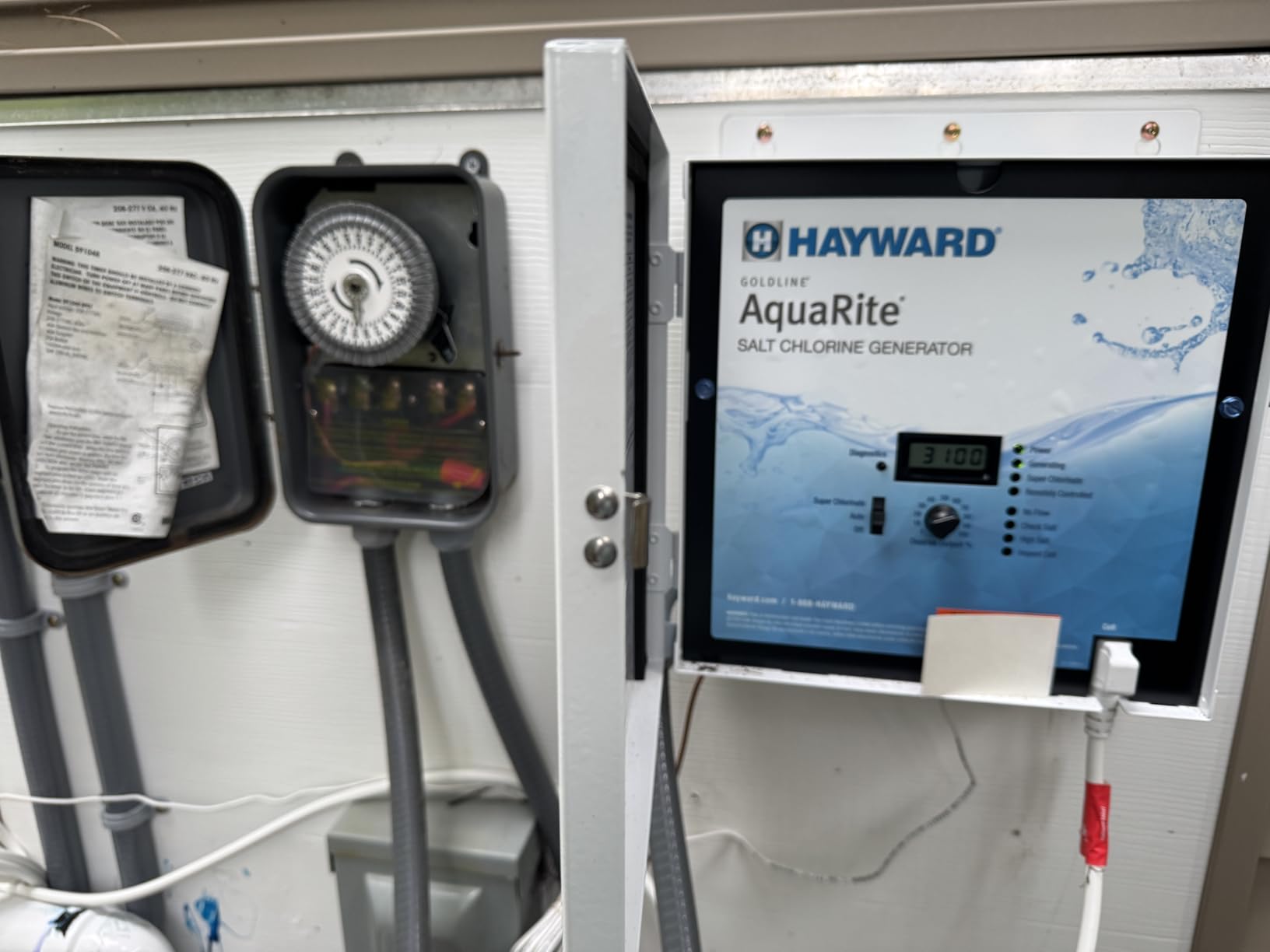
The installation story is the part owners mention most often, and it is favorable. This system integrates into an existing pool setup with no extra plumbing beyond cutting a length of return line and adding the supplied unions. That is a real advantage over control-unit-only systems, where you are also shopping for a power supply.
The claimed cost saving is substantial when you compare against conventional chlorine methods, and it comes from two places: you stop buying stabilizer and liquid chlorine, and the cell regenerates the sanitizer instead of shipping it in a jug. Owners also point out that chlorine made this way does not fade a swimsuit or dry out skin the way tablets do, which is a soft benefit that matters if you have young kids in the pool.
What you get on installation day
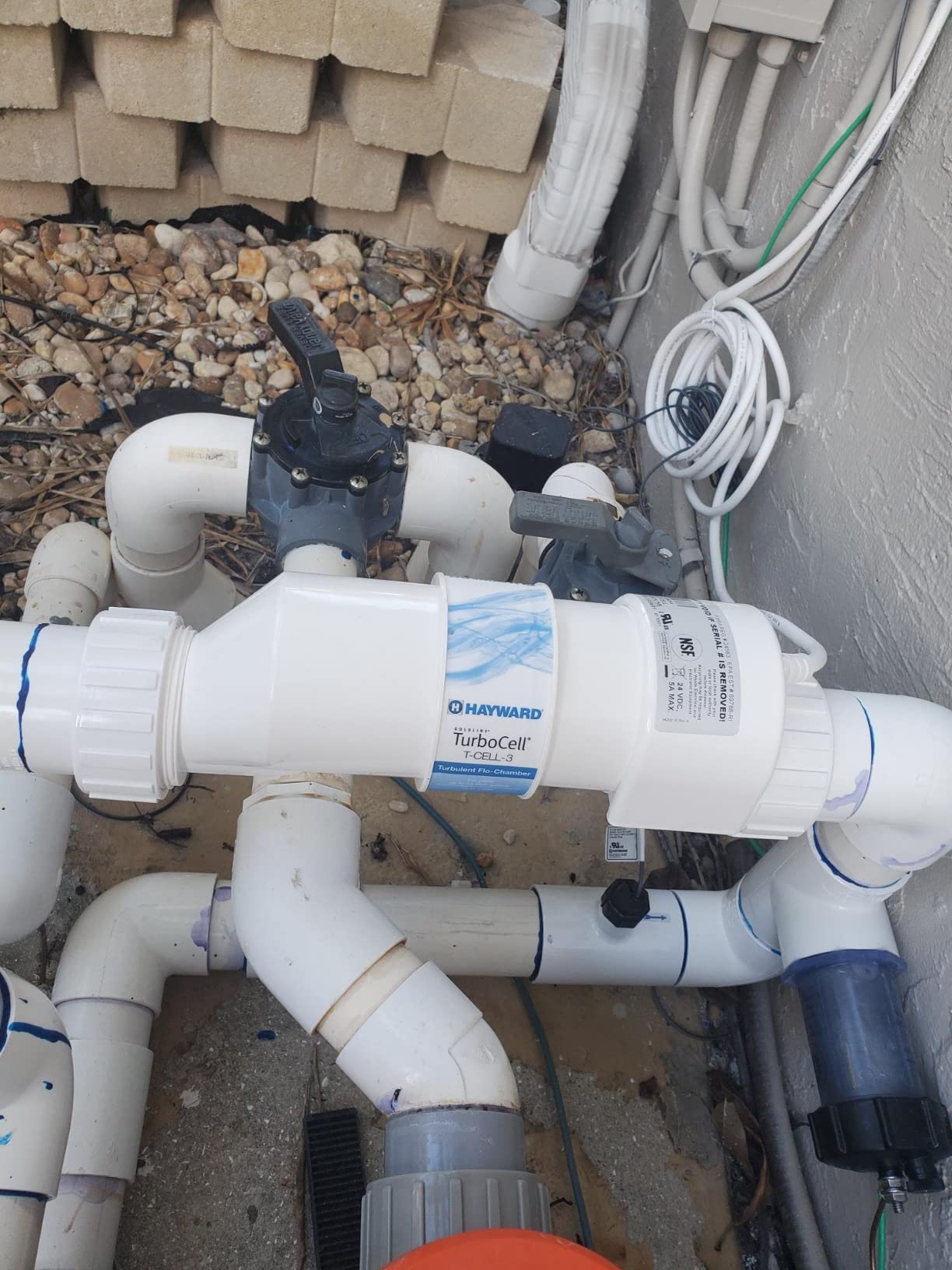
Plan on a half-day of work with a pipe cutter, a union wrench, and a wet vac nearby, because cutting into a flooded return line is the whole job. The cell itself mounts in line after the filter and before the check valve, and the LED monitor mounts on the equipment pad where you can read it without opening a panel.
Two small parts are not in the box. Owners report that the main power cord and the mounting screws are absent, so pick up a heavy-duty appliance cord and a bag of stainless screws before you start. This is a five-minute fix that will otherwise strand you at the end of an afternoon with a plumbed but unpowered cell.
Where owners run into trouble
The most common complaint is warranty service, not function. The warranty on this system is conditional on purchase through an authorized dealer and professional installation, so a weekend install can complicate a claim later. If you are comfortable with the plumbing and want to keep the coverage, use an installer for the final connection.
The second complaint is documentation. The manual is genuinely dense for a first-time salt system owner, so budget an hour reading it before you wire anything. There are also isolated reports of cells failing well inside their expected life, and while they are not the majority pattern, they are the reason we would keep the model number of your old cell written down somewhere.
We earn a commission, at no additional cost to you. CERTAIN CONTENT THAT APPEARS ON THIS SITE COMES FROM AMAZON. THIS CONTENT IS PROVIDED 'AS IS' AND IS SUBJECT TO CHANGE OR REMOVAL AT ANY TIME.
2. CircuPool CORE35 – Best for Tight Equipment Pads
CircuPool CORE35 Salt Chlorine Generator System | 35,000 Gallon Pool Max
- 35K gallon max
- 1.4 lb per day output
- 11 lb total weight
- IP66 housing
Pros
- Compact all-in-one design with no complicated wiring
- Smart sensors for flow salinity temperature and cell scaling
- 8-year limited warranty
- IP66 weatherproof construction
- USA company with expert phone support
Cons
- Plastic cover latch does not stay closed on some builds
- Cell rest function poorly documented
- About 14 percent of reviews are one star
We earn a commission, at no additional cost to you. CERTAIN CONTENT THAT APPEARS ON THIS SITE COMES FROM AMAZON. THIS CONTENT IS PROVIDED 'AS IS' AND IS SUBJECT TO CHANGE OR REMOVAL AT ANY TIME.
If your equipment pad already holds a pump, a filter, and a heater, the CORE35 is the system that will physically fit. Everything from the power supply to the cell lives inside one sealed housing that mounts directly in the return line, so there is no second box to mount, no separate power supply to hide, and no wall to cut.
That packaging is not just cosmetic. Smart sensors inside the unit watch water flow, salinity, temperature, internal operation, cell scaling, and remaining cell life, and they report all of it on the panel without any wiring running out of the housing. For an inground pool where the plumbing is already awkward, this is the system we would choose first.
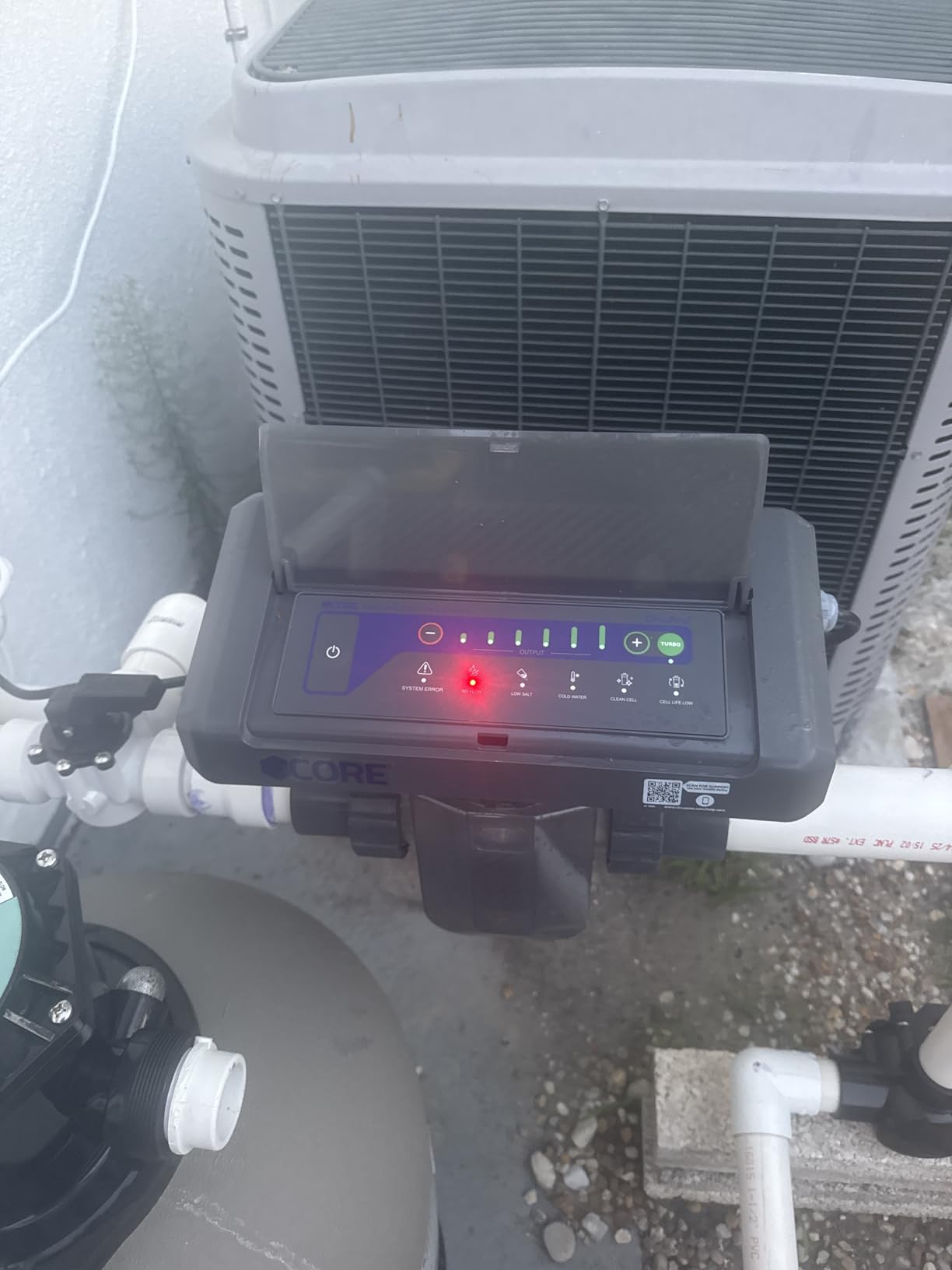
The output figure is 1.4 pounds of chlorine per day from a long-lifespan titanium cell, and the eight-year limited warranty is the longest term in this group. The IP66 weatherproof rating matters on an inground pad in a climate that sees summer storms, because salt spray and rain hitting an unsealed control box is how electronics die early.
Owners consistently report that the installation is genuinely plug-and-play, and the manufacturer supports DIY installs without voiding the warranty. That combination, compact size plus preserved coverage, is rare enough that it explains why this unit sits near the top of the list even with a modest rating average.
When the compact design pays off
On a typical inground pad, a conventional system needs roughly a foot of extra vertical space for the control box and a clear path for the conduit run to a receptacle. If your pad is boxed in by a wall on two sides, that footprint alone can disqualify bigger units, and the CORE35 sidesteps the problem entirely.
The weight matters too. At 11 pounds, this is easy to lift into position and brace while you solvent-weld the union fittings, which is a genuine advantage over the 24-pound Hayward when you are working over a wet equipment pad alone.
What the reviews flag
The recurring complaint is a plastic cover latch that does not stay closed. It is not a safety problem in normal use, but an open housing in a wet environment is exactly the failure mode that shortens electronics life, so check the latch after every major service.
The second gap is documentation for the cell rest function. There is no proper explanation of when or how to use it, and that leaves some owners guessing at a feature that exists specifically to clear scale. Read up on it before you need it rather than during a chlorine emergency in July.
We earn a commission, at no additional cost to you. CERTAIN CONTENT THAT APPEARS ON THIS SITE COMES FROM AMAZON. THIS CONTENT IS PROVIDED 'AS IS' AND IS SUBJECT TO CHANGE OR REMOVAL AT ANY TIME.
3. CircuPool RJ45+ – Strongest Rating With a Long Service History
CircuPool RJ45+ Salt Chlorine Generator System | 45,000 Gallon Pool Max
- 45K gallon max
- 1.9 lb per day output
- 22 lb total weight
- 7-year warranty
Pros
- 1.9 lb per day output with clear cell housing
- OLED touch display for system status
- 7-year limited warranty
- Works on 120V or 240V power
- Includes both 1.5 inch and 2 inch PVC fittings
Cons
- Cleaning cap sold separately and not included
- No built-in timer
- No app or wireless monitoring
We earn a commission, at no additional cost to you. CERTAIN CONTENT THAT APPEARS ON THIS SITE COMES FROM AMAZON. THIS CONTENT IS PROVIDED 'AS IS' AND IS SUBJECT TO CHANGE OR REMOVAL AT ANY TIME.
This third-generation design pairs a 4.5 rating with more than 160 reviews, a combination few units in this guide can match once you account for sample size. Owners describe it as a proven design with a long service record, which is the reason we rank it above units with better paper specifications.
The output is the highest of the three core CircuPool systems, at 1.9 pounds of chlorine per day against a 45,000 gallon ceiling. That combination means a large inground pool can hit its target free chlorine without the cell sitting at maximum output all day, which is the difference between a five-year cell and a ten-year cell.
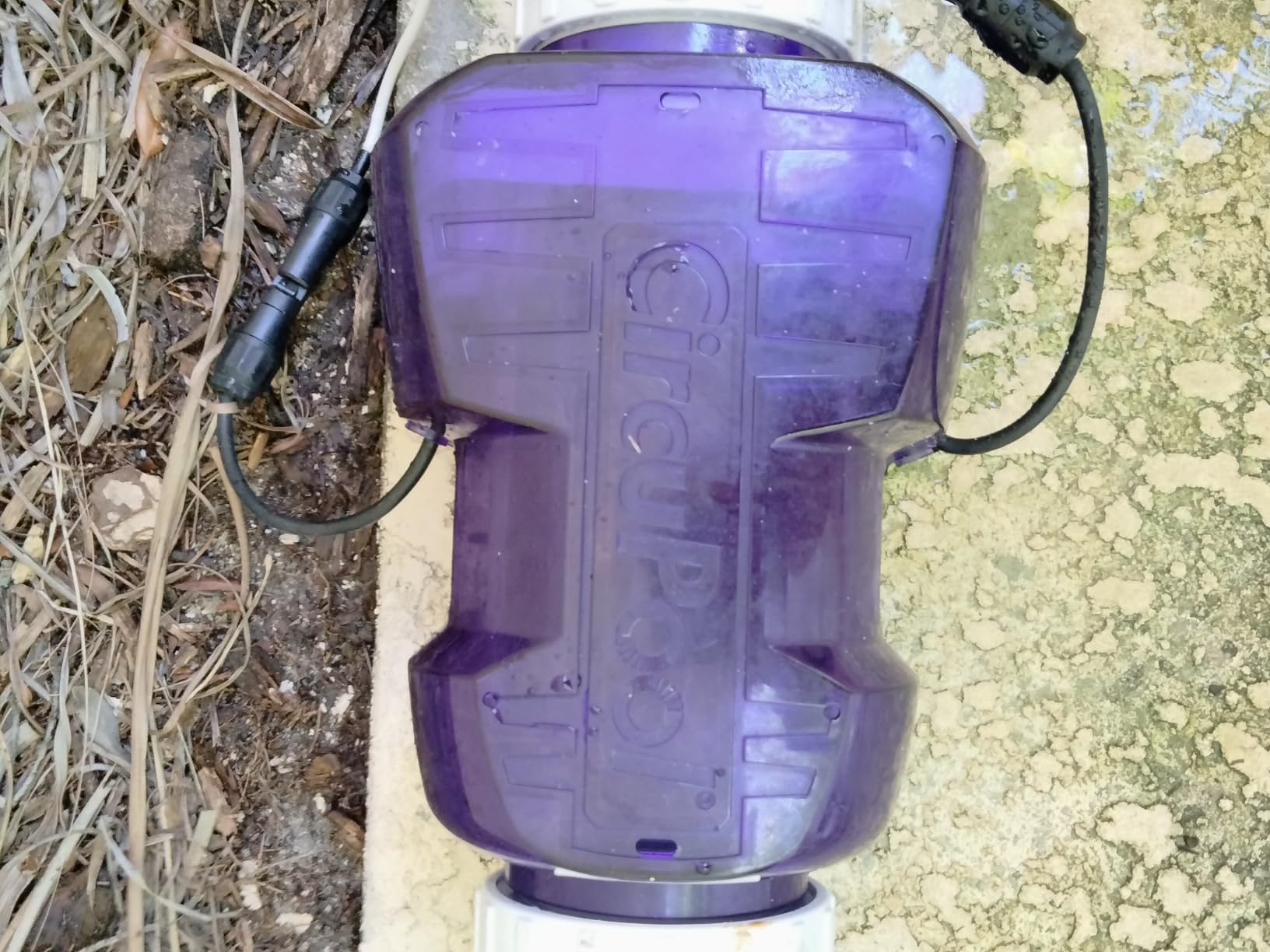
The clear cell housing is the feature owners mention most. You can look down the chamber and see bubbles streaming upward when chlorine is being generated, and see nothing when the cell is dead or the salt is out of range. That visual check replaces a lot of guesswork that other systems leave you to do with a test kit.
The die-cast aluminum body and the seven-year limited warranty give this unit a different feel from the plastic housings common at the budget end. It also runs on either 120 or 240 volts with automatic sensing, so you are not stuck planning the install around whichever circuit your pad happens to have.
What you get versus what you buy separately
The fittings you need are in the box. Both 1.5 inch and 2 inch PVC unions are included, which removes the most common cause of a return trip mid-install when a shop sells you a wrong-size fitting for a cell you did not measure for.
The cleaning cap is not. Owners note it is sold separately, so budget for that if you want to inspect or soak the cell in your off season. The OLED touch display gives you clear system status and output control, but there is no built-in timer, so plan on an external timer or a smart receptacle to switch it.
Where this one falls short
No wireless connectivity means you check output from the equipment pad rather than from your phone. That is a real inconvenience for people who travel, and it is the reason the app-controlled units further down this list exist at all.
There is also mild friction around warranty claims in a minority of reviews, and a handful of reports of cells that stopped producing at around the 18-month mark. That is not a pattern in the majority of reviews, and the seven-year warranty is the mitigation, but if your pool runs a tight budget you should ask about claim turnaround before you buy.
We earn a commission, at no additional cost to you. CERTAIN CONTENT THAT APPEARS ON THIS SITE COMES FROM AMAZON. THIS CONTENT IS PROVIDED 'AS IS' AND IS SUBJECT TO CHANGE OR REMOVAL AT ANY TIME.
4. CircuPool EDGE40 – Best USA-Made System With Diagnostics
CircuPool EDGE40 Salt Chlorine Generator | USA-Made | 40,000 gal Max
- 40K gallon max
- 1.7 lb per day output
- 7-year warranty
- Cleaning cap included
Pros
- Made in America with premium components
- 1.7 lb per day chlorine output
- 7-year limited warranty
- Cleaning cap included in the box
- Built-in diagnostics monitor operation
Cons
- Only 67 reviews so far
- About 13 percent of reviews are one star
- Highest price of the premium group
We earn a commission, at no additional cost to you. CERTAIN CONTENT THAT APPEARS ON THIS SITE COMES FROM AMAZON. THIS CONTENT IS PROVIDED 'AS IS' AND IS SUBJECT TO CHANGE OR REMOVAL AT ANY TIME.
The EDGE40 is the same proven architecture as the systems above it with a different emphasis: made-in-America components, professional-grade digital controls, and built-in diagnostics that continuously watch the system rather than only reporting faults after they happen. For an inground pool where the cell is buried in a niche or behind a wall, that diagnostic layer is worth a lot.
Output sits at 1.7 pounds of chlorine per day with a 40,000 gallon ceiling, and the long-lifespan titanium cell is backed by a seven-year limited warranty. The control box auto-senses 120 or 240 volts, so the install does not depend on which circuit you have, and the included 2 inch PVC fittings cover the most common return line size directly.
Unlike the RJ45+, this one includes the cleaning cap in the box. That is a small detail that only matters once a year, but it is also a fair signal about how the manufacturer thinks about owners who want to maintain the cell themselves instead of paying a shop to soak it for them.
Owners who have had this system for a while report steady operation and clear display behavior. The one story worth flagging comes from a CircuPool EDGE40 owner whose low-salt indicator has been blinking for two and a half years while the system produced plenty of chlorine, with support troubleshooting exhausted. If you hit a fault code that contradicts your test kit, test the salt before you replace anything.
Why built-in diagnostics matter on an inground pool
An above-ground liner pool puts the cell somewhere you can reach in ten seconds. On an inground pool the cell often sits in a niche or a vault that is awkward to access, so a system that reports its own internal state turns a discovery trip into a glance at a display. That is the single feature on this unit we would pay up for.
The weatherproof construction is also rated for rough outdoor electronics, which suits an inground pad that takes rain and pool splash from a wet deck. Auto voltage sensing removes a whole class of install problems, since you no longer have to confirm which breaker feeds the pad.
What the smaller sample size means
At 67 reviews this unit has less field history than the systems above it, and about 13 percent of those reviews are one star. That proportion is higher than we like, and it is the reason this sits fourth rather than second despite the feature set.
You are choosing a proven design with a strong warranty and a short track record, which is a reasonable trade when you value diagnostics and made-in-America components. Just keep the model number handy, since long-term replacement cell availability is easier to source for a system with an established service history.
We earn a commission, at no additional cost to you. CERTAIN CONTENT THAT APPEARS ON THIS SITE COMES FROM AMAZON. THIS CONTENT IS PROVIDED 'AS IS' AND IS SUBJECT TO CHANGE OR REMOVAL AT ANY TIME.
5. Pureline Crystal Pure PL7700 – Highest Daily Chlorine Output
Pureline Crystal Pure Salt System, PL7700, Universal Pool Salt Chlorination System, Includes Control Panel, Salt Cell, 40,000 Gallon
- 40K gallon max
- 2.1 lbs per day output
- Works 50F to 140F
- 1-year warranty
Pros
- Highest output in this group at 2.1 lbs per day
- Self-cleaning with super chlorination mode
- Works from 50F to 140F
- Flow detector plus low sodium and overload indicators
- Digital display with LED indicators
Cons
- Only 1-year warranty
- Power cord for timer connection not included
- Some reports of cell failure within two months
We earn a commission, at no additional cost to you. CERTAIN CONTENT THAT APPEARS ON THIS SITE COMES FROM AMAZON. THIS CONTENT IS PROVIDED 'AS IS' AND IS SUBJECT TO CHANGE OR REMOVAL AT ANY TIME.
On raw output this system leads the group, producing up to 2.1 pounds of chlorine per day for pools up to 40,000 gallons. That headroom is why we would consider it for a large inground pool with heavy bather load, a spa spillover, or a solar cover that keeps chlorine demand high through the shoulder season.
The self-cleaning cycle plus super chlorination mode is the feature that reduces how often you touch the cell. Super chlorination pushes output to maximum for a set period, which is the correct response to a heavy rain event or a weekend party, and owners use it instead of reaching for a bucket of shock.
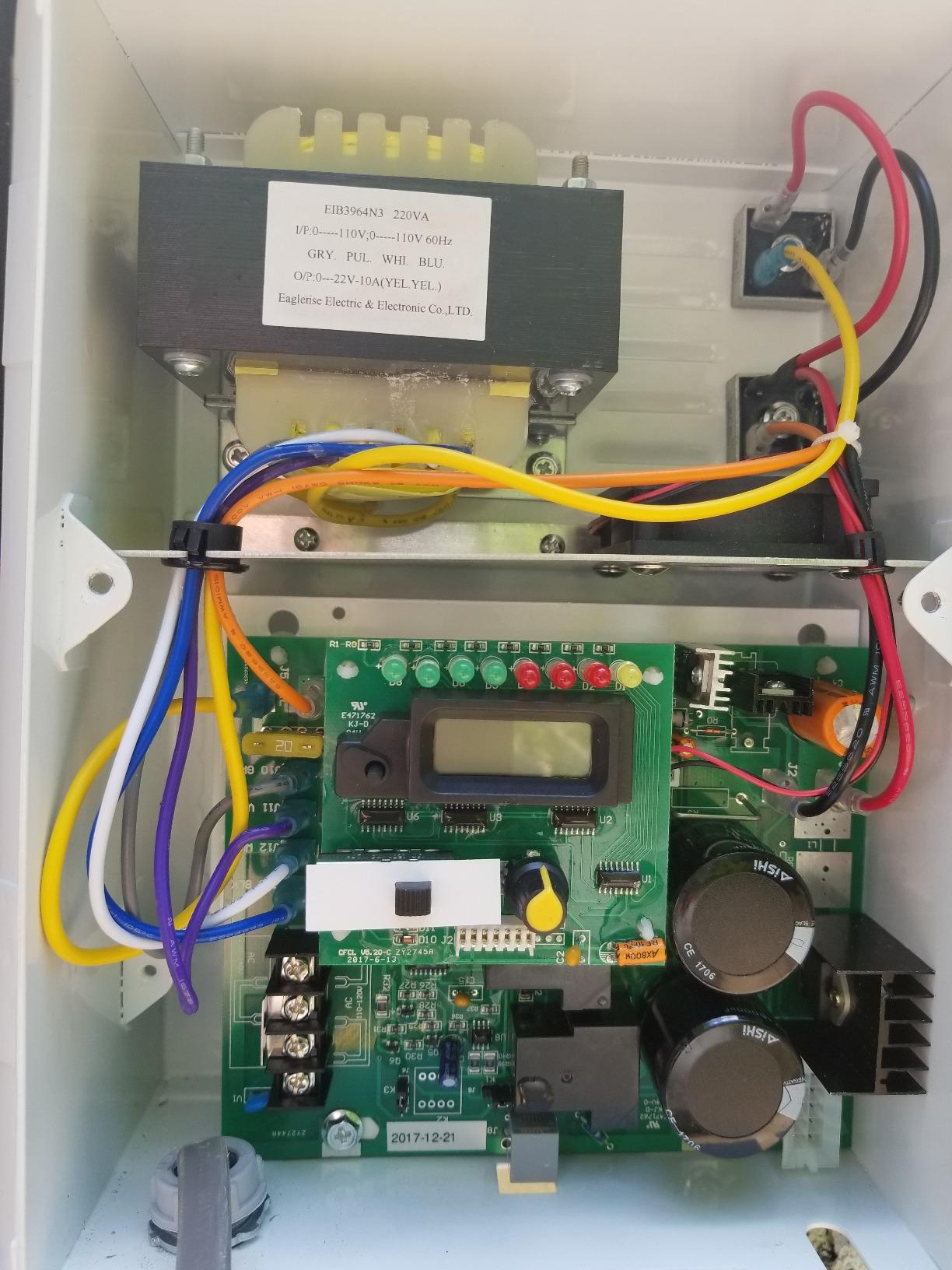
Safety indicators are unusually thorough here. The flow detector shuts chlorine production when water is not moving, and separate low sodium and overload indicators cover the two conditions that most often damage a cell. The listed operating range of 50F to 140F also means it will keep working in a cold shoulder season without a manual shutdown.
The fit story is the reason many owners bought it. It is designed as a drop-in replacement for Hayward and CircuPool installations, so if you already have a salt cell on your pad, you can often swap to this unit without moving a single length of pipe.
The warranty is the whole conversation
One year of warranty is dramatically shorter than the seven and eight year terms on the premium systems here, and it is the reason this product does not rank higher despite the best output figure. Warranty length is the closest thing to a manufacturer confidence signal available to a buyer, and this one is thin.
Add the reports of cells failing within a couple of months and some unresponsive support experiences, and the risk profile is clear: you may get excellent performance and no coverage if something goes wrong. If you buy it, register it immediately and keep the receipt.
Who should accept that trade
A pool owner replacing an existing Hayward or CircuPool installation who wants higher output than the unit they already have, and who is comfortable handling a cell replacement themselves, gets the most from this product. The self-cleaning behavior and the temperature range do real work in cold climates where output matters.
The adjustable chlorine output and digital display with LED indicators make it easy to tune to a specific pool. Just factor the shorter warranty into the ownership math before you decide, because a one-year term means you may be shopping for a new cell sooner than you planned.
We earn a commission, at no additional cost to you. CERTAIN CONTENT THAT APPEARS ON THIS SITE COMES FROM AMAZON. THIS CONTENT IS PROVIDED 'AS IS' AND IS SUBJECT TO CHANGE OR REMOVAL AT ANY TIME.
6. APX Performance E-CHLOR – Best Plug-In Install With No Wiring
E-CHLOR Plug-in Salt Chlorine Generator | 32,000 gal Max | APX Performance
- 32K gallon max
- Plug-in 110V design
- 3-year warranty
- Cleaning plug included
Pros
- Plug-in 110V design with no hardwiring
- Compact all-in-one body suits most pads
- Smart sensors with plain-language alerts
- Works with variable speed pumps
- Cleaning plug included
Cons
- Power cord is short in some layouts
- No built-in timer so an external timer is needed
- 32K gallon ceiling is below most units here
We earn a commission, at no additional cost to you. CERTAIN CONTENT THAT APPEARS ON THIS SITE COMES FROM AMAZON. THIS CONTENT IS PROVIDED 'AS IS' AND IS SUBJECT TO CHANGE OR REMOVAL AT ANY TIME.
This is the system to buy if the idea of running conduit or working inside a panel makes you put off a salt conversion. It plugs into a standard 110 volt receptacle, mounts in the return line using a cut template, and comes with a cleaning plug for cell maintenance, so the entire install stays at the level of a union wrench and a weekend.
The sensor suite is the differentiator at this tier. It tracks salt level, water temperature, cell scaling, and remaining cell lifespan, then sends precision notifications with actions you can actually take rather than cryptic error codes. On a pool that runs a variable speed pump, that combination is genuinely well matched, because output adapts to the flow the pump is delivering.
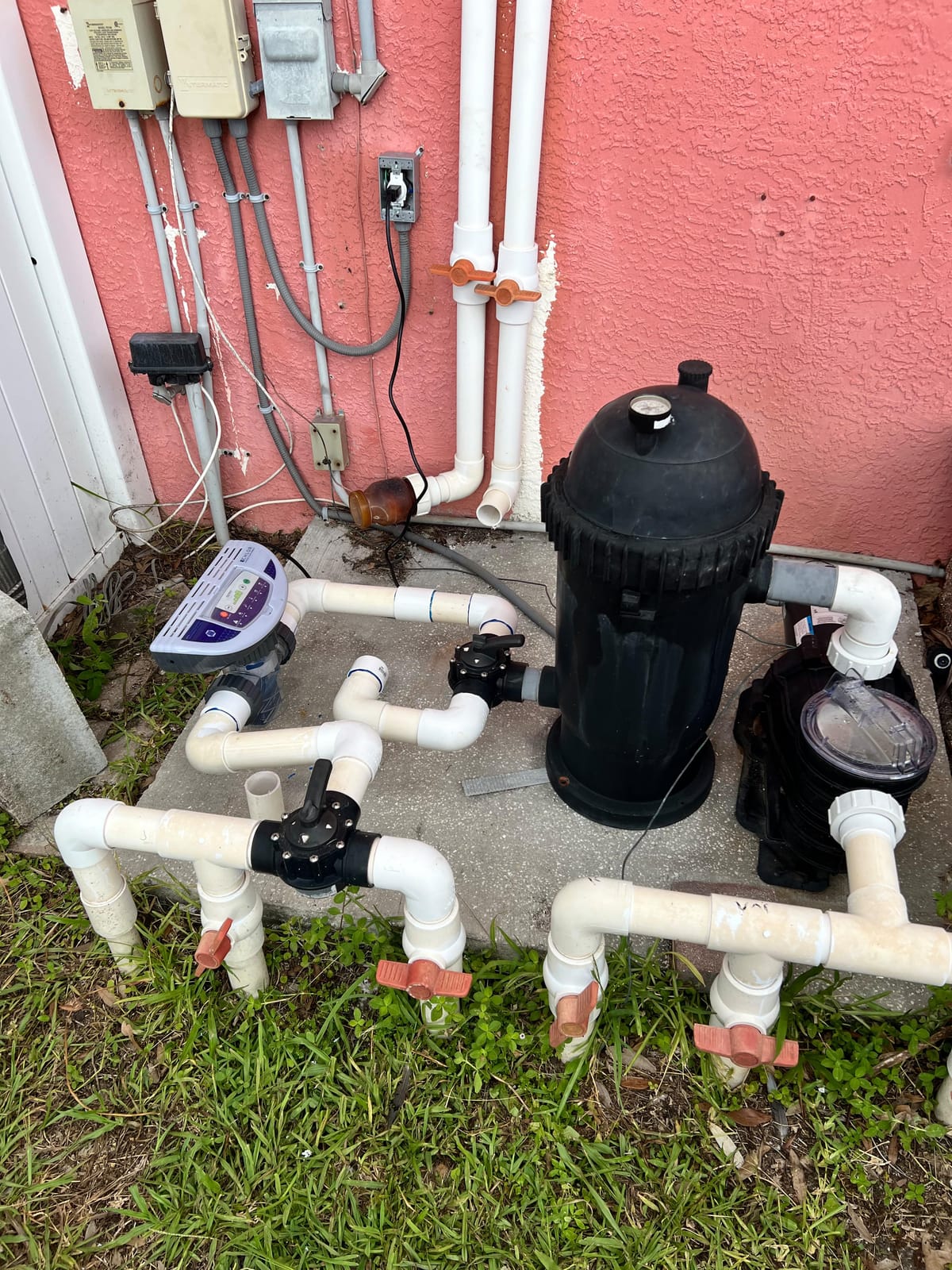
The listing claims output up to 15 percent higher than other compact salt chlorinators of this size, and it is rated for winter operation, which is unusual for a unit in this category. Owners rate the alerts highly, since they tell you whether the problem is salt, temperature, or flow instead of making you test all three.
It is also one of the few units here that compares favorably on cost against a Pentair replacement cell, which is the calculation that matters if you are swapping a dead cell rather than converting a whole pool.
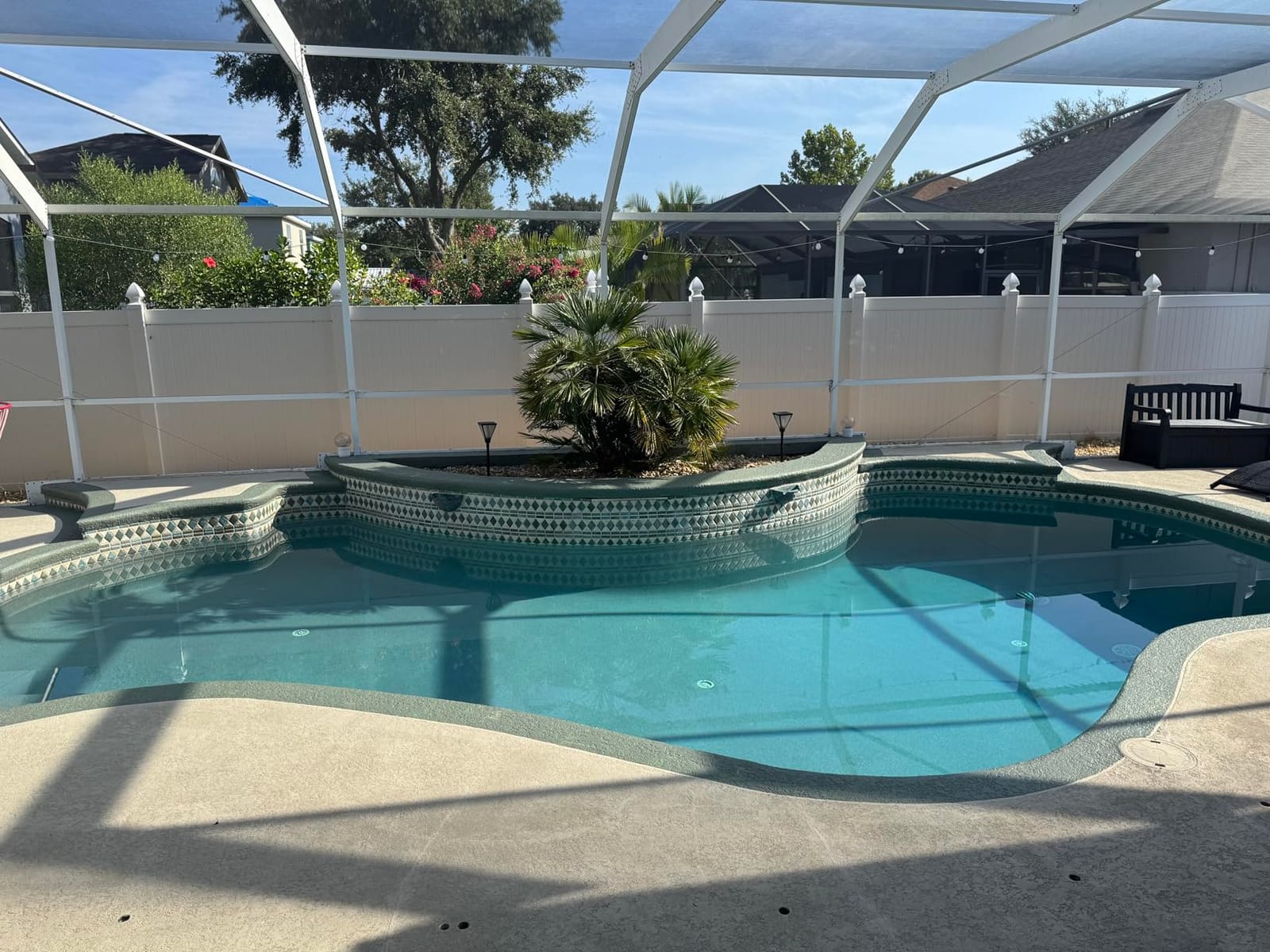
Where the 32,000 gallon ceiling matters
Capacity is the constraint on this pick. Thirty-two thousand gallons covers most mid-size residential inground pools with room to spare, but a larger pool would push the cell to full output constantly, which is the exact condition that shortens cell life.
If your pool is above that size, apply the size-up rule honestly and skip this unit rather than running it at maximum. A model rated above your volume that idles at half output will outlast a correctly matched unit that never stops running.
Two install gotchas
The power cord is short, and on a crowded pad it may not reach a receptacle. Measure the distance from your return line to the nearest outlet before you order, because an extension cord in a wet equipment area is not a good solution.
There is no built-in timer, so the unit needs an external mechanical timer or a smart receptacle to switch on and off with your pump schedule. That is a cheap part and ten minutes of setup, but it has to be accounted for, and without it the cell stays powered whenever the receptacle is live.
We earn a commission, at no additional cost to you. CERTAIN CONTENT THAT APPEARS ON THIS SITE COMES FROM AMAZON. THIS CONTENT IS PROVIDED 'AS IS' AND IS SUBJECT TO CHANGE OR REMOVAL AT ANY TIME.
7. Westaho EL-032 – Best for Cold Climates and Year-Round Monitoring
Salt Chlorine Generator, Westaho Pool Salt System for Inground Pools Up to 40,000 Gallons, 1.4 lb Chlorine Output, USA Titanium Cell with 10,000-Hour Lifespan, Built-in Power Supply
- 40K gallon max
- 1.4 lb per day
- Built-in power supply
- Shutoff below 52F
Pros
- Built-in power supply so no separate box
- USA-made titanium cell rated 10000 hours
- Smart panel shows salt temperature voltage and current
- Magnetic flow switch instead of mechanical
- IP66 waterproof rating
Cons
- Only 30 reviews so far
- About 21 percent of reviews are one star
- After-sales support limited to one year
We earn a commission, at no additional cost to you. CERTAIN CONTENT THAT APPEARS ON THIS SITE COMES FROM AMAZON. THIS CONTENT IS PROVIDED 'AS IS' AND IS SUBJECT TO CHANGE OR REMOVAL AT ANY TIME.
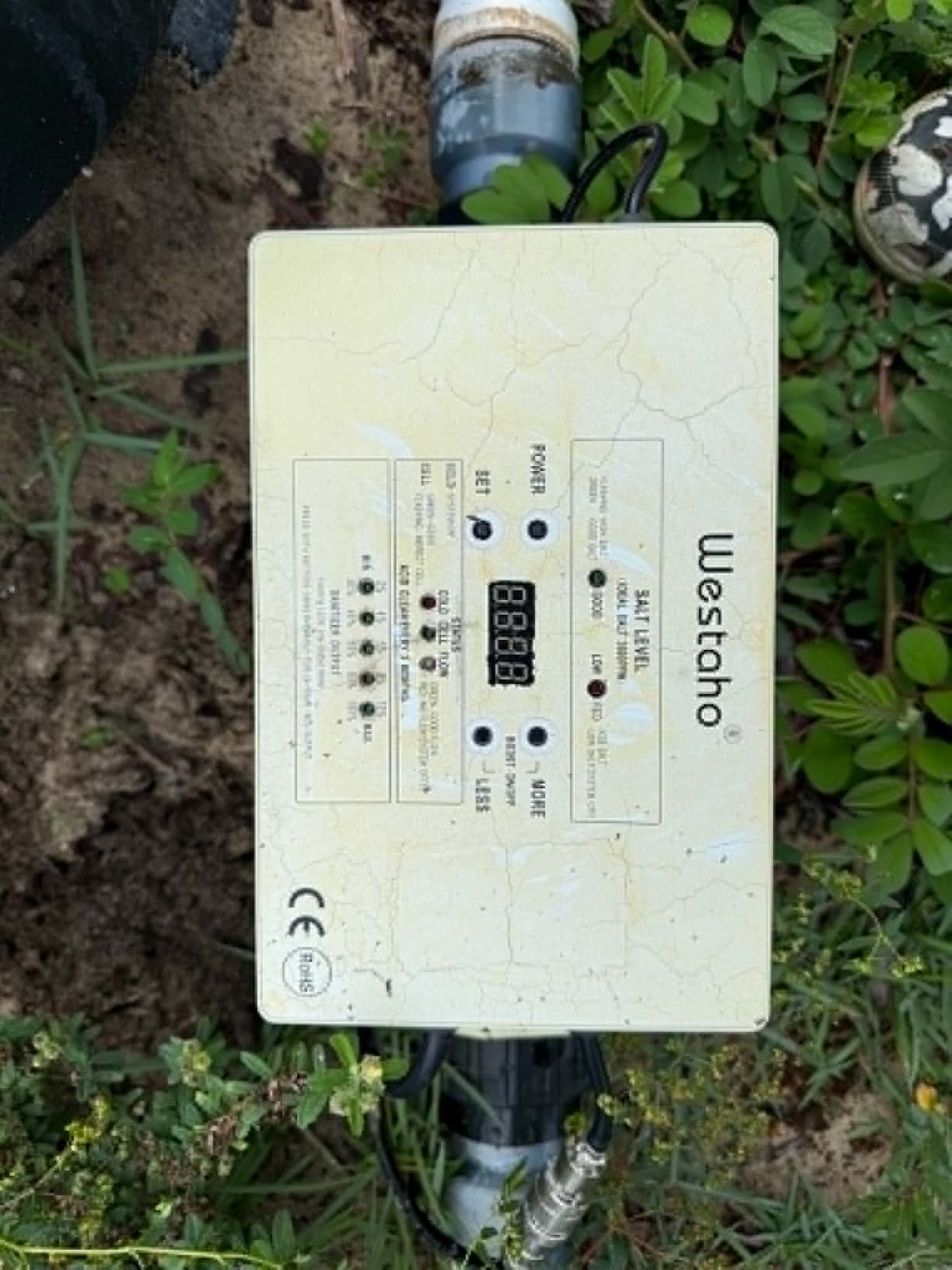
The Westaho is built around the conditions that shorten cell life in a northern climate. It auto-shuts off below 52 degrees Fahrenheit to protect the cell in cold water, and the smart display shows salt level, water temperature, cell usage, voltage, and current in real time, so you can confirm the unit is standing down rather than grinding scale off the plates all winter.
Output is 1.4 pounds of chlorine per day across a 40,000 gallon ceiling, and the built-in power supply removes the separate control box entirely. The magnetic flow switch is the detail we like most, since mechanical flow switches are the usual failure point in this category and a magnetic one has no moving parts to jam.
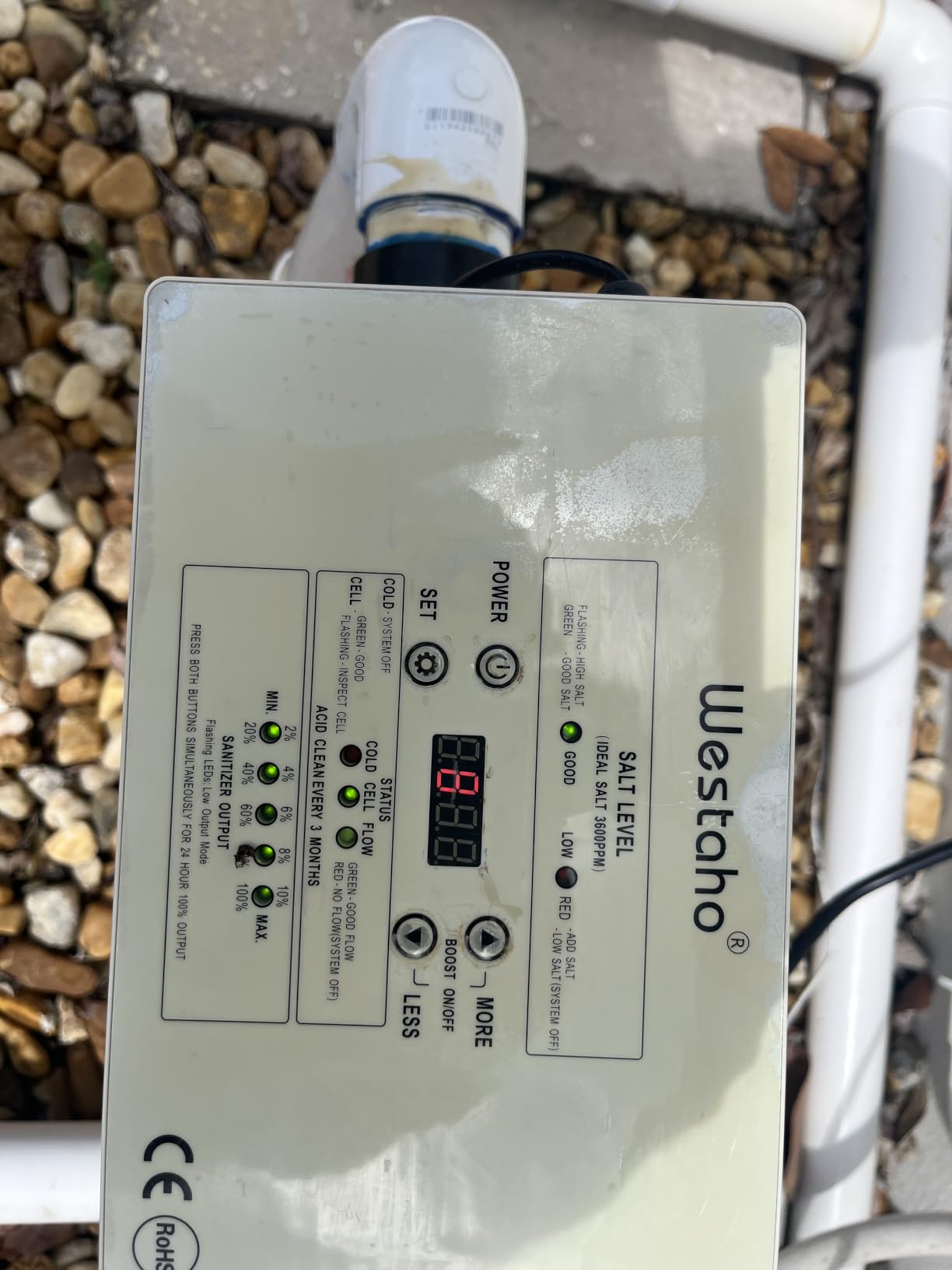
The titanium cell is described as USA-made with a 10,000 hour lifespan, which works out to roughly seven years of normal run time. The IP66 rating covers year-round outdoor operation, and the included 2 inch to 1.5 inch adapter means the cell fits either common return line size without a trip for a part.
Those are genuinely good specifications. The question is whether the track record backs them up, and at 30 reviews with roughly 21 percent one-star feedback, it is a thinner data set than the specs alone would suggest.
What the low-temperature protection really does
Chlorine production drops as water gets cold, and a cell forced to run in near-freezing water produces less chlorine while accumulating more scale. The automatic cutoff below 52F sidesteps that entirely by making the unit wait, and it is the single most useful feature here for anyone who does not close the pool for winter.
Pair it with the display and you get a readable answer to the question owners ask most in the off season, which is whether the system is actually doing anything or just sitting there. Voltage and current readings on that same panel will tell you whether a cell is drawing power before you assume it is dead.
Where the risk sits
One year of after-sales support against seven and eight year warranties elsewhere is the main gap. There are also reports of app and connectivity problems, which is worth knowing if you were counting on remote monitoring as a reason to buy.
Our advice is to treat this as a value pick with a known support ceiling. It suits a cost-conscious owner who is comfortable doing their own cell maintenance and lives somewhere with hard winters, and it is less suited to anyone who wants a manufacturer answer the phone in year five.
We earn a commission, at no additional cost to you. CERTAIN CONTENT THAT APPEARS ON THIS SITE COMES FROM AMAZON. THIS CONTENT IS PROVIDED 'AS IS' AND IS SUBJECT TO CHANGE OR REMOVAL AT ANY TIME.
8. Bonvoisin LC-200A – Best App-Controlled System for Pools Under 25,000 Gallons
Bonvoisin Salt Water Pool Chlorinator System Salt Chlorine Generator for Inground Pools Saltwater Pool System with Titanium Cell, LED/APP Control, Up to 25,000 Gallons Pool
- 25K gallon max
- WiFi and app control
- 4.7 by 13 inches
- 3.5 lb body
Pros
- App control with 2.4G WiFi and scheduling
- Output adjustable from 5 to 100 percent in 5 percent steps
- Self-cleaning with auto polarity reversal
- Compact body installs horizontally or vertically
- Both 1.5 inch and 2 inch adapters included
Cons
- No internal timer so it will not auto restart after power loss
- WiFi connectivity problems reported by multiple owners
- 25K gallon ceiling is the lowest here
We earn a commission, at no additional cost to you. CERTAIN CONTENT THAT APPEARS ON THIS SITE COMES FROM AMAZON. THIS CONTENT IS PROVIDED 'AS IS' AND IS SUBJECT TO CHANGE OR REMOVAL AT ANY TIME.
Smartphone control is this model’s headline feature, and for a smaller inground pool that wants hands-off scheduling it does something the panel-only systems here cannot. The app sets chlorine production from 5 to 100 percent in 5 percent increments and controls production time, with alarms and troubleshooting guidance pushed to your phone.
The body is genuinely compact at 4.7 by 13 inches and 3.5 pounds, and it can be installed horizontally or vertically with a choice of 1.5 inch and 2 inch adapters in the box. The self-cleaning titanium plate reverses polarity on a 4, 8, or 12 hour cycle and issues a cleaning reminder after 500 hours of accumulated run time.
The no-timer problem you have to know about
This is the single most important detail in the whole review, so read it before you buy. The unit has no internal timer, and if the power cycles, it will not come back on by itself. Owners report having to press the button manually each day, which defeats the entire point of an automatic chlorination system.
If your pool power is stable and you never see an outage, this may never come up. If you are on a generator-backed circuit or an area with frequent summer brownouts, treat it as a deal breaker rather than a minor annoyance.
Where the app falls short
Connectivity issues are reported by multiple owners, including failures to link the unit to WiFi at all. If remote monitoring is the reason you wanted this system, verify the pairing works in your equipment pad before you commit, because a saltwater unit that silently stops producing is a real problem.
There are also reports of units failing after about three months and reporting E1 or E2 errors, and a ceiling of 25,000 gallons makes this the smallest pool here. It works best on a smaller inground pool in a house where someone is home most days and can confirm the unit restarted.
We earn a commission, at no additional cost to you. CERTAIN CONTENT THAT APPEARS ON THIS SITE COMES FROM AMAZON. THIS CONTENT IS PROVIDED 'AS IS' AND IS SUBJECT TO CHANGE OR REMOVAL AT ANY TIME.
9. EverCrystal ECLI40-1T – Best Clear Cell for Watching Output
EverCrystal Salt Water Pool Chlorinator System – Up to 40,000 Gallons
- 40K gallon max
- Clear cell housing
- Metal control box
- Salt calibration plus or minus 800 ppm
Pros
- Clear housing lets you watch chlorine production
- Self-cleaning cell cuts back on upkeep
- Built-in salt calibration for more accurate readings
- Heavy-duty metal control box rather than plastic
- Plug-and-play union fittings with wall mount option
Cons
- Only 18 reviews so far
- No operating manual included
- Support channels described as unclear
We earn a commission, at no additional cost to you. CERTAIN CONTENT THAT APPEARS ON THIS SITE COMES FROM AMAZON. THIS CONTENT IS PROVIDED 'AS IS' AND IS SUBJECT TO CHANGE OR REMOVAL AT ANY TIME.
The EverCrystal posts the highest average rating of any unit in this guide, and the feature that earns it is visibility. The clear housing shows you the electrolytic cell working, so you can confirm chlorine production at a glance instead of trusting a display and a test kit. For a first-time salt system owner, that feedback loop is worth more than it sounds.
The display is also unusually informative, tracking salinity, voltage, current, temperature, and cell operation with a built-in salt calibration of plus or minus 800 ppm. That calibration offsets the reading drift that causes so many false low-salt complaints on other brands, because it lets you set a known-good baseline instead of trusting an absolute number.
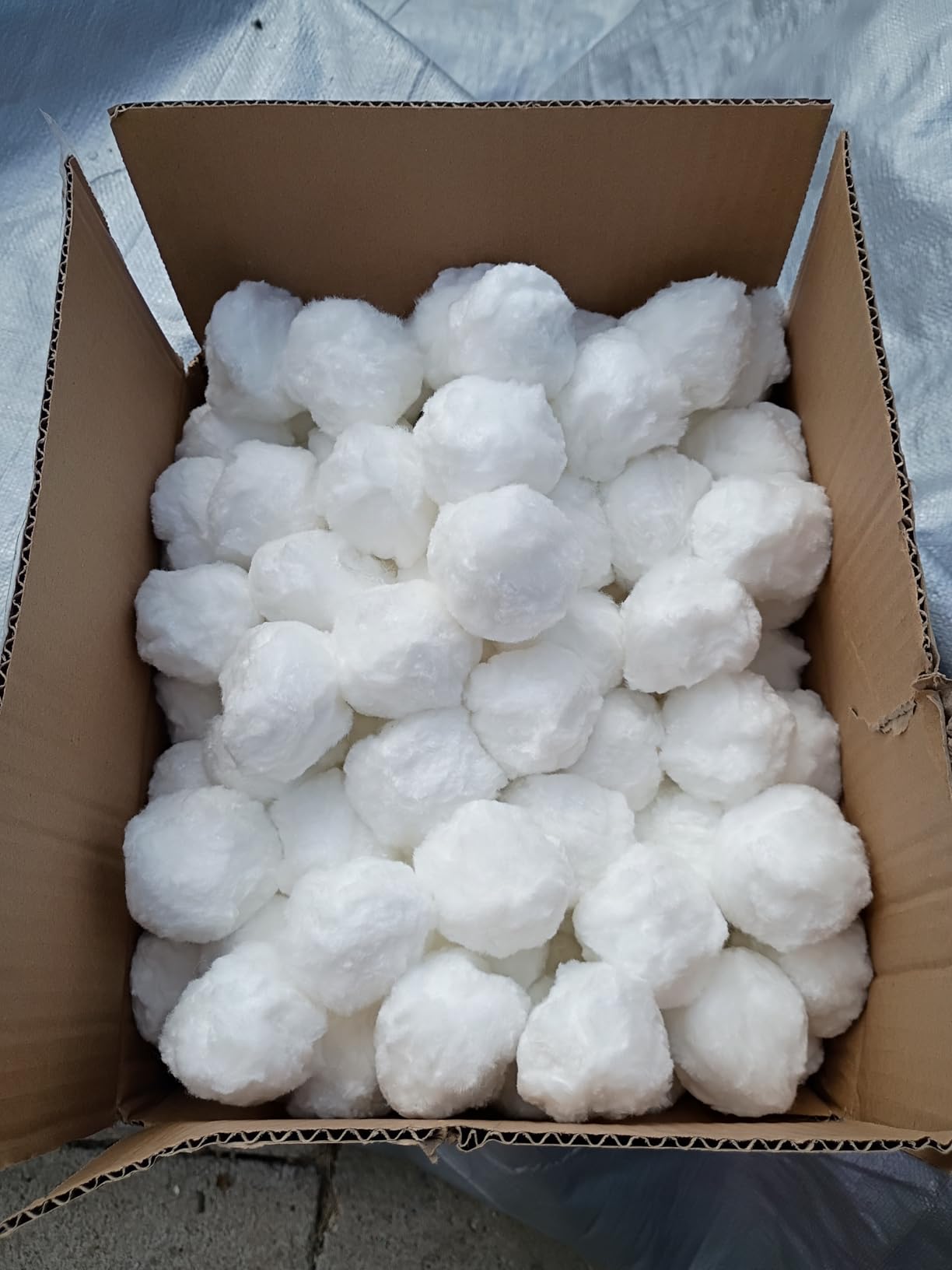
Construction is above the norm for this category. The control box is metal rather than plastic, which resists the UV and moisture exposure that degrades plastic housings on a wet inground pad, and the cell is self-cleaning so scale removal is not an annual task.
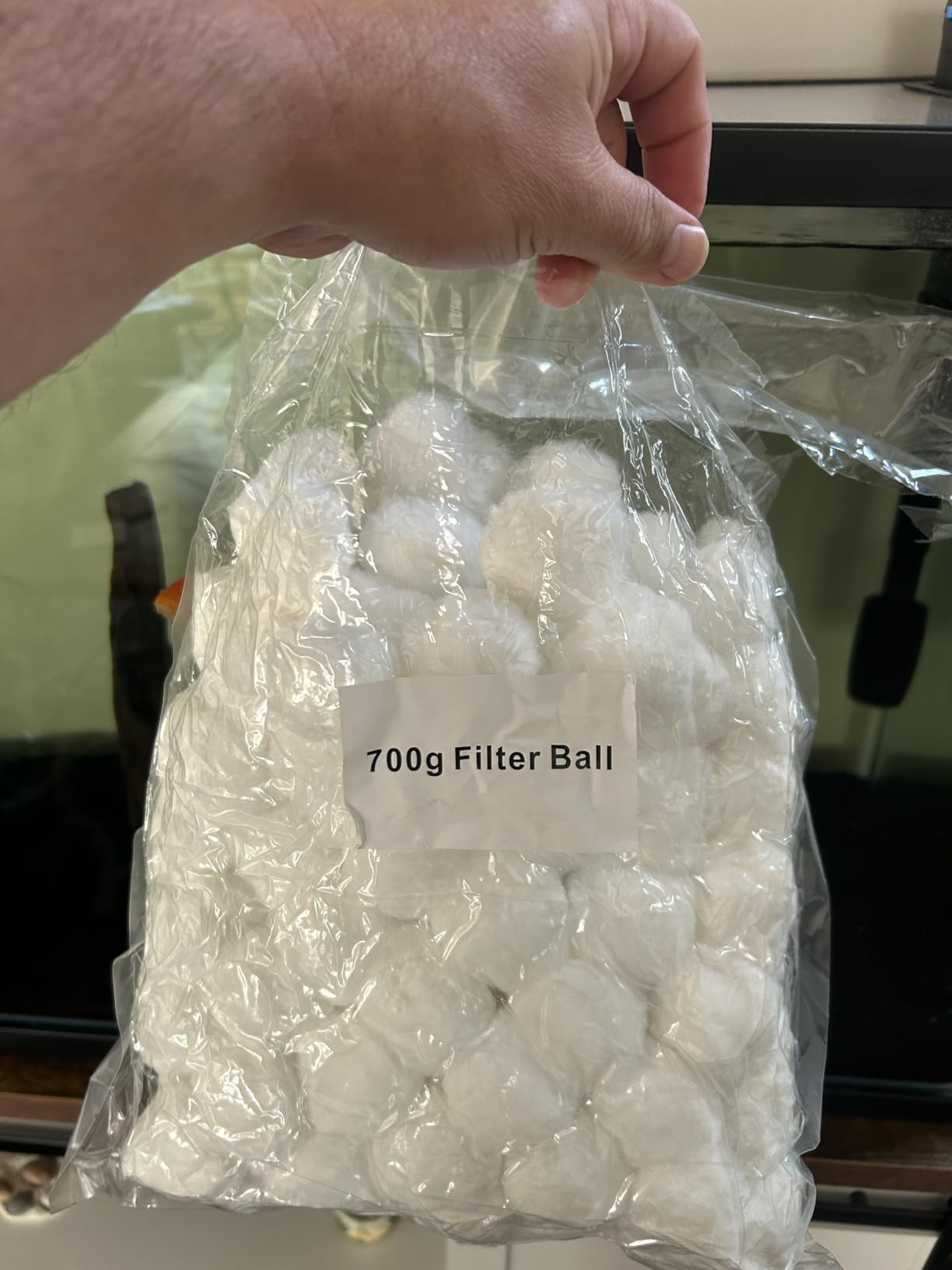
Installation is plug-and-play with union fittings included, and it can be wall-mounted if your pad layout is tight. The design covers pools up to 40,000 gallons, which covers most residential inground installations.
Why we did not rank this first
Eighteen reviews is a very small sample, and there is a further problem: some of the reviews attached to this listing appear to concern other pool products, which makes the 4.8 average less trustworthy than the number suggests. A rating built on a sample that size can move several full points with a dozen more reviews.
The second concern is support. After-sales coverage here is one year, and owners report a missing operating manual and unclear support channels. For a first-time installer, documentation matters, and this is where the thin record shows.
What it is genuinely good for
Pick this unit if you are the kind of owner who likes to look at the equipment, confirm the cell is producing, and adjust output based on what you see. The clear housing and live monitoring make it the most satisfying system to own in that respect.
Also worth noting: it is one of the few units here where the salt calibration feature directly addresses the most common complaint in salt system ownership. If you have been burned by a false low-salt warning before, that is a real reason to choose it.
We earn a commission, at no additional cost to you. CERTAIN CONTENT THAT APPEARS ON THIS SITE COMES FROM AMAZON. THIS CONTENT IS PROVIDED 'AS IS' AND IS SUBJECT TO CHANGE OR REMOVAL AT ANY TIME.
10. Troxlly TP30 – Best Retrofit for Pentair IntelliChlor Plumbing
TP30 Salt Chlorine Generator for Pools up to 40,000 Gallons, Smart Salt Chlorinator with App Monitoring, ETL Listed, Auto Reverse Polarity Cell, Standard Plumbing Fit
- 40K gallon max
- Transparent cell
- Retrofit line length matches IntelliChlor
- ETL Listed
Pros
- Retrofit ready line length matches Pentair IntelliChlor
- Transparent cell with automatic reverse polarity
- App and panel monitoring of output salinity and flow
- ETL Listed for applicable safety standards
- Turbo Boost function for faster ramp up
Cons
- Cannot be installed with downward vertical flow
- Reported salt PPM readings run 500 to 600 ppm off
- App and unit sometimes out of sync
- Support by email only
We earn a commission, at no additional cost to you. CERTAIN CONTENT THAT APPEARS ON THIS SITE COMES FROM AMAZON. THIS CONTENT IS PROVIDED 'AS IS' AND IS SUBJECT TO CHANGE OR REMOVAL AT ANY TIME.
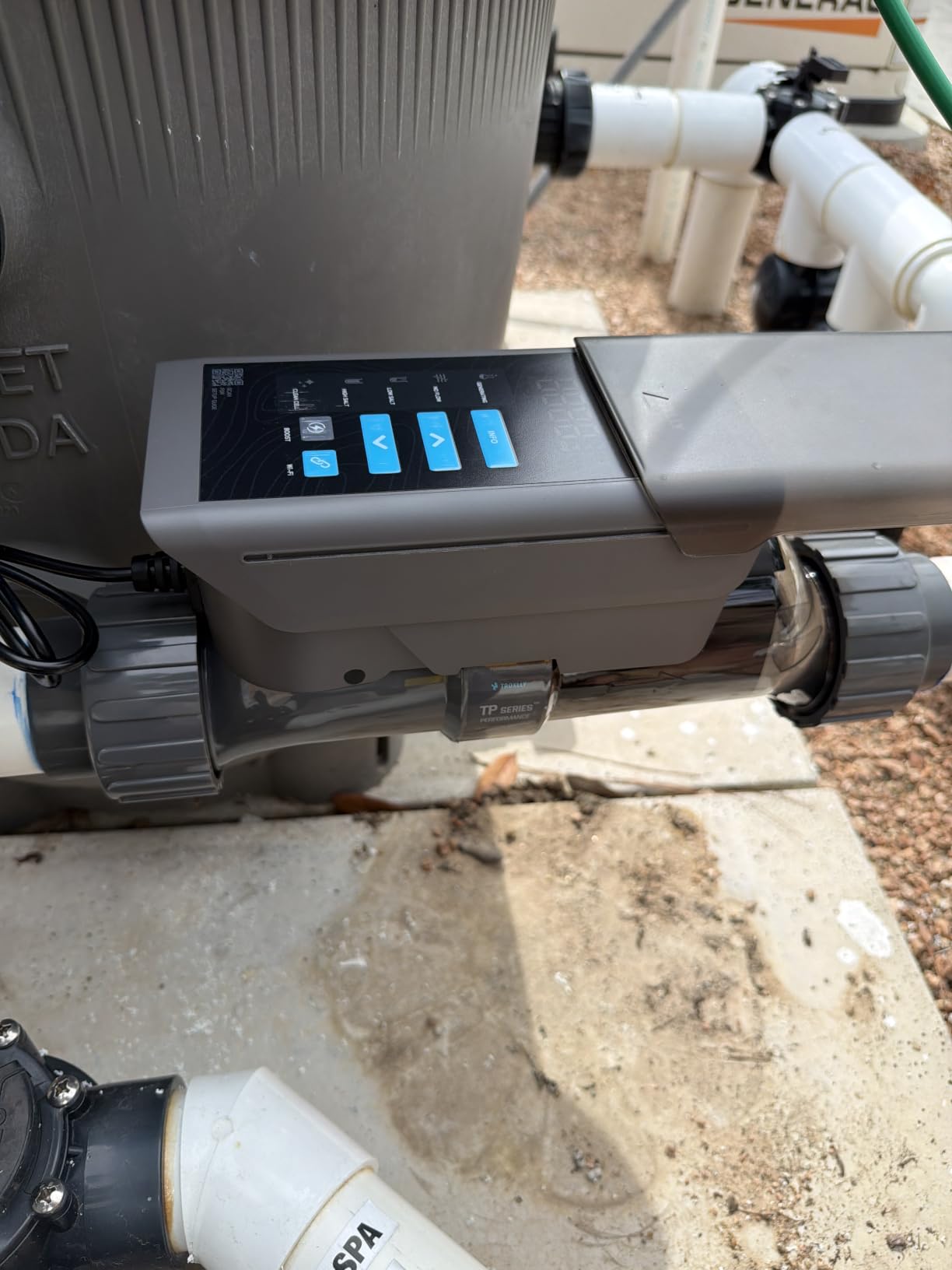
If your pad already has a Pentair IntelliChlor cell installed, this is the only unit here that drops straight into the same plumbing footprint. The retrofit line length matches IntelliChlor IC20, IC40, and IC60 installed length, so replacing a dead cell becomes a union wrench job instead of a pipe-cutting job.
The transparent cell with automatic reverse polarity lets you watch the cell work and self-clean at the same time, and the app and panel together report output, salinity, flow, water temperature, and system alerts. The Turbo Boost function pushes output higher when you need a fast ramp, which is useful after a heavy rain or before a party.
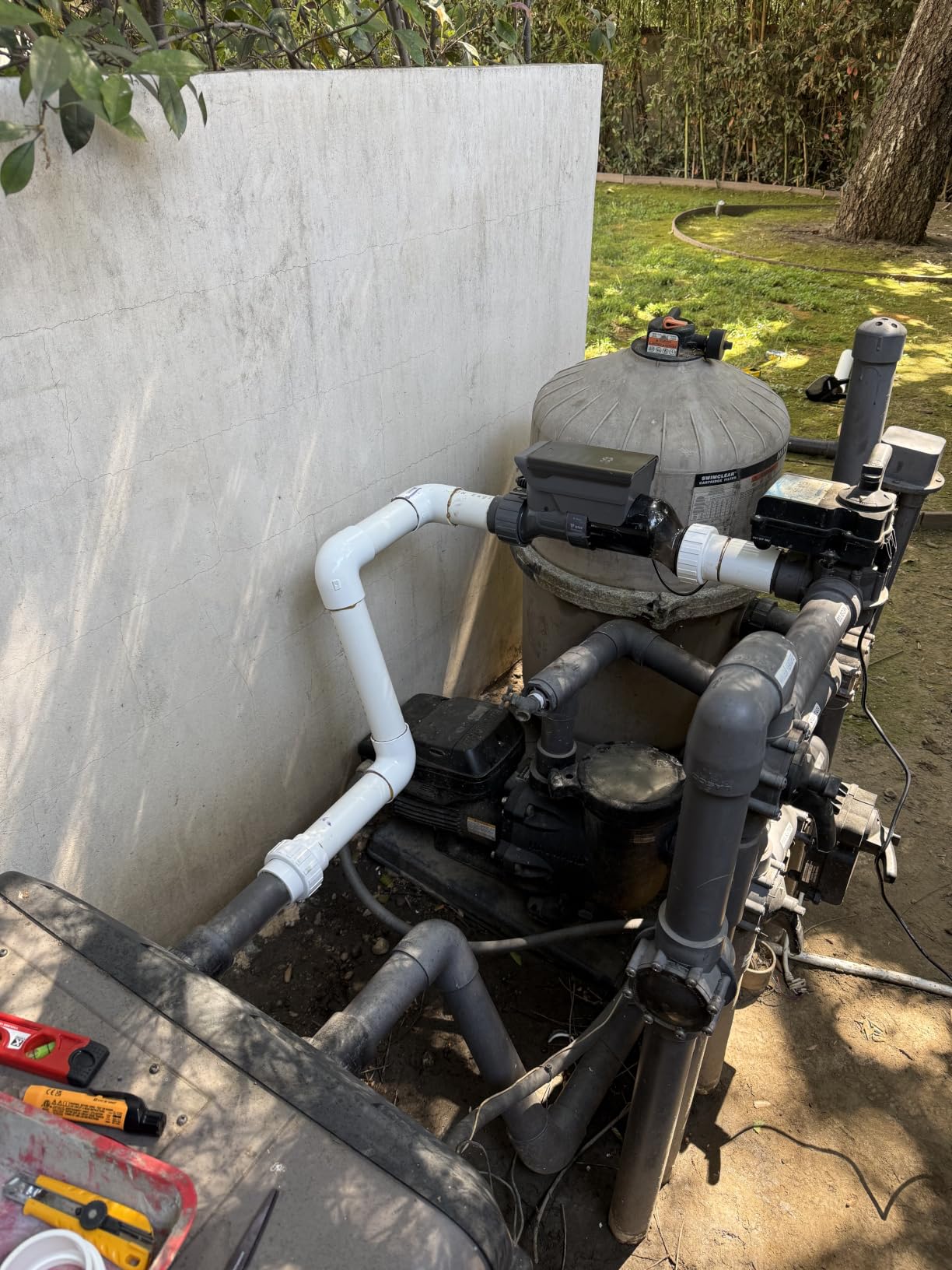
It is ETL Listed for applicable safety standards and includes its own power adapter, so you are not stuck hunting for a compatible supply. Variants exist in 15,000, 25,000, and 40,000 gallon sizes, so the same platform covers a small retrofit or a large inground pool.
Owners mostly report easy installation and good value for what they get. The app-based monitoring is genuinely useful on a system you can watch remotely instead of walking out to the pad.
Check your flow direction before ordering
This unit cannot be installed where water flows downward vertically. That is a genuine disqualifier for some plumbing layouts, and owners report it was not obvious from the listing, so trace your return line direction and confirm before you commit to a retrofit.
It is also not affiliated with Pentair, which matters if you assumed otherwise from the retrofit compatibility. The compatibility is mechanical, in the line length and fittings, not an endorsement or a guarantee of the original platform.
Reading accuracy and support
Salt PPM readings reportedly run 500 to 600 ppm off from a pool store test, and the app does not always stay in sync with the unit. Confirm any salt reading with a drop test before you start adding salt, because dumping pounds of salt into the pool based on a misreading is an expensive mistake.
Support is email only and owners describe the responsiveness as spotty. Some also report the unit struggling to keep up at full output, so if your pool is near 40,000 gallons, size up rather than running this at maximum.
We earn a commission, at no additional cost to you. CERTAIN CONTENT THAT APPEARS ON THIS SITE COMES FROM AMAZON. THIS CONTENT IS PROVIDED 'AS IS' AND IS SUBJECT TO CHANGE OR REMOVAL AT ANY TIME.
How to Size a Salt Chlorine Generator for an Inground Pool
Size up by 1.5 to 2 times your pool volume, and aim for the cell to run at 40 to 60 percent output. This is the most consequential decision in the category and it is the one most roundups skip, so here is the method in full.
Step one is to know your actual pool volume in gallons, which is often printed on a label inside the equipment pad or in the original paperwork. If you cannot find it, measure. Length times width times average depth gives cubic feet, and multiplying by 7.5 converts that to gallons for a roughly rectangular pool.
Step two is to multiply that number by 1.5 for a moderate climate and 2 for a hot one, or for a pool with heavy bather load, a spa, or a solar cover that keeps chlorine demand high. A 20,000 gallon inground pool in Arizona and the same pool in Maine do not have the same chlorine demand, and sizing should reflect that.
Step three is to check the output figure, not just the gallon rating. A system rated for 40,000 gallons at 1.9 pounds per day has far more headroom than one rated for 40,000 gallons at 1.4 pounds per day. When two systems cover your pool, the one with higher output will idle lower and last longer.
Salt concentration is the fourth input. These systems expect roughly 2,700 to 3,400 parts per million of salt, and several units allow that whole band to be set, which gives you tolerance for a slightly under-salted pool. Keeping your readings inside that band is what prevents the salt cell from running hot and scaling.
Installing a Salt Cell on Inground Plumbing
The cell goes in the return line after the filter and before the check valve, oriented so water flows in the direction marked on the housing. Most listings include the union fittings, but verify the size matches your actual pipe before you start, because a 2 inch return line with 1.5 inch unions is a very common mismatch.
Shut the pump down, lower the water if the return line is at risk of draining the pool below the skimmer, then cut the line and solvent-weld your unions. Budget a few hours for a first attempt at this, and remember that the cell has to be plumbed in a spot where water will flow through it the entire time the pump is running. A cell installed on a dead leg will never produce chlorine.
Leave room to remove the cell. Every year you will want to pull it for inspection, and in cold climates you will want a bypass so you can plumb around it in winter. A union on each side is not optional, it is the difference between a five-minute swap and cutting pipe.
Power is the other install decision. Complete systems include a control box or a built-in supply, while cells-only products need a matching control unit or power supply sold separately. That hidden extra is the trap that catches buyers who assumed a cell was a finished system, so confirm what is in the box before you order.
Salt Pool Water Chemistry and Monthly Routine
Hold cyanuric acid between 70 and 80 parts per million in a salt pool, which is higher than the 30 to 50 ppm typical of a chlorine pool. Sunlight breaks down chlorine faster in a salt system, and the stabilizer is what keeps the chlorine you generate in the water where it belongs.
Keep pH between 7.2 and 7.6, and expect it to sit high. Electrolysis produces sodium hydroxide as a byproduct, so salt pools drift upward and need more frequent pH correction than chlorine pools. Correct pH before you adjust output settings, because a system running at a pH of 8.0 will not sanitize properly no matter what the cell is doing.
For salt quantity, the working number is 83 pounds of pool-grade salt for every 1,000 ppm you want to raise, in a 10,000 gallon pool. That means an initial fill of several hundred pounds for a mid-size inground pool, poured directly into the deep end with the pump running. Use pool-grade salt, not solar or table salt, which carry additives that damage cell plates.
Test salt monthly once you are settled, and know that salt does not evaporate. It only leaves through backwash, splash-out, and overflow, so a pool that needs salt added constantly has a water balance or leak problem, not a chlorinator problem.
Cell lifespan is usually three to seven years depending on output hours and water temperature. The cell itself tracks cumulative run time on most of the systems above, so replace it when the reported usage hits its limit rather than waiting for output to visibly fail.
Troubleshooting the Four Salt Chlorinator Faults That Fill the Forums
False low-salt warnings are the most common complaint across pool forums. A CircuPool Edge-40 owner reported the low-salt light blinking for two and a half years while the system produced plenty of chlorine, with support troubleshooting exhausted. The habit that solves this is simple: confirm with an independent salt test before you add salt or replace anything.
Salt reading mismatches come next, with cells reporting as much as 1,000 ppm below what a pool store measures. Calibrate the reading at the store while you are both in front of it, and if your system allows a salt offset, set it to the corrected number. Several units here offer exactly that offset feature for this reason.
No chlorine production usually means one of four things: no flow through the cell, salt out of range, a failed cell, or a control unit that lost power. Check the flow switch first, since a cell plumbed on a dead leg or a valve left closed produces nothing while the display still lights up.
Cell scale is the slow failure. Calcium builds on the titanium plates until output drops, and reverse polarity cleaning handles light scale but not heavy scale. An acid soak by removing the cell is the cure for a bad one, and it is why we prefer systems that include a cleaning plug or cap.
Output that stops suddenly deserves a manual chlorine fallback. Forum owners running two inexpensive systems in parallel describe keeping liquid chlorine on hand precisely because a cell can stop producing between one week and the next. Any system, at any price, can leave you stranded without a backup plan.
Is a Salt Water Chlorinator Worth It on an Inground Pool?
It is worth it when you have an inground pool above roughly 15,000 gallons, want to stop buying chlorine weekly, and are willing to spend an afternoon plumbing a cell. The savings come from eliminating liquid chlorine purchases and stabilizer, and owners of larger systems commonly report meaningful reductions in annual chemical spending.
It is not worth it if you have a very small pool, if you are planning to move within a year, or if the control box and cell have nowhere to mount on a crowded pad. In those cases a canister chlorinator with a tablet costs less and takes an hour to set up.
Judge reliability by warranty length rather than star rating. The systems with seven and eight year terms are making a decade-long bet on their cell, and the one-year terms are not. Over a ten-year ownership horizon, cell replacement is the dominant cost either way, so the warranty length is the best proxy you have for whether that second cell will arrive when you need it.
Frequently Asked Questions
What is the best salt water pool system?
The best salt water pool system for an inground pool is the Hayward AquaRite, because it has the deepest service history of any unit here and close to a thousand reviews describing steady chlorination with drop-in cell replacement. For large pools above 35,000 gallons, the CircuPool RJ45+ offers more daily output, and for tight equipment pads the CircuPool CORE35 fits where a separate control box will not.
Which salt water chlorinator is the most reliable?
Reliability tracks warranty length more than star rating. The systems with seven and eight year limited warranties are the ones manufacturers bet on for a decade, while several budget units carry only one year of after-sales support and show higher rates of early cell failure. Among units with meaningful review volume, the Hayward AquaRite and the CircuPool RJ45+ rank highest for reliability.
What size salt chlorine generator do I need for my inground pool?
Multiply your pool volume in gallons by 1.5 for a moderate climate or 2 for a hot climate, high bather load, or a pool with a spa or solar cover. Then choose a system rated above that number with at least 1.7 pounds of chlorine per day, so the cell idles at 40 to 60 percent output instead of running at maximum.
Is a salt water chlorinator worth it?
It is worth it for an inground pool above roughly 15,000 gallons if you want to stop buying liquid chlorine weekly and can spend an afternoon plumbing a cell into the return line. It is not worth it for very small pools, for a pad with no room to mount a control box, or if you expect to move within a year.
What is the life expectancy of a salt water chlorinator cell?
A titanium salt cell typically lasts three to seven years depending on how many hours it runs and how warm the water is. Sizing up 1.5 to 2 times your pool volume so the cell runs at 40 to 60 percent output is the biggest lever on lifespan. Most systems here track cumulative run time and report remaining cell life on the panel.
Is there an automatic chlorine dispenser for swimming pools?
Yes. A salt chlorine generator is an automatic dispenser that makes its own chlorine. It converts the salt dissolved in the pool into hypochlorous acid using a titanium electrolytic cell, then returns the sodium hydroxide byproduct to the water, which is why salt pools still need pH correction even though they need no manual chlorine dosing.
Final Verdict: Which Inground Salt System Should You Buy?
For most inground pools, the best saltwater chlorinator is the Hayward AquaRite W3AQR15. Nearly a thousand reviews, a decade-plus service record on the cell family, and an LED monitor that reports service alerts instead of making you interpret codes. It is the choice we would make for a pool between 15,000 and 40,000 gallons where a pool tech already knows this platform.
Pick the CircuPool RJ45+ instead if your pool runs 35,000 gallons or more and you want the higher 1.9 pound per day output, an OLED display, and a clear housing so you can watch the cell work. Pick the CircuPool CORE35 if your equipment pad physically will not fit a separate control box and power supply, since its all-in-one housing and eight-year warranty solve that problem better than anything else here.
For a plug-and-play conversion with no panel work, the APX Performance E-CHLOR is the one to look at, keeping in mind its 32,000 gallon ceiling and the external timer it needs. Whatever you choose, size up 1.5 to 2 times your pool volume, keep cyanuric acid between 70 and 80 ppm, and confirm every salt reading with an independent test before you add salt.
We will keep this list current as new models land through the rest of 2026, and we update it whenever the ratings and warranty terms behind these picks change.