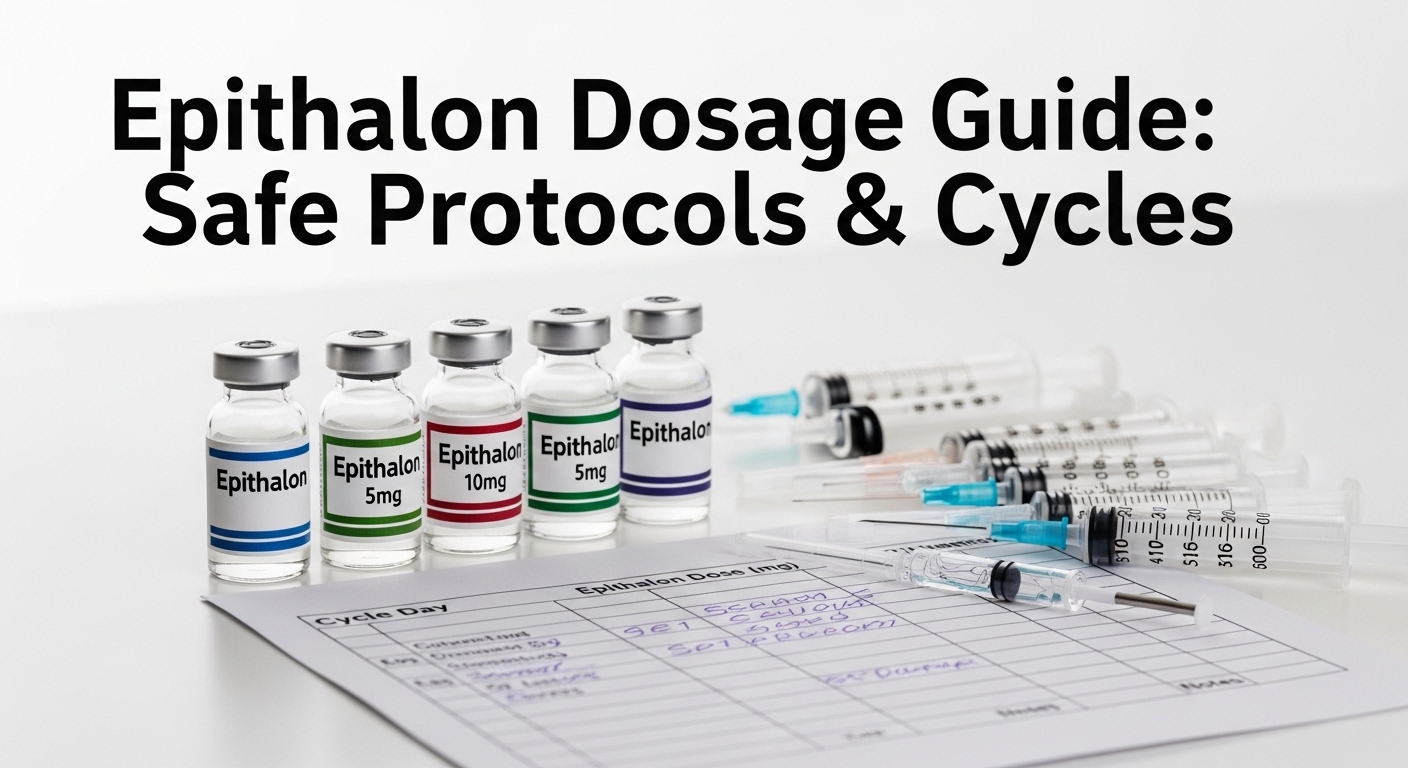
Finding the right epithalon dosage can be confusing. I spent weeks sifting through research papers, Reddit threads, and peptide forums only to discover that most people mix up protocols designed for different compounds entirely.
The standard epithalon dosage is 5-10mg per day administered subcutaneously for 10-20 consecutive days, repeated 1-2 times per year with 4-6 months between cycles.
In this guide, I break down the Russian Protocol, Ukrainian Protocol, and standard research protocols so you can make an informed decision. I also address the critical distinction between Epithalamin and Epithalon that causes so much confusion online.
Here is what you will learn: exact dosages for each protocol, step-by-step reconstitution instructions, cycling guidelines, and safety considerations based on published research.
ContentsTable of Contents
- 1Quick Epithalon Dosage Chart→
- 2What Is Epithalon?→
- 3How Epithalon Works?→
- 4Telomerase Activation→
- 5Pineal Gland Function→
- 6Why Dosage Matters?→
- 7Epithalon Dosage Protocols→
- 8Russian Protocol→
- 9Ukrainian Protocol→
- 10Standard Research Protocol→
- 11Which Protocol Should You Choose?→
- 12Administration Methods→
- 13Subcutaneous Injection (Most Common)→
- 14How to Reconstitute Epithalon?→
- 15Alternative Administration Routes→
- 16Epithalon Cycling Guidelines→
- 17Standard Cycling Pattern→
- 18What to Expect: Timeline of Results→
- 19Side Effects and Safety→
- 20Reported Side Effects→
- 21Contraindications→
- 22The Dosing Controversy→
- 23FDA Status→
- 24Frequently Asked Questions→
- 25How much epithalon should I take?→
- 26What is the Russian Protocol for epithalon?→
- 27How long should an epithalon cycle be?→
- 28What time of day should you take epithalon?→
- 29Is epithalon safe?→
- 30How do you reconstitute epithalon?→
- 31What is the difference between Epithalamin and Epithalon?→
- 32Final Thoughts on Epithalon Dosage→
Quick Epithalon Dosage Chart
This comparison table shows the three main epithalon dosing protocols used in research settings.
| Protocol | Daily Dose | Duration | Total Dose | Frequency |
|---|---|---|---|---|
| Russian Protocol | 10mg daily | 10 days | 100mg per cycle | 1-2x per year |
| Ukrainian Protocol | 10mg per dose | Days 1, 5, 9, 13, 17 | 50mg per cycle | 1-2x per year |
| Standard Research | 5mg daily | 20 days | 100mg per cycle | 1-2x per year |
All protocols recommend a minimum of 4 months between cycles. Evening administration is preferred due to melatonin-related mechanisms.
What Is Epithalon?
Epithalon (also spelled Epitalon or Epithalone) is a synthetic tetrapeptide consisting of four amino acids: Alanine-Glutamate-Aspartate-Glycine (AEDG).
It was developed by Russian scientist Vladimir Khavinson based on research into the natural pineal gland peptide called Epithalamin.
Important Distinction: Epithalamin is a natural extract from bovine pineal glands, while Epithalon is the synthetic version. Much of the dosing confusion online stems from conflating protocols designed for these different compounds.
The original Epithalamin research used different dosing than modern Epithalon protocols. This matters because some forum discussions reference Epithalamin doses (often in micrograms) when discussing the synthetic Epithalon (typically dosed in milligrams).
Epithalon gained attention in longevity research circles for its potential geroprotective properties. Studies suggest it may activate telomerase and support telomere length, which are key markers associated with cellular aging.
In Russia, Epithalamin received approval for certain clinical applications. However, Epithalon remains classified as a research chemical in the United States and most other countries.
How Epithalon Works?
Understanding the mechanism helps explain why dosage timing and cycling matter for this peptide.
Telomerase Activation
Epithalon’s primary mechanism involves activating telomerase, the enzyme responsible for maintaining telomere length at the ends of chromosomes.
Telomeres shorten with each cell division. When they become critically short, cells enter senescence and stop dividing. Research suggests epithalon may help maintain telomere length, potentially supporting cellular longevity.
A study published in the Bulletin of Experimental Biology and Medicine found that epithalon activated telomerase in human somatic cells.
Pineal Gland Function
Epithalon appears to support pineal gland function and melatonin synthesis.
The pineal gland produces melatonin, which regulates circadian rhythm and has antioxidant properties. Pineal function naturally declines with age.
Research indicates epithalon may help restore melatonin production to more youthful levels in older subjects. This explains why evening dosing is often recommended to align with natural melatonin cycles.
Why Dosage Matters?
The peptide’s mechanism suggests a threshold effect rather than a dose-response relationship. This means taking more is not necessarily better.
Some forum discussions raise concerns that very high doses might theoretically promote cellular senescence rather than prevent it. While this remains speculative, it underscores the importance of following established research protocols rather than experimenting with higher doses.
Epithalon Dosage Protocols
Three main dosing protocols appear consistently in research and clinical practice. Each has different advantages depending on your preferences and goals.
Russian Protocol
The Russian Protocol is the most intensive approach, developed in the laboratories where epithalon was first synthesized.
- Daily Dose: 10mg once daily (or split into 5mg AM and 5mg before bed)
- Duration: 10 consecutive days
- Total Dose: 100mg per cycle
- Frequency: Up to twice per year
- Off-Cycle: Minimum 4 months between cycles
This protocol delivers the full dose over a shorter period. Some users report more noticeable initial effects with this approach.
The divided dosing option (5mg AM and 5mg PM) may help maintain more stable peptide levels throughout the day.
Ukrainian Protocol
The Ukrainian Protocol uses a spaced-dose approach with the same per-dose amount but fewer total injections.
- Daily Dose: 10mg per injection
- Schedule: Days 1, 5, 9, 13, and 17 (five doses total)
- Total Dose: 50mg per cycle
- Frequency: Up to twice per year
- Off-Cycle: Minimum 4 months between cycles
This protocol uses half the total peptide compared to the Russian Protocol. The spacing may allow for extended telomerase activation periods between doses.
Some practitioners prefer this approach for its lower total dose and reduced injection frequency.
Standard Research Protocol
The Standard Research Protocol extends the cycle duration while using a lower daily dose.
- Daily Dose: 5mg once daily (evening preferred)
- Duration: 20 consecutive days
- Total Dose: 100mg per cycle
- Frequency: Up to twice per year
- Off-Cycle: 4-6 months between cycles
This protocol matches the Russian Protocol’s total dose but spreads it over twice the duration. The lower daily dose may reduce any potential side effects while maintaining efficacy.
Which Protocol Should You Choose?
Your choice depends on several factors:
- Choose Russian Protocol if: You prefer a shorter cycle and can commit to daily injections for 10 days
- Choose Ukrainian Protocol if: You want fewer injections and prefer a lower total dose
- Choose Standard Protocol if: You prefer a lower daily dose spread over a longer period
All three protocols have appeared in research contexts. There is no definitive evidence that one is superior to the others.
Administration Methods
How you administer epithalon affects its bioavailability and effectiveness. Here is what research and practical experience suggest about each method.
Subcutaneous Injection (Most Common)
Subcutaneous injection is the standard administration method with the highest bioavailability.
Injection sites include the abdomen (avoiding the navel area), thighs, or upper arms. Rotating sites between injections helps prevent irritation.
- Needle Size: 29-31 gauge insulin syringe
- Angle: 45-90 degrees depending on skin thickness
- Timing: Evening administration preferred (aligns with melatonin cycle)
Always use sterile technique. Clean the injection site with alcohol and allow to dry before injecting.
How to Reconstitute Epithalon?
Epithalon typically comes as a lyophilized (freeze-dried) powder that requires reconstitution before use.
Pro Tip: For a 10mg vial, use 2.0mL of bacteriostatic water. This creates a concentration of 5mg/mL, making dosing calculations straightforward.
Follow these reconstitution steps:
- Step 1: Draw 2.0mL of bacteriostatic water using a sterile syringe
- Step 2: Inject the water slowly down the inside wall of the peptide vial (avoid spraying directly onto the powder)
- Step 3: Gently swirl or roll the vial until fully dissolved (do not shake vigorously)
- Step 4: Label the vial with the date, concentration (5mg/mL), and store in refrigerator
- Step 5: Use within 2-4 weeks and avoid freeze-thaw cycles
At 5mg/mL concentration, each 0.1mL (10 units on a U-100 insulin syringe) contains 0.5mg of epithalon. For a 5mg dose, you would draw 1.0mL (100 units).
Alternative Administration Routes
While injection is standard, some alternative routes exist:
| Method | Bioavailability | Convenience | Research Support |
|---|---|---|---|
| Subcutaneous Injection | Highest | Moderate | Strong |
| Intramuscular Injection | High | Moderate | Moderate |
| Nasal Spray | Moderate | High | Limited |
| Sublingual | Low-Moderate | High | Minimal |
| Oral | Very Low | High | Not Recommended |
Nasal spray formulations typically use 10-20mg per day in divided doses. However, research support for this route is limited compared to injection.
Oral administration is not recommended due to enzymatic breakdown in the digestive tract.
Epithalon Cycling Guidelines
Proper cycling is essential for epithalon. Unlike some peptides used continuously, epithalon follows distinct on-cycle and off-cycle periods.
Standard Cycling Pattern
- On-Cycle: 10-20 days (depending on protocol)
- Off-Cycle: 4-6 months minimum
- Cycles Per Year: Maximum of 2-3 cycles
The extended off-cycle period allows the body to respond to the telomerase activation. Taking more frequent cycles does not appear to provide additional benefits based on available research.
Some practitioners follow a pattern of one cycle every 4-6 months, resulting in 2 cycles per year. Others prefer annual cycling with a single extended protocol.
What to Expect: Timeline of Results
Epithalon works at the cellular level, so changes are not immediately visible like some other compounds.
| Timeframe | What Users May Notice |
|---|---|
| Week 1-2 | Improved sleep quality, more vivid dreams (melatonin effect) |
| Week 2-4 | Increased energy levels, improved mood |
| Month 1-3 | Better sleep patterns, potentially improved skin appearance |
| Month 3-6 | Cumulative effects on cellular health (not directly observable) |
| Long-term | Potential longevity benefits (theoretical, based on mechanism) |
The most commonly reported early effect is improved sleep quality. This aligns with epithalon’s effect on melatonin synthesis.
Longevity-related benefits like telomere maintenance are not something you can feel directly. These effects are based on the peptide’s mechanism of action rather than subjective experience.
Side Effects and Safety
Epithalon has demonstrated a favorable safety profile in available research, though long-term data in healthy adults remains limited.
Reported Side Effects
Side effects are generally mild when following established protocols:
- Common: Mild injection site reactions (redness, itching, minor irritation)
- Occasional: Sleep pattern changes during the adjustment period
- Rare: Headache, fatigue, or mild hormonal shifts
A 15-year follow-up study on elderly subjects found no serious adverse events associated with epithalon use.
Contraindications
Certain individuals should avoid epithalon or consult a physician first:
- Pregnant or breastfeeding women
- Individuals with active or suspected cancer (telomerase activation concerns)
- Those with known hypersensitivity to peptides
- Anyone on medications that affect hormonal balance
Important: The theoretical concern with telomerase activation is that it could potentially affect cancer cells. While research has not demonstrated this, individuals with cancer history should exercise caution and consult their healthcare provider.
The Dosing Controversy
Some online discussions suggest that standard milligram doses may be too high, with claims that original research used microgram doses.
This confusion typically stems from conflating Epithalamin (the natural extract) with Epithalon (the synthetic peptide). The compounds have different potencies and dosing requirements.
The protocols outlined in this guide (5-10mg daily) are consistent with published research on synthetic Epithalon. If you have concerns, consulting with a healthcare provider familiar with peptide protocols is advisable.
FDA Status
Disclaimer: Epithalon is not FDA-approved for any medical condition in the United States. It is classified as a research chemical. The information in this article is for educational purposes only.
Frequently Asked Questions
How much epithalon should I take?
The standard epithalon dosage is 5-10mg per day administered subcutaneously. The Russian Protocol uses 10mg daily for 10 days, the Ukrainian Protocol uses 10mg on days 1, 5, 9, 13, and 17, and the Standard Research Protocol uses 5mg daily for 20 days.
What is the Russian Protocol for epithalon?
The Russian Protocol involves taking 10mg of epithalon daily (or 5mg twice daily) via subcutaneous injection for 10 consecutive days, totaling 100mg per cycle. This protocol is repeated 1-2 times per year with at least 4 months between cycles.
How long should an epithalon cycle be?
Epithalon cycles typically last 10-20 days depending on the protocol used. The Russian Protocol runs 10 days, the Ukrainian Protocol spans 17 days with intermittent dosing, and the Standard Protocol runs 20 consecutive days. All protocols require 4-6 months off between cycles.
What time of day should you take epithalon?
Evening administration is generally preferred for epithalon due to its effect on melatonin synthesis. Taking it before bed may align better with natural pineal gland function and circadian rhythm. However, some protocols split the dose between morning and evening.
Is epithalon safe?
Research suggests epithalon has a favorable safety profile. A 15-year follow-up study in elderly subjects reported no serious adverse events. Common side effects are limited to mild injection site reactions. However, it is not FDA-approved and individuals with cancer or pregnancy should avoid it.
How do you reconstitute epithalon?
To reconstitute a 10mg vial of epithalon, add 2.0mL of bacteriostatic water by slowly injecting it down the inside wall of the vial. Gently swirl until dissolved (do not shake). This creates a 5mg/mL concentration. Store refrigerated and use within 2-4 weeks.
What is the difference between Epithalamin and Epithalon?
Epithalamin is a natural peptide extract derived from bovine pineal glands, while Epithalon is the synthetic version consisting of the tetrapeptide AEDG. They have different potencies and dosing protocols. Much dosing confusion online comes from mixing up these two compounds.
Final Thoughts on Epithalon Dosage
Epithalon dosing follows well-established protocols ranging from 5-10mg daily over 10-20 day cycles. The Russian, Ukrainian, and Standard Research protocols all deliver similar total doses with different timing approaches.
The key takeaways for safe epithalon use are:
- Stick to 5-10mg daily doses as outlined in research protocols
- Allow 4-6 months between cycles for proper off-cycle periods
- Use subcutaneous injection for best bioavailability
- Administer in the evening to align with melatonin cycles
- Reconstitute properly with bacteriostatic water and store refrigerated
Understanding the distinction between Epithalamin and Epithalon helps avoid the dosing confusion prevalent in online discussions.
Disclaimer: This article is for informational and educational purposes only. Epithalon is not FDA-approved for any medical condition. The information provided does not constitute medical advice. Always consult a licensed healthcare provider before using any peptide or supplement, especially if you have existing health conditions or take medications.