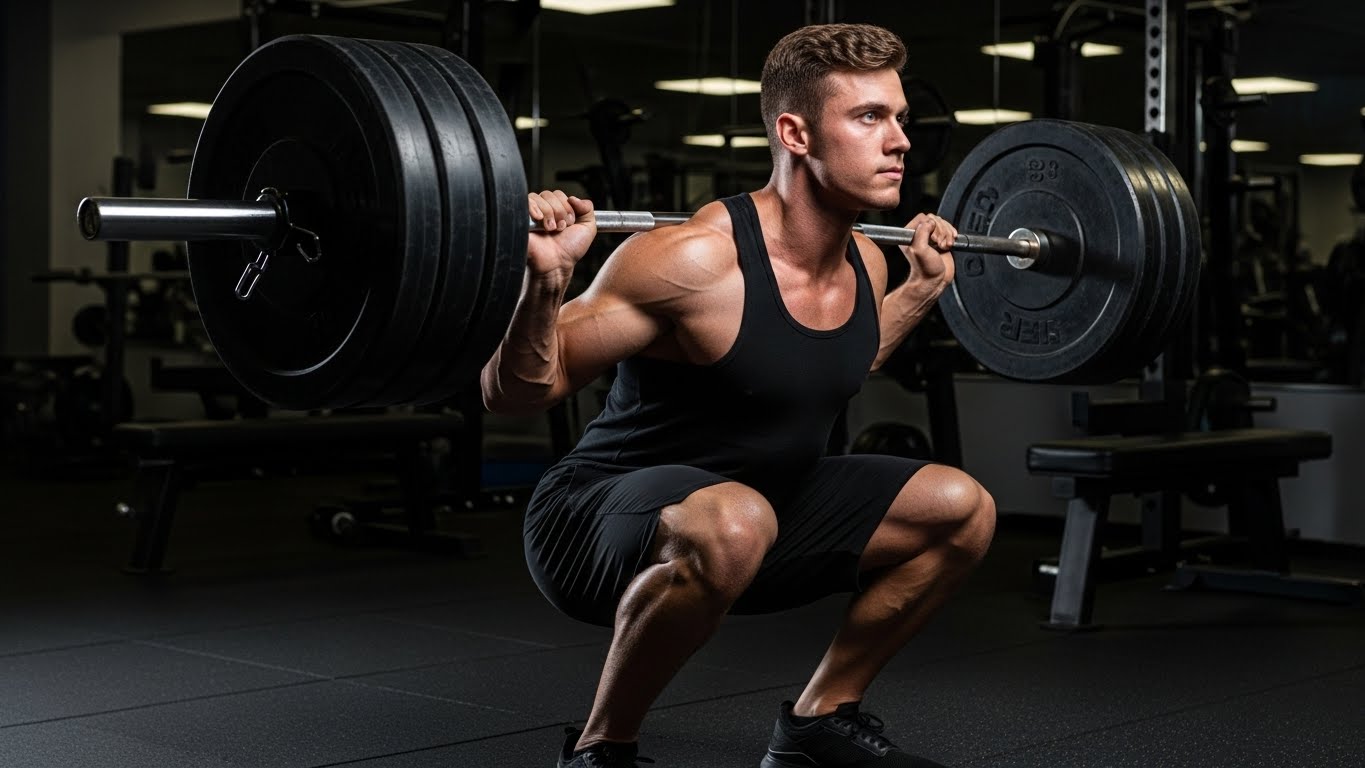
Building massive legs is one of the most challenging goals in fitness. I spent years training my upper body while neglecting leg day, and the results showed.
The best workout for big legs combines heavy compound movements like barbell squats and Romanian deadlifts with targeted isolation exercises for quads, hamstrings, and calves.
After testing dozens of leg programs and studying what actually works, I’ve put together this comprehensive guide. You’ll learn the 10 best exercises for building bigger legs, get a ready-to-use workout routine, and discover the training principles that separate those with impressive legs from everyone else.
Whether you’re starting from scratch or breaking through a plateau, this ultimate big legs workout will help you build the lower body you want.
ContentsTable of Contents
- 1Why You Need to Train Your Legs?→
- 2Leg Muscles: Know What You’re Training→
- 3Quadriceps (Front of Thigh)→
- 4Hamstrings (Back of Thigh)→
- 5Glutes (Buttocks)→
- 6Calves (Lower Leg)→
- 7The 10 Best Leg Exercises for Building Bigger Legs→
- 81. Barbell Back Squat→
- 92. Romanian Deadlift (RDL)→
- 103. Leg Press→
- 114. Walking Lunges→
- 125. Bulgarian Split Squat→
- 136. Hack Squat→
- 147. Leg Extension→
- 158. Leg Curl→
- 169. Hip Thrust→
- 1710. Standing Calf Raise→
- 18The Big Legs Workout Routine: Day A and Day B Split→
- 19Day A: Quad-Focused Workout→
- 20Day B: Hamstring and Glute-Focused Workout→
- 21Progressive Overload Strategy→
- 225 Tips for Maximum Leg Growth→
- 231. Prioritize Progressive Overload→
- 242. Train Legs Twice Per Week→
- 253. Use a Mix of Rep Ranges→
- 264. Focus on Mind-Muscle Connection→
- 275. Take Your Sets Close to Failure→
- 28Common Leg Day Mistakes to Avoid→
- 29Frequently Asked Questions→
- 30What is the best workout for big legs?→
- 31How can I bulk up my legs fast?→
- 32How long does it take to build big legs?→
- 33Is training legs 2x a week too much?→
- 34What is the 3-3-3 rule in gym?→
- 35What is the 6-12-25 rule?→
- 36Will 100 squats a day grow my legs?→
- 37How many leg exercises should I do?→
- 38Build Bigger Legs Starting Today→
Why You Need to Train Your Legs?
Training legs isn’t optional if you want a balanced, powerful physique. Your legs contain the largest muscles in your body, and neglecting them creates obvious imbalances.
Here’s why leg training matters:
- Hormonal response: Heavy leg exercises like squats and deadlifts trigger significant testosterone and growth hormone release, benefiting muscle growth throughout your entire body
- Functional strength: Strong legs improve athletic performance, everyday activities, and reduce injury risk
- Metabolic boost: Leg muscles burn more calories at rest than smaller muscle groups, supporting fat loss goals
- Aesthetic balance: A well-developed upper body on chicken legs looks unbalanced and signals incomplete training
The hormonal benefits alone make leg training essential. Research shows that compound leg exercises produce a greater anabolic response than upper body movements of similar intensity.
Your legs are the foundation of your physique. Skip them, and you’re leaving significant gains on the table.
Leg Muscles: Know What You’re Training
Understanding your leg anatomy helps you select exercises that target each muscle group effectively. Your legs consist of four major muscle groups that require different movements to develop fully.
Quadriceps (Front of Thigh)
The quadriceps consist of four muscles on the front of your thigh: rectus femoris, vastus lateralis, vastus medialis, and vastus intermedius. They’re responsible for knee extension and are the primary muscles worked during squats, leg presses, and leg extensions.
Hamstrings (Back of Thigh)
Your hamstrings include the biceps femoris, semitendinosus, and semimembranosus. They handle knee flexion and hip extension. Romanian deadlifts, leg curls, and hip hinges target these muscles.
Glutes (Buttocks)
The gluteus maximus is the largest muscle in your body. It handles hip extension and external rotation. Squats, hip thrusts, and lunges all engage your glutes heavily.
Calves (Lower Leg)
Your calves consist of the gastrocnemius and soleus muscles. The gastrocnemius is the larger, visible muscle targeted with straight-leg calf raises. The soleus sits beneath and responds better to bent-knee calf work.
| Muscle Group | Primary Function | Best Exercises |
|---|---|---|
| Quadriceps | Knee extension | Squats, leg press, leg extension |
| Hamstrings | Knee flexion, hip extension | Romanian deadlift, leg curl |
| Glutes | Hip extension | Hip thrust, squats, lunges |
| Calves | Ankle plantarflexion | Standing and seated calf raises |
The 10 Best Leg Exercises for Building Bigger Legs
The best leg exercises for building bigger legs are:
- Barbell Back Squat – targets quads, glutes, hamstrings
- Romanian Deadlift – targets hamstrings, glutes
- Leg Press – targets quads, glutes
- Walking Lunges – targets quads, glutes, hamstrings
- Bulgarian Split Squat – targets quads, glutes
- Hack Squat – targets quadriceps
- Leg Extension – isolates quadriceps
- Leg Curl – isolates hamstrings
- Hip Thrust – targets glutes
- Standing Calf Raise – targets calves
Here’s how to perform each exercise with proper form for maximum muscle growth.
1. Barbell Back Squat
Muscles targeted: Quadriceps, glutes, hamstrings, core
The barbell back squat is the king of leg exercises. No other movement loads your entire lower body as effectively while also demanding core stability and overall strength.
How to perform:
- Set the bar at upper chest height in a squat rack
- Step under the bar and position it across your upper traps (high bar) or rear delts (low bar)
- Grip the bar wider than shoulder width and unrack by standing up
- Take 2-3 steps back and set your feet shoulder-width apart, toes slightly pointed out
- Brace your core, keep your chest up, and begin the descent by pushing your hips back and bending your knees
- Descend until your hip crease drops below your knee (parallel or below)
- Drive through your whole foot to stand back up, squeezing your glutes at the top
Pro Tip: Focus on pushing the floor away rather than lifting the weight up. This mental cue helps maintain proper form and keeps tension on your legs rather than your lower back.
Common mistakes: Letting knees cave inward, rising onto toes, rounding lower back, cutting depth short.
2. Romanian Deadlift (RDL)
Muscles targeted: Hamstrings, glutes, lower back
The Romanian deadlift is the best exercise for hamstring development. It emphasizes the eccentric (lowering) phase, creating significant muscle damage that drives hypertrophy.
How to perform:
- Stand with feet hip-width apart, holding a barbell with an overhand grip
- Keep a slight bend in your knees throughout the movement
- Hinge at your hips by pushing them backward while keeping your back flat
- Lower the bar along your thighs until you feel a strong stretch in your hamstrings
- Drive your hips forward to return to standing, squeezing your glutes at the top
Mind-Muscle Tip: Think about pushing your hips back to a wall behind you. Keep the bar close to your body throughout the movement to maximize hamstring engagement.
Common mistakes: Rounding the lower back, bending knees too much, letting the bar drift away from the body.
3. Leg Press
Muscles targeted: Quadriceps, glutes, hamstrings
The leg press allows you to move heavy weight safely without the stability demands of squats. It’s excellent for adding volume when your lower back is fatigued from compounds.
How to perform:
- Sit in the leg press machine with your back flat against the pad
- Place feet shoulder-width apart on the platform, positioned in the middle
- Release the safety handles and lower the platform by bending your knees
- Descend until your knees reach 90 degrees or slightly below
- Press through your whole foot to extend your legs without locking your knees
Foot placement variations: Higher placement emphasizes glutes and hamstrings. Lower placement targets quads more. Wider stance hits inner thighs (adductors).
Common mistakes: Lifting hips off the seat at the bottom, locking knees at the top, using too much weight with limited range of motion.
4. Walking Lunges
Muscles targeted: Quadriceps, glutes, hamstrings
Walking lunges develop unilateral leg strength and balance while providing an excellent metabolic stimulus. They’re particularly effective for glute development.
How to perform:
- Stand upright holding dumbbells at your sides or a barbell across your back
- Take a large step forward with your right leg
- Lower your body until your right thigh is parallel to the ground and your left knee nearly touches the floor
- Push through your right heel to step forward, bringing your left foot to meet it or directly into the next lunge
- Continue alternating legs for the desired distance or reps
Common mistakes: Taking too short of steps, letting the front knee travel too far forward, rushing through reps.
5. Bulgarian Split Squat
Muscles targeted: Quadriceps, glutes, hamstrings
The Bulgarian split squat is one of the most challenging leg exercises. It develops single-leg strength, improves balance, and addresses muscle imbalances between legs.
How to perform:
- Stand about 2 feet in front of a bench with your back to it
- Place the top of your rear foot on the bench behind you
- Hold dumbbells at your sides or a barbell across your back
- Lower your body by bending your front knee until your thigh is parallel to the ground
- Keep your torso upright and front knee tracking over your toes
- Push through your front heel to return to the starting position
Mind-Muscle Tip: Lean your torso slightly forward to increase glute activation, or stay more upright to emphasize your quads.
Common mistakes: Standing too close to the bench, letting the front knee cave inward, rushing the eccentric phase.
6. Hack Squat
Muscles targeted: Quadriceps
The hack squat machine allows you to target your quads with minimal lower back stress. It’s excellent for adding quad volume after heavy barbell squats.
How to perform:
- Position yourself in the machine with your back against the pad and shoulders under the shoulder pads
- Place feet shoulder-width apart on the platform
- Release the safety handles and lower the weight by bending your knees
- Descend until your thighs are parallel to the platform or slightly below
- Press through your feet to extend your legs without locking your knees
Common mistakes: Placing feet too high on the platform, using excessive weight with partial range of motion.
7. Leg Extension
Muscles targeted: Quadriceps (isolation)
Leg extensions isolate your quadriceps completely. They’re perfect for adding targeted quad volume and achieving a strong muscle pump.
How to perform:
- Sit in the machine with your back against the pad and ankles behind the lower roller
- Adjust the machine so your knees align with the pivot point
- Grip the handles and extend your legs by straightening your knees
- Pause briefly at the top with your quads fully contracted
- Lower the weight under control to the starting position
Mind-Muscle Tip: Point your toes slightly upward at the top of the movement to maximize quad contraction. Use a slow 3-second eccentric for enhanced time under tension.
Common mistakes: Using momentum, not achieving full extension, lifting your hips off the seat.
8. Leg Curl
Muscles targeted: Hamstrings (isolation)
Leg curls isolate your hamstrings for targeted development. They complement hip hinge movements like Romanian deadlifts for complete hamstring training.
How to perform:
- Lie face down on the machine (lying leg curl) or sit with legs extended (seated leg curl)
- Position the pad just above your heels
- Curl your legs by bending your knees, bringing the pad toward your glutes
- Squeeze your hamstrings at the top of the movement
- Lower under control to the starting position
Common mistakes: Lifting hips during the movement, using excessive momentum, not achieving full range of motion.
9. Hip Thrust
Muscles targeted: Glutes, hamstrings
The hip thrust is the most effective exercise for glute development. It allows maximum glute activation at full hip extension, which squats and deadlifts can’t achieve.
How to perform:
- Sit on the ground with a bench behind you and a barbell over your hips (use a pad for comfort)
- Lean your upper back against the bench with your shoulder blades on the edge
- Plant your feet flat on the ground, about shoulder-width apart
- Drive through your heels to lift your hips until your body forms a straight line from knees to shoulders
- Squeeze your glutes hard at the top for a 1-2 second hold
- Lower your hips back down under control
Common mistakes: Hyperextending the lower back, not achieving full hip extension, poor foot placement.
10. Standing Calf Raise
Muscles targeted: Gastrocnemius, soleus
Standing calf raises target the gastrocnemius, the larger, visible calf muscle. Consistent calf training is often neglected but essential for complete leg development.
How to perform:
- Stand on a calf raise machine or a raised platform with the balls of your feet on the edge
- Lower your heels below the platform level to achieve a full stretch
- Rise onto your toes as high as possible, squeezing your calves at the top
- Hold the contracted position for 1-2 seconds
- Lower under control to the stretched position
Pro Tip: Calves respond well to higher rep ranges (15-25 reps) and frequent training. Consider training them 3-4 times per week for optimal growth.
Common mistakes: Bouncing at the bottom, not achieving full range of motion, using too much weight.
The Big Legs Workout Routine: Day A and Day B Split
Training legs twice per week allows you to spread volume across sessions for better recovery and growth. Research supports training each muscle group at least twice weekly for optimal hypertrophy.
Here’s a ready-to-use leg workout split:
Day A: Quad-Focused Workout
| Exercise | Sets | Reps | Rest |
|---|---|---|---|
| Barbell Back Squat | 4 | 6-8 | 3 min |
| Leg Press | 3 | 10-12 | 2 min |
| Hack Squat | 3 | 10-12 | 2 min |
| Leg Extension | 3 | 12-15 | 90 sec |
| Standing Calf Raise | 4 | 15-20 | 60 sec |
Day B: Hamstring and Glute-Focused Workout
| Exercise | Sets | Reps | Rest |
|---|---|---|---|
| Romanian Deadlift | 4 | 8-10 | 3 min |
| Bulgarian Split Squat | 3 | 10-12 each leg | 2 min |
| Hip Thrust | 3 | 10-12 | 2 min |
| Leg Curl | 3 | 12-15 | 90 sec |
| Walking Lunges | 2 | 12 each leg | 90 sec |
| Seated Calf Raise | 3 | 15-20 | 60 sec |
Schedule suggestion: Train Day A on Monday, Day B on Thursday or Friday, allowing 3-4 days between leg sessions.
Progressive Overload Strategy
To build bigger legs, you must progressively increase demands on your muscles. Use this simple progression scheme:
- Start at the lower end of the rep range with a challenging weight
- Add 1-2 reps each workout until you hit the top of the rep range
- Increase weight by 5-10 pounds and restart at the lower rep range
- Track every workout in a training log
5 Tips for Maximum Leg Growth
Based on research and real-world experience from lifters who’ve successfully built impressive legs, here are the key principles that drive results.
1. Prioritize Progressive Overload
Adding weight to the bar over time is the single most important factor for muscle growth. If you’re not getting stronger, you’re not getting bigger.
Track your lifts and aim to add weight or reps each session.
2. Train Legs Twice Per Week
Research consistently shows that training muscle groups twice weekly produces better hypertrophy than once weekly at equal volume. Splitting your leg volume across two sessions allows for better performance and recovery.
3. Use a Mix of Rep Ranges
Combine heavy compounds (5-8 reps) with moderate rep work (8-12 reps) and higher rep isolation exercises (12-15 reps). This approach stimulates different muscle fiber types and growth mechanisms.
4. Focus on Mind-Muscle Connection
Feeling the target muscle working matters. Slow down your reps, especially on isolation exercises, and consciously squeeze the muscle you’re training. Many lifters who struggle with leg growth simply don’t engage their legs properly.
5. Take Your Sets Close to Failure
Stopping 2-3 reps short of failure on compounds and 1-2 reps short on isolation exercises provides sufficient stimulus for growth while allowing recovery. Going to complete failure on every set can impair recovery and subsequent performance.
Common Leg Day Mistakes to Avoid
Based on forum discussions and common training errors, here are the mistakes that prevent leg growth:
- Ego lifting with bad form: Using too much weight and cutting range of motion short. Full range of motion with moderate weight builds more muscle than partial reps with heavy weight.
- Neglecting hamstrings and glutes: Many lifters focus only on quads. Balanced development requires direct hamstring and glute work.
- Skipping the tough exercises: Avoiding squats, lunges, and other challenging movements in favor of easier machine work limits your potential.
- Insufficient training frequency: Training legs once per week may not provide enough stimulus for optimal growth.
- Ignoring nutrition: Building bigger legs requires a caloric surplus and adequate protein (0.7-1g per pound of bodyweight daily).
- Not tracking progress: Without a training log, you can’t ensure you’re progressing over time.
Frequently Asked Questions
What is the best workout for big legs?
The best workout for big legs combines heavy compound movements (squats, Romanian deadlifts, leg press) with targeted isolation exercises (leg extensions, leg curls, calf raises). Training legs twice per week with 10-20 sets per muscle group weekly produces optimal hypertrophy for most lifters.
How can I bulk up my legs fast?
To bulk up your legs quickly, prioritize compound movements with progressive overload, train legs twice weekly, eat in a caloric surplus with adequate protein (0.7-1g per pound bodyweight), and ensure proper recovery with 7-9 hours of sleep. Consistency over 3-6 months yields noticeable results.
How long does it take to build big legs?
Building noticeably bigger legs typically takes 3-6 months of consistent training for beginners and 6-12 months for intermediate lifters. Genetics, training intensity, nutrition, and recovery all influence the timeline. Most people can expect to add 1-2 inches to their thighs within the first year of dedicated training.
Is training legs 2x a week too much?
Training legs twice per week is not too much – it’s actually optimal for most people. Research shows that hitting each muscle group twice weekly produces better muscle growth than once weekly when total volume is equal. Just ensure adequate recovery (48-72 hours) between leg sessions.
What is the 3-3-3 rule in gym?
The 3-3-3 rule refers to performing 3 sets of 3 reps with 3 minutes rest between sets. It’s a strength-focused protocol designed for building maximal strength with heavy weights. For hypertrophy (muscle size), higher rep ranges (6-15 reps) are generally more effective.
What is the 6-12-25 rule?
The 6-12-25 method is a giant set protocol where you perform 6 reps of a heavy compound exercise, immediately followed by 12 reps of a moderate exercise, then 25 reps of an isolation exercise. For legs, this might be squats (6), leg press (12), leg extensions (25) with no rest between exercises.
Will 100 squats a day grow my legs?
Doing 100 bodyweight squats daily may improve endurance and conditioning but is unlikely to build significant muscle mass. Muscle growth requires progressive overload with challenging resistance. Once bodyweight squats become easy, you need added weight to continue stimulating growth.
How many leg exercises should I do?
Most people should perform 4-6 leg exercises per workout. This typically includes 2-3 compound movements (squats, deadlifts, lunges) and 2-3 isolation exercises (leg extensions, leg curls, calf raises). Total weekly sets of 10-20 per muscle group is the research-supported range for hypertrophy.
Build Bigger Legs Starting Today
Building impressive legs comes down to consistent effort, progressive overload, and proper exercise selection. The workout routine and exercises outlined in this guide provide everything you need to start building bigger, stronger legs.
Pick your first leg day workout above, track your weights and reps, and commit to showing up twice per week. Your future self will thank you for not skipping leg day.