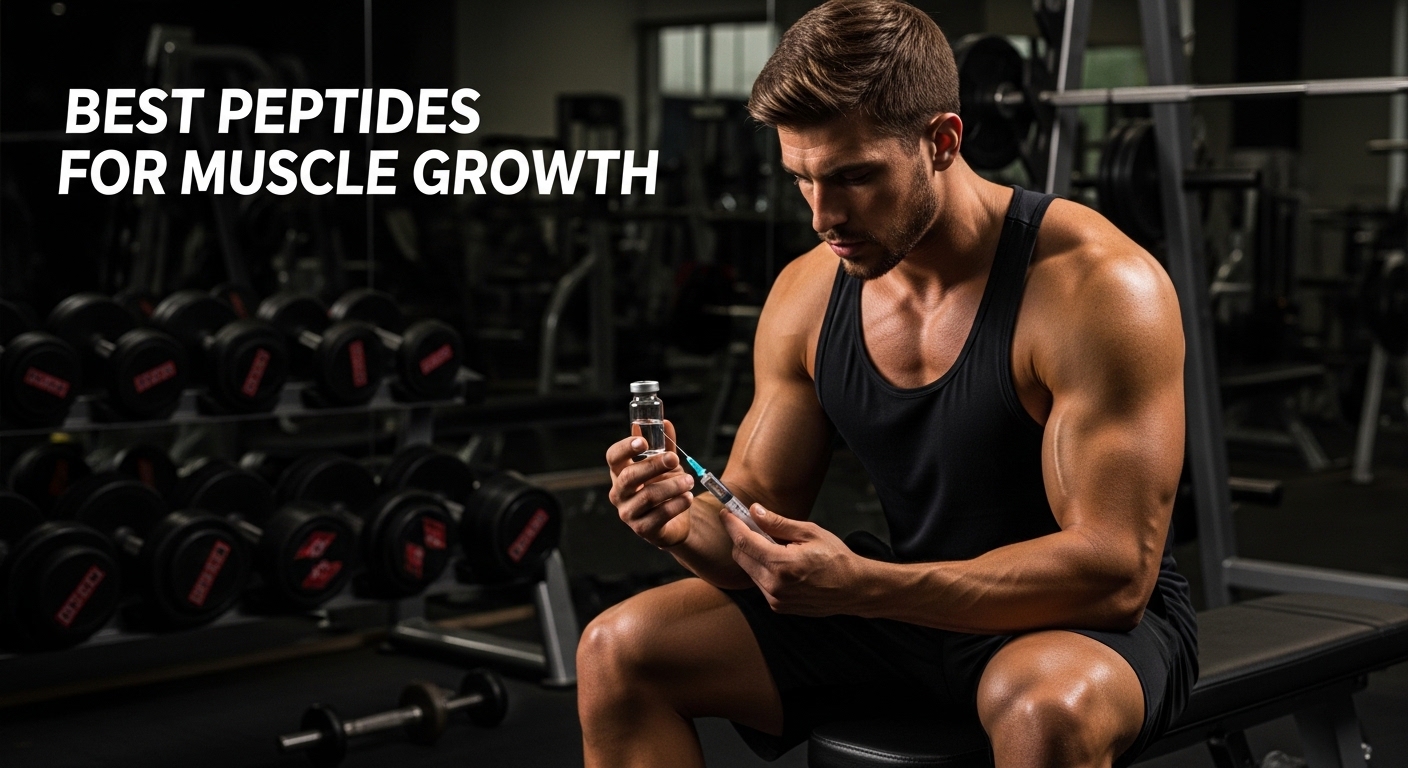
After spending 18 months researching peptide therapy and testing protocols with two different telehealth clinics, I can tell you this: the best peptides for muscle growth work differently than most people expect.
The most effective peptides for muscle growth in 2026 are: 1) CJC-1295 + Ipamorelin (best overall), 2) Tesamorelin (body recomposition), 3) Sermorelin (long-term GH support), 4) BPC-157 (recovery), 5) TB-500 (tissue repair), 6) MK-677 (oral option), 7) IGF-1 LR3 (advanced users), and 8) Collagen peptides (tested athletes).
These growth hormone secretagogues stimulate your pituitary gland to release more natural growth hormone, supporting muscle protein synthesis, recovery, and fat loss.
But here’s what most articles won’t tell you: peptides are optimizers, not magic solutions. Based on forum discussions and real user experiences, you should expect a minimum of 6 months before seeing significant results. In this guide, I’ll break down each peptide’s mechanism, dosing, side effects, and whether it’s worth your money.
ContentsTable of Contents
- 1What Are Peptides for Muscle Growth?→
- 2How Do Peptides Build Muscle?→
- 3Peptides vs Steroids: Key Differences→
- 48 Best Peptides for Muscle Growth in 2026→
- 51. CJC-1295 + Ipamorelin – Best Overall for Muscle Growth→
- 62. Tesamorelin – Best for Body Recomposition→
- 73. Sermorelin – Best for Long-Term GH Support→
- 84. BPC-157 – Best for Injury Recovery→
- 95. TB-500 (Thymosin Beta-4 Fragment) – Best for Tissue Repair and Flexibility→
- 106. MK-677 (Ibutamoren) – Best Oral Option→
- 117. IGF-1 LR3 – Most Potent (Advanced Users Only)→
- 128. Collagen Peptides – Best for Tested Athletes→
- 13Where to Get Peptides: Provider Comparison→
- 14Wellcore – Best for Comprehensive Peptide Therapy→
- 15Wellcore→
- 16Pros→
- 17Cons→
- 18Hone Health – Best for Comprehensive Men’s Health→
- 19Hone Health→
- 20Pros→
- 21Cons→
- 22Safety, Side Effects, and Legal Status→
- 23Common Side Effects→
- 24WADA and Drug Testing Status→
- 25FDA Status→
- 26Medical Supervision Is Essential→
- 27Who Should Consider Peptides for Muscle Growth?→
- 28Ideal Candidates→
- 29Skip Peptides If→
- 30What Results to Expect (And When)→
- 31Frequently Asked Questions→
- 32What is the most effective peptide for muscle growth?→
- 33Do peptides really work to build muscle?→
- 34Does BPC-157 build muscle?→
- 35Are peptides steroids?→
- 36Are peptides legal?→
- 37How quickly do peptides work?→
- 38What peptide does Joe Rogan take?→
- 39Can I use peptides without working out?→
- 40Final Verdict: Are Peptides Worth It for Muscle Growth?→
What Are Peptides for Muscle Growth?
Peptides: Short chains of amino acids (typically 2-50) that act as signaling molecules in the body. For muscle growth, specific peptides called growth hormone secretagogues (GHS) stimulate natural growth hormone production.
Peptides for muscle growth belong primarily to a category called growth hormone secretagogues (GHS). These compounds signal your pituitary gland to produce and release more human growth hormone (HGH) naturally.
Unlike synthetic HGH injections that flood your body with external hormones, GHS peptides work with your natural production system. This approach may reduce some risks associated with exogenous hormone replacement.
There are two main types of GHS peptides:
- GHRH Analogs: Growth hormone-releasing hormone mimics (Sermorelin, Tesamorelin, CJC-1295) that tell your pituitary to produce more GH
- Ghrelin Mimetics: Peptides that mimic the hunger hormone ghrelin (Ipamorelin, MK-677) to trigger GH pulses
The most effective protocols often combine both types. For example, CJC-1295 (GHRH analog) paired with Ipamorelin (ghrelin mimetic) provides both sustained and pulsatile GH release.
Beyond GHS peptides, tissue repair peptides like BPC-157 and TB-500 support muscle growth indirectly by accelerating recovery from training and injury.
How Do Peptides Build Muscle?
Growth hormone secretagogue peptides work through the HGH-IGF-1 pathway, which is one of the body’s primary anabolic systems.
Here’s the mechanism in simple terms:
- Peptide Administration: You inject the peptide subcutaneously (under the skin)
- Pituitary Stimulation: The peptide signals your pituitary gland to release stored growth hormone
- GH Release: Growth hormone enters your bloodstream
- IGF-1 Production: Your liver converts GH into insulin-like growth factor-1 (IGF-1)
- Muscle Effects: IGF-1 promotes muscle protein synthesis, reduces muscle breakdown, and supports tissue repair
This cascade affects muscle growth in several ways. IGF-1 activates satellite cells that repair and build muscle fibers after training. It also increases nitrogen retention, which is essential for an anabolic (muscle-building) state.
Peptides vs Steroids: Key Differences
Many people confuse peptides with anabolic steroids, but they work completely differently.
| Factor | Peptides (GHS) | Anabolic Steroids |
|---|---|---|
| Mechanism | Stimulate natural hormone production | Introduce synthetic hormones directly |
| Muscle Gains | Moderate, gradual improvements | Rapid, dramatic increases |
| Recovery Time | Improved | Improved |
| Side Effects | Generally milder | Can be severe (liver, heart, hormonal) |
| Natural Production | Supports natural GH | Suppresses natural testosterone |
| Legal Status | Prescription required; WADA banned | Controlled substance; illegal without Rx |
| Results Timeline | 3-6+ months | Weeks to months |
The bottom line: peptides are not steroids. They offer more modest results with a potentially better safety profile, but they require patience and realistic expectations.
8 Best Peptides for Muscle Growth in 2026
Based on research, clinical evidence, and real user experiences, here are the most effective peptides for building muscle, ranked by overall effectiveness and safety.
| Peptide | Best For | Administration | Safety Rating | WADA Status |
|---|---|---|---|---|
| CJC-1295 + Ipamorelin | Maximum muscle growth | Subcutaneous injection | 3/5 | Prohibited |
| Tesamorelin | Body recomposition | Subcutaneous injection | 4/5 | Prohibited |
| Sermorelin | Long-term GH support | Subcutaneous injection | 4/5 | Prohibited |
| BPC-157 | Injury recovery | Injection or oral | 3/5 | Prohibited |
| TB-500 | Tissue repair | Subcutaneous injection | 4/5 | Prohibited |
| MK-677 | Oral administration | Oral capsule | 2/5 | Prohibited |
| IGF-1 LR3 | Maximum anabolic effect | Subcutaneous injection | 2/5 | Prohibited |
| Collagen Peptides | Tested athletes, OTC option | Oral powder/capsules | 5/5 | NOT Prohibited |
1. CJC-1295 + Ipamorelin – Best Overall for Muscle Growth
The CJC-1295 and Ipamorelin combination is widely considered the gold standard for muscle-building peptide therapy. This stack provides both sustained and pulsatile growth hormone release, mimicking your body’s natural GH secretion pattern more closely than any single peptide.
How It Works: CJC-1295 is a GHRH analog that provides a steady baseline of GH release over several days (especially the DAC version with a 6-8 day half-life). Ipamorelin mimics ghrelin to trigger acute GH pulses without spiking cortisol or prolactin like other ghrelin mimetics.
Benefits According to Research:
- May increase lean muscle mass
- Supports fat loss, particularly visceral fat
- May improve recovery between training sessions
- Users commonly report better sleep quality
- Anti-aging effects on skin and energy levels
Typical Dosing Protocol: 100-300mcg of each peptide, administered via subcutaneous injection 5 days per week. Most protocols suggest injecting before bed to align with natural GH pulses during sleep. Common cycling: 3 months on, 1 month off.
Potential Side Effects:
- Flu-like symptoms during initial weeks
- Water retention and bloating
- Injection site reactions
- Risk of immunogenicity with CJC-1295 (body may develop antibodies)
Important: The FDA has expressed safety concerns about CJC-1295 and has restricted its compounding in some cases. Always work with a licensed provider who can monitor your health.
Best For: Men seeking maximum muscle growth and body recomposition who are comfortable with injectable protocols.
Skip If: You want an oral option, are subject to drug testing, or have concerns about newer peptides with limited long-term data.
2. Tesamorelin – Best for Body Recomposition
Tesamorelin stands out because it’s the most studied GHRH analog, with FDA approval for treating HIV-associated lipodystrophy. This gives it stronger clinical evidence than most muscle-growth peptides.
How It Works: Tesamorelin is a synthetic GHRH that stimulates the pituitary to produce growth hormone. Clinical trials have specifically demonstrated its effectiveness for reducing visceral (abdominal) fat while preserving lean muscle mass.
Benefits According to Research:
- Reduces visceral fat by 15-18% in clinical trials
- Supports lean muscle retention during fat loss
- May improve cognitive function (currently being studied)
- Better body composition without extreme measures
Typical Dosing Protocol: 1-2mg daily via subcutaneous injection, typically in the evening. Clinical trials used 2mg daily for 26 weeks.
Potential Side Effects:
- Joint pain and muscle aches
- Injection site reactions
- Peripheral edema (swelling)
- Increased blood glucose levels
Best For: Men focused on body recomposition, especially those wanting to reduce stubborn belly fat while building or maintaining muscle.
Skip If: You have diabetes or are at high risk, as tesamorelin may affect blood sugar regulation.
3. Sermorelin – Best for Long-Term GH Support
Sermorelin has the longest track record among muscle-building peptides. It was FDA-approved in 1997 for diagnosing growth hormone deficiency in children, giving it decades of safety data that newer peptides lack.
How It Works: As the shortest GHRH analog (29 amino acids matching the first 29 of natural GHRH), sermorelin stimulates natural GH production without overwhelming the system. It works with your body’s feedback mechanisms to prevent excessive GH levels.
Benefits According to Research:
- Stimulates natural GH production
- Users report improved sleep quality
- May support muscle tone and recovery
- Longer safety track record than alternatives
- Less risk of GH overdose due to natural feedback
Typical Dosing Protocol: 200-500mcg nightly via subcutaneous injection. Many providers recommend starting at 200mcg and titrating up based on response.
Potential Side Effects:
- Injection site reactions (redness, swelling)
- Headache
- Flushing
- Generally well-tolerated due to natural feedback mechanisms
Best For: Men over 40 seeking gradual, sustainable improvements in GH levels, recovery, and overall vitality with an established safety profile.
Skip If: You want rapid, dramatic results. Sermorelin works gradually over months.
4. BPC-157 – Best for Injury Recovery
BPC-157 (Body Protection Compound-157) is unique among muscle peptides because it doesn’t directly stimulate growth hormone. Instead, it accelerates tissue repair, making it valuable for recovering from training and injuries.
How It Works: BPC-157 promotes angiogenesis (new blood vessel formation), increases growth hormone receptor expression, and modulates nitric oxide synthesis. These mechanisms accelerate healing of muscles, tendons, and ligaments.
Does BPC-157 Build Muscle? Not directly. BPC-157 supports muscle growth indirectly by accelerating recovery, reducing inflammation, and potentially improving gut health (which affects nutrient absorption). It’s best viewed as a recovery enhancer rather than a muscle builder.
Benefits According to Research:
- May accelerate tendon and ligament healing
- Reduces inflammation
- Supports gut health and healing
- May protect against NSAID-induced gut damage
- Available in oral form (though injection may be more effective)
Typical Dosing Protocol: 250-500mcg daily, either via subcutaneous injection near the injury site or orally. Oral bioavailability is debated, but many users report benefits.
Potential Side Effects:
- Generally well-tolerated in studies
- Nausea (primarily with oral use)
- Not FDA-approved for human use
- Limited human clinical trial data
Best For: Athletes recovering from injuries, those with chronic joint or tendon issues, or anyone wanting to support recovery alongside GH-stimulating peptides.
Skip If: You’re looking for direct muscle-building effects. Pair with CJC-1295/Ipamorelin for a comprehensive protocol.
5. TB-500 (Thymosin Beta-4 Fragment) – Best for Tissue Repair and Flexibility
TB-500 is a synthetic fragment of Thymosin Beta-4, a naturally occurring protein that promotes cell migration and tissue repair. It’s often stacked with BPC-157 for a synergistic recovery protocol.
How It Works: TB-500 upregulates actin, a cell-building protein, and promotes angiogenesis and cell migration to injury sites. This makes it particularly effective for soft tissue injuries and maintaining flexibility.
Benefits According to Research:
- May accelerate soft tissue healing
- Reduces inflammation
- Supports joint health and flexibility
- May improve range of motion
Typical Dosing Protocol: 2-5mg weekly via subcutaneous injection, typically split into 2-3 doses. Loading phase of 4-6 weeks, then maintenance dosing.
Potential Side Effects:
- Generally well-tolerated
- Headache
- Fatigue
- Limited human research data
Best For: Athletes dealing with soft tissue injuries, those wanting to maintain mobility and flexibility, or users stacking with BPC-157 for comprehensive recovery.
6. MK-677 (Ibutamoren) – Best Oral Option
MK-677, also called Ibutamoren, is technically not a peptide but a growth hormone secretagogue that can be taken orally. It mimics ghrelin to stimulate GH release, making it appealing for those who want to avoid injections.
How It Works: MK-677 binds to ghrelin receptors, triggering GH and IGF-1 release. Unlike injectable peptides, it has a long half-life (24 hours) and maintains elevated GH levels throughout the day.
FDA Warning: In October 2023, the FDA issued a warning against MK-677 compounding due to concerns about increased heart failure hospitalizations. Some compounding pharmacies no longer offer it. Proceed with extreme caution and only under medical supervision.
Benefits According to Research:
- Oral administration (no injections)
- May increase GH and IGF-1 levels
- Users report improved sleep
- Potential muscle preservation during caloric deficit
Potential Side Effects:
- Significantly increased appetite (problematic for some)
- Water retention and bloating
- Elevated blood sugar levels
- Lethargy and fatigue
- Heart failure concerns (per FDA warning)
Best For: Those who absolutely cannot use injectable peptides and accept the higher risk profile.
Skip If: You have any cardiovascular concerns, diabetes risk, or access to injectable alternatives. The FDA warning should give serious pause.
7. IGF-1 LR3 – Most Potent (Advanced Users Only)
IGF-1 LR3 is a modified version of insulin-like growth factor-1 with an extended half-life. It bypasses the HGH pathway entirely, delivering IGF-1 directly. This makes it the most potent but also the riskiest option.
How It Works: While GHS peptides stimulate your body to produce GH (which then converts to IGF-1), IGF-1 LR3 delivers the end product directly. This provides immediate anabolic effects but bypasses natural feedback mechanisms.
Benefits According to Research:
- Direct muscle protein synthesis stimulation
- May promote muscle hyperplasia (new muscle cell creation)
- Powerful anabolic effects
Potential Side Effects:
- Hypoglycemia (low blood sugar) – potentially dangerous
- Joint pain
- Organ growth with prolonged use
- Very limited human research
- High potential for misuse and adverse effects
Typical Dosing Protocol: 20-100mcg daily via subcutaneous injection. Due to hypoglycemia risk, timing around meals is critical.
Best For: Experienced users who have already used other peptides and understand the risks. This is not a beginner peptide.
Skip If: You’re new to peptides, have blood sugar regulation issues, or prefer a more conservative approach. Most users are better served by CJC-1295/Ipamorelin.
8. Collagen Peptides – Best for Tested Athletes
Collagen peptides are the only muscle-supporting peptides that are NOT banned by WADA, making them the sole option for competitive, tested athletes. They’re also available over-the-counter without a prescription.
How It Works: Collagen peptides are broken-down collagen protein with good oral bioavailability (up to 63%). They provide amino acids that support connective tissue, joint health, and muscle mass preservation.
Benefits According to Research:
- A 2015 randomized controlled trial found 15g daily collagen peptides combined with resistance training improved muscle strength, reduced fat mass, and increased fat-free mass in elderly men with sarcopenia
- Supports joint and tendon health
- Improves skin elasticity (anti-aging benefit)
- No injection required
- Not banned by WADA
Typical Dosing Protocol: 10-15g daily in powder or capsule form, typically taken with meals.
Potential Side Effects:
- Minimal – generally very well tolerated
- Rare allergic reactions in individuals sensitive to the source (bovine, marine, etc.)
Best For: Competitive athletes subject to drug testing, beginners exploring peptides, anyone wanting a non-prescription option, or as a complement to prescription peptide therapy.
Skip If: You’re seeking maximum muscle growth results. Collagen peptides are supportive, not transformative.
Where to Get Peptides: Provider Comparison
Legitimate peptides require a prescription and should come from licensed telehealth clinics that use certified US compounding pharmacies. The gray market is risky – research-grade peptides may have purity issues and no medical oversight.
Based on my research, here are two reputable providers offering peptide therapy for muscle growth:
| # | Provider | Highlights | Price | |
|---|---|---|---|---|
| 01 | Wellcore |
|
$199-250/mo | Visit Provider → |
| 02 | Hone Health |
|
$25-149/mo membership + treatments | Visit Provider → |
We may earn a commission at no extra cost to you.
Wellcore – Best for Comprehensive Peptide Therapy
Medically-guided peptide therapy clinic offering telehealth consultations and prescription peptides for men's health optimization.
Offers both injectable and oral peptide options with US-compounded medications.
Pros
- Medical supervision throughout
- US-compounded pharmaceutical-grade peptides
- No long-term commitment
- Offers injectable and oral options
- Comprehensive peptide selection
Cons
- Requires prescription and consultation
- Some pricing only available after consultation
- Injectable options require self-administration
This post contains affiliate links. If you purchase through them, we may earn a commission (at no extra cost to you).
Wellcore specializes in peptide therapy for men’s health. They offer the key muscle-building peptides including Sermorelin (starting at $250/month), Tesamorelin (starting at $199/month), and the CJC-1295 + Ipamorelin combination.
What stands out is their comprehensive approach. You get physician-guided telehealth consultations, lab testing and monitoring, and peptides compounded in certified US pharmacies. They also offer BPC-157 in oral capsule form for those who prefer avoiding injections.
Best For: Men seeking medically-supervised peptide therapy specifically for muscle growth and anti-aging.
Skip If: You’re looking for over-the-counter options without medical oversight.
Hone Health – Best for Comprehensive Men’s Health
Comprehensive men's and women's health platform offering hormone optimization, longevity treatments, and advanced biomarker testing.
More focused on overall health optimization than peptide-specific therapy.
Pros
- Comprehensive hormone and longevity platform
- Advanced 50-biomarker lab testing
- Strong evidence-based approach
- Flexible membership tiers
- Full care team support
Cons
- Membership fee on top of medication costs
- More focused on TRT/hormones than peptides
- Limited injectable peptide options
This post contains affiliate links. If you purchase through them, we may earn a commission (at no extra cost to you).
Hone Health takes a broader approach to men’s health optimization. While they offer longevity treatments including NAD+ ($165/month + membership), they’re more focused on hormone optimization and comprehensive biomarker testing than peptide-specific therapy.
Their 50-biomarker blood testing ($65) is excellent for establishing baselines before starting any peptide protocol. Membership tiers range from $25/month (basic) to $149/month (premium with included consultations).
Best For: Men wanting comprehensive hormone optimization alongside longevity treatments, with excellent lab testing and monitoring.
Skip If: You specifically want injectable growth hormone peptides – Wellcore offers more peptide-specific options.
Safety, Side Effects, and Legal Status
Before starting peptide therapy, you need to understand the safety profile and legal considerations.
Common Side Effects
Most peptide side effects are manageable and often decrease after the first few weeks:
- Flu-like symptoms: Common during initial use, typically resolves within 1-2 weeks
- Water retention: Especially with GHS peptides, may cause temporary weight gain and bloating
- Injection site reactions: Redness, swelling, or itching at injection sites
- Headache and flushing: Particularly with GHRH analogs like Sermorelin
- Increased appetite: Notable with MK-677 and Ipamorelin
- Joint pain: May occur with Tesamorelin and higher GH levels
WADA and Drug Testing Status
All growth hormone secretagogue peptides are prohibited by the World Anti-Doping Agency (WADA). If you compete in tested sports, using these peptides could result in a ban.
The exception: Collagen peptides are NOT prohibited by WADA and are safe for competitive athletes.
FDA Status
Most muscle-growth peptides exist in a regulatory gray area:
- Tesamorelin: FDA-approved for HIV lipodystrophy; off-label for body composition
- Sermorelin: FDA-approved for pediatric GH deficiency testing; off-label for adults
- CJC-1295, Ipamorelin, BPC-157, TB-500: Not FDA-approved; available through compounding pharmacies
- MK-677: FDA has warned against compounding due to heart failure concerns
- IGF-1 LR3: Research use only; not approved for human use
Important: Compounded peptides are not FDA-approved. Always work with licensed providers who can monitor your health and adjust protocols based on lab work and symptoms.
Medical Supervision Is Essential
I can’t stress this enough: peptide therapy should only be done under medical supervision. A qualified provider will:
- Review your health history and contraindications
- Order baseline and follow-up lab work
- Prescribe appropriate dosing protocols
- Monitor for side effects and adjust as needed
- Ensure you receive pharmaceutical-grade peptides from certified pharmacies
Avoid research-grade peptides from unregulated sources. Purity issues are common, and you have no medical support if something goes wrong.
Who Should Consider Peptides for Muscle Growth?
Peptides for muscle growth are not for everyone. Based on research and real user experiences, here’s who may benefit most:
Ideal Candidates
- Men over 30-40: Natural GH production declines 3-8% per decade after age 30. Peptides may help restore optimal levels.
- Those experiencing age-related muscle loss: If you’re training consistently but losing muscle despite good nutrition, declining GH may be a factor.
- Athletes focused on recovery: BPC-157 and TB-500 may accelerate healing from training and injuries.
- Bodybuilders seeking an edge: Peptides won’t replace training and nutrition, but may optimize results for those with everything else dialed in.
- Biohackers and longevity seekers: GH optimization has implications beyond muscle for sleep, skin, cognition, and overall vitality.
Skip Peptides If
- You’re not training consistently: Peptides are optimizers. Without progressive resistance training, results will be minimal.
- Your nutrition isn’t dialed in: No peptide compensates for inadequate protein intake or chronic caloric deficit.
- You expect steroid-like results: Peptides provide gradual, modest improvements. If you want dramatic transformation, they’ll disappoint.
- You compete in tested sports: Most peptides are WADA-prohibited (collagen peptides excepted).
- You have diabetes or cancer history: GH-elevating peptides may be contraindicated.
- You’re under 25: Natural GH production is still high; peptides are unlikely to provide benefit.
What Results to Expect (And When)
One of the biggest disappointments with peptides comes from unrealistic expectations. Based on forum discussions and real user experiences, here’s an honest timeline:
| Timeframe | What to Expect |
|---|---|
| Weeks 1-4 | Improved sleep quality, potential side effects settling, possible water retention |
| Weeks 4-8 | Better recovery between workouts, improved energy, potential fat loss beginning |
| Months 2-4 | Noticeable body composition changes, improved workout performance |
| Months 4-6 | Visible muscle tone improvements, continued fat loss, strength gains |
| Months 6+ | Cumulative effects become significant, skin improvements, anti-aging benefits |
Reality Check: According to experienced users on forums like r/Biohackers and ExcelMale, “9-11 weeks is not enough time to get much results from peptides. You need a minimum of 6 months.” Commit to the long game or save your money.
Also remember: peptides are optimizers that work best when stacked with proper training, nutrition, and recovery. Users who expect peptides alone to transform their physique are consistently disappointed.
Frequently Asked Questions
What is the most effective peptide for muscle growth?
CJC-1295 combined with Ipamorelin is widely considered the most effective peptide combination for muscle growth. This stack provides both sustained and pulsatile growth hormone release, supporting muscle protein synthesis, recovery, and fat loss. Most protocols involve subcutaneous injections 5 days per week for 3+ months.
Do peptides really work to build muscle?
Research suggests that growth hormone secretagogue peptides may support muscle growth by stimulating natural GH and IGF-1 production. However, results are gradual and modest compared to anabolic steroids. Peptides work best when combined with consistent resistance training, adequate protein intake, and patience (6+ months of use).
Does BPC-157 build muscle?
BPC-157 does not directly build muscle like GH-stimulating peptides. Instead, it accelerates tissue repair, reduces inflammation, and supports recovery. This may indirectly support muscle growth by helping you recover faster from training and injuries. It is best used alongside GHS peptides like CJC-1295/Ipamorelin.
Are peptides steroids?
No, peptides are not steroids. Anabolic steroids are synthetic hormones that directly introduce testosterone or similar compounds into your body. Peptides are amino acid chains that stimulate your body to produce more of its own hormones naturally. Peptides offer more modest results with a potentially better safety profile.
Are peptides legal?
Peptides exist in a legal gray area. Prescription peptides from licensed telehealth clinics and US compounding pharmacies are legal with a valid prescription. However, most muscle-growth peptides are not FDA-approved for this use (they are used off-label). Research-grade peptides sold for non-human use are legal to purchase but not to inject. All GHS peptides are banned by WADA.
How quickly do peptides work?
Most users notice initial effects (improved sleep, better recovery) within 2-4 weeks. Visible body composition changes typically take 2-4 months. Significant muscle growth results require 6+ months of consistent use. Peptides work gradually – expect a slow build rather than rapid transformation.
What peptide does Joe Rogan take?
Joe Rogan has publicly discussed using BPC-157 for injury recovery. He has mentioned using it for gut health and healing from training-related injuries. BPC-157 is popular among athletes and podcasters for its tissue repair properties rather than direct muscle-building effects.
Can I use peptides without working out?
Technically yes, but results will be minimal. Peptides optimize your body’s response to training and recovery. Without resistance training to stimulate muscle protein synthesis, GH-elevating peptides provide little muscle-building benefit. You may still see some fat loss and anti-aging effects, but muscle growth requires training stimulus.
Final Verdict: Are Peptides Worth It for Muscle Growth?
After researching peptide therapy extensively and analyzing real user experiences, here’s my honest assessment:
Peptides for muscle growth are worth considering if you have realistic expectations, are committed to at least 6 months of consistent use, and have your training and nutrition already optimized. They’re not magic solutions – they’re optimizers that may provide an edge for those who’ve plateaued despite doing everything else right.
For most people, I recommend starting with the CJC-1295 + Ipamorelin combination through a reputable provider like Wellcore. Add BPC-157 if recovery is a concern. Save IGF-1 LR3 and other advanced peptides until you have experience with the basics.
And if you compete in tested sports, collagen peptides are your only safe option.
The bottom line: peptides may help, but they’re not shortcuts. Expect gradual improvements over months, not weeks – and always work with a licensed provider who can monitor your health.
Disclaimer: Compounded peptides are not FDA-approved and may not be available in all states. This article is for informational purposes only and does not constitute medical advice. Always consult a licensed healthcare provider before starting any peptide therapy or making changes to your health regimen.