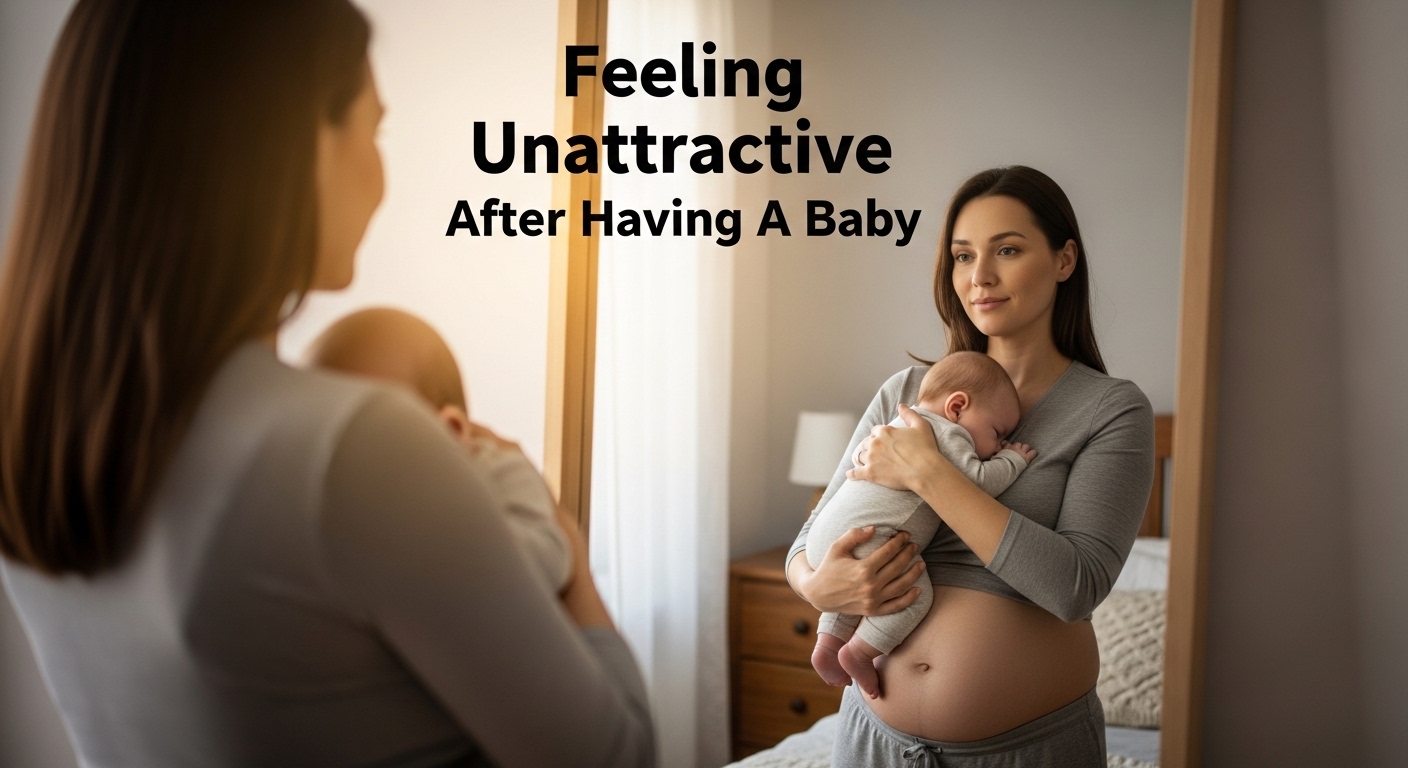
If you caught a glimpse of yourself in the mirror today and barely recognized the person staring back, you are not alone. Feeling unattractive after having a baby is one of the most common yet least talked about experiences of new motherhood.
Yes, it is completely normal to feel unattractive after having a baby. Research suggests that hormonal shifts, physical changes, sleep deprivation, and the pressure to “bounce back” create a perfect storm that affects how many new mothers see themselves. These feelings do not mean something is wrong with you. They mean you are human.
I remember scrolling through my phone at 3 AM, feeding my newborn, and coming across photos of myself from just a year before. The contrast felt crushing. If you have found yourself avoiding mirrors, dreading photos with your baby, or mourning the person you used to see in your reflection, this guide is for you.
Here, we will explore why these feelings happen, what you can realistically expect from your postpartum body, and practical strategies that have helped real moms start feeling like themselves again. Because you deserve to feel good, not despite being a mother, but as one.
ContentsTable of Contents
- 1Why You Feel This Way (And Why It Makes Complete Sense)?→
- 2Hormonal Changes Are Hijacking Your Perception→
- 3Your Identity Is Shifting→
- 4Sleep Deprivation Changes Everything→
- 5The “Bounce Back” Pressure Is Relentless→
- 6Understanding Your Postpartum Body Changes→
- 7Weight Changes Are Complex→
- 8Diastasis Recti Affects Many New Moms→
- 9Hair Loss Is Temporary But Distressing→
- 10Skin Changes Need Time→
- 1112 Ways to Start Feeling Like Yourself Again→
- 121. Buy Clothes That Fit Right Now→
- 132. Create a 5-Minute Beauty Routine→
- 143. Invest in Your Hair→
- 154. Address Your Skin→
- 165. Move Your Body Gently→
- 176. Practice Self-Compassion Daily→
- 187. Curate Your Social Media Ruthlessly→
- 198. Build Your Support System→
- 209. Communicate With Your Partner→
- 2110. Embrace Comfortable Athleisure→
- 2211. Try Positive Affirmations→
- 2312. Celebrate Small Wins→
- 24Budget-Friendly Self-Care Options→
- 25Free and Low-Cost Ideas→
- 26Worth the Investment→
- 27How Long Until You Feel Like Yourself Again?→
- 28A Realistic Timeline→
- 29When to Seek Professional Help?→
- 30Understanding Postpartum Body Dysmorphia→
- 31Postpartum Depression and Body Image→
- 32Frequently Asked Questions→
- 33Is it normal to feel unattractive after having a baby?→
- 34How long does it take to feel attractive again after giving birth?→
- 35What is postpartum body dysmorphia?→
- 36How can my partner help with my postpartum body image?→
- 37What is the 5-5-5 rule for new moms?→
- 38You Are More Than Your Reflection→
Why You Feel This Way (And Why It Makes Complete Sense)?
Understanding why you feel unattractive can help you stop blaming yourself for these emotions. Several powerful forces are working against your self-image right now, and none of them are your fault.
Hormonal Changes Are Hijacking Your Perception
After giving birth, your estrogen and progesterone levels drop dramatically. These hormonal shifts do not just affect your body. They directly impact your mood, your emotions, and how you perceive yourself when you look in the mirror.
Many mothers report feeling insecure and unattractive every time they catch their reflection, even when others tell them they look fine. This is not imagination or weakness. It is biology.
Your Identity Is Shifting
Before baby, you had routines, rituals, and ways of presenting yourself to the world that made you feel like you. Maybe it was your morning skincare routine, your workout schedule, or simply having time to choose an outfit you loved.
Now those identity markers may feel impossible to maintain. As one mom on Reddit described it, “I feel like I have been replaced by a caretaker version of myself.”
Sleep Deprivation Changes Everything
Chronic exhaustion affects your skin, your posture, the dark circles under your eyes, and your overall energy. But it also impacts your brain’s ability to process positive information about yourself.
When you are running on three hours of broken sleep, your brain literally focuses more on negatives. That harsh self-criticism in the mirror? Sleep deprivation is amplifying it.
The “Bounce Back” Pressure Is Relentless
Social media algorithms seem designed to show you celebrities in crop tops six weeks postpartum. Family members ask when you are going to “get your body back.” The message everywhere is that your current body is temporary, wrong, something to escape from as quickly as possible.
This pressure is toxic and unrealistic. Your body just did something incredible. It does not need to “bounce back.” It needs care, rest, and time.
Understanding Your Postpartum Body Changes
Knowledge can be power when it comes to accepting your postpartum body. Understanding what is happening and why can help you extend more compassion to yourself.
Weight Changes Are Complex
Many women retain 10 to 20 pounds after giving birth, and this is completely normal. Your body stored extra fat to support pregnancy and breastfeeding. Research suggests it can take 12 months or longer for your body to reach its new normal, and that normal may look different than before.
Breastfeeding, in particular, affects weight in unpredictable ways. Some women lose weight quickly while nursing. Others hold onto weight until they wean. Neither response is better or worse.
Diastasis Recti Affects Many New Moms
What is diastasis recti? Diastasis recti is a separation of the abdominal muscles that commonly occurs during pregnancy. It can make your belly look pregnant months or even years after giving birth, and it affects an estimated 60 percent of women postpartum.
This condition was one of the most mentioned concerns in postpartum forums I reviewed. Women described feeling frustrated that their belly still looked pregnant when they were not, or struggling to feel connected to their core.
The good news? Diastasis recti can often be improved with specific exercises. Physical therapists who specialize in postpartum recovery can help, and YouTube channels like Grow with Jo offer free workouts designed for this issue.
Hair Loss Is Temporary But Distressing
Around three to six months postpartum, many women experience significant hair shedding. This is called telogen effluvium, and it happens because the hair you did not shed during pregnancy all falls out at once.
Some moms lose so much hair they consider cutting it short or even shaving their heads. While this is usually temporary and resolves by 12 months, it can feel devastating when combined with other body image challenges.
Skin Changes Need Time
Stretch marks, loose skin, and changes in skin texture and tone are all common. Many women describe their skin looking dull, dry, or “old” during the postpartum period.
Hormonal fluctuations, dehydration from breastfeeding, and lack of sleep all contribute. Your skin will likely improve with time, hydration, and basic care, but it may never return to exactly how it was, and that is okay.
12 Ways to Start Feeling Like Yourself Again
These strategies come from a combination of what research suggests and what real postpartum mothers report actually helping. Not every tip will resonate with you, and that is fine. Choose what feels manageable and meaningful for your situation.
1. Buy Clothes That Fit Right Now
Stop waiting for your pre-baby clothes to fit. Wearing clothes that are too tight or that you cannot button reinforces negative body feelings every single day.
Many moms recommend thrift store shopping for this transitional period. You can find flattering pieces without spending much money on sizes you may not wear long-term. The goal is to have clothes that make you feel put together today, not clothes that remind you of a body you are mourning.
2. Create a 5-Minute Beauty Routine
You do not need an hour for self-care. Even five minutes can shift how you feel about yourself.
A simple routine might include: moisturizer, under-eye concealer, mascara, and a tinted lip balm. Add perfume if that makes you feel more like yourself. This is not about looking perfect for others. It is about reclaiming a small ritual that helps you feel human.
3. Invest in Your Hair
Forum discussions consistently mention hair as a game-changer for postpartum confidence. A new cut, a fresh color, or simply finding an easy styling routine can make a significant difference.
Practical tips from real moms include using foam hair rollers overnight for effortless volume, investing in an electric brush for quick styling, and choosing low-maintenance cuts that look good even when you cannot shower daily.
4. Address Your Skin
Postpartum skin often needs extra attention. Tretinoin, vitamin C serum, and simple hydrating products were frequently mentioned as helpful for the dull, tired skin many new moms experience.
If you are breastfeeding, check with your healthcare provider about which products are safe. Even a basic routine of gentle cleanser, moisturizer, and sunscreen can improve how your skin looks and how you feel about it.
5. Move Your Body Gently
Exercise postpartum is not about weight loss. It is about reconnecting with your body and releasing mood-boosting endorphins.
Start gentle with walking, stretching, or postpartum-specific workouts. Many women find that wearing cute workout clothes helps them feel more motivated and put-together, even if the workout is just a walk around the block with the stroller.
6. Practice Self-Compassion Daily
The way you speak to yourself matters. When you catch yourself thinking harsh thoughts, try asking: “Would I say this to my best friend if she just had a baby?”
One perspective that resonated with many mothers: “You are the butterfly and she was the caterpillar, not the other way around.” You have not deteriorated. You have transformed into someone capable of creating and sustaining life.
7. Curate Your Social Media Ruthlessly
Your algorithm is not your friend during this time. Unfollow or mute any accounts that make you feel worse about yourself. Actively seek out accounts that show realistic postpartum bodies and honest motherhood experiences.
If social media as a whole is triggering, consider taking a break. You do not owe anyone your attention, especially not accounts that profit from making you feel inadequate.
8. Build Your Support System
Isolation makes body image struggles worse. Connecting with other new moms who understand what you are going through can provide validation and perspective.
This might mean joining a local new moms group, finding an online community like Reddit’s r/beyondthebump, or simply being honest with existing friends about how you are feeling. You do not have to pretend everything is fine.
9. Communicate With Your Partner
If you have a partner, they may not understand why you are struggling with your body image. Many partners continue to find their postpartum partners attractive but do not know how to express it in helpful ways.
Be direct about what you need. Maybe it is compliments that focus on non-physical attributes. Maybe it is physical affection without pressure for intimacy. Maybe it is simply understanding when you need a few minutes alone to feel like yourself.
10. Embrace Comfortable Athleisure
There is a middle ground between pajamas and pre-baby clothes. Cute, comfortable athleisure can help you feel put-together without constricting or uncomfortable fabrics.
Many new moms find that having a few “nice” loungewear sets helps them feel less frumpy during the exhausting early months. You are not giving up on yourself by choosing comfort. You are being practical.
11. Try Positive Affirmations
This might feel awkward at first, but many women report that daily affirmations help shift their inner dialogue over time.
Examples that work for postpartum body image include:
- “My body did something incredible, and it deserves my respect.”
- “I am more than my reflection.”
- “I am allowed to take up space.”
- “My worth is not measured in pounds or stretch marks.”
12. Celebrate Small Wins
In the postpartum period, “winning” might mean you managed to shower and put your hair in a decent ponytail. That counts. Acknowledge it.
Keep your expectations realistic and celebrate what you are able to accomplish rather than focusing on what you used to do. You are in survival mode, and that is a valid place to be.
Budget-Friendly Self-Care Options
New parenthood often comes with financial stress, and expensive self-care is not accessible for everyone. Here are options that do not require significant spending.
Free and Low-Cost Ideas
- YouTube workouts: Channels like Grow with Jo offer free postpartum-friendly exercise videos, including specific routines for diastasis recti.
- Thrift store shopping: Find flattering transition clothes for a fraction of retail prices.
- DIY spa moments: A warm bath, drugstore face mask, or even just washing your face with intention can feel restorative.
- Self-tanner: An inexpensive way to address the pale, washed-out look many postpartum moms experience.
- Library resources: Many libraries offer free digital access to meditation apps, audiobooks on self-compassion, and parenting resources.
Worth the Investment
- One good haircut: A well-shaped cut can make daily styling easier for months.
- Basic skincare: Drugstore vitamin C serum and moisturizer can make a noticeable difference.
- Comfortable, flattering basics: A few pieces that fit well and make you feel good are worth prioritizing.
Remember, self-care does not have to be expensive to be effective. Sometimes the most valuable thing is giving yourself permission to take ten minutes just for you.
How Long Until You Feel Like Yourself Again?
This is one of the most common questions in postpartum forums, and the honest answer is: it varies, but it takes longer than most people expect.
A Realistic Timeline
Based on what many mothers report, here is a more realistic progression:
- 0-3 months: Survival mode. If you are showering and eating, you are succeeding.
- 3-6 months: You may start having occasional “good” days where you feel more like yourself.
- 6-12 months: Many women begin to feel more comfortable in their bodies, though challenges remain.
- 12-18 months: Energy often improves as sleep becomes more regular. More time for self-care becomes possible.
- 18-24 months: Multiple mothers in forum discussions identified this as when they finally felt “like themselves again.”
One experienced mother shared advice that resonated with many: “I did not start feeling like my old self again for the first two years. It will come.”
Give yourself permission to not be okay yet. Your timeline is your own.
When to Seek Professional Help?
While feeling unattractive after having a baby is common, sometimes these feelings are a sign of something more serious that deserves professional support.
Seek help if you experience:
- Persistent feelings of sadness, hopelessness, or emptiness lasting more than two weeks
- Inability to care for yourself or your baby
- Thoughts of harming yourself or your baby
- Intense preoccupation with perceived physical flaws that others do not notice
- Restricting food intake or other disordered eating behaviors
- Avoiding leaving the house due to how you look
- Feeling disconnected from your baby or unable to bond
Understanding Postpartum Body Dysmorphia
Body dysmorphia involves intense preoccupation with perceived flaws in your appearance that are not noticeable or seem minor to others. The postpartum period can trigger or worsen this condition.
If you spend hours examining perceived flaws, frequently seek reassurance about your appearance, or avoid social situations because of how you look, a mental health professional can help.
Postpartum Depression and Body Image
Postpartum depression affects approximately 1 in 7 new mothers, and negative body image is often one component. If your feelings about your appearance are accompanied by other symptoms like persistent sadness, anxiety, or difficulty functioning, please reach out for help.
Your healthcare provider, a postpartum therapist, or a crisis helpline can connect you with appropriate support. The Postpartum Support International helpline (1-800-944-4773) is available if you need to talk to someone.
Frequently Asked Questions
Is it normal to feel unattractive after having a baby?
Yes, it is completely normal. Hormonal changes, physical transformations, sleep deprivation, and the pressure to bounce back all contribute to negative body image after childbirth. Research suggests that a majority of new mothers experience some degree of body dissatisfaction postpartum. These feelings do not reflect reality or your worth as a person.
How long does it take to feel attractive again after giving birth?
Most mothers report that it takes 12 to 24 months to feel like themselves again. The early months are survival mode, and gradual improvement typically happens between 6 and 18 months postpartum. Many experienced mothers identify the two-year mark as when they finally felt comfortable in their new body. Your timeline may be shorter or longer, and both are valid.
What is postpartum body dysmorphia?
Postpartum body dysmorphia is characterized by intense preoccupation with perceived physical flaws that are not noticeable to others. After giving birth, physical changes like weight gain, stretch marks, and loose skin can trigger or worsen this condition. If you spend excessive time examining perceived flaws or avoid social situations due to appearance concerns, consider speaking with a mental health professional.
How can my partner help with my postpartum body image?
Partners can help by offering genuine compliments, providing physical affection without pressure for intimacy, taking on household tasks so you have time for self-care, and simply listening without trying to fix everything. Direct communication about what you need is important. Some women want reassurance about their appearance while others prefer support that focuses on their overall well-being.
What is the 5-5-5 rule for new moms?
The 5-5-5 rule is a postpartum recovery guideline for the first 15 days after birth. It suggests spending 5 days in bed, 5 days on the bed with light movement, and 5 days near the bed with short walks while resting frequently. This approach prioritizes rest and healing over rushing back to normal activity, supporting both physical recovery and mental well-being.
You Are More Than Your Reflection
Feeling unattractive after having a baby is painful, isolating, and more common than anyone talks about. But these feelings are not permanent, and they are not the whole truth about who you are.
Your body carried and birthed a new human being. It continues to function, even exhausted, even changed, even when you cannot see its beauty through tired eyes. The woman in the mirror is not a lesser version of who you were. She is someone who did something extraordinary.
Be patient with yourself. Take whatever small steps feel manageable. Reach out when you need help. And know that countless other mothers understand exactly what you are going through.
The day will come when you catch your reflection and feel something other than disappointment. Until then, be gentle with yourself. You deserve it.
Disclaimer: This content is for informational purposes only and does not constitute medical or mental health advice. If you are struggling with postpartum depression, anxiety, or thoughts of self-harm, please contact your healthcare provider or call the Postpartum Support International helpline at 1-800-944-4773.