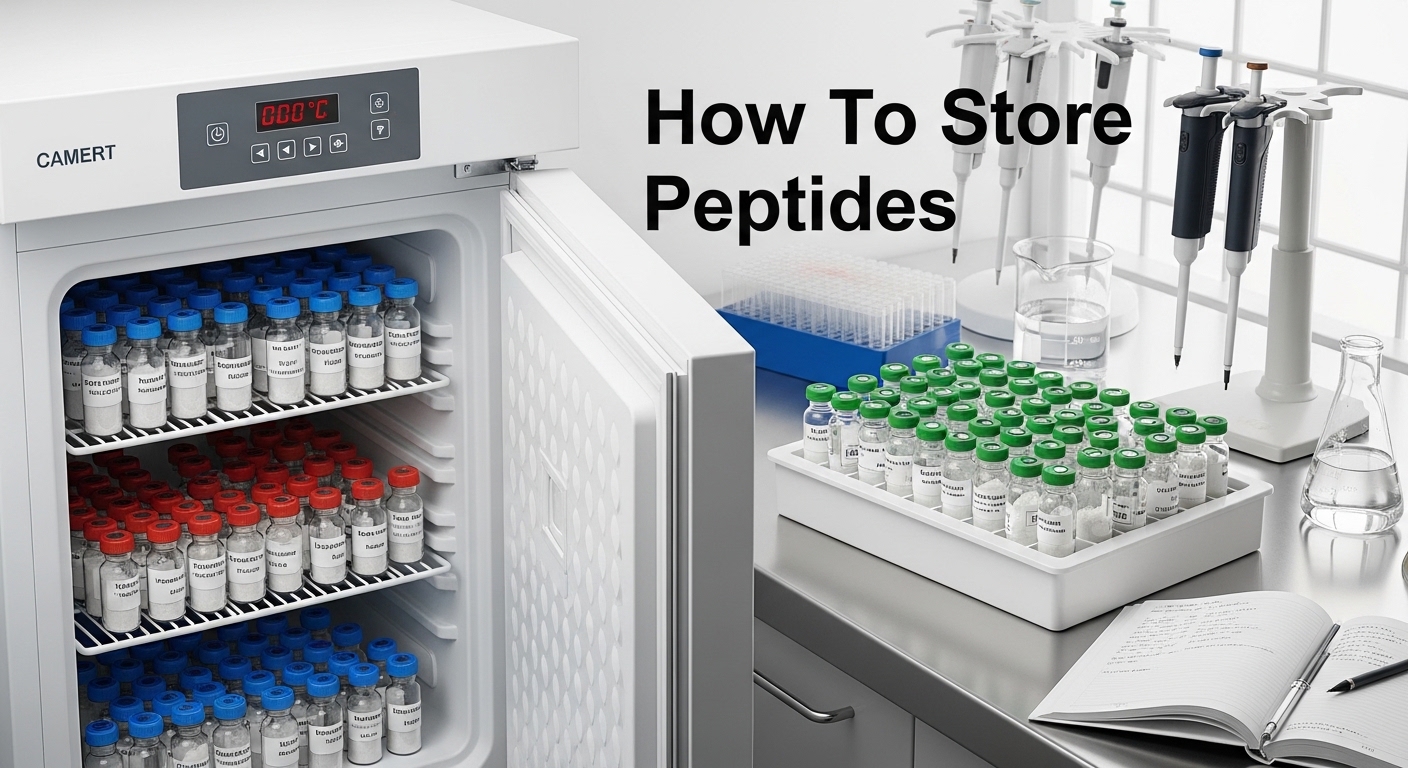
Improper peptide storage can destroy months of investment in just days. I learned this the hard way after losing a $200 vial of BPC-157 to temperature fluctuation in my fridge door.
The good news? Proper peptide storage is straightforward once you understand the basics. Store lyophilized (powder) peptides at -20C or colder, and keep reconstituted (liquid) peptides refrigerated at 2-8C.
In this guide, I will walk you through everything you need to know about storing peptides correctly. You will learn the difference between powder and liquid storage, exact temperature requirements, and the common mistakes that ruin peptides prematurely.
Whether you are new to peptides or looking to optimize your current storage setup, these guidelines may help extend your peptides’ shelf life and maintain their potency.
ContentsTable of Contents
- 1Quick Peptide Storage Reference Guide→
- 2Six Essential Rules for Peptide Storage→
- 3Understanding Peptide Forms: Lyophilized vs Reconstituted→
- 4What Are Lyophilized Peptides?→
- 5What Are Reconstituted Peptides?→
- 6Why the Difference Matters?→
- 7Temperature Guidelines for Peptide Storage→
- 8Room Temperature Storage (Not Recommended)→
- 9Refrigerator Storage (2-8C)→
- 10Freezer Storage (-20C)→
- 11Ultra-Low Freezer Storage (-80C)→
- 12Temperature Summary Table→
- 13How to Store Lyophilized (Powder) Peptides?→
- 14Step-by-Step Storage Process→
- 15Ideal Storage Conditions→
- 16Shelf Life Expectations→
- 17How to Store Reconstituted (Liquid) Peptides?→
- 18Bacteriostatic Water vs Sterile Water→
- 19Refrigeration Requirements→
- 20Shelf Life After Reconstitution→
- 21Organization Tips for Multiple Vials→
- 22Storage Guide for Specific Peptides→
- 23BPC-157 Storage→
- 24Semaglutide and GLP-1 Peptides Storage→
- 25TB-500 Storage→
- 26Collagen Peptides Storage→
- 27Research Peptides General Guidelines→
- 28Common Peptide Storage Mistakes to Avoid→
- 29Freeze-Thaw Cycles→
- 30Door Storage→
- 31Temperature Fluctuations→
- 32Light Exposure→
- 33Contamination Risks→
- 34Reconstituting Too Much at Once→
- 35Signs of Peptide Degradation: When to Discard→
- 36Visual Indicators→
- 37Color Changes→
- 38When to Discard?→
- 39Frequently Asked Questions→
- 40Should peptides be refrigerated?→
- 41What is the best storage for peptides?→
- 42What happens to peptides if they aren’t refrigerated?→
- 43Can you freeze reconstituted peptides?→
- 44How long do peptides last in the fridge?→
- 45Do peptides need to be refrigerated before reconstitution?→
- 46Final Thoughts on Peptide Storage→
- 47Medical Disclaimer→
Quick Peptide Storage Reference Guide
Here is a quick reference for peptide storage. Bookmark this section for easy access.
| Peptide Form | Temperature | Shelf Life | Key Notes |
|---|---|---|---|
| Lyophilized (Powder) – Long-term | -20C to -80C | 2-5 years | Keep sealed, away from light, with desiccant |
| Lyophilized (Powder) – Short-term | 2-8C (Refrigerator) | 3-6 months | Acceptable for peptides you will use soon |
| Reconstituted (Liquid) – With BAC water | 2-8C (Refrigerator) | 28-60 days | Never freeze, use bacteriostatic water |
| Reconstituted (Liquid) – With sterile water | 2-8C (Refrigerator) | 7-14 days | Use quickly, higher contamination risk |
Six Essential Rules for Peptide Storage
- Keep peptides cold: Refrigerate or freeze based on form
- Protect from light: Use amber vials or keep in dark containers
- Minimize air exposure: Keep vials sealed when not in use
- Avoid freeze-thaw cycles: Each cycle can degrade potency
- Use bacteriostatic water: Extends reconstituted shelf life significantly
- Store away from fridge door: Temperature fluctuates with opening
Understanding Peptide Forms: Lyophilized vs Reconstituted
Peptides come in two main forms, and each has different storage requirements. Understanding this distinction is fundamental to proper storage.
What Are Lyophilized Peptides?
Lyophilized peptides are freeze-dried into a powder form. This process removes water content, making the peptide significantly more stable for storage.
In powder form, peptides can remain stable for years when stored correctly. The lack of water means chemical degradation processes like hydrolysis cannot occur as readily.
Most peptides arrive from suppliers in lyophilized form. They appear as a white or off-white powder, often described as a fluffy cake or crystalline structure at the bottom of the vial.
What Are Reconstituted Peptides?
Reconstituted peptides have been mixed with water (bacteriostatic or sterile) to create a liquid solution. This is the form you actually use for administration.
Once reconstituted, peptides become much less stable. Water reintroduces the possibility of hydrolysis and bacterial contamination.
This is why reconstituted peptides have a significantly shorter shelf life – typically 28-60 days compared to years for powder form.
Why the Difference Matters?
The key takeaway: only reconstitute what you need within the next month or two. Keep your remaining supply in powder form until you are ready to use it.
I have seen people make the mistake of reconstituting their entire stockpile at once. This drastically reduces overall shelf life and can lead to wasted peptides.
| Characteristic | Lyophilized (Powder) | Reconstituted (Liquid) |
|---|---|---|
| Appearance | White/off-white powder or cake | Clear liquid solution |
| Stability | Very stable (years) | Less stable (weeks to months) |
| Storage Temperature | -20C ideal, 2-8C acceptable | 2-8C only, never freeze |
| Ready to Use | No – requires reconstitution | Yes – ready for administration |
| Main Risks | Moisture, light, oxidation | Bacterial contamination, hydrolysis |
Temperature Guidelines for Peptide Storage
Temperature is the single most important factor in peptide storage. Getting this right can mean the difference between peptides lasting years versus weeks.
Room Temperature Storage (Not Recommended)
Room temperature storage (20-25C) is generally not recommended for peptides. At these temperatures, degradation processes accelerate significantly.
However, lyophilized peptides can tolerate brief periods at room temperature during shipping or handling. This typically will not cause significant potency loss if the exposure is limited to a few days.
Never store reconstituted peptides at room temperature. Bacterial growth and chemical degradation occur rapidly in liquid form without refrigeration.
Refrigerator Storage (2-8C)
Refrigerator temperature (2-8C or 36-46F) is the standard recommendation for reconstituted peptides and short-term powder storage.
This temperature range slows degradation significantly while remaining practical for home use. Most household refrigerators maintain temperatures within this range.
For reconstituted peptides, this is your primary storage method. Keep them in the refrigerator from the moment of reconstitution until use.
Warning – Fridge Door Storage: Never store peptides in the refrigerator door. According to user reports from peptide forums, the temperature in fridge doors can fluctuate by 5-10 degrees every time you open it. Store peptides on a back shelf where temperature remains most stable.
Freezer Storage (-20C)
Freezer storage at -20C is ideal for long-term storage of lyophilized peptides. At this temperature, peptides can remain stable for 2-5 years or longer.
Standard household freezers typically reach -18 to -20C, which is adequate for most peptide storage needs.
If you have a significant peptide stockpile, freezer storage is essential for maintaining long-term potency.
Ultra-Low Freezer Storage (-80C)
Laboratory-grade storage at -80C offers maximum stability and can preserve peptides for 5+ years. This is typically only necessary for research applications or very long-term storage.
Most home users will not have access to -80C freezers. Standard freezer temperatures are sufficient for typical use cases.
Caution – Mini Fridges: Based on peptide community discussions, mini fridges may not maintain consistent cold temperatures, especially budget models. If you use a mini fridge, verify it maintains 2-8C consistently. Consider using a thermometer to monitor. Many users recommend keeping only your current vial in a mini fridge while storing stockpile in a full-size refrigerator or freezer.
Temperature Summary Table
| Temperature | Suitable For | Shelf Life | Notes |
|---|---|---|---|
| Room Temp (20-25C) | Brief transit only | Days | Not for storage |
| Refrigerator (2-8C) | Reconstituted; Short-term powder | Weeks to months | Back shelf, not door |
| Freezer (-20C) | Lyophilized powder | 2-5 years | Ideal for stockpiling |
| Ultra-Low (-80C) | Long-term research storage | 5+ years | Lab use typically |
How to Store Lyophilized (Powder) Peptides?
Lyophilized peptides are the most stable form, but they still require proper handling. Here is a step-by-step approach to maximize their shelf life.
Step-by-Step Storage Process
- Inspect upon receipt: Check that the powder appears as a white or off-white cake. Look for signs of moisture or discoloration.
- Keep sealed: Leave the vial sealed until ready to reconstitute. The rubber stopper and crimp cap provide protection from air and moisture.
- Use desiccant: If storing multiple vials, place them in a container with a desiccant packet to absorb any ambient moisture.
- Protect from light: Store in a dark place or use amber vials. Light exposure can cause photodegradation over time.
- Freeze for long-term: Place sealed vials in the freezer at -20C for storage periods exceeding a few months.
- Refrigerate for short-term: If you plan to use the peptide within 3-6 months, refrigerator storage at 2-8C is acceptable.
Ideal Storage Conditions
The ideal environment for lyophilized peptides combines cold temperature, darkness, and low humidity.
Keep peptides in their original sealed vials when possible. The crimp-sealed rubber stopper provides an effective barrier against moisture and oxygen.
If storing in a frost-free freezer, consider placing vials in an airtight container. Frost-free freezers have temperature cycles that can introduce small amounts of moisture over time.
Shelf Life Expectations
Under optimal conditions (-20C, sealed, dark), most lyophilized peptides may remain stable for 2-5 years. Some particularly stable peptides can last even longer.
At refrigerator temperatures, expect 3-6 months of stability for most peptides. This is still suitable for peptides you plan to use in the near term.
Room temperature storage dramatically reduces shelf life to weeks or a few months at best. Avoid this unless necessary for brief periods.
How to Store Reconstituted (Liquid) Peptides?
Once you add water to your peptide, the storage rules change completely. Reconstituted peptides require more careful handling to maintain potency and prevent contamination.
Bacteriostatic Water vs Sterile Water
The type of water you use for reconstitution significantly impacts shelf life after mixing.
Bacteriostatic water (BAC water) contains 0.9% benzyl alcohol, which inhibits bacterial growth. This is the preferred choice for peptide reconstitution because it allows for longer storage – typically 28-60 days.
Sterile water contains no preservatives. While suitable for single-use applications, it provides no protection against bacterial growth over time. Peptides reconstituted with sterile water should ideally be used within 7-14 days.
For most users, bacteriostatic water is the clear choice. The extended shelf life provides flexibility and reduces waste.
| Water Type | Preservative | Shelf Life After Reconstitution | Best For |
|---|---|---|---|
| Bacteriostatic Water | 0.9% benzyl alcohol | 28-60 days | Multi-dose vials, most users |
| Sterile Water | None | 7-14 days | Single-use, immediate use |
Refrigeration Requirements
Refrigerate reconstituted peptides immediately after mixing. Store at 2-8C (36-46F) on a back shelf of your refrigerator.
Keep the vial upright to prevent solution contact with the rubber stopper for extended periods. Some users place vials in a small container or case for organization and protection.
Never freeze reconstituted peptides. Freezing can cause proteins to denature and aggregate, potentially destroying the peptide. If you need to store peptides long-term, keep them in lyophilized form.
Shelf Life After Reconstitution
Most reconstituted peptides remain stable for 28-30 days when using bacteriostatic water and proper refrigeration. Some particularly stable peptides may last up to 8 weeks, according to user reports.
Factors that can reduce shelf life include:
- Using sterile water instead of bacteriostatic water
- Temperature fluctuations from improper storage
- Repeated needle insertions (contamination risk)
- Exposure to light
Organization Tips for Multiple Vials
If you use multiple peptides simultaneously, organization becomes important. Here are some practical tips from the peptide community:
- Label each vial: Include peptide name, reconstitution date, and concentration
- Use a dedicated container: A small plastic box keeps vials organized and protected
- First in, first out: Use older reconstituted vials before newer ones
- Separate current from stock: Keep your in-use vial accessible, stockpile in freezer
Storage Guide for Specific Peptides
While general storage principles apply to most peptides, some have specific considerations worth noting.
BPC-157 Storage
BPC-157 is considered relatively stable among peptides. In lyophilized form, it may remain stable for 2-3 years at -20C.
Once reconstituted with bacteriostatic water, store at 2-8C and use within 28-30 days. Some users report maintaining potency for up to 6 weeks, but 4 weeks is a safer guideline.
BPC-157 is sensitive to light, so keep in amber vials or store in a dark container.
Semaglutide and GLP-1 Peptides Storage
Semaglutide and other GLP-1 peptides (tirzepatide, liraglutide) follow similar storage guidelines to other peptides, with some nuances.
Pre-filled pens (like Ozempic or Wegovy) should be stored in the refrigerator at 2-8C. Once in use, they can be kept at room temperature for up to 56 days, according to manufacturer guidelines.
Compounded semaglutide follows standard reconstituted peptide storage: refrigerate at 2-8C and use within 28-30 days.
GLP-1 peptides are sensitive to both light and extreme temperatures. Never freeze pre-filled pens or expose them to temperatures above 30C.
TB-500 Storage
TB-500 (Thymosin Beta-4) is stable in lyophilized form and can be stored at -20C for extended periods.
Once reconstituted, refrigerate at 2-8C and use within 28 days. TB-500 is relatively stable in solution compared to some other peptides.
Like most peptides, protect from light and avoid freeze-thaw cycles.
Collagen Peptides Storage
Collagen peptides (often sold as supplements) are different from injectable peptides. They typically come in powder form designed for oral consumption.
Store collagen peptide powders in a cool, dry place away from direct sunlight. They do not require refrigeration but should be kept sealed to prevent moisture absorption.
Once mixed into a beverage, consume immediately. Collagen peptides in solution are not designed for storage.
Research Peptides General Guidelines
For other research peptides (ipamorelin, CJC-1295, GHRP-2, GHRP-6, and similar), follow these general guidelines:
- Lyophilized: Store at -20C for long-term, 2-8C for short-term
- Reconstituted: Refrigerate at 2-8C, use within 28-30 days
- Use bacteriostatic water for reconstitution
- Protect from light and moisture
Common Peptide Storage Mistakes to Avoid
After speaking with dozens of peptide users and reading through community forums, I have identified the most common storage mistakes that lead to premature degradation.
Freeze-Thaw Cycles
Repeatedly freezing and thawing peptides is one of the most damaging things you can do. Each cycle causes physical stress that can break peptide bonds and reduce potency.
If you have a large supply, consider dividing it into smaller portions (aliquots) that can be thawed individually as needed.
Door Storage
I mentioned this earlier, but it bears repeating: the refrigerator door is the worst place to store peptides. Temperature can swing 5-10 degrees with every opening.
Always use a back shelf in the main compartment where temperature remains stable.
Temperature Fluctuations
Beyond door storage, be aware of other temperature fluctuation sources:
- Mini fridges with poor temperature regulation
- Refrigerators that cycle to higher temperatures
- Leaving peptides out during use for extended periods
- Power outages affecting freezer storage
Light Exposure
Peptides containing certain amino acids (tryptophan, tyrosine, phenylalanine) are particularly sensitive to light. Photodegradation can occur with prolonged exposure.
Use amber vials when possible. If your peptides come in clear vials, store them in an opaque container or dark area of your refrigerator/freezer.
Contamination Risks
Each time you insert a needle into a vial, you introduce potential contamination. Minimize this by:
- Using bacteriostatic water with its antimicrobial properties
- Swabbing the vial stopper with alcohol before each use
- Using clean, sterile needles every time
- Avoiding touching the needle or stopper
Reconstituting Too Much at Once
A common mistake among beginners is reconstituting their entire peptide supply at once. This dramatically shortens overall shelf life.
Only reconstitute what you will use within 4 weeks. Keep the rest in lyophilized form until needed.
Signs of Peptide Degradation: When to Discard
Knowing when peptides have gone bad can prevent you from using degraded products with reduced effectiveness or potential safety concerns.
Visual Indicators
Healthy reconstituted peptides should appear as a clear, colorless solution. Watch for these warning signs:
- Cloudiness or turbidity: May indicate bacterial contamination or protein aggregation
- Visible particles: Floating particles suggest degradation or contamination
- Clumping: Peptides should dissolve completely; clumps indicate problems
Color Changes
Any change in color from the expected clear solution warrants caution:
- Yellow, brown, or pink tinting suggests oxidation
- Green coloration may indicate bacterial growth
- Any color change from the original is a red flag
When to Discard?
Err on the side of caution with the following guidelines:
- Reconstituted peptides older than 30 days (or 14 days with sterile water)
- Any visible particles, cloudiness, or color change
- Peptides exposed to temperatures above 25C for extended periods
- Vials with damaged seals or stoppers
- Any peptide that smells unusual
When in doubt, discard. The cost of a new vial is less than the risk of using degraded product.
Frequently Asked Questions
Should peptides be refrigerated?
Yes, peptides should generally be refrigerated. Reconstituted (liquid) peptides must be refrigerated at 2-8C and used within 28-30 days. Lyophilized (powder) peptides can be refrigerated for short-term storage or frozen at -20C for long-term storage of 2-5 years.
What is the best storage for peptides?
The best storage for peptides depends on their form. Lyophilized peptides should be stored in a freezer at -20C in sealed vials with desiccant, protected from light. Reconstituted peptides should be stored in a refrigerator at 2-8C on a back shelf (not the door), used within 28-30 days when reconstituted with bacteriostatic water.
What happens to peptides if they aren’t refrigerated?
Peptides stored at room temperature degrade significantly faster through oxidation, hydrolysis, and bacterial contamination. Reconstituted peptides left unrefrigerated may lose potency within hours to days and can become unsafe due to bacterial growth. Lyophilized peptides can tolerate brief room temperature exposure during shipping but should not be stored this way long-term.
Can you freeze reconstituted peptides?
No, you should not freeze reconstituted peptides. Freezing can cause proteins to denature and aggregate, potentially destroying the peptide’s structure and effectiveness. If you need long-term storage, keep peptides in lyophilized (powder) form and only reconstitute what you will use within 4 weeks.
How long do peptides last in the fridge?
Reconstituted peptides last 28-30 days in the fridge when mixed with bacteriostatic water, or 7-14 days with sterile water. Lyophilized (powder) peptides can remain stable in the fridge for 3-6 months but are better stored in a freezer for periods longer than a few months.
Do peptides need to be refrigerated before reconstitution?
Lyophilized peptides are stable enough to tolerate room temperature for short periods but should ideally be refrigerated or frozen for optimal long-term stability. For storage beyond a few months, freezer storage at -20C is recommended. Once reconstituted, immediate refrigeration is essential.
Final Thoughts on Peptide Storage
Proper peptide storage is not complicated once you understand the key principles: keep lyophilized peptides frozen for long-term storage, refrigerate reconstituted peptides, use bacteriostatic water, and protect from light and temperature fluctuations.
The most important takeaway is this: only reconstitute what you need for the next 4 weeks. This simple practice can save significant money and ensure you are always using peptides at their full potency.
Remember to store vials on a back shelf of your refrigerator (never the door), use proper sterile technique when drawing from vials, and discard any peptides showing signs of degradation.
With these guidelines, your peptide investment can remain stable and effective for months or even years.
Medical Disclaimer
This article is for informational purposes only and does not constitute medical advice. Always follow storage instructions provided by your healthcare provider or peptide manufacturer. Consult with a qualified healthcare professional before using any peptides. The information provided here is based on general guidelines and user community experiences; individual products may have specific storage requirements.