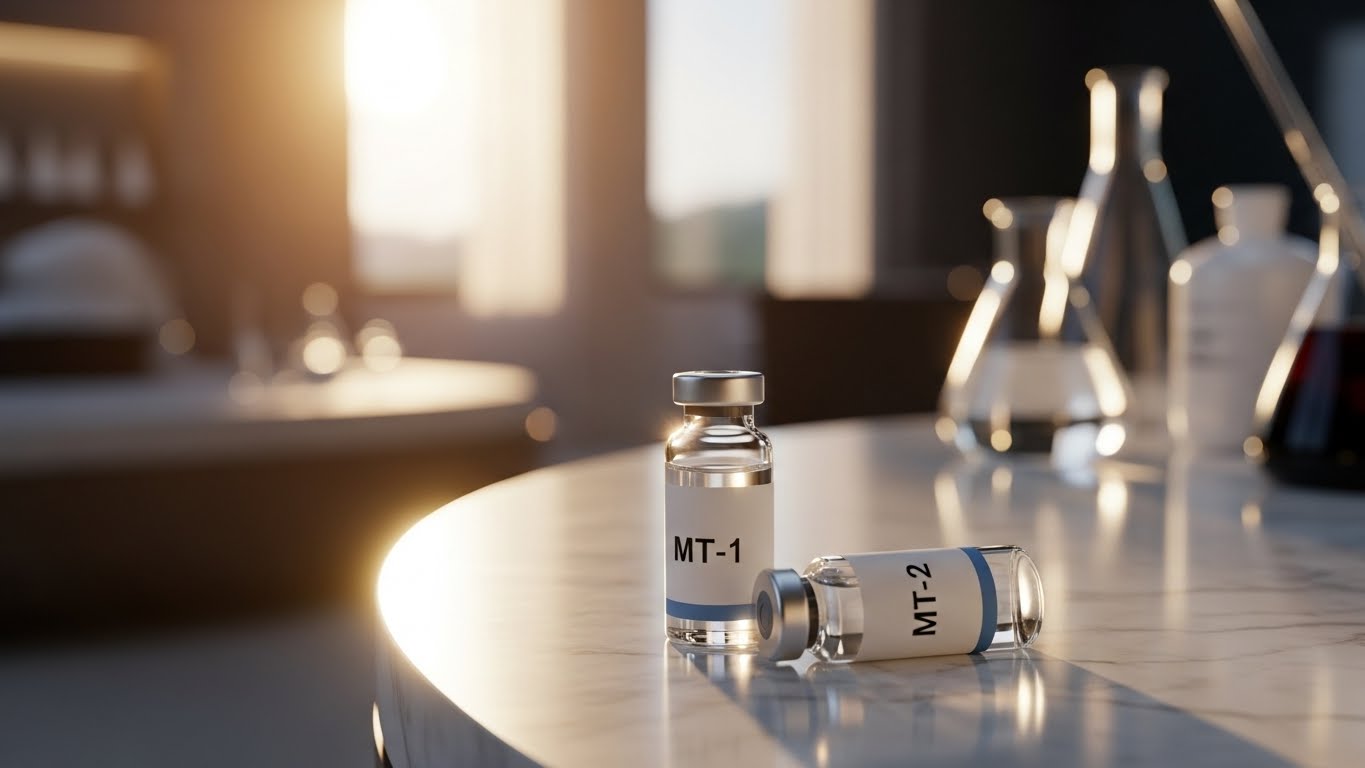
Finding a way to achieve a natural-looking tan without spending hours in the sun has been a goal for researchers and skincare enthusiasts alike. Based on our research into melanocortin peptides, melanotan offers a range of potential benefits that extend well beyond simple skin darkening.
Melanotan peptides may help with sunless tanning, enhanced libido, and appetite regulation according to published research. These synthetic versions of alpha-melanocyte-stimulating hormone (alpha-MSH) work by activating specific receptors throughout the body.
In this comprehensive guide, we will explore the science-backed benefits of both Melanotan 1 and Melanotan 2, help you understand how they work, and provide practical information about what to expect. Whether you are researching these peptides for skin protection or exploring their broader effects, this guide covers everything you need to know about melanotan benefits in 2026.
Important Safety Notice: Melanotan peptides are not FDA-approved for cosmetic tanning and are sold as research chemicals only. Always consult a healthcare provider before considering any peptide therapy.
ContentsTable of Contents
- 1What Is Melanotan?→
- 2How Does Melanotan Work?→
- 3Key Melanotan Benefits: Complete Overview→
- 4Tanning and Skin Pigmentation Benefits→
- 5How Melanotan Tanning Works?→
- 6Research Findings on Skin Pigmentation→
- 7Photoprotection Benefits→
- 8Who Benefits Most From Tanning Effects?→
- 9Sexual Function and Libido Benefits→
- 10Mechanism of Sexual Effects→
- 11Research on Erectile Function→
- 12Libido Enhancement in Both Genders→
- 13Appetite Suppression and Metabolic Benefits→
- 14How Melanotan Affects Appetite?→
- 15Research on Fat Loss and Metabolism→
- 16Potential Weight Management Applications→
- 17Melanotan 1 vs Melanotan 2: Key Differences→
- 18Which One Is Right for Different Goals?→
- 19Potency Differences→
- 20Results Timeline: What to Expect?→
- 21Tanning Results Timeline→
- 22Sexual Effects Timeline (MT-2 Only)→
- 23Appetite Effects Timeline (MT-2 Only)→
- 24Side Effects and Safety Considerations→
- 25Common Side Effects→
- 26Serious Safety Concerns→
- 27Contraindications→
- 28Harm Reduction Recommendations→
- 29Dosing Guidelines and Protocols→
- 30Typical Dosing Protocols→
- 31Reconstitution Notes→
- 32Frequently Asked Questions→
- 33How long does it take for melanotan 2 to start working?→
- 34Does melanotan 2 change skin color?→
- 35Does melanotan cause fat loss?→
- 36Which peptide makes you look tan?→
- 37Is melanotan 1 or 2 better?→
- 38Is melanotan legal?→
- 39The Bottom Line on Melanotan Benefits→
What Is Melanotan?
Melanotan: A synthetic peptide analog of alpha-melanocyte-stimulating hormone (alpha-MSH) that stimulates melanin production for skin tanning without significant UV exposure. Two versions exist: Melanotan 1 (MT-1) and Melanotan 2 (MT-2).
Melanotan peptides were first developed at the University of Arizona in the 1980s. Researchers were searching for a way to protect fair-skinned individuals from skin cancer by stimulating the body’s natural tanning response.
The original research focused on creating analogs of alpha-MSH, a naturally occurring hormone that triggers melanin production. This work eventually led to two distinct compounds.
Melanotan 1 (MT-1), also known as afamelanotide, is a linear peptide containing 13 amino acids. It received FDA approval under the brand name Scenesse for treating erythropoietic protoporphyria (EPP), a rare condition causing extreme sun sensitivity.
Melanotan 2 (MT-2) is a shorter, cyclic peptide with 7 amino acids. It binds to multiple melanocortin receptors, giving it effects beyond tanning. MT-2 has not received FDA approval for any indication, though research into its effects continues.
Both peptides function as melanocortin receptor agonists. This means they activate the same pathways as your body’s natural melanocyte-stimulating hormone, but with potentially greater potency and duration.
How Does Melanotan Work?
Melanotan works by binding to melanocortin receptors (MCRs) located throughout the body. These receptors form part of a signaling system that regulates everything from skin pigmentation to appetite and sexual function.
The primary mechanism involves melanocortin receptor activation, specifically:
- MC1R (Melanocortin 1 Receptor): Found in skin cells called melanocytes. When activated, triggers melanin production for skin darkening and UV protection.
- MC3R (Melanocortin 3 Receptor): Located primarily in the brain and gut. Involved in energy homeostasis and appetite regulation.
- MC4R (Melanocortin 4 Receptor): Found in the hypothalamus. Controls appetite, sexual arousal, and metabolic function.
When melanotan binds to MC1R in melanocytes, it initiates a process called melanogenesis. This is your body’s natural pigment production pathway.
The melanocytes begin producing more melanin, specifically eumelanin (the darker pigment), which gets distributed to surrounding skin cells. This creates the tanning effect without requiring UV exposure to trigger the process.
Melanotan 2 differs from MT-1 because it activates multiple receptor types. While MT-1 is relatively selective for MC1R, MT-2 binds to MC1R, MC3R, MC4R, and even MC5R. This broader receptor binding profile explains why MT-2 produces effects beyond tanning, including libido enhancement and appetite suppression.
The peptides are typically administered via subcutaneous injection after reconstitution with bacteriostatic water. Once injected, they enter the bloodstream and circulate to receptor sites throughout the body.
Key Melanotan Benefits: Complete Overview
Research and user reports suggest melanotan peptides may offer several distinct benefits. Here is a comprehensive overview of the primary advantages documented in scientific literature and clinical studies:
- Sunless Skin Tanning: Achieves darker skin pigmentation with minimal UV exposure, potentially reducing skin cancer risk
- Photoprotection: Increases skin’s natural defense against UV radiation through enhanced melanin production
- Libido Enhancement: May improve sexual desire and arousal in both men and women (MT-2 specific)
- Erectile Function: Research shows potential benefits for men with erectile dysfunction (MT-2 specific)
- Appetite Suppression: MC4R activation may help reduce food intake and support weight management
- Fat Metabolism: Animal studies suggest potential benefits for lipolysis and fat reduction
- Reduced Sun Exposure Need: Maintains tan with less time in direct sunlight
Research Note: Many of these benefits are based on preclinical research and user reports. The only FDA-approved use for any melanotan compound is afamelanotide (Scenesse) for erythropoietic protoporphyria. Other uses remain investigational.
The benefits you may experience depend significantly on whether you are using Melanotan 1 or Melanotan 2. MT-1 is primarily focused on tanning and photoprotection, while MT-2 offers the broader range of effects due to its multi-receptor activity.
Tanning and Skin Pigmentation Benefits
The primary reason most people explore melanotan is for its tanning effects. Clinical studies suggest these peptides can increase skin pigmentation significantly with reduced UV exposure requirements.
How Melanotan Tanning Works?
When melanotan activates MC1R receptors in melanocytes, it triggers eumelanin production. Eumelanin is the darker, photoprotective pigment that gives skin its brown color.
This differs from UV-induced tanning in an important way. Sun exposure causes DNA damage that triggers melanin production as a repair response. Melanotan stimulates pigment production directly, potentially bypassing some of the damaging aspects of traditional tanning.
Research Findings on Skin Pigmentation
Studies on afamelanotide (MT-1) demonstrated significant tanning effects. Research published in the Journal of Investigative Dermatology found that subjects receiving MT-1 showed measurable increases in melanin density compared to placebo groups.
One study noted a 50% reduction in sunburn cells and a 60% decrease in sun-damaged cells among participants using MT-1. This suggests potential photoprotective benefits beyond cosmetic tanning.
MT-2 research indicates even stronger tanning effects at lower doses. Users report visible skin darkening within days of starting treatment, though individual results vary based on baseline skin tone and sun exposure.
Photoprotection Benefits
Beyond cosmetic tanning, melanotan may offer genuine protective benefits:
- Reduced UV vulnerability: Higher melanin levels provide natural sun protection
- Less time needed in sun: Maintains tan with minimal ongoing UV exposure
- Fair skin protection: May benefit those who normally burn easily
The FDA approval of Scenesse (afamelanotide) for EPP patients validates the photoprotective potential. These patients have extreme sun sensitivity, and the medication allows them to tolerate more light exposure without painful reactions.
Who Benefits Most From Tanning Effects?
Based on research and user reports, melanotan tanning benefits may be most significant for:
- Fair-skinned individuals who burn easily and rarely tan naturally
- People seeking to maintain a tan with minimal sun exposure
- Those concerned about cumulative UV damage from traditional tanning
- Individuals with photosensitivity conditions (under medical supervision)
Sexual Function and Libido Benefits
Melanotan 2 gained significant attention for its effects on sexual function. These benefits occur through MC4R and MC3R activation in the brain’s hypothalamus and other nervous system regions.
Mechanism of Sexual Effects
The melanocortin system plays a role in sexual arousal and response. MC4R receptors in the hypothalamus influence the neural pathways controlling erection and sexual desire.
When MT-2 binds to these receptors, it may enhance sexual arousal signals. Research suggests this occurs through a central nervous system mechanism rather than direct vascular effects like traditional ED medications.
Research on Erectile Function
Multiple clinical studies have investigated melanotan 2 for erectile dysfunction. Research published in peer-reviewed journals found that MT-2 produced erections in men with both organic and psychogenic ED.
Key findings from this research include:
- Mean onset time of approximately 2 hours (range: 15-270 minutes)
- Effects in men who did not respond to traditional ED treatments
- Duration of effects lasting several hours
- Improved rigidity scores compared to baseline
These findings led to the development of Bremelanotide (PT-141), a derivative of MT-2. In 2026, Bremelanotide remains the only FDA-approved melanocortin-based sexual function medication, approved under the brand name Vyleesi for hypoactive sexual desire disorder in premenopausal women.
Libido Enhancement in Both Genders
Unlike many sexual enhancement compounds, MT-2 appears to affect both men and women. Research suggests the central mechanism of action influences desire and arousal rather than just physical function.
For women, the effects center on increased sexual desire and arousal. The FDA approval of Bremelanotide for HSDD in women validates this potential application of melanocortin agonists.
For men, benefits may include both enhanced desire and improved erectile response. Users report these effects even in the absence of underlying dysfunction.
Important Distinction: Melanotan 1 does not produce significant sexual effects. These benefits are specific to Melanotan 2 due to its MC4R receptor activity.
Appetite Suppression and Metabolic Benefits
Beyond tanning and sexual function, Melanotan 2 may influence appetite and metabolism. These effects occur primarily through MC4R activation in the hypothalamus, which regulates energy balance and food intake.
How Melanotan Affects Appetite?
The MC4R receptor plays a crucial role in satiety signaling. When activated, it promotes feelings of fullness and reduces food-seeking behavior. This is the same pathway targeted by some anti-obesity medications currently in development.
Users frequently report decreased appetite and reduced food cravings while using MT-2. These effects appear distinct from the tanning benefits and may persist throughout the treatment period.
Research on Fat Loss and Metabolism
Animal studies provide the strongest evidence for metabolic benefits. Research published in scientific journals found noteworthy effects on body composition:
- Abdominal fat pads were approximately 40% smaller in subjects receiving MT-2 compared to controls
- Improved insulin sensitivity markers observed in some studies
- Enhanced lipolysis (fat breakdown) through receptor-mediated pathways
- Reduced food intake independent of palatability changes
Human research is more limited, but user reports consistently mention appetite reduction as a noticeable effect. Some users report modest weight loss, though isolating MT-2 as the cause is difficult without controlled studies.
Potential Weight Management Applications
The melanocortin pathway has attracted pharmaceutical interest for obesity treatment. Several companies are developing MC4R agonists specifically for weight management, building on the foundation established by melanotan research.
Current evidence suggests potential benefits for:
- Reducing caloric intake through appetite suppression
- Supporting fat loss in conjunction with diet and exercise
- Improving metabolic markers like insulin sensitivity
However, these applications remain investigational. Melanotan is not approved for weight loss, and using it for this purpose carries risks given its unregulated status.
Melanotan 1 vs Melanotan 2: Key Differences
Understanding the differences between MT-1 and MT-2 is essential for anyone researching these peptides. Despite sharing a similar name and origin, they have distinct properties and effects.
| Feature | Melanotan 1 (MT-1) | Melanotan 2 (MT-2) |
|---|---|---|
| Structure | Linear peptide (13 amino acids) | Cyclic peptide (7 amino acids) |
| Other Names | Afamelanotide, Scenesse, CUV1647 | MT-II, Barbie Peptide |
| Receptor Selectivity | Primarily MC1R | MC1R, MC3R, MC4R, MC5R |
| FDA Status | Approved (Scenesse for EPP) | Not approved |
| Primary Effects | Tanning, photoprotection | Tanning, libido, appetite suppression |
| Sexual Effects | Minimal to none | Significant (both genders) |
| Appetite Effects | Not significant | Appetite suppression reported |
| Tanning Potency | Moderate | Higher (less dose needed) |
| Half-Life | Shorter | Longer |
| Side Effect Profile | Generally milder | More side effects due to broader receptor activity |
| Typical Dosing | 1-2mg daily (loading) | 250mcg-1mg daily (loading) |
| Medical Use | EPP treatment (approved) | Research only |
Which One Is Right for Different Goals?
Choose MT-1 if:
- Tanning and photoprotection are your primary interests
- You want to avoid sexual side effects
- You prefer a compound with some regulatory approval
- You want a more selective receptor profile
Choose MT-2 if:
- You want multiple benefits (tanning plus libido or appetite effects)
- Faster, more potent tanning is desired
- Sexual enhancement is a goal
- Appetite suppression would be beneficial
Potency Differences
MT-2 produces tanning effects at lower cumulative doses than MT-1. This increased potency comes from its cyclic structure, which provides greater stability and receptor binding efficiency.
However, increased potency also means more pronounced side effects. The broader receptor activity of MT-2 creates additional effects that some users find beneficial while others consider unwanted.
Results Timeline: What to Expect?
One of the most common questions involves how quickly melanotan works. Based on research and user reports, here is what to expect at different stages:
Tanning Results Timeline
| Timeframe | What to Expect |
|---|---|
| Days 1-3 | Side effects most noticeable (nausea, flushing). No visible tanning yet. |
| Days 4-7 | First signs of skin darkening may appear, especially in areas with existing color. |
| Week 2 | Noticeable tan developing. Freckles and moles may darken. |
| Weeks 3-4 | Full tanning effect typically achieved. Transition to maintenance dosing. |
| Maintenance | Reduced dosing frequency maintains tan. Some UV exposure enhances results. |
Sexual Effects Timeline (MT-2 Only)
Sexual effects from MT-2 occur much faster than tanning effects:
- Onset: 1-2 hours after injection (range: 15 minutes to 4+ hours)
- Peak: 2-4 hours post-injection
- Duration: Effects may last 4-6 hours or longer
These effects can occur from the first dose, unlike tanning which requires cumulative exposure.
Appetite Effects Timeline (MT-2 Only)
Users report appetite suppression beginning within the first few days of use. This effect tends to persist throughout active dosing and may diminish after stopping the peptide.
Side Effects and Safety Considerations
Understanding potential side effects is crucial before considering any peptide therapy. Melanotan peptides carry risks that users should carefully evaluate.
Common Side Effects
Most users experience some side effects, particularly during the initial dosing phase:
- Nausea: Very common, especially with higher doses. Usually diminishes with continued use.
- Facial flushing: Temporary redness and warmth, typically lasting 1-2 hours.
- Fatigue: Some users report drowsiness after injection.
- Injection site reactions: Redness, itching, or irritation at injection location.
- Spontaneous erections: MT-2 specific, can occur unexpectedly.
Serious Safety Concerns
Warning: The following concerns require careful consideration before using melanotan:
Mole Changes and Melanoma Risk:
Melanotan can cause existing moles to darken and new nevi (moles) to appear. This raises theoretical concerns about melanoma risk. While no direct link to melanoma has been proven in studies, the long-term effects are not fully understood.
Anyone with a history of melanoma, atypical moles, or family history of skin cancer should avoid melanotan and consult a dermatologist.
Unregulated Product Quality:
Since melanotan is sold as a research chemical, product quality varies significantly. Forum discussions reveal reports of hospitalizations linked to contaminated or improperly dosed products. Users have no guarantee of purity or accurate concentration.
Unknown Long-Term Effects:
Long-term safety data for melanotan use is limited. Effects of chronic melanocortin receptor activation over years or decades are not well studied.
Contraindications
Melanotan should be avoided by individuals with:
- Personal or family history of melanoma
- Atypical mole syndrome
- Autoimmune conditions affecting the skin
- Pregnancy or breastfeeding
- Severe cardiovascular conditions
- History of adverse reactions to peptide therapies
Harm Reduction Recommendations
For those who choose to use melanotan despite the risks:
- Start with the lowest effective dose
- Monitor all moles for changes (size, shape, color, borders)
- Get regular dermatological check-ups
- Source from vendors with third-party testing
- Stop immediately if concerning symptoms develop
- Document your baseline moles with photos before starting
Dosing Guidelines and Protocols
Dosing information provided here is for educational purposes only and reflects protocols commonly discussed in research and user communities. Always consult a healthcare provider before considering any peptide therapy.
Typical Dosing Protocols
| Phase | Melanotan 1 | Melanotan 2 |
|---|---|---|
| Starting Dose | 0.5mg daily | 100-250mcg daily |
| Loading Dose | 1-2mg daily for 10-14 days | 500mcg-1mg daily for 7-10 days |
| Maintenance | 1mg 2-3x weekly | 500mcg 1-2x weekly |
| Administration | Subcutaneous injection | Subcutaneous injection |
Reconstitution Notes
Melanotan typically comes in lyophilized (freeze-dried) powder form requiring reconstitution:
- Standard reconstitution: 10mg vial + 2mL bacteriostatic water = 5mg/mL (5000mcg/mL)
- Store reconstituted peptide refrigerated (2-8C)
- Use within 4-6 weeks of reconstitution
- Use sterile technique for all injections
Dose Calculation Example: With a 5mg/mL concentration, 0.1mL = 500mcg. An insulin syringe marked in units makes measurement straightforward: 10 units = 0.1mL = 500mcg.
Frequently Asked Questions
How long does it take for melanotan 2 to start working?
Melanotan 2 typically shows visible tanning results within 3-7 days of starting treatment, with full effects apparent in 2-3 weeks. Sexual effects occur much faster, usually within 1-2 hours after injection (range: 15 minutes to 4+ hours). Individual results vary based on baseline skin tone and dosing protocol.
Does melanotan 2 change skin color?
Yes, melanotan 2 increases skin pigmentation by stimulating melanin production in melanocytes. Research shows it can produce significant skin darkening at lower cumulative doses than Melanotan 1. The effect creates a natural-looking tan without requiring extensive UV exposure, though some sun exposure may enhance results.
Does melanotan cause fat loss?
Research suggests melanotan 2 may support fat loss through appetite suppression and metabolic effects. Animal studies found abdominal fat pads were approximately 40% smaller in subjects receiving MT-2 compared to controls. This effect appears related to MC4R receptor activation in the hypothalamus, which regulates appetite and metabolism. Human research is more limited.
Which peptide makes you look tan?
Both Melanotan 1 (MT-1) and Melanotan 2 (MT-2) stimulate skin tanning by activating melanocortin receptors and increasing melanin production. MT-2 is more potent for tanning, requiring lower doses for similar effects. MT-1 (afamelanotide/Scenesse) is FDA-approved for specific medical conditions, while MT-2 remains a research compound.
Is melanotan 1 or 2 better?
The better choice depends on your goals. MT-1 is better if you want tanning only, with fewer side effects and some regulatory approval. MT-2 is better if you want multiple benefits including tanning, libido enhancement, and appetite suppression, but it has more side effects due to broader receptor activity. MT-2 is also more potent for tanning at lower doses.
Is melanotan legal?
Melanotan legality varies by jurisdiction. In most countries, it is not approved for cosmetic use and is sold only as a research chemical not for human consumption. Scenesse (afamelanotide/MT-1) is FDA-approved in the United States specifically for treating erythropoietic protoporphyria. Purchasing melanotan for personal use exists in a legal gray area in many regions.
The Bottom Line on Melanotan Benefits
Melanotan peptides offer a range of potential benefits that extend beyond simple tanning. Based on our research, the primary advantages include sunless skin pigmentation, photoprotection, libido enhancement (MT-2), and appetite suppression (MT-2).
The choice between Melanotan 1 and Melanotan 2 depends on your specific goals. MT-1 provides focused tanning benefits with a more favorable safety profile and some regulatory approval. MT-2 offers broader effects but comes with additional side effects and no regulatory approval.
What stands out from the research is the scientific foundation underlying these effects. The melanocortin system plays legitimate roles in pigmentation, sexual function, and appetite regulation. Compounds targeting these pathways have produced FDA-approved medications, validating the underlying mechanisms.
However, the lack of regulatory approval for cosmetic use means quality control, long-term safety, and optimal dosing protocols remain uncertain. Anyone considering melanotan should weigh the potential benefits against these real risks.
The key difference between informed use and dangerous experimentation lies in understanding what you are doing and why. We hope this guide has provided the comprehensive information needed to make an educated decision.
Medical Disclaimer: This article is for informational purposes only and does not constitute medical advice. Melanotan peptides are not FDA-approved for cosmetic tanning and are sold as research chemicals only. Always consult a licensed healthcare provider before considering any peptide therapy. Never use research chemicals for human consumption without proper medical supervision.
FDA Notice: Melanotan 2 is not FDA-approved for any indication. Melanotan 1 (afamelanotide/Scenesse) is FDA-approved only for the treatment of erythropoietic protoporphyria (EPP). Using these compounds outside of approved indications carries unknown risks.